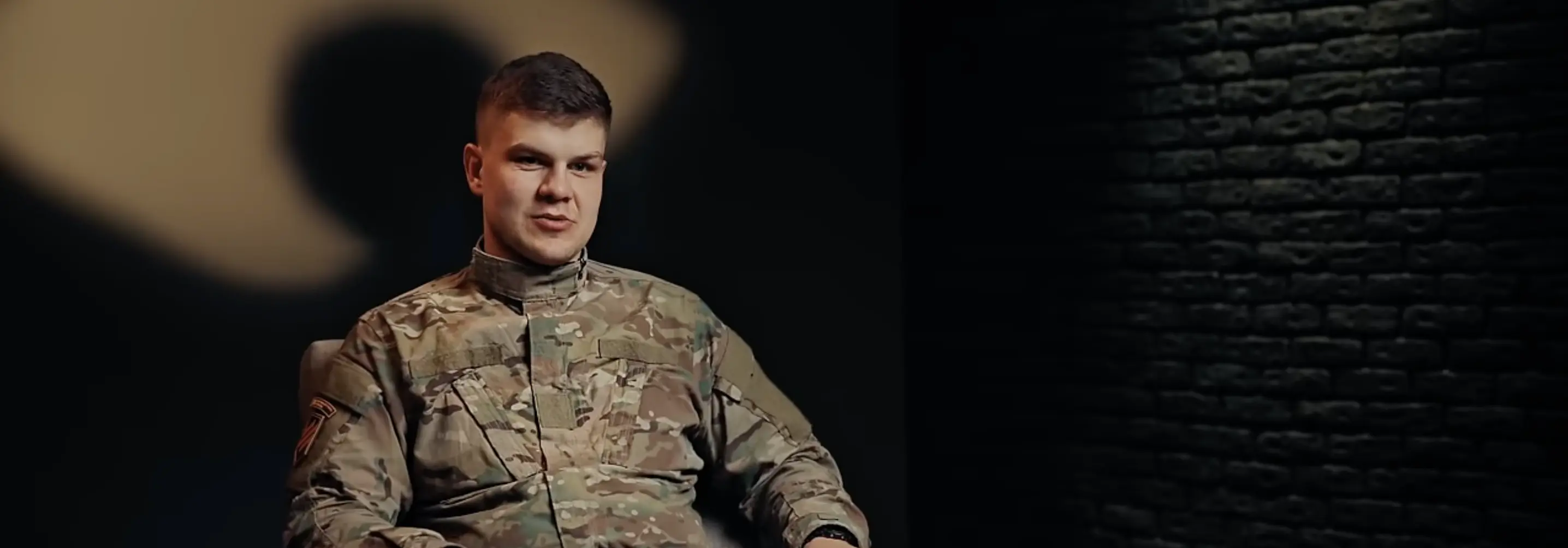
"There were 20% of our loyalists in captivity": an interview with Maksym Levchenko, a fighter with the Third Brigade
Source: Hrun
Maksym Levchenko, call sign Roger, is a professional kickboxer and ultras supporter. He survived the hell of Azovstal and 13 months of Russian captivity. He currently serves as a sergeant and physical training instructor in the Third Assault Battalion.
We talk with Maksym about the defense of Mariupol, his experience in Russian captivity, and his service in the now-legendary Third Assault Battalion.
Let’s start with your call sign. Why Roger?
— That was back when I was 15 or 16. I was an avid soccer fan, and we had a tradition on May 1st: when the “Peace, Labor, May” communists would gather, we’d give them a little chase. We went out with a few of us, and there were some communist guys in front of us. We clashed, and for a while I couldn’t figure out why our guys in the front rows weren’t hitting them. I charged out from the back row, trying to jump on one of them—and got hit in the head with a projectile. It was a bottle or something with ice inside. My eyebrow was completely split open. They stitched it up, but my eye was completely swollen shut. And when I came to practice with the guys, they said, “You’ll be ‘Cheerful Roger.’” That’s how it all started. Short for Roger.
For English subtitles, please enable captions in the video settings and select Auto-translate → English.
Maksym Levchenko, call sign Roger, is a professional kickboxer and ultras supporter. He survived the hell of Azovstal and 13 months of Russian captivity. He currently serves as a sergeant and physical training instructor in the Third Assault Battalion.
We talk with Maksym about the defense of Mariupol, his experience in Russian captivity, and his service in the now-legendary Third Assault Battalion.
Let’s start with your call sign. Why Roger?
— That was back when I was 15 or 16. I was an avid soccer fan, and we had a tradition on May 1st: when the “Peace, Labor, May” communists would gather, we’d give them a little chase. We went out with a few of us, and there were some communist guys in front of us. We clashed, and for a while I couldn’t figure out why our guys in the front rows weren’t hitting them. I charged out from the back row, trying to jump on one of them—and got hit in the head with a projectile. It was a bottle or something with ice inside. My eyebrow was completely split open. They stitched it up, but my eye was completely swollen shut. And when I came to practice with the guys, they said, “You’ll be ‘Cheerful Roger.’” That’s how it all started. Short for Roger.
For English subtitles, please enable captions in the video settings and select Auto-translate → English.
"Plans for the future helped me not to lose myself in captivity"
Please tell us about your own experience defending Mariupol. How did you end up there?
— I arrived on March 28; that’s when volunteers were gathering to break the siege of Mariupol. Our commander suggested it to us, and most of our unit—about 8 to 10 people—flew to Mariupol as volunteers to defend the city.
Did you agree right away, without a second of hesitation or thought?
— At first, they told us there would be a relief operation. We didn’t understand how. You know full well that without planes, without heavy artillery, and so on, it’s impossible to break the siege there. But then information came in that the guys had made it to Mariupol. The first group had successfully arrived and was defending the city. From that moment on, I went to a close friend, Oleksandr, and said, “Let’s go.” He agreed too. Plus our unit, with whom we had been defending Kyiv together.
Were you with “Azov” at that time?
– The “Azov-Kyiv” Operational-Tactical Group, yes.
What did you see in the city when you arrived there?
— It’s a shattered city. Graves, people wandering around like they’re lost, like in some movies. You walk through the city, and there’s no one around. Some people show up, looking for food.
So, without exaggeration, were there [people—ed.] buried in every yard?
— Well, if they had time. By the time I was there, they didn’t even have time to dig anymore. Well, it’s not that they didn’t have time; they just dumped [the dead—ed.] into some building, and they lay there.
And how long did you spend at Azovstal in Mariupol in total?
— We were in Mariupol from March 28 to April 14. And on April 14, we moved from the city to Azovstal, and we held the defense there until the end.
How difficult was it to decide to surrender? What was the deciding factor?
— It was clear that the command was spreading some information to prevent any mutiny inside the plant and so on. We were told that it would be an honorable surrender. We’d stay for three months, go through screening, and then be sent home. I heard this information. It was our only chance to survive. We had no supplies, no food—we lacked everything. We might have lasted another half a month at most. So this was our only chance to survive.
What helped you hold on in captivity, not break down, and not lose yourself?
— Mostly plans for the future, goals, and desires. I thought about where I’d like to go, where to relax. These thoughts helped me replace the negativity with something positive, and I thought about that more.
And, as far as I understand, did you become more religious while you were there?
— Well, how did I become more religious? I started reading the Bible; it was interesting; I prayed.
Wasn’t that forbidden in captivity?
— There was a time when some pastor from all over Russia came. He prayed for us and gave a sermon. It was before or after Easter. We had a three-hour lecture there. At first we waited for an hour standing in the sun, then sat on a bench in the sun for two hours. Some of us went up to receive communion—that Christian ritual. After that, we had a body search. So they lifted us up, motivated us, and then—bang—that was it, they let us down. I won’t go into details about the body search, but it’s an unpleasant experience.
Were the Azov fighters treated differently in captivity, or was everyone treated the same?
— They separated all the Azov fighters there; there were no Azov fighters with us. Did they consider me an Azov fighter? No, they didn’t.
How did your family cope with your captivity?
— My mom, of course, was worried; she had health issues. It’s coming out now with a delay, but thank God, her health is fine now; she’s getting treatment. She’s serving, but she’s also keeping an eye on her health.
As far as I know, she’s also in the Third Assault Battalion. Was that her choice, to be closer to you?
— I didn’t have time to ask. She’s staying there now because she has friends and a support network there, and she understands that she’s helping our army.
Do you see her often?
— We talk on the phone every day.
— I arrived on March 28; that’s when volunteers were gathering to break the siege of Mariupol. Our commander suggested it to us, and most of our unit—about 8 to 10 people—flew to Mariupol as volunteers to defend the city.
Did you agree right away, without a second of hesitation or thought?
— At first, they told us there would be a relief operation. We didn’t understand how. You know full well that without planes, without heavy artillery, and so on, it’s impossible to break the siege there. But then information came in that the guys had made it to Mariupol. The first group had successfully arrived and was defending the city. From that moment on, I went to a close friend, Oleksandr, and said, “Let’s go.” He agreed too. Plus our unit, with whom we had been defending Kyiv together.
Were you with “Azov” at that time?
– The “Azov-Kyiv” Operational-Tactical Group, yes.
What did you see in the city when you arrived there?
— It’s a shattered city. Graves, people wandering around like they’re lost, like in some movies. You walk through the city, and there’s no one around. Some people show up, looking for food.
So, without exaggeration, were there [people—ed.] buried in every yard?
— Well, if they had time. By the time I was there, they didn’t even have time to dig anymore. Well, it’s not that they didn’t have time; they just dumped [the dead—ed.] into some building, and they lay there.
And how long did you spend at Azovstal in Mariupol in total?
— We were in Mariupol from March 28 to April 14. And on April 14, we moved from the city to Azovstal, and we held the defense there until the end.
How difficult was it to decide to surrender? What was the deciding factor?
— It was clear that the command was spreading some information to prevent any mutiny inside the plant and so on. We were told that it would be an honorable surrender. We’d stay for three months, go through screening, and then be sent home. I heard this information. It was our only chance to survive. We had no supplies, no food—we lacked everything. We might have lasted another half a month at most. So this was our only chance to survive.
What helped you hold on in captivity, not break down, and not lose yourself?
— Mostly plans for the future, goals, and desires. I thought about where I’d like to go, where to relax. These thoughts helped me replace the negativity with something positive, and I thought about that more.
And, as far as I understand, did you become more religious while you were there?
— Well, how did I become more religious? I started reading the Bible; it was interesting; I prayed.
Wasn’t that forbidden in captivity?
— There was a time when some pastor from all over Russia came. He prayed for us and gave a sermon. It was before or after Easter. We had a three-hour lecture there. At first we waited for an hour standing in the sun, then sat on a bench in the sun for two hours. Some of us went up to receive communion—that Christian ritual. After that, we had a body search. So they lifted us up, motivated us, and then—bang—that was it, they let us down. I won’t go into details about the body search, but it’s an unpleasant experience.
Were the Azov fighters treated differently in captivity, or was everyone treated the same?
— They separated all the Azov fighters there; there were no Azov fighters with us. Did they consider me an Azov fighter? No, they didn’t.
How did your family cope with your captivity?
— My mom, of course, was worried; she had health issues. It’s coming out now with a delay, but thank God, her health is fine now; she’s getting treatment. She’s serving, but she’s also keeping an eye on her health.
As far as I know, she’s also in the Third Assault Battalion. Was that her choice, to be closer to you?
— I didn’t have time to ask. She’s staying there now because she has friends and a support network there, and she understands that she’s helping our army.
Do you see her often?
— We talk on the phone every day.
"If we do nothing, the guys may never be released from captivity"
Did you have any contact with your family while in captivity, or were you able to call anyone?
— No, I didn’t.
So you didn’t know what was going on out there?
— I had absolutely no idea; it was a complete information vacuum. You’re sitting in a cell, and the only information you get is from your fellow prisoners. So you could find out some information. For example, I worked in furniture, so we talked about furniture there. I played sports, so I talked about sports. That’s how we shared information with each other. We’d overhear things from the guards, but otherwise all the information came either from them or from each other.
These, as you say, guards—were they all ideologically driven and outright hated you, or were they just people doing their jobs?
— Outright hated us, probably about 30 percent. About 50 percent were just doing their jobs. And about 20 percent were loyal to us.
How did that loyalty show itself?
— Well, for example, when there was an order to beat us, they would pretend to beat us. Or they’d give us some information, telling us what was happening in Ukraine right now, what was going on with the prisoner exchanges. Well, we did get some information from these loyal guards.
Did you have any contact with international organizations while in captivity? The Red Cross or any human rights activists?
— I don’t know how the “Red Cross” operates around the world, but I can tell you how it was for us. Red Cross workers took us out of the factory, got on the bus with us, and said, “We’re on your side; we’ll record your information, and everything will be fine.” And that was only on the first day. Then they came to Olenivka a couple more times, fumbled around a bit, and supposedly gave us some food. We did something there—I won’t say exactly what, I don’t remember. Then they scattered us across different zones, and that was it. The Red Cross vanished without a trace.
And when that terrorist attack happened in Olenivka, had you already been transferred to another zone?
— Yes, I was in Olenivka for about five days, and the attack happened sometime in the middle or at the end of summer. I don’t remember exactly.
So, you didn’t receive anything from international organizations during all 13 months of captivity?
— I know that the Red Cross was in Sevastopol. So, for the guys who ended up in Sevastopol, the Red Cross was there on a permanent basis, and they had normal prison conditions, without physical or psychological pressure. There was adequate communication; some of the guys were allowed to write on Telegram. This was only in that city, nowhere else.
And where were you the whole time?
— In Sevastopol.
What kind of information or actions here in Ukraine by ordinary people or officials could harm the guys and girls in captivity there? What is best not to say or discuss?
— As experience has shown, you shouldn’t share details about what it was like in captivity, because that could negatively affect the guys. About specific areas and so on. That is, you can speak in general terms about what happened. The civilian world needs to know, but you shouldn’t go into specific details, because that could end badly.
That’s basically it—is everything else more or less allowed?
— Of course, you should attend rallies and show support. It’s a way of supporting the guys themselves, who will be released from captivity and realize that we haven’t forgotten about them. And it’s also support for the families of prisoners of war, which is equally important. I understand that if my mom hadn’t been in the military sphere and my comrades hadn’t been around, it would have been very hard for her. But since she was part of this community and was constantly in touch, it was easier for her to get through that time. But other civilians may not have such conditions. So we need to support the civilians who are waiting for their loved ones to come home. And the soldiers who return will know this too. Overall, this has a big impact—the more people hear about them, the more action is taken. If we do nothing, the guys might never make it out of there.
— No, I didn’t.
So you didn’t know what was going on out there?
— I had absolutely no idea; it was a complete information vacuum. You’re sitting in a cell, and the only information you get is from your fellow prisoners. So you could find out some information. For example, I worked in furniture, so we talked about furniture there. I played sports, so I talked about sports. That’s how we shared information with each other. We’d overhear things from the guards, but otherwise all the information came either from them or from each other.
These, as you say, guards—were they all ideologically driven and outright hated you, or were they just people doing their jobs?
— Outright hated us, probably about 30 percent. About 50 percent were just doing their jobs. And about 20 percent were loyal to us.
How did that loyalty show itself?
— Well, for example, when there was an order to beat us, they would pretend to beat us. Or they’d give us some information, telling us what was happening in Ukraine right now, what was going on with the prisoner exchanges. Well, we did get some information from these loyal guards.
Did you have any contact with international organizations while in captivity? The Red Cross or any human rights activists?
— I don’t know how the “Red Cross” operates around the world, but I can tell you how it was for us. Red Cross workers took us out of the factory, got on the bus with us, and said, “We’re on your side; we’ll record your information, and everything will be fine.” And that was only on the first day. Then they came to Olenivka a couple more times, fumbled around a bit, and supposedly gave us some food. We did something there—I won’t say exactly what, I don’t remember. Then they scattered us across different zones, and that was it. The Red Cross vanished without a trace.
And when that terrorist attack happened in Olenivka, had you already been transferred to another zone?
— Yes, I was in Olenivka for about five days, and the attack happened sometime in the middle or at the end of summer. I don’t remember exactly.
So, you didn’t receive anything from international organizations during all 13 months of captivity?
— I know that the Red Cross was in Sevastopol. So, for the guys who ended up in Sevastopol, the Red Cross was there on a permanent basis, and they had normal prison conditions, without physical or psychological pressure. There was adequate communication; some of the guys were allowed to write on Telegram. This was only in that city, nowhere else.
And where were you the whole time?
— In Sevastopol.
What kind of information or actions here in Ukraine by ordinary people or officials could harm the guys and girls in captivity there? What is best not to say or discuss?
— As experience has shown, you shouldn’t share details about what it was like in captivity, because that could negatively affect the guys. About specific areas and so on. That is, you can speak in general terms about what happened. The civilian world needs to know, but you shouldn’t go into specific details, because that could end badly.
That’s basically it—is everything else more or less allowed?
— Of course, you should attend rallies and show support. It’s a way of supporting the guys themselves, who will be released from captivity and realize that we haven’t forgotten about them. And it’s also support for the families of prisoners of war, which is equally important. I understand that if my mom hadn’t been in the military sphere and my comrades hadn’t been around, it would have been very hard for her. But since she was part of this community and was constantly in touch, it was easier for her to get through that time. But other civilians may not have such conditions. So we need to support the civilians who are waiting for their loved ones to come home. And the soldiers who return will know this too. Overall, this has a big impact—the more people hear about them, the more action is taken. If we do nothing, the guys might never make it out of there.
Do you remember how you felt when you were released from captivity and found out about all the support for the prisoners? What were you feeling at that moment?
— I never doubted that my guys, my friends, my sports community, and my military buddies hadn’t forgotten about me. I just saw with my own eyes what I believed deep down. Of course, it gave me more positive emotions, feelings, and the realization that I hadn’t been forgotten.
There are still a lot of Azov fighters in Russian captivity right now. Why do you think the Russians don’t want to exchange them?
— They probably realize that once the Azov fighters are released—and they’re motivated, ideologically driven soldiers—they’ll continue their cause. That’s probably why.
Did your Russian guards know that you were a professional athlete?
— Yes.
— And did they ever comment on it, or did it lead to any special treatment toward you?
— Not at all. Well, there were some who didn’t believe it. We’re all in the same conditions there—everyone’s skinny, everyone’s in the same uniform. And, basically, anyone could say whatever they wanted about themselves, so some just didn’t believe it. There was a moment when it almost came to a fight—it’s clear that this is my professional field, and I’ll never back down. If someone wants to fight, everyone’s all for it. There were those who had already started, I showed that I was ready, and their desire to fight vanished instantly. As for actually fighting someone there—that never happened.
Did they force you to do any sparring or fights? Because I’ve seen interviews with guys who boxed professionally.
— I just went out for check-ups; I’d hit the bag a lot. It was after they found out I was a pro athlete that I’d just box in the hallway with my eyes closed, never looking up—that’s all. There was one time when a guard—a special forces guy—came up to me and said, “Come on, get ready. You’ve got two weeks; we’re going to train for a fight.” I was like, “Oh, cool.” I saw it as a cool experience, something I’d have to tell my grandkids later. I thought it would be awesome—I’d get to spar with someone while in captivity.
And they wanted to use you as a punching bag, that is, for training the special forces?
— What did they tell me? Get ready, there’ll be a fight in two weeks. I told him I was ready, that I’d fight fair. Whenever they offered me a fight, I knew you couldn’t trust these Russians. I could say “I’m ready,” but they’d immediately put four guys on me and just beat me up. I kept saying I was ready to fight fair. This guy offered me a fight in two weeks [—ed.], so I got motivated and trained quietly in my cell every day, doing push-ups. A week goes by, and they move us to another cell. And the guys say beforehand, “Talk to them so they give us more to eat.” I held back because I understood how that could end. Then they took us to another cell and actually gave us more to eat. I told the guys, “You understand who influenced this, don’t you?” Then another two weeks went by and there were no fights. I realize it was just a coincidence.
"If there are people who are ready to defend Ukraine, it is better to use this resource in the army."
How does the 3rd Assault Brigade take care of its veterans who have been wounded or taken prisoner? Are there any special support or rehabilitation programs?
— Of course, there’s a welfare service that handles all of that.
— So it helps the families as well?
— Yes. The Third Assault Brigade gives guys who want to continue serving after being wounded the opportunity to work in staff positions within the brigade. We have two guys serving at our recruitment center who are missing an arm.
And how can a volunteer join the Third Assault Brigade now? What steps do they have to go through?
— They submit an application on the website, we contact them, and invite them for an interview. During the interview, they take a physical test. The physical test includes a one-week trial period as an assault soldier—this is a trial period during which a civilian can decide for themselves which branch of military service they’d like to join, identify any weaknesses they need to work on for military service, And to understand the kind of information they need to work on.
So it’s not like you show up and a week later you’re already storming a landing?
— No, it’s a trial week where they come and live like regular recruits. There are recruits who have already decided to become soldiers, and they go through the YBC [Young Soldier Course – ed.]. It includes tactical training, medical training, various lectures, ideological training, physical training, and training in urban combat and trench warfare—all taught by professional instructors.
Based on your observations, how many recruits remain after this trial week?
— I’ve only been here for about three months, and there are people who went through the week but returned three months later. So I can’t give you those statistics. As far as I recall, about 40–50 percent returned.
As far as I understand, the Third Assault Unit isn’t just about assaults. What other positions are available for people who aren’t ready to charge into an assault? Are there any other positions?
— There are various positions: mortar operator, UAV pilot, drivers, and engineers. There are also assault positions. In short, there are a lot of different positions.
So that doesn’t mean that if you’re in the Third Assault Brigade, you’re automatically an assault soldier?
— Of course, there are a lot of different positions there, and we’ll find a place for everyone.
You’re currently serving as a sergeant-instructor for physical training. What is the minimum physical fitness level required to serve in the Third Assault Unit?
— They come in and take a test. This test consists of a 1.5 km run, 4 sets of 25 push-ups, sit-ups (also 4 sets), and jumping jacks. That’s about it. The thing is, we’re currently taking people with varying levels of fitness, but we train them up. That’s where I come in—I design programs that help them improve. But the soldier’s own motivation will also grow.
But are these requirements the same for absolutely everyone? I mean, for example, if someone is applying for an administrative position, do they still have to pass this level?
— We often have military personnel in staff positions who have seen combat. Both we and the recruitment center offer the opportunity to serve in the rear. And the main roles we focus on are the ones we discussed.
Did you develop the physical training program yourself to meet your needs, or do you use any Western best practices?
— I talk to the guys and figure out what’s needed myself. I ask senior military veterans what recruits need more of, and I adjust the program based on that. Plus, for example, I’ve shifted the program now: weapons training goes hand in hand with physical training. There’s a CrossFit program, but they do almost all the exercises with assault rifles.
What’s the best way for someone preparing for mobilization to get in shape? What sports or exercises should they do?
— CrossFit.
Is that the best option?
— 100%. Essentially, a soldier carries a certain amount of extra weight. He has to cover a certain distance with that weight, and he has to run, squat, and crawl. That’s why CrossFit is ideal for military service.
Another question about mobilization. There’s a very lively debate right now about whether convicted criminals should be allowed to enlist.
— As far as I know, the law hasn’t been passed yet, so I can’t offer any analysis on whether it’s right or wrong. But I believe that if there are people willing to defend Ukraine, it’s clear that this resource is better utilized in the army. As for how to work with them and how to integrate them into the army—that’s not my area of expertise. I’ve never dealt with that.
How did you and your comrades react to the news about the change in commander-in-chief? Has anything changed for the Third Assault Battalion? Or, basically, are you fighting the same way you always have?
— In fact, decisions regarding the Third Assault Battalion are made by the battalion’s commanders. I’m doing my job just as I always have. I’m not part of the command structure myself, so I can’t say if it had any impact. I train just as I always have.
So it didn’t become a demotivating factor?
— The main motivation is a free, independent Ukraine. That’s the main motivation. And that’s it.
In your opinion, what’s the best way to motivate people to mobilize right now?
— I think the example of the Third Assault Battalion has shown the way. While other units constantly recruit only through the Territorial Recruitment Center—compulsorily—we have a steady stream of volunteers. I think we just need to adopt the Third Assault Battalion’s system, or better yet, allow us to train more, and then we’ll see results.
What does the Third Assault Battalion’s system consist of?
— It’s ideological training. It’s the training of professional instructors who teach our fighters. It is professional leadership that issues orders to accomplish missions and save the lives of fighters. It is a support service that assists wounded soldiers and helps with bureaucratic matters. The core value is that we are one family and we work to defend Ukraine.
Thank you for taking the time. Thank you for your service, for everything you do and will continue to do for Ukraine.
— Thank you for your work.
Glory to Ukraine!
— Glory to the heroes!
— Of course, there’s a welfare service that handles all of that.
— So it helps the families as well?
— Yes. The Third Assault Brigade gives guys who want to continue serving after being wounded the opportunity to work in staff positions within the brigade. We have two guys serving at our recruitment center who are missing an arm.
And how can a volunteer join the Third Assault Brigade now? What steps do they have to go through?
— They submit an application on the website, we contact them, and invite them for an interview. During the interview, they take a physical test. The physical test includes a one-week trial period as an assault soldier—this is a trial period during which a civilian can decide for themselves which branch of military service they’d like to join, identify any weaknesses they need to work on for military service, And to understand the kind of information they need to work on.
So it’s not like you show up and a week later you’re already storming a landing?
— No, it’s a trial week where they come and live like regular recruits. There are recruits who have already decided to become soldiers, and they go through the YBC [Young Soldier Course – ed.]. It includes tactical training, medical training, various lectures, ideological training, physical training, and training in urban combat and trench warfare—all taught by professional instructors.
Based on your observations, how many recruits remain after this trial week?
— I’ve only been here for about three months, and there are people who went through the week but returned three months later. So I can’t give you those statistics. As far as I recall, about 40–50 percent returned.
As far as I understand, the Third Assault Unit isn’t just about assaults. What other positions are available for people who aren’t ready to charge into an assault? Are there any other positions?
— There are various positions: mortar operator, UAV pilot, drivers, and engineers. There are also assault positions. In short, there are a lot of different positions.
So that doesn’t mean that if you’re in the Third Assault Brigade, you’re automatically an assault soldier?
— Of course, there are a lot of different positions there, and we’ll find a place for everyone.
You’re currently serving as a sergeant-instructor for physical training. What is the minimum physical fitness level required to serve in the Third Assault Unit?
— They come in and take a test. This test consists of a 1.5 km run, 4 sets of 25 push-ups, sit-ups (also 4 sets), and jumping jacks. That’s about it. The thing is, we’re currently taking people with varying levels of fitness, but we train them up. That’s where I come in—I design programs that help them improve. But the soldier’s own motivation will also grow.
But are these requirements the same for absolutely everyone? I mean, for example, if someone is applying for an administrative position, do they still have to pass this level?
— We often have military personnel in staff positions who have seen combat. Both we and the recruitment center offer the opportunity to serve in the rear. And the main roles we focus on are the ones we discussed.
Did you develop the physical training program yourself to meet your needs, or do you use any Western best practices?
— I talk to the guys and figure out what’s needed myself. I ask senior military veterans what recruits need more of, and I adjust the program based on that. Plus, for example, I’ve shifted the program now: weapons training goes hand in hand with physical training. There’s a CrossFit program, but they do almost all the exercises with assault rifles.
What’s the best way for someone preparing for mobilization to get in shape? What sports or exercises should they do?
— CrossFit.
Is that the best option?
— 100%. Essentially, a soldier carries a certain amount of extra weight. He has to cover a certain distance with that weight, and he has to run, squat, and crawl. That’s why CrossFit is ideal for military service.
Another question about mobilization. There’s a very lively debate right now about whether convicted criminals should be allowed to enlist.
— As far as I know, the law hasn’t been passed yet, so I can’t offer any analysis on whether it’s right or wrong. But I believe that if there are people willing to defend Ukraine, it’s clear that this resource is better utilized in the army. As for how to work with them and how to integrate them into the army—that’s not my area of expertise. I’ve never dealt with that.
How did you and your comrades react to the news about the change in commander-in-chief? Has anything changed for the Third Assault Battalion? Or, basically, are you fighting the same way you always have?
— In fact, decisions regarding the Third Assault Battalion are made by the battalion’s commanders. I’m doing my job just as I always have. I’m not part of the command structure myself, so I can’t say if it had any impact. I train just as I always have.
So it didn’t become a demotivating factor?
— The main motivation is a free, independent Ukraine. That’s the main motivation. And that’s it.
In your opinion, what’s the best way to motivate people to mobilize right now?
— I think the example of the Third Assault Battalion has shown the way. While other units constantly recruit only through the Territorial Recruitment Center—compulsorily—we have a steady stream of volunteers. I think we just need to adopt the Third Assault Battalion’s system, or better yet, allow us to train more, and then we’ll see results.
What does the Third Assault Battalion’s system consist of?
— It’s ideological training. It’s the training of professional instructors who teach our fighters. It is professional leadership that issues orders to accomplish missions and save the lives of fighters. It is a support service that assists wounded soldiers and helps with bureaucratic matters. The core value is that we are one family and we work to defend Ukraine.
Thank you for taking the time. Thank you for your service, for everything you do and will continue to do for Ukraine.
— Thank you for your work.
Glory to Ukraine!
— Glory to the heroes!
This is an automatic translation generated by DeepL.