"We were given 3 books. One of them was definitely written by Lenin": Azov soldier Yaroslav about Mariupol, captivity and freedom
Source: Ukrainska Pravda
Author: Olena Barsukova
"Commander Denys Prokopenko is a remarkable man, without whom the defense of Mariupol would not have been possible. If it weren’t for him, we wouldn’t have held out for so long, and we would all have been wiped out.
"Radish" saved as many of his men as he possibly could, for which I am personally grateful to him," says Azov fighter Yaroslav, call sign "Yas."
Yaroslav is a 27-year-old soldier from Kharkiv who has been serving since 2015. He is one of thousands of Azovstal defenders who left the steel plant’s grounds when, after three months of grueling battles for Mariupol, “Redis” gave the order to save the lives of the personnel.
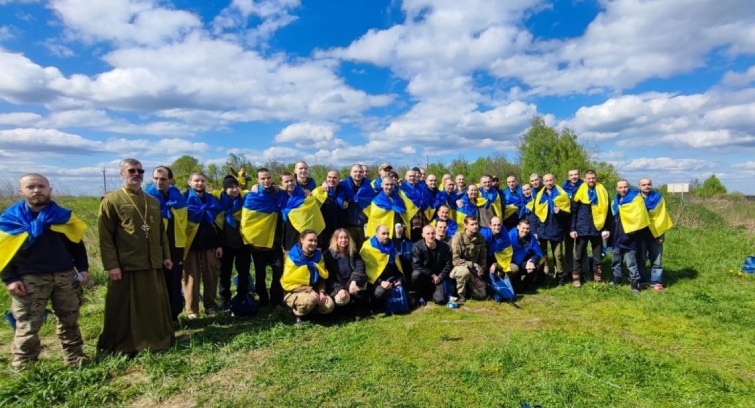
“Yas” defended Mariupol, specifically Azovstal, spent nearly a year in captivity, and returned home on May 6, 2023, as part of a prisoner exchange along with 44 other Azov soldiers.
Now he is back on the front lines and reminds the public of his fellow soldiers who remain in captivity.
Yaroslav says little about the torture he endured, but recalls how the fighters lifted each other’s spirits while held in the non-Bolshevik torture chambers.
He also recalls a dream he had almost every night in captivity, the day before the exchange, and the wish he fulfilled upon his return.
The soldier spoke to UP. Life about the defense of Mariupol, his captivity, and his journey home.
Below is his direct account.
War. Mariupol
Ever since my teenage years, I really wanted to enlist. I believed that a man should know how to handle a weapon and defend his country. So right after I finished school in 2015, I went to fight.
Why Azov, specifically? I had no idea what military service was like. In my youth, I was a bit involved in the fan movement, but it was pretty superficial. I had a friend from Kharkiv who served in Azov. He told me who to contact.
On February 24, I was in Yurievka near Mariupol. In the morning, the order came for everyone to gather and pack their things to move to Mariupol for combat operations. We got ready quickly. I decided to leave all my belongings, all my possessions, in Yurivka—let them burn there. I immediately detached myself from my material possessions. I thought: if war starts, it starts.
At the start of the full-scale war, I held the position of squad leader for fire support in a special-purpose sniper group. Since our group was specialized, we got up early, around two or three in the morning, got ready, and headed out to work in Mariupol, to the area assigned to us.
There we carried out our duties. We worked until evening, then returned to our forward operating base for a while, reloaded our weapons, and took new equipment to engage the enemy.
Probably, the biggest challenge in Mariupol was that we couldn’t always maintain communication and contact with other units.
I was getting 3–4 hours of sleep a day before I was wounded. When I was wounded, it was my first day off.
In short, there was close combat, and as I understood it, an RPG (hand-held anti-tank grenade launcher—ed.) landed somewhere near my feet. I was behind cover; it hit the armor, and shrapnel flew toward me and my comrade. Both of us were wounded then, but thanks to the high level of training of my comrades who were medics, I received prompt medical attention and was evacuated.
After being wounded, I spent about a week lying down. Over time, the route to the right bank was cut off. There was no way to rejoin my guys to continue fighting with them. All I could do was wait for the so-called day of the crossing. I waited for my guys, we moved to Azovstal, and continued to carry out combat missions.
At Azovstal, it was the same work, but under more difficult conditions, as the encirclement was tightening. We had to figure something out, like how to get food. The conditions were unpleasant when you eat very little just once a day and still have to do your job.
I managed to get in touch once every two days; the internet connection was sporadic. I tried to send messages saying I was alive. There was a time when I had no contact with my loved ones for a week.
At first, when I was wounded, I was at the “iron” – that’s what we called the field hospital. I stayed there for maybe a week. Then I was transferred to another bunker for less seriously wounded patients, after which I ended up in the infamous bunker known as “Store 20.”
In the “Store 10” bunker, there was an airstrike and a fire. In fact, “Store 20” was an even larger tragedy with more serious consequences. It happened three days before “Store 10.” Back then, many people were burned to death by a single rocket. I was lucky to escape. After that, I joined a reconnaissance unit and remained there until I was taken prisoner.
Fortunately, I didn’t need emergency medical care. I just needed a simple antibiotic and surgery immediately after being wounded. But it was really very hard for the guys. At one point, there were no painkillers or antibiotics. Very often, it wasn’t possible to save limbs; they had to be amputated.
“We didn’t think about captivity at all. We were waiting for the moment when we’d have to face the Russians empty-handed.”
To be honest, we had no hope that we’d be pulled out of Azovstal. But it was exciting when we heard about the ships led by Erdogan.
We’re all grown men, so we understood that we were surrounded in a ring spanning several dozen kilometers. Counting on any help was unrealistic. We thought that maybe we’d all die there, which we were truly prepared for. But no one lost heart; we fought to the very end.
We didn’t think about being taken prisoner at all. We had already buried ourselves and were waiting for our food and ammunition to run out, and for the moment when we would have to face the Russians with our bare hands. No one even considered the possibility of capture. It was something unknown and terrifying. Actually, we weren’t wrong.
I told only one person about my capture—the person I’d entrusted with handling all my affairs while I was away: my girlfriend.
I no longer had any reaction to the news of my capture—only exhaustion. I felt no emotions.
When we left the factory, the first search took place on the bridge. The Russians confiscated a lot of things. We set off by bus to Olenivka, then there was another search, and they took some more things. Some were luckier than others.
We lived in barracks, ate twice a day, and were given very little. For the “first course”—some kind of water with cabbage, like borscht. The second course—grains. And they gave us bread. At first, when there were a lot of people from Azovstal, there wasn’t enough food for everyone. I’m sure this was done on purpose to make us starve.
But a community is a community. Even under those conditions, we didn’t lose heart. We gathered in “interest groups” and talked. People shared whatever they were passionate about in life. Some knew English well; others had traveled a lot. We played sports as much as we could. We read books that we managed to smuggle out of Azovstal.
Later, when we arrived in Taganrog, the library was “more interesting.”
When I found myself in Ukraine, I saw the traditional site for all exchanges, many journalists, some commanders from our unit, and my girlfriend. I thought, well, that’s it, it’s all over for me, I can move on with my life. <\
<\
Because of the extreme stress we’d been through, I didn’t feel any emotions for a very long time. You can’t even imagine how exhausted my body was—it couldn’t even react emotionally to what was happening. I know rationally that it wouldn’t hurt to feel some joy, but I’m just like a vegetable—I can’t feel anything.
When I arrived back on our homeland, my condition was pretty bad, as it probably was for everyone. My left leg was severely injured from my time in captivity; it was done on purpose. A lot of doctors immediately swarmed around us—let’s do X-rays, examinations.
We were first sent to some hospital in Sumy, then we arrived in Kyiv, and that’s where our treatment began. We were welcomed very warmly.
We were very tired. Personally, at that point, I hadn’t slept for probably three days. I was in a daze, walking around like a zombie. We didn’t even understand what was happening.
My brain wasn’t functioning at all. Because of the flood of information coming at us, I couldn’t process anything. If you don’t exercise your brain, it slows down. This happens after such prolonged torture, a long period of captivity. We spent about a month recovering; they gave us leave.
Of course, both our physical and mental-psychological condition improved significantly. During my leave, I went home to Kharkiv to see my family.
After that, I went west to see the Carpathian landscapes. I’ve been doing this for as long as I can remember.
Society must adapt to the military, not demand that they adapt to civilians.
If you want to help, don’t do harm. No special treatment is needed. It’s a matter of basic respect, just as you would show to the sick. Personally, this drove me crazy. People start to forget the price they pay for their morning coffee.
Remember that over 700 Azov soldiers and 2,000 defenders of Mariupol are still in captivity.
Author: Olena Barsukova
"Commander Denys Prokopenko is a remarkable man, without whom the defense of Mariupol would not have been possible. If it weren’t for him, we wouldn’t have held out for so long, and we would all have been wiped out.
"Radish" saved as many of his men as he possibly could, for which I am personally grateful to him," says Azov fighter Yaroslav, call sign "Yas."
Yaroslav is a 27-year-old soldier from Kharkiv who has been serving since 2015. He is one of thousands of Azovstal defenders who left the steel plant’s grounds when, after three months of grueling battles for Mariupol, “Redis” gave the order to save the lives of the personnel.
“Yas” defended Mariupol, specifically Azovstal, spent nearly a year in captivity, and returned home on May 6, 2023, as part of a prisoner exchange along with 44 other Azov soldiers.
Now he is back on the front lines and reminds the public of his fellow soldiers who remain in captivity.
Yaroslav says little about the torture he endured, but recalls how the fighters lifted each other’s spirits while held in the non-Bolshevik torture chambers.
He also recalls a dream he had almost every night in captivity, the day before the exchange, and the wish he fulfilled upon his return.
The soldier spoke to UP. Life about the defense of Mariupol, his captivity, and his journey home.
Below is his direct account.
War. Mariupol
Ever since my teenage years, I really wanted to enlist. I believed that a man should know how to handle a weapon and defend his country. So right after I finished school in 2015, I went to fight.
Why Azov, specifically? I had no idea what military service was like. In my youth, I was a bit involved in the fan movement, but it was pretty superficial. I had a friend from Kharkiv who served in Azov. He told me who to contact.
On February 24, I was in Yurievka near Mariupol. In the morning, the order came for everyone to gather and pack their things to move to Mariupol for combat operations. We got ready quickly. I decided to leave all my belongings, all my possessions, in Yurivka—let them burn there. I immediately detached myself from my material possessions. I thought: if war starts, it starts.
At the start of the full-scale war, I held the position of squad leader for fire support in a special-purpose sniper group. Since our group was specialized, we got up early, around two or three in the morning, got ready, and headed out to work in Mariupol, to the area assigned to us.
There we carried out our duties. We worked until evening, then returned to our forward operating base for a while, reloaded our weapons, and took new equipment to engage the enemy.
Probably, the biggest challenge in Mariupol was that we couldn’t always maintain communication and contact with other units.
I was getting 3–4 hours of sleep a day before I was wounded. When I was wounded, it was my first day off.
In short, there was close combat, and as I understood it, an RPG (hand-held anti-tank grenade launcher—ed.) landed somewhere near my feet. I was behind cover; it hit the armor, and shrapnel flew toward me and my comrade. Both of us were wounded then, but thanks to the high level of training of my comrades who were medics, I received prompt medical attention and was evacuated.
After being wounded, I spent about a week lying down. Over time, the route to the right bank was cut off. There was no way to rejoin my guys to continue fighting with them. All I could do was wait for the so-called day of the crossing. I waited for my guys, we moved to Azovstal, and continued to carry out combat missions.
"Azovstal"
At Azovstal, it was the same work, but under more difficult conditions, as the encirclement was tightening. We had to figure something out, like how to get food. The conditions were unpleasant when you eat very little just once a day and still have to do your job.
I managed to get in touch once every two days; the internet connection was sporadic. I tried to send messages saying I was alive. There was a time when I had no contact with my loved ones for a week.
At first, when I was wounded, I was at the “iron” – that’s what we called the field hospital. I stayed there for maybe a week. Then I was transferred to another bunker for less seriously wounded patients, after which I ended up in the infamous bunker known as “Store 20.”
In the “Store 10” bunker, there was an airstrike and a fire. In fact, “Store 20” was an even larger tragedy with more serious consequences. It happened three days before “Store 10.” Back then, many people were burned to death by a single rocket. I was lucky to escape. After that, I joined a reconnaissance unit and remained there until I was taken prisoner.
Fortunately, I didn’t need emergency medical care. I just needed a simple antibiotic and surgery immediately after being wounded. But it was really very hard for the guys. At one point, there were no painkillers or antibiotics. Very often, it wasn’t possible to save limbs; they had to be amputated.
“We didn’t think about captivity at all. We were waiting for the moment when we’d have to face the Russians empty-handed.”
To be honest, we had no hope that we’d be pulled out of Azovstal. But it was exciting when we heard about the ships led by Erdogan.
We’re all grown men, so we understood that we were surrounded in a ring spanning several dozen kilometers. Counting on any help was unrealistic. We thought that maybe we’d all die there, which we were truly prepared for. But no one lost heart; we fought to the very end.
We didn’t think about being taken prisoner at all. We had already buried ourselves and were waiting for our food and ammunition to run out, and for the moment when we would have to face the Russians with our bare hands. No one even considered the possibility of capture. It was something unknown and terrifying. Actually, we weren’t wrong.
I told only one person about my capture—the person I’d entrusted with handling all my affairs while I was away: my girlfriend.
I no longer had any reaction to the news of my capture—only exhaustion. I felt no emotions.
Olenivka
When we left the factory, the first search took place on the bridge. The Russians confiscated a lot of things. We set off by bus to Olenivka, then there was another search, and they took some more things. Some were luckier than others.
We lived in barracks, ate twice a day, and were given very little. For the “first course”—some kind of water with cabbage, like borscht. The second course—grains. And they gave us bread. At first, when there were a lot of people from Azovstal, there wasn’t enough food for everyone. I’m sure this was done on purpose to make us starve.
But a community is a community. Even under those conditions, we didn’t lose heart. We gathered in “interest groups” and talked. People shared whatever they were passionate about in life. Some knew English well; others had traveled a lot. We played sports as much as we could. We read books that we managed to smuggle out of Azovstal.
Later, when we arrived in Taganrog, the library was “more interesting.”
Taganrog
When we arrived in Taganrog, we went through a brutal “initiation,” which I can’t talk about right now. The only thing I’ll say is that after it, I lost the ability to walk for six weeks. My cellmates helped me take care of my needs as a “bedridden” prisoner.
After one of the interrogations and the usual beatings, when I was able to move around on crutches, the next day they threw me into solitary confinement and took away my crutches, meaning they deprived me of the ability to move around in an upright position.
Solitary confinement cells are single-person cells where you are alone with your thoughts and fears. It was impossible to think because of the constantly blaring loud music like “Red Army, White Baron.” The music was a specific form of torture and also made it hard to hear the guards’ footsteps in the hallway.
During the checks twice a day (and four times a day in solitary confinement), I had to crawl out and, while lying down, once again endure blows from batons and kicks.
There were three of us in a regular cell, so we were usually given three books. One or two of these books were always written by Lenin or someone like him. There were several volumes on empirio-criticism. I still can’t figure out what those words mean. We read about such things, as sad as it may be.
In Olenivka, there was some opportunity to contact our families, but we did so in secret. But once we ended up in Taganrog—that was it. From the moment I arrived there in September until my release from captivity, I had no way to send a signal that I was even alive.
In Taganrog, we were forbidden to communicate. Only in whispers, so they wouldn’t catch you. How did we cheer each other up? There’s a lot of free time in captivity. If there were any of Lenin’s works available, we couldn’t read them anymore. All we could do was entertain ourselves by talking. We had gotten on each other’s nerves to such an extent that it’s hard to describe.
It’s a group of three people with whom you spend many months. You feel like you already know the person completely, and you’re sick of talking to each other. But there’s no other entertainment. So you can’t get by without respect within the group. The space was confined; it was very hard.
Almost every day I had the same dream. I don’t know why I had it. Every day, it was as if I were driving down Khreshchatyk in a car, and I had a thermos cup within reach. As soon as I was released from captivity, I didn’t tell anyone about this dream, and then my friends started teasing me about the thermos. And I decided I needed to buy a car. After my captivity, I got myself a Volvo.
After one of the interrogations and the usual beatings, when I was able to move around on crutches, the next day they threw me into solitary confinement and took away my crutches, meaning they deprived me of the ability to move around in an upright position.
Solitary confinement cells are single-person cells where you are alone with your thoughts and fears. It was impossible to think because of the constantly blaring loud music like “Red Army, White Baron.” The music was a specific form of torture and also made it hard to hear the guards’ footsteps in the hallway.
During the checks twice a day (and four times a day in solitary confinement), I had to crawl out and, while lying down, once again endure blows from batons and kicks.
There were three of us in a regular cell, so we were usually given three books. One or two of these books were always written by Lenin or someone like him. There were several volumes on empirio-criticism. I still can’t figure out what those words mean. We read about such things, as sad as it may be.
In Olenivka, there was some opportunity to contact our families, but we did so in secret. But once we ended up in Taganrog—that was it. From the moment I arrived there in September until my release from captivity, I had no way to send a signal that I was even alive.
In Taganrog, we were forbidden to communicate. Only in whispers, so they wouldn’t catch you. How did we cheer each other up? There’s a lot of free time in captivity. If there were any of Lenin’s works available, we couldn’t read them anymore. All we could do was entertain ourselves by talking. We had gotten on each other’s nerves to such an extent that it’s hard to describe.
It’s a group of three people with whom you spend many months. You feel like you already know the person completely, and you’re sick of talking to each other. But there’s no other entertainment. So you can’t get by without respect within the group. The space was confined; it was very hard.
Almost every day I had the same dream. I don’t know why I had it. Every day, it was as if I were driving down Khreshchatyk in a car, and I had a thermos cup within reach. As soon as I was released from captivity, I didn’t tell anyone about this dream, and then my friends started teasing me about the thermos. And I decided I needed to buy a car. After my captivity, I got myself a Volvo.
The Exchange
"The prison guards come in and say, 'These are allowed, but these aren’t.'"
I remember the day of the exchange very well. The day before, we had our final interrogation. The only thing that wasn’t quite typical was that we were repeatedly filmed. I was ordered to give the same testimony I had given before.
They were framing me for one case, but during the last interrogation, I decided I had to tell the whole truth after all, because otherwise things would turn out really badly for me. I told them that I didn’t do what they were framing me for, and all of this was on camera.
After that, they took me to the so-called “glass cell,” also known as the “refrigerator” or “dungeon.” This is where they hold everyone before interrogation. At the same time, they were bringing in other guys from the cells, also Azov members. The prison guards came in and said, “Those are yours, and those aren’t yours; these ones are okay, but these ones aren’t.” And then I hear them taking the guys out one by one and starting to torture them. It was very loud.
After that, they started bringing us, one by one, to the office where we gave our statements to sign. I sign. My eyes were closed; I couldn’t see anything, and then someone’s voice told me that I was going home tomorrow. I thought, “What do you mean?” Then I said, “Sir, may I open my eyes and lift my head?” And I ask, “Why are you joking like that?” I don’t know why I decided to act so freely, because allowing yourself to communicate like that there is tantamount to death…
But it really struck a chord with me. No one had ever joked like that during my entire captivity, not once in the whole year. And somehow we got into a conversation. He said that tomorrow they were sending me and a few other guys from this place back home. I was like, “No way.” Maybe they’re just joking now, and starting Monday I’ll be… They’d be beating a confession out of me again, the one they wanted to hear.
My state of mind after that conversation, as you can imagine, was far from the best. I’m sitting in a cell with my brothers-in-arms, not knowing what to say to them or how to react. I was just in a panic, in shock. I knew that tomorrow morning I’d be going either home or to another detention facility. I can’t sleep, I can’t eat. I’m just a nervous wreck. Honestly, when I first saw myself in the mirror, I realized I’d gone gray in just six months.
Then lights out, but I couldn’t sleep. I had a bad feeling. That person didn’t tell me that information for no reason. Time goes by, goes by, goes by. At night I hear footsteps in the hallway, the neighboring cell opens, they call out a name—get your things and head out. I think, some movement, I wonder what will happen next. The second cell opens—same story, another name. The third cell, and then the fourth—mine.
My name is called—get your things and head out. I was on crutches back then, so walking with my things was especially hard. I think someone carried them for me. And there was the procedure, so to speak, of “check-ins and check-outs.”
Then they took us downstairs and dressed us in whatever they had. But I was lucky; I even got a full set of camouflage fatigues, so at least I looked like a soldier. Though it was a bit baggy.
After that, they put us in a police van or something like that. They took us to the airfield. I could hear the planes roaring. Although, as always, our eyes were blindfolded, our hands were bound, and our heads were bowed—all in the best traditions of maximum secrecy.
No one touched us, no one beat us; everything went peacefully, as it should during an exchange. But they made us sit in the most uncomfortable positions possible.
I no longer had a feeling that they were taking us somewhere else. But everything could change at any moment. From the plane, they put us on a bus and we drove to the border, where we were exchanged.
I remember the day of the exchange very well. The day before, we had our final interrogation. The only thing that wasn’t quite typical was that we were repeatedly filmed. I was ordered to give the same testimony I had given before.
They were framing me for one case, but during the last interrogation, I decided I had to tell the whole truth after all, because otherwise things would turn out really badly for me. I told them that I didn’t do what they were framing me for, and all of this was on camera.
After that, they took me to the so-called “glass cell,” also known as the “refrigerator” or “dungeon.” This is where they hold everyone before interrogation. At the same time, they were bringing in other guys from the cells, also Azov members. The prison guards came in and said, “Those are yours, and those aren’t yours; these ones are okay, but these ones aren’t.” And then I hear them taking the guys out one by one and starting to torture them. It was very loud.
After that, they started bringing us, one by one, to the office where we gave our statements to sign. I sign. My eyes were closed; I couldn’t see anything, and then someone’s voice told me that I was going home tomorrow. I thought, “What do you mean?” Then I said, “Sir, may I open my eyes and lift my head?” And I ask, “Why are you joking like that?” I don’t know why I decided to act so freely, because allowing yourself to communicate like that there is tantamount to death…
But it really struck a chord with me. No one had ever joked like that during my entire captivity, not once in the whole year. And somehow we got into a conversation. He said that tomorrow they were sending me and a few other guys from this place back home. I was like, “No way.” Maybe they’re just joking now, and starting Monday I’ll be… They’d be beating a confession out of me again, the one they wanted to hear.
My state of mind after that conversation, as you can imagine, was far from the best. I’m sitting in a cell with my brothers-in-arms, not knowing what to say to them or how to react. I was just in a panic, in shock. I knew that tomorrow morning I’d be going either home or to another detention facility. I can’t sleep, I can’t eat. I’m just a nervous wreck. Honestly, when I first saw myself in the mirror, I realized I’d gone gray in just six months.
Then lights out, but I couldn’t sleep. I had a bad feeling. That person didn’t tell me that information for no reason. Time goes by, goes by, goes by. At night I hear footsteps in the hallway, the neighboring cell opens, they call out a name—get your things and head out. I think, some movement, I wonder what will happen next. The second cell opens—same story, another name. The third cell, and then the fourth—mine.
My name is called—get your things and head out. I was on crutches back then, so walking with my things was especially hard. I think someone carried them for me. And there was the procedure, so to speak, of “check-ins and check-outs.”
Then they took us downstairs and dressed us in whatever they had. But I was lucky; I even got a full set of camouflage fatigues, so at least I looked like a soldier. Though it was a bit baggy.
After that, they put us in a police van or something like that. They took us to the airfield. I could hear the planes roaring. Although, as always, our eyes were blindfolded, our hands were bound, and our heads were bowed—all in the best traditions of maximum secrecy.
No one touched us, no one beat us; everything went peacefully, as it should during an exchange. But they made us sit in the most uncomfortable positions possible.
I no longer had a feeling that they were taking us somewhere else. But everything could change at any moment. From the plane, they put us on a bus and we drove to the border, where we were exchanged.
Freedom
When I found myself in Ukraine, I saw the traditional site for all exchanges, many journalists, some commanders from our unit, and my girlfriend. I thought, well, that’s it, it’s all over for me, I can move on with my life. <\
<\
Because of the extreme stress we’d been through, I didn’t feel any emotions for a very long time. You can’t even imagine how exhausted my body was—it couldn’t even react emotionally to what was happening. I know rationally that it wouldn’t hurt to feel some joy, but I’m just like a vegetable—I can’t feel anything.
When I arrived back on our homeland, my condition was pretty bad, as it probably was for everyone. My left leg was severely injured from my time in captivity; it was done on purpose. A lot of doctors immediately swarmed around us—let’s do X-rays, examinations.
We were first sent to some hospital in Sumy, then we arrived in Kyiv, and that’s where our treatment began. We were welcomed very warmly.
We were very tired. Personally, at that point, I hadn’t slept for probably three days. I was in a daze, walking around like a zombie. We didn’t even understand what was happening.
My brain wasn’t functioning at all. Because of the flood of information coming at us, I couldn’t process anything. If you don’t exercise your brain, it slows down. This happens after such prolonged torture, a long period of captivity. We spent about a month recovering; they gave us leave.
Of course, both our physical and mental-psychological condition improved significantly. During my leave, I went home to Kharkiv to see my family.
After that, I went west to see the Carpathian landscapes. I’ve been doing this for as long as I can remember.
Return to the Front
A few weeks ago, I returned to active duty. This was my personal choice because, to be honest, I was tired of resting. I wanted to return as soon as possible, which is why I turned down the sanatorium and further treatment, which is still necessary.
I want to work; I want to be needed by my country. Simply put, I don’t want to sit around doing nothing. I spent a year just sitting in one place and doing nothing useful, so my conscience is subconsciously gnawing at me.
I joined a new unit within Azov, which is currently in need of personnel. It’s a company of strike unmanned aerial systems. We’re tasked with taking out the enemy using drones. Right now, we need pilots, bomb disposal experts, administrative staff, medics, and other military personnel.
I want to work; I want to be needed by my country. Simply put, I don’t want to sit around doing nothing. I spent a year just sitting in one place and doing nothing useful, so my conscience is subconsciously gnawing at me.
I joined a new unit within Azov, which is currently in need of personnel. It’s a company of strike unmanned aerial systems. We’re tasked with taking out the enemy using drones. Right now, we need pilots, bomb disposal experts, administrative staff, medics, and other military personnel.
Testimonies of torture and the occupiers’ reaction
All the interviews the guys gave after returning from captivity were later reviewed by "DPR" members or Russians. After that, during inspections and interrogations, they would recount all of this to us, of course, from their own perspective, the way they perceived it. And, accordingly, certain “measures” were taken.
Personally, I believe that some information about the conditions in captivity needs to be made public so that the international community takes notice and so that the exchange processes can at least begin to move forward and accelerate.
No matter how bad things are for the guys, if we don’t do this, they might be forgotten. The world will forget that Mariupol once existed, that the Azov soldiers are still in captivity. All of this needs to be spoken about. Media coverage, unfortunately, plays a major role in our century.
Personally, I believe that some information about the conditions in captivity needs to be made public so that the international community takes notice and so that the exchange processes can at least begin to move forward and accelerate.
No matter how bad things are for the guys, if we don’t do this, they might be forgotten. The world will forget that Mariupol once existed, that the Azov soldiers are still in captivity. All of this needs to be spoken about. Media coverage, unfortunately, plays a major role in our century.
Advice to society: “If you want to help, don’t do harm”
Society must adapt to the military, not demand that they adapt to civilians.
If you want to help, don’t do harm. No special treatment is needed. It’s a matter of basic respect, just as you would show to the sick. Personally, this drove me crazy. People start to forget the price they pay for their morning coffee.
Remember that over 700 Azov soldiers and 2,000 defenders of Mariupol are still in captivity.
This is an automatic translation generated by DeepL.