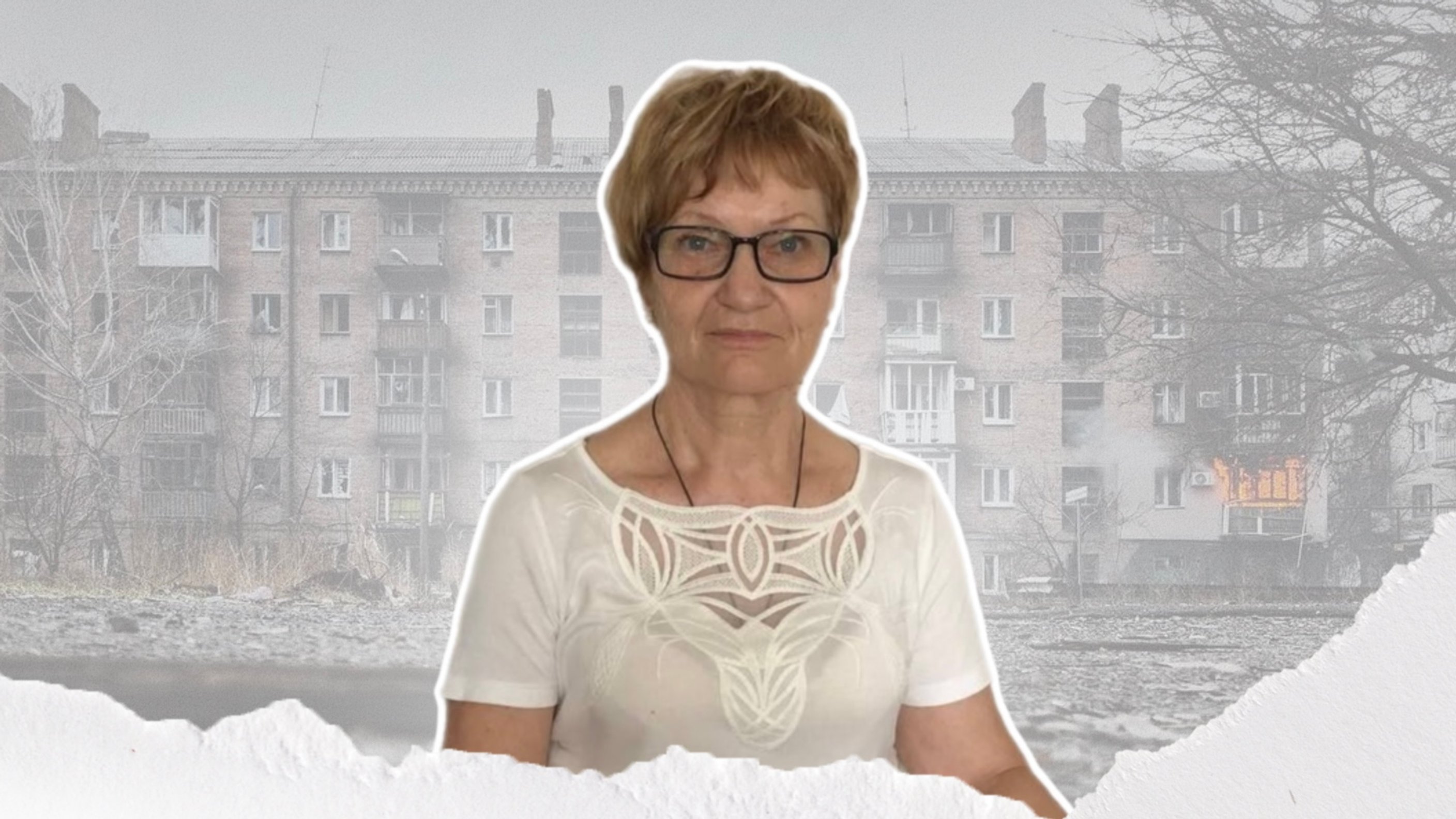
Unbreakable: the story of a Kharkiv woman who, at the age of 70, found herself "in the basement" of the Russian occupiers
Source: Varosh
Author: Roman Sovyak
“I was waiting for you. I didn’t go out to weave nets today on purpose, because we had agreed,” Taisiya Prokopivna tells me. This 70-year-old woman is very lively and active, radiating boundless energy and confidence. You wouldn’t immediately guess that this woman spent seven months under occupation, that she was sent “to the basement,” starved, and that she survived the death of her husband and the loss of her home. This woman has seen enough grief to last three generations, but it hasn’t broken her.
Our conversation begins with two questions: what language we’ll speak and whether the woman will remain anonymous in the story. “It’s a little hard for me to speak Ukrainian, but after everything I’ve been through—I can’t stand hearing Russian. It makes me sick. Can you imagine? I lived in a village that borders Russia. Everyone there spoke Russian, and there were a lot of Russians living there. But now I can’t stand hearing their language,” the woman replies. “I have nothing to fear; you can write that. So there’s no need for anonymity.”
“We don’t have much time to just wait.” How older people support the Ukrainian military
Taisiya Prokhorova worked for 52 years at Kharkiv Regional Psychiatric Hospital No. 1, located in the village of Strilets. This facility is situated on the Ukrainian-Russian border. The village is equally close to both the Ukrainian city of Kharkiv and the Russian city of Belgorod. On the border between the countries, where the villagers’ gardens abut the Russian border and a short walk through the village can take you into another country, Taisiya lived and worked. On February 24, columns of military vehicles passed right through their village on their way to capture Kharkiv.
“We felt it all right away. It was something terrifying. I heard and saw those scary black helicopters, the explosions, and heard the bombs falling. I immediately gathered the children and said, ‘Run, because war has started here.’ And my daughter replied, ‘Mom, it’s happening here too,’”—this is how Taisiya Prokopivna recalls the night of February 24.
Her daughter and son-in-law were living in Kharkiv at the time. Olena—her daughter—works as a medic, and her husband is in the military. This fact would later have a major impact on Taisiya’s fate, because the whole village knew that her son-in-law was in the military. And collaborators told the Russian occupiers about it.
“One of the roads from Belgorod to Kharkiv runs through our village. It was along this very road that columns of military equipment were moving. Our house is near the highway to Kharkiv, and I saw these vehicles, tanks, and rocket launchers. I started counting. I counted up to 500 and thought: ‘Poor Kharkiv, what will happen there?’”
The woman sent encrypted text messages to her daughter and granddaughter. They passed the information on to her son-in-law—a lieutenant colonel in the Ukrainian Armed Forces. He defended Kharkiv and was one of the first to liberate the village of Striletsa seven months later.
The village was occupied on the very first night. Some of the troops remained there, while the equipment and personnel moved toward Kharkiv. The woman and her seriously ill husband did not want to evacuate to Russia, and it was no longer possible to go to Kharkiv. So they decided to stay in the village under occupation.
At that time, there were nearly 800 patients at the psychiatric hospital in Strilets. The staff dwindled very quickly, and instead of 4–5 medical workers per shift, only Taisiya Prokopivna and a colleague were on duty. And sometimes she was alone.
“Eighty people for one nurse is very difficult. But we did our best; we fed them and gave them water. We’d cook at home to bring food to the patients the next time,” the woman recalls. “There was a checkpoint on the hospital grounds, and we went to work with passes.
Once I bought two three-liter cans of milk. I didn’t have time to take them home, so I brought them to work with me. They were heavy, so I carried them, stopping to rest. A soldier saw that I was carrying something bulky, pointed a machine gun at me, and ordered me to show him. “He probably thought I was carrying explosives or something?”
There was a severe shortage of medicine for patients, but we managed to beg for certain medications, including from a young doctor serving the occupiers. He said he was from St. Petersburg himself.
Russian soldiers set up a hospital in the local school. They treated their own wounded there, and sent only one occupier—who showed signs of mental illness—to the psychiatric hospital.
“Before allowing anyone to work, they went around, checked all the patients, and made sure none of them were ATO veterans. They behaved very brutally. It was terrifying.”
Some of the patients could not cope with the stress of the occupation. The Russians had no intention of transporting them to Russia; there were not enough medicines or medical staff, so people began to die. The hospital staff who remained on duty buried them on the hospital grounds. They placed nameplates on each grave with the name of the deceased. “It was important to us. After all, if their relatives come looking for them, at least this way they’ll be able to identify them,” says Ms. Taisiya.
Later, after the village was liberated, Ukrainian soldiers and medical staff evacuated the patients from this psychiatric hospital. More precisely, those who had survived the occupation. Immediately after their retreat, Russian troops began bombing Strilets. As a result, during the evacuation, two patients were wounded, and four medical staff members were killed.
There turned out to be many collaborators in the village and its surroundings. The former head of the Lypetsk Village Council, and at that time a local deputy, Oleksandr Fedorenko, voluntarily defected to the enemy and headed the occupation administration. By the way, he fled to Russia but later returned to Ukraine, where he was detained and is currently on trial as a collaborator. There was also Taisiya Prokopivna’s neighbor—a local transport entrepreneur—local police officers who guarded the occupying officers and the places where Ukrainians were held and tortured, the director of the local school, certain village deputies, and so on. In such an environment, holding a pro-Ukrainian stance meant walking a tightrope.
“An entrepreneur lived next door to me. He owned minibuses that ran to Kharkiv. So he went to serve the Russians, along with his wife and her sister. She, by the way, was handing out food rations to the locals, since there was nothing to buy. ‘My God, you can’t imagine how my mom and I waited for Russia; I’ve dreamed of it since childhood,’ she told me. “But when she found out who I was, she fell silent right away. Because everyone in the area already knew I had a pro-Ukrainian stance,” the woman recalls.
It was only a matter of time before Ms. Taisiya was detained. Soon after, soldiers showed up at her door with a search warrant. They didn’t give a reason, but they were looking for her son-in-law, a soldier. They found nothing and no one, but they waved a blank sheet of A4 paper in front of her—one that had been lying on the dresser—and claimed it was some kind of document from the military registration office.
“Of course, that was a lie, but they didn’t come looking for the truth—they came to arrest me. They shoved me into a car and took me to a basement. ‘You’ll sit here, granny,’ the soldier told me. They threw me into that basement. There were 25 people there—men and women. The men were smoking in the small room. “I’ve never smoked in my life, and here everything was filled with smoke. It felt like my brain was just melting from that smoke,” says Ms. Taya.
Five days later, another woman was brought to the basement—a doctor named Tetyana from Kharkiv. She had come to her parents’ village with her husband before the invasion. They ended up under occupation there. A neighbor reported that the couple was passing information to the Ukrainian Armed Forces, and they were also taken “to the basement.”
“By the way, she’s a doctor too—such a smart, psychologically strong woman. I really want to find her. There were only two of us women; the rest were men. They treated us more or less normally, but they brought in guys from neighboring villages—mostly ATO veterans. Right in front of me, they ran electricity through them. They attached wires to their little fingers and shocked them with electricity,” the woman says. “Then they beat one of them, Serhiy, so hard with batons that they broke his ribs. “He was moaning terribly.”
The husband of Tetyana, a doctor who was also taken to the basement, was tortured. He was never returned to the prisoners. And what became of them is unknown. Many of the young men tortured by collaborators and Russian soldiers were taken to Russia. Taisiya Prokhorova herself was luckier. After 12 days, she was released. She never said anything about her son-in-law. After all, what could she say if she had no direct contact with her son-in-law?
“They didn’t beat me, probably because I’m old. But they put a lot of psychological pressure on me. They took me in for interrogation and yelled at me, then another Russian soldier would come in, question me, and they’d yell again. And so it went, over and over. There was no medical care; they gave me some sour cabbage with vinegar to eat, which stung my mouth. It was a nightmare,” the woman recalls.
In 12 days, the woman lost 10 kilograms. Even before that, she was frail and not very tall. She barely made it home and spent several days just lying in bed, coming to her senses. “I really wanted to wash myself, to wash all that dirt off me—both literally and figuratively,” recalls Ms. Taisiya.
Later, she learned that the occupiers had conducted several more searches while she was being held hostage. They took all her electronics: her laptop, phone, and tablet. They also took the restaurant dishes that friends of the family had brought over for storage. Even before the Great War, during the COVID-19 pandemic, they had to close their restaurant in Kharkiv. And all the expensive tableware had to be moved somewhere. The Prokhorovs offered their garage. But during the occupation, the “Luhansk militants” took everything.
“Believe me, the worst, the most brutal were the Luhansk militants who came with the Russians. They mocked and robbed everyone. Horrible people,” recalls Taisiya Prokopivna.
When Kharkiv came under fire in the early hours of February 24, 2022, Taisiya’s daughter and granddaughter decided to leave the city. They went to stay with their grandparents. They thought they would be safe there. But they couldn’t reach Strilcha safely. Halfway there, they encountered columns of Russian military vehicles; no one was allowed to pass in either direction. So the women were effectively stuck between two armies. Taisiya knew about the girls’ plan to go to the village and was very worried. By then, Ukrainian mobile networks were no longer working there, and communication had been lost. She asked the local authorities for help. Eventually, they managed to track them down. After a week of hardships and staying in another village, the women made it to Strilcha. But then the factor of “the wife and daughter of a Ukrainian soldier” came into play.
“No one was shelling our village. The Russians had captured it, so they didn’t bomb it; the Ukrainians weren’t firing, and they were fighting on the outskirts of Kharkiv. So we had some peace. Especially when the girls finally made it home. But soon one of my neighbors told me: ‘Be careful—your son-in-law is a soldier, and now the girls have arrived.’ And when another person said the same thing, and then a third, I panicked. She came and said they had to flee. But where to go? Only toward Russia. Then a convoy of cars formed, and they managed to leave,” says Ms. Taisiya.
The women crossed the border, ended up in the Belgorod region, and then headed for the border of one of the Baltic countries: “They gathered their documents, their belongings, their little dog, and drove through Russia. And from there, they went through the Baltic states. And they made it to Germany,” says the woman.
By the way, the family has now returned to Ukraine. Immediately after the village was liberated, Taisiya Prokopivna and her husband Vasyl Mykolayovych were taken to Kharkiv by her son-in-law. Their daughter and granddaughter also returned there.
The women left on their own, even though they were offered to take the grandparents with them. At the time, the elderly couple refused. They were worried about how Vasyl Mykolayovych would handle the journey. Later, after 12 days “in the basement,” Taisiya finally decided to leave. She and her husband tried to follow their daughter’s route and travel through Russia and the Baltic states to reach Germany, where part of the family was at the time.
“Back then, you needed permission to leave. Honestly, I thought I had to go to the children. I had those thoughts. But I found out I wasn’t allowed to leave. There was a room where those Luhansk guys were. Among them was a commander with the call sign “Granite.” He grabbed me by the collar and said, “We’ve got you on our radar—in short, you’re not leaving.” And there were also our Ukrainian police officers there who were already working for Russia. They drank and ate with those Luhansk guys and guarded their base. Then everyone fled,” the woman says.
“I was on the night shift. It was around the 10th of September, and a Russian soldier came up to me and said, ‘Don’t let the patients out for a walk under any circumstances. I said not to let them out; they’ll bomb us.’ I protested, saying I had a schedule and needed to take the people out for a walk, but he forbade it. And in the morning, I went out onto the street and it was easier to breathe. “They all fled overnight: both the soldiers and the collaborators,” recalls Ms. Taisiya.
At that very time, the Ukrainian military was achieving tremendous success in the Kharkiv sector. Villages and towns were being liberated at an incredible speed, and the Russians were fleeing so hastily that they often left behind their equipment and ammunition.
Of course, the Ukrainian military didn’t bomb Strilets. So when Ms. Taya met the young men in uniform and asked, “Who are you?”, she couldn’t believe they were our soldiers. She burst into tears of joy and offered them watermelons. That year, the watermelons were a bountiful harvest, as big as buckets. And when she picked them, she could barely carry them.
A few days later, her son-in-law arrived in the village with a team to evacuate patients. He practically forced my mother-in-law and father-in-law to leave. “I was sure the village had been liberated and that the war would end soon. The Russians would run away. But my son-in-law said the Russians were going to bomb Strilets and we had to leave. I didn’t want to. We had to prepare for winter. Where would we go? But he practically grabbed me by the scruff of the neck and put me in the car. He brought my husband and me to his apartment in Kharkiv, and he went on to work, to fight,” the woman says.
Vasyl Mykolayovych didn’t live long after moving to Kharkiv. My husband passed away six months ago. Since then, my solace has been a shared cause. Along with dozens of other Kharkiv residents and displaced people from across the region, I knit nets for the military. She goes there almost as if it were a job.
“Here I have found my spiritual happiness. It’s peaceful here, and I’m among like-minded people. I don’t need to prove to anyone that honey is sweeter and kinder to flies than, you know, that other stuff. I thank my granddaughter, because she was the one who convinced me to join the groups and weave nets. Honestly, I never thought that after living so many years in my own home, for my own pleasure, I would also witness a terrible war. But since it has happened, I must do my part so that we can win and stop this invasion,” admits Taisiya Prokopivna.
Before the war, the woman and her husband had a beautiful garden; they made homemade jams and liqueurs that the whole family loved so much. Their country house was a little piece of paradise for both the older generation and the young people. Now the house and garden have been partially destroyed by Russian artillery. The property has been partially looted. But both Ms. Taya and I believe that the Prokhorovs’ gardens will bloom again, the houses will be rebuilt, and Strilets will be a peaceful, tranquil place under the protection of the Ukrainian military.
Author: Roman Sovyak
“I was waiting for you. I didn’t go out to weave nets today on purpose, because we had agreed,” Taisiya Prokopivna tells me. This 70-year-old woman is very lively and active, radiating boundless energy and confidence. You wouldn’t immediately guess that this woman spent seven months under occupation, that she was sent “to the basement,” starved, and that she survived the death of her husband and the loss of her home. This woman has seen enough grief to last three generations, but it hasn’t broken her.
Our conversation begins with two questions: what language we’ll speak and whether the woman will remain anonymous in the story. “It’s a little hard for me to speak Ukrainian, but after everything I’ve been through—I can’t stand hearing Russian. It makes me sick. Can you imagine? I lived in a village that borders Russia. Everyone there spoke Russian, and there were a lot of Russians living there. But now I can’t stand hearing their language,” the woman replies. “I have nothing to fear; you can write that. So there’s no need for anonymity.”
“We don’t have much time to just wait.” How older people support the Ukrainian military
Taisiya Prokhorova worked for 52 years at Kharkiv Regional Psychiatric Hospital No. 1, located in the village of Strilets. This facility is situated on the Ukrainian-Russian border. The village is equally close to both the Ukrainian city of Kharkiv and the Russian city of Belgorod. On the border between the countries, where the villagers’ gardens abut the Russian border and a short walk through the village can take you into another country, Taisiya lived and worked. On February 24, columns of military vehicles passed right through their village on their way to capture Kharkiv.
The Start of a Major War
“We felt it all right away. It was something terrifying. I heard and saw those scary black helicopters, the explosions, and heard the bombs falling. I immediately gathered the children and said, ‘Run, because war has started here.’ And my daughter replied, ‘Mom, it’s happening here too,’”—this is how Taisiya Prokopivna recalls the night of February 24.
Her daughter and son-in-law were living in Kharkiv at the time. Olena—her daughter—works as a medic, and her husband is in the military. This fact would later have a major impact on Taisiya’s fate, because the whole village knew that her son-in-law was in the military. And collaborators told the Russian occupiers about it.
“One of the roads from Belgorod to Kharkiv runs through our village. It was along this very road that columns of military equipment were moving. Our house is near the highway to Kharkiv, and I saw these vehicles, tanks, and rocket launchers. I started counting. I counted up to 500 and thought: ‘Poor Kharkiv, what will happen there?’”
The woman sent encrypted text messages to her daughter and granddaughter. They passed the information on to her son-in-law—a lieutenant colonel in the Ukrainian Armed Forces. He defended Kharkiv and was one of the first to liberate the village of Striletsa seven months later.
The village was occupied on the very first night. Some of the troops remained there, while the equipment and personnel moved toward Kharkiv. The woman and her seriously ill husband did not want to evacuate to Russia, and it was no longer possible to go to Kharkiv. So they decided to stay in the village under occupation.
Psychiatric hospital. Checkpoint. Assault rifle
At that time, there were nearly 800 patients at the psychiatric hospital in Strilets. The staff dwindled very quickly, and instead of 4–5 medical workers per shift, only Taisiya Prokopivna and a colleague were on duty. And sometimes she was alone.
“Eighty people for one nurse is very difficult. But we did our best; we fed them and gave them water. We’d cook at home to bring food to the patients the next time,” the woman recalls. “There was a checkpoint on the hospital grounds, and we went to work with passes.
Once I bought two three-liter cans of milk. I didn’t have time to take them home, so I brought them to work with me. They were heavy, so I carried them, stopping to rest. A soldier saw that I was carrying something bulky, pointed a machine gun at me, and ordered me to show him. “He probably thought I was carrying explosives or something?”
There was a severe shortage of medicine for patients, but we managed to beg for certain medications, including from a young doctor serving the occupiers. He said he was from St. Petersburg himself.
Russian soldiers set up a hospital in the local school. They treated their own wounded there, and sent only one occupier—who showed signs of mental illness—to the psychiatric hospital.
“Before allowing anyone to work, they went around, checked all the patients, and made sure none of them were ATO veterans. They behaved very brutally. It was terrifying.”
Some of the patients could not cope with the stress of the occupation. The Russians had no intention of transporting them to Russia; there were not enough medicines or medical staff, so people began to die. The hospital staff who remained on duty buried them on the hospital grounds. They placed nameplates on each grave with the name of the deceased. “It was important to us. After all, if their relatives come looking for them, at least this way they’ll be able to identify them,” says Ms. Taisiya.
Later, after the village was liberated, Ukrainian soldiers and medical staff evacuated the patients from this psychiatric hospital. More precisely, those who had survived the occupation. Immediately after their retreat, Russian troops began bombing Strilets. As a result, during the evacuation, two patients were wounded, and four medical staff members were killed.
“Please go to the basement,” she was told
There turned out to be many collaborators in the village and its surroundings. The former head of the Lypetsk Village Council, and at that time a local deputy, Oleksandr Fedorenko, voluntarily defected to the enemy and headed the occupation administration. By the way, he fled to Russia but later returned to Ukraine, where he was detained and is currently on trial as a collaborator. There was also Taisiya Prokopivna’s neighbor—a local transport entrepreneur—local police officers who guarded the occupying officers and the places where Ukrainians were held and tortured, the director of the local school, certain village deputies, and so on. In such an environment, holding a pro-Ukrainian stance meant walking a tightrope.
“An entrepreneur lived next door to me. He owned minibuses that ran to Kharkiv. So he went to serve the Russians, along with his wife and her sister. She, by the way, was handing out food rations to the locals, since there was nothing to buy. ‘My God, you can’t imagine how my mom and I waited for Russia; I’ve dreamed of it since childhood,’ she told me. “But when she found out who I was, she fell silent right away. Because everyone in the area already knew I had a pro-Ukrainian stance,” the woman recalls.
It was only a matter of time before Ms. Taisiya was detained. Soon after, soldiers showed up at her door with a search warrant. They didn’t give a reason, but they were looking for her son-in-law, a soldier. They found nothing and no one, but they waved a blank sheet of A4 paper in front of her—one that had been lying on the dresser—and claimed it was some kind of document from the military registration office.
“Of course, that was a lie, but they didn’t come looking for the truth—they came to arrest me. They shoved me into a car and took me to a basement. ‘You’ll sit here, granny,’ the soldier told me. They threw me into that basement. There were 25 people there—men and women. The men were smoking in the small room. “I’ve never smoked in my life, and here everything was filled with smoke. It felt like my brain was just melting from that smoke,” says Ms. Taya.
Five days later, another woman was brought to the basement—a doctor named Tetyana from Kharkiv. She had come to her parents’ village with her husband before the invasion. They ended up under occupation there. A neighbor reported that the couple was passing information to the Ukrainian Armed Forces, and they were also taken “to the basement.”
“By the way, she’s a doctor too—such a smart, psychologically strong woman. I really want to find her. There were only two of us women; the rest were men. They treated us more or less normally, but they brought in guys from neighboring villages—mostly ATO veterans. Right in front of me, they ran electricity through them. They attached wires to their little fingers and shocked them with electricity,” the woman says. “Then they beat one of them, Serhiy, so hard with batons that they broke his ribs. “He was moaning terribly.”
The husband of Tetyana, a doctor who was also taken to the basement, was tortured. He was never returned to the prisoners. And what became of them is unknown. Many of the young men tortured by collaborators and Russian soldiers were taken to Russia. Taisiya Prokhorova herself was luckier. After 12 days, she was released. She never said anything about her son-in-law. After all, what could she say if she had no direct contact with her son-in-law?
“They didn’t beat me, probably because I’m old. But they put a lot of psychological pressure on me. They took me in for interrogation and yelled at me, then another Russian soldier would come in, question me, and they’d yell again. And so it went, over and over. There was no medical care; they gave me some sour cabbage with vinegar to eat, which stung my mouth. It was a nightmare,” the woman recalls.
In 12 days, the woman lost 10 kilograms. Even before that, she was frail and not very tall. She barely made it home and spent several days just lying in bed, coming to her senses. “I really wanted to wash myself, to wash all that dirt off me—both literally and figuratively,” recalls Ms. Taisiya.
Later, she learned that the occupiers had conducted several more searches while she was being held hostage. They took all her electronics: her laptop, phone, and tablet. They also took the restaurant dishes that friends of the family had brought over for storage. Even before the Great War, during the COVID-19 pandemic, they had to close their restaurant in Kharkiv. And all the expensive tableware had to be moved somewhere. The Prokhorovs offered their garage. But during the occupation, the “Luhansk militants” took everything.
“Believe me, the worst, the most brutal were the Luhansk militants who came with the Russians. They mocked and robbed everyone. Horrible people,” recalls Taisiya Prokopivna.
A Successful and Unsuccessful Escape to Russia
When Kharkiv came under fire in the early hours of February 24, 2022, Taisiya’s daughter and granddaughter decided to leave the city. They went to stay with their grandparents. They thought they would be safe there. But they couldn’t reach Strilcha safely. Halfway there, they encountered columns of Russian military vehicles; no one was allowed to pass in either direction. So the women were effectively stuck between two armies. Taisiya knew about the girls’ plan to go to the village and was very worried. By then, Ukrainian mobile networks were no longer working there, and communication had been lost. She asked the local authorities for help. Eventually, they managed to track them down. After a week of hardships and staying in another village, the women made it to Strilcha. But then the factor of “the wife and daughter of a Ukrainian soldier” came into play.
“No one was shelling our village. The Russians had captured it, so they didn’t bomb it; the Ukrainians weren’t firing, and they were fighting on the outskirts of Kharkiv. So we had some peace. Especially when the girls finally made it home. But soon one of my neighbors told me: ‘Be careful—your son-in-law is a soldier, and now the girls have arrived.’ And when another person said the same thing, and then a third, I panicked. She came and said they had to flee. But where to go? Only toward Russia. Then a convoy of cars formed, and they managed to leave,” says Ms. Taisiya.
The women crossed the border, ended up in the Belgorod region, and then headed for the border of one of the Baltic countries: “They gathered their documents, their belongings, their little dog, and drove through Russia. And from there, they went through the Baltic states. And they made it to Germany,” says the woman.
By the way, the family has now returned to Ukraine. Immediately after the village was liberated, Taisiya Prokopivna and her husband Vasyl Mykolayovych were taken to Kharkiv by her son-in-law. Their daughter and granddaughter also returned there.
The women left on their own, even though they were offered to take the grandparents with them. At the time, the elderly couple refused. They were worried about how Vasyl Mykolayovych would handle the journey. Later, after 12 days “in the basement,” Taisiya finally decided to leave. She and her husband tried to follow their daughter’s route and travel through Russia and the Baltic states to reach Germany, where part of the family was at the time.
“Back then, you needed permission to leave. Honestly, I thought I had to go to the children. I had those thoughts. But I found out I wasn’t allowed to leave. There was a room where those Luhansk guys were. Among them was a commander with the call sign “Granite.” He grabbed me by the collar and said, “We’ve got you on our radar—in short, you’re not leaving.” And there were also our Ukrainian police officers there who were already working for Russia. They drank and ate with those Luhansk guys and guarded their base. Then everyone fled,” the woman says.
Sudden de-occupation
“I was on the night shift. It was around the 10th of September, and a Russian soldier came up to me and said, ‘Don’t let the patients out for a walk under any circumstances. I said not to let them out; they’ll bomb us.’ I protested, saying I had a schedule and needed to take the people out for a walk, but he forbade it. And in the morning, I went out onto the street and it was easier to breathe. “They all fled overnight: both the soldiers and the collaborators,” recalls Ms. Taisiya.
At that very time, the Ukrainian military was achieving tremendous success in the Kharkiv sector. Villages and towns were being liberated at an incredible speed, and the Russians were fleeing so hastily that they often left behind their equipment and ammunition.
Of course, the Ukrainian military didn’t bomb Strilets. So when Ms. Taya met the young men in uniform and asked, “Who are you?”, she couldn’t believe they were our soldiers. She burst into tears of joy and offered them watermelons. That year, the watermelons were a bountiful harvest, as big as buckets. And when she picked them, she could barely carry them.
A few days later, her son-in-law arrived in the village with a team to evacuate patients. He practically forced my mother-in-law and father-in-law to leave. “I was sure the village had been liberated and that the war would end soon. The Russians would run away. But my son-in-law said the Russians were going to bomb Strilets and we had to leave. I didn’t want to. We had to prepare for winter. Where would we go? But he practically grabbed me by the scruff of the neck and put me in the car. He brought my husband and me to his apartment in Kharkiv, and he went on to work, to fight,” the woman says.
Vasyl Mykolayovych didn’t live long after moving to Kharkiv. My husband passed away six months ago. Since then, my solace has been a shared cause. Along with dozens of other Kharkiv residents and displaced people from across the region, I knit nets for the military. She goes there almost as if it were a job.
“Here I have found my spiritual happiness. It’s peaceful here, and I’m among like-minded people. I don’t need to prove to anyone that honey is sweeter and kinder to flies than, you know, that other stuff. I thank my granddaughter, because she was the one who convinced me to join the groups and weave nets. Honestly, I never thought that after living so many years in my own home, for my own pleasure, I would also witness a terrible war. But since it has happened, I must do my part so that we can win and stop this invasion,” admits Taisiya Prokopivna.
Before the war, the woman and her husband had a beautiful garden; they made homemade jams and liqueurs that the whole family loved so much. Their country house was a little piece of paradise for both the older generation and the young people. Now the house and garden have been partially destroyed by Russian artillery. The property has been partially looted. But both Ms. Taya and I believe that the Prokhorovs’ gardens will bloom again, the houses will be rebuilt, and Strilets will be a peaceful, tranquil place under the protection of the Ukrainian military.
This is an automatic translation generated by DeepL.