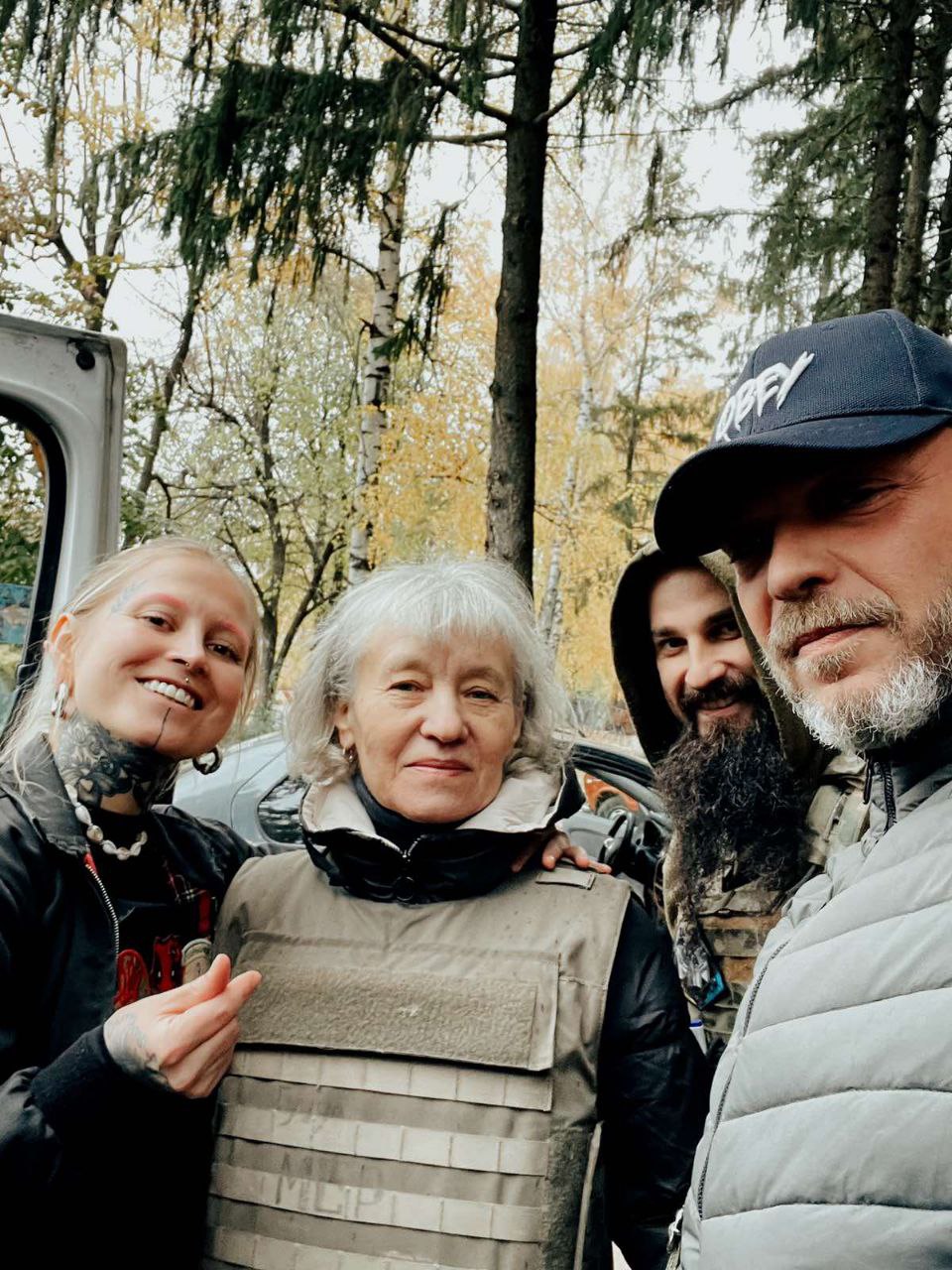
"My mother was told that I was an enemy of the people" - the story of the head of Dvorichanska community, who spent almost three months in captivity
Source: Ukrainska Pravda
Author: Dmytro Kuzubov
The story of Galina Turbaba, who in 2020 became head of the Dvorichansk Village Council in Kharkiv Oblast as a member of the Opposition Platform—For Life party, was kidnapped twice by the occupiers during the Russian invasion, and after the partial de-occupation of the region, she became the head of the town’s military administration.
In 2020, Galina Turbaba became the head of the Dvorichansk Village Council in the Kharkiv region as a member of the Opposition Platform—For Life party.
Shortly after the start of the full-scale invasion, her community, which borders Russia, found itself under occupation. Galina Grigorivna refused to cooperate with the invaders. They then abducted her, interrogated her, and held her in a detention center for over a month to force her to switch sides. However, she refused. She was released, but was soon abducted a second time. And held captive even longer.
During the Kharkiv counteroffensive in September 2022, the Ukrainian Armed Forces liberated about 40% of the Dvorichanskyi district; the rest, on the other side of the Oskil River, remains under occupation. Oleg Synyegubov, head of the Kharkiv Regional State Administration, calls Turbaba “a true patriot of our country”; in October, President Volodymyr Zelenskyy appointed her head of the newly formed Dvorichanska Settlement Military Administration.
Since the de-occupation, the Russians have been intensively shelling the liberated part of the Dvorichansk district, killing local residents and volunteers. And in the community’s center, the village of Dvorichna, only 60 of the 14,000 residents remain.
"Ukrainska Pravda" spoke with Halyna Turbaba about her life under occupation and in captivity, her former colleagues who collaborated with the occupiers, her efforts to help locals after liberation, Russia’s "scorched earth" tactics, and the evolution of her attitude toward the Russian Federation.
"It was just a way to get into office; under the law, self-nomination wasn’t allowed—you could only become a candidate for mayor through nomination by a party organization," – says Galina Turbaba about her political past, which is linked to the now-banned OPZZh party.
She was born in 1959 in Dvorichna and has lived there almost her entire life. She graduated from a local school and the Kyiv Institute of Foreign Languages, majoring in foreign language teaching. After returning from Kyiv, she taught English and some Spanish at her alma mater.
In 1984, she became head of the district Komsomol committee. During Perestroika, she returned to teaching. After independence, she was elected as a deputy to the Dvorichanska District Council representing the “Party of Regions” and the Opposition Platform—For Life. Eventually, she became head of the district council.
In 2020, Turbaba became head of the Dvorichanska settlement community in the Kupianskyi district of Kharkiv Oblast—she received 38% of the vote. She has always been an independent, but she ran for local office on the ticket of pro-Russian parties. Today, she regrets that decision.
“Our region supported this particular political force (OPZZh – UP) the most. I wasn’t acquainted with the party’s leaders; we didn’t even have a district branch of this party—I was nominated by the regional organization,” she explains.
I didn’t have any particular preference for this party. OPZZh MP Dmytro Shentsev (who voted for the “dictatorial laws” on January 16, 2014; On September 22, 2022, the Verkhovna Rada approved the early termination of the MP’s powers following his corresponding statement – UP) helped our community a lot. Perhaps it was him I sympathized with, which is why I ran as a candidate for this party."
"From today’s perspective and in light of current events, yes," the community leader replies when asked if she regrets running as a candidate for the Opposition Platform—For Life. “Of course, if I had known, I wouldn’t have associated myself with this political force.”
The Dvorichany region is home to a picturesque national nature park with chalk mountains, as well as plants and animals listed in the Red Book. With Turbaba’s election as village head, the community began developing green tourism, reviving Ukrainian traditions, and restoring the legacy associated with Nobel laureate Ilya Mechnikov, who was born in this region.
Previously, Galina Turbaba, like most residents of the Dvorichany region, had no negative feelings toward Russians. This was also facilitated by the community’s geographical location, which borders the Belgorod Oblast of the Russian Federation—many locals had relatives and friends on the other side of the border and kept in touch with them. The community leader did not expect a large-scale Russian attack.
“There was no hostility toward Russians. To be honest, I secretly believed that we were brotherly nations,” she admits. “Back then, there were many intermarriages, cultural ties, exchanges of sports delegations, and agricultural producers helped one another.
When, in the early hours of February 24, village heads from the border villages started calling and saying there were explosions and shelling, I didn’t believe them.”
At first, the occupiers passed through the community and moved on, but they returned a week later. They settled in the district cultural center and the police station, set up checkpoints, and positioned military equipment between residential buildings.
The head of the Dvorichanshchyna community says these were groups of the so-called “L/DNR.” There were no Russian regular units in the community during her stay. Meanwhile, the village council continued to operate.
“From the very first days of the occupation, we tried to maintain the community’s essential services so that life would be a little easier for people under occupation,” says Halyna Turbaba. “We had doctors working here, and a local center that served single pensioners and people with disabilities. Banks were initially open; as long as there was cash, people could withdraw funds.”
In their usual manner, the occupiers began repressing civilians in the occupied territory—they kidnapped people (the community still doesn’t know the fate of some of them), seized cars from locals, and searched for former military personnel. The invaders also began to exert psychological pressure on the head and staff of the village council, conducting searches in the administrative building under false pretenses.
“Soldiers with automatic weapons came to us, accusing us of causing people to suffer, of not having humanitarian aid, and of not allowing it to be brought into the community,” recalls Galina Grigorivna.
“Apparently, they had a plan—to incite people against us. They organized a gathering in the square, called me over, and said, ‘People are unhappy with you; they want to stage a coup.’
They spread rumors that I had handed over my duties. People started coming, asking who our leader was. I said, “As long as the Dvorichansk Village Council is functioning, I am the village head of Dvorichansk in Kharkiv Oblast. I am working and will not hand over my duties to anyone.”
On May 11, the occupiers conducted another search of Galina Turbaba’s office. Then they took her from her workplace and drove her to an unknown destination.
"I asked, 'Where are you taking me? What should I tell my family and staff?' They replied, 'We’ll talk and bring you back,'" she recalls.
They took me away blindfolded; I didn’t know where. As it turned out later, they took me to the Kupiansk District Police Department, to a temporary detention cell. They made me sit with my back to the wall and interrogated me until nightfall. They said, “We have questions for you; you’re staying here,” and took me to a cell.
Later, they interrogated me about cooperation with law enforcement agencies, my attitude toward Russia, and May 9. They said: “People are already working, and you’re on the sidelines. Doesn’t it bother you that, with your experience,
you’re not working?” Presumably, in their “agencies.”
They called me a “nationalist” and a “Banderite.” Probably because I said I work for a Ukrainian government agency and that the Kharkiv region is Ukraine."
The village head was released from captivity on June 13, after spending 33 days there. As they released her, the occupiers began asking what she would do next and whether she would coordinate her actions with anyone.
“I said, ‘If I have the chance, I’ll work in my position; if not, I’ll work in the garden,’” she recounts. “When they took me away, there weren’t any of their ‘authorities’ in place yet. But by the time they released me, they’d already found a replacement for me, which is probably why they let me go.”
After her release from captivity, Turbabi struggled both physically and mentally. She had lost a lot of weight, suffered from insomnia, and felt unwell.
“My mom didn’t know where I was; they didn’t tell her the truth. And my family didn’t know anything about me for the first two weeks; they would come, and they’d be told, ‘There’s no one like that here.’ And when I returned and they told me all this, it was very hard emotionally," says Galina Grigorivna.
By the end of June, the occupiers had set up a fake "government body"—the "Dvorichansk Territorial Administration." About a third of the staff of the Dvorichanske Village Council’s executive office and the village heads began collaborating with the occupiers.
“Two days after I was released, I went to work, but they told me, ‘You’re not allowed in the building.’ I haven’t worked since then,” recalls Turbaba.
They started handing out 10,000 Russian rubles to people in our area, which they called ‘aid.’ Some village council employees were already collaborating with them. And that’s a real shame; it’s hard to be disappointed in people who were close to you.
I don’t know what their motives were. They said they were intimidated by my example—that if they didn’t cooperate, the same thing would happen to them as happened to me.” Almost all local police officers and unemployed marginalized individuals also chose to collaborate with the occupiers, emphasizes the head of the Dvorichanska Community Council.
"Our police disappeared from the community’s territory from the very first days of the occupation—there was no law enforcement to turn to," she says. "And when they began forming their own ‘authorities,’ it turned out that almost the entire police force had agreed to cooperate.
In some settlements, ‘pseudo-activists’ began collaborating with the occupiers. These are unemployed people who wanted either quick money or a career and positions. People supposedly didn’t notice them, didn’t vote for them in elections, but then it turned out that their “moment in the spotlight” had come and they could “take the helm.”
Despite the ongoing occupation, Galina Turbaba decided to stay in her hometown of Dvorichna.
“There was fighting going on; it was impossible to get to Kharkiv, there was no crossing over the Pechenigi River at the time, and I couldn’t bring myself to leave via Russia. Besides, my mom is 87 years old; I couldn’t leave her behind either,” she explains.
“I met with people and told them that we receive funds from Ukraine—both pensions and aid: ‘Yes, we don’t have real cash, but it’s on our cards. Ukraine hasn’t abandoned us, and no one has incorporated us into the Russian Federation yet.”
The head of the Dvorichanshchyna district suspects that these conversations eventually reached the occupiers. On July 21, her home was searched, and she was taken away again. They took her to the now-familiar cell at the Kupiansk District Police Station.
“They told my mom, ‘She’s an enemy of the people.’ And again, they kept me in a two-person cell,” Galina Grigorivna recounts. “But there were 6–8 women there. And on some days, they crammed 10–12 of us in because, as it turned out later, there was only one women’s cell. It was a mixed crowd. There were school principals who refused to cooperate, and local female farmers. But there were also drug addicts and alcoholics.
We slept on the floor, lying in rows. In the middle of the night, they would wake us up for a security check, take roll call, or call us out of the cell. They didn’t use physical force on me personally, although the girls said they were tortured with electricity. And we heard that they were beating the men, and those screams also took a psychological toll.”
This time, Galina Turbaba spent 50 days in captivity. She was released during the Kharkiv counteroffensive on September 8, along with 130–150 other prisoners. The occupiers left them in locked cells and fled.
“At night, the guys broke a window in one of the cells, removed the bars, found the keys, and opened all the cells; we walked out into a smoke-filled room,” she recalls. “We got out, but we were afraid to go home because we thought they would come after us. But they weren’t concerned with us anymore; they were fleeing.”
On September 9, the occupiers left Dvorichna and fled to the other bank, blowing up the bridge across the Oskil River behind them. On September 11, the Ukrainian Armed Forces entered the Dvorichna region, liberating 40% of its territory.
"Of course, we were happy to be liberated—we’d been waiting for this, hoping for it," recalls Halyna Turbaba. "And once again, the question of whether to stay or leave didn’t even cross my mind. I am the village head; the people elected me so that I would be there for them.”
However, the joy of liberation was soon overshadowed by a sense of constant danger. Starting in mid-September, the occupiers began shelling the liberated part of the community, and the shelling became increasingly frequent.
“(The occupiers were shelling) residential areas, private homes, and apartment buildings,” says the head of the Dvorichanska Territorial Community. “That’s the difference: our forces didn’t fire on residential areas, but they just pick a block, work it over, and move on to the next one. I don’t know why they’re doing this. Just to destroy everything so no one gets anything.”
Due to the shelling of Dvorichna, shops and the market were damaged and ceased operations, so the head of the council, together with concerned citizens, organized bread baking for the locals. In coordination with the district and regional administrations and volunteers, they began distributing humanitarian aid.
“Local residents started helping us with the humanitarian aid,” Turbaba emphasizes. “They received and unloaded it, then our vehicles delivered it under shelling. We held out like this until February 23, when a shell hit the administrative building."
At the same time, the community began collecting evacuation requests and transporting people out of the shelling zone. However, the village head says that community residents often refuse to leave. After New Year’s, a mandatory evacuation was declared in the Dvorichany district. But even after that, some locals wrote statements saying they refused to leave.
“If you take me along with my cow, then I’ll go”—we’ve even had cases like that,” recalls the community leader, adding with emotion: “There are many wounded, and there are casualties among the local residents. I never thought I’d be working on a “funeral team.”
You bring them to the cemetery, where there’s no one at all; no one is there to see them off on their final journey. A coffin stands by the dug grave, but at that moment there’s gunfire, and we can’t lower it into the hole and say goodbye.”
Some residents of Dvorichanshchyna have left for Europe, others for Russia. Some don’t want to return to Ukraine; others can’t.
"Many left [for Russia] after the occupation began," says Turbaba. "People who remained on that side [of the Oskol River] when the bridges were blown up simply had no way to cross over to the Ukrainian side. Some later returned to Ukraine via Europe, while others stayed there [in Russia].”
Before the full-scale war began, approximately 14,000 people lived in the Dvorichany region. Currently, about 1,100 people live in the 28 de-occupied settlements (27 others remain under occupation).
In Dvorichna itself, which had a population of 3,500, no more than 60 people remain. People are forced to live in basements. Turbaba says the village is being wiped off the face of the earth.
“Dvorichna is gone; it’s been destroyed,” she sighs. “It’s impossible to clear the mines right now; we don’t know what’s in our gardens and on our properties.
We don’t know if it’s safe to go out into the fields now; even in the de-occupied part, we haven’t been able to do our spring fieldwork.
Nature has also suffered—both the forests and those very chalk hills. There are areas where the trees have been cut down as if by a scythe."
Galina Turbaba hopes that the entire Dvorichansk region will be liberated from the occupiers as soon as possible and that people will return home. She is convinced that Ukraine will prevail and restore its 1991 borders, and that her home community will be rebuilt.
Turbaba still has many acquaintances in Russia. Some, she says, believe the local propaganda, while others are gradually changing their minds. But the general attitude toward Russians in the Dvorichanshchyna region is now radically different from what it was before February 24:
“I wouldn’t want them to accept this regime. I wish they weren’t invaders and occupiers. But the Russia of the past, after they’ve shown their true colors, will never return; everyone’s attitude toward Russians will change. I can no longer call them brothers.”
Author: Dmytro Kuzubov
The story of Galina Turbaba, who in 2020 became head of the Dvorichansk Village Council in Kharkiv Oblast as a member of the Opposition Platform—For Life party, was kidnapped twice by the occupiers during the Russian invasion, and after the partial de-occupation of the region, she became the head of the town’s military administration.
In 2020, Galina Turbaba became the head of the Dvorichansk Village Council in the Kharkiv region as a member of the Opposition Platform—For Life party.
Shortly after the start of the full-scale invasion, her community, which borders Russia, found itself under occupation. Galina Grigorivna refused to cooperate with the invaders. They then abducted her, interrogated her, and held her in a detention center for over a month to force her to switch sides. However, she refused. She was released, but was soon abducted a second time. And held captive even longer.
During the Kharkiv counteroffensive in September 2022, the Ukrainian Armed Forces liberated about 40% of the Dvorichanskyi district; the rest, on the other side of the Oskil River, remains under occupation. Oleg Synyegubov, head of the Kharkiv Regional State Administration, calls Turbaba “a true patriot of our country”; in October, President Volodymyr Zelenskyy appointed her head of the newly formed Dvorichanska Settlement Military Administration.
Since the de-occupation, the Russians have been intensively shelling the liberated part of the Dvorichansk district, killing local residents and volunteers. And in the community’s center, the village of Dvorichna, only 60 of the 14,000 residents remain.
"Ukrainska Pravda" spoke with Halyna Turbaba about her life under occupation and in captivity, her former colleagues who collaborated with the occupiers, her efforts to help locals after liberation, Russia’s "scorched earth" tactics, and the evolution of her attitude toward the Russian Federation.
"I regret running as a candidate for the Opposition Platform—For Life party"
"It was just a way to get into office; under the law, self-nomination wasn’t allowed—you could only become a candidate for mayor through nomination by a party organization," – says Galina Turbaba about her political past, which is linked to the now-banned OPZZh party.
She was born in 1959 in Dvorichna and has lived there almost her entire life. She graduated from a local school and the Kyiv Institute of Foreign Languages, majoring in foreign language teaching. After returning from Kyiv, she taught English and some Spanish at her alma mater.
In 1984, she became head of the district Komsomol committee. During Perestroika, she returned to teaching. After independence, she was elected as a deputy to the Dvorichanska District Council representing the “Party of Regions” and the Opposition Platform—For Life. Eventually, she became head of the district council.
In 2020, Turbaba became head of the Dvorichanska settlement community in the Kupianskyi district of Kharkiv Oblast—she received 38% of the vote. She has always been an independent, but she ran for local office on the ticket of pro-Russian parties. Today, she regrets that decision.
“Our region supported this particular political force (OPZZh – UP) the most. I wasn’t acquainted with the party’s leaders; we didn’t even have a district branch of this party—I was nominated by the regional organization,” she explains.
I didn’t have any particular preference for this party. OPZZh MP Dmytro Shentsev (who voted for the “dictatorial laws” on January 16, 2014; On September 22, 2022, the Verkhovna Rada approved the early termination of the MP’s powers following his corresponding statement – UP) helped our community a lot. Perhaps it was him I sympathized with, which is why I ran as a candidate for this party."
"From today’s perspective and in light of current events, yes," the community leader replies when asked if she regrets running as a candidate for the Opposition Platform—For Life. “Of course, if I had known, I wouldn’t have associated myself with this political force.”
The Dvorichany region is home to a picturesque national nature park with chalk mountains, as well as plants and animals listed in the Red Book. With Turbaba’s election as village head, the community began developing green tourism, reviving Ukrainian traditions, and restoring the legacy associated with Nobel laureate Ilya Mechnikov, who was born in this region.
"People are unhappy with you; they want to stage a coup"
Previously, Galina Turbaba, like most residents of the Dvorichany region, had no negative feelings toward Russians. This was also facilitated by the community’s geographical location, which borders the Belgorod Oblast of the Russian Federation—many locals had relatives and friends on the other side of the border and kept in touch with them. The community leader did not expect a large-scale Russian attack.
“There was no hostility toward Russians. To be honest, I secretly believed that we were brotherly nations,” she admits. “Back then, there were many intermarriages, cultural ties, exchanges of sports delegations, and agricultural producers helped one another.
When, in the early hours of February 24, village heads from the border villages started calling and saying there were explosions and shelling, I didn’t believe them.”
At first, the occupiers passed through the community and moved on, but they returned a week later. They settled in the district cultural center and the police station, set up checkpoints, and positioned military equipment between residential buildings.
The head of the Dvorichanshchyna community says these were groups of the so-called “L/DNR.” There were no Russian regular units in the community during her stay. Meanwhile, the village council continued to operate.
“From the very first days of the occupation, we tried to maintain the community’s essential services so that life would be a little easier for people under occupation,” says Halyna Turbaba. “We had doctors working here, and a local center that served single pensioners and people with disabilities. Banks were initially open; as long as there was cash, people could withdraw funds.”
In their usual manner, the occupiers began repressing civilians in the occupied territory—they kidnapped people (the community still doesn’t know the fate of some of them), seized cars from locals, and searched for former military personnel. The invaders also began to exert psychological pressure on the head and staff of the village council, conducting searches in the administrative building under false pretenses.
“Soldiers with automatic weapons came to us, accusing us of causing people to suffer, of not having humanitarian aid, and of not allowing it to be brought into the community,” recalls Galina Grigorivna.
“Apparently, they had a plan—to incite people against us. They organized a gathering in the square, called me over, and said, ‘People are unhappy with you; they want to stage a coup.’
They spread rumors that I had handed over my duties. People started coming, asking who our leader was. I said, “As long as the Dvorichansk Village Council is functioning, I am the village head of Dvorichansk in Kharkiv Oblast. I am working and will not hand over my duties to anyone.”
"They took me away blindfolded; I didn’t know where"
On May 11, the occupiers conducted another search of Galina Turbaba’s office. Then they took her from her workplace and drove her to an unknown destination.
"I asked, 'Where are you taking me? What should I tell my family and staff?' They replied, 'We’ll talk and bring you back,'" she recalls.
They took me away blindfolded; I didn’t know where. As it turned out later, they took me to the Kupiansk District Police Department, to a temporary detention cell. They made me sit with my back to the wall and interrogated me until nightfall. They said, “We have questions for you; you’re staying here,” and took me to a cell.
Later, they interrogated me about cooperation with law enforcement agencies, my attitude toward Russia, and May 9. They said: “People are already working, and you’re on the sidelines. Doesn’t it bother you that, with your experience,
you’re not working?” Presumably, in their “agencies.”
They called me a “nationalist” and a “Banderite.” Probably because I said I work for a Ukrainian government agency and that the Kharkiv region is Ukraine."
The village head was released from captivity on June 13, after spending 33 days there. As they released her, the occupiers began asking what she would do next and whether she would coordinate her actions with anyone.
“I said, ‘If I have the chance, I’ll work in my position; if not, I’ll work in the garden,’” she recounts. “When they took me away, there weren’t any of their ‘authorities’ in place yet. But by the time they released me, they’d already found a replacement for me, which is probably why they let me go.”
After her release from captivity, Turbabi struggled both physically and mentally. She had lost a lot of weight, suffered from insomnia, and felt unwell.
“My mom didn’t know where I was; they didn’t tell her the truth. And my family didn’t know anything about me for the first two weeks; they would come, and they’d be told, ‘There’s no one like that here.’ And when I returned and they told me all this, it was very hard emotionally," says Galina Grigorivna.
By the end of June, the occupiers had set up a fake "government body"—the "Dvorichansk Territorial Administration." About a third of the staff of the Dvorichanske Village Council’s executive office and the village heads began collaborating with the occupiers.
“Two days after I was released, I went to work, but they told me, ‘You’re not allowed in the building.’ I haven’t worked since then,” recalls Turbaba.
They started handing out 10,000 Russian rubles to people in our area, which they called ‘aid.’ Some village council employees were already collaborating with them. And that’s a real shame; it’s hard to be disappointed in people who were close to you.
I don’t know what their motives were. They said they were intimidated by my example—that if they didn’t cooperate, the same thing would happen to them as happened to me.” Almost all local police officers and unemployed marginalized individuals also chose to collaborate with the occupiers, emphasizes the head of the Dvorichanska Community Council.
"Our police disappeared from the community’s territory from the very first days of the occupation—there was no law enforcement to turn to," she says. "And when they began forming their own ‘authorities,’ it turned out that almost the entire police force had agreed to cooperate.
In some settlements, ‘pseudo-activists’ began collaborating with the occupiers. These are unemployed people who wanted either quick money or a career and positions. People supposedly didn’t notice them, didn’t vote for them in elections, but then it turned out that their “moment in the spotlight” had come and they could “take the helm.”
"Ukraine hasn’t abandoned us"
Despite the ongoing occupation, Galina Turbaba decided to stay in her hometown of Dvorichna.
“There was fighting going on; it was impossible to get to Kharkiv, there was no crossing over the Pechenigi River at the time, and I couldn’t bring myself to leave via Russia. Besides, my mom is 87 years old; I couldn’t leave her behind either,” she explains.
“I met with people and told them that we receive funds from Ukraine—both pensions and aid: ‘Yes, we don’t have real cash, but it’s on our cards. Ukraine hasn’t abandoned us, and no one has incorporated us into the Russian Federation yet.”
The head of the Dvorichanshchyna district suspects that these conversations eventually reached the occupiers. On July 21, her home was searched, and she was taken away again. They took her to the now-familiar cell at the Kupiansk District Police Station.
“They told my mom, ‘She’s an enemy of the people.’ And again, they kept me in a two-person cell,” Galina Grigorivna recounts. “But there were 6–8 women there. And on some days, they crammed 10–12 of us in because, as it turned out later, there was only one women’s cell. It was a mixed crowd. There were school principals who refused to cooperate, and local female farmers. But there were also drug addicts and alcoholics.
We slept on the floor, lying in rows. In the middle of the night, they would wake us up for a security check, take roll call, or call us out of the cell. They didn’t use physical force on me personally, although the girls said they were tortured with electricity. And we heard that they were beating the men, and those screams also took a psychological toll.”
This time, Galina Turbaba spent 50 days in captivity. She was released during the Kharkiv counteroffensive on September 8, along with 130–150 other prisoners. The occupiers left them in locked cells and fled.
“At night, the guys broke a window in one of the cells, removed the bars, found the keys, and opened all the cells; we walked out into a smoke-filled room,” she recalls. “We got out, but we were afraid to go home because we thought they would come after us. But they weren’t concerned with us anymore; they were fleeing.”
"A coffin stands by the freshly dug grave, and they’re shooting right now"
On September 9, the occupiers left Dvorichna and fled to the other bank, blowing up the bridge across the Oskil River behind them. On September 11, the Ukrainian Armed Forces entered the Dvorichna region, liberating 40% of its territory.
"Of course, we were happy to be liberated—we’d been waiting for this, hoping for it," recalls Halyna Turbaba. "And once again, the question of whether to stay or leave didn’t even cross my mind. I am the village head; the people elected me so that I would be there for them.”
However, the joy of liberation was soon overshadowed by a sense of constant danger. Starting in mid-September, the occupiers began shelling the liberated part of the community, and the shelling became increasingly frequent.
“(The occupiers were shelling) residential areas, private homes, and apartment buildings,” says the head of the Dvorichanska Territorial Community. “That’s the difference: our forces didn’t fire on residential areas, but they just pick a block, work it over, and move on to the next one. I don’t know why they’re doing this. Just to destroy everything so no one gets anything.”
Due to the shelling of Dvorichna, shops and the market were damaged and ceased operations, so the head of the council, together with concerned citizens, organized bread baking for the locals. In coordination with the district and regional administrations and volunteers, they began distributing humanitarian aid.
“Local residents started helping us with the humanitarian aid,” Turbaba emphasizes. “They received and unloaded it, then our vehicles delivered it under shelling. We held out like this until February 23, when a shell hit the administrative building."
At the same time, the community began collecting evacuation requests and transporting people out of the shelling zone. However, the village head says that community residents often refuse to leave. After New Year’s, a mandatory evacuation was declared in the Dvorichany district. But even after that, some locals wrote statements saying they refused to leave.
“If you take me along with my cow, then I’ll go”—we’ve even had cases like that,” recalls the community leader, adding with emotion: “There are many wounded, and there are casualties among the local residents. I never thought I’d be working on a “funeral team.”
You bring them to the cemetery, where there’s no one at all; no one is there to see them off on their final journey. A coffin stands by the dug grave, but at that moment there’s gunfire, and we can’t lower it into the hole and say goodbye.”
Some residents of Dvorichanshchyna have left for Europe, others for Russia. Some don’t want to return to Ukraine; others can’t.
"Many left [for Russia] after the occupation began," says Turbaba. "People who remained on that side [of the Oskol River] when the bridges were blown up simply had no way to cross over to the Ukrainian side. Some later returned to Ukraine via Europe, while others stayed there [in Russia].”
Before the full-scale war began, approximately 14,000 people lived in the Dvorichany region. Currently, about 1,100 people live in the 28 de-occupied settlements (27 others remain under occupation).
In Dvorichna itself, which had a population of 3,500, no more than 60 people remain. People are forced to live in basements. Turbaba says the village is being wiped off the face of the earth.
“Dvorichna is gone; it’s been destroyed,” she sighs. “It’s impossible to clear the mines right now; we don’t know what’s in our gardens and on our properties.
We don’t know if it’s safe to go out into the fields now; even in the de-occupied part, we haven’t been able to do our spring fieldwork.
Nature has also suffered—both the forests and those very chalk hills. There are areas where the trees have been cut down as if by a scythe."
***
Galina Turbaba hopes that the entire Dvorichansk region will be liberated from the occupiers as soon as possible and that people will return home. She is convinced that Ukraine will prevail and restore its 1991 borders, and that her home community will be rebuilt.
Turbaba still has many acquaintances in Russia. Some, she says, believe the local propaganda, while others are gradually changing their minds. But the general attitude toward Russians in the Dvorichanshchyna region is now radically different from what it was before February 24:
“I wouldn’t want them to accept this regime. I wish they weren’t invaders and occupiers. But the Russia of the past, after they’ve shown their true colors, will never return; everyone’s attitude toward Russians will change. I can no longer call them brothers.”
This is an automatic translation generated by DeepL.