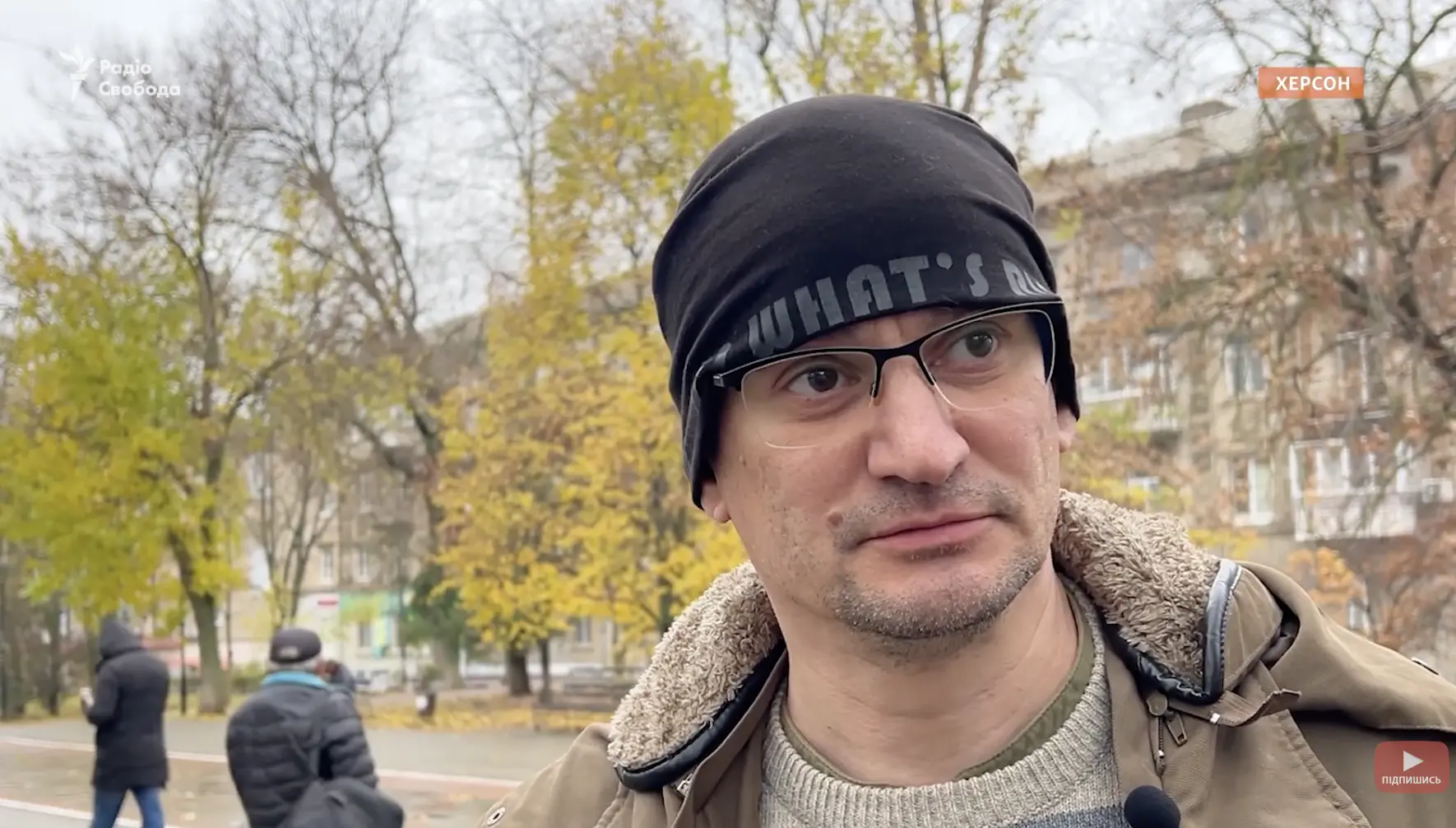
"They put me in front of a pit with corpses". Kherson man's story about a week in Russian captivity
Source: Radio Free Europe/Radio
Liberty Ihor Bondarenko, a former journalist from Kherson, spent nearly a week in Russian captivity after attempting to flee the occupied territory via Crimea. He told Radio Free Europe’s “News of the Azov Region” project about how the war came to his hometown, his interrogations by the Russian FSB, and five days of starvation.
For English subtitles, please enable captions in the video settings and select Auto-translate → English.
Liberty Ihor Bondarenko, a former journalist from Kherson, spent nearly a week in Russian captivity after attempting to flee the occupied territory via Crimea. He told Radio Free Europe’s “News of the Azov Region” project about how the war came to his hometown, his interrogations by the Russian FSB, and five days of starvation.
For English subtitles, please enable captions in the video settings and select Auto-translate → English.
“We hoped they would leave”
“Around 7 a.m., my older sister called me; she lived in Mariupol. She said, ‘Igor, everything’s fine, we’re alive, everything’s normal, don’t worry, we’re hiding in a bomb shelter.’ And I was like—what exactly? It’s 7 a.m., I’d just woken up—what bomb shelter? And that’s when we found out that the war had begun.
According to him, the residents of Kherson were in a state of shock immediately after the invasion. Bondarenko also reported that fighting was already taking place on the outskirts of the city.
There was no street fighting, but on the outskirts, at the entrance to Kherson, there was very heavy fighting
– There were none in the city itself, but there was very heavy fighting on the Antonivsky Bridge and on the left bank. So when people say, “Kherson was surrendered without a fight,” I’ll say that’s not true. There was no street fighting, but on the outskirts, on the approach to Kherson, there was very heavy fighting. And that bridge—it took the occupiers two days to cross it. Our entire city was in a state of shock. Some had already left for Mykolaiv or Kryvyi Rih, while others stayed behind. No one really understood yet what had happened.
The occupiers entered the city in early March. Bondarenko recalled how the people of Kherson held rallies against the invaders.
It wasn’t just some soldiers who came to us; murderers and looters came to
us. “At first, we really hoped they would leave or maybe realize that the war was all a farce; to us, it seemed unreal. But then, after people started disappearing and they grew bolder—dispersing protesters with batons and flash-bang grenades, firing into the air—we realized they weren’t joking. It wasn’t just some soldiers who came to us; murderers and looters came to us.
Bondarenko said that many Kherson residents had left, and the city “had changed and was devastated.”
“It’s three o’clock in the afternoon in the summer—empty, no one around. You walk down Ushakov Avenue, and there are maybe 3 or 4 people on the entire avenue. And that’s why, even on November 11, not everyone knew the city had been liberated. Because there was no internet, no communication.
“You’ll end up in a basement in Crimea”
Immediately after the occupation, my husband realized they would be looking for him.– Because I was a journalist; I worked at our radio station “Sofia,” which later became “Kherson FM.” I collaborated on the information front with some people who were connected to patriotic organizations. For example, I had a very close relationship with the leader of the “Right Sector,” Natalia Voteichkina; she’s my childhood friend.
However, the occupiers didn’t come for the former journalist at his home, but detained him when he tried to leave Kherson.
– That was on August 10. When I arrived at Kalanchak—the checkpoint (near the administrative border with occupied Crimea—ed.)—I handed over my documents, passed through “customs” (Russian—ed.), and then they let us through to these FSB agents sitting in white booths. They called me over, took my phone and tablet, an FSB agent came out, brought a stack of A4 papers listing all the contacts I had deleted over the past six months.
– The first thing he asked me was: “Who is Natalia Votichkina?” Then the interrogation began. They started showing me photos from some Ukrainian online publications, and I was so surprised because all that information was from 2014–2015.
That same day, they locked me in a white, iron-reinforced container. No water, no toilet—there was nothing
. Representatives of the Russian special services were particularly interested in the contacts they found on Bondarenko.
– I immediately started spinning a cover story that I had been a journalist until 2016 and was working in Poland; I showed them documents from a Polish company and my foreign passports. Look, here are my visas: three months there, one month at home, four months there, one month at home. But they told me, “No, kid, you’re going to Crimea, to the basement.” That same day, they locked me in a white, iron-reinforced container. No water, no toilet—there was nothing.
“A fist between the shoulder blades”
However, the man from Kherson says they never actually took him to Crimea.– A white van with a Z on it pulled up; three guys got out with automatic weapons, wearing body armor and balaclavas; one of them had captain’s epaulets. They put plastic ties on me, threw some kind of red jacket over my head, wrapped it with duct tape, threw all my stuff—even my cat in its carrier—into the bus, and drove off.
In front of me was a pit, about 2 meters wide and maybe 3–4 meters long; there were men’s bodies lying
there – Then, when they took the rag off my head, I saw that there was a steppe all around; I immediately realized that this was the Kherson region, not Crimea at all. And in front of me was a pit, about 2 meters wide, maybe 3–4 meters long; there lay the bodies of men. Maybe there were eight men, covered with dirt; you could see their legs, arms, and I even made out the face of one of them. I didn’t know if they were their soldiers or ours; it even seemed to me that there was one civilian. They asked me, “Do you want to join them?” I said, “No.” And at that very moment, a single shot rang out, and a bullet hit me between the shoulder blades; I fell to my knees. They picked me up, put the red cloth back on my head, wrapped my head in duct tape, laughed, put me in that van, and drove off.
The man spent several days on the tile floor with his head wrapped and without food.
– There was a mat like the ones you put under your feet, and on that mat on the cold floor I spent about three days, or maybe even five days, with my head wrapped; I couldn’t see a thing. They told me that if I took this T-shirt off my head, they’d kill me right away; if I caused trouble, the guard would shoot me. Well, I behaved quite politely and calmly.
On the fifth day, they brought me rice, cooked until it was as thick as glue.
They started feeding me five days later, after they’d taken the rag off my head. They gave me water every day—it was hot—a 0.5-liter bottle. There was a plastic bottle for me to use as a toilet. I asked, “What if I need to go to the bathroom?” They told me to just go where I was. On the fifth day, they brought me rice cooked to a paste-like consistency, and there was probably some spoiled canned food from their rations that tasted like metal. That’s what they fed me. Sometimes once a day, sometimes twice a day—it varied.
“Five Days of Tension”
The occupiers offered my husband a deal and ordered him to create a Telegram channel to broadcast information from the occupiers. Bondarenko also recalled what he was told during interrogations and conversations while in captivity.Another person came to me; she was a bit nervous, communicated with me using her feet, and shocked me a
couple of times – At night, another person came to me; he was a bit nervous, spoke to me using his feet, and shocked me a couple of times. Sometimes he’d play around, turning it on right next to my ear, and then there’d be an electronic squeal. And he told me a story that “you ‘Ukrop,’ ‘fascists,’ need to be cut up, killed.” He said that he “had been captured by the ‘Right Sector,’ that they had supposedly cut him to pieces there, broken him apart, but the doctors in Donbas somehow put him back together, stitched him up.” He talked about how much he hates all of us.
Once he got his hands on a phone, the man managed to figure out his location and send his family a message with his geolocation.
“I saw that I was in the city of Skadovsk near the dolphinarium.” I took a screenshot of that and sent it to my sister. By the 16th, I already knew they were looking for me because I went to news sites and saw that there was already a criminal case open regarding my disappearance. So the authorities already knew, and my sister and my wife had already kicked up quite a fuss. They reached out to journalists.
The man noted that his time in captivity was very difficult and stressful for him.
“For five days of my life, when I was chained up, lying in that little hut, my brain had never worked like that in my entire life—you know, like a computer. I’d fall asleep, wake up, and recall what I’d told them, whose names I’d mentioned—these were people I knew for certain had already left and weren’t under occupation.
Before releasing the man from Kherson, the Russians recorded a video in which he supposedly agreed to cooperate.
– They led me out with the Russian flag, and I recorded this statement: “I am so-and-so, and I agree to cooperate with the armed forces of the Russian Federation in the fight against bandits and terrorists.”
This is an automatic translation generated by DeepL.