"They don't consider you a human being". Stories of women who survived Russian captivity
Source: Ukrainska Pravda
Author: Anastasia Koropetska
At least 126 Ukrainian women are being held captive in Russia, according to data released by the Ministry for the Reintegration of the Temporarily Occupied Territories of Ukraine. Eighty of them are civilians, and 46 are military personnel.
The Geneva Convention does not regulate the detention of civilians. In other words, they should be released. However, the Russians are taking a significant number of Ukrainian civilians into captivity.
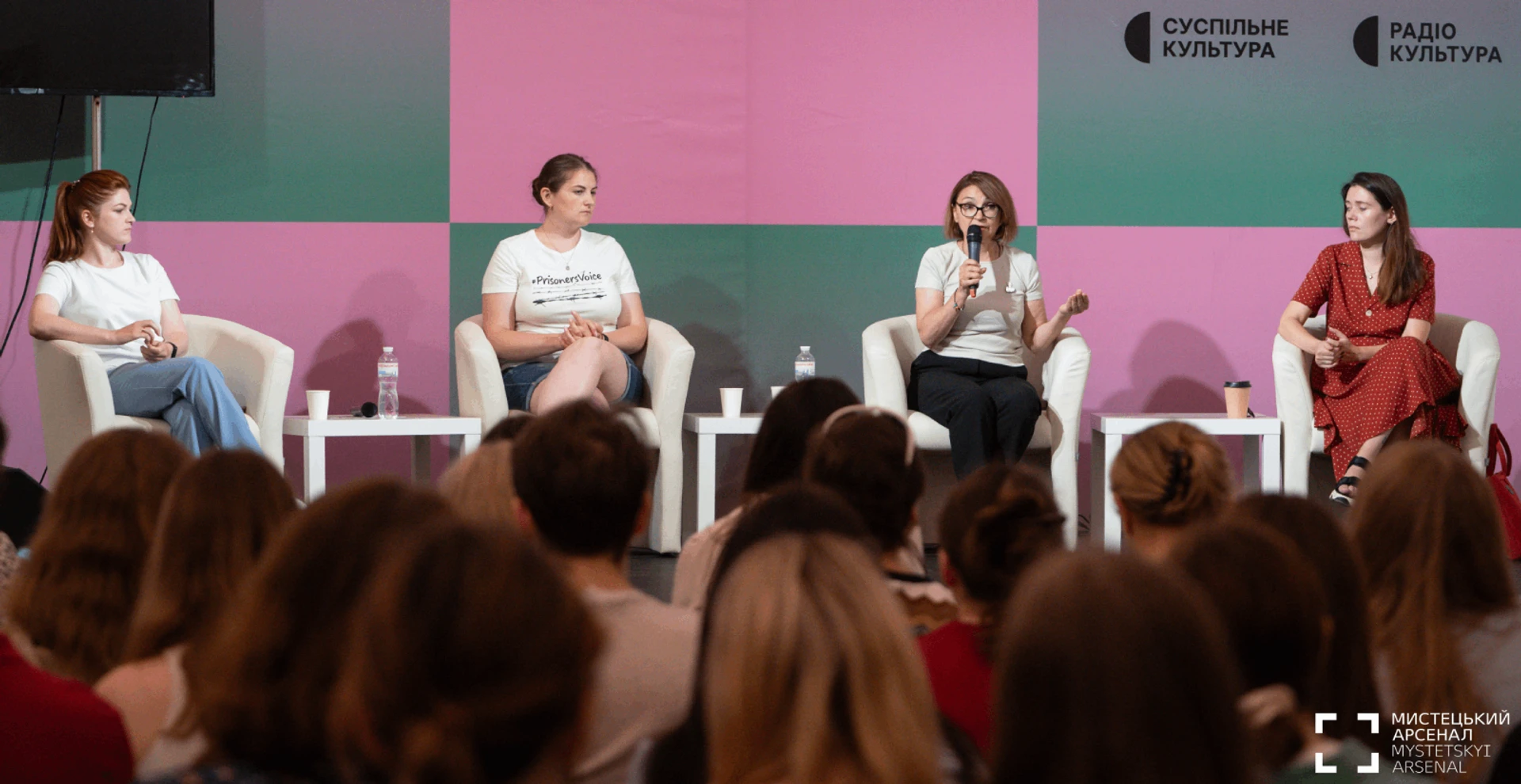
Lyudmyla Huseynova and Viktoria Andrush are civilian women who were held in Russian captivity. They, along with military medic Mariana Mamonova, spoke about their experiences in captivity during this year’s Book Arsenal.
“UP.Life” recorded their stories and is sharing the text versions of their accounts.
Lyudmila Huseynova
Human rights activist, held captive by the Russians from 2019 to 2022.
Lyudmila spent 50 days in the “Izolyatsia” prison in the temporarily occupied territory. Her story as a “civilian in captivity” began even before the full-scale invasion of the Donetsk region.
The woman helped orphaned children in occupied Novoazovsk and publicly expressed a pro-Ukrainian stance. She was arrested at work. According to the “case files,” her own acquaintances testified about her stance.
The following is her own account.
I was held at “Izolyatsia” for 50 days. Those were the most terrifying days of my life.
I testify that any woman who was in “Izolyatsia” was not merely tortured. She was raped. This is one of the most horrific forms of abuse against Ukrainian women, and they were held there for years.
Unfortunately, this doesn’t happen only to women, but I am speaking about what I experienced.
Forced undressing, forced examinations in front of men, and abuse of the genitals—all of this is sexual violence. Any forced sexual act or the use of another person’s sexuality without their consent is a crime.
After nearly two months in “Izolyatsia,” I was transferred to the Donetsk pretrial detention center and held there for about three years. I lived in a cell with criminal offenders, with women who had fought against Ukraine, convicted of murder, drug offenses, or other serious crimes.
When they took me out of “Izolyatsia,” they brought me to a cell measuring 20 square meters. In that cell, people lived their own lives: they slept, drank, and smoked around the clock. A hole in the floor served as their toilet. When I entered there for the first time, I couldn’t see anything because of the thick cigarette smoke. I stood by the door and didn’t know where to go.
The so-called “watchwoman” asked me what I was charged with and branded me: “Ukrainian.” And then it began. It was just constant pressure: you see those angry eyes, you’re afraid to turn your back because you don’t know what will happen. These people are in prison for brutal murders; several of them had AIDS, and a few more had tuberculosis. One woman had syphilis. I slept in the same bed with them and breathed the same air.
I lived in that hell for three years. Seven months before my release, they brought Olga Meleshchenko to our cell. My family allowed me to use her name. At this moment, she is being tortured in Russian captivity. I remember when they shoved Olya into this cell; she had a terrible fit of hysteria, curled up in a corner, and cried. And the guards were laughing at her.
Later, she explained that she had heard the most brutal murderers were held in this cell.
In 2021, Ukrainian prisoners of war were brought into the cell above us. Through the window, we saw them being led in with bags over their heads and their hands bound with duct tape. There, in the cell above us, they were tortured. They were forced to sing the Russian anthem and shout Russian slogans. But we had no way to help them.
We also had no access to medical care, no right to a defense, and no right to meet with our families, because no request to arrange such a meeting was ever accepted.
I regret that at that time, people didn’t speak out as loudly about women like us. Perhaps fewer of them would have gone through this experience today. I hope that when those territories and those women are liberated, they will have the strength to speak about it, and society will have empathy for such terrible stories.
I strongly ask everyone not to call people who have been held captive by Russia “victims.” We are not victims. We are survivors; we endured and persevered.
This gives us strength, the ability to move forward, grow, and help others. I have many friends here; a community organization has welcomed me, and I am inspired by the women who have emerged from captivity and have the strength to speak about it.
I want women who have endured torture, abuse, and physical and sexual violence to know: there is a way to move on.
Lyudmila Huseynova was released from captivity on October 17, 2022, along with 107 other women.
Viktoria Andrusha
A teacher, she was held captive by the Russians from March to September 2022.
25-year-old Viktoria from the Chernihiv region was taken captive by the Russians during the occupation of northern Ukraine following the start of the full-scale invasion.
On March 27, Russian soldiers took Viktoria from her home. She was subsequently taken to Russia and held in a detention center in Kursk.
The following is a direct quote.
They didn’t separate us (civilians—ed.) from our soldiers in captivity. They scrutinized the Ukrainian women from every angle; I was constantly made to stand against the wall. They always punished me for doing something not the way they wanted.
Conditions varied from one detention facility to another. At first, everyone treated us with the utmost cruelty. They openly stated that they didn’t consider me human: “Be glad that once a week they let you take a shower for three minutes.”
When we spoke Ukrainian, the guards would bang loudly on the cell door and force us to speak Russian. Ukrainian really annoyed them; they even threatened to do something to us if we didn’t stop, but it never came to that.
We had no hygiene products; we were given a bar of soap once a month and toilet paper once every two months. We didn’t get a change of clothes; they gave us a uniform once at the beginning.
Everyone wanted to pick on me while I was in captivity. They used physical violence, and then psychological abuse followed. With all of this, I began to lose myself as a person. But if there are decent people in the cell who can offer support, it’s easier to get through it.
We were held in the Kursk pretrial detention center for six months, then they began transporting us. We had thoughts that we would be released, but no one said so directly until the very end. On the contrary, the detention center staff said we were going to Siberia and the Taiga. But when they put us on a military bus and didn’t blindfold us, we realized we were going home.
After my captivity, I found myself in a situation where I didn’t want anyone to touch me. This is one of those phenomena that is common to many. However, a person who has survived captivity needs to be surrounded by loved ones who can support them.
You don’t need to pry into a person’s soul and ask questions. They will tell you everything themselves, if they want to. Let them breathe in freedom and get back into the rhythm of life.
Don’t try to arrange everything so that the person feels comfortable. They will ask for help themselves when they need it.
Mariana Mamonova
Medical professional, held captive from March to September 2022.
A military medic from the Rivne region was taken captive by the Russians during the fighting in Mariupol.
In Mariupol, Mariana found out she was pregnant. She carried her child to term while in captivity. Her relatives said there were days when she ate only two apples the entire day.
Here is her account.
I feared captivity more than anything else in my life.
I received almost no medical care, even though I was pregnant. It wasn’t until my seventh month that a doctor came to the prison where I was being held. I had such severe swelling that I couldn’t move, and I asked the girls to lift my legs for me.
The examination was conducted in the cell, and they said there was nothing wrong with me. But then the prison warden finally said, “She looks terrible—do something about her.” So they took me to a hospital in Donetsk.
In Donetsk, they performed an ultrasound, and that was the extent of the medical care I received. In my eighth month of pregnancy, on August 23, they took me to the hospital where I was supposed to give birth. I remember that day because I thought they were going to exchange me.
At the hospital, they treated me with caution because they thought I was a convicted criminal. But, as it turned out, it was better to be a convicted criminal than a “Ukrainian” and a Ukrainian soldier. At first, it was very difficult; my condition didn’t allow me to show my true self, because I had no other choice but to stay there.
But later, the hospital staff began to treat me better and even gave me more food. I remember I couldn’t get enough to eat because I thought they’d take it away and there wouldn’t be any more.
When I was in Olenivka, it was our own military medics who provided medical care to our soldiers. That was a huge plus, because no one else would treat Ukrainian soldiers with such kindness, warmth, and love. When Russian doctors came to see us, they didn’t even open the door. They’d open their “feeding trough” and toss in a few pills, and everyone would rush over.
They treated us like dogs. No one was allowed to touch us or come near us.
Usually, in such conditions, all chronic illnesses flare up, and everyone’s are different. There was a constant shortage of medication. And when our medicine ran out, there was absolutely nothing left to treat us with.
After my captivity, I realized that a person who has gone through this needs to
simply be accepted as they are. They are just like everyone else. Just with their own difficult life experience, which they will carry with them for the rest of their lives.
It’s not worth focusing on who was where and what they did. Not everyone wants to talk about it. It takes several months for a person to understand what happened to them and come to terms with that experience.
Mariana Mamonova and over 200 other Ukrainian soldiers who defended Mariupol were exchanged for former People’s Deputy Viktor Medvedchuk of the “OPZZh” party Viktor Medvedchuk, who is accused of treason, and several other Russian soldiers. Mariana was released on September 21, and four days later she gave birth to a baby girl.
Author: Anastasia Koropetska
At least 126 Ukrainian women are being held captive in Russia, according to data released by the Ministry for the Reintegration of the Temporarily Occupied Territories of Ukraine. Eighty of them are civilians, and 46 are military personnel.
The Geneva Convention does not regulate the detention of civilians. In other words, they should be released. However, the Russians are taking a significant number of Ukrainian civilians into captivity.
Lyudmyla Huseynova and Viktoria Andrush are civilian women who were held in Russian captivity. They, along with military medic Mariana Mamonova, spoke about their experiences in captivity during this year’s Book Arsenal.
“UP.Life” recorded their stories and is sharing the text versions of their accounts.
Lyudmila Huseynova
Human rights activist, held captive by the Russians from 2019 to 2022.
Lyudmila spent 50 days in the “Izolyatsia” prison in the temporarily occupied territory. Her story as a “civilian in captivity” began even before the full-scale invasion of the Donetsk region.
The woman helped orphaned children in occupied Novoazovsk and publicly expressed a pro-Ukrainian stance. She was arrested at work. According to the “case files,” her own acquaintances testified about her stance.
The following is her own account.
I was held at “Izolyatsia” for 50 days. Those were the most terrifying days of my life.
I testify that any woman who was in “Izolyatsia” was not merely tortured. She was raped. This is one of the most horrific forms of abuse against Ukrainian women, and they were held there for years.
Unfortunately, this doesn’t happen only to women, but I am speaking about what I experienced.
Forced undressing, forced examinations in front of men, and abuse of the genitals—all of this is sexual violence. Any forced sexual act or the use of another person’s sexuality without their consent is a crime.
After nearly two months in “Izolyatsia,” I was transferred to the Donetsk pretrial detention center and held there for about three years. I lived in a cell with criminal offenders, with women who had fought against Ukraine, convicted of murder, drug offenses, or other serious crimes.
When they took me out of “Izolyatsia,” they brought me to a cell measuring 20 square meters. In that cell, people lived their own lives: they slept, drank, and smoked around the clock. A hole in the floor served as their toilet. When I entered there for the first time, I couldn’t see anything because of the thick cigarette smoke. I stood by the door and didn’t know where to go.
The so-called “watchwoman” asked me what I was charged with and branded me: “Ukrainian.” And then it began. It was just constant pressure: you see those angry eyes, you’re afraid to turn your back because you don’t know what will happen. These people are in prison for brutal murders; several of them had AIDS, and a few more had tuberculosis. One woman had syphilis. I slept in the same bed with them and breathed the same air.
I lived in that hell for three years. Seven months before my release, they brought Olga Meleshchenko to our cell. My family allowed me to use her name. At this moment, she is being tortured in Russian captivity. I remember when they shoved Olya into this cell; she had a terrible fit of hysteria, curled up in a corner, and cried. And the guards were laughing at her.
Later, she explained that she had heard the most brutal murderers were held in this cell.
In 2021, Ukrainian prisoners of war were brought into the cell above us. Through the window, we saw them being led in with bags over their heads and their hands bound with duct tape. There, in the cell above us, they were tortured. They were forced to sing the Russian anthem and shout Russian slogans. But we had no way to help them.
We also had no access to medical care, no right to a defense, and no right to meet with our families, because no request to arrange such a meeting was ever accepted.
I regret that at that time, people didn’t speak out as loudly about women like us. Perhaps fewer of them would have gone through this experience today. I hope that when those territories and those women are liberated, they will have the strength to speak about it, and society will have empathy for such terrible stories.
I strongly ask everyone not to call people who have been held captive by Russia “victims.” We are not victims. We are survivors; we endured and persevered.
This gives us strength, the ability to move forward, grow, and help others. I have many friends here; a community organization has welcomed me, and I am inspired by the women who have emerged from captivity and have the strength to speak about it.
I want women who have endured torture, abuse, and physical and sexual violence to know: there is a way to move on.
Lyudmila Huseynova was released from captivity on October 17, 2022, along with 107 other women.
Viktoria Andrusha
A teacher, she was held captive by the Russians from March to September 2022.
25-year-old Viktoria from the Chernihiv region was taken captive by the Russians during the occupation of northern Ukraine following the start of the full-scale invasion.
On March 27, Russian soldiers took Viktoria from her home. She was subsequently taken to Russia and held in a detention center in Kursk.
The following is a direct quote.
They didn’t separate us (civilians—ed.) from our soldiers in captivity. They scrutinized the Ukrainian women from every angle; I was constantly made to stand against the wall. They always punished me for doing something not the way they wanted.
Conditions varied from one detention facility to another. At first, everyone treated us with the utmost cruelty. They openly stated that they didn’t consider me human: “Be glad that once a week they let you take a shower for three minutes.”
When we spoke Ukrainian, the guards would bang loudly on the cell door and force us to speak Russian. Ukrainian really annoyed them; they even threatened to do something to us if we didn’t stop, but it never came to that.
We had no hygiene products; we were given a bar of soap once a month and toilet paper once every two months. We didn’t get a change of clothes; they gave us a uniform once at the beginning.
Everyone wanted to pick on me while I was in captivity. They used physical violence, and then psychological abuse followed. With all of this, I began to lose myself as a person. But if there are decent people in the cell who can offer support, it’s easier to get through it.
We were held in the Kursk pretrial detention center for six months, then they began transporting us. We had thoughts that we would be released, but no one said so directly until the very end. On the contrary, the detention center staff said we were going to Siberia and the Taiga. But when they put us on a military bus and didn’t blindfold us, we realized we were going home.
After my captivity, I found myself in a situation where I didn’t want anyone to touch me. This is one of those phenomena that is common to many. However, a person who has survived captivity needs to be surrounded by loved ones who can support them.
You don’t need to pry into a person’s soul and ask questions. They will tell you everything themselves, if they want to. Let them breathe in freedom and get back into the rhythm of life.
Don’t try to arrange everything so that the person feels comfortable. They will ask for help themselves when they need it.
Mariana Mamonova
Medical professional, held captive from March to September 2022.
A military medic from the Rivne region was taken captive by the Russians during the fighting in Mariupol.
In Mariupol, Mariana found out she was pregnant. She carried her child to term while in captivity. Her relatives said there were days when she ate only two apples the entire day.
Here is her account.
I feared captivity more than anything else in my life.
I received almost no medical care, even though I was pregnant. It wasn’t until my seventh month that a doctor came to the prison where I was being held. I had such severe swelling that I couldn’t move, and I asked the girls to lift my legs for me.
The examination was conducted in the cell, and they said there was nothing wrong with me. But then the prison warden finally said, “She looks terrible—do something about her.” So they took me to a hospital in Donetsk.
In Donetsk, they performed an ultrasound, and that was the extent of the medical care I received. In my eighth month of pregnancy, on August 23, they took me to the hospital where I was supposed to give birth. I remember that day because I thought they were going to exchange me.
At the hospital, they treated me with caution because they thought I was a convicted criminal. But, as it turned out, it was better to be a convicted criminal than a “Ukrainian” and a Ukrainian soldier. At first, it was very difficult; my condition didn’t allow me to show my true self, because I had no other choice but to stay there.
But later, the hospital staff began to treat me better and even gave me more food. I remember I couldn’t get enough to eat because I thought they’d take it away and there wouldn’t be any more.
When I was in Olenivka, it was our own military medics who provided medical care to our soldiers. That was a huge plus, because no one else would treat Ukrainian soldiers with such kindness, warmth, and love. When Russian doctors came to see us, they didn’t even open the door. They’d open their “feeding trough” and toss in a few pills, and everyone would rush over.
They treated us like dogs. No one was allowed to touch us or come near us.
Usually, in such conditions, all chronic illnesses flare up, and everyone’s are different. There was a constant shortage of medication. And when our medicine ran out, there was absolutely nothing left to treat us with.
After my captivity, I realized that a person who has gone through this needs to
simply be accepted as they are. They are just like everyone else. Just with their own difficult life experience, which they will carry with them for the rest of their lives.
It’s not worth focusing on who was where and what they did. Not everyone wants to talk about it. It takes several months for a person to understand what happened to them and come to terms with that experience.
Mariana Mamonova and over 200 other Ukrainian soldiers who defended Mariupol were exchanged for former People’s Deputy Viktor Medvedchuk of the “OPZZh” party Viktor Medvedchuk, who is accused of treason, and several other Russian soldiers. Mariana was released on September 21, and four days later she gave birth to a baby girl.
This is an automatic translation generated by DeepL.