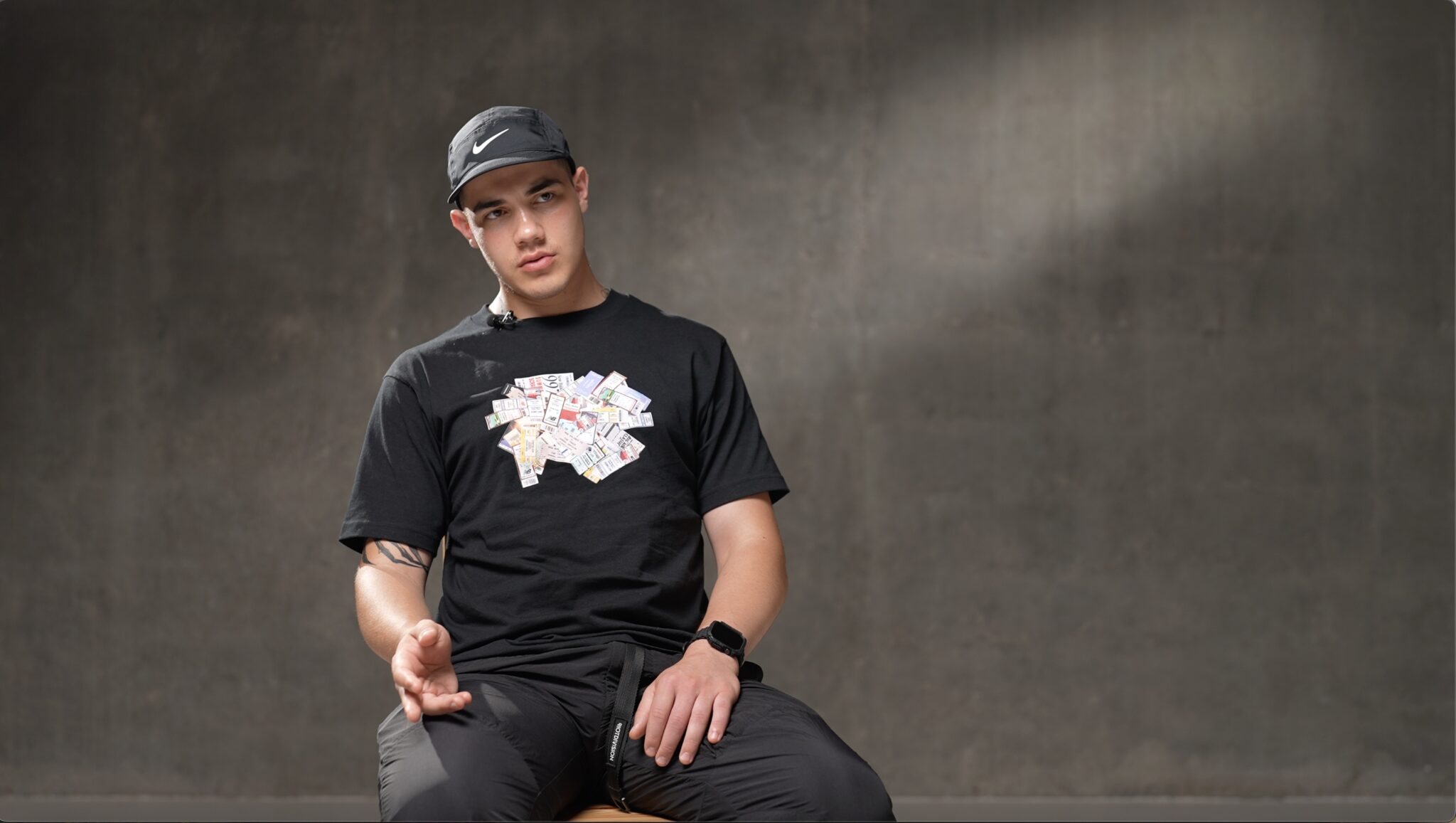
"They came again and broke my leg": 23-year-old 'Azov' man about more than 3 years in Russian captivity
Source: SlidstvoInfo
Author: Vladyslava Kobko
Azov fighter Danylo Murashkin went to war at the age of 19. He defended Mariupol, where he was taken prisoner. He spent more than three years in
Russian prisons Danylo Murashkin, who just turned 23, went to war at the age of 19. From the first days of the invasion, he and other Azov fighters defended their hometown—Mariupol—and in May 2022, he was taken prisoner by the Russians. Over the course of more than three years, Danylo was held in four different prisons. He lost 30 kilograms: “There could be stones in the bowl, some unidentifiable debris in the food, rat shit,” Danylo says of the food in the Taganrog pretrial detention center.
While in captivity, the soldier had his back burned with a stun gun, and his leg was beaten with an iron rod so severely that the muscles in it tore. Danilo recently returned to Ukraine as part of a prisoner exchange. He told “Slidstvo.Info” about what happens in Russian prisons and what gave him the strength not to give up.
This is covered in the Slidstvo.Info article.
If you prefer to watch the video with subtitles in another language, go to YouTube Settings → Subtitles → Auto-translate and select the desired language.
Author: Vladyslava Kobko
Azov fighter Danylo Murashkin went to war at the age of 19. He defended Mariupol, where he was taken prisoner. He spent more than three years in
Russian prisons Danylo Murashkin, who just turned 23, went to war at the age of 19. From the first days of the invasion, he and other Azov fighters defended their hometown—Mariupol—and in May 2022, he was taken prisoner by the Russians. Over the course of more than three years, Danylo was held in four different prisons. He lost 30 kilograms: “There could be stones in the bowl, some unidentifiable debris in the food, rat shit,” Danylo says of the food in the Taganrog pretrial detention center.
While in captivity, the soldier had his back burned with a stun gun, and his leg was beaten with an iron rod so severely that the muscles in it tore. Danilo recently returned to Ukraine as part of a prisoner exchange. He told “Slidstvo.Info” about what happens in Russian prisons and what gave him the strength not to give up.
This is covered in the Slidstvo.Info article.
If you prefer to watch the video with subtitles in another language, go to YouTube Settings → Subtitles → Auto-translate and select the desired language.
“SOMEDAY YOU’LL HAVE TO FIGHT TOO”
Danylo Murashkin, a resident of Mariupol, began thinking about a military career when he was 12—back in 2014, when the Russians first occupied his city.
My grandfather and I were out on the street that day. There were explosions, and I could see something was happening. I asked my grandfather:
— Grandpa, what’s that?
He said:
— War.
I said:
— What should we do?
He said:
— Fight.
I said:
— Me too?
He said:
— Someday, you too.
I was like:
— Yeah.
During the hostilities in 2014, the Azov Special Forces Battalion was formed: “I looked at those soldiers and thought how much I wanted to be like them,” says Danylo. Even back then, as a teenager, he told his mother he would go serve in “Azov,” though the young man’s dream didn’t come true until seven years later, in 2021. By then, Danylo had reached the age of majority, graduated from the Mariupol Maritime Lyceum, and completed basic training.
At the age of 19, from the very first day of the open invasion, Danylo defended Mariupol. He sustained shrapnel wounds in battle, and an explosion caused a dislocated shoulder. However, Danylo calls these injuries quite minor compared to what he had to endure in Russian captivity. He and his comrades were taken there on May 16, 2022, from the Azovstal plant.
“They checked what you had on you. I personally took everything off. I didn’t want them to get anything. I didn’t want to have any items with me that could reveal anything about me. I broke my phone and threw it away. We got on the buses and went to Olenivka,” the soldier recounts.
At the penal colony in occupied Olenivka, the prisoners were placed in barracks, where all their belongings were searched again and each person’s personal data was recorded. On the night of July 29, Russia carried out a terrorist attack: several explosions rang out in one of the barracks of the Olenivka prison camp, killing 54 prisoners and injuring more than 70 others.
“I had this feeling that something was going to happen. Because on that day, they gathered everyone and took them to that barrack. I witnessed the attack. I heard the explosions, saw the flames. And I went out into the street and heard our guys screaming. And I realized something was wrong,” recalls Danylo Murashkin.
“THERE COULD BE STONES IN THE CUP, RAT SHIT IN THE FOOD”
Danylo stayed in Olenivka until September 27, 2022. The day before our transfer, I celebrated my 20th birthday—my fellow prisoners gave me a piece of bread and a cigarette.
“And on the 27th, they gathered us up, called out my last name, and I thought: ‘Wow, is this a birthday present? Or is it something bad?’ They started loading us into the vehicles, and we were already on our way to Taganrog. When we arrived at the detention center itself, they removed our blindfolds, we heard Russian music, and I realized we were in Russia. “We didn’t come home,” says the Azov soldier.
In Taganrog, Danylo and the other prisoners were forced to undergo a lengthy and brutal so-called “intake process.”
“It was like a test. That’s how I personally saw it. You had to endure it in order to survive. There was physical beatings and psychological pressure. There was no clock; it was very hard to tell the time, but it seemed to me that it lasted about five hours,” says Danylo.
In the Taganrog pretrial detention center, the Azov soldier lost 30 kilograms. The food was completely lacking in calories, and often spoiled: “There could be stones in the bowl, some incomprehensible bits in the food, rat shit. In the evening they gave a piece of fish; I’d open it up, and there were just worms inside. The food there was absolutely terrible. The first course was just some water with a bay leaf. Salty or not. And for the second course, you might get a couple of rotten or half-frozen potatoes. And you, a healthy man, look at all this and think, ‘Are you guys out of your minds?’
“‘WHAT, YOUR LEG HURTS? WE’LL TREAT IT RIGHT NOW.’ AND THEY BROKE MY LEG AGAIN”
Danylo was placed in a six-person cell—they gave him a black jumpsuit with reflective strips, a towel, shoes, a cup, and underwear. The prisoners had to follow a strict schedule: wake-up, breakfast, and two daily inspections—before and after lunch. These inspections could be accompanied by beatings.
“They beat my leg with an iron pipe. If I’m not mistaken, it was the special forces, because when I fell, I saw military boots and uniforms. They beat my leg until I couldn’t stand anymore. I fell, and they kept beating it. It was completely black. I’m grateful to my comrades who helped me. They took me to the bathroom, to the table. My leg wouldn’t bend at all; it hurt terribly. At the time, I didn’t know that my muscles were torn there. I found out about it after the exchange, when they took an MRI scan,” says Danylo.
The man asked for medical help, but they refused, saying it would “go away on its own.”
“And then those same people who had beaten my leg—I recognized them by their voices—came back. And they beat me again. And they asked me, ‘So, does your leg hurt?’ I said, ‘Yes, it hurts.’ He said, ‘We’ll fix it right now,’” recalls Danylo.
After 14 months of captivity in Taganrog, the soldier was transferred to the Kirovsk colony, where he was housed not in a cell but in barracks: “I look up at the sky and think, ‘Yeees, the sky!’”
“I associate Kirovsk with a certain sense of relief. I arrived there before New Year’s and left the following year before New Year’s,” says Danylo. At the Kirovsk colony, the prisoners didn’t face such strict restrictions as in Taganrog—sometimes they could smoke cigarettes, and the uniform wasn’t standardized: “We wore whatever we could get our hands on, except for military uniforms: ‘civvies,’ ‘prisoner’s clothes,’ it didn’t matter.”
While in captivity, Danylo began to believe in God and really wanted to read the Bible for the first time, so he constantly asked the guards for it, even during interrogations. They usually just laughed and called Danylo offensive names. However, thanks to his constant requests, Danylo received his first Bible while in Taganrog: “I wanted to read it, to gain a certain philosophy. Today, it is the book of my life. I would give away my food during fasting periods and didn’t eat meat. It didn’t always end up on my plate, but whenever a meat dish was served, I would give it all away. There were times when I even lost consciousness. It was hard. But, I suppose, my faith gave me strength. I wanted to observe the fast specifically for God. To show Him that even in such conditions, I maintain my respect for Him.”
In December 2024, Danila was transferred to Pretrial Detention Center No. 3 in the city of Kizel, Perm Krai, Russian Federation. He says he was lucky because on the day of his arrival, there was effectively no so-called intake procedure. First, the new arrivals were sent to a several-week quarantine, and then distributed among the cells. Throughout the day, the prisoners were forced to stand in one spot. Meanwhile, Russian music or a propaganda podcast played constantly in the cell.
“You have your imaginary square where you stand. Moving around the cell is forbidden. You can’t sit down. You stand, stare at a single point, and it’s as if you’re not in this reality, but in your own inner one. I prayed, I talked to God. Well, I spoke to Him, but He didn’t answer me. Because if He had answered, that would be schizophrenia,” Danilo jokes.
In the pseudo-historical podcast that the Russians played for the prisoners day after day, they recounted their version of the battles for Mariupol, World War II, and the mass riots in Odesa in 2014.
“It was only turned off at night. And there were moments when they couldn’t even figure out the computer, or they did it on purpose—you know, when you don’t turn off the microphone, it hisses. And they’d turn off the podcast but leave the microphone on. And there’d be noise coming from the speaker all night. You’re lying there, trying to fall asleep, your head is buzzing because it was so loud. But you get used to it anyway and realize there’s nothing you can do about it. I mean, you’re not going to go in there and break the speaker, because there’ll be consequences,” says the interviewee.
“THEY BURNED MY ENTIRE BACK WITH A STUN GUN. THE WOUNDS STARTED TO ROT”
Absolutely any action—such as going to the bathroom, eating, singing the Russian anthem, or going to sleep—the prisoners could only perform on the guards’ orders.
“There was a loudspeaker through which they gave voice commands. A person was sitting behind the microphone. I realized that it wasn’t a recorded voice—that is, not just a script you press a button for and it plays—but a real person, and they were saying it every time. Because the intonation changed, the tempo changed, the speed at which these commands were spoken. Once I even went to a movie. They took us into a room with benches and showed a film about “Azov,” about how we fought in Mariupol. They wanted to show who we really are,” says Danylo Murashkin.
He adds: in Kizel, the guards’ favorite “toy” was the stun gun. One time, they called Danilo to the so-called “feeding trough” and ordered him to hold out his hand. Then they started shocking him with electricity: “He was expecting some kind of reaction—that you’d scream or beg him [not to torment you]. But if he’s expecting something, you can’t give it to him. I just stayed silent. And that helped. They burned my entire back with the stun gun. I had wounds that started to fester. The swelling was very severe, along with inflammation. Once they shocked me so hard that I lost consciousness.”
In addition, the temperature in the cells at Kizel was constantly low, and the guards would leave the windows open all day, causing drafts.
“The uniform was made of very cheap synthetic fabric. It doesn’t breathe, it doesn’t keep you warm—it just covers your naked body and that’s it. So there was nothing to keep you warm. You stand there, freezing, feeling the draft cut right through you. There were radiators, but because they opened the windows, they didn’t help. I remember one time it was about 30 degrees below zero. That’s Kizel—it’s very cold there. I think there’s even snow there in the summer,” says Danylo.
Danylo compares his time in the Kizel pretrial detention center to a time loop, since he had to repeat the same actions every day. The guards there carefully concealed their faces—they always wore balaclavas and addressed each other by numbers, not names. The detainees were not provided with proper medical care—one of Danilo’s cellmates constantly suffered from excruciating headaches, but he was only occasionally given a pill, which was ineffective.
Danilo Murashkin was returned to Ukraine during this year’s prisoner exchange. A few days earlier in Kizel, he was taken to a separate room where they photographed him from various angles (to document that there were no signs of beatings), changed his clothes, gave him a dry ration, and put him in a police van, which took him to the airport.
“The prisoners are talking among themselves, and someone is telling stories that they’re being flown home. And I think: they took our photos, gave us a Bible, asked if everything was okay. I guess we really are going home. I see the Belarusian flag; we’re getting on the buses. And that’s it, we’re crossing the border—it’s such a joy that it’s very hard to put into words. All that journey you’ve been through—you see the result, you see your homeland. It’s such a rush,” says Danylo Murashkin.
Danylo is currently undergoing rehabilitation after his captivity. Doctors are deciding whether surgery is needed on his right leg, which was severely beaten in Taganrog. Danilo’s family evacuated from Mariupol to Europe and has already visited him in Ukraine.
Danylo Murashkin, a resident of Mariupol, began thinking about a military career when he was 12—back in 2014, when the Russians first occupied his city.
My grandfather and I were out on the street that day. There were explosions, and I could see something was happening. I asked my grandfather:
— Grandpa, what’s that?
He said:
— War.
I said:
— What should we do?
He said:
— Fight.
I said:
— Me too?
He said:
— Someday, you too.
I was like:
— Yeah.
During the hostilities in 2014, the Azov Special Forces Battalion was formed: “I looked at those soldiers and thought how much I wanted to be like them,” says Danylo. Even back then, as a teenager, he told his mother he would go serve in “Azov,” though the young man’s dream didn’t come true until seven years later, in 2021. By then, Danylo had reached the age of majority, graduated from the Mariupol Maritime Lyceum, and completed basic training.
At the age of 19, from the very first day of the open invasion, Danylo defended Mariupol. He sustained shrapnel wounds in battle, and an explosion caused a dislocated shoulder. However, Danylo calls these injuries quite minor compared to what he had to endure in Russian captivity. He and his comrades were taken there on May 16, 2022, from the Azovstal plant.
“They checked what you had on you. I personally took everything off. I didn’t want them to get anything. I didn’t want to have any items with me that could reveal anything about me. I broke my phone and threw it away. We got on the buses and went to Olenivka,” the soldier recounts.
At the penal colony in occupied Olenivka, the prisoners were placed in barracks, where all their belongings were searched again and each person’s personal data was recorded. On the night of July 29, Russia carried out a terrorist attack: several explosions rang out in one of the barracks of the Olenivka prison camp, killing 54 prisoners and injuring more than 70 others.
“I had this feeling that something was going to happen. Because on that day, they gathered everyone and took them to that barrack. I witnessed the attack. I heard the explosions, saw the flames. And I went out into the street and heard our guys screaming. And I realized something was wrong,” recalls Danylo Murashkin.
“THERE COULD BE STONES IN THE CUP, RAT SHIT IN THE FOOD”
Danylo stayed in Olenivka until September 27, 2022. The day before our transfer, I celebrated my 20th birthday—my fellow prisoners gave me a piece of bread and a cigarette.
“And on the 27th, they gathered us up, called out my last name, and I thought: ‘Wow, is this a birthday present? Or is it something bad?’ They started loading us into the vehicles, and we were already on our way to Taganrog. When we arrived at the detention center itself, they removed our blindfolds, we heard Russian music, and I realized we were in Russia. “We didn’t come home,” says the Azov soldier.
In Taganrog, Danylo and the other prisoners were forced to undergo a lengthy and brutal so-called “intake process.”
“It was like a test. That’s how I personally saw it. You had to endure it in order to survive. There was physical beatings and psychological pressure. There was no clock; it was very hard to tell the time, but it seemed to me that it lasted about five hours,” says Danylo.
In the Taganrog pretrial detention center, the Azov soldier lost 30 kilograms. The food was completely lacking in calories, and often spoiled: “There could be stones in the bowl, some incomprehensible bits in the food, rat shit. In the evening they gave a piece of fish; I’d open it up, and there were just worms inside. The food there was absolutely terrible. The first course was just some water with a bay leaf. Salty or not. And for the second course, you might get a couple of rotten or half-frozen potatoes. And you, a healthy man, look at all this and think, ‘Are you guys out of your minds?’
“‘WHAT, YOUR LEG HURTS? WE’LL TREAT IT RIGHT NOW.’ AND THEY BROKE MY LEG AGAIN”
Danylo was placed in a six-person cell—they gave him a black jumpsuit with reflective strips, a towel, shoes, a cup, and underwear. The prisoners had to follow a strict schedule: wake-up, breakfast, and two daily inspections—before and after lunch. These inspections could be accompanied by beatings.
“They beat my leg with an iron pipe. If I’m not mistaken, it was the special forces, because when I fell, I saw military boots and uniforms. They beat my leg until I couldn’t stand anymore. I fell, and they kept beating it. It was completely black. I’m grateful to my comrades who helped me. They took me to the bathroom, to the table. My leg wouldn’t bend at all; it hurt terribly. At the time, I didn’t know that my muscles were torn there. I found out about it after the exchange, when they took an MRI scan,” says Danylo.
The man asked for medical help, but they refused, saying it would “go away on its own.”
“And then those same people who had beaten my leg—I recognized them by their voices—came back. And they beat me again. And they asked me, ‘So, does your leg hurt?’ I said, ‘Yes, it hurts.’ He said, ‘We’ll fix it right now,’” recalls Danylo.
After 14 months of captivity in Taganrog, the soldier was transferred to the Kirovsk colony, where he was housed not in a cell but in barracks: “I look up at the sky and think, ‘Yeees, the sky!’”
“I associate Kirovsk with a certain sense of relief. I arrived there before New Year’s and left the following year before New Year’s,” says Danylo. At the Kirovsk colony, the prisoners didn’t face such strict restrictions as in Taganrog—sometimes they could smoke cigarettes, and the uniform wasn’t standardized: “We wore whatever we could get our hands on, except for military uniforms: ‘civvies,’ ‘prisoner’s clothes,’ it didn’t matter.”
While in captivity, Danylo began to believe in God and really wanted to read the Bible for the first time, so he constantly asked the guards for it, even during interrogations. They usually just laughed and called Danylo offensive names. However, thanks to his constant requests, Danylo received his first Bible while in Taganrog: “I wanted to read it, to gain a certain philosophy. Today, it is the book of my life. I would give away my food during fasting periods and didn’t eat meat. It didn’t always end up on my plate, but whenever a meat dish was served, I would give it all away. There were times when I even lost consciousness. It was hard. But, I suppose, my faith gave me strength. I wanted to observe the fast specifically for God. To show Him that even in such conditions, I maintain my respect for Him.”
In December 2024, Danila was transferred to Pretrial Detention Center No. 3 in the city of Kizel, Perm Krai, Russian Federation. He says he was lucky because on the day of his arrival, there was effectively no so-called intake procedure. First, the new arrivals were sent to a several-week quarantine, and then distributed among the cells. Throughout the day, the prisoners were forced to stand in one spot. Meanwhile, Russian music or a propaganda podcast played constantly in the cell.
“You have your imaginary square where you stand. Moving around the cell is forbidden. You can’t sit down. You stand, stare at a single point, and it’s as if you’re not in this reality, but in your own inner one. I prayed, I talked to God. Well, I spoke to Him, but He didn’t answer me. Because if He had answered, that would be schizophrenia,” Danilo jokes.
In the pseudo-historical podcast that the Russians played for the prisoners day after day, they recounted their version of the battles for Mariupol, World War II, and the mass riots in Odesa in 2014.
“It was only turned off at night. And there were moments when they couldn’t even figure out the computer, or they did it on purpose—you know, when you don’t turn off the microphone, it hisses. And they’d turn off the podcast but leave the microphone on. And there’d be noise coming from the speaker all night. You’re lying there, trying to fall asleep, your head is buzzing because it was so loud. But you get used to it anyway and realize there’s nothing you can do about it. I mean, you’re not going to go in there and break the speaker, because there’ll be consequences,” says the interviewee.
“THEY BURNED MY ENTIRE BACK WITH A STUN GUN. THE WOUNDS STARTED TO ROT”
Absolutely any action—such as going to the bathroom, eating, singing the Russian anthem, or going to sleep—the prisoners could only perform on the guards’ orders.
“There was a loudspeaker through which they gave voice commands. A person was sitting behind the microphone. I realized that it wasn’t a recorded voice—that is, not just a script you press a button for and it plays—but a real person, and they were saying it every time. Because the intonation changed, the tempo changed, the speed at which these commands were spoken. Once I even went to a movie. They took us into a room with benches and showed a film about “Azov,” about how we fought in Mariupol. They wanted to show who we really are,” says Danylo Murashkin.
He adds: in Kizel, the guards’ favorite “toy” was the stun gun. One time, they called Danilo to the so-called “feeding trough” and ordered him to hold out his hand. Then they started shocking him with electricity: “He was expecting some kind of reaction—that you’d scream or beg him [not to torment you]. But if he’s expecting something, you can’t give it to him. I just stayed silent. And that helped. They burned my entire back with the stun gun. I had wounds that started to fester. The swelling was very severe, along with inflammation. Once they shocked me so hard that I lost consciousness.”
In addition, the temperature in the cells at Kizel was constantly low, and the guards would leave the windows open all day, causing drafts.
“The uniform was made of very cheap synthetic fabric. It doesn’t breathe, it doesn’t keep you warm—it just covers your naked body and that’s it. So there was nothing to keep you warm. You stand there, freezing, feeling the draft cut right through you. There were radiators, but because they opened the windows, they didn’t help. I remember one time it was about 30 degrees below zero. That’s Kizel—it’s very cold there. I think there’s even snow there in the summer,” says Danylo.
Danylo compares his time in the Kizel pretrial detention center to a time loop, since he had to repeat the same actions every day. The guards there carefully concealed their faces—they always wore balaclavas and addressed each other by numbers, not names. The detainees were not provided with proper medical care—one of Danilo’s cellmates constantly suffered from excruciating headaches, but he was only occasionally given a pill, which was ineffective.
Danilo Murashkin was returned to Ukraine during this year’s prisoner exchange. A few days earlier in Kizel, he was taken to a separate room where they photographed him from various angles (to document that there were no signs of beatings), changed his clothes, gave him a dry ration, and put him in a police van, which took him to the airport.
“The prisoners are talking among themselves, and someone is telling stories that they’re being flown home. And I think: they took our photos, gave us a Bible, asked if everything was okay. I guess we really are going home. I see the Belarusian flag; we’re getting on the buses. And that’s it, we’re crossing the border—it’s such a joy that it’s very hard to put into words. All that journey you’ve been through—you see the result, you see your homeland. It’s such a rush,” says Danylo Murashkin.
Danylo is currently undergoing rehabilitation after his captivity. Doctors are deciding whether surgery is needed on his right leg, which was severely beaten in Taganrog. Danilo’s family evacuated from Mariupol to Europe and has already visited him in Ukraine.
This is an automatic translation generated by DeepL.