"There is Kyrylo on the star". The story of a mother who survived the capture and death of her military son
Source: Ukrainska Pravda
Author: Roksana Kasumova
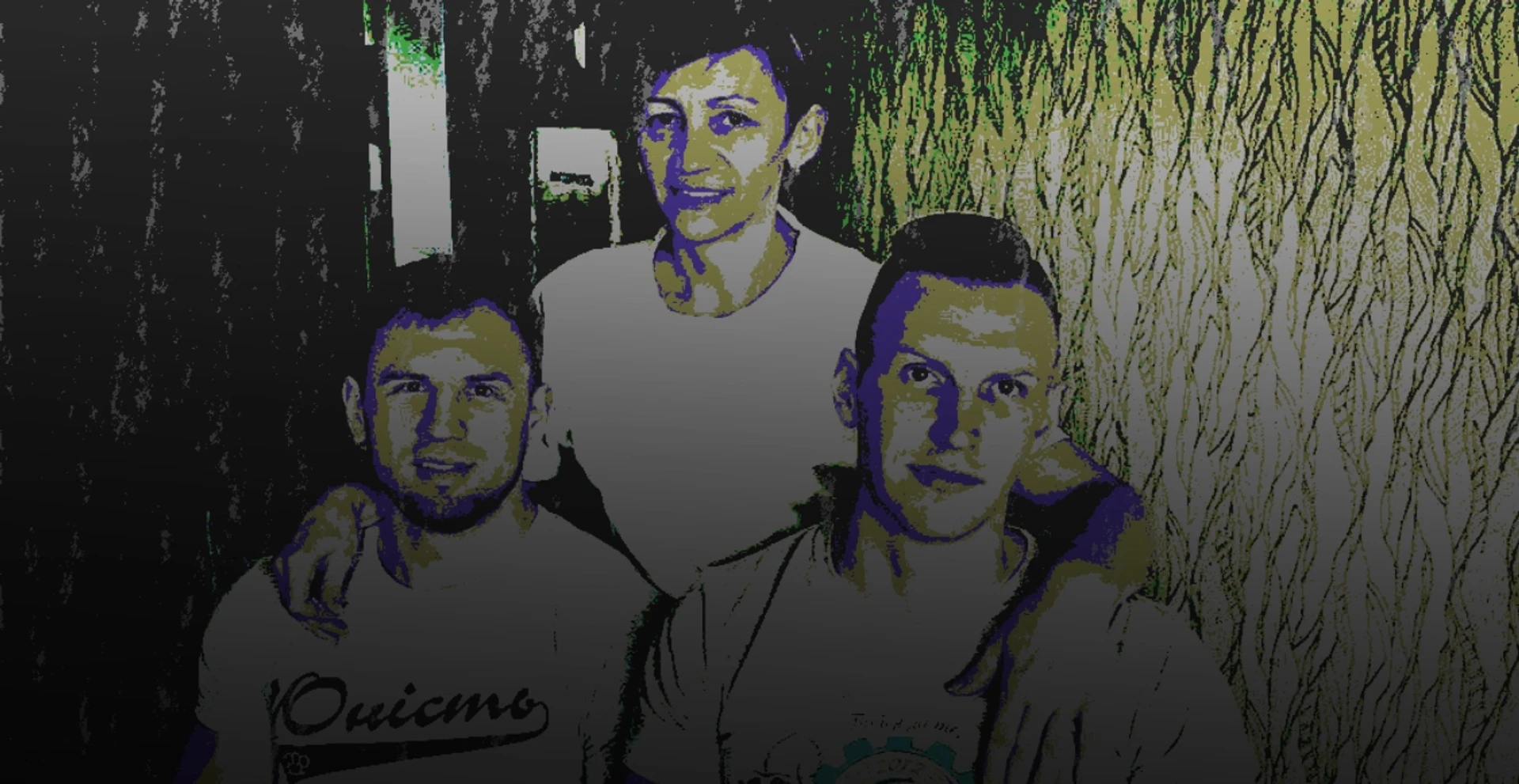
Olena Marchenko is from Mariupol. She is the mother of two Azov fighters. Her older son, Kirill, was killed; she never saw his body and never had the chance to say goodbye to him. Her younger son, Mykola, continues to defend Ukraine.
During the siege of Mariupol, she buried her mother right in her backyard. And while trying to leave, she was taken prisoner, where she spent over half a year with her husband.
“You realize that you used to live peacefully, but now you walk—and you can’t straighten your shoulders. You’re afraid of something all the time,” the woman says.
Readers of “Ukrainska Pravda. Life” are the first to whom Olena recounts this waking nightmare.
“What happened to us is very scary”
The family moved to Mariupol from Snizhne in 2002: the mines were closing, there were no jobs, life had practically come to a standstill—the city was dying.
“We moved for the sake of the children, to give them a future. Everything was fine for us in Mariupol: we worked, the children went to school. We’re a working-class family. We’ve worked our whole lives, just like our parents. And we lived well: we had a place to live and a way to make ends meet,” says Olena.
Their eldest son, Kirill, was born in 1991. Their younger son, Mykola, was born a year and four months later.
“Kirill was very independent from a young age; we never had to sit with him or help him with his homework. He took care of himself and got straight A’s. He loved soccer and enjoyed playing goalkeeper. After high school, he enrolled in the Institute of Tourism Business in Donetsk, and after graduating, he started working at a travel agency in Mariupol. My younger son first graduated from a mechanical and metallurgical technical school, and later earned a college degree in law,” his mother says.
Both sons were soccer ultras. That, the woman says, is how it all began:
“When the war started in 2014, they applied to join Azov. They didn’t ask us or their father; they just presented us with a fait accompli. We had no choice but to support them, even though it was very scary—after all, this is a war where people get killed.”
They told their parents very little about the war; they were protecting them. They just kept repeating, “Everything’s fine, everything’s okay.”
When the Shyrokyne operation began, they went off the grid. My mom later heard on the radio that Azov had launched a counteroffensive, which saved Mariupol from shelling at the time:
"We lived in the Sхідний neighborhood of Mariupol; it’s just on the outskirts of the city, a residential area. There was a checkpoint right next to us, and the shelling was constant. But after that operation, the enemy was pushed back to a lower elevation, and they could no longer fire at us. Shyrokyne itself was completely destroyed; people were relocated—some to Mariupol, others elsewhere.”
Since then, they haven’t spent much time together with the children. But whenever possible, the sons would always come over for dinner on the weekends: they’d sit down and share whatever each of them had.
“I asked them to write to me, even just a little. That was my condition. If they couldn’t talk, just one word would do. And that’s how it was; I got used to it,” says Olena. “But what happened to us afterward—that was truly terrifying.”
Bodies lay in the yards for weeks
On February 24, her sons tried to convince her to leave Mariupol. Kirill said then: there’s still a train to Lviv, let’s go. But she refused—and later regretted it deeply.
“My mom was living with us. She was 78 and sick. She said she wouldn’t go anywhere. And I couldn’t leave her,” Olena said. “Honestly, I thought it would all blow over. Since 2014—they’ve been shooting and shooting. I thought they’d shoot for a few days and then stop. And we didn’t go anywhere, even though the kids insisted.”
On February 26, a friend of her older son drove them from the Eastern neighborhood closer to the city center. We thought it would be better there, but in reality—we ended up right in the middle of hell:
“All the buildings were burned down; ours was the last one left. After March 15, the shelling got so bad that I couldn’t take it anymore—it was impossible to endure. Plus, we weren’t going through this in basements, but upstairs, in our apartment. My mom was feeling really bad; I was giving her painkillers. One day I looked out from the balcony—there was our tank. I said, ‘Guys, how’s the situation? And they just looked at me and asked, ‘What are you doing here? You should have left or been sitting in the basement.’”
Only when the apartment right below them caught fire did they finally go down to the basement.
“My mom couldn’t walk—she was just dragging herself along,” Olena recalls. “People helped get her down. There was a fire all around, and heavy smoke. We grabbed whatever we could.”
The building burned for another day. It was completely gutted. The smoke seeped into the basement too, but eventually, thankfully, it cleared out.
They spent six days in the basement, from March 22 to 28. Even when the shelling subsided slightly, Olena didn’t go out into the yard; she stayed by her mother’s side the whole time—she sat her on a small chair closer to the exit so she could breathe.
Her husband went out under shelling to fetch water and firewood. When the shelling stopped briefly, people tried to cook whatever food they could over a fire in the yard and boil water for tea. Everyone shared whatever they had.
Her elderly mother ate very little; she grew weaker with each passing day. She lamented that just as she was born during the war, so would she die during the war.
“On March 26, the Russians entered the house. They opened the door to the basement, and some people just started throwing themselves at them, shouting, ‘My dears, how we’ve been waiting for you.’ It was a shock for my husband and me… But no one in that building knew us; they didn’t know our sons were in the Azov Regiment—and that saved us,” says Olena Marchenko.
On March 28, they went upstairs to what was left of their burned-out apartment: the walls were cracked, the laminate flooring was warped, and everything was covered in soot. But compared to the neighbors’—it wasn’t the worst option.
And the next day—Olena’s mother died.
“I didn’t know what to do,” she says. “Rusnya said that all the bodies—whether people died or were killed—should be carried out into the yard, and we would take them away and bury them in mass graves. But that was out of the question; I wanted to reburial my mom later. My husband went to ask for help, and they dug a hole right behind the house. That’s where we buried my mom. And people were carrying their loved ones out wrapped in rugs or sheets. And right where we cooked our meals, they lay there for weeks, their legs sticking out. I couldn’t understand how that was possible."
"Take care of Mom!": A son said goodbye to his parents
On the same day, March 29, 2022, her son Kirill was killed. They didn’t know it then—they only found out after returning to territory controlled by Ukraine following their ordeal.
They last saw each other on March 5:
"He came and brought us groceries. Then he came back with medicine and a power bank. My mom had just been paralyzed on March 5. I was hysterical and said, 'What should we do, son?' But he was so calm. And that was the last time, on March 5, we saw and heard him. There was no further contact. And the fact that he came back more than once—he was probably saying goodbye to us. When he left, he told my father, ‘Take care of Mom!’ He never called me that. He always called me “Mom”...”—his mother cries.
In early April, Olena fell seriously ill: her fever stayed just under 40 degrees for about a week. She wasn’t eating anything, there was nothing to treat her with—she was surviving on water alone. That’s when we decided to leave Mariupol. We managed to get in touch and talk on the phone with our younger son:
“We talked for over an hour, but he didn’t say anything to me about Kirill then. I asked when they last got in touch and what he had said. But Kolya just said, ‘Mom, everything’s fine.’ He knew I was sick and didn’t want to upset me so I could make it to government-controlled territory. But we didn’t get anywhere…”.
First, they made it to Mangush, and from there, they took a transport to Berdyansk. However, at one of the checkpoints, they were taken prisoner.
“They restored all the apps I had deleted from my phone, all the photos with the children. They saw a photo of my sons in uniform,” the woman says. “And right then at the checkpoint, they told me, ‘One of your sons has been killed.’ Of course, I cried a lot. I wasn’t afraid that they had detained us—I just didn’t care anymore. I was exhausted from the fever, from Mariupol, from everything.”
When they were brought to the prison colony, Olena told her husband: “That’s not true; they can’t know. Kirill is alive.” And every day they prayed for him, for the living.
Eight months of abuse
They were placed in the 77th special-regime penal colony in the temporarily occupied city of Berdyansk. They took all our money, all our belongings, our phones; they only allowed us to keep a photo of our granddaughter, which Olena had taken down from the wall of our apartment.
“Physically, they didn’t touch us—neither me nor my husband. But psychologically—they tortured us, they tormented us terribly,” Olena shudders. “They said we had raised two terrorists, that ‘Azov’ is considered a terrorist organization in Russia. And that we would be convicted under their laws. That we would go to prison.”
At the same time, they blackmailed our younger son: they demanded money for his parents’ release. When our son said he would collect the money, they started demanding that he bring it himself, not through some intermediary. Then it became clear that it wasn’t about the money:
“They were filming us, forcing us to beg our son to take us out of there. I refused, but the FSB agents threatened us with guns and threatened to separate me from my husband. And in the end, we said what they forced us to say. Later, my son told me: ‘I know, Mom, that you didn’t want to say that. You were forced to." He was constantly working on our release, but it didn’t happen quickly. I was constantly afraid that he might take some rash steps, that he might come—because it’s a one-way trip."
Later, he told his mom what he went through when he found out about their imprisonment, how he couldn’t serve in peace, how he received videos of his parents that were physically painful to watch:
"After Mariupol, I lost 15 kilograms. It was something else. But then he said, ‘Mom, everything will be fine,’ and I told him—it won’t be fine anymore, how could it possibly be fine?”
“There on the star—Kirill. He’s standing there, looking at us”
The exchange fell through many times. They weren’t released until late fall: they didn’t reach territory controlled by Ukraine until November 26. First to Zaporizhzhia, and from there a border guard doctor took them to Kyiv, transporting wounded soldiers for treatment. He was the one who delivered the terrible news:
“When we arrived in Kyiv, he hugged me and said, ‘Your family is in mourning, but you have to go on living. You have someone to live for." That’s when I understood everything. What I had feared so much turned out to be true. Kirill is gone. And I don’t know if I’ll ever see his body."
Kirill Marchenko was killed while carrying out an important combat mission. His group of six was supposed to mine the road to prevent the enemy from advancing quickly. They weren’t allowed to do it—the group was hit by an airstrike.
“He was the senior member and went first. I spoke with a guy who was on duty with Kirill in Mariupol. He said that the sixth man, who was walking last, fell slightly behind—and survived. He’s in captivity now; I’m really looking forward to seeing him. Maybe he’ll tell me something else,” Olena recounts. “There was a crater—8 meters wide… According to the guy, they found only a fragment of one body; the deceased was identified by a tattoo. They told me the exact location where it happened, but that doesn’t make it any easier. I’m really looking forward to the de-occupation of Mariupol!”
January 21, 2022, was Kirill’s birthday. The whole family gathered in Mariupol. Everyone was alive:
“There’s a video where my granddaughter is dancing with my son. And I say that no one knew what would happen a month later. And now there’s only ‘after.’
I’m worried that I’ll never find my son Kirill. It’s crushing. My younger son says, ‘You have me.’ And I promise him I’ll try to be strong… Kirill often appears in Kolya’s dreams now. But I haven’t dreamed of him even once.”
Mykola’s little daughter, Mia, is perhaps their only comfort.
“She’s our little ray of light that keeps us going. With her, you forget about everything; all other thoughts fade into the background,” says her grandmother. “She also often thinks of Kirill. When she doesn’t want to eat, I say, ‘Let’s do it for Mom, for Dad,’ but she says, ‘No, for Kirill.’ And once, after I bathed her, I told her to go to bed, but she stood there barefoot, looking out the window and saying, ‘Grandma, Kirill is up there on that star. He’s looking at us.”
The younger son continues:
“I ask him, ‘What am I supposed to do, God forbid? My daughter needs you; we need you.’ And he replies, ‘Mom, I can’t go. How could I go with a clear conscience?’ That’s how we live, as if on a powder keg.”
“Memory is the only thing military families have”
Psychologists worked with Olena: individual sessions, art therapy, group therapy.
“I stopped crying all the time,” she says. “My husband held it together, but eventually he started crying too. We’re still on antidepressants together. Because we couldn’t sleep, nothing.”
In Kyiv, Olena feels out of place. She says she feels like she’s floating, as if she’s cutting herself off from life:
“I don’t want anything. I need Mariupol! I’m worried we won’t be able to find Mom. We buried her, but then they were digging up the heating pipeline and dug her up.”
They only feel at ease among other “Azov” families. Here, everyone understands each other; here, everyone shares a common grief and common problems. Some of which, unfortunately, are compounded by the authorities: they promised to build a National Military Memorial Cemetery this year, but construction never began. The ashes of many heroes remain unburied; the urns are simply kept at their parents’ homes or in crematoriums, in temporary storage.
“They promise a military cemetery and don’t deliver,” says Olena Marchenko in despair. “There’s a bill for it, but it hasn’t been signed. First they planned it for Lysa Hora, then for Bykivnia… It’s all so sad. Our boys didn’t hesitate, knowing they would stay there; they held Mariupol to give other areas time to prepare. And here, just to get a signature, we’ve been waiting a year.”
She also really hopes they’ll allow us to hold a proper burial for the fallen soldiers whose bodies were never found:
“A psychologist told us we need to choose a place we can visit. My husband planted oak saplings; they’re growing in pots at our place… But it would be better if this place were in a military cemetery, among the boys, among their comrades. But…
We are all very depressed; we are offended by this attitude. It’s as if our President says that no one will be forgotten and everyone will be honored. The best support the state can offer is remembrance. Remembrance is the only thing the families of soldiers have."
***
On the "Prykhytok" website, concerned Ukrainians can offer housing to displaced persons by posting an ad. Thus, IDPs can find temporary shelter in any region of Ukraine or abroad, for a few days or a longer period. The filter system makes it easy to find an option that meets your criteria and quickly contact the owner. The website is available in 40 languages.
This is a completely volunteer-driven initiative. It was launched on the first day of the full-scale invasion by Ukrainian MP Galina Yanchenko. Later, the "Prykhytok" program received state support. Homeowners who have taken in displaced persons receive compensation from the state to cover utility costs.
This is an automatic translation generated by DeepL.