The Real Sentsov. The story of a director and a stormtrooper with thick skin
Source: Ukrainska Pravda
Author: Mykhailo Krygel
“‘Now they’ll finally kick you out of the army,’ a girl told me after watching it,” Oleg Sentsov smiles a few days before the Ukrainian premiere of his film “Real.”
He certainly doesn’t need to worry about that: it’s unlikely there are many people eager to replace Sentsov, the commander of an assault company. It’s just as unlikely that Oleg will be taken off assault missions if some high-ranking official suddenly takes issue with “Real” showing too much of the truth about war. Because that’s exactly what he’s been doing for two and a half years.
In October 2024, for the first time in a long while, Sentsov was granted leave—specifically to screen his new film at the “Kyiv Critics’ Week” festival.
Kyiv disappointed him once again.
“It reminds me of *The Godfather Part II*, where the party in Havana went on until Castro’s troops entered the city. We’ve already lost so much time, resources, and people that only radical changes can now stabilize the situation in the future. But we continue to choose the ostrich strategy, because burying our heads in the sand is much safer than facing the truth," Oleg wrote on social media.
Before that, Sentsov had hesitated for two days about whether to do this.
– This post is pretty dark. But I realized it was necessary. If I feel the need to say or do something, I say it and do it.
For ten years, he has existed not only in the human dimension but also in the world of symbols. Sentsov is a former prisoner of the Kremlin, sentenced to 20 years. He spent five of those years in Russian prisons. He also endured a 145-day hunger strike before returning to Ukraine in September 2019 following a prisoner exchange.
For five years since his release from a Russian maximum-security prison, Oleg has been trying to break the inertia of the “Sentsov” brand, the dividends from which would have been enough to last him a lifetime.
The last thing he wants is to be a symbol. Of anything. Of resilience. Of resistance. All that is good against all that is bad. How many of them—symbols—have crashed down from the pedestals onto which they were hoisted by an enthusiastic crowd over the past ten years?
The last thing he wants is to live up to anyone’s expectations.
The last thing he wants today is to talk about Russian prisons, Putin, and that other disgusting existence.
He is a director and wants to talk about cinema—both others’ and his own, the film “Rhinoceros” he directed and the upcoming “Kaya.”
Sentsov is a rare phenomenon in the modern world. He knows how to see things through to the end and not get bogged down in trivialities. And he knows everything about the difference between “being” and “appearing.”
He has learned to trust actions, not words; he does not believe in life after death, forgiveness without repentance, or the repentance of an enemy without victory over him.
UP spoke with the director on the eve of his film’s screening in Kyiv.
That evening in the auditorium of Kyiv’s Zhovten cinema, the buckets of popcorn in the audience’s hands remained untouched.
Everything that happens in "Reality" could resemble a video game—a first-person shooter. But this film is a window not to a fictional reality, but to a real war. One as it is from the inside. No setup, no climax, no resolution, and no chance to live six more lives if things don’t go according to plan in this one and you get killed.
"Real," "Marseille," "Chelsea"—these names are constantly heard on screen for an hour and a half. The Champions League has nothing to do with this. These are all positions in the Zaporizhzhia sector, where Ukrainian fighters tried to gain a foothold in the summer of 2023.
Those in the frame are at “Marseille” and are communicating via radio—with “Real,” with headquarters, with artillery, with aerial reconnaissance.
The artillery is silent, ammunition isn’t being delivered, the wounded aren’t being evacuated, and who’s in charge of the “reconnaissance units”—no one knows. A powerful counteroffensive is underway.
One of the soldiers shakes his head, then reflexively brings a cigarette to his mouth and takes a drag. But there is no cigarette in his hand. Someday, this very real drag will go down in film history just like the baby carriage rolling down the Potemkin Stairs in Eisenstein’s film.
Instead of a professional movie camera in "Real," there’s a GoPro on a soldier’s helmet that accidentally turned on amid the commotion. Instead of a script—a live stream of war, unadorned by editing, music, or special effects. Instead of a film set—the claustrophobic space of a single trench. Occasionally, the camera zooms in on its earthen wall—the soil.
The call sign of the soldier, who does not appear on screen but whose voice is heard off-screen throughout, is also “Soil.”
This is Oleg Sentsov’s call sign. When I ask about the symbolism of the call sign—of course, something about the earth that protects, into which he has grown roots, which gives strength—how could it be otherwise— he looks at me with the eyes of a man chronically exhausted by idiotic questions—with a mixture of disgust and sympathy.
“Listen, I get what you’re getting at. But there’s no deep meaning here. It’s a call sign from my esports nickname, which I had 25 years ago. It comes from the English word ‘grunt,’ meaning ‘oinking’ or ‘grumbling.’ Actually, it’s kind of like my personality—it’s not very pleasant.
“A film that isn’t a film,” says Sentsov about “Real.” – I decided I had to show this. Because few people see the real war, and few understand it. Half of even those who wear uniforms have never been on the front lines. But those who have been there know that it’s always chaos, nothing goes according to plan, people mess up, people die, people go the wrong way, communications fail, the plan was bad, someone didn’t do their job, someone didn’t do what they were supposed to do.
The film runs 90 minutes. The battle at “Reali” lasted 18 hours. Twenty-two Ukrainian soldiers died at their posts.
In the language of the General Staff’s morning briefing, the synopsis of Sentsov’s film would look like this:
“Over the past 24 hours, Ukrainian defenders struck 16 enemy concentration areas and also hit other enemy targets. In the Zaporizhzhia and Kherson sectors, the enemy continues to conduct defensive operations."
[UPCLUB]
Sentsov has a way of transforming the space and terrain around him simply by his presence, even in silence. It’s not just his six-foot height. Jonathan Swift once described this phenomenon in his *Gulliver’s Travels*: “Quinbus Flestrin,” translated from Lilliputian as “mountain man.”
In half an hour of conversation with Sentsov, I’ve gathered several dozen of his quotes in the “What I’ve Learned” format, coined by American Esquire. Each one is experience distilled into words.
“I have no regrets about anything in life, but I wouldn’t want to live the same life all over again.”
“I’m not as thin-skinned as I was as a child. My skin is thick; it’s hard to bite through. The skin of a rhinoceros.”
“There isn’t some separate perfectionist director, a little gnome, a cockroach, or anyone else living inside me. I am a whole person."
"I’m a loner. Although I know how to work with people. That’s why a career as a commander in the army isn’t exactly easy for me, but it’s doable. Though I need time to recharge my batteries on my own. And I don’t have that time."
"I have many friends and a wonderful family; that supports me. But ultimately, I can only rely on myself. If, God forbid, suddenly no one is left tomorrow, I won’t break."
"My wife told me about a training session led by some Israeli guy who said that happiness requires three simple things: doing what you want, not doing what you don’t want, and a third thing—I forgot what it was. I do the first two things; there was a third one, but these two are enough.” If the “thick-skinned” Sentsov has an Achilles’ heel, it is probably the irritation that externally imposed life scenarios are confining him to the cage of a single role.
"It’s actually so strange to read about myself. It’s as if the real me, lying here on the bed with this newspaper in my hand, has absolutely nothing to do with the person they write so much about and, apparently, talk so much about. You don’t even look much like him in the photo anymore.
I wonder if I and others will ever be able to reconcile this real Sentsov with the virtual one? The effect will likely be interesting, but difficult; perhaps many will be disappointed, as is often the case with fictional characters,” he wrote in his diary in the summer of 2019, on the 33rd day of his hunger strike in a Russian prison.
After his release, Oleg stubbornly sought to erase all traces of his past as a “Kremlin captive.” He burned his prison uniform. He donated the letters he had received in the Russian prison to a museum. In September 2019, Volodymyr Zelenskyy received a plastic tea canister with yellow and blue stripes and a prison badge inside, which had been with Sentsov throughout his five years of imprisonment.
“I’ve put this chapter behind me. I’ve let it all go,” Oleg concludes.
One of his talents is not to carry the burden of past victories and defeats with him.
“I don’t live in the past, I don’t live in the future, I don’t live in a fictional reality. I live a real life. That’s just how it is; I like it; there’s nothing else.
We’re talking right now, an evening in Podil, the last warm day of autumn, because tomorrow it’s going to get colder. I’m just enjoying this,” says Oleg in October 2024.
“I’m a man of action,” he sums it up, as if that explains everything about him. It is precisely in his words that this phrase—which might otherwise be considered a cliché—takes on meaning and weight.
Another half-hour of conversation with Sentsov, and the next batch of quotes is ready. Sometimes about the rules of life, more often about life without rules. And also without snot, manipulation, or cheap motivational speeches.
On betrayal.
“Another person’s soul is a dark place.” That’s what a man I’d considered a friend for 20 years told me. And when the occupation of Crimea began, he joined the local pro-Russian self-defense group. He saw me at a rally and reported to his commander: “Look, that’s Oleg; if he’s here with a phone in his hand, then he’s definitely organizing all this.” And that was very interesting. A person whose favorite saying is “You can’t know what’s in someone else’s heart.” The circle has closed. Life throws up scenarios that not everyone can picture in their mind.” On forgiveness.
"Collecting grudges is a pastime for the weak. If you want to be strong, learn to forgive. I’ve always believed that and have forgiven many people. But I’m not ready to forgive my killer. I am one of those who will try to snatch the axe from his hands and chop off his head. Besides, forgiveness is impossible without repentance. And the repentance of the Russians is impossible without our victory."
On death.
"There will be nothing after death. A person lives, then dies, and that’s it. Just the end of the movie and a black screen. All that remains of you is memory, some mark in history, your work, or simply something that remains in your children.
In war, you don’t just see death; you feel it passing right by you. Ten men set out, and two won’t be coming back. And not because anyone was less trained—just a bit of bad luck.”
I remind Oleg of a passage from his collection of short stories *Life*, first published in 2015.
“A man was asked how he would like to die. The man replied: ‘With a shout of “Hurrah!”, a machine gun in my hands, and my mouth full of blood.’ I’d want that too, because it’s beautiful, because it’s manly.”
I ask if that desire has changed ten years later.
“If you’ve read the book, there was a continuation of that line. "I’d want that too, because it’s beautiful, because it’s manly. But it won’t work out that way. Heroes only die beautifully in movies and books. In real life, they’re covered in their own blood, screaming in pain, and thinking of their mom."
“Hero,” “heroism,” “died a hero”—these are the right words to say to the families of the fallen. Because the family needs to know that their husband, son, father went to war and died a hero. No matter how he died, he died a hero, first and foremost. As for the details…
In direct combat, perhaps 10% of total casualties are killed. All the rest—during logistics, while moving somewhere, driving somewhere, walking somewhere, sitting somewhere—some were hit by artillery, some by an FPV or a mortar, and some, God forbid, were run over by their own vehicles. A person might have gone through hundreds of trials, proving themselves a hero, but survived—only to die without a shout of “hurrah!” It happens. War.
As for heroism—on the front lines, that word carries a negative connotation. Heroism means sticking your neck out where you shouldn’t, putting yourself and your comrades in danger. Or it’s forced heroism, when you have to cover the holes that someone else screwed up somewhere.
I’ll share another flashback—to his story about school. It’s about how, during the final exam, a teacher gave him the answer to a problem. And about the feeling of lies, filth, and shame that never left him after that. What makes him feel ashamed today, just as he did back then during that exam?
– Back then, it was just about the triangles in the problem, but now it’s about people’s lives.
And I’m ashamed of the same thing. The amount of lies in our country is enormous. And in the army, it’s simply on a massive scale. Everyone reports only good news to the higher-ups. And those who report the real situation are removed. They’re replaced by those who say: “Yes, it will be done, no problem, forward, forward.”
That’s how a distorted view is formed, where there’s one reality in headquarters and a completely different one on the ground. They say: go there, take this. But we can’t—we don’t have that much strength. How is that possible? Forward, forward! We went—we didn’t accomplish anything, and our numbers dwindled even further. Let’s try again and again. No, not here, but over there. And it’s a madhouse, endless—I see no end to this.
At some levels, commanders can smooth things over, do something, but the system as a whole works like this. Unfortunately, we remain a small Soviet army fighting against a large Soviet army.
There is nothing worse than a well-rounded hero who lives in harmony with himself.
Sentsov is exactly that—whole and harmonious.
In conversation with him, a strange feeling arises: despite all the horror of the present, this is Sentsov’s time. Because the worst thing that can happen to such people is the lingering post-truth, where “nothing is true and everything is possible,” in which you become frozen, like a fly in amber.
– My friend, who is also from Crimea, says that out of all the options, I always choose the hardest one. I never see it that way. I always choose the option I believe is right for me and reject the others. And whether it’s difficult or not—that’s not an argument for me.
I could have chosen not to go to war. I could have worked peacefully somewhere on the cultural front, I could have gone abroad, and no one would have said a word to me. But I joined the army. Not just the military—the infantry. Not just the infantry—the assault troops. And I don’t understand how it could be any other way.
It seems he’s always been exactly like that. Sentsov doesn’t like to dwell on his past—he advises that everything one needs to know about him can be found in his books and films. Finding the moment of a fateful choice in his biography is quite a task.
Perhaps the prologue to that choice took place when, at the age of 10 or 11, Oleg went on a field trip to the Khan’s Palace in Bakhchisaray. One of the paintings in the museum’s exhibition struck him.
The ruler sits on his throne, stamping his foot in anger, while his confused and frightened servants, entourage, and guards scatter around him; before him stands a man, dignified and calm.
“It was an ambassador sent to the khan who refused to prostrate himself before him and, by local standards, didn’t behave very obsequiously at all,” Sentsov recalls of that painting. “The khan was enraged by this and threw him into a dungeon, where he spent twenty years and died a sick old man.”
“That story struck me deeply at the time. It seemed terrifying and impossible to me to give up life itself, the summer sun, everything—just to avoid bowing down once before a ruler…
I’m glad that many things happened in that boy’s life that changed him profoundly, and when the moment came—one he hadn’t expected or hoped for—he was able to make the right choice. Twenty years in a dungeon are worth it if it means never bowing to a tyrant, even once.”
“A haberdasher and a cardinal—that’s power!”—quoting *The Three Musketeers*, Sentsov will smile if you happen to compare him to Churchill. But there is actually more sense to this comparison than it seems. The British prime minister, in his time, became perhaps the only politician who, instead of playing games and bargaining with Hitler, did not look away.
– The courage to face the truth is very important, and it is rare among politicians. We lacked this at the beginning of the war, and we lack it now. That is precisely why Churchill is one of my favorite figures—very controversial, but for me, he is an example.
He understood that the main weapon of dictators is fear. Their power does not rest on the army, on weapons, or on a punitive system. When fear ends, power ends, and it turns out the emperor has no clothes.
In April 2015, at a court hearing in Lefortovo, I said that I wasn’t afraid of a 20-year prison sentence. Because the era of the bloody dwarf will end sooner. Later, in Yakutsk, I heard: “What are you waiting for? You called Putin a bloody dwarf in court. You’ll never get out of prison—they don’t forgive insults like that.”
I did it deliberately, because I understood that soon it would all be over, they would drag me off somewhere beyond the Arctic Circle, and no one would ever hear those words. That’s why I seized the opportunity. Because this is my personal war against Putin and his regime.
Somewhere beyond the Arctic Circle, in the Russian maximum-security colony “White Bear,” the prisoners line up in a column. The column begins to move: everyone on the left foot, except Sentsov in the first row. The formation breaks.
“It seems like a trifle, but only at first glance. It was like not saluting Hitler at a Nazi rally or not standing when the Soviet Union anthem was played… That’s how our little war began,” he recalls.
Next came threats and intimidation, searches several times a day. After a few months, they stopped harassing him. He was the only one who continued to march on the right foot, and everyone pretended that was how it was supposed to be.
When he recalls that five-year standoff between a man and a man-eating system today, you realize that this is a deeply personal story for him. On one side, Sentsov without an army, a punitive apparatus, or a nuclear briefcase. On the other—Putin. And suddenly it turned out that the world is not ruled by missiles or red buttons, but by a person’s will to see things through to the end without betraying themselves. Such is this unproven—forgive me, Lord—idealism.
In September 2019, Putin lost by agreeing to a swap. Sentsov is confident that the same will happen this time. If enough people, particularly politicians in the West, cross the “red line” of fear.
Sometimes, through the “rhino hide,” you can see the features of the boy from his old story, hopping on one leg after his grandfather on a bicycle, not caring how it looks from the outside.
I ask, how is that inner boy of his doing?
– It’s hard for me to say if he’s hopping on one leg. But one thing’s for sure: I don’t care what people think of me.
Today I was at a funeral. At the memorial dinner, a guy I’d rescued while he was wounded came up to me. And he says, “Listen, I was in the hospital, and someone in the ward said you’re such a show-off, always putting on airs. I almost bit his throat off, because you saved my life, and he’s saying stuff like that about you.” There you go—two people. I’m not going to run around trying to prove something to everyone.
I live the way I want to. And let everyone think of me however they see fit. I’ve found a kind of inner harmony within myself. It’s a bit like Buddhism.
Sentsov doesn’t believe in grand statements, the meaning of which everyone interprets in their own way. He doesn’t declare a desire to change, let alone save, the world. And yet he changes it, at least within his immediate sphere of influence. How? Perhaps the point is that he always chooses to follow his own path, to make his own films.
His next film—*Kai*—is about a family in crisis. The time for an artistic film about this war hasn’t come yet, Oleg believes. When that will happen—in 5 years or 10—he doesn’t know. Long distances don’t scare him.
We finish our conversation and say goodbye. I wait to see which foot he’ll take his first step with. The right one. This time not out of protest, but because it comes naturally to him.
That same day, I happen to hear a phrase that seems to have nothing to do with Sentsov, but in reality, it’s about him.
“Mom, I’m leaving so I can get there,” says a seven-year-old child calmly, running late for school, while his mother, on edge, throws a fit of panic and whining.
Sentsov is one of those who leaves so he can get there.
Author: Mykhailo Krygel
“‘Now they’ll finally kick you out of the army,’ a girl told me after watching it,” Oleg Sentsov smiles a few days before the Ukrainian premiere of his film “Real.”
He certainly doesn’t need to worry about that: it’s unlikely there are many people eager to replace Sentsov, the commander of an assault company. It’s just as unlikely that Oleg will be taken off assault missions if some high-ranking official suddenly takes issue with “Real” showing too much of the truth about war. Because that’s exactly what he’s been doing for two and a half years.
In October 2024, for the first time in a long while, Sentsov was granted leave—specifically to screen his new film at the “Kyiv Critics’ Week” festival.
Kyiv disappointed him once again.
“It reminds me of *The Godfather Part II*, where the party in Havana went on until Castro’s troops entered the city. We’ve already lost so much time, resources, and people that only radical changes can now stabilize the situation in the future. But we continue to choose the ostrich strategy, because burying our heads in the sand is much safer than facing the truth," Oleg wrote on social media.
Before that, Sentsov had hesitated for two days about whether to do this.
– This post is pretty dark. But I realized it was necessary. If I feel the need to say or do something, I say it and do it.
For ten years, he has existed not only in the human dimension but also in the world of symbols. Sentsov is a former prisoner of the Kremlin, sentenced to 20 years. He spent five of those years in Russian prisons. He also endured a 145-day hunger strike before returning to Ukraine in September 2019 following a prisoner exchange.
For five years since his release from a Russian maximum-security prison, Oleg has been trying to break the inertia of the “Sentsov” brand, the dividends from which would have been enough to last him a lifetime.
The last thing he wants is to be a symbol. Of anything. Of resilience. Of resistance. All that is good against all that is bad. How many of them—symbols—have crashed down from the pedestals onto which they were hoisted by an enthusiastic crowd over the past ten years?
The last thing he wants is to live up to anyone’s expectations.
The last thing he wants today is to talk about Russian prisons, Putin, and that other disgusting existence.
He is a director and wants to talk about cinema—both others’ and his own, the film “Rhinoceros” he directed and the upcoming “Kaya.”
Sentsov is a rare phenomenon in the modern world. He knows how to see things through to the end and not get bogged down in trivialities. And he knows everything about the difference between “being” and “appearing.”
He has learned to trust actions, not words; he does not believe in life after death, forgiveness without repentance, or the repentance of an enemy without victory over him.
UP spoke with the director on the eve of his film’s screening in Kyiv.
"A Film That Is Not a Film"
That evening in the auditorium of Kyiv’s Zhovten cinema, the buckets of popcorn in the audience’s hands remained untouched.
Everything that happens in "Reality" could resemble a video game—a first-person shooter. But this film is a window not to a fictional reality, but to a real war. One as it is from the inside. No setup, no climax, no resolution, and no chance to live six more lives if things don’t go according to plan in this one and you get killed.
"Real," "Marseille," "Chelsea"—these names are constantly heard on screen for an hour and a half. The Champions League has nothing to do with this. These are all positions in the Zaporizhzhia sector, where Ukrainian fighters tried to gain a foothold in the summer of 2023.
Those in the frame are at “Marseille” and are communicating via radio—with “Real,” with headquarters, with artillery, with aerial reconnaissance.
The artillery is silent, ammunition isn’t being delivered, the wounded aren’t being evacuated, and who’s in charge of the “reconnaissance units”—no one knows. A powerful counteroffensive is underway.
One of the soldiers shakes his head, then reflexively brings a cigarette to his mouth and takes a drag. But there is no cigarette in his hand. Someday, this very real drag will go down in film history just like the baby carriage rolling down the Potemkin Stairs in Eisenstein’s film.
Instead of a professional movie camera in "Real," there’s a GoPro on a soldier’s helmet that accidentally turned on amid the commotion. Instead of a script—a live stream of war, unadorned by editing, music, or special effects. Instead of a film set—the claustrophobic space of a single trench. Occasionally, the camera zooms in on its earthen wall—the soil.
The call sign of the soldier, who does not appear on screen but whose voice is heard off-screen throughout, is also “Soil.”
This is Oleg Sentsov’s call sign. When I ask about the symbolism of the call sign—of course, something about the earth that protects, into which he has grown roots, which gives strength—how could it be otherwise— he looks at me with the eyes of a man chronically exhausted by idiotic questions—with a mixture of disgust and sympathy.
“Listen, I get what you’re getting at. But there’s no deep meaning here. It’s a call sign from my esports nickname, which I had 25 years ago. It comes from the English word ‘grunt,’ meaning ‘oinking’ or ‘grumbling.’ Actually, it’s kind of like my personality—it’s not very pleasant.
“A film that isn’t a film,” says Sentsov about “Real.” – I decided I had to show this. Because few people see the real war, and few understand it. Half of even those who wear uniforms have never been on the front lines. But those who have been there know that it’s always chaos, nothing goes according to plan, people mess up, people die, people go the wrong way, communications fail, the plan was bad, someone didn’t do their job, someone didn’t do what they were supposed to do.
The film runs 90 minutes. The battle at “Reali” lasted 18 hours. Twenty-two Ukrainian soldiers died at their posts.
In the language of the General Staff’s morning briefing, the synopsis of Sentsov’s film would look like this:
“Over the past 24 hours, Ukrainian defenders struck 16 enemy concentration areas and also hit other enemy targets. In the Zaporizhzhia and Kherson sectors, the enemy continues to conduct defensive operations."
[UPCLUB]
"Thick skin, hard to bite through. Rhinoceros skin"
Sentsov has a way of transforming the space and terrain around him simply by his presence, even in silence. It’s not just his six-foot height. Jonathan Swift once described this phenomenon in his *Gulliver’s Travels*: “Quinbus Flestrin,” translated from Lilliputian as “mountain man.”
In half an hour of conversation with Sentsov, I’ve gathered several dozen of his quotes in the “What I’ve Learned” format, coined by American Esquire. Each one is experience distilled into words.
“I have no regrets about anything in life, but I wouldn’t want to live the same life all over again.”
“I’m not as thin-skinned as I was as a child. My skin is thick; it’s hard to bite through. The skin of a rhinoceros.”
“There isn’t some separate perfectionist director, a little gnome, a cockroach, or anyone else living inside me. I am a whole person."
"I’m a loner. Although I know how to work with people. That’s why a career as a commander in the army isn’t exactly easy for me, but it’s doable. Though I need time to recharge my batteries on my own. And I don’t have that time."
"I have many friends and a wonderful family; that supports me. But ultimately, I can only rely on myself. If, God forbid, suddenly no one is left tomorrow, I won’t break."
"My wife told me about a training session led by some Israeli guy who said that happiness requires three simple things: doing what you want, not doing what you don’t want, and a third thing—I forgot what it was. I do the first two things; there was a third one, but these two are enough.” If the “thick-skinned” Sentsov has an Achilles’ heel, it is probably the irritation that externally imposed life scenarios are confining him to the cage of a single role.
"It’s actually so strange to read about myself. It’s as if the real me, lying here on the bed with this newspaper in my hand, has absolutely nothing to do with the person they write so much about and, apparently, talk so much about. You don’t even look much like him in the photo anymore.
I wonder if I and others will ever be able to reconcile this real Sentsov with the virtual one? The effect will likely be interesting, but difficult; perhaps many will be disappointed, as is often the case with fictional characters,” he wrote in his diary in the summer of 2019, on the 33rd day of his hunger strike in a Russian prison.
After his release, Oleg stubbornly sought to erase all traces of his past as a “Kremlin captive.” He burned his prison uniform. He donated the letters he had received in the Russian prison to a museum. In September 2019, Volodymyr Zelenskyy received a plastic tea canister with yellow and blue stripes and a prison badge inside, which had been with Sentsov throughout his five years of imprisonment.
“I’ve put this chapter behind me. I’ve let it all go,” Oleg concludes.
One of his talents is not to carry the burden of past victories and defeats with him.
“I don’t live in the past, I don’t live in the future, I don’t live in a fictional reality. I live a real life. That’s just how it is; I like it; there’s nothing else.
We’re talking right now, an evening in Podil, the last warm day of autumn, because tomorrow it’s going to get colder. I’m just enjoying this,” says Oleg in October 2024.
“I’m a man of action,” he sums it up, as if that explains everything about him. It is precisely in his words that this phrase—which might otherwise be considered a cliché—takes on meaning and weight.
"Heroes only die beautifully in movies and books"
Another half-hour of conversation with Sentsov, and the next batch of quotes is ready. Sometimes about the rules of life, more often about life without rules. And also without snot, manipulation, or cheap motivational speeches.
On betrayal.
“Another person’s soul is a dark place.” That’s what a man I’d considered a friend for 20 years told me. And when the occupation of Crimea began, he joined the local pro-Russian self-defense group. He saw me at a rally and reported to his commander: “Look, that’s Oleg; if he’s here with a phone in his hand, then he’s definitely organizing all this.” And that was very interesting. A person whose favorite saying is “You can’t know what’s in someone else’s heart.” The circle has closed. Life throws up scenarios that not everyone can picture in their mind.” On forgiveness.
"Collecting grudges is a pastime for the weak. If you want to be strong, learn to forgive. I’ve always believed that and have forgiven many people. But I’m not ready to forgive my killer. I am one of those who will try to snatch the axe from his hands and chop off his head. Besides, forgiveness is impossible without repentance. And the repentance of the Russians is impossible without our victory."
On death.
"There will be nothing after death. A person lives, then dies, and that’s it. Just the end of the movie and a black screen. All that remains of you is memory, some mark in history, your work, or simply something that remains in your children.
In war, you don’t just see death; you feel it passing right by you. Ten men set out, and two won’t be coming back. And not because anyone was less trained—just a bit of bad luck.”
I remind Oleg of a passage from his collection of short stories *Life*, first published in 2015.
“A man was asked how he would like to die. The man replied: ‘With a shout of “Hurrah!”, a machine gun in my hands, and my mouth full of blood.’ I’d want that too, because it’s beautiful, because it’s manly.”
I ask if that desire has changed ten years later.
“If you’ve read the book, there was a continuation of that line. "I’d want that too, because it’s beautiful, because it’s manly. But it won’t work out that way. Heroes only die beautifully in movies and books. In real life, they’re covered in their own blood, screaming in pain, and thinking of their mom."
“Hero,” “heroism,” “died a hero”—these are the right words to say to the families of the fallen. Because the family needs to know that their husband, son, father went to war and died a hero. No matter how he died, he died a hero, first and foremost. As for the details…
In direct combat, perhaps 10% of total casualties are killed. All the rest—during logistics, while moving somewhere, driving somewhere, walking somewhere, sitting somewhere—some were hit by artillery, some by an FPV or a mortar, and some, God forbid, were run over by their own vehicles. A person might have gone through hundreds of trials, proving themselves a hero, but survived—only to die without a shout of “hurrah!” It happens. War.
As for heroism—on the front lines, that word carries a negative connotation. Heroism means sticking your neck out where you shouldn’t, putting yourself and your comrades in danger. Or it’s forced heroism, when you have to cover the holes that someone else screwed up somewhere.
I’ll share another flashback—to his story about school. It’s about how, during the final exam, a teacher gave him the answer to a problem. And about the feeling of lies, filth, and shame that never left him after that. What makes him feel ashamed today, just as he did back then during that exam?
– Back then, it was just about the triangles in the problem, but now it’s about people’s lives.
And I’m ashamed of the same thing. The amount of lies in our country is enormous. And in the army, it’s simply on a massive scale. Everyone reports only good news to the higher-ups. And those who report the real situation are removed. They’re replaced by those who say: “Yes, it will be done, no problem, forward, forward.”
That’s how a distorted view is formed, where there’s one reality in headquarters and a completely different one on the ground. They say: go there, take this. But we can’t—we don’t have that much strength. How is that possible? Forward, forward! We went—we didn’t accomplish anything, and our numbers dwindled even further. Let’s try again and again. No, not here, but over there. And it’s a madhouse, endless—I see no end to this.
At some levels, commanders can smooth things over, do something, but the system as a whole works like this. Unfortunately, we remain a small Soviet army fighting against a large Soviet army.
Step with the right foot
According to the conventions of drama, the protagonist must constantly search for himself, make difficult choices, make mistakes, suffer, and go around in circles.There is nothing worse than a well-rounded hero who lives in harmony with himself.
Sentsov is exactly that—whole and harmonious.
In conversation with him, a strange feeling arises: despite all the horror of the present, this is Sentsov’s time. Because the worst thing that can happen to such people is the lingering post-truth, where “nothing is true and everything is possible,” in which you become frozen, like a fly in amber.
– My friend, who is also from Crimea, says that out of all the options, I always choose the hardest one. I never see it that way. I always choose the option I believe is right for me and reject the others. And whether it’s difficult or not—that’s not an argument for me.
I could have chosen not to go to war. I could have worked peacefully somewhere on the cultural front, I could have gone abroad, and no one would have said a word to me. But I joined the army. Not just the military—the infantry. Not just the infantry—the assault troops. And I don’t understand how it could be any other way.
It seems he’s always been exactly like that. Sentsov doesn’t like to dwell on his past—he advises that everything one needs to know about him can be found in his books and films. Finding the moment of a fateful choice in his biography is quite a task.
Perhaps the prologue to that choice took place when, at the age of 10 or 11, Oleg went on a field trip to the Khan’s Palace in Bakhchisaray. One of the paintings in the museum’s exhibition struck him.
The ruler sits on his throne, stamping his foot in anger, while his confused and frightened servants, entourage, and guards scatter around him; before him stands a man, dignified and calm.
“It was an ambassador sent to the khan who refused to prostrate himself before him and, by local standards, didn’t behave very obsequiously at all,” Sentsov recalls of that painting. “The khan was enraged by this and threw him into a dungeon, where he spent twenty years and died a sick old man.”
“That story struck me deeply at the time. It seemed terrifying and impossible to me to give up life itself, the summer sun, everything—just to avoid bowing down once before a ruler…
I’m glad that many things happened in that boy’s life that changed him profoundly, and when the moment came—one he hadn’t expected or hoped for—he was able to make the right choice. Twenty years in a dungeon are worth it if it means never bowing to a tyrant, even once.”
“A haberdasher and a cardinal—that’s power!”—quoting *The Three Musketeers*, Sentsov will smile if you happen to compare him to Churchill. But there is actually more sense to this comparison than it seems. The British prime minister, in his time, became perhaps the only politician who, instead of playing games and bargaining with Hitler, did not look away.
– The courage to face the truth is very important, and it is rare among politicians. We lacked this at the beginning of the war, and we lack it now. That is precisely why Churchill is one of my favorite figures—very controversial, but for me, he is an example.
He understood that the main weapon of dictators is fear. Their power does not rest on the army, on weapons, or on a punitive system. When fear ends, power ends, and it turns out the emperor has no clothes.
In April 2015, at a court hearing in Lefortovo, I said that I wasn’t afraid of a 20-year prison sentence. Because the era of the bloody dwarf will end sooner. Later, in Yakutsk, I heard: “What are you waiting for? You called Putin a bloody dwarf in court. You’ll never get out of prison—they don’t forgive insults like that.”
I did it deliberately, because I understood that soon it would all be over, they would drag me off somewhere beyond the Arctic Circle, and no one would ever hear those words. That’s why I seized the opportunity. Because this is my personal war against Putin and his regime.
Somewhere beyond the Arctic Circle, in the Russian maximum-security colony “White Bear,” the prisoners line up in a column. The column begins to move: everyone on the left foot, except Sentsov in the first row. The formation breaks.
“It seems like a trifle, but only at first glance. It was like not saluting Hitler at a Nazi rally or not standing when the Soviet Union anthem was played… That’s how our little war began,” he recalls.
Next came threats and intimidation, searches several times a day. After a few months, they stopped harassing him. He was the only one who continued to march on the right foot, and everyone pretended that was how it was supposed to be.
When he recalls that five-year standoff between a man and a man-eating system today, you realize that this is a deeply personal story for him. On one side, Sentsov without an army, a punitive apparatus, or a nuclear briefcase. On the other—Putin. And suddenly it turned out that the world is not ruled by missiles or red buttons, but by a person’s will to see things through to the end without betraying themselves. Such is this unproven—forgive me, Lord—idealism.
In September 2019, Putin lost by agreeing to a swap. Sentsov is confident that the same will happen this time. If enough people, particularly politicians in the West, cross the “red line” of fear.
The one who walks to arrive
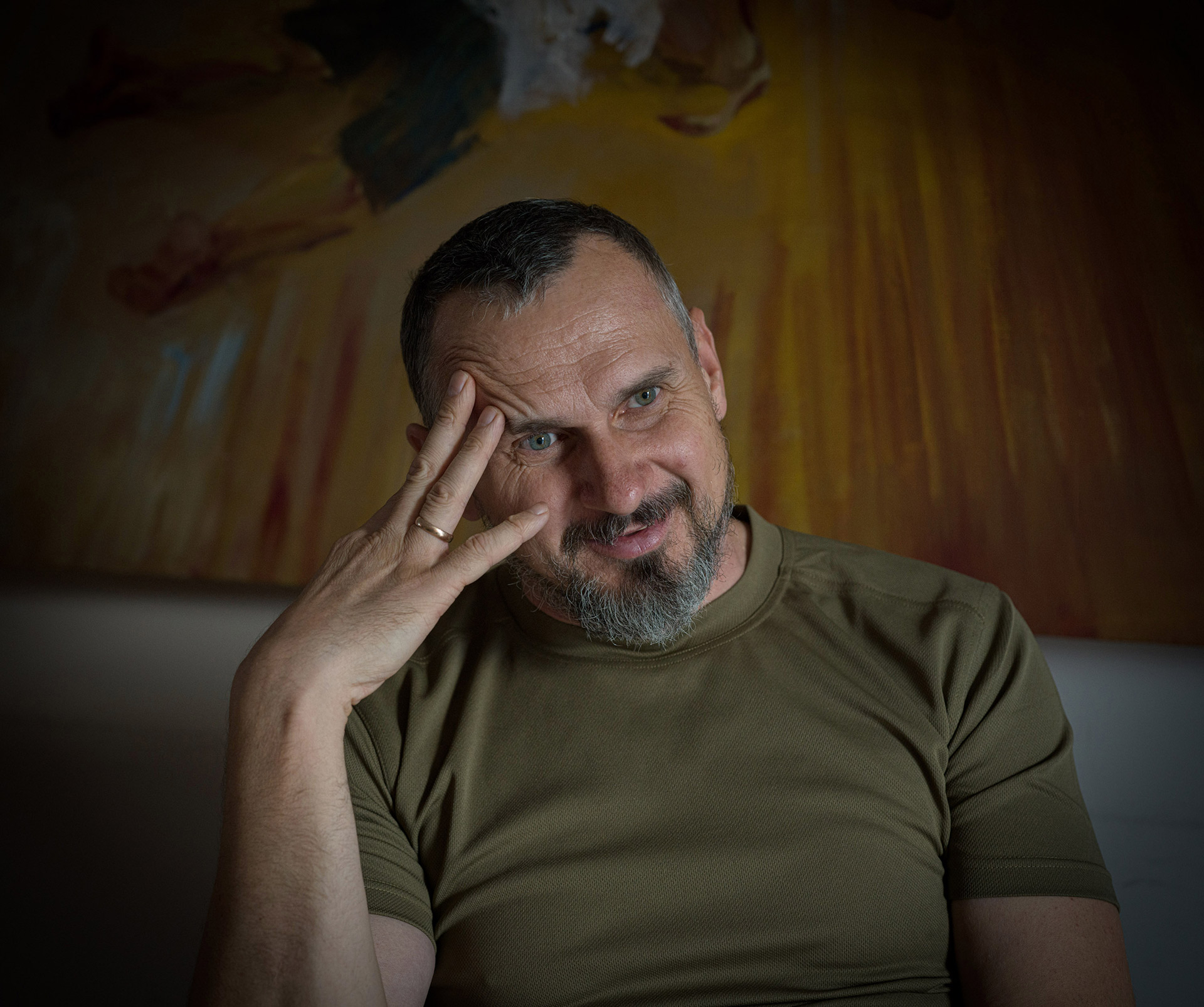
Sentsov is one of those who is no less eloquent in silence than in speech. It’s all on his face. Sometimes during a conversation he breaks into a smile; sometimes you’re not sure if a chair won’t fly at you in response.Sometimes, through the “rhino hide,” you can see the features of the boy from his old story, hopping on one leg after his grandfather on a bicycle, not caring how it looks from the outside.
I ask, how is that inner boy of his doing?
– It’s hard for me to say if he’s hopping on one leg. But one thing’s for sure: I don’t care what people think of me.
Today I was at a funeral. At the memorial dinner, a guy I’d rescued while he was wounded came up to me. And he says, “Listen, I was in the hospital, and someone in the ward said you’re such a show-off, always putting on airs. I almost bit his throat off, because you saved my life, and he’s saying stuff like that about you.” There you go—two people. I’m not going to run around trying to prove something to everyone.
I live the way I want to. And let everyone think of me however they see fit. I’ve found a kind of inner harmony within myself. It’s a bit like Buddhism.
Sentsov doesn’t believe in grand statements, the meaning of which everyone interprets in their own way. He doesn’t declare a desire to change, let alone save, the world. And yet he changes it, at least within his immediate sphere of influence. How? Perhaps the point is that he always chooses to follow his own path, to make his own films.
His next film—*Kai*—is about a family in crisis. The time for an artistic film about this war hasn’t come yet, Oleg believes. When that will happen—in 5 years or 10—he doesn’t know. Long distances don’t scare him.
We finish our conversation and say goodbye. I wait to see which foot he’ll take his first step with. The right one. This time not out of protest, but because it comes naturally to him.
That same day, I happen to hear a phrase that seems to have nothing to do with Sentsov, but in reality, it’s about him.
“Mom, I’m leaving so I can get there,” says a seven-year-old child calmly, running late for school, while his mother, on edge, throws a fit of panic and whining.
Sentsov is one of those who leaves so he can get there.
This is an automatic translation generated by DeepL.