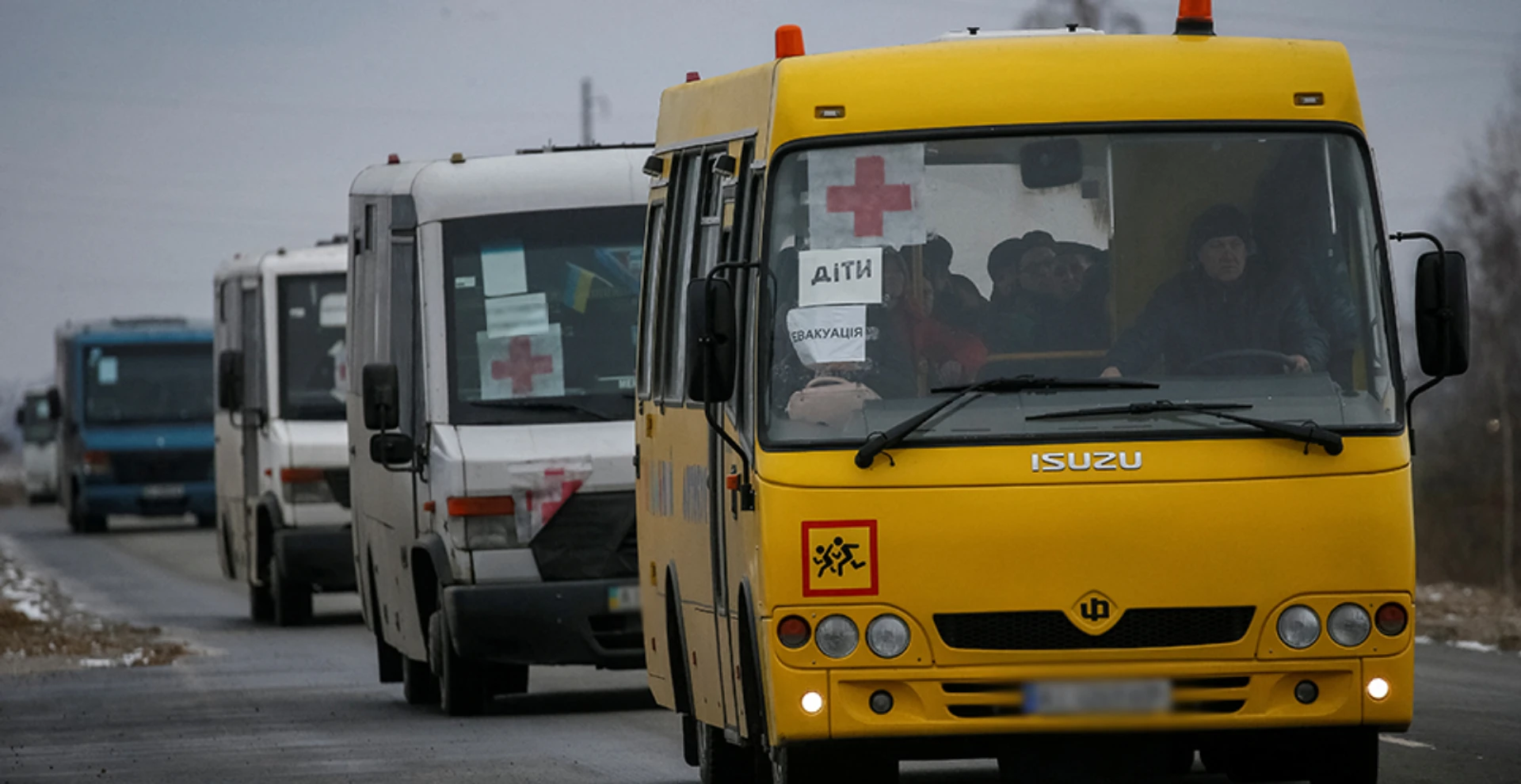
The occupiers have captured 33 volunteers and are charging them with "terrorism". Stories of drivers who saved people in Mariupol
Source: Ukrainska Pravda
Author: Olena Barsukova
Mariupol is a symbol of hell in this great war. Russian troops destroyed it, not even allowing residents to evacuate.
The occupiers opened fire on the “green corridors” many times, so organized evacuations were thwarted.
Mariupol residents tried to flee the city on their own—volunteer drivers came to their aid.
Risking their lives, they ventured into the very heart of the war to rescue people.
The drivers brought humanitarian aid to Mariupol, evacuated people—including women and seniors—from the devastated city, and tried to save their loved ones from the bombings.
Russian occupiers have been holding at least 33 volunteer drivers captive for over two months. At least two of them require immediate medical attention.
At first, the volunteers were held in occupied Olenivka, but were later transferred to a detention center in Donetsk.
The occupiers are charging the captive drivers with “terrorism” and want to imprison them for terms ranging from 5 to 10 years. The families have no contact with the drivers.
“Ukrainska Pravda. Life" has learned the stories of the people who were taken captive while rescuing Mariupol residents.
We spoke with the relatives of the captives, as well as with a woman who was rescued by one of the drivers.
Vitaliy Sitnikov is a resident of Mariupol who worked as a taxi driver.
Alevtina Shvetsova, a journalist for "Mariupol Television" and his girlfriend, told us about his efforts to help the city’s residents during the full-scale war.
Here is her account.
"Vitalik drove people around completely free of charge"
Vitaliy Sitnikov and I have known each other for a long time; we’re both from Mariupol. Recently, Vitalik had been working as a taxi driver. When shelling began in Mariupol on February 24, he continued to drive people around.
At that time, taxi drivers were afraid to drive into areas under fire, or they charged 10 times the usual fare. For example, if a certain route cost 100 hryvnias before the war, on February 24–25 that trip was priced at a thousand or a thousand and a half.
But Vitalik drove people around completely for free. He sincerely responded to his friends’ requests to go pick up someone’s mother, grandmother, or relatives. He was able to find out if people caught in the shelling were safe while there was still a connection.
Vitalik transported people from the most dangerous areas. Then, unfortunately, we lost contact, and I was only able to reach him again after our family had managed to get out of Mariupol.
He also evacuated his own family in mid-March, but he couldn’t just sit idly by in Dnipro. He started looking for ways to help people evacuate from the cities.
"Absolutely all the volunteers in captivity are civilians"
People around the world began to learn what was happening in Mariupol and that the organized evacuation was falling apart. There were announcements on social media calling for volunteers to staff small buses that needed to be sent to pick up people. For example, to go to a specific location and pick up people who were left in a particular basement with no food or water. In particular, many children and their mothers needed help.
Vitalik joined exactly such a volunteer initiative. He left his own car behind because a minibus could transport more people. So he went to Mariupol to pick up civilians. He managed to evacuate 15 people from the occupied city.
According to Vitalik’s mother, he was detained at a checkpoint in Nikolskoye. We last spoke on March 26, when he was leaving Zaporizhzhia for Mariupol. At first, other volunteers reported that the drivers would be held for a month for verification. Then this period was extended by another month. We have had no contact with Vitalik during this entire time.
All the volunteers who are being held captive—absolutely all of them—are civilians. There are no military personnel among them. They were all either traveling to rescue their relatives or loved ones, or, like Vitalik, were rescuing Mariupol residents. They went because they knew how many people were under fire.
59-year-old Yuriy Lega was taken captive when he went to Mariupol to pick up his sister.
Yuriy’s story was shared by his wife, Olga Lega.
Here is her account:
“He said: ‘If I can’t get my sister out, at least I’ll help other people.’”
My husband’s sister lives in Mariupol. When active hostilities began, he decided to pick her up and bring her to Zaporizhzhia, where we live. On March 26, he left for Mariupol with a convoy of volunteers. The last call I received from him was on March 27. It was my birthday, and he was still in territory controlled by Ukraine. He called to wish me a happy birthday.
On March 31, a volunteer who had traveled with him came to my home and told me that my husband and another volunteer driver had been detained at a checkpoint in Nikolskoye “for inspection.” She said we had to wait a few days: he would pass the check and return home. I was worried, but I didn’t think it would turn into such a tragedy. He has been held captive in Olenivka for almost three months now. There is no contact with him.
In April, I received a call from an unknown man who had been released from captivity. He told me that Yuriy is alive. I’m in tears, my hands are shaking. I asked how things were there, what the conditions were—the man simply replied, “Like in prison.” He also said that Yuriy is a wonderful and strong person, that he’s holding on.
I understand—they won’t share details so as not to upset us too much. The main thing is that he’s alive. And it’s important that he doesn’t lose heart.
“I protected him; I didn’t want him to go”
Yuriy is the oldest one there, having just undergone a complicated kidney surgery. He had just been discharged from the hospital—they operated on him after the war had already started. The stitches had barely healed, and he left…
Of course, I protected him; I didn’t want him to go. But I also understand that his sister and her family are there. He said, “If I can’t get my sister out, at least I’ll help other people”—and that’s exactly what happened. He got more than 20 people out, two of them very elderly men, between 80 and 90 years old. But as soon as he left Mariupol, he was detained.
Volunteers said that these people were later picked up by other minibuses, and then volunteers from Zaporizhzhia provided additional assistance. My husband’s sister briefly got in touch—she’s at home with her family, and the house is intact.
I’ve already reached out everywhere—to all the organizations and centers involved in the release of prisoners; I’ve submitted applications to nine organizations. But they all say my husband isn’t on the exchange lists, so they can’t exchange him.
Both the Red Cross and the UN write back to me: “We have received your application, we sympathize, thank you for reaching out,” and that’s it.
I want the President and all government agencies to know about this, so they don’t abandon our men who saved people’s lives. Risking their own lives, they evacuated people and asked for nothing in return. They are heroes!
One of those who managed to escape from Mariupol to Zaporizhzhia was 52-year-old Oksana (name changed for security reasons).
She is grateful for her rescue to driver Volodymyr Hnatovskyi, who took her out of the city in March.
Here is her account.
"Half the house was gone because of a fire after an airstrike"
I lived in the center of Mariupol. The Russian military "bombed" us relentlessly, you know. Everything was shaking, burning; there was shelling from ships and aircraft.
We had a five-story building with four entrances. On the first floor was a dental office with a basement. We’d been hiding there since around March 3. Some people came to spend the night, others waited out the shelling. I started going there to spend the night starting on March 5, because I lived alone, and it’s still more fun in company with people.
There were about 100 people in that basement: pregnant women, the sick, and the paralyzed. Everyone helped each other as best they could. We cooked over an open fire. The feeling of hunger was stronger than the feeling of fear. When we were being bombed, we cooked food because we were so hungry. And by March 24, half the building was gone due to a fire following an airstrike.
The entrance to the building was destroyed. On the 24th, around 6 p.m., a fire broke out in our building. We were saved by a miracle, with God’s help. We went to live in another basement.
Next, we had to do something, because staying in Mariupol wasn’t an option. On March 27, we were planning to walk to Melekine—a suburb of Mariupol. You don’t realize that everything is destroyed. It’s all rebar; there’s no asphalt. You think you’ll walk on the asphalt, but no. We spent a few days getting our bearings, planning to walk. And at that time, we were still living in the basement.
“Volodya was sent to us by God”
In our basement, groups formed—sort of like “interest clubs.” A neighbor we’d become friends with went out for a smoke. He looks up—there’s a minibus with red crosses on it. And then Volodymyr turns to him and gives an address:
— I need to go there, to get some people.
– You won’t get through there; there’s fighting going on. You’d better take us.
– Alright, let’s go.
In literally five minutes, we jumped onto that bus, threw our things in, and helped each other—the old, the young. Everyone was praying. The elderly, the women, and the men. We drove through checkpoints. Dirty, hungry, terrified, coming from the fire—it was just horrific. The checkpoints were “DPR” ones. Our army wasn’t there because this is the western part of Mariupol, which had already been occupied.
If it had been peacetime, the drive from Mariupol would have taken maybe 30 minutes, but since everything was destroyed and there were checkpoints, the trip took a long time. A man was sitting next to me—he was about 60 years old; I don’t even remember his name. The whole way, the entire time we were driving, he kept saying: “God, Volodya is so brave. I take my hat off to him. I couldn’t have done that. I wouldn’t have wanted to, even for a lot of money—I couldn’t have gone—but Volodya didn’t take a penny from us.”
Volodya was sent
to us by God.
People who haven’t been through this might think: well, the bus arrived, so we went, and what’s the big deal? But, first of all, the road is dangerous. Second, it’s impossible to get to the city center. I don’t know how he managed to drive through there.
“We practically bared our teeth at that soldier”
Generally, we passed through the checkpoints without issue, because you’d look at us and, as they say, “one look and you’d back off.” Everyone was exhausted, ragged, looking like they’d been taken down from the cross. Then there was the checkpoint before Mangush. They stopped Volodya. This well-fed guy (an occupier—ed.) gets into the van; I don’t know if he’s a “DNR” guy or a Russian. At the checkpoints, all the Russian soldiers were exhausted and dirty. But this one was so well-fed, so polished. And he started giving Volodya a hard time, saying, “You’re raking in the cash here”—he started accusing him of driving for money.
We all glared at this soldier. One woman started crying, saying, “What are you talking about, money! Everything was free.” Volodymyr didn’t take a single penny from us! We’re so grateful to him.
There wasn’t even any talk of paying. We don’t have any money—we’re from the fire! Even if people did have money, it was on their cards, but there was no electricity, and you couldn’t even physically withdraw money in Mariupol.
Then we traveled from Mangush with volunteers as well. From there, the buses were mostly headed for Rostov and Donetsk. And I really didn’t want to go there. I thought, “God, help me.” I’m walking, turn the corner, and there are three minibuses standing there. I asked the guys, “Which way?” They said to Zaporizhzhia. Can you believe it! Not to Russia, but to Zaporizhzhia. These guys took us in three buses and didn’t charge a single penny.
I know that Vladimir went on more trips after that; he was saving people. As far as I understand, he was taken prisoner at the end of March.
(Oksana is currently in touch with Vladimir’s sister. They write to each other, call one another, and share news about the driver-rescuer. They are eagerly awaiting his return home – ed.)
Author: Olena Barsukova
Mariupol is a symbol of hell in this great war. Russian troops destroyed it, not even allowing residents to evacuate.
The occupiers opened fire on the “green corridors” many times, so organized evacuations were thwarted.
Mariupol residents tried to flee the city on their own—volunteer drivers came to their aid.
Risking their lives, they ventured into the very heart of the war to rescue people.
The drivers brought humanitarian aid to Mariupol, evacuated people—including women and seniors—from the devastated city, and tried to save their loved ones from the bombings.
Russian occupiers have been holding at least 33 volunteer drivers captive for over two months. At least two of them require immediate medical attention.
At first, the volunteers were held in occupied Olenivka, but were later transferred to a detention center in Donetsk.
The occupiers are charging the captive drivers with “terrorism” and want to imprison them for terms ranging from 5 to 10 years. The families have no contact with the drivers.
“Ukrainska Pravda. Life" has learned the stories of the people who were taken captive while rescuing Mariupol residents.
We spoke with the relatives of the captives, as well as with a woman who was rescued by one of the drivers.
Story 1: Vitaliy Sitnikov
Vitaliy Sitnikov is a resident of Mariupol who worked as a taxi driver.
Alevtina Shvetsova, a journalist for "Mariupol Television" and his girlfriend, told us about his efforts to help the city’s residents during the full-scale war.
Here is her account.
"Vitalik drove people around completely free of charge"
Vitaliy Sitnikov and I have known each other for a long time; we’re both from Mariupol. Recently, Vitalik had been working as a taxi driver. When shelling began in Mariupol on February 24, he continued to drive people around.
At that time, taxi drivers were afraid to drive into areas under fire, or they charged 10 times the usual fare. For example, if a certain route cost 100 hryvnias before the war, on February 24–25 that trip was priced at a thousand or a thousand and a half.
But Vitalik drove people around completely for free. He sincerely responded to his friends’ requests to go pick up someone’s mother, grandmother, or relatives. He was able to find out if people caught in the shelling were safe while there was still a connection.
Vitalik transported people from the most dangerous areas. Then, unfortunately, we lost contact, and I was only able to reach him again after our family had managed to get out of Mariupol.
He also evacuated his own family in mid-March, but he couldn’t just sit idly by in Dnipro. He started looking for ways to help people evacuate from the cities.
"Absolutely all the volunteers in captivity are civilians"
People around the world began to learn what was happening in Mariupol and that the organized evacuation was falling apart. There were announcements on social media calling for volunteers to staff small buses that needed to be sent to pick up people. For example, to go to a specific location and pick up people who were left in a particular basement with no food or water. In particular, many children and their mothers needed help.
Vitalik joined exactly such a volunteer initiative. He left his own car behind because a minibus could transport more people. So he went to Mariupol to pick up civilians. He managed to evacuate 15 people from the occupied city.
According to Vitalik’s mother, he was detained at a checkpoint in Nikolskoye. We last spoke on March 26, when he was leaving Zaporizhzhia for Mariupol. At first, other volunteers reported that the drivers would be held for a month for verification. Then this period was extended by another month. We have had no contact with Vitalik during this entire time.
All the volunteers who are being held captive—absolutely all of them—are civilians. There are no military personnel among them. They were all either traveling to rescue their relatives or loved ones, or, like Vitalik, were rescuing Mariupol residents. They went because they knew how many people were under fire.
Story 2: Yuriy Lega
59-year-old Yuriy Lega was taken captive when he went to Mariupol to pick up his sister.
Yuriy’s story was shared by his wife, Olga Lega.
Here is her account:
“He said: ‘If I can’t get my sister out, at least I’ll help other people.’”
My husband’s sister lives in Mariupol. When active hostilities began, he decided to pick her up and bring her to Zaporizhzhia, where we live. On March 26, he left for Mariupol with a convoy of volunteers. The last call I received from him was on March 27. It was my birthday, and he was still in territory controlled by Ukraine. He called to wish me a happy birthday.
On March 31, a volunteer who had traveled with him came to my home and told me that my husband and another volunteer driver had been detained at a checkpoint in Nikolskoye “for inspection.” She said we had to wait a few days: he would pass the check and return home. I was worried, but I didn’t think it would turn into such a tragedy. He has been held captive in Olenivka for almost three months now. There is no contact with him.
In April, I received a call from an unknown man who had been released from captivity. He told me that Yuriy is alive. I’m in tears, my hands are shaking. I asked how things were there, what the conditions were—the man simply replied, “Like in prison.” He also said that Yuriy is a wonderful and strong person, that he’s holding on.
I understand—they won’t share details so as not to upset us too much. The main thing is that he’s alive. And it’s important that he doesn’t lose heart.
“I protected him; I didn’t want him to go”
Yuriy is the oldest one there, having just undergone a complicated kidney surgery. He had just been discharged from the hospital—they operated on him after the war had already started. The stitches had barely healed, and he left…
Of course, I protected him; I didn’t want him to go. But I also understand that his sister and her family are there. He said, “If I can’t get my sister out, at least I’ll help other people”—and that’s exactly what happened. He got more than 20 people out, two of them very elderly men, between 80 and 90 years old. But as soon as he left Mariupol, he was detained.
Volunteers said that these people were later picked up by other minibuses, and then volunteers from Zaporizhzhia provided additional assistance. My husband’s sister briefly got in touch—she’s at home with her family, and the house is intact.
I’ve already reached out everywhere—to all the organizations and centers involved in the release of prisoners; I’ve submitted applications to nine organizations. But they all say my husband isn’t on the exchange lists, so they can’t exchange him.
Both the Red Cross and the UN write back to me: “We have received your application, we sympathize, thank you for reaching out,” and that’s it.
I want the President and all government agencies to know about this, so they don’t abandon our men who saved people’s lives. Risking their own lives, they evacuated people and asked for nothing in return. They are heroes!
Story 3: Volodymyr Hnatovskyi
One of those who managed to escape from Mariupol to Zaporizhzhia was 52-year-old Oksana (name changed for security reasons).
She is grateful for her rescue to driver Volodymyr Hnatovskyi, who took her out of the city in March.
Here is her account.
"Half the house was gone because of a fire after an airstrike"
I lived in the center of Mariupol. The Russian military "bombed" us relentlessly, you know. Everything was shaking, burning; there was shelling from ships and aircraft.
We had a five-story building with four entrances. On the first floor was a dental office with a basement. We’d been hiding there since around March 3. Some people came to spend the night, others waited out the shelling. I started going there to spend the night starting on March 5, because I lived alone, and it’s still more fun in company with people.
There were about 100 people in that basement: pregnant women, the sick, and the paralyzed. Everyone helped each other as best they could. We cooked over an open fire. The feeling of hunger was stronger than the feeling of fear. When we were being bombed, we cooked food because we were so hungry. And by March 24, half the building was gone due to a fire following an airstrike.
The entrance to the building was destroyed. On the 24th, around 6 p.m., a fire broke out in our building. We were saved by a miracle, with God’s help. We went to live in another basement.
Next, we had to do something, because staying in Mariupol wasn’t an option. On March 27, we were planning to walk to Melekine—a suburb of Mariupol. You don’t realize that everything is destroyed. It’s all rebar; there’s no asphalt. You think you’ll walk on the asphalt, but no. We spent a few days getting our bearings, planning to walk. And at that time, we were still living in the basement.
“Volodya was sent to us by God”
In our basement, groups formed—sort of like “interest clubs.” A neighbor we’d become friends with went out for a smoke. He looks up—there’s a minibus with red crosses on it. And then Volodymyr turns to him and gives an address:
— I need to go there, to get some people.
– You won’t get through there; there’s fighting going on. You’d better take us.
– Alright, let’s go.
In literally five minutes, we jumped onto that bus, threw our things in, and helped each other—the old, the young. Everyone was praying. The elderly, the women, and the men. We drove through checkpoints. Dirty, hungry, terrified, coming from the fire—it was just horrific. The checkpoints were “DPR” ones. Our army wasn’t there because this is the western part of Mariupol, which had already been occupied.
If it had been peacetime, the drive from Mariupol would have taken maybe 30 minutes, but since everything was destroyed and there were checkpoints, the trip took a long time. A man was sitting next to me—he was about 60 years old; I don’t even remember his name. The whole way, the entire time we were driving, he kept saying: “God, Volodya is so brave. I take my hat off to him. I couldn’t have done that. I wouldn’t have wanted to, even for a lot of money—I couldn’t have gone—but Volodya didn’t take a penny from us.”
Volodya was sent
to us by God.
People who haven’t been through this might think: well, the bus arrived, so we went, and what’s the big deal? But, first of all, the road is dangerous. Second, it’s impossible to get to the city center. I don’t know how he managed to drive through there.
“We practically bared our teeth at that soldier”
Generally, we passed through the checkpoints without issue, because you’d look at us and, as they say, “one look and you’d back off.” Everyone was exhausted, ragged, looking like they’d been taken down from the cross. Then there was the checkpoint before Mangush. They stopped Volodya. This well-fed guy (an occupier—ed.) gets into the van; I don’t know if he’s a “DNR” guy or a Russian. At the checkpoints, all the Russian soldiers were exhausted and dirty. But this one was so well-fed, so polished. And he started giving Volodya a hard time, saying, “You’re raking in the cash here”—he started accusing him of driving for money.
We all glared at this soldier. One woman started crying, saying, “What are you talking about, money! Everything was free.” Volodymyr didn’t take a single penny from us! We’re so grateful to him.
There wasn’t even any talk of paying. We don’t have any money—we’re from the fire! Even if people did have money, it was on their cards, but there was no electricity, and you couldn’t even physically withdraw money in Mariupol.
Then we traveled from Mangush with volunteers as well. From there, the buses were mostly headed for Rostov and Donetsk. And I really didn’t want to go there. I thought, “God, help me.” I’m walking, turn the corner, and there are three minibuses standing there. I asked the guys, “Which way?” They said to Zaporizhzhia. Can you believe it! Not to Russia, but to Zaporizhzhia. These guys took us in three buses and didn’t charge a single penny.
I know that Vladimir went on more trips after that; he was saving people. As far as I understand, he was taken prisoner at the end of March.
(Oksana is currently in touch with Vladimir’s sister. They write to each other, call one another, and share news about the driver-rescuer. They are eagerly awaiting his return home – ed.)
A volunteer is not a terrorist
At first, the families of those detained did not disclose information about their relatives so as not to endanger them.
“They were told that they would be under investigation for a month. The relatives didn’t raise the alarm so they wouldn’t be harmed. They waited a month, then this period was extended to two months,” says journalist Alevtina Shvetsova.
The volunteers were held at the site of the former penal colony No. 120 in the occupied village of Olenivka in the Donetsk region, and later began to be transferred to a pretrial detention center in Donetsk.
The occupiers are charging the drivers with “participation in a terrorist group.” Under the “legislation” of the so-called “DPR,” the men could face prison terms ranging from 5 to 10 years.
“Their loved ones realized that if they kept quiet about this situation, the men could be put behind bars for such a long time simply for volunteering, for having a good heart, and for the good deeds they did,” says Alevtina.
That is exactly how the “Volunteer Is Not a Terrorist” campaign began.
The families of the captive drivers are trying to let the world know what happened to their loved ones and to seek justice.
"This is what sparked the comments from relatives, which they are now actively sharing with the media to show that we know about the volunteer drivers in captivity," the journalist emphasizes.
Who is being held captive by the occupiers?
Currently, at least 33 captive drivers are known, but the relatives have not yet disclosed the name of one of them. The youngest of the volunteers is 21, and the oldest is 59.
The captives’ relatives have released the following list:
Ruslan Maratovich Akhmetov, March 24, 1989;
Bogdan Bogonyuk;
Dmytro Yevhenovych Bodrov, 09/20/1989;
Kostyantyn Viktorovych Velychko, 01/16/1981;
Hanna Mykolayivna Vorosheva, 05/31/1976;
Stanislav Oleksandrovych Glushkov, April 10, 1986;
Volodymyr Ivanovych Hnatovskyi, May 27, 1972;
Pavlo Homzikov;
Vladislav Viktorovich Domashniy;
Roman Vasilyevich Dyakonov, April 20, 1983;
Sergey Ivasyuk;
Dmitry Yevgenyevich Kapsha, August 27, 1990;
Serhiy Karpachov;
Stanislav Borysovych Kartmazov, February 5, 1987;
Oleksandr Mykolayovych Kysilov, July 24, 1992;
Serhiy Klevets;
Yuriy Oleksandrovych Kotlyarov, January 30, 1980;
Yuriy Fedorovych Lega, December 20, 1962;
Serhiy Lanovych Lin, October 12, 1970;
Malyarchuk Yevgen Serhiyovych;
Matviyenko Nikita Serhiyovych;
Myarkivsky Denys;
Andriy Volodymyrovych Parkhomenko;
Oleg Volodymyrovych Prykhodko;
Vitaliy Serhiyovych Sitnikov;
Ihor Talalay;
Serhiy Tarashchenko;
Roman Serhiyovych Filonov;
Anton Serhiyovych Filipenko;
Vladyslav Volodymyrovych Shabanets;
Bogdan Oleksandrovych Shalvinsky;
Valeriy Serhiyovych Yadrishnikov.
What demands are the relatives of the captives making?
Despite the fact that the volunteers are effectively being held captive, they are not included on any lists.
Therefore, the families are demanding that the ORDO acknowledge that the drivers are on their territory and include them in the exchange lists.
"We would like to know the conditions under which the volunteer drivers are currently being held. We would like to know why they are there, since no charges have been brought against them. We want them to be included in the lists and subsequently released. It is unclear what the Russians are accusing them of or what evidence they are using,” says Alevtina.
The families of the captives are calling on the Russian occupiers to grant doctors and human rights organizations access to the captives.
"We are asking that volunteers from the International Committee of the Red Cross be allowed to visit them, as at least two of them need immediate medical attention," the journalist adds.
One of the drivers has a pacemaker, and driver Anna Vorosheva has an infection in her braces, which were supposed to be removed back in March.
“We are certain that they also need psychological support, as they have no contact with their families,” the journalist explains.
The drivers’ relatives know nothing about their health, just as the captives do not know whether their loved ones, who are under occupation or in a combat zone, are safe.
Some of the drivers went to Mariupol to pick up their loved ones but were unable to get them out of the city.
"There is no contact with anyone. This is scattered information that came in as early as April from people who were released from the penal colony. One young man was seen in a video on a Russian Telegram channel.
We can’t call them directly to find out their condition or get information that would give us the full picture. But evidence that these men and the woman are in Olenivka has been gathered from numerous testimonies," Alevtina emphasizes.
The families of the captured drivers are communicating with human rights activists and the SBU, and are also awaiting information from the International Committee of the Red Cross.
According to Alevtina, the organization stated that they are currently actively working on the cases of the captives from Azovstal, so their requests will be reviewed later.
Relatives of the captives are also sending numerous inquiries to the Investigative Committee of the Russian Federation, but they remain unanswered.
“The inquiries require confirmation of kinship and the submission of certain documents. Relatives are currently handling this. For some, it’s a shock, because they have to set up a VPN to submit requests on Russian websites, pay exorbitant fees to call +7 numbers, and install special apps to reach hotlines regarding the prisoners,” Alevtina explains.
So far, no representatives of the aggressor country, the Russian Federation, have contacted the relatives of the prisoners.
"We don’t get a response when we contact the ‘ombudsman’ of the so-called ‘DPR’ (the occupiers appointed Daria Morozova as ‘ombudsman’—ed.).
But we understand that if we want to see our drivers, we’ll have to communicate with that side,” the journalist says.
The families of the volunteers are calling on the international community and the Ukrainian government to help free their loved ones.
This is an automatic translation generated by DeepL.