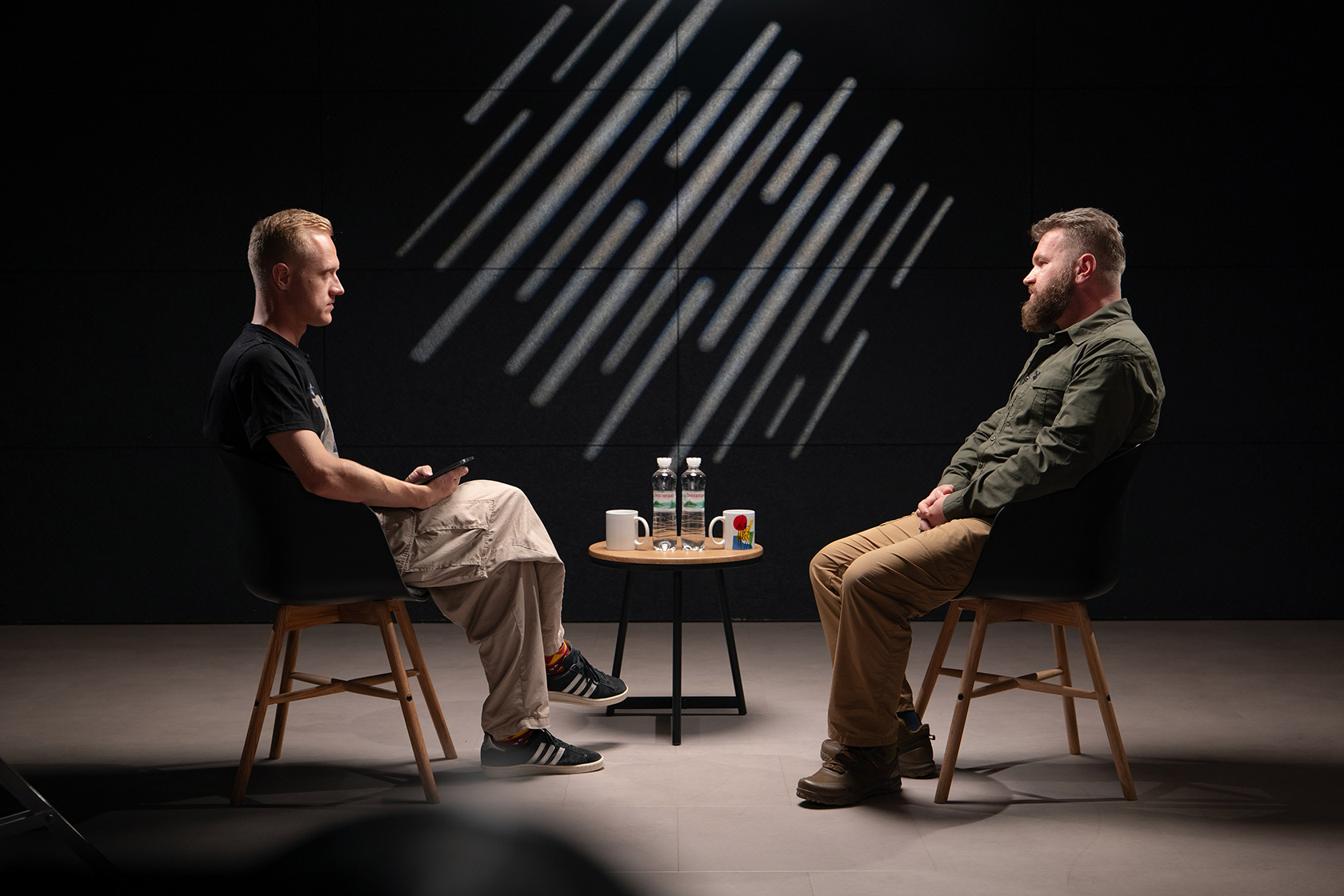
Svyatoslav "Kalyna" Palamar about Pokrovske direction, siege and exit from Azovstal, Olenivka, Lefortovo and stay in Turkey
Source: Ukrainska Pravda
Author: Roman Kravets
Throughout 2022–2023, the leadership of the Azov Regiment faced trials that will be the subject of books and films.
This is a story of a struggle lasting several months under inhuman conditions, sacrifice, Russian captivity, a stay in Turkey, a return to duty, memory, and an unstoppable desire for revenge.
“Kalyna” is part of this story.
Recently, his unit has expanded and become the 1st Corps of the Azov National Guard. The corps’ soldiers are holding the line in Donetsk Oblast on several fronts simultaneously.
In his first interview with "Ukrainska Pravda" since 2022, Sviatoslav Palamar talks about the loss of his comrades at "Azovstal," Denys Prokopenko’s difficult negotiations with the enemy, the Russians’ constant deception, a solitary confinement cell in "Lefortovo," an unexpected meeting with Medvedchuk, the conditions of his stay in Turkey, and his return to Ukraine on the presidential plane.
Kalyna also discusses the situation on the Pokrovsk front, analyzes changes in enemy tactics, and the recent transformation of the Ukrainian military.
Below is an abridged version of the conversation for reading. You can view the full version in video format.
If you prefer to watch the video with subtitles in another language, go to YouTube Settings → Subtitles → Auto-translate and select the desired language.
Author: Roman Kravets
Throughout 2022–2023, the leadership of the Azov Regiment faced trials that will be the subject of books and films.
This is a story of a struggle lasting several months under inhuman conditions, sacrifice, Russian captivity, a stay in Turkey, a return to duty, memory, and an unstoppable desire for revenge.
“Kalyna” is part of this story.
Recently, his unit has expanded and become the 1st Corps of the Azov National Guard. The corps’ soldiers are holding the line in Donetsk Oblast on several fronts simultaneously.
In his first interview with "Ukrainska Pravda" since 2022, Sviatoslav Palamar talks about the loss of his comrades at "Azovstal," Denys Prokopenko’s difficult negotiations with the enemy, the Russians’ constant deception, a solitary confinement cell in "Lefortovo," an unexpected meeting with Medvedchuk, the conditions of his stay in Turkey, and his return to Ukraine on the presidential plane.
Kalyna also discusses the situation on the Pokrovsk front, analyzes changes in enemy tactics, and the recent transformation of the Ukrainian military.
Below is an abridged version of the conversation for reading. You can view the full version in video format.
If you prefer to watch the video with subtitles in another language, go to YouTube Settings → Subtitles → Auto-translate and select the desired language.
"They were successfully advancing in the Pokrovske direction. Now they are getting normal traction"
– Let’s start with the current situation in the Pokrovsk sector, where the 1st Corps of the National Guard “Azov” is currently deployed. How would you describe what is happening there?
– Regarding the operational zone of the 1st Corps of the National Guard “Azov,” the situation was quite critical by the time we arrived there, that is, by August 4. As could be seen even on the DeepState map, the enemy was advancing there. We managed to improve the command and organization of our troops and strengthen our defenses.
The problem with this sector is that it is currently the main target of two enemy armies—the 51st and 8th.
They have no particular problems with replenishing their personnel. We defeat them, they withdraw for regrouping, then quickly replenish their ranks and advance again.
But overall, the situation is much better than it was before we entered the area.
During this period, enemy losses were approximately as follows: over 1,600 soldiers, about 800 non-commissioned officers, and 58 prisoners of war.
On a related note—we recently captured a prisoner from Polohy in the Zaporizhzhia region, a young man born in 1997 who was forcibly conscripted into our enemy’s army. And that speaks volumes about the cynicism of our enemy.
– You know what we’re strong in? In our people who are participating in combat operations and who are growing. It’s important to note the generation of young officers, young soldiers, and sergeants who have been fighting since 2014; they have tremendous experience.
I’d also highlight the technological aspect, where we’re very strong.
As for the enemy, they adapt and scale up quickly. That’s something they’re good at. Perhaps in a totalitarian state, this is done much more quickly.
– (Pauses to think) I think it’s in their motivation. For them, it’s about money and the fear of being killed for disobeying orders.
– Well, I wouldn’t put it that way. In 2022, when we took Russian officers and even ordinary soldiers prisoner, they believed what they were told on TV. That Ukraine needed to be saved, that they were going to “liberate” something. There are no such people left now.
– They’re all actually the same. There is a difference in how they were at the beginning, because it was a fairly professional army. But now, the vast majority are a rabble.
For example, if we’re talking about our sector, about 60% of the people fighting against us are mobilized from the temporarily occupied territories. And not just Donetsk and Luhansk, which have been under occupation for a long time, but, for example, the Zaporizhzhia region.
They aren’t very motivated. A lot depends on who is standing against them. For example, we have neutralized their offensive potential in our sector. They have lost the initiative on the battlefield, and from radio intercepts we hear that their morale is quite low.
Whereas before they were advancing successfully, now they are taking a real beating. And as a result, we hear from intercepts that they’re being forced to launch assaults. They refuse, and they’re told they’ll be shot, that their own mortars will shell them. They’re actually torturing and killing their own people. There are also tons of videos online showing how they treat their own. It’s all true.
– Regarding the operational zone of the 1st Corps of the National Guard “Azov,” the situation was quite critical by the time we arrived there, that is, by August 4. As could be seen even on the DeepState map, the enemy was advancing there. We managed to improve the command and organization of our troops and strengthen our defenses.
The problem with this sector is that it is currently the main target of two enemy armies—the 51st and 8th.
They have no particular problems with replenishing their personnel. We defeat them, they withdraw for regrouping, then quickly replenish their ranks and advance again.
But overall, the situation is much better than it was before we entered the area.
During this period, enemy losses were approximately as follows: over 1,600 soldiers, about 800 non-commissioned officers, and 58 prisoners of war.
On a related note—we recently captured a prisoner from Polohy in the Zaporizhzhia region, a young man born in 1997 who was forcibly conscripted into our enemy’s army. And that speaks volumes about the cynicism of our enemy.
– In your opinion, what conclusions can be drawn about the Ukrainian military during this full-scale war? Where are we strong, and where do we still need to improve?
– You know what we’re strong in? In our people who are participating in combat operations and who are growing. It’s important to note the generation of young officers, young soldiers, and sergeants who have been fighting since 2014; they have tremendous experience.
I’d also highlight the technological aspect, where we’re very strong.
As for the enemy, they adapt and scale up quickly. That’s something they’re good at. Perhaps in a totalitarian state, this is done much more quickly.
– And what are their weaknesses?
– (Pauses to think) I think it’s in their motivation. For them, it’s about money and the fear of being killed for disobeying orders.
– So nothing changes?
– Well, I wouldn’t put it that way. In 2022, when we took Russian officers and even ordinary soldiers prisoner, they believed what they were told on TV. That Ukraine needed to be saved, that they were going to “liberate” something. There are no such people left now.
– What stands out to you about the prisoners now? Did anyone surprise you?
– They’re all actually the same. There is a difference in how they were at the beginning, because it was a fairly professional army. But now, the vast majority are a rabble.
For example, if we’re talking about our sector, about 60% of the people fighting against us are mobilized from the temporarily occupied territories. And not just Donetsk and Luhansk, which have been under occupation for a long time, but, for example, the Zaporizhzhia region.
They aren’t very motivated. A lot depends on who is standing against them. For example, we have neutralized their offensive potential in our sector. They have lost the initiative on the battlefield, and from radio intercepts we hear that their morale is quite low.
Whereas before they were advancing successfully, now they are taking a real beating. And as a result, we hear from intercepts that they’re being forced to launch assaults. They refuse, and they’re told they’ll be shot, that their own mortars will shell them. They’re actually torturing and killing their own people. There are also tons of videos online showing how they treat their own. It’s all true.
"When there was no internet in Mariupol, we printed news on A4 and it kept people engaged."
– I’d like to talk about Mariupol. As it happens, I’ve never been to Mariupol, but I hope to visit someday. Can you tell me what kind of city it was before 2022?
– The city before 2019 and after is something completely different.
Before that, it was an industrial city. It’s not like Donetsk; it’s still the Azov region, so people’s mindset is different than it was in Donetsk. But Mariupol was industrial and Soviet.
Later, things started to change for the better. Parks, ports, public squares, and a beach were built; benches were installed, and nice sidewalks were laid. Theater troupes would come to town, and there was a classical music festival near the drama theater. And as the city began to look nicer, people started behaving better too. If there were nice playgrounds, you were less likely to run into drunks with a bottle of beer.
– Do you remember the events of 2022? Or does your memory, on the contrary, want to erase them?
– For the most part, tragic events are forgotten.
Well, and now there are so many events that you don’t have time to process it all. Maybe when the war ends, the memories will come back more often. But not now.
We have a lot of responsibility. It’s no longer just responsibility for a single brigade, but for an entire corps, for various brigades.
Our situation is such that only one regular brigade—the “Chervona Kalyna”—is in the corps’ operational zone, while the other brigades are on other fronts. These are the Toretsk, Kupiansk, and Kharkiv directions. And they’re all fighting with dignity.
– The events at Azovstal: for you, is this a tragedy, a symbol of heroism, or an unfinished struggle?
– It is definitely a symbol of heroism.
The defense of Mariupol is a very important component of Ukraine’s overall defense in 2022. The men and women who fought there showed that they were ready to die rather than let the enemy advance.
We understood that by doing so, we were delaying the enemy’s advance in other directions. Perhaps if the enemy had managed to capture Mariupol sooner, all those forces would have moved on to Zaporizhzhia, and the situation there would have been much worse than it is now.
– What was the hardest thing for you personally at Azovstal?
– Losing my brothers-in-arms—that was the hardest part (pauses).
There were a lot of strange things that I never would have thought could happen.
Everything you’ve acquired in life fades into the background; you just don’t care about it anymore. The money you had in your pocket wasn’t needed. But at the same time, when there was no internet in Mariupol, we’d write newsletters right there on A4 paper, where we’d report on the situation in “Greater Ukraine,” describe what was happening on the front lines, and including in Mariupol. And those newsletters went like hotcakes. When you gave them to the guys at their posts—it was so important… (searching for words, visibly moved).
It boosted morale. It was important because, for example, some people’s families were in Zaporizhzhia, some were worried about what was happening in Kyiv, and what was going on in other cities.
I could never have imagined that in the 21st century, information printed on a plain sheet of paper would be so valuable.
– Please tell us more about the helicopter missions of the Main Intelligence Directorate of the Ministry of Defense. To remind readers, they transported ammunition, food, and medical supplies, and then picked up the wounded from the factory grounds on the way back. Can you recall how that happened?
– Those missions should be included in military history textbooks.
Credit must be given to the Army Aviation, the Main Intelligence Directorate, and other units involved in this.
What is important to note? The delivery of weapons, NLAWs—the guys would connect to the internet and learn online how to operate them. We didn’t receive Western equipment until 2022. And the guys were literally learning on the fly and quite effectively destroying enemy equipment and personnel.
Medicines were crucial, because those supplies actually saved hundreds of lives.
Plus, we must mention the personnel reinforcements—that’s how the guys were deployed to us.
But most importantly: if it was dangerous to fly into Mariupol, it was even more dangerous to get back out. And the guys who decided to fly are true heroes.
Evacuating the wounded was also a crucial part of the operation. For example, Mykyta Nadtochii, who is now the deputy corps commander for combat training.
In March 2022, he sustained a very serious injury, but he was successfully evacuated. In Dnipro, at Mechnikov Hospital, Mykyta was quickly treated; he got back on his feet and began commanding a unit on the “mainland” while the defense of Mariupol was still underway. That’s important.
"At Azovstal, we wanted to fight to the end"
– Let’s talk about the evacuation from Azovstal. In order to leave the plant, we had to communicate with the enemy. How did the negotiations between Azov and the Russian GRU proceed?
– There were GRU generals and military commanders present. Our commander, my friend Redis, communicated directly with them. I also know that there were representatives from our special services.
At the time, there were many civilians at the plant, and I appealed to the whole world for their evacuation.
The negotiations were about the civilians and the evacuation of the wounded, and it was also very important for us to retrieve all those killed on the battlefield.
The enemy understood that if they went along with this, we would, so to speak, have a free hand and might do something truly serious. And we wanted to, to be frank. That’s why the negotiations were taking place.
The enemy understood that we were holding back our forces. A direct assault on Azovstal would have resulted in colossal losses for them. Because the system of cover provided us with a fairly prolonged defense.
On the other hand, our situation was dire: food shortages, the wounded, and the enemy trying to force us to cease our defense.
Later, an order was given to cease the defense, and then Redis, along with all the unit commanders present, went to negotiate with representatives of the Russian Federation, where our demands were presented.
They were basically standard things: normal, humane treatment of prisoners, compliance with the Geneva Conventions, and so on. But things turned out the way they did—you know the story.
– Is it true that, in order for the negotiations to take place, armored jeeps would arrive at the Azovstal site, pick up Redis, and take him to a special location in the occupied territory?
– Once, Redis went to negotiations in one of the settlements that were already occupied at that time. That is true.
– When the enemy took your commander to an unknown location without weapons or guards, what were you going through at that moment?
– To be honest, it’s hard to imagine what would have happened if he had been killed or taken prisoner like that.
The entire unit was worried. Everyone was on edge. But Redis is a level-headed person and quite cool-headed in such difficult situations. And he understood all the risks. He made that decision, and it was truly important.
– When Redis was heading into enemy-controlled territory, was there a discussion about who would take command?
– Bohdan Krotevych was the chief of staff at the time. If something had happened to Redis, he would have taken over the defense of Mariupol, but by then all the troops were already inside the Azovstal plant.
– So if, God forbid, something had happened to Redis, would you have fought it out there to the end?
– But we wanted to fight to the end anyway. Redis wasn’t negotiating our surrender, but rather to evacuate the wounded to the “mainland.” If that had been possible, the situation would have been completely different.
"They were really afraid of us in Lefortovo"
– Do you remember your last day at Azovstal? What were you doing, what were you thinking about?
– It was about destroying everything. My phone, other communication devices, all my weapons—I destroyed everything I had. And everyone else was doing the same.
We did everything we could to leave nothing for the enemy. Flash drives, information, anything on paper—we destroyed it all. We were going into captivity. And we couldn’t hide anything there.
– According to the agreements, all the Azov fighters were supposed to be together in one place. That was supposed to be Olenivka, where you personally stayed for only four days. Do you remember how they took you away from Olenivka?
– How did it happen? We were already in the barracks; it was nighttime. I hear: “Redis, come out, for interrogation.”
Then: “Sviatoslav Palamar, come out.” They took me for interrogation; it lasted about two or three hours. Later they brought him back; it was already dawn. And—out, without our belongings.
Then they lined us up. I remember a drone flying overhead, filming us at face level.
Then they put us in prisoner transport vehicles, with bags over our heads and handcuffs. We were riding in that van; the heat was still intense. The road was long; I don’t know exactly how long it took, but it felt like six hours. Then they led us out of the vans. The first one went, then the second, and I just heard—“Oh…”
– Did they beat you?
– Yes. But I thought to myself, if they wanted to execute us, why all this fuss with such a long drive? Then a bag over our heads, duct tape, heads down. And there we were like that for a long time, just like in the movies about Guantanamo. And I could hear the roar of planes.
Then they loaded us onto the plane. I remember two things that worried me. I thought: what about Gandalf in handcuffs? He’s missing an arm. And then I thought—what about Redis? His shoulder was injured—how is he doing?
We flew like that all day—no water, nothing. But then they crammed us into a car and took us to some prison. Where, exactly?
There was a tiny window in the cell; you could only see the sky through it. I figured it must be sunrise, because we’d been flying for a long time—four or five hours—even though I kept passing out and coming to.
They changed my clothes, made me face the wall, gave me a basin, slippers, underwear, a jacket, pants, and all those bags too; hands behind my back, and they led me somewhere into a cell.
And, to be honest, they didn’t bother me at all during that whole time. For about a month, they didn’t touch me at all. I didn’t know where I was, who I was, or what time it was. A little window would open, they’d give me some slop, and the window would close. And that was it.
– What did you do all day?
– I did push-ups, squats, and sang. They’d come in and say, “Shut up already.”
– And what did you sing?
– “Red Viburnum,” “It’s so good, brothers, so good, so good, brothers, to live. With our chieftain, there’s no need to grieve.” It’s so emotional, so loud—it helped me.
They let me read books a couple of times. I remember there was *The Golden Calf*, *To Kill a Mockingbird* by Harper Lee, and *The Brothers Karamazov* by Dostoevsky.
And then they gave me some other Russian drivel, steeped in propaganda about “officers, the Russian army”—nonsense.
I must have worn out the pages: once I read a book, before they took it away, I read it again.
– No access to news, no newspapers?
– When I returned to Ukraine after some time, I met with the brilliant Ukrainian military officer and director Oleg Sentsov. He had also been held in Lefortovo and told me that they were taken out into the courtyard for a walk. I was like, “Wow, so there are courtyards there? You could go out for a walk?” (smiles).
No, the lights are always on; through the little window, you can see day and night—something like that. I took a regular spoon and used it to write words on the table, recalling things, repeating the multiplication table.
Then I’d draw little lines with toothpaste to keep track of the days.
The Russians would come into the cell: “Face the window!” And they’d erase the lines so I wouldn’t know what time it was. Well, objectively speaking, they were afraid of us.
– How did that show?
– In their behavior. They were worried that we might pull something off. And if we’d had the chance, we would have (smiles).
They were overly cautious; they didn’t leave anything unnecessary in the cell.
You know, their GULAG system has been perfected over the years. The floorboards in the hallway are soft so you can’t hear footsteps.
Specific behavior, the sound of a key turning—everything is worked out down to the smallest detail.
"In Turkey, we all lived in the same house and were guarded by the Turkish secret services."
– I was the first to get off the plane. I remember Kirill Budanov was there, the late Denis Monastyrsky, the military attaché, and other people. They escorted me to the ambulance, and I saw Medvedchuk.
– In the ambulance?
– Yes. Medvedchuk was also donating blood. I waited until he finished donating and got out, then I went in myself.
– Why donate blood?
– It’s my first time in a situation like this, hopefully my last (laughs) – I don’t know. It was the Turks who were collecting the blood.
I think the Turkish intelligence services might have been worried that the Russians could poison us with “Novichok” or some other toxins that might show up later.
– You mentioned Medvedchuk in the ambulance. Do you remember what you thought when you saw him?
– Maybe it’s just my emotions. But I really felt a chill coming from him.
– If you had the opportunity to meet with Medvedchuk under different circumstances, without the oversight of the security services or anyone else, what would you do?
– I would meet him in court. I want people like that to be tried.
We must not tolerate any kind of violence. That’s what the law enforcement system is for.
I would like Putin to face a tribunal as well. So that he isn’t killed by his own people somewhere out there—though that might happen—but so that he ends his life in a prison cell. I want all citizens of Ukraine to see this and savor it.
– Where were you staying the whole time in Turkey?
– We all lived in the same house, where everyone had their own room. But I can’t say anything more than that.
– Who was guarding you there?
– The Turkish special services. Really cool guys. I grew very fond of them and fell in love with Turkey. We had an interpreter. By the end, we even started learning a little Turkish.
– What were your living conditions like in Turkey?
– You can’t even compare it to Lefortovo. There was a shower; we could wash properly. We set up a basic gym for ourselves in the garage.
– Did you have constant access to each other?
– Yes, of course. We met for breakfast, lunch, and dinner, and drank Turkish tea.
We talked, and we went for a walk around the house once a week.
As for TV, we had a few Ukrainian channels and one or two Russian ones. We could compare what they were saying with what was actually happening back home.
– When the evacuation took place, the news reported that you were supposed to remain in Turkey until the end of hostilities. But in July 2023, the president visited Erdogan and took all of you back to Ukraine on the presidential plane. Am I correct in understanding that you could have been returned to Ukraine at any time?
– I don’t know. As a soldier, an order from the Supreme Commander-in-Chief is enough for me.
I remember that the Minister of Internal Affairs came the day before. Representatives of the Security Service of Ukraine also came.
We talked, and then they said, “Guys, pack your things.” Everyone was overjoyed, realizing that we were finally returning to Ukraine. What were our actions? “Yes, sir,” and that was it.
We boarded the presidential plane and flew to Poland, and from Poland on to Lviv. We had a very warm and welcoming reception there.
– What happened on the plane?
– There were a lot of people on board whom I had spoken with on the phone during the defense of Mariupol, and here I saw them all in person.
First and foremost, it was interesting to hear about international politics directly from the president—to learn firsthand what’s really going on—not everyone gets that chance. There were questions for the president, for Andriy Yermak, and for the foreign minister.
I remember the president showed us a video of him landing on Zmiinyi Island. We were impressed by this, and we were glad that the island is under Ukraine’s control.
Obviously, the president asked about our families, how we were feeling, what we planned to do, whether we were ready to work on defense, and so on.
– Were there any requests from the president or his team to Redis to keep his public profile as low as possible after returning to Ukraine?
– There were discussions about restrictions due to security concerns.
That is, we received briefings from SBU representatives on how to behave in Ukraine, because who knows what the Russian special services might do.
– Was it hard to get back into the swing of things after being held captive?
– Honestly, not at all. We didn’t have any other plans—we just went back to the unit, got things up and running, and got to work. There’s a ton of work, and we have a lot of new people we don’t know.
I took a day off, stopped by my parents’ place, and was accompanied by Security Service representatives. Then, on the same day, I went to see my wife, and after that I returned to Kyiv.
Everything just went on like that, and it’s been that way ever since.
This is an automatic translation generated by DeepL.