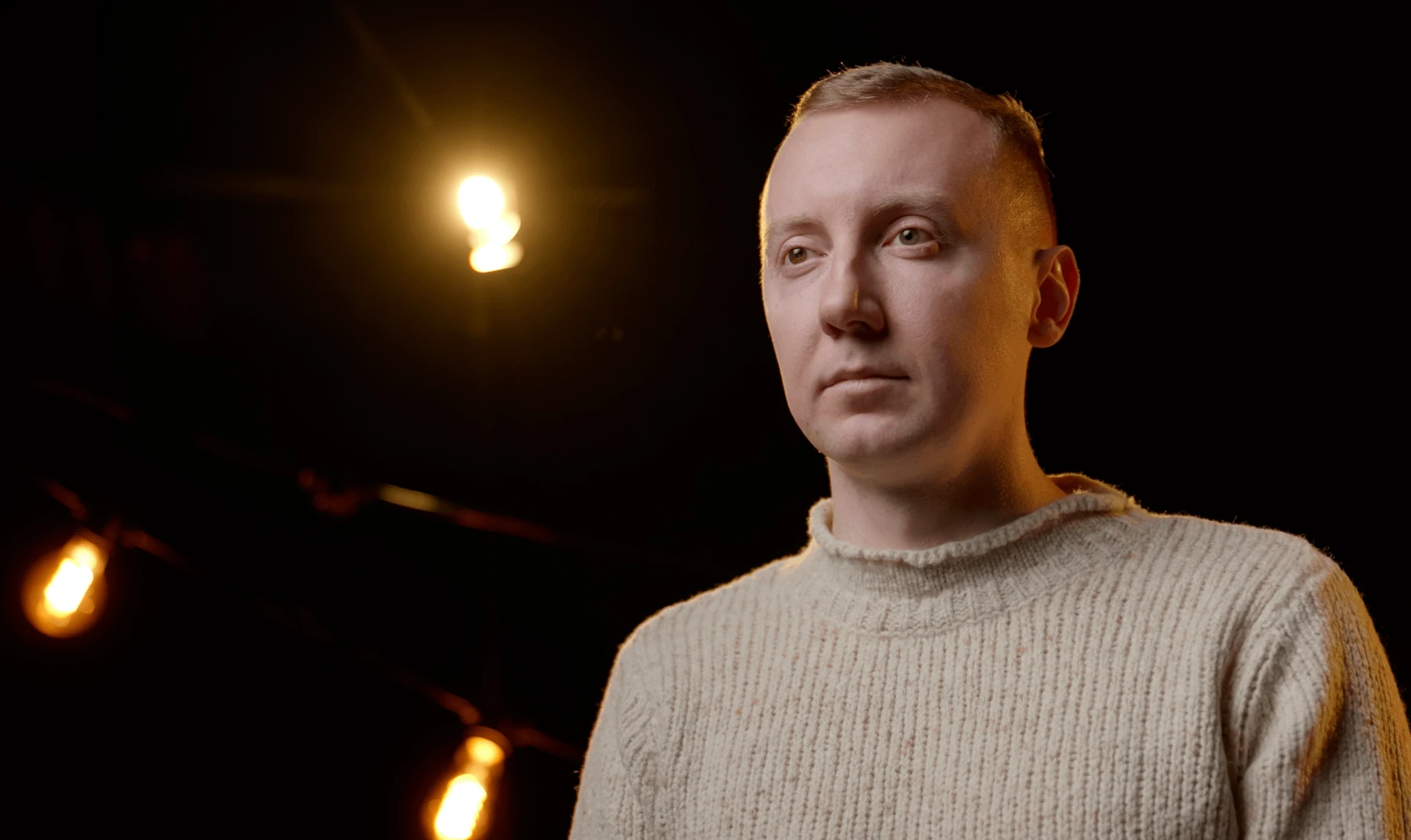
Stanislav Aseyev: The fear of being captured again is greater for me than being killed in the war
Source: Ukrainska Pravda
Author: Sofia Sereda
For journalist and writer Stanislav Aseev, 2024 brought new experiences and new challenges: mobilization, concussion, injury, discharge from military service, and a trip to the Syrian concentration camp "Sedna."
“All these things teach me that chance plays a bigger role in life than any deliberate actions. That’s why I now plan less and, in some cases, just let things be,” says Stanislav.
He endured 2.5 years of abuse at the Donetsk torture chamber “Izolyatsia,” where he was held by pro-Russian militants. After his release, Stanislav wrote a book about his experiences and for several years did not dare to return to his native Donbas out of fear of being captured again. It wasn’t until 2024 that he did so for the first time, this time as a soldier.
“Overall, I didn’t see anything unique in Donbas now that I hadn’t seen before the war. Although in some ways it reminded me of Bolivia, when you find yourself as if in the jungle. You wouldn’t notice that if you were just driving through the forest rather than sitting in it,” Aseyev shares.
Why does he feel more at ease on the front lines with a machine gun than in headquarters with paperwork? What did he see in Syria after the fall of the Assad regime and its “Sedna” concentration camp? Is there really no future for Donbas, even if Donetsk is de-occupied tomorrow?
“Ukrainska Pravda” spoke with Stanislav Aseyev about this. Below are the main points of the conversation.
Watch the full version of the interview on UP’s YouTube channel.
For English subtitles, please enable captions in the video settings and select Auto-translate → English.
Author: Sofia Sereda
For journalist and writer Stanislav Aseev, 2024 brought new experiences and new challenges: mobilization, concussion, injury, discharge from military service, and a trip to the Syrian concentration camp "Sedna."
“All these things teach me that chance plays a bigger role in life than any deliberate actions. That’s why I now plan less and, in some cases, just let things be,” says Stanislav.
He endured 2.5 years of abuse at the Donetsk torture chamber “Izolyatsia,” where he was held by pro-Russian militants. After his release, Stanislav wrote a book about his experiences and for several years did not dare to return to his native Donbas out of fear of being captured again. It wasn’t until 2024 that he did so for the first time, this time as a soldier.
“Overall, I didn’t see anything unique in Donbas now that I hadn’t seen before the war. Although in some ways it reminded me of Bolivia, when you find yourself as if in the jungle. You wouldn’t notice that if you were just driving through the forest rather than sitting in it,” Aseyev shares.
Why does he feel more at ease on the front lines with a machine gun than in headquarters with paperwork? What did he see in Syria after the fall of the Assad regime and its “Sedna” concentration camp? Is there really no future for Donbas, even if Donetsk is de-occupied tomorrow?
“Ukrainska Pravda” spoke with Stanislav Aseyev about this. Below are the main points of the conversation.
Watch the full version of the interview on UP’s YouTube channel.
For English subtitles, please enable captions in the video settings and select Auto-translate → English.
About the "training center" of the Armed Forces of Ukraine
Once I ended up at the “training center,” I actually regretted having been mobilized. The first “training center” resembled the Donetsk “central,” the second—the 32nd maximum-security colony in Makiivka.
I lived with the thought that everything would change at the front, that there wouldn’t be anything like that there.
The guys told me: “Hang in there for a month and a half to two months until you head to the front lines. You’ll see that there—that’s freedom. There’s none of that ‘red tape’ (military bureaucracy—UP) there.” And that’s exactly how it turned out.
On serving in the infantry
I’m an active person, so I just can’t stand being in headquarters. I had to do some administrative work for a few days—shuffling papers, filing them—and I nearly lost my mind. It’s just unbearable for me!
Although the people around me there said: “Listen, you have the option to go to the front lines, to Donbas, but you’re sitting in headquarters in the Zaporizhzhia sector. That’s normal!” I say: “No, it’s not normal! I wouldn’t have come here; I wouldn’t have enlisted if I’d known they’d shove me into headquarters.”
So
, oddly enough, I’m more comfortable on the front lines with a machine gun than in headquarters with some piece of paper. On the front lines, there’s minimal bureaucracy; you deal with very few of the things you see at headquarters every day, around the clock.
On the fear of being captured again
The entire time I was serving in Donbas, I had this fear.It became particularly acute during close-quarters combat, especially in Arkhangelsk. Because it’s one thing when you’re sitting in the trenches, the enemy is 200 meters away from you but isn’t advancing—just machine-gun fire. It’s another thing entirely when an assault begins: we’re retreating, losing house after house, and the Russians are closing in.
I was terrified—not that I would be killed right then, but that, God forbid, if I wasn’t killed, I wouldn’t be able to do anything to stop myself and would end up in captivity again.
I couldn’t do anything about these thoughts. So I just had to live with them, that’s all.
On how to survive in captivity
In captivity, there are two radically different behavioral models: the hero and the victim.To survive, you must adopt the psychology of the victim exclusively. As if to say, “I’m just a small person, I know nothing.” No heroism. You have to sign whatever they want you to sign. If they ask you to say “Glory to Russia,” say “Glory to Russia,” because your main task is to survive.
Given the possibility that you might be held hostage for years, you need to preserve your health as much as possible during this time.
In my case, deeply personal things helped me endure captivity: my girlfriend at the time and my mom, who was waiting for me. I knew that these people lived only because I was alive, and if I were to do something to myself now, it wouldn’t be easy for them, at least emotionally.
Unfortunately, in the army, the question of discussing the possibility of being taken prisoner with the soldiers doesn’t even come up. I suggested to my commanders at the “training camp”: “Maybe I should talk to the personnel of various brigades, since I have some experience—I’ve given lectures on this in the West.” They replied, “Great idea.” And that was it.
On Discharge from Military Service
I was recovering from my second injury when our battalion was simply wiped out—it was finished. Its remnants were scattered among various neighboring battalions. And when I returned, I was faced with a choice: either be transferred to a completely unfamiliar unit with questionable leadership, transfer somewhere else on my own, or be discharged from military service.I tried to transfer to the Main Intelligence Directorate (GUR): first, they have a fundamentally different approach to training there, and second, I have a lot of acquaintances there. Nothing came of it. I won’t go into detail about how it happened, but the issue of transfers within the military is a whole other story. So I resigned from military service on the grounds that I was a servicemember who had once been held captive.
On the Syrian “Sednaya” torture
chamber
chamber
The idea for this trip came to me when I saw that CNN had done a report from there.
Since I have a good relationship with General Kirill Budanov, I went to him for advice on whether I should go there at all or not. The meeting was on Sunday, and it turned out that a group from the Main Intelligence Directorate (GUR) was scheduled to fly to Syria on Monday to evacuate our citizens.
So I ended up in Syria with our special forces from the GUR’s “Shambat” unit. They knew that I had experience as a prisoner of war and that I wanted to compare the Donetsk torture chamber “Izolyatsia” with the conditions at the Syrian concentration camp “Sedna.”
In terms of the number of detainees, “Izolyatsia” is effectively a single cell of “Sedna”: usually there were about 45–50 people in “Izolyatsia,” at worst 80, while in “Sedna” there could be 50 in just one cell!
“Sedna” is truly a massive concentration camp. Thousands of people were held there. It is a factory of death and destruction. Executions were carried out there, including by crushing people with a special press and then dissolving their remains in acid. This was systematic. Of course, nothing like that happened at “Izolyatsia.”
On the punishment of war criminals
These people must be held accountable for their crimes.The burden of punishing war criminals will fall solely on Ukraine’s shoulders. Everyone else won’t give a damn. That’s why I think Ukraine has at least the moral right to punish these people (through liquidation – UP).
For me, the highest form of punishment for them is, I suppose, still a legal one. You see, when war criminals are killed, they don’t have time for any reflection; they don’t reconsider what they’re being punished for. It’s all instantaneous: one shot—and the person is gone. But in the case of a court verdict, whether you like it or not, you start to think about why you ended up behind bars.
On Donbas
Overall, I no longer expect any sentimental moments from Donbas. For me, it’s the past, to which I’m unlikely to return, even if, hypothetically speaking, we liberate Donetsk tomorrow.I always say: the further you travel from Donetsk, the deeper you travel into the Soviet past. Time there stopped before 2014. That’s why, for example, I have no particular sentimental attachment to Makiivka (where Aseev is from—UP).
I developed as a person in Donetsk. There was my teacher, Igor Kozlovsky, and other people who taught us philosophy and metaphysics, who opened up a whole new world to me—a child who had come from Makiivka.
Central Donetsk was a model of European culture. The city looked very prosperous; money was being invested in it, and its cultural life was very diverse.
But I am convinced that the people who continue to remain in the occupied territories of Donbas have not drawn any conclusions for themselves during this time. It is unlikely that they are engaging in any kind of reflection in the opposite direction.
I’m not even talking about the children, about the younger generation, which is completely cut off from Ukrainian culture, the Ukrainian language, and Ukrainian statehood. They don’t read or understand Ukrainian. I have absolutely no idea how to work with them mentally.
On the prospects of the war
I see that we have drawn no conclusions at either the state or the national level.It would seem that after 2022, it will be absolutely clear what to do with Russia, with its informational and political elements within Ukraine, and that there can be no compromises.
It is very important to preserve the memory of what Russia is and the crimes it commits, because this will influence future political decisions.
Unfortunately, I see that people are simply emotionally exhausted and cannot live with these memories constantly, but, on the other hand, it would be good if the state, at the national level, somehow documented this for itself.
At the very least, we need to radically change the system of training military personnel, especially the infantry, because that is the backbone of the army. If the crisis in our infantry continues, we will keep losing.
Russia will keep pushing as long as we let it.
This is an automatic translation generated by DeepL.