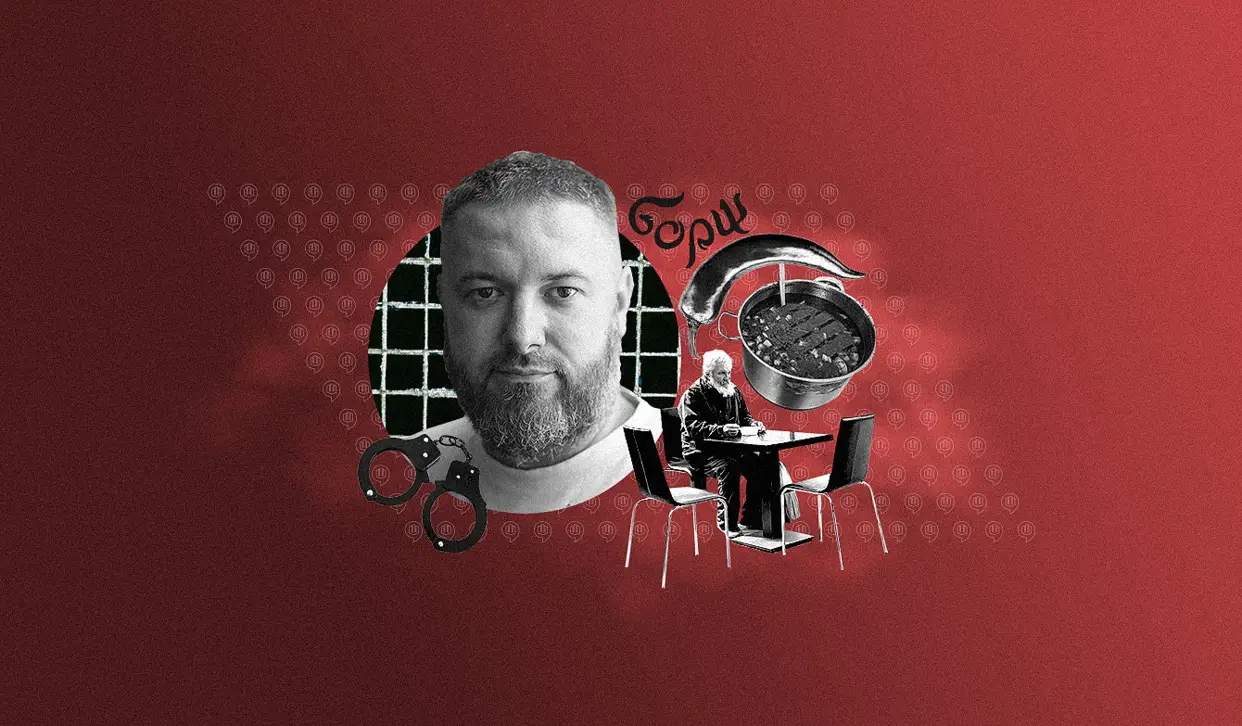
Some people were freaking out. But I thought, “Oh my God, it’s too soon.” The story of Igor Kovtonyuk, a resident of Kherson who survived torture while in captivity
Source: Signal to Resist
Author: Dmytro Kuzubov
Before the full-scale war, Ihor Kovtoniuk managed kitchens at restaurants in Kherson, as well as a summer business in Zaliznyi Port on the Black Sea.
When the occupation began, Kovtoniuk remained in Kherson and began volunteering. Together with his colleagues, they fed hundreds of people in need.
In early September 2022, Ihor was taken prisoner. The occupiers tormented him in every way they could: they beat him, stubbed cigarette butts out on his skin, and tortured him with water and electricity in an attempt to extract any useful information from him. But Ihor had nothing to say.
In a conversation with us, Ihor Kovtoniuk looks back on those terrible times to recount his 45 days in captivity, the occupiers’ game of “good cop, bad cop,” the hours-long interrogations and inhuman torture, his miraculous release, and the threat to drown him in the Dnipro River if he returned to Kherson.
“The city was helpless”
Igor Kovtonyuk was born in Izmail, in the Odesa region. When he was six, his parents moved with him to Kherson. He trained to be a chef and found work in his field after graduation. At times, he worked as a ship’s cook—traveling with the crew to Turkey, Greece, and Singapore.
Later, he started a small seasonal business—food stands in Zalizny Port in the Kherson region. Then, in Kherson, he helped a friend manage a restaurant. In the summer, he often went to the beach; in the fall, he went to the forest; and from late fall through early spring, he practiced cold hardening. He wasn’t interested in politics: “Like ordinary, average people, I heard and saw things here and there, but I didn’t delve into it as deeply as I perhaps should have.”
On the evening of February 23, 2022, Igor’s parents came to visit him. The family had dinner and went to bed, not knowing what the next day would bring. That morning—loud and turbulent—they, like most Ukrainians, will remember for the rest of their lives.
“The day before, everyone was following the news, but no one suspected that something like this could happen,” Igor admits. “At five in the morning, we got a call saying there were explosions somewhere.”
Later, Igor would realize that the explosions were coming from Chornobaivka Airport, from which the occupiers had begun to “terrorize” the Kherson region. First, he drove to a gas station, filled up his tank, and returned home. On the first day, he didn’t even think about leaving the city.
“We had a lot of staff at the café,” Igor explains. “We decided to divide all the revenue we had among the employees so they could get by in the beginning. Another person and I started handing out the money to everyone. That’s how the day flew by.”
The next day, Igor suggested that his parents leave, but they refused. The family decided to stay—at least for a while.
“In the first days of full-scale war, the city was helpless,” Igor recalls. “Chaos. Lines at stores, gas stations, and pharmacies. People didn’t know what to do.”
At that time, many Kherson residents—including Igor—still believed that all of this would last a couple of weeks, a month at most. Kovtonyuk had no idea what trials lay ahead for him, so he decided to help others.
One of the places where he worked—a small café—was located in a semi-basement. During the first few days, staff, relatives, and acquaintances took shelter there. The café had some food supplies.
“Anyone who needed help would come, eat, and drink,” says Igor. “We turned the sofas into beds and used the tables as barricades—back then, we still thought that if the worst came to the worst, it would save us.”
However, in early March, the Russians entered Kherson. That’s when Igor learned from his parents that the people of Kherson were planning to gather for a pro-Ukrainian rally. He forwarded the link to his friends.
The first and last time Igor had participated in street protests was during the Orange Revolution. The CEO of the company where his father worked supported Viktor Yushchenko. Ihor was 16 at the time; he went to Maidan and still remembers that spirit of unity. Back then, he had no idea that 18 years later, he and his parents would have to attend rallies under completely different circumstances.
At first, pro-Ukrainian rallies took place every day. Protesters would gather at 10 or 11 in the morning at the central square—Freedom Square. The Russians stood near the regional administration building, while the demonstrators were across the street, near the “Ukraine” movie theater.
“In the early days, not everyone knew about these gatherings yet, but then the number of participants kept growing,” says Igor. “People went there to demonstrate their clear stance and to get the latest news. If we stay at home and don’t show that we stand for Ukraine, it looks like we’re siding with the Russians. But we didn’t want that. It was powerful.”
In total, Igor took part in five or six rallies. However, the occupiers’ apparent indifference to pro-Ukrainian demonstrations quickly faded—they began using force against the protesters. That’s when Igor stopped going to the square.
“At first, not everyone understood where all this was headed. So we drew posters, pinned ribbons with Ukrainian flags to our jackets, and chanted ‘Putin is a dickhead’ and ‘Kherson is Ukraine,’” he recalls. “At first, there was no aggression from the Russians. But then they started dispersing people with batons and smoke grenades. That’s when the protests began to die down.”
“We fed 250 people every day”
During the occupation, Ihor recalls, Kherson seemed to have gone back to the ’90s. Lawlessness encouraged impunity. Looting began—stores and ATMs were ransacked. And it wasn’t just the Russians; our own compatriots were doing it too. Many drunk people appeared on the streets.
Meanwhile, Ihor moved into a friend’s house in the city center that had a huge basement. During the first month of the occupation, 16–17 people lived there—young people, older people, and children.
“When the situation escalated, thoughts would cross my mind: ‘Maybe we should leave?’ And after the tension eased: ‘We’re staying home,’” says Igor. “I have a private house; we’d finished renovating it before the full-scale war broke out. It’s silly, of course, but it was a shame to leave it all behind. If I’d understood even 5% of what this could lead to back then, I would have left, of course.”
Together with his colleagues, Igor began volunteering. They helped everyone who needed it—especially women and the elderly.
“Some people left Kherson, leaving behind their parents and wives; we helped them,” says Kovtonyuk. “We had supplies at our café; we delivered food to schools, maternity hospitals, field kitchens, and bakeries. Then we started cooking at the café where we worked, feeding 250 people every day at the Kherson City Council.” Grandmas and grandpas would start coming in at five in the morning.”
At that time, Igor recalls, you could see many nationalities in Kherson that were exotic for the city—the very same ones that made up the occupying army. There were even some who didn’t understand Russian. Some of the invaders seemed stuck somewhere deep in the past.
“One day we were driving, and at a checkpoint I showed him our ‘Diya’,” recalls Igor. “And he says, ‘Where’s your passport?’ I say, ‘But this is our passport.’ And he says, ‘That’s not a passport. Where’s the little book?’”
The Russians tried to hand out their humanitarian aid, but at first almost no one took it. And only later, says Igor, did people have no other choice.
“We were moved by their ‘reports’ claiming that ‘thousands’ were coming for humanitarian aid. We saw that there were at most 20–30 people,” he says. “It wasn’t until later, in late spring to early summer, when our people’s financial situation was getting worse, that many began to accept their humanitarian aid.”
The volunteers were very worried that one day the occupiers would “pay a visit” to their kitchen. Fortunately, however, that didn’t happen. Although the danger was always lurking nearby.
“Once I was driving back from the market with my trunk packed with vegetables and meat,” the volunteer recalls. “They stopped me at a checkpoint and asked why I had so much food. I told them we were helping people. And they said, ‘No way! We’ve heard that you young Ukrainians take money and gold from grandmothers—you’re not helping, you’re just making things worse.’ I say, ‘I’m the first “ukrop” who’s doing the exact opposite.’”
Author: Dmytro Kuzubov
Before the full-scale war, Ihor Kovtoniuk managed kitchens at restaurants in Kherson, as well as a summer business in Zaliznyi Port on the Black Sea.
When the occupation began, Kovtoniuk remained in Kherson and began volunteering. Together with his colleagues, they fed hundreds of people in need.
In early September 2022, Ihor was taken prisoner. The occupiers tormented him in every way they could: they beat him, stubbed cigarette butts out on his skin, and tortured him with water and electricity in an attempt to extract any useful information from him. But Ihor had nothing to say.
In a conversation with us, Ihor Kovtoniuk looks back on those terrible times to recount his 45 days in captivity, the occupiers’ game of “good cop, bad cop,” the hours-long interrogations and inhuman torture, his miraculous release, and the threat to drown him in the Dnipro River if he returned to Kherson.
“The city was helpless”
Igor Kovtonyuk was born in Izmail, in the Odesa region. When he was six, his parents moved with him to Kherson. He trained to be a chef and found work in his field after graduation. At times, he worked as a ship’s cook—traveling with the crew to Turkey, Greece, and Singapore.
Later, he started a small seasonal business—food stands in Zalizny Port in the Kherson region. Then, in Kherson, he helped a friend manage a restaurant. In the summer, he often went to the beach; in the fall, he went to the forest; and from late fall through early spring, he practiced cold hardening. He wasn’t interested in politics: “Like ordinary, average people, I heard and saw things here and there, but I didn’t delve into it as deeply as I perhaps should have.”
On the evening of February 23, 2022, Igor’s parents came to visit him. The family had dinner and went to bed, not knowing what the next day would bring. That morning—loud and turbulent—they, like most Ukrainians, will remember for the rest of their lives.
“The day before, everyone was following the news, but no one suspected that something like this could happen,” Igor admits. “At five in the morning, we got a call saying there were explosions somewhere.”
Later, Igor would realize that the explosions were coming from Chornobaivka Airport, from which the occupiers had begun to “terrorize” the Kherson region. First, he drove to a gas station, filled up his tank, and returned home. On the first day, he didn’t even think about leaving the city.
“We had a lot of staff at the café,” Igor explains. “We decided to divide all the revenue we had among the employees so they could get by in the beginning. Another person and I started handing out the money to everyone. That’s how the day flew by.”
The next day, Igor suggested that his parents leave, but they refused. The family decided to stay—at least for a while.
“In the first days of full-scale war, the city was helpless,” Igor recalls. “Chaos. Lines at stores, gas stations, and pharmacies. People didn’t know what to do.”
At that time, many Kherson residents—including Igor—still believed that all of this would last a couple of weeks, a month at most. Kovtonyuk had no idea what trials lay ahead for him, so he decided to help others.
One of the places where he worked—a small café—was located in a semi-basement. During the first few days, staff, relatives, and acquaintances took shelter there. The café had some food supplies.
“Anyone who needed help would come, eat, and drink,” says Igor. “We turned the sofas into beds and used the tables as barricades—back then, we still thought that if the worst came to the worst, it would save us.”
However, in early March, the Russians entered Kherson. That’s when Igor learned from his parents that the people of Kherson were planning to gather for a pro-Ukrainian rally. He forwarded the link to his friends.
The first and last time Igor had participated in street protests was during the Orange Revolution. The CEO of the company where his father worked supported Viktor Yushchenko. Ihor was 16 at the time; he went to Maidan and still remembers that spirit of unity. Back then, he had no idea that 18 years later, he and his parents would have to attend rallies under completely different circumstances.
At first, pro-Ukrainian rallies took place every day. Protesters would gather at 10 or 11 in the morning at the central square—Freedom Square. The Russians stood near the regional administration building, while the demonstrators were across the street, near the “Ukraine” movie theater.
“In the early days, not everyone knew about these gatherings yet, but then the number of participants kept growing,” says Igor. “People went there to demonstrate their clear stance and to get the latest news. If we stay at home and don’t show that we stand for Ukraine, it looks like we’re siding with the Russians. But we didn’t want that. It was powerful.”
In total, Igor took part in five or six rallies. However, the occupiers’ apparent indifference to pro-Ukrainian demonstrations quickly faded—they began using force against the protesters. That’s when Igor stopped going to the square.
“At first, not everyone understood where all this was headed. So we drew posters, pinned ribbons with Ukrainian flags to our jackets, and chanted ‘Putin is a dickhead’ and ‘Kherson is Ukraine,’” he recalls. “At first, there was no aggression from the Russians. But then they started dispersing people with batons and smoke grenades. That’s when the protests began to die down.”
“We fed 250 people every day”
During the occupation, Ihor recalls, Kherson seemed to have gone back to the ’90s. Lawlessness encouraged impunity. Looting began—stores and ATMs were ransacked. And it wasn’t just the Russians; our own compatriots were doing it too. Many drunk people appeared on the streets.
Meanwhile, Ihor moved into a friend’s house in the city center that had a huge basement. During the first month of the occupation, 16–17 people lived there—young people, older people, and children.
“When the situation escalated, thoughts would cross my mind: ‘Maybe we should leave?’ And after the tension eased: ‘We’re staying home,’” says Igor. “I have a private house; we’d finished renovating it before the full-scale war broke out. It’s silly, of course, but it was a shame to leave it all behind. If I’d understood even 5% of what this could lead to back then, I would have left, of course.”
Together with his colleagues, Igor began volunteering. They helped everyone who needed it—especially women and the elderly.
“Some people left Kherson, leaving behind their parents and wives; we helped them,” says Kovtonyuk. “We had supplies at our café; we delivered food to schools, maternity hospitals, field kitchens, and bakeries. Then we started cooking at the café where we worked, feeding 250 people every day at the Kherson City Council.” Grandmas and grandpas would start coming in at five in the morning.”
At that time, Igor recalls, you could see many nationalities in Kherson that were exotic for the city—the very same ones that made up the occupying army. There were even some who didn’t understand Russian. Some of the invaders seemed stuck somewhere deep in the past.
“One day we were driving, and at a checkpoint I showed him our ‘Diya’,” recalls Igor. “And he says, ‘Where’s your passport?’ I say, ‘But this is our passport.’ And he says, ‘That’s not a passport. Where’s the little book?’”
The Russians tried to hand out their humanitarian aid, but at first almost no one took it. And only later, says Igor, did people have no other choice.
“We were moved by their ‘reports’ claiming that ‘thousands’ were coming for humanitarian aid. We saw that there were at most 20–30 people,” he says. “It wasn’t until later, in late spring to early summer, when our people’s financial situation was getting worse, that many began to accept their humanitarian aid.”
The volunteers were very worried that one day the occupiers would “pay a visit” to their kitchen. Fortunately, however, that didn’t happen. Although the danger was always lurking nearby.
“Once I was driving back from the market with my trunk packed with vegetables and meat,” the volunteer recalls. “They stopped me at a checkpoint and asked why I had so much food. I told them we were helping people. And they said, ‘No way! We’ve heard that you young Ukrainians take money and gold from grandmothers—you’re not helping, you’re just making things worse.’ I say, ‘I’m the first “ukrop” who’s doing the exact opposite.’”
It seemed as though Igor was no longer in any danger. However, it turned out that the worst was yet to come.
“They put me in a minibus, and off I went to find out what the ‘Russian World’ was all about.”
On September 8, Igor was driving down Lugovaya Street, near his home. Suddenly, a minibus blocked his path. Two men in plain clothes got out. And when he tried to start the car, special forces soldiers in helmets, earpieces, and body armor jumped out of the minibus and pointed their weapons at him.
“I realized it was better not to make a move. I opened the door; they dragged me out, threw me onto the asphalt, put a bag over my head, and tied my hands behind my back with zip ties. They shoved me into the van. And off I went to find out what the ‘Russian World’ was all about,” Igor recalls.
“I was completely freaked out in the van. That feeling of hopelessness, confusion, and shock.” On the way, they kept mentioning my neighbor’s name. I have a lot of acquaintances with that name, so I didn’t understand who they were talking about. I only figured it out later.”
It turned out that Igor “owed” his detention to that very neighbor. In early September, he had been boasting about his patriotism in the company of some girls he barely knew, who most likely passed the information on to the occupiers. A day or two later, my neighbor was detained. In the end, his acquaintances—including Igor—became the scapegoats. A week later, they took him away too.
“My neighbor, while drunk, told a group of people that he was a ‘fighter for Ukraine,’ that there were many of us like that, and that we were thinking of ways to help the Ukrainian army,” Igor explains. “When they detained him, to deflect the aggression away from himself, he ratted out innocent guys—saying they had weapons stashed away, that they were drug addicts and alcoholics. Before that, I thought my neighbor and I shared similar views. But it turned out that wasn’t the case. A decent person wouldn’t falsely accuse his own fellow countrymen of things that aren’t true just to save his own skin.”
It took five to seven minutes to drive Igor to his destination. Although he couldn’t see where they were going, at first he intuitively understood:
“We were heading toward the city center. But then they started zigzagging, and I ‘lost my bearings.’”
“When they applied intense pressure, I bit my tongue off.”
The kidnappers took Igor to an old Soviet-era building on Pylyp Orlyk Street, which nowadays houses a business center.
The captive was held for two and a half days in the basement of this building, which had been converted into a prison cell. It was something like a boiler room with a huge crane in the middle and countless pipes all around. The prisoner was handcuffed to one of them.
Yevhen, who had been brought there earlier, was also held in the basement with Igor. The occupiers had also “fabricated” false charges against this father of four. Now, when Igor thinks of his cellmate, tears well up in his eyes. Nothing is known about Yevgeny’s fate.
“Zhenya is an awesome guy,” says Igor. “He ended up there because of a relative—the guy was with the ‘authorities’ and had hidden weapons in his garage. The Russians searched the garages and found them. For the first few days, they wouldn’t give me any food; they brought food to Zhenya, but they forbade me from eating. I wasn’t allowed to drink water either, but he managed to pass some to me. He kept my spirits up for two and a half days.”
Igor was held at the business center from September 8 to 10, until he was transferred to a temporary detention center (ITT) on Teploenergetikov Street on the outskirts of the city. Compared to the basement on Orlyka Street, he says, the conditions there were much better.
“At the ITT, it was already a ‘luxury’ cell, a ‘resort’,” Igor says with a sad smile. “There’s running water, electricity, spoons, forks, mattresses, a toilet—and they bring us food. When I arrived, the guys who were there gave me a toothbrush. The cell was meant for four, but there were consistently six or seven of us there. A motley crew—from officials to drug dealers. “There were none who had anything to do with the war.”
At the same time, for some reason, they took Igor to a business center for interrogations. In fact, they began interrogating him from the very first hours of his captivity. And at the same time—they began to torment him.
During these interrogations, Igor always kept his head down and a hat or plastic bag pulled over his eyes. So when, after his release, law enforcement officers showed him photographs that might have included some of his tormentors, he was unable to identify a single one. He remembers only a few details of the interior: old linoleum and budget-grade furniture.
“There was daylight in the room, so I think it was on one of the upper floors so that the screams wouldn’t be heard on the street,” he speculates. “When I was taken captive, everyone said, ‘Just get through the first week; it’ll get easier after that.’ But for some reason, they kept ‘toughening me up’ [tormenting me—ed.] for about 16 or 17 days. The first week, they took me for interrogations every day; after that, once every two days.”
Among those who interrogated him, Igor recalls, were both young men and “older” ones—“more serious” ones. Most of the “young ones” were from the temporarily occupied territories of Donetsk and Luhansk regions. The “older” ones, on the other hand, had a distinct Russian accent. The “young ones” would “prepare” us: they beat us, taunted us, stubbed cigarette butts out on our skin, and used a whole range of “sophisticated” torture methods.
“They might, for example, challenge you to guess the flavor of an iQOS,” Igor recalls. “I’m lying on the floor, and they’re holding my arms and legs so I can’t move. They put a gas mask on me and cut off my air supply. They’d open the hose—it was called the ‘elephant’—and blow the vapor from an iQOS or an ‘electronic cigarette’ [e-cigarette—ed.] into your face. And you’d start to suffocate. And they’d ask, ‘What does it taste like now? Guess!’ Sometimes they’d take off one of my socks, shove it in my mouth, and pour water into it. And you’d choke until you lost consciousness.”
Igor falls silent for a moment. He catches his breath and continues:
“They tortured me with electric shocks. First, they prepare you with a stun gun. Then they pour water on you. They attach wires to your little finger, your ears, your tongue, and your penis, and turn on the current. And they ‘play.’ It hurts. You might pass out. At the peak of the pain, I’d rip those restraints off myself and jerk away. When they apply a strong current, your body doesn’t know what it’s doing. And I kept biting my tongue. Once I passed out, and then, when I came to, I saw a hole right through my left leg. I have no idea why.
I was lucky—I pulled through on my own. But the guys I was with—I saw this with my own eyes—stopped breathing. Then they [the occupiers—ed.] would call in their medical personnel, who would give them “ammonia” and “snap them out of it.”
Toward the end of the interrogations, Igor recalls, when he was “on his last breath,” the “higher-ups” would come into the room—people who, he suspects, didn’t want to get their hands dirty.
“They tried to play the ‘good guys’: before that, there were the ‘bad guys,’ but they spoke without using violence: ‘Have a cigarette, drink some sweet sparkling water, have a cookie,’ ” Igor recounts. “They said, ‘Stop lying,’ and asked, ‘Who’s your boss? Where are the weapons caches? Who’s funding the DRGs in Kherson, and who’s in them?” And they’d list names: “Do you know this guy?” I knew some of them—all guys from Kherson, from the territorial defense, ‘ultras.’ Then they started accusing us of volunteering—claiming that under the guise of this work, we were getting money to sponsor the DRGs. Nonsense, of course.”
The interrogations and torture were aimed at extracting any information whatsoever from the prisoners.
“I offered: ‘Tell me what I need to say. I’ll say it.’ I had nothing to tell. But they didn’t believe me.”
Igor’s cellmates say he was interrogated for three to four hours each time. However, according to his own account, the abuse lasted for days on end.
“Because I kept biting my tongue, I couldn’t speak and wouldn’t eat anything except liquids,” he says. “They beat me hard on the kidneys, so my legs swelled up. After the interrogation, they’d bring me back to my cell. The guys would put me under the bunk and pile my belongings into a mound, then prop my legs up so the blood would drain. And by morning, my legs were back to normal.”
Ihor considers his torturers to be “underdeveloped people” who had once been oppressed themselves, and who therefore took their anger out on others. He gives an example to illustrate his point.
“In the early days, they’d say to me, ‘You’re fat, you Ukrainian lard,’” recalls Igor, who weighed about 100 kilograms at the time. “One time they took me along so I could show them where everything was. They let me lift my hat or a bag—I don’t remember what I was wearing at the time—so I could see the area. I looked, and two of them were just ‘fat pigs,’ weighing 150 kilos each. One of them was carrying my bag, which they’d taken when they arrested me.”
While in captivity, the prisoners were kept in an information vacuum for some time. The occupiers took full advantage of this.
“They kept hammering home that Mykolaiv and Odesa had supposedly been captured, that they were already near Uman and advancing on Kyiv, and that Ukraine would soon cease to exist. They’d say, ‘You’d better tell us what you know—that way you’ll be on our side,’” says Ihor.
At the same time, whenever new people were brought into the detention cell, they would share the latest news. That’s how the prisoners learned that the Russians had been driven out of most of the Kharkiv region, and that several collaborators had been killed in the Kherson region.
“And when our guys blew up the Antonivsky Bridge, we were jumping for joy as if we’d done it ourselves,” Igor smiles.
“They gave us water and told us they were taking us out to be shot”
Igor spent 20–23 days in the temporary detention center. In early October, he was returned to the basement of the business center. Zhenya was no longer in the cell. Igor was held there for another 20 days.
“Time seemed to stand still in the basement: you sleep on the floor, in the cold, eat raw buckwheat every day, they don’t give you water, and you use a bottle as a toilet,” says Igor. “For all 20 days, I barely slept; I just stared at the ceiling. I was there with three young guys, aged 18 to 20, who simply filmed our ‘arrival’ and posted it online.”
By the end of October, it was already very cold. The prisoners were brought old mattresses, blankets, and clothes, and told they would spend the winter in the basement. Everyone had already chosen their clothes and set up their bunks for the winter. But suddenly, they stopped feeding the prisoners—for three days, they gave us neither food nor water. They also turned off the surveillance cameras.
“I thought they wanted to kill us or that something was going on with them,” Igor explains. “Cars were driving by day and night; they were taking things away, bringing things in, and unloading them. It was only later, after piecing all these facts together, that I realized they were preparing to leave. Three days later, they came to us and asked how we were doing. We replied that we wanted something to drink. They gave us water and told us they were taking us away to be shot.”
The occupiers opened all the cells and led 23–26 prisoners out. They put hats or plastic bags over their heads and tied their hands behind their backs with duct tape. They threw firecrackers at them and reloaded their automatic weapons. They loaded us into a vehicle and drove off in an unknown direction.
“They were probably transporting us in a police van—it was a loud, tall vehicle,” Igor speculates. “We realized we were heading to the Komyshanske Cemetery. Some people started crying.”
However, in the end, the occupiers drove past the cemetery with the prisoners. They stopped between Bilozerka and the Stanislavsky Canyon. The prisoners were led out into a field between vineyards and apple orchards.
“They made everyone kneel in a line. Then they started pulling people out one by one,” recalls Igor. “They handed out some kind of tag—I don’t know what was written on it. And everyone said their first name, last name, date of birth, and the phrase ‘I’m fine.’ Once they’d filmed everyone, they reloaded their weapons again. We thought that was it.”
Fortunately, the worst didn’t happen. The occupiers stood there for a couple more minutes and ordered those who had agreed to cooperate and had assignments in Mykolaiv to “go there,” and the rest to also head in that direction, saying, “Go to Mykolaiv and live there.” And before they left, they threatened:
“If we see you in Kherson again, we’ll feed you to the crayfish in the Dnipro.”
“In slippers and a woman’s sweater, I hadn’t washed for 40 days”
The first thing Igor thought of upon his release was hunger—he and the other prisoners hadn’t eaten for three days. They started gathering apples, but the harvest had already been picked by then, so only sour and rotten ones were left. But the prisoners were happy even with that.
The occupiers had scattered some of the released prisoners’ documents on the ground, and everyone began searching for their own. However, Igor never found his. Next, they started thinking about how to get to Kherson, which was about 10 kilometers away. They split into groups.
“I set off with one man, an old man named Misha, toward Kizomys, because he had a fortune-teller he knew there,” Igor explains. “It was already late fall, and I was wearing slippers and socks, a long T-shirt, and a woman’s sweater. We hadn’t washed for 40 days; we were unshaven and dirty. We got there, but the fortune-teller wasn’t there. A relative of hers helped us—she let us into a neighboring house where no one lived.”
For the first 20 days, while Igor was being held in the temporary detention center, his relatives still knew his whereabouts from his cellmates who were released from there. However, once he was in the basement, Igor’s trail went cold. Upon reaching “civilization,” he first called his girlfriend. Meanwhile, the locals gave the former prisoners clothes and hygiene supplies.
“I gave Grandpa Misha a haircut, he gave me a haircut, we shaved, and we cleaned ourselves up,” says Igor with a smile. “It’s like in a movie—two convicts have settled into a dacha and are trying to get themselves in order. We were those ‘convicts.’”
On the road from Kizomys to Kherson, there were several Russian checkpoints. Igor’s family and friends began to figure out how to get him out of the occupied village. Eventually, they came up with a “cover story.”
“A friend of mine has his own mini-bakery and a bread machine,” says Igor. “So we made up a story that I was their employee—that they’d come to pick me up, I was on my way to work, but I’d forgotten my documents at home. That bread-making machine came to pick me up; I was already clean and smelled good, so I got in. That’s how we made it home.”
When asked about his reunion with his family, Igor is silent at first. And finally, he can’t hold back his tears.
“It was a good reunion,” he replies after a pause.
“This experience will never fully fade away.”
On the way to Kherson, Ihor didn’t yet realize that Ukrainian flags would soon be flying again in the city. There were indeed no outward signs of this: the surrounding villages were still under occupation, and there were checkpoints manned by the occupiers along the road.
Because the Russians had forbidden Igor from returning to Kherson, once he arrived home, he didn’t go outside for a long time so he wouldn’t be “spotted.”
On the eve of a date sacred to the people of Kherson—November 11, 2022—there was no cell service in the city. Then an acquaintance of Igor’s came to Kherson and suggested taking a drive around the city—saying there weren’t many Russians left there.
“The next day he came back and said, ‘Our guys are already in the city.’ I said, ‘Really? How?’ And he said, ‘Just like that. Trust me!’ So we went to the market at the Kherson Building Complex. There we met another friend I used to hang out with,” Igor says. “The market was already buzzing with the news that our guys were in town; everyone had started partying. Then we actually saw our guys. I didn’t go to Freedom Square to welcome the Ukrainian Armed Forces—I was afraid. Maybe I should have, but after such an unpleasant experience, I decided not to go.”
Igor now lives in Odesa. He works and helps the military. He’s gradually recovering mentally. However, the events he went through will stay with him forever.
“At first, I withdrew into myself. I didn’t want to work with a psychologist; I thought I could get through it all on my own,” he says. “Now I sometimes talk to a psychologist, take sedatives, and am recovering. This experience will never fully go away. But I have to push myself as much as possible and help those around me. The guys I was with ‘in the basement’—we see each other, talk, and support one another. When they were taking us away, supposedly to be shot, some of them were freaking out. But I thought, ‘Oh my God, it’s too soon.’ “You always have to believe in the best.”
“They put me in a minibus, and off I went to find out what the ‘Russian World’ was all about.”
On September 8, Igor was driving down Lugovaya Street, near his home. Suddenly, a minibus blocked his path. Two men in plain clothes got out. And when he tried to start the car, special forces soldiers in helmets, earpieces, and body armor jumped out of the minibus and pointed their weapons at him.
“I realized it was better not to make a move. I opened the door; they dragged me out, threw me onto the asphalt, put a bag over my head, and tied my hands behind my back with zip ties. They shoved me into the van. And off I went to find out what the ‘Russian World’ was all about,” Igor recalls.
“I was completely freaked out in the van. That feeling of hopelessness, confusion, and shock.” On the way, they kept mentioning my neighbor’s name. I have a lot of acquaintances with that name, so I didn’t understand who they were talking about. I only figured it out later.”
It turned out that Igor “owed” his detention to that very neighbor. In early September, he had been boasting about his patriotism in the company of some girls he barely knew, who most likely passed the information on to the occupiers. A day or two later, my neighbor was detained. In the end, his acquaintances—including Igor—became the scapegoats. A week later, they took him away too.
“My neighbor, while drunk, told a group of people that he was a ‘fighter for Ukraine,’ that there were many of us like that, and that we were thinking of ways to help the Ukrainian army,” Igor explains. “When they detained him, to deflect the aggression away from himself, he ratted out innocent guys—saying they had weapons stashed away, that they were drug addicts and alcoholics. Before that, I thought my neighbor and I shared similar views. But it turned out that wasn’t the case. A decent person wouldn’t falsely accuse his own fellow countrymen of things that aren’t true just to save his own skin.”
It took five to seven minutes to drive Igor to his destination. Although he couldn’t see where they were going, at first he intuitively understood:
“We were heading toward the city center. But then they started zigzagging, and I ‘lost my bearings.’”
“When they applied intense pressure, I bit my tongue off.”
The kidnappers took Igor to an old Soviet-era building on Pylyp Orlyk Street, which nowadays houses a business center.
The captive was held for two and a half days in the basement of this building, which had been converted into a prison cell. It was something like a boiler room with a huge crane in the middle and countless pipes all around. The prisoner was handcuffed to one of them.
Yevhen, who had been brought there earlier, was also held in the basement with Igor. The occupiers had also “fabricated” false charges against this father of four. Now, when Igor thinks of his cellmate, tears well up in his eyes. Nothing is known about Yevgeny’s fate.
“Zhenya is an awesome guy,” says Igor. “He ended up there because of a relative—the guy was with the ‘authorities’ and had hidden weapons in his garage. The Russians searched the garages and found them. For the first few days, they wouldn’t give me any food; they brought food to Zhenya, but they forbade me from eating. I wasn’t allowed to drink water either, but he managed to pass some to me. He kept my spirits up for two and a half days.”
Igor was held at the business center from September 8 to 10, until he was transferred to a temporary detention center (ITT) on Teploenergetikov Street on the outskirts of the city. Compared to the basement on Orlyka Street, he says, the conditions there were much better.
“At the ITT, it was already a ‘luxury’ cell, a ‘resort’,” Igor says with a sad smile. “There’s running water, electricity, spoons, forks, mattresses, a toilet—and they bring us food. When I arrived, the guys who were there gave me a toothbrush. The cell was meant for four, but there were consistently six or seven of us there. A motley crew—from officials to drug dealers. “There were none who had anything to do with the war.”
At the same time, for some reason, they took Igor to a business center for interrogations. In fact, they began interrogating him from the very first hours of his captivity. And at the same time—they began to torment him.
During these interrogations, Igor always kept his head down and a hat or plastic bag pulled over his eyes. So when, after his release, law enforcement officers showed him photographs that might have included some of his tormentors, he was unable to identify a single one. He remembers only a few details of the interior: old linoleum and budget-grade furniture.
“There was daylight in the room, so I think it was on one of the upper floors so that the screams wouldn’t be heard on the street,” he speculates. “When I was taken captive, everyone said, ‘Just get through the first week; it’ll get easier after that.’ But for some reason, they kept ‘toughening me up’ [tormenting me—ed.] for about 16 or 17 days. The first week, they took me for interrogations every day; after that, once every two days.”
Among those who interrogated him, Igor recalls, were both young men and “older” ones—“more serious” ones. Most of the “young ones” were from the temporarily occupied territories of Donetsk and Luhansk regions. The “older” ones, on the other hand, had a distinct Russian accent. The “young ones” would “prepare” us: they beat us, taunted us, stubbed cigarette butts out on our skin, and used a whole range of “sophisticated” torture methods.
“They might, for example, challenge you to guess the flavor of an iQOS,” Igor recalls. “I’m lying on the floor, and they’re holding my arms and legs so I can’t move. They put a gas mask on me and cut off my air supply. They’d open the hose—it was called the ‘elephant’—and blow the vapor from an iQOS or an ‘electronic cigarette’ [e-cigarette—ed.] into your face. And you’d start to suffocate. And they’d ask, ‘What does it taste like now? Guess!’ Sometimes they’d take off one of my socks, shove it in my mouth, and pour water into it. And you’d choke until you lost consciousness.”
Igor falls silent for a moment. He catches his breath and continues:
“They tortured me with electric shocks. First, they prepare you with a stun gun. Then they pour water on you. They attach wires to your little finger, your ears, your tongue, and your penis, and turn on the current. And they ‘play.’ It hurts. You might pass out. At the peak of the pain, I’d rip those restraints off myself and jerk away. When they apply a strong current, your body doesn’t know what it’s doing. And I kept biting my tongue. Once I passed out, and then, when I came to, I saw a hole right through my left leg. I have no idea why.
I was lucky—I pulled through on my own. But the guys I was with—I saw this with my own eyes—stopped breathing. Then they [the occupiers—ed.] would call in their medical personnel, who would give them “ammonia” and “snap them out of it.”
Toward the end of the interrogations, Igor recalls, when he was “on his last breath,” the “higher-ups” would come into the room—people who, he suspects, didn’t want to get their hands dirty.
“They tried to play the ‘good guys’: before that, there were the ‘bad guys,’ but they spoke without using violence: ‘Have a cigarette, drink some sweet sparkling water, have a cookie,’ ” Igor recounts. “They said, ‘Stop lying,’ and asked, ‘Who’s your boss? Where are the weapons caches? Who’s funding the DRGs in Kherson, and who’s in them?” And they’d list names: “Do you know this guy?” I knew some of them—all guys from Kherson, from the territorial defense, ‘ultras.’ Then they started accusing us of volunteering—claiming that under the guise of this work, we were getting money to sponsor the DRGs. Nonsense, of course.”
The interrogations and torture were aimed at extracting any information whatsoever from the prisoners.
“I offered: ‘Tell me what I need to say. I’ll say it.’ I had nothing to tell. But they didn’t believe me.”
Igor’s cellmates say he was interrogated for three to four hours each time. However, according to his own account, the abuse lasted for days on end.
“Because I kept biting my tongue, I couldn’t speak and wouldn’t eat anything except liquids,” he says. “They beat me hard on the kidneys, so my legs swelled up. After the interrogation, they’d bring me back to my cell. The guys would put me under the bunk and pile my belongings into a mound, then prop my legs up so the blood would drain. And by morning, my legs were back to normal.”
Ihor considers his torturers to be “underdeveloped people” who had once been oppressed themselves, and who therefore took their anger out on others. He gives an example to illustrate his point.
“In the early days, they’d say to me, ‘You’re fat, you Ukrainian lard,’” recalls Igor, who weighed about 100 kilograms at the time. “One time they took me along so I could show them where everything was. They let me lift my hat or a bag—I don’t remember what I was wearing at the time—so I could see the area. I looked, and two of them were just ‘fat pigs,’ weighing 150 kilos each. One of them was carrying my bag, which they’d taken when they arrested me.”
While in captivity, the prisoners were kept in an information vacuum for some time. The occupiers took full advantage of this.
“They kept hammering home that Mykolaiv and Odesa had supposedly been captured, that they were already near Uman and advancing on Kyiv, and that Ukraine would soon cease to exist. They’d say, ‘You’d better tell us what you know—that way you’ll be on our side,’” says Ihor.
At the same time, whenever new people were brought into the detention cell, they would share the latest news. That’s how the prisoners learned that the Russians had been driven out of most of the Kharkiv region, and that several collaborators had been killed in the Kherson region.
“And when our guys blew up the Antonivsky Bridge, we were jumping for joy as if we’d done it ourselves,” Igor smiles.
“They gave us water and told us they were taking us out to be shot”
Igor spent 20–23 days in the temporary detention center. In early October, he was returned to the basement of the business center. Zhenya was no longer in the cell. Igor was held there for another 20 days.
“Time seemed to stand still in the basement: you sleep on the floor, in the cold, eat raw buckwheat every day, they don’t give you water, and you use a bottle as a toilet,” says Igor. “For all 20 days, I barely slept; I just stared at the ceiling. I was there with three young guys, aged 18 to 20, who simply filmed our ‘arrival’ and posted it online.”
By the end of October, it was already very cold. The prisoners were brought old mattresses, blankets, and clothes, and told they would spend the winter in the basement. Everyone had already chosen their clothes and set up their bunks for the winter. But suddenly, they stopped feeding the prisoners—for three days, they gave us neither food nor water. They also turned off the surveillance cameras.
“I thought they wanted to kill us or that something was going on with them,” Igor explains. “Cars were driving by day and night; they were taking things away, bringing things in, and unloading them. It was only later, after piecing all these facts together, that I realized they were preparing to leave. Three days later, they came to us and asked how we were doing. We replied that we wanted something to drink. They gave us water and told us they were taking us away to be shot.”
The occupiers opened all the cells and led 23–26 prisoners out. They put hats or plastic bags over their heads and tied their hands behind their backs with duct tape. They threw firecrackers at them and reloaded their automatic weapons. They loaded us into a vehicle and drove off in an unknown direction.
“They were probably transporting us in a police van—it was a loud, tall vehicle,” Igor speculates. “We realized we were heading to the Komyshanske Cemetery. Some people started crying.”
However, in the end, the occupiers drove past the cemetery with the prisoners. They stopped between Bilozerka and the Stanislavsky Canyon. The prisoners were led out into a field between vineyards and apple orchards.
“They made everyone kneel in a line. Then they started pulling people out one by one,” recalls Igor. “They handed out some kind of tag—I don’t know what was written on it. And everyone said their first name, last name, date of birth, and the phrase ‘I’m fine.’ Once they’d filmed everyone, they reloaded their weapons again. We thought that was it.”
Fortunately, the worst didn’t happen. The occupiers stood there for a couple more minutes and ordered those who had agreed to cooperate and had assignments in Mykolaiv to “go there,” and the rest to also head in that direction, saying, “Go to Mykolaiv and live there.” And before they left, they threatened:
“If we see you in Kherson again, we’ll feed you to the crayfish in the Dnipro.”
“In slippers and a woman’s sweater, I hadn’t washed for 40 days”
The first thing Igor thought of upon his release was hunger—he and the other prisoners hadn’t eaten for three days. They started gathering apples, but the harvest had already been picked by then, so only sour and rotten ones were left. But the prisoners were happy even with that.
The occupiers had scattered some of the released prisoners’ documents on the ground, and everyone began searching for their own. However, Igor never found his. Next, they started thinking about how to get to Kherson, which was about 10 kilometers away. They split into groups.
“I set off with one man, an old man named Misha, toward Kizomys, because he had a fortune-teller he knew there,” Igor explains. “It was already late fall, and I was wearing slippers and socks, a long T-shirt, and a woman’s sweater. We hadn’t washed for 40 days; we were unshaven and dirty. We got there, but the fortune-teller wasn’t there. A relative of hers helped us—she let us into a neighboring house where no one lived.”
For the first 20 days, while Igor was being held in the temporary detention center, his relatives still knew his whereabouts from his cellmates who were released from there. However, once he was in the basement, Igor’s trail went cold. Upon reaching “civilization,” he first called his girlfriend. Meanwhile, the locals gave the former prisoners clothes and hygiene supplies.
“I gave Grandpa Misha a haircut, he gave me a haircut, we shaved, and we cleaned ourselves up,” says Igor with a smile. “It’s like in a movie—two convicts have settled into a dacha and are trying to get themselves in order. We were those ‘convicts.’”
On the road from Kizomys to Kherson, there were several Russian checkpoints. Igor’s family and friends began to figure out how to get him out of the occupied village. Eventually, they came up with a “cover story.”
“A friend of mine has his own mini-bakery and a bread machine,” says Igor. “So we made up a story that I was their employee—that they’d come to pick me up, I was on my way to work, but I’d forgotten my documents at home. That bread-making machine came to pick me up; I was already clean and smelled good, so I got in. That’s how we made it home.”
When asked about his reunion with his family, Igor is silent at first. And finally, he can’t hold back his tears.
“It was a good reunion,” he replies after a pause.
“This experience will never fully fade away.”
On the way to Kherson, Ihor didn’t yet realize that Ukrainian flags would soon be flying again in the city. There were indeed no outward signs of this: the surrounding villages were still under occupation, and there were checkpoints manned by the occupiers along the road.
Because the Russians had forbidden Igor from returning to Kherson, once he arrived home, he didn’t go outside for a long time so he wouldn’t be “spotted.”
On the eve of a date sacred to the people of Kherson—November 11, 2022—there was no cell service in the city. Then an acquaintance of Igor’s came to Kherson and suggested taking a drive around the city—saying there weren’t many Russians left there.
“The next day he came back and said, ‘Our guys are already in the city.’ I said, ‘Really? How?’ And he said, ‘Just like that. Trust me!’ So we went to the market at the Kherson Building Complex. There we met another friend I used to hang out with,” Igor says. “The market was already buzzing with the news that our guys were in town; everyone had started partying. Then we actually saw our guys. I didn’t go to Freedom Square to welcome the Ukrainian Armed Forces—I was afraid. Maybe I should have, but after such an unpleasant experience, I decided not to go.”
Igor now lives in Odesa. He works and helps the military. He’s gradually recovering mentally. However, the events he went through will stay with him forever.
“At first, I withdrew into myself. I didn’t want to work with a psychologist; I thought I could get through it all on my own,” he says. “Now I sometimes talk to a psychologist, take sedatives, and am recovering. This experience will never fully go away. But I have to push myself as much as possible and help those around me. The guys I was with ‘in the basement’—we see each other, talk, and support one another. When they were taking us away, supposedly to be shot, some of them were freaking out. But I thought, ‘Oh my God, it’s too soon.’ “You always have to believe in the best.”
This is an automatic translation generated by DeepL.