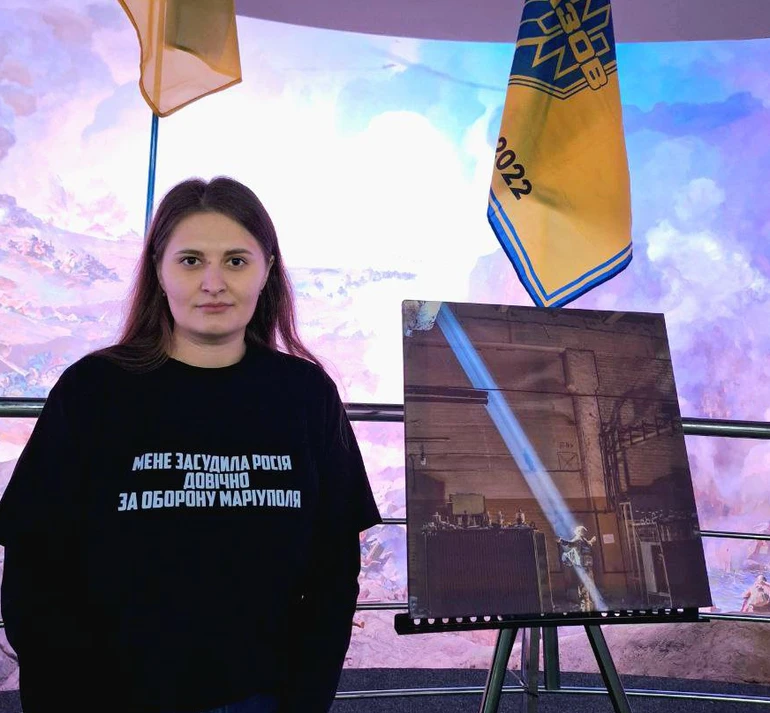
"See you soon" and a life sentence. What it's like to wait for a loved one from Siberia in the twenty-first century
Source: Ukrainska Pravda
Author: Olena Barsukova
The first Ukrainian to be exiled to Siberia was the 17th-century hetman Demian Ignatovich (Mnohohrishnyi).
During the Soviet era, dozens of Gulag concentration camps were built in Siberia, where political prisoners were held, as well as special settlements to which thousands of Ukrainians, Crimean Tatars, Estonians, Lithuanians, Latvians, Armenians, Germans, Finns, and other members of repressed peoples.
A century later, Russia continues to send Ukrainians to Siberia, imprisoning them in prisons with inhumane conditions. One such prison, known as the “Northern Wolf,” was established in the abandoned buildings of the former 501st camp unit of the Gulag.
Currently, 26-year-old Azov fighter and defender of Azovstal, Serhiy Mykhailenko, is being held in these Siberian torture chambers. According to the latest information received by his wife, Tamara, the Azov fighter is being held at the “Northern Wolf” colony.
Serhiy’s wife learned of his imprisonment from Russian Telegram channels after he was subjected to an illegal trial in Donetsk. The defender of Mariupol was “sentenced” to life imprisonment.
Tamara has not received any letters from Serhiy and has only seen him in propaganda videos. To save her husband and other unlawfully convicted prisoners, she traveled all the way to the Vatican to meet with the Pope.
The wife of an Azov soldier spoke to “Ukrainska Pravda. Life” about her love and fight for her husband, survival in Mariupol, the illegal trials of prisoners, her recent visit to the Pope, and her hope for an exchange.
June 6, 2023—the day Tamara first saw her husband after he left Azovstal. Well, how she saw him…
The Russians released a video in which Serhiy was forced to confess to crimes he did not commit. He was gaunt, pale, and exhausted. It was hard to recognize the burly Azov soldier in him now.
“At first, I didn’t pay attention to that video, since it’s a very common practice among Russians to publish clips of this nature. But then my friends messaged me and said it was being broadcast across all Russian media.
When I watched the video, I couldn’t believe that was my Serhiy. He was simply unrecognizable. I heard that he was stuttering. I suspect this is the result of torture. I just cried all day: it felt like a part of my soul had died inside me," recalls Tamara.
That was when the Azov soldier’s wife first underwent psychological rehabilitation. But she had no idea that she would have to be even stronger, because from that day on, Serhiy was under a fake Russian “investigation.”
January 16, 2024. The Russians published photos from an illegal trial in Donetsk, during which Serhiy was “found guilty” on trumped-up charges. The “sentence”: life imprisonment in a maximum-security penal colony.
After that, according to Tamara, her husband was held in Penal Colony No. 3, known as the “Polar Wolf,” located in western Siberia beyond the Arctic Circle (IK-3 of the Federal Penitentiary Service of Russia for the Yamalo-Nenets Autonomous Okrug – Russian).
"I saw a vacant stare, a pale face. He was very, very thin and lightly dressed, even though it was freezing outside. I know that he is currently in Siberia, in the same prison where Alexei Navalny was held. Also, he may have been in solitary confinement since April 2024. It’s very scary.
I couldn’t believe it, because in the 21st century people fly into space, new technologies are being developed, but Russia still lives in a time when people were sent to Siberia. “I’d only read about this in books and never thought I’d end up in the same situation as those people,” the woman says.
The woman receives no letters or calls from her husband. She has to monitor Russian media sources, as this is the only way to find out that her beloved is at least alive.
“On January 16, I saw a video from the courtroom and heard that he had been sentenced to life in prison. But for what? For defending Mariupol? I think that was already my third breakdown, because I realized the situation with these sham trials was critical,” the woman shares.
From Russian Telegram channels, Tamara learned that Serhiy suffered a concussion during the so-called “initiation” (a group beating). He suffers from panic attacks due to his injuries and torture. Tamara doesn’t even know if they gave him warm clothes.
“I’ve heard that in Siberia they feed them very poorly, and they might be sent to do hard labor: not just gluing bags, but hauling rocks and doing backbreaking work. This violates the Geneva Conventions, under which the Russians have no right to try prisoners of war at all,” says Tamara.
Her situation is not unique. The defenders of Mariupol are receiving harsh "sentences": 20–30 years and even life imprisonment for just one thing—defending their hometown.
According to Tamara, they are being sent to horrific places, specifically colonies for life-sentenced prisoners: “Black Dolphin,” “Polar Owl,” “Northern Wolf,” and “Vologda Five.”
"The situation with the illegal courts has spiraled out of control, because we have over a hundred convicts from Azov alone. For example, there are Azov fighters being held in 'Black Dolphin.' It’s one of the most terrifying prisons in Russia.
It’s psychologically very difficult when you realize that the person you plan to spend your whole life with is beyond the Arctic Circle. And you just go crazy from the uncertainty, because you don’t know if he’s eaten today,” Tamara shares.
23-year-old Tamara Koryagina is from Mariupol, just like her husband Sergey. They’ve been together for over 6 years. They once attended the same school, but didn’t know it, and met again during their college years.
“My husband is the best for me. And I simply can’t imagine my life without him. He’s the life of the party, cheerful, extremely sensitive, kind, brave, and always ready to help,” is how Tamara describes her beloved.
In 2019, Serhiy joined the ranks of "Azov," while Tamara was studying at the Faculty of Foreign Philology in Zaporizhzhia. In 2020, when the lockdown began, the couple started living together.
Tamara founded an English language school for adults and children, and Serhiy, in addition to his military service, was interested in graphic design and classical literature.
“When I was a freshman in college, we just hung out. We started a serious relationship when I turned 19. We were planning our wedding. Unfortunately, it hasn’t happened yet, and some guests will never come because we’ve lost so many friends. We’ve only just signed the marriage certificate,” Tamara says sadly.
When the war broke out, Tamara was in Mariupol, and Serhiy was in the Lviv region on military exercises. On February 26, he texted his beloved, “I’m home,” and went to defend his hometown.
Almost immediately, communication, heating, and water supply were cut off in Mariupol. Enemy planes constantly flew overhead, and explosions rang out almost every minute.
Tamara tried to survive in the city with her grandmother and Serhiy’s aunt. To stay warm, Tamara had to burn copies of *The Divine Comedy* and *Myths of Ancient Greece*—books Serhiy loved to read—in a bonfire. And to find out at least some news, the girl would go to the Mariupol Drama Theater.
On March 16, 2022, just minutes before the Russian airstrike, the girl left the theater. That saved her life.
“We lived near Azovstal, and in the early days, the occupiers were shelling the neighboring districts more. We just went to the drama theater because it was a sort of news hub. There, you could get help from the soldiers and police who had stayed in the city, and get some hot water and food.
I remember walking out of the theater, crossing the street, and a bomb falling. That horror is still vivid in my mind. I miraculously survived. I remember a local man running toward me, covered in blood. I saw him die, but I couldn’t do anything to help him,” the woman recalls.
Tamara left Mariupol on March 18. All that time, since late February, she had no contact with Serhiy. He called again on March 26.
“I realized then that Serhiy was at Azovstal. Every day was hell. I asked when he last ate, and he said, ‘I don’t remember, but I hate Snickers.’ That was the only thing they had to eat,” the woman says.
On April 7, Serhiy was wounded by shrapnel from an aerial bomb. He lost contact with his girlfriend because his phone was destroyed. The soldier spent some time in the hospital, but he wasn’t operated on due to a lack of medication. The shrapnel is still lodged in his legs.
The last time Tamara spoke with her husband was on May 16, 2022, when he texted from a friend’s phone: “Don’t worry, everything’s fine. We’ve been ordered to surrender. See you soon, get ready for the wedding.”
“I’ve been living with this message for three years now. We don’t receive any information about our loved ones. We only see the trials against them on Telegram channels and in the Russian media," the young woman says.
Tamara had no idea what condition Serhiy was in after leaving Azovstal. Later, she learned that in September 2022, he was transferred to the Donetsk pretrial detention center.
Serhiy’s comrades who returned from captivity said that the Russians were moving him from place to place and torturing him.
"In May 2023, I received a message from a guy who was in the same cell as Serhiy. He said they were fabricating some kind of case against him and that the Russians were accusing our relatives of crimes they themselves had committed.
The case claims that he ‘committed a crime’ in March, but that’s impossible even technically, because in March he stepped on something sharp, his leg was pierced, and he was in the hospital for a while. “He wasn’t even at the front lines,” says Tamara.
Tamara holds on, remembering Serhiy’s messages declaring his love, and lives with the dream that she will soon embrace her husband.
Every day, the woman thinks only of how to bring her husband home. She no longer cries, because Serhiy always said that tears can’t help in times of trouble.
“I’m waiting for him. I’ve even learned to cook his favorite borscht, even though I don’t really like the dish myself,” she shares.
Tamara stays in constant contact with the Coordination Headquarters for the Treatment of Prisoners of War, but the International Committee of the Red Cross has not provided her with any information about Serhiy’s fate—only confirming his release from “Azovstal” in May 2022.
“The Red Cross and the UN are organizations that don’t exist for me. Recently, someone called me and asked if I had any information about my husband. I asked, ‘Isn’t it your job to find out where the prisoners are?’ They said, ‘Unfortunately, Russia won’t let us in.’ And that’s it,” Tamara shares.
The Azov soldier’s wife admits she has lost faith in international human rights organizations because they have never visited the penal colonies where the Russians are holding the defenders of Mariupol. But recently, Tamara found new hope—a meeting with Pope Francis.
On June 26, 2024, the wives of the captured Azovstal defenders—now illegally convicted by Russia—visited the Pope once again. One of the delegation members was Tamara.
The women presented the pontiff with the book “The Eyes of Mariupol,” translated into Italian, a list of the illegally convicted Azov soldiers, a child’s drawing of the captured soldiers, and a scaled-down replica of hands in shackles—an installation erected on Sofiyskaya Square in honor of the Azovstal defenders.
"Many families have spoken to foreign media about the unlawfully convicted prisoners, traveled to Geneva… We decided that the Vatican is our last resort. The Pope is an influential figure throughout the world.
I hope the Pope was moved by our story, because I saw how he looked at us. I remember his eyes,” Tamara shares.
The trip to the Vatican was also intended to help draw attention to the illegal trials. The wives of the Azov soldiers spoke with dozens of foreign media outlets and explained that these fabricated trials completely contradict the Geneva Convention. However, according to Tamara, some Italian journalists did not understand why Russia has no right to imprison prisoners of war.
The wife of an Azov soldier asks Ukrainians and the international community to keep the captured defenders of Mariupol in mind, demand prisoner exchanges, and attend peaceful protests.
"The exchange of those illegally convicted is highly uncertain. We are very afraid that they have little chance of returning home, but we continue to fight, telling everyone that these illegal trials are truly a massive problem, and we ask the international community to help us, to put pressure on the aggressor country," says Tamara.
Under the Geneva Conventions, prisoners of war cannot be tried for participating in hostilities on behalf of their own state. At the same time, the conventions allow for them to be held accountable in cases of serious violations of the Geneva Conventions.
Therefore, Russia is attempting to accuse Ukrainian prisoners of war of war crimes: prisoners are typically charged with killing civilians or destroying civilian infrastructure. But the cases are mostly based on false testimony and “confessions” extracted under torture, according to the Coordination Headquarters for the Treatment of Prisoners of War.
The Geneva Conventions require the party holding prisoners of war to treat them humanely and provide a fair trial. "No moral or physical pressure may be exerted on a prisoner of war to force him to admit guilt for an offense of which he is accused," states Article 99. But the Russian Federation does not comply with any of these provisions.
"Russia has no right to seize foreigners on the territory of another country and subject them to Russian 'justice.' These people have done nothing illegal; they were defending their country, especially if they are military personnel serving in legitimate armed formations.
And the fact that Russia has long used fake justice and sham trials is a well-established fact. The judicial system under Putin is the heir to the fake Soviet system and Stalinist repressions. “Here we see the entire arsenal of methods honed during the era of Soviet pseudo-justice,” said Petro Yatsenko, spokesperson for the Coordination Headquarters.
94% of Ukrainian servicemen who returned from Russian captivity reported that they had been subjected to torture and inhumane treatment. Therefore, a “sincere confession of guilt” has nothing to do with reality, Petro Yatsenko emphasizes.
"The Russians are trying to charge civilians primarily under terrorism charges, and military personnel under charges related to war crimes. They also use phrases like ‘obstructing a special military operation.’ This is utter nonsense, arbitrariness, and a violation of all international norms and rules.
These sham courts are handing down fantastically long prison sentences. “We know that even cooks who worked in the Azovstal kitchen are receiving court sentences,” says Petro Yatsenko.
Furthermore, the Russian Federation does not provide adequate legal assistance to Ukrainians in captivity, and lawyers mostly play a nominal role in the staged proceedings. Only in rare cases do lawyers take an interest in the “defendant’s” fate and contact the captive’s relatives—so that families can at least find out that he is alive.
"Of course, receiving some kind of bogus sentence is a major source of stress for the families of a servicemember or an unlawfully detained civilian. But from a negotiation standpoint, receiving a sentence is not an obstacle to exchanges.
All that’s needed is the other side’s willingness to take back collaborators and their own military personnel. Right now, they have very little of that desire," explains Petro Yatsenko, spokesperson for the Coordination Headquarters.
As of June 30, 2024, the Coordination Headquarters is aware of criminal proceedings against 620 servicemen in Russian captivity, but the actual number may be higher. In violation of the Geneva Conventions, the Russian side does not inform Ukraine about open criminal proceedings, so the Coordination Headquarters can only monitor reports from the Russian prosecutor’s office and the media.
The Coordination Headquarters tracks all locations where Ukrainians are being held within the Russian Federation and in the temporarily occupied territories of Ukraine—104 such locations have already been identified.
To date, only 29 unlawfully convicted soldiers have been released from captivity. According to Petro Yatsenko, the main problem is that exchanges are not frequent enough. Despite the fact that many Russians are taken prisoner, Russia does not want to take back its soldiers and is trying to slow down the exchange process.
"The prisons are located quite far from one another. These include the infamous Mordovia and Taganrog. In fact, the treatment is inhumane everywhere; our people are subjected to torture and humiliation, and the conditions are completely inconsistent with the Geneva Conventions.
In 1949, amendments were made to the Third Geneva Convention on the Treatment of Prisoners of War, which addressed medical care, adequate food, the ability to communicate with family, respect for human dignity, and the absence of torture. None of this exists. “Even in those places where they supposedly feed them a little better and beat them a little less, the conditions are significantly worse than what Ukraine provides for Russians,” says Petro Yatsenko.
Russia does not allow representatives of the International Committee of the Red Cross to visit detention facilities or speak with prisoners. The Coordination Headquarters emphasizes that the international community must pressure Russia to stop torture, provide medical care to prisoners of war, and allow them to contact their families.
"The health of the prisoners is rapidly deteriorating. Many have been unable to contact their families for over two years, unlike Russians, who are able to receive packages and speak on the phone.
It is very important that the international community put pressure on Russia, tighten sanctions, and use all possible diplomatic and economic means to urge the Russians to stop torture. Because our people must return alive,” Petro Yatsenko emphasizes.
The spokesperson for the Coordination Headquarters also explained that it may be easier to secure the return of a prisoner of war who has already been “sentenced” than to secure the return of a person whose “trial” is still ongoing.
"When a so-called 'investigation' is underway, the Russians refuse to exchange the person, citing the fact that, supposedly, the process is not yet complete. There have been such precedents. Once a person has this sentence—even if it’s a huge, fake one—it may no longer be an obstacle for the aggressor country’s judicial system.
If the Russians do decide to take one of their own back, then a person serving a sentence can be exchanged. A sentence is not a reason to lose hope, even though it is difficult for the families,” says Petro Yatsenko.
Author: Olena Barsukova
The first Ukrainian to be exiled to Siberia was the 17th-century hetman Demian Ignatovich (Mnohohrishnyi).
During the Soviet era, dozens of Gulag concentration camps were built in Siberia, where political prisoners were held, as well as special settlements to which thousands of Ukrainians, Crimean Tatars, Estonians, Lithuanians, Latvians, Armenians, Germans, Finns, and other members of repressed peoples.
A century later, Russia continues to send Ukrainians to Siberia, imprisoning them in prisons with inhumane conditions. One such prison, known as the “Northern Wolf,” was established in the abandoned buildings of the former 501st camp unit of the Gulag.
Currently, 26-year-old Azov fighter and defender of Azovstal, Serhiy Mykhailenko, is being held in these Siberian torture chambers. According to the latest information received by his wife, Tamara, the Azov fighter is being held at the “Northern Wolf” colony.
Serhiy’s wife learned of his imprisonment from Russian Telegram channels after he was subjected to an illegal trial in Donetsk. The defender of Mariupol was “sentenced” to life imprisonment.
Tamara has not received any letters from Serhiy and has only seen him in propaganda videos. To save her husband and other unlawfully convicted prisoners, she traveled all the way to the Vatican to meet with the Pope.
The wife of an Azov soldier spoke to “Ukrainska Pravda. Life” about her love and fight for her husband, survival in Mariupol, the illegal trials of prisoners, her recent visit to the Pope, and her hope for an exchange.
"Russia is still living in a time when people were sent to Siberia"
June 6, 2023—the day Tamara first saw her husband after he left Azovstal. Well, how she saw him…
The Russians released a video in which Serhiy was forced to confess to crimes he did not commit. He was gaunt, pale, and exhausted. It was hard to recognize the burly Azov soldier in him now.
“At first, I didn’t pay attention to that video, since it’s a very common practice among Russians to publish clips of this nature. But then my friends messaged me and said it was being broadcast across all Russian media.
When I watched the video, I couldn’t believe that was my Serhiy. He was simply unrecognizable. I heard that he was stuttering. I suspect this is the result of torture. I just cried all day: it felt like a part of my soul had died inside me," recalls Tamara.
That was when the Azov soldier’s wife first underwent psychological rehabilitation. But she had no idea that she would have to be even stronger, because from that day on, Serhiy was under a fake Russian “investigation.”
January 16, 2024. The Russians published photos from an illegal trial in Donetsk, during which Serhiy was “found guilty” on trumped-up charges. The “sentence”: life imprisonment in a maximum-security penal colony.
After that, according to Tamara, her husband was held in Penal Colony No. 3, known as the “Polar Wolf,” located in western Siberia beyond the Arctic Circle (IK-3 of the Federal Penitentiary Service of Russia for the Yamalo-Nenets Autonomous Okrug – Russian).
"I saw a vacant stare, a pale face. He was very, very thin and lightly dressed, even though it was freezing outside. I know that he is currently in Siberia, in the same prison where Alexei Navalny was held. Also, he may have been in solitary confinement since April 2024. It’s very scary.
I couldn’t believe it, because in the 21st century people fly into space, new technologies are being developed, but Russia still lives in a time when people were sent to Siberia. “I’d only read about this in books and never thought I’d end up in the same situation as those people,” the woman says.
The woman receives no letters or calls from her husband. She has to monitor Russian media sources, as this is the only way to find out that her beloved is at least alive.
“On January 16, I saw a video from the courtroom and heard that he had been sentenced to life in prison. But for what? For defending Mariupol? I think that was already my third breakdown, because I realized the situation with these sham trials was critical,” the woman shares.
From Russian Telegram channels, Tamara learned that Serhiy suffered a concussion during the so-called “initiation” (a group beating). He suffers from panic attacks due to his injuries and torture. Tamara doesn’t even know if they gave him warm clothes.
“I’ve heard that in Siberia they feed them very poorly, and they might be sent to do hard labor: not just gluing bags, but hauling rocks and doing backbreaking work. This violates the Geneva Conventions, under which the Russians have no right to try prisoners of war at all,” says Tamara.
Her situation is not unique. The defenders of Mariupol are receiving harsh "sentences": 20–30 years and even life imprisonment for just one thing—defending their hometown.
According to Tamara, they are being sent to horrific places, specifically colonies for life-sentenced prisoners: “Black Dolphin,” “Polar Owl,” “Northern Wolf,” and “Vologda Five.”
"The situation with the illegal courts has spiraled out of control, because we have over a hundred convicts from Azov alone. For example, there are Azov fighters being held in 'Black Dolphin.' It’s one of the most terrifying prisons in Russia.
It’s psychologically very difficult when you realize that the person you plan to spend your whole life with is beyond the Arctic Circle. And you just go crazy from the uncertainty, because you don’t know if he’s eaten today,” Tamara shares.
Love, Mariupol, and a Fire from Ancient Literature
23-year-old Tamara Koryagina is from Mariupol, just like her husband Sergey. They’ve been together for over 6 years. They once attended the same school, but didn’t know it, and met again during their college years.
“My husband is the best for me. And I simply can’t imagine my life without him. He’s the life of the party, cheerful, extremely sensitive, kind, brave, and always ready to help,” is how Tamara describes her beloved.
In 2019, Serhiy joined the ranks of "Azov," while Tamara was studying at the Faculty of Foreign Philology in Zaporizhzhia. In 2020, when the lockdown began, the couple started living together.
Tamara founded an English language school for adults and children, and Serhiy, in addition to his military service, was interested in graphic design and classical literature.
“When I was a freshman in college, we just hung out. We started a serious relationship when I turned 19. We were planning our wedding. Unfortunately, it hasn’t happened yet, and some guests will never come because we’ve lost so many friends. We’ve only just signed the marriage certificate,” Tamara says sadly.
When the war broke out, Tamara was in Mariupol, and Serhiy was in the Lviv region on military exercises. On February 26, he texted his beloved, “I’m home,” and went to defend his hometown.
Almost immediately, communication, heating, and water supply were cut off in Mariupol. Enemy planes constantly flew overhead, and explosions rang out almost every minute.
Tamara tried to survive in the city with her grandmother and Serhiy’s aunt. To stay warm, Tamara had to burn copies of *The Divine Comedy* and *Myths of Ancient Greece*—books Serhiy loved to read—in a bonfire. And to find out at least some news, the girl would go to the Mariupol Drama Theater.
On March 16, 2022, just minutes before the Russian airstrike, the girl left the theater. That saved her life.
“We lived near Azovstal, and in the early days, the occupiers were shelling the neighboring districts more. We just went to the drama theater because it was a sort of news hub. There, you could get help from the soldiers and police who had stayed in the city, and get some hot water and food.
I remember walking out of the theater, crossing the street, and a bomb falling. That horror is still vivid in my mind. I miraculously survived. I remember a local man running toward me, covered in blood. I saw him die, but I couldn’t do anything to help him,” the woman recalls.
Tamara left Mariupol on March 18. All that time, since late February, she had no contact with Serhiy. He called again on March 26.
“I realized then that Serhiy was at Azovstal. Every day was hell. I asked when he last ate, and he said, ‘I don’t remember, but I hate Snickers.’ That was the only thing they had to eat,” the woman says.
On April 7, Serhiy was wounded by shrapnel from an aerial bomb. He lost contact with his girlfriend because his phone was destroyed. The soldier spent some time in the hospital, but he wasn’t operated on due to a lack of medication. The shrapnel is still lodged in his legs.
"We’ll see each other soon, get ready for the wedding"
The last time Tamara spoke with her husband was on May 16, 2022, when he texted from a friend’s phone: “Don’t worry, everything’s fine. We’ve been ordered to surrender. See you soon, get ready for the wedding.”
“I’ve been living with this message for three years now. We don’t receive any information about our loved ones. We only see the trials against them on Telegram channels and in the Russian media," the young woman says.
Tamara had no idea what condition Serhiy was in after leaving Azovstal. Later, she learned that in September 2022, he was transferred to the Donetsk pretrial detention center.
Serhiy’s comrades who returned from captivity said that the Russians were moving him from place to place and torturing him.
"In May 2023, I received a message from a guy who was in the same cell as Serhiy. He said they were fabricating some kind of case against him and that the Russians were accusing our relatives of crimes they themselves had committed.
The case claims that he ‘committed a crime’ in March, but that’s impossible even technically, because in March he stepped on something sharp, his leg was pierced, and he was in the hospital for a while. “He wasn’t even at the front lines,” says Tamara.
Tamara holds on, remembering Serhiy’s messages declaring his love, and lives with the dream that she will soon embrace her husband.
Every day, the woman thinks only of how to bring her husband home. She no longer cries, because Serhiy always said that tears can’t help in times of trouble.
“I’m waiting for him. I’ve even learned to cook his favorite borscht, even though I don’t really like the dish myself,” she shares.
Tamara stays in constant contact with the Coordination Headquarters for the Treatment of Prisoners of War, but the International Committee of the Red Cross has not provided her with any information about Serhiy’s fate—only confirming his release from “Azovstal” in May 2022.
“The Red Cross and the UN are organizations that don’t exist for me. Recently, someone called me and asked if I had any information about my husband. I asked, ‘Isn’t it your job to find out where the prisoners are?’ They said, ‘Unfortunately, Russia won’t let us in.’ And that’s it,” Tamara shares.
The Azov soldier’s wife admits she has lost faith in international human rights organizations because they have never visited the penal colonies where the Russians are holding the defenders of Mariupol. But recently, Tamara found new hope—a meeting with Pope Francis.
Visit to the Pope
On May 11, 2022, the wives of Azov fighters, Kateryna Prokopenko and Yulia Fedosyuk, came for an audience with the Pope and presented him with photographs of the wounded from Azovstal. The relatives of the Azovstal defenders pleaded for the fighters to be evacuated from Mariupol to a third country.
On June 26, 2024, the wives of the captured Azovstal defenders—now illegally convicted by Russia—visited the Pope once again. One of the delegation members was Tamara.
The women presented the pontiff with the book “The Eyes of Mariupol,” translated into Italian, a list of the illegally convicted Azov soldiers, a child’s drawing of the captured soldiers, and a scaled-down replica of hands in shackles—an installation erected on Sofiyskaya Square in honor of the Azovstal defenders.
"Many families have spoken to foreign media about the unlawfully convicted prisoners, traveled to Geneva… We decided that the Vatican is our last resort. The Pope is an influential figure throughout the world.
I hope the Pope was moved by our story, because I saw how he looked at us. I remember his eyes,” Tamara shares.
The trip to the Vatican was also intended to help draw attention to the illegal trials. The wives of the Azov soldiers spoke with dozens of foreign media outlets and explained that these fabricated trials completely contradict the Geneva Convention. However, according to Tamara, some Italian journalists did not understand why Russia has no right to imprison prisoners of war.
The wife of an Azov soldier asks Ukrainians and the international community to keep the captured defenders of Mariupol in mind, demand prisoner exchanges, and attend peaceful protests.
"The exchange of those illegally convicted is highly uncertain. We are very afraid that they have little chance of returning home, but we continue to fight, telling everyone that these illegal trials are truly a massive problem, and we ask the international community to help us, to put pressure on the aggressor country," says Tamara.
Why are the trials of Ukrainian prisoners of war illegal?
Under the Geneva Conventions, prisoners of war cannot be tried for participating in hostilities on behalf of their own state. At the same time, the conventions allow for them to be held accountable in cases of serious violations of the Geneva Conventions.
Therefore, Russia is attempting to accuse Ukrainian prisoners of war of war crimes: prisoners are typically charged with killing civilians or destroying civilian infrastructure. But the cases are mostly based on false testimony and “confessions” extracted under torture, according to the Coordination Headquarters for the Treatment of Prisoners of War.
The Geneva Conventions require the party holding prisoners of war to treat them humanely and provide a fair trial. "No moral or physical pressure may be exerted on a prisoner of war to force him to admit guilt for an offense of which he is accused," states Article 99. But the Russian Federation does not comply with any of these provisions.
"Russia has no right to seize foreigners on the territory of another country and subject them to Russian 'justice.' These people have done nothing illegal; they were defending their country, especially if they are military personnel serving in legitimate armed formations.
And the fact that Russia has long used fake justice and sham trials is a well-established fact. The judicial system under Putin is the heir to the fake Soviet system and Stalinist repressions. “Here we see the entire arsenal of methods honed during the era of Soviet pseudo-justice,” said Petro Yatsenko, spokesperson for the Coordination Headquarters.
94% of Ukrainian servicemen who returned from Russian captivity reported that they had been subjected to torture and inhumane treatment. Therefore, a “sincere confession of guilt” has nothing to do with reality, Petro Yatsenko emphasizes.
"The Russians are trying to charge civilians primarily under terrorism charges, and military personnel under charges related to war crimes. They also use phrases like ‘obstructing a special military operation.’ This is utter nonsense, arbitrariness, and a violation of all international norms and rules.
These sham courts are handing down fantastically long prison sentences. “We know that even cooks who worked in the Azovstal kitchen are receiving court sentences,” says Petro Yatsenko.
Furthermore, the Russian Federation does not provide adequate legal assistance to Ukrainians in captivity, and lawyers mostly play a nominal role in the staged proceedings. Only in rare cases do lawyers take an interest in the “defendant’s” fate and contact the captive’s relatives—so that families can at least find out that he is alive.
Is it possible to free illegally convicted prisoners?
The Coordination Headquarters for the Treatment of Prisoners of War says yes."Of course, receiving some kind of bogus sentence is a major source of stress for the families of a servicemember or an unlawfully detained civilian. But from a negotiation standpoint, receiving a sentence is not an obstacle to exchanges.
All that’s needed is the other side’s willingness to take back collaborators and their own military personnel. Right now, they have very little of that desire," explains Petro Yatsenko, spokesperson for the Coordination Headquarters.
As of June 30, 2024, the Coordination Headquarters is aware of criminal proceedings against 620 servicemen in Russian captivity, but the actual number may be higher. In violation of the Geneva Conventions, the Russian side does not inform Ukraine about open criminal proceedings, so the Coordination Headquarters can only monitor reports from the Russian prosecutor’s office and the media.
The Coordination Headquarters tracks all locations where Ukrainians are being held within the Russian Federation and in the temporarily occupied territories of Ukraine—104 such locations have already been identified.
To date, only 29 unlawfully convicted soldiers have been released from captivity. According to Petro Yatsenko, the main problem is that exchanges are not frequent enough. Despite the fact that many Russians are taken prisoner, Russia does not want to take back its soldiers and is trying to slow down the exchange process.
"The prisons are located quite far from one another. These include the infamous Mordovia and Taganrog. In fact, the treatment is inhumane everywhere; our people are subjected to torture and humiliation, and the conditions are completely inconsistent with the Geneva Conventions.
In 1949, amendments were made to the Third Geneva Convention on the Treatment of Prisoners of War, which addressed medical care, adequate food, the ability to communicate with family, respect for human dignity, and the absence of torture. None of this exists. “Even in those places where they supposedly feed them a little better and beat them a little less, the conditions are significantly worse than what Ukraine provides for Russians,” says Petro Yatsenko.
Russia does not allow representatives of the International Committee of the Red Cross to visit detention facilities or speak with prisoners. The Coordination Headquarters emphasizes that the international community must pressure Russia to stop torture, provide medical care to prisoners of war, and allow them to contact their families.
"The health of the prisoners is rapidly deteriorating. Many have been unable to contact their families for over two years, unlike Russians, who are able to receive packages and speak on the phone.
It is very important that the international community put pressure on Russia, tighten sanctions, and use all possible diplomatic and economic means to urge the Russians to stop torture. Because our people must return alive,” Petro Yatsenko emphasizes.
The spokesperson for the Coordination Headquarters also explained that it may be easier to secure the return of a prisoner of war who has already been “sentenced” than to secure the return of a person whose “trial” is still ongoing.
"When a so-called 'investigation' is underway, the Russians refuse to exchange the person, citing the fact that, supposedly, the process is not yet complete. There have been such precedents. Once a person has this sentence—even if it’s a huge, fake one—it may no longer be an obstacle for the aggressor country’s judicial system.
If the Russians do decide to take one of their own back, then a person serving a sentence can be exchanged. A sentence is not a reason to lose hope, even though it is difficult for the families,” says Petro Yatsenko.
This is an automatic translation generated by DeepL.