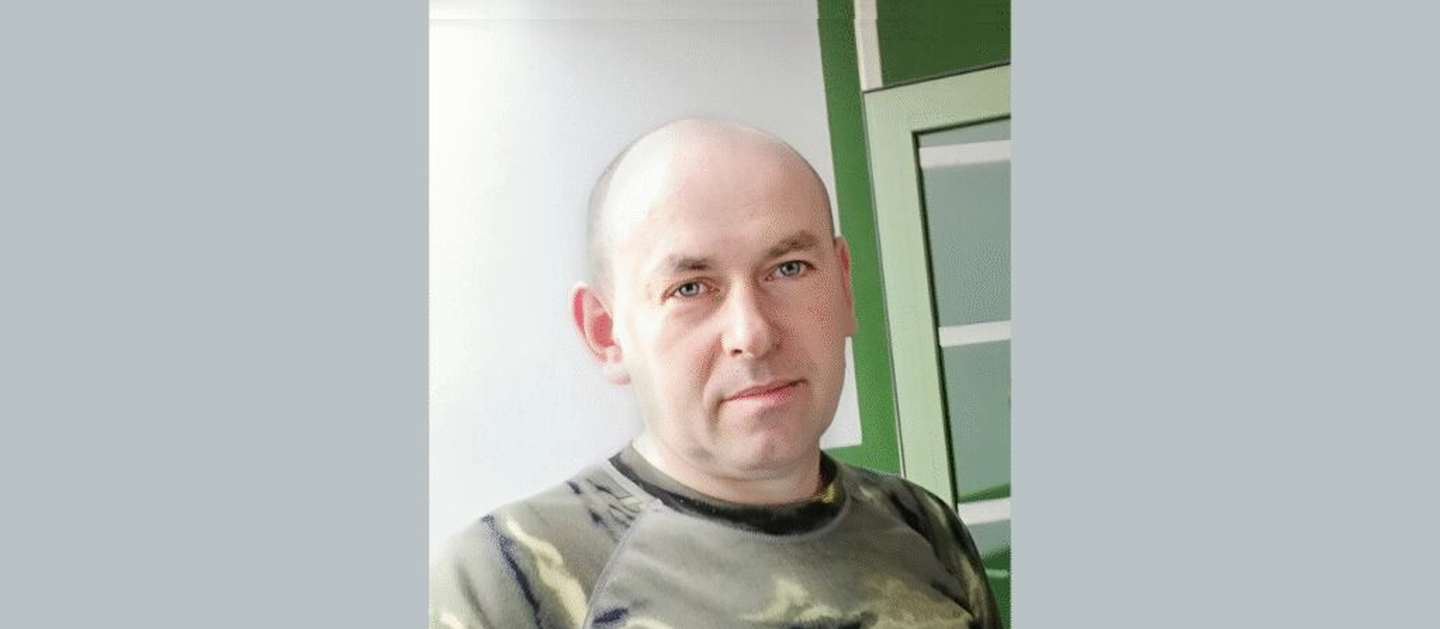
Russians have abducted a youth coach from the Kyiv region and are torturing him in a prison camp
Source: MIPL
Authors: Stanislav Miroshnychenko, Yulia Abibok
Broken fingers, surgery without anesthesia, starvation, and torture—this is how Oleksandr Malovany, a civilian from the Kyiv region, spent three years in captivity.
In the early days of the full-scale invasion, Russian troops rapidly seized the northern villages of the Kyiv region, where they immediately began detaining civilians en masse. According to local residents, by the end of March, the occupiers were holding about five hundred people in local basements and factory buildings. Among the first captives was 47-year-old Oleksandr Malovany, a children’s coach from Novi Petrivtsi near Kyiv, whose life was unexpectedly turned upside down by the war.
On the eve of the invasion, Oleksandr and his family had traveled to their summer cottage in the village of Rykhta near Chernobyl to stock up on firewood. On the morning of February 24, they were awakened by explosions. The family decided to stay in Rykhta, hoping to wait out the danger in the relative isolation of the village in the forest. The first few weeks there were indeed quiet—the front line ran further south. However, by mid-March, the Russians had reached this area as well. At noon on March 13, 2022, three Russian armored personnel carriers stormed into Rykhta, firing into the air in turn. The locals rushed to take cover. Oleksandr helped his wife Anastasia and their two young children escape into the forest, but he himself ended up on the street, where he was captured. The occupiers herded him and the rest of those who hadn’t managed to escape into a group and began searching them. First, they checked their documents; the men were forced to undress, their bodies were searched, and their phones were rummaged through.
When it was Malovany’s turn, he refused to unlock his smartphone. The occupiers then broke the fingers on his hand. And when he still refused to comply, they staged a mock execution of one of his acquaintances. Under such intense pressure, Oleksandr was forced to give in and unlock his phone. On it, the Russians saw photos of Ukrainian military helicopters and other images that seemed suspicious to them, so they took Malovany with them. He was the only resident of Rykhta taken by the occupiers that day.
When the enemy armored vehicles left the village, his wife Anastasia and their children risked returning home, but her husband was not there. Since then, the family has been searching for him.
First stop—the basement of “Viknaland”
From the start of the occupation of northern Kyiv Oblast, rumors spread throughout the region about makeshift prisons that the Russians had set up there. Very soon, all the freed captives began referring to one such place: the grounds of the “Viknaland” factory in the village of Dymer. The enemy had turned this plastic window manufacturing plant into a detention center for civilian captives from the surrounding villages. Oleksandr Malovany ended up there, as his wife later learned.
The conditions were horrific. The abducted people were herded into a damp basement—a dark and cold room with neither beds nor basic living conditions. They were kept right on the concrete floor without food or water in the freezing cold of March.
Some of the surviving witnesses admitted that it was torture: the occupiers would take some of the men outside, tie them to trees in the freezing cold, and leave them there for several days.
Others were constantly beaten with rifle butts and fists and interrogated in an attempt to identify “spotters” or “saboteurs” among the civilians. From time to time, Russian soldiers took the captives away for interrogation. According to one of those released, people were questioned about their jobs, their connections among the military, and so on. In Oleksandr’s case, such “pretexts” for persecution were absurd, since he had spent his entire life working with children as a sports coach and had never been interested in either politics or military affairs.
What happened behind closed doors at “Viknaland” is known thanks to the released captives, though people prefer not to talk about the horrors they endured. In late March, under pressure from the Ukrainian Armed Forces, the Russians were preparing to retreat from the Kyiv region. A few days before their withdrawal, a mine exploded near “Viknaland,” damaging part of the premises. After that, according to locals, the Russians released some of the hostages and transported the rest to other locations.
The Gostomel Cold Storage Units and a Leg
Injury Before transporting some of the captives to Russia, the Russians gathered them in a large transit camp on the outskirts of Hostomel, in the cold storage chambers of the captured airport. Some stayed there for just one night; others for two weeks. Oleksandr was brought here after Dymer. It was in Hostomel that something happened to him that would have serious consequences for his health.
According to eyewitness accounts, Malovany sustained a severe leg injury while at the Hostomel base. One version of events is that security guards shot him in the leg. The injury required immediate surgical attention. The operation was performed hastily under field conditions. According to some accounts, this happened while he was still in Hostomel; according to others, it occurred after the captives were transported to Gomel, Belarus. Oleksandr underwent surgery on his leg without any anesthesia: they cut it open, removed bone fragments and tissue, and stitched it up. His wife learned these details from freed captives who had been with Oleksandr. They also reported that after the surgery, the wound did not heal and became infected.
Oleksandr Malovany, a children’s coach from the Kyiv region. Photo: family archive
In late March, convoys of Russian military vehicles set out from the Kyiv region through the Chernobyl exclusion zone toward Belarus. Malovany, along with other captives, was transported through Gomel. That is how he ended up in Bryansk Pretrial Detention Center No. 2 in the city of Novozybkov, Russia.
Novozybkov Pretrial Detention Center: A Secret Prison, Starvation, and Torture
For the next 14 months, Pretrial Detention Center No. 2 in Novozybkov became Oleksandr’s permanent place of detention. It was a special prison where Ukrainians captured during the battles for Kyiv were brought en masse. As of early 2023, approximately 650 prisoners of war and civilians were being held there. Russia cynically denied holding Ukrainians there, effectively turning the detention center into a secret prison for those abducted in the Kyiv region—people like Oleksandr Malovany.
From the very beginning, conditions at the Bryansk pretrial detention center were extremely harsh. Witnesses describe the intake procedure for new arrivals as a “conveyor belt of fear.” When Ukrainian captives, handcuffed and with bags over their heads, were led into the prison yard, they were herded through a line of special forces soldiers. During this time, the captives were beaten, knocked to the ground, and mauled by dogs.
“We’d fall, and as soon as we got back up, they’d shove us again. Heads down, they’d shout, and the dogs would bark. Whichever dog got to someone would tear a chunk of flesh from them,” recalls one of the former prisoners about the intake process in Novozybkov.
During the intake process, guards broke another man’s ribs and beat him so severely that bruises covered his entire body. After that, he couldn’t lie down or stand properly for a month. People were distributed among overcrowded cells; they were constantly shuffled around, moved from cell to cell every few days to prevent them from forming close bonds. The routine was grueling: wake-up at 6 a.m., a ban on sitting or lying down during the day—people stood almost the entire day with their heads bowed, afraid to move. If anyone dared to walk around the cell, guards would immediately rush in and brutally beat the “offender.” Searches were conducted twice a day: special forces ordered people to undress and shout “Glory to Russia!”; they beat people and used stun guns on those who were slowest to comply.
There was a catastrophic shortage of food. They were fed three times a day, but the portions were meager. Constant malnutrition led to rapid exhaustion. People fell asleep hungry and woke up just as hungry. There was almost no medical care in the detention center. The doctor would show up only as a formality and ignored even the most serious cases. After surgery without anesthesia, both of Oleksandr Malovany’s legs were in critical condition: they were festering and would not heal. However, the Russian prison guards provided no medication or proper care. Only later, at the penal colony, were his wounds treated to some extent by other inmates, who shared pieces of soap to use as an antiseptic. Oleksandr teetered on the brink of sepsis for a long time but ultimately survived against all odds.
In 2022, through the International Committee of the Red Cross, Malovany sent a letter home. The yellow envelope bore a Russian postmark. In a short handwritten note, Malovany wrote: “Alive and well.” These two words, received by his wife, brought the family both tears of joy and new pain: it meant he had survived, but was still suffering in captivity.
The prisoners at Bryansk Pretrial Detention Center No. 2 were told lies—that Ukraine no longer existed, that Kyiv had been captured and bombed. Some were offered the chance to sign a waiver of exchange, with the officials saying, “Why should we exchange you? You’re ours now.” Oleksandr held his ground.
Transfer to Pakino: The Ordeal Continues
In May 2023, he was transferred from the Bryansk region deep into Russia to Maximum-Security Penal Colony No. 7 in the village of Pakino, Vladimir Oblast, Russian Federation. There, behind barbed wire in Soviet-style barracks, the Russians are holding both prisoners of war and civilian captives from Ukraine.
The beginning of his stay in Pakino turned out to be less unbearable than in the Bryansk pretrial detention center. And in the summer of 2024, according to the testimony of those released, conditions there temporarily improved: the food got better, and physical abuse subsided somewhat. This was likely due to increased attention from the international community. In the spring of 2024, representatives of the ICRC, together with Russian Human Rights Commissioner Tatyana Moskalkova, visited the prison. The day before, the Russians had pointedly piled mountains of supplies—food and hygiene products—on the tables, ostensibly for the prisoners, to create the appearance of humane treatment. In reality, however, the prisoners received only a pittance: after the delegation left, they were each given one tube of toothpaste and one can of condensed milk. The rest of the props were taken back to the warehouses.
Oleksandr was supposed to be included in the group of prisoners with whom the Red Cross was allowed to have a brief meeting. But the day before, the prison guards brutally beat him—striking him on the head and leaving a bloody wound that was impossible to hide. As a result, Malovany was not brought out to meet the international observers. After this incident, the prison administration likely ordered a temporary reduction in the severity of the abuse. According to the released soldiers, throughout the summer and until October 2024, physical torture was rarely used—the focus was more on psychological pressure. Sometimes the prisoners were even allowed to exercise in their cells.
However, the “thaw” did not last long. Starting in November, according to the prisoners, the regime tightened up again, and the beatings resumed. In early 2025, strict restrictions returned: guards no longer allowed exercise and scrutinized the prisoners’ every move.
Pakino Prison, Russia. Photo: open sources
Conditions at Pakino Colony No. 7 remain harsh, and the cells are overcrowded: 12 to 14 people may be held in a single cell, even though there are far fewer beds. Some are forced to take turns sleeping or sleep on the floor between the bunks. The prisoners see almost no daylight; even when they are occasionally taken out for walks, this takes place in courtyard-like spaces where the sun cannot be seen. The Ukrainian language is strictly prohibited, just as it is in the Bryansk pretrial detention center; prisoners are forced to sing Russian songs and the Russian national anthem every day. According to the recollections of former prisoners, Russian radio played in the cell all day long. The detainees are forced to listen to stories about Moscow’s fictitious victories and claims that “Ukraine does not exist.” Guards regularly humiliate the detainees, call them names, and try to break them psychologically.
As in the Bryansk pretrial detention center, prisoners are fed three times a day, but the portions are meager. The meals are simple: “balanda” (warm water with seasoning instead of soup), watery porridge, and occasionally a handful of rotten or dried potatoes. The lack of drinking water is a separate problem: the prison provides only tap water, which stinks and is undrinkable. People are constantly thirsty or forced to drink this dirty water, risking their health.
During the day, inmates are not allowed to lie down or sit on their bunks; they can only stand or pace the cell. Due to lack of space, only 1–2 people can walk at a time; the rest must stand pressed against the wall. Prisoners are beaten for even the slightest violation of the rules. The guards also invent “physical exercises”: they force prisoners to crawl on the floor and crawl under the beds. If they see dust on a prisoner’s body afterward, they force them to do hundreds of squats. When someone secretly tries to do calisthenics or push-ups in the cell, the guards punish them with solitary confinement or beatings. But even under such conditions, Oleksandr Malovanyy continues to try to stay in shape so his body doesn’t weaken completely.
“He even tries to exercise in there; they don’t let him, but he does something anyway,” says his wife, referring to her husband’s rare moments of physical activity.
Faith, Stronger Than Fear
The hardest ordeal for Oleksandr Malovany is not only the physical torment but also the separation from his family. During the first months after his abduction, he had no information about the fate of his loved ones and was tormented by the thought that they might have been killed during the shelling.
“He guessed that we had fled into the forest, but he didn’t know if we had made it back alive,” recalls his wife, Anastasia. “His mental state was very difficult.”
It wasn’t until late 2022, when a short letter from his family reached his cell, that Oleksandr learned his wife and children were safe. The news revived him: people sitting nearby said he perked up after that. His love for his family became his main source of strength.
Meanwhile, Anastasia is doing everything she can to bring her husband home. For more than three years, she has been knocking on the doors of various authorities, gathering documents and testimonies regarding Oleksandr’s abduction. At first, it wasn’t even easy to file a criminal case regarding his disappearance: the police dragged their feet until she began complaining about their inaction. When the case was finally registered, she faced bureaucratic cynicism. She recalls hearing the following from SBU employees in the investigator’s office:
— I fought for a very long time to get the case entered into the Unified Register of Pre-trial Investigations (ERDR). When I came to pick up an extract from the registry, there was an SBU employee sitting in the office next door along with some woman who looked like a secretary, and she said, ‘Why do they all need the Unified Register of Pre-trial Investigations?’ And he said, ‘Well, they all just want the money.’ That was very incompetent, very offensive, and very unpleasant.
Anastasia emphasizes that it’s not money she needs, but her husband. All these years, she and the children have been living in anxiety and hope. Emotionally, she says, it’s incredibly difficult. Every time a major prisoner exchange takes place, Anastasia’s heart skips a beat: what if Oleksandr is among those released? So far, that hasn’t happened. However, some exchanges have brought the family a glimmer of comfort: she has learned details about her husband from the freed soldiers. In May 2023, one of the released prisoners called her and recounted Alexander’s entire journey: Dymer—Gostomel—Belarus—Novozybkov—Pakino. And in early February 2025, after another prisoner exchange, another former prisoner of war called her and shared news about her husband.
Anastasia and the children dream of their dad coming home; they’re preparing for his rehabilitation, knowing that recovery will take a long time. But the most important thing, she says, is that he’s by their side. She is waiting for the long-awaited moment when Oleksandr sets foot on his native soil again. And then, surrounded by his family, he will finally tell his story himself—a story of how love and hope helped him withstand inhuman evil.
Authors: Stanislav Miroshnychenko, Yulia Abibok
Broken fingers, surgery without anesthesia, starvation, and torture—this is how Oleksandr Malovany, a civilian from the Kyiv region, spent three years in captivity.
In the early days of the full-scale invasion, Russian troops rapidly seized the northern villages of the Kyiv region, where they immediately began detaining civilians en masse. According to local residents, by the end of March, the occupiers were holding about five hundred people in local basements and factory buildings. Among the first captives was 47-year-old Oleksandr Malovany, a children’s coach from Novi Petrivtsi near Kyiv, whose life was unexpectedly turned upside down by the war.
On the eve of the invasion, Oleksandr and his family had traveled to their summer cottage in the village of Rykhta near Chernobyl to stock up on firewood. On the morning of February 24, they were awakened by explosions. The family decided to stay in Rykhta, hoping to wait out the danger in the relative isolation of the village in the forest. The first few weeks there were indeed quiet—the front line ran further south. However, by mid-March, the Russians had reached this area as well. At noon on March 13, 2022, three Russian armored personnel carriers stormed into Rykhta, firing into the air in turn. The locals rushed to take cover. Oleksandr helped his wife Anastasia and their two young children escape into the forest, but he himself ended up on the street, where he was captured. The occupiers herded him and the rest of those who hadn’t managed to escape into a group and began searching them. First, they checked their documents; the men were forced to undress, their bodies were searched, and their phones were rummaged through.
When it was Malovany’s turn, he refused to unlock his smartphone. The occupiers then broke the fingers on his hand. And when he still refused to comply, they staged a mock execution of one of his acquaintances. Under such intense pressure, Oleksandr was forced to give in and unlock his phone. On it, the Russians saw photos of Ukrainian military helicopters and other images that seemed suspicious to them, so they took Malovany with them. He was the only resident of Rykhta taken by the occupiers that day.
When the enemy armored vehicles left the village, his wife Anastasia and their children risked returning home, but her husband was not there. Since then, the family has been searching for him.
First stop—the basement of “Viknaland”
From the start of the occupation of northern Kyiv Oblast, rumors spread throughout the region about makeshift prisons that the Russians had set up there. Very soon, all the freed captives began referring to one such place: the grounds of the “Viknaland” factory in the village of Dymer. The enemy had turned this plastic window manufacturing plant into a detention center for civilian captives from the surrounding villages. Oleksandr Malovany ended up there, as his wife later learned.
The conditions were horrific. The abducted people were herded into a damp basement—a dark and cold room with neither beds nor basic living conditions. They were kept right on the concrete floor without food or water in the freezing cold of March.
Some of the surviving witnesses admitted that it was torture: the occupiers would take some of the men outside, tie them to trees in the freezing cold, and leave them there for several days.
Others were constantly beaten with rifle butts and fists and interrogated in an attempt to identify “spotters” or “saboteurs” among the civilians. From time to time, Russian soldiers took the captives away for interrogation. According to one of those released, people were questioned about their jobs, their connections among the military, and so on. In Oleksandr’s case, such “pretexts” for persecution were absurd, since he had spent his entire life working with children as a sports coach and had never been interested in either politics or military affairs.
What happened behind closed doors at “Viknaland” is known thanks to the released captives, though people prefer not to talk about the horrors they endured. In late March, under pressure from the Ukrainian Armed Forces, the Russians were preparing to retreat from the Kyiv region. A few days before their withdrawal, a mine exploded near “Viknaland,” damaging part of the premises. After that, according to locals, the Russians released some of the hostages and transported the rest to other locations.
The Gostomel Cold Storage Units and a Leg
Injury Before transporting some of the captives to Russia, the Russians gathered them in a large transit camp on the outskirts of Hostomel, in the cold storage chambers of the captured airport. Some stayed there for just one night; others for two weeks. Oleksandr was brought here after Dymer. It was in Hostomel that something happened to him that would have serious consequences for his health.
According to eyewitness accounts, Malovany sustained a severe leg injury while at the Hostomel base. One version of events is that security guards shot him in the leg. The injury required immediate surgical attention. The operation was performed hastily under field conditions. According to some accounts, this happened while he was still in Hostomel; according to others, it occurred after the captives were transported to Gomel, Belarus. Oleksandr underwent surgery on his leg without any anesthesia: they cut it open, removed bone fragments and tissue, and stitched it up. His wife learned these details from freed captives who had been with Oleksandr. They also reported that after the surgery, the wound did not heal and became infected.
Oleksandr Malovany, a children’s coach from the Kyiv region. Photo: family archive
In late March, convoys of Russian military vehicles set out from the Kyiv region through the Chernobyl exclusion zone toward Belarus. Malovany, along with other captives, was transported through Gomel. That is how he ended up in Bryansk Pretrial Detention Center No. 2 in the city of Novozybkov, Russia.
Novozybkov Pretrial Detention Center: A Secret Prison, Starvation, and Torture
For the next 14 months, Pretrial Detention Center No. 2 in Novozybkov became Oleksandr’s permanent place of detention. It was a special prison where Ukrainians captured during the battles for Kyiv were brought en masse. As of early 2023, approximately 650 prisoners of war and civilians were being held there. Russia cynically denied holding Ukrainians there, effectively turning the detention center into a secret prison for those abducted in the Kyiv region—people like Oleksandr Malovany.
From the very beginning, conditions at the Bryansk pretrial detention center were extremely harsh. Witnesses describe the intake procedure for new arrivals as a “conveyor belt of fear.” When Ukrainian captives, handcuffed and with bags over their heads, were led into the prison yard, they were herded through a line of special forces soldiers. During this time, the captives were beaten, knocked to the ground, and mauled by dogs.
“We’d fall, and as soon as we got back up, they’d shove us again. Heads down, they’d shout, and the dogs would bark. Whichever dog got to someone would tear a chunk of flesh from them,” recalls one of the former prisoners about the intake process in Novozybkov.
During the intake process, guards broke another man’s ribs and beat him so severely that bruises covered his entire body. After that, he couldn’t lie down or stand properly for a month. People were distributed among overcrowded cells; they were constantly shuffled around, moved from cell to cell every few days to prevent them from forming close bonds. The routine was grueling: wake-up at 6 a.m., a ban on sitting or lying down during the day—people stood almost the entire day with their heads bowed, afraid to move. If anyone dared to walk around the cell, guards would immediately rush in and brutally beat the “offender.” Searches were conducted twice a day: special forces ordered people to undress and shout “Glory to Russia!”; they beat people and used stun guns on those who were slowest to comply.
There was a catastrophic shortage of food. They were fed three times a day, but the portions were meager. Constant malnutrition led to rapid exhaustion. People fell asleep hungry and woke up just as hungry. There was almost no medical care in the detention center. The doctor would show up only as a formality and ignored even the most serious cases. After surgery without anesthesia, both of Oleksandr Malovany’s legs were in critical condition: they were festering and would not heal. However, the Russian prison guards provided no medication or proper care. Only later, at the penal colony, were his wounds treated to some extent by other inmates, who shared pieces of soap to use as an antiseptic. Oleksandr teetered on the brink of sepsis for a long time but ultimately survived against all odds.
In 2022, through the International Committee of the Red Cross, Malovany sent a letter home. The yellow envelope bore a Russian postmark. In a short handwritten note, Malovany wrote: “Alive and well.” These two words, received by his wife, brought the family both tears of joy and new pain: it meant he had survived, but was still suffering in captivity.
The prisoners at Bryansk Pretrial Detention Center No. 2 were told lies—that Ukraine no longer existed, that Kyiv had been captured and bombed. Some were offered the chance to sign a waiver of exchange, with the officials saying, “Why should we exchange you? You’re ours now.” Oleksandr held his ground.
Transfer to Pakino: The Ordeal Continues
In May 2023, he was transferred from the Bryansk region deep into Russia to Maximum-Security Penal Colony No. 7 in the village of Pakino, Vladimir Oblast, Russian Federation. There, behind barbed wire in Soviet-style barracks, the Russians are holding both prisoners of war and civilian captives from Ukraine.
The beginning of his stay in Pakino turned out to be less unbearable than in the Bryansk pretrial detention center. And in the summer of 2024, according to the testimony of those released, conditions there temporarily improved: the food got better, and physical abuse subsided somewhat. This was likely due to increased attention from the international community. In the spring of 2024, representatives of the ICRC, together with Russian Human Rights Commissioner Tatyana Moskalkova, visited the prison. The day before, the Russians had pointedly piled mountains of supplies—food and hygiene products—on the tables, ostensibly for the prisoners, to create the appearance of humane treatment. In reality, however, the prisoners received only a pittance: after the delegation left, they were each given one tube of toothpaste and one can of condensed milk. The rest of the props were taken back to the warehouses.
Oleksandr was supposed to be included in the group of prisoners with whom the Red Cross was allowed to have a brief meeting. But the day before, the prison guards brutally beat him—striking him on the head and leaving a bloody wound that was impossible to hide. As a result, Malovany was not brought out to meet the international observers. After this incident, the prison administration likely ordered a temporary reduction in the severity of the abuse. According to the released soldiers, throughout the summer and until October 2024, physical torture was rarely used—the focus was more on psychological pressure. Sometimes the prisoners were even allowed to exercise in their cells.
However, the “thaw” did not last long. Starting in November, according to the prisoners, the regime tightened up again, and the beatings resumed. In early 2025, strict restrictions returned: guards no longer allowed exercise and scrutinized the prisoners’ every move.
Pakino Prison, Russia. Photo: open sources
Conditions at Pakino Colony No. 7 remain harsh, and the cells are overcrowded: 12 to 14 people may be held in a single cell, even though there are far fewer beds. Some are forced to take turns sleeping or sleep on the floor between the bunks. The prisoners see almost no daylight; even when they are occasionally taken out for walks, this takes place in courtyard-like spaces where the sun cannot be seen. The Ukrainian language is strictly prohibited, just as it is in the Bryansk pretrial detention center; prisoners are forced to sing Russian songs and the Russian national anthem every day. According to the recollections of former prisoners, Russian radio played in the cell all day long. The detainees are forced to listen to stories about Moscow’s fictitious victories and claims that “Ukraine does not exist.” Guards regularly humiliate the detainees, call them names, and try to break them psychologically.
As in the Bryansk pretrial detention center, prisoners are fed three times a day, but the portions are meager. The meals are simple: “balanda” (warm water with seasoning instead of soup), watery porridge, and occasionally a handful of rotten or dried potatoes. The lack of drinking water is a separate problem: the prison provides only tap water, which stinks and is undrinkable. People are constantly thirsty or forced to drink this dirty water, risking their health.
During the day, inmates are not allowed to lie down or sit on their bunks; they can only stand or pace the cell. Due to lack of space, only 1–2 people can walk at a time; the rest must stand pressed against the wall. Prisoners are beaten for even the slightest violation of the rules. The guards also invent “physical exercises”: they force prisoners to crawl on the floor and crawl under the beds. If they see dust on a prisoner’s body afterward, they force them to do hundreds of squats. When someone secretly tries to do calisthenics or push-ups in the cell, the guards punish them with solitary confinement or beatings. But even under such conditions, Oleksandr Malovanyy continues to try to stay in shape so his body doesn’t weaken completely.
“He even tries to exercise in there; they don’t let him, but he does something anyway,” says his wife, referring to her husband’s rare moments of physical activity.
Faith, Stronger Than Fear
The hardest ordeal for Oleksandr Malovany is not only the physical torment but also the separation from his family. During the first months after his abduction, he had no information about the fate of his loved ones and was tormented by the thought that they might have been killed during the shelling.
“He guessed that we had fled into the forest, but he didn’t know if we had made it back alive,” recalls his wife, Anastasia. “His mental state was very difficult.”
It wasn’t until late 2022, when a short letter from his family reached his cell, that Oleksandr learned his wife and children were safe. The news revived him: people sitting nearby said he perked up after that. His love for his family became his main source of strength.
Meanwhile, Anastasia is doing everything she can to bring her husband home. For more than three years, she has been knocking on the doors of various authorities, gathering documents and testimonies regarding Oleksandr’s abduction. At first, it wasn’t even easy to file a criminal case regarding his disappearance: the police dragged their feet until she began complaining about their inaction. When the case was finally registered, she faced bureaucratic cynicism. She recalls hearing the following from SBU employees in the investigator’s office:
— I fought for a very long time to get the case entered into the Unified Register of Pre-trial Investigations (ERDR). When I came to pick up an extract from the registry, there was an SBU employee sitting in the office next door along with some woman who looked like a secretary, and she said, ‘Why do they all need the Unified Register of Pre-trial Investigations?’ And he said, ‘Well, they all just want the money.’ That was very incompetent, very offensive, and very unpleasant.
Anastasia emphasizes that it’s not money she needs, but her husband. All these years, she and the children have been living in anxiety and hope. Emotionally, she says, it’s incredibly difficult. Every time a major prisoner exchange takes place, Anastasia’s heart skips a beat: what if Oleksandr is among those released? So far, that hasn’t happened. However, some exchanges have brought the family a glimmer of comfort: she has learned details about her husband from the freed soldiers. In May 2023, one of the released prisoners called her and recounted Alexander’s entire journey: Dymer—Gostomel—Belarus—Novozybkov—Pakino. And in early February 2025, after another prisoner exchange, another former prisoner of war called her and shared news about her husband.
Anastasia and the children dream of their dad coming home; they’re preparing for his rehabilitation, knowing that recovery will take a long time. But the most important thing, she says, is that he’s by their side. She is waiting for the long-awaited moment when Oleksandr sets foot on his native soil again. And then, surrounded by his family, he will finally tell his story himself—a story of how love and hope helped him withstand inhuman evil.
This is an automatic translation generated by DeepL.