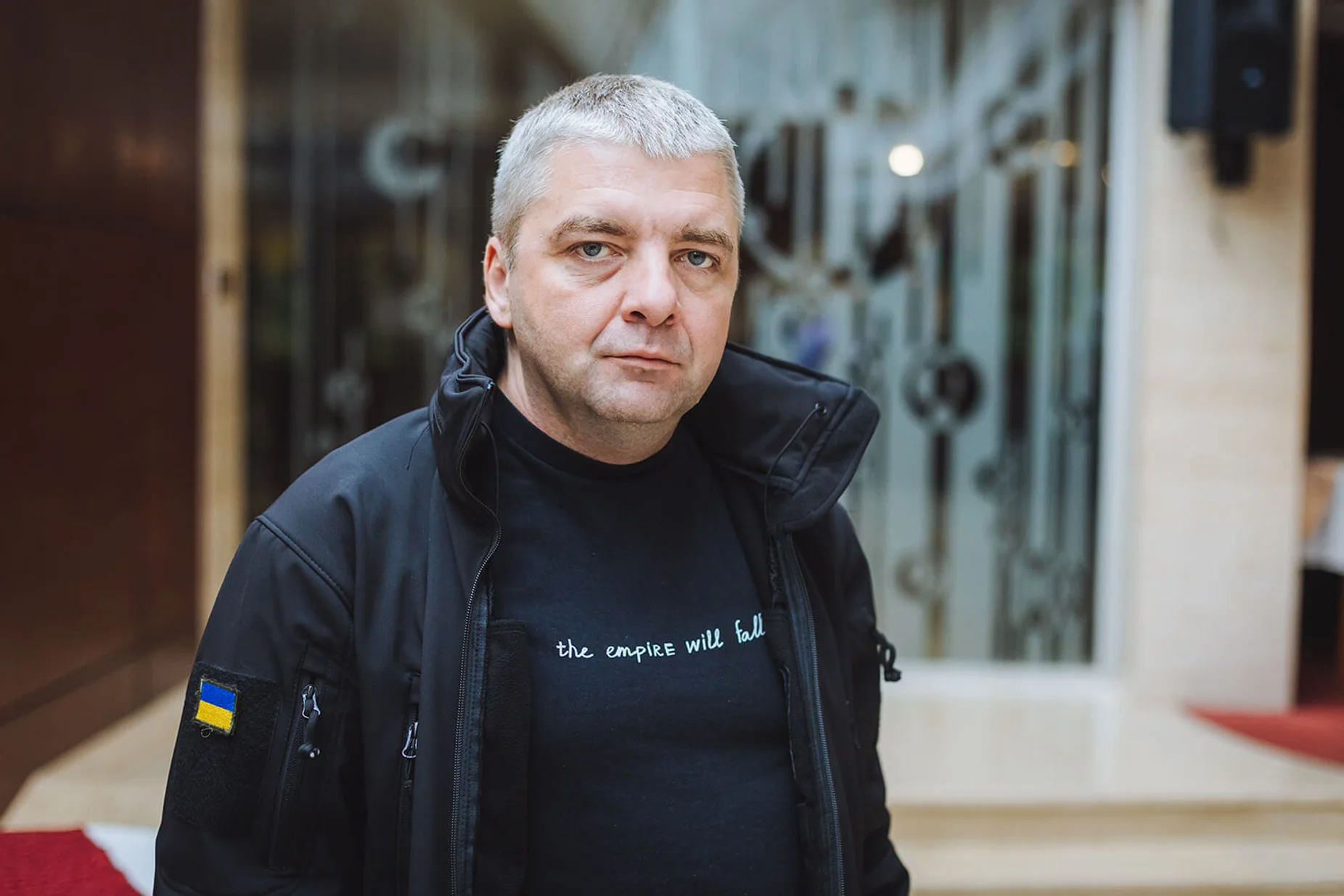
Maksym Butkevych, released from captivity: "I saw what the 'Russian world' is from the inside... It is a real Mordor in terms of values and freedom"
Source: Varosh
Author: Larysa Lypkan
Maksym Butkevych, a journalist, public figure, co-founder of the ZMINA Human Rights Center, and co-coordinator of the human rights organization “Principle of Hope,” took up arms in the early days of Russia’s full-scale invasion to defend the rights and freedom of Ukrainians—no longer relying solely on the law. He says he didn’t even consider any other option—military aggression understands only the language of force. While carrying out an operation in the Luhansk region, he was surrounded and then taken prisoner by the Russians. He spent two years and four months in captivity, unsure if he would survive.
Maksym’s public activities could not go unnoticed by enemy intelligence services. The human rights defender and journalist’s background negatively affected his chances of escaping the clutches of the Kremlin’s punitive machine without losing his dignity, health, or life. Under psychological pressure and the threat of torture, Butkevych confessed to crimes he did not commit and was sentenced to 13 years in prison under a fabricated criminal charge. People like him don’t get included in prisoner exchanges... But he never stopped believing that people were looking for him and working to secure his release. What makes Maksym’s story unique is that while in captivity, he personally witnessed violations of prisoners’ rights, even though he himself had fought for many years to ensure that such things did not happen in any prisons.
On October 18, 2024, a prisoner of war exchange took place, and Butkevych returned to Ukraine. Now he continues his human rights and civic activism, openly shares his own experiences and exposes the crimes of the Russian Federation, helps free as many soldiers as possible from prisons, and urges people not to ignore the influence of Kremlin propaganda on the minds of people around the world.
This interview is about Maksym Butkevych, one of those Ukrainians who care—passionate individuals who are building a healthy society and creating real change with their own hands.
— Maksym, when did you first feel the desire to fight injustice?
— I think that desire emerged back in school. At the time, like most Soviet children, I was happy to become a Pioneer. But then it quickly became clear that what was actually happening and what we were being told were two different things. Behind the mask of propaganda’s beautiful words about solidarity, mutual aid, and the absence of inequality lay hypocrisy, a harsh authoritarian system, and a repressive machine. Once this became clear, every subsequent instance of lies provoked a reaction in me.
I remember how, in the late 1980s, we had to study and recite from memory in our Ukrainian literature class the poem “My Homeland” by Maksym Rylsky, written in the early 1930s. By that time, information was gradually beginning to emerge about what was actually happening in Ukraine at the time—the first mentions of the 1932–33 Holodomor. And here was a thoroughly Stalinist poem, a sort of hymn to the glorious USSR. I said it was a lie and refused to recite it. It was a scandal. The teacher was afraid of accusations of Ukrainian bourgeois nationalism; they called in the party organizer and the school principal.
Then things went further: I joined initiatives related to the movement for Ukrainian independence and supported the student hunger strike during the “Revolution on Granite.” While studying at the Philosophy Department of Taras Shevchenko National University of Kyiv, I joined the independent student union “Direct Action,” which was predominantly anarchist. Although it was an active period of my life, it was actually quite a dark time for people trying to change something in society. It was a time of economic and social crisis, of Kuchma’s authoritarianism. All of this brought disappointment and apathy. I joined the union then because I understood: if anyone is responsible for everything happening in my country, it is first and foremost me. A sense of responsibility emerged, one that has never left me since.
— You worked as an international correspondent for the TV channels STB, “1+1,” and “Inter,” as well as for the BBC, and founded “Hromadske Radio.” Why did you leave journalism at some point?
— I was thrilled when, after graduating from the Philosophy Department at Taras Shevchenko National University of Kyiv, I got the chance to work in television. Everything was great until it became clear that my colleagues were working in a toxic atmosphere of “storylines.” Fortunately, censorship didn’t extend to the “international desk” back then, but I knew it was only a matter of time. They told me: “Don’t take on this topic, because you won’t write it the way you’re supposed to. And even if you do, the editor won’t let it through anyway, so just don’t waste your time.”
In the fall of 2002, I was selected for a job at the BBC Ukrainian Service, and in January 2003, I flew to London. It was a fixed-term contract with no possibility of renewal. When it ended, I realized I needed a break from media work. I needed time to look at my work from the outside.
I wanted to learn something new, so I earned a spot in a one-year program at the University of Sussex. There, I studied applied anthropology, researching communities—how they function internally and what needs to be considered in development projects. This gave me the impetus to look for work that had meaning.
— What does “meaning” mean? What answer did you give yourself back then?
— Improving people’s lives. That question remains key for me, both then and now. And it sometimes prompted me to quit jobs that, as they say, you wouldn’t leave on your own. Because I understood that there was another cause that made more sense.
— How did you get involved in human rights advocacy?
— In February 2006, an incident occurred that changed everything. Thirteen Uzbeks who had sought asylum from persecution in their homeland were forcibly returned from Ukraine to Uzbekistan. I was already interested in refugee issues at that time; I understood why they were fleeing and what awaited them there. Their forced return was a violation of the basic principles of international law, in particular the Refugee Convention, which Ukraine had signed and ratified. In practice, we disregarded our international obligations and ruined people’s lives, apparently due to some “backroom deals” with the then-leadership of Uzbekistan. I wrote about this on social media, and my friends from the anarchist community, activists from “Black Hour,” and Maidan activists gathered to organize a protest. We wanted to ensure this would not happen again in the future.
It soon became clear that we needed not just a single protest, but a major campaign. We joined forces with other human rights organizations, and I became a member of the National Committee of Amnesty International in Ukraine. Refugees began reaching out to us with their problems, and we gradually began to transform into an organization—that’s how the “Without Borders” Project came to be.
— What aspect of the refugees’ problems affected you the most?
— The issue of freedom of movement as a fundamental human right had interested me for a very long time. The Universal Declaration of Human Rights is actually a very poetic document. Listen to this article: “All human beings are born free and equal in dignity and rights and should treat one another in a spirit of brotherhood.” But beyond that, it states that everyone has the right to freely leave their country and return to it. That wasn’t true, because back then we had a visa regime with EU countries, and getting a visa wasn’t easy. It was a rather humiliating process, so freedom of movement was important to me.
And then I realized that for some people, this is a matter of survival. Once, at an international conference, we met Natalia Kabatsii from the “Medical Aid Committee in Transcarpathia,” and we’ve been working together ever since. They helped people seeking asylum in Transcarpathia, and we consulted on complex cases. In 2007, I was one of the co-organizers of an international refugee camp near Uzhhorod, which housed over 300 people from 13 countries. We accomplished a great deal back then.
The “Without Borders” project expanded and began addressing issues of discrimination and racism, particularly everyday racism. We were the first organization to begin monitoring phenomena such as attacks or crimes motivated by racial hatred; we dealt with tragedies where people died simply because of the color of their skin, or were treated with prejudice due to their appearance, phenotype, or eye shape.
But I wasn’t interested only in refugees. After some time, I became a public monitor of the preventive mechanism to prevent torture in law enforcement agencies and visited places of detention.
— There is something fateful about the fact that a few years later, you looked at this problem from a different perspective after being captured and imprisoned in a Russian jail… But a few years before that, you even managed to win the “Butkevych v. Russia” case. Tell us about that.
— In 2006, I was an activist in the anti-globalization movement in Britain. A year earlier, I had participated in nonviolent protests against the then “G8” summit in Scotland. That year, the summit was held in St. Petersburg, so I went there. Together with a media group, we were doing informational work, which resulted in my being detained for three days while I was photographing a protest without directly participating in it. That’s how I ended up spending some time in St. Petersburg. This was the first time I had been imprisoned under Russian control (and my second experience of imprisonment overall: the first was in Kyiv in 1997, during the late Kuchma era, when I was detained for several days for participating in a protest). The court’s decision was appealed to the appellate court, which, of course, upheld the ruling; it then went to the European Court of Human Rights. I won, but given the pace of such proceedings, it wasn’t until 2018. However, the case of “Butkevych v. Russia” became a landmark case for many journalists. At the time, I received compensation of several thousand euros, which I spent largely on a campaign to support Ukrainian political prisoners held by the Kremlin: Oleg Sentsov, Oleksandr Kolchenko, Hennadiy Afanasyev, and others.
— How did you, a humanities major, become a military commander in this war, and what tasks did you carry out?
— I was given the rank of officer by the military department at the university where I studied. And on the evening of February 24, 2022, I grabbed my backpack and went to the Territorial Defense Forces. I didn’t overestimate my knowledge or training in military affairs, so I said, “Give me a Kalashnikov or a shovel; I’m ready to go to the Territorial Defense Forces.” They recorded my information and called me a week later. Throughout that week, I wrote for European media about the events unfolding in Ukraine.
After mobilization, I was assigned to the newly formed 210th Separate Special Battalion, which was named “Berlingo” (it is now the 210th Separate Assault Regiment). We were formed to defend Kyiv in the event of a breakthrough by enemy tank columns, to operate in urban combat conditions. At the time, we were given Citroën Berlingo vehicles for transportation—vehicles marketed as ideal for active family recreation. The “recreation” part didn’t work out, but our unit really was like a family. I was appointed platoon commander. We had to stop enemy columns at close range with a grenade launcher, then withdraw so that artillery could take over our position. There was no time for training. I gathered everyone and said, “Let’s share our experience; we’ll make decisions together.” I decided for myself: the only thing I can do is try to take care of people. And I tried to take care of my 20 guys.
In late March and early April 2022, my platoon took part in the liberation of the Kyiv region along the Bucha, Irpin, and Zhytomyr highway. We were lucky back then—we returned from the mission without a single casualty, even though artillery and armored vehicles were targeting us.
We were the first unit, aside from the scouts, to enter the settlements after their liberation. That moment was very important to me. We were the first Ukrainian soldiers the local residents met. It’s an absolutely incredible feeling—to be a liberator. They cried, gave us everything they had left, and asked through their tears, “Boys, tell me, they won’t come back, will they?”
We saw burned-out houses, shot-up civilian vehicles clearly marked as evacuation vehicles, bodies on the roads, the aftermath of looting. I saw what occupation meant.
— How and where were you taken prisoner?
— On June 14, 2022, we received combat orders to head east. We first arrived in the Donetsk region, and a few days later our company was sent to the Luhansk region. On June 19, we entered a settlement where we were to reinforce our troops. Most of the time during those two days, we were under constant mortar fire. Half of my platoon received an order to move to an observation post, which we did.
We were told that we were only to observe, report on any enemy movements, and wait for reinforcements. When we moved out, communication was immediately lost. When the enemy appeared, there were nine of us. We didn’t see them, only heard them. Judging by the voices, there were several dozen or even a hundred of them, plus a lot of equipment in the nearby grove. We couldn’t report back and realized that something had changed while we were here. We didn’t know what to do. We ran out of water. Suddenly, one of the fighters from the unit to which we were being transferred got in touch with us. He said the area was surrounded by Russians, but they hadn’t closed the ring yet, and if we moved quickly through the “green zone” and the fields following his instructions, we would get out together with his guys. A few dozen meters before the final landing, he ordered us to stop and said, “I’m sorry, guys, I’ve been a prisoner since last night; you’re now standing in an open field in the line of fire. If you don’t lay down your weapons, you’ll be killed.” Russians emerged from the landing zone so we could see them. In other words, it was a kind of radio play with us. Then I realized that I had eight guys who, without carrying out any tasks, would die. So I gave the order to lay down our weapons, and that’s how, on June 21, 2022, we were taken prisoner.
— I won’t go into detail about your captivity right now; your time there has been described in many interviews. Just tell me, what kind of period was it? How do you view it now? How did those two years and four months change you?
— Captivity is the kind of experience that changes a person forever. It’s a unique, prolonged, and nerve-wracking experience. You learn something new about yourself and about other people. It’s not always pleasant. But there are pleasant aspects too—that’s important. It’s hard to assess in hindsight. Because when you’re in the midst of it, everything looks different. There are things you have to live with for the rest of your life. It’s certainly a traumatic experience.
But for me, it was also an opportunity. There was a certain irony that I couldn’t help but notice. I was involved in human rights advocacy and found myself in a situation of constant, massive violations of those rights. I was a monitor for the National Preventive Mechanism against Torture, and torture was used against me and the guys in my cell to force me to confess to a war crime I didn’t commit. I have been an anti-militarist for most of my life and am proud to be a senior lieutenant (now) in the Armed Forces of Ukraine. But that does not negate the fact that I am still an anti-militarist.
I think I tried to resist internally the attempts to break us psychologically and thought about the most important things. I had time to think. I approached this sometimes with irony, and sometimes seriously, as if it were field research—human rights and anthropological. The latter is unavoidable, especially after being convicted on trumped-up criminal charges, after being transported along with those convicted of criminal offenses. So it was interesting to explore prison subculture from the inside.
— Did you feel that people were fighting for you, that you weren’t abandoned?
— In captivity, everyone experiences emotional breakdowns. Sooner or later, it hits you. Including the thought that you’ve been left behind and forgotten, especially since the guards constantly told us that nobody needed us. But I never had a second of doubt, regardless of my mood. I always knew that they would get me out of here, that people cared about me and remembered me. The only thing was, in the colony, when I started feeling my health deteriorate, I thought I might not make it to my release. But that was also a way out, so I wouldn’t have to spend all 13 years in a maximum-security prison, which is what I was sentenced to. The thought of my people—my colleagues, my relatives—kept me going.
— You were transferred between detention centers and prisons. Where was it the hardest?
— Probably in the Luhansk detention center. They don’t give prisoners of war anything there—not even toilet paper. I had to file my nails down against the wall because I had nothing to trim them with for several months. The longest stretch without a shower lasted six weeks. The first few months were especially difficult—hunger and physical abuse. Then it got a little easier.
— What was their objective? What were the Russian investigators trying to achieve?
— They quickly realized they had obtained all the military intelligence and that we knew nothing more. Then their next objective emerged—to break us down, to shake us emotionally. Perhaps so that someone would switch to their side, or if someone returned, they would carry out their orders. Sometimes simply because Russian propaganda had created the image for them that the Ukrainian people were being deceived by a Nazi leadership. But here they encountered a mass of conscious people. There is a wide range of education and living standards. It’s one thing to prepare to encounter one or two “Nazis” and “Banderites,” but it’s another to suddenly realize that this seems to be a genuine people’s war. Although, of course, Ukrainian people who worked with their hands in peacetime and lacked the education to articulate their thoughts could not defend their convictions before their interrogators. But even in them, the Russians saw no signs of “Nazism.”
The Russians saw people who had gone to war to defend their homes and families, even though they wanted to hear that people had gone to fight for money or that they really wanted to be “liberated.” So they tried to extract that confession by various means. I think there was also a moment of complacency on their part, in an attempt to shake us of our conviction that we were in the right. And to be honest, there were a few—not many—but there were outright sadists there who simply enjoyed feeling power over defenseless people.
— Now that you’ve returned home to your human rights work, what is the most important thing you want to convey to the world? How do you use the experience you’ve gone through?
— It’s important to me that I can say with absolute sincerity: “I’ve seen what the ‘Russian World’ is like from the inside.” I know what values it’s built on, because I had the chance to talk to local Russian prisoners, and sometimes to some investigators and guards. This worldview is the exact opposite of what we now consider our own. For them, the state is everything; the individual is nothing. A person is expendable. People cannot determine their own fate in principle. The authorities decide everything. It’s better not to stick your neck out, to obey, to follow orders—then they’ll feed you and, perhaps, won’t beat you. In the near future, there is no reason to hope for the emergence of any passionate individuals.
You know, I’ve stopped thinking of Tolkien as just fantasy. I see Mordor. It’s a real Mordor in terms of values and freedom.
— What are the most striking changes you’ve noticed in Ukraine during this time?
— I’ve missed a lot, of course; a lot has changed. At the start of the full-scale invasion, the whole society was mobilized; there was a sense that we had to pull together and repel the enemy. Now the war has become the new normal. Especially in Kyiv. It’s just life now, with air raid sirens, blackouts, and incoming shells. People have gotten used to it and are living their lives under the current conditions.
It’s more complicated with the volunteers. Although I think the idea that there’s a total reluctance to join the military is somewhat exaggerated. We have a strong culture of mutual aid and support for the Defense Forces. I personally know people who start their day with a donation and end it with one. That, too, has become part of this new normal.
On the other hand, there’s a growing sense that since everything could end at any moment, we need to live in the here and now.
I see a clear cultural boom. Before the war, the last article I read about Ukrainian book publishing and its prospects was very pessimistic, because part of the production capacity was destroyed in 2022. But it turned out that alongside bulletproof vests, people are buying books. This cultural boom extends not only to literature but also to film, theater, and the arts. People want to learn new things, study something, or simply celebrate life. They’ve stopped putting things off until later, because “later” might simply never come.
— Doesn’t the calm, measured life in Uzhhorod surprise you?
— This is the rear, and you can feel the difference from Kyiv here. But thank God. There is no front without a rear—we need a calm region, otherwise we won’t be able to fight.
I remember one time, in the spring of 2022, the National Opera of Ukraine resumed operations, and I was sent there as one of the officers. They just told me, “You’re going to the opera.” It was sort of a cultural assignment. I showed up in uniform; there were a lot of foreign journalists there for the season opening. It turned out I was one of the few English-speaking people there, so I had to give a few interviews. The main question was about how I felt seeing the opera, evening gowns, and champagne in glasses when the combat zone was literally just a few dozen kilometers away. Did I feel a sense of dissonance or anger? I didn’t feel that way. On the contrary, it brings me great joy, because we aren’t fighting to be in a state of constant mourning. We are fighting so that life can go on. So that people can meet, go to the opera, take walks, donate, organize weddings, have children, and develop something new. Life is what we are defending.
During the last few months of captivity, one of the things that kept me going was that we were allowed to correspond. Getting these letters delivered was very difficult. But I asked my loved ones: please, no matter what happens, don’t put anything on hold just because I’m in captivity. Only if your lives continue in full force will my captivity have any meaning. I’m very glad that’s how it turned out. So no, of course, I don’t judge anyone who, aside from donating, is helping the front lines, taking care of themselves, their loved ones, and the people dear to me. And I’ll still take the guys from my unit to the Kyiv Opera when all this is over.
— As someone who worked at the UN and continues to speak at their meetings, what do you think the future holds for this organization? Given its obvious weakness and inability to make decisive, effective decisions, as has been demonstrated time and again.
— A time bomb was planted in this organization from the very moment of its creation: the status of a permanent member of the UN Security Council with veto power, which the Soviet Union held and which later passed to Russia. As long as this state of affairs persists, the UN will remain a platform where positions are merely stated. I wouldn’t write off the organization entirely, but as we can see, it is not an effective instrument for maintaining peace and security in the world; the organization is completely dysfunctional. Individual agencies, especially humanitarian ones—such as the UN Refugee Agency—play an important role. But this has nothing to do with the UN specifically as a guarantor of peace and security. There is no longer any peace, no security, and no guarantors.
— How does what is currently happening in the U.S. with Donald Trump’s rise to power affect Europe? Now this question is for you as a journalist who has long specialized in international relations.
— I recently returned from an extended advocacy trip through European countries. Although no, let me correct myself—countries of the European Union, because Ukraine is also a European country. Moreover, we are probably the most European country in all of Europe right now, because we are defending values shared by most European societies, but we are the ones defending them tooth and nail. We are paying a heavy price, while they are very slowly gathering their strength. So, here are my observations from the trip: this new shift by the new American administration, however dangerous and unexpected it may be for many, has served as a wake-up call for a great many Europeans. It made many realize that they must finally pull themselves together and take much better care of themselves and Ukraine.
— Given the latest global geopolitical trends, what do you see as the mission of Ukrainians?
— To protect the core and fundamental values of all communities that want to live more freely. In solidarity and without fear. To protect them from the “Russian World,” but also from other similar worldviews. Because for us, people come first. We put respect for people above all else. We are not just defending ourselves, but all people who want to live freely.
— What are you doing now?
— First and foremost, I’m focused on international advocacy. On my trips, I try to share my experiences. We established the “Principle of Hope” Charitable Foundation to help soldiers, veterans, and civilians released from captivity, as well as people facing difficult life circumstances. The “Without Borders” project continues its work.
As a former prisoner of war and military serviceman (I am not currently on active duty but remain on the roster), I travel on behalf of various organizations to events in Ukraine and abroad.
One of the priorities is assisting organizations and individuals working to secure the release of our captives. This is a priority because I am here, and they are still there. I am in touch with many relatives of the guys I was imprisoned with.
Of course, I work on issues of reintegration and rehabilitation because we need a support system for those released from captivity. The first few weeks—everything’s fine here—but then the person enters the most difficult period, about 3–4 months after release. Now I can confirm this personally. PTSD is brutal. For the first few months, you’re riding a high of endorphins and euphoria, but then everything normalizes and the emotional swings, flashbacks, and sleep problems begin. You have to figure out how to cope with this, learn to live with it.
There are many avenues for human rights work. You asked how I endured captivity? I had already developed a system for myself along the way—how to act, what to hold onto. Personnel of the Defense Forces absolutely need to be instructed on a basic algorithm of actions while in captivity. I saw how guys who didn’t know these things were emotionally shaken.
Also, for the first time in 11 years, I’ve returned to “Hromadske Radio.” We’ll now be going on the air every week with host Daria Bura (the human rights podcast “I Hear Others”—Ed.).
— What can we, Ukrainian society, do to ensure you don’t feel alone?
— On the one hand, I’m actually glad to feel this loneliness, because I want to stay this way. I don’t want anyone else to go through what I went through. No one should have to go through that. Being alone doesn’t mean being by yourself, isolated. I always know there are people who fought for me. I know that now I’m able to do something thanks to those people. I’m incredibly grateful to them.
What can be done for those released from captivity? Just don’t leave people alone. Many of them need help or simply attention. By the way, one of the first projects of “Principle of Hope” that we’re implementing is creating a video on how to interact with those who have been in captivity. Don’t force anything on them, be patient, give them time and space, but at the same time make them feel supported. So that the person knows that if they need it, there are other people nearby. At the same time, don’t say: “You know, right now you have to do this.” Any pressure is counterproductive. The main thing is to see each other as human beings. I generally think that it is precisely in moments like these that we realize that what matters most are other people. We rely on them.
Maksym Butkevych also participated in the “Dilemma” Mobile Academy in Uzhhorod and spoke at the “Dialogues on Europe” 2025 forum. You can watch his speech on the Re:Open Ukraine initiative’s YouTube channel:
For English subtitles, please enable captions in the video settings and select Auto-translate → English.
Author: Larysa Lypkan
A conversation about values and freedom that neither colonial rule nor torture could break.
Maksym Butkevych, a journalist, public figure, co-founder of the ZMINA Human Rights Center, and co-coordinator of the human rights organization “Principle of Hope,” took up arms in the early days of Russia’s full-scale invasion to defend the rights and freedom of Ukrainians—no longer relying solely on the law. He says he didn’t even consider any other option—military aggression understands only the language of force. While carrying out an operation in the Luhansk region, he was surrounded and then taken prisoner by the Russians. He spent two years and four months in captivity, unsure if he would survive.
Maksym’s public activities could not go unnoticed by enemy intelligence services. The human rights defender and journalist’s background negatively affected his chances of escaping the clutches of the Kremlin’s punitive machine without losing his dignity, health, or life. Under psychological pressure and the threat of torture, Butkevych confessed to crimes he did not commit and was sentenced to 13 years in prison under a fabricated criminal charge. People like him don’t get included in prisoner exchanges... But he never stopped believing that people were looking for him and working to secure his release. What makes Maksym’s story unique is that while in captivity, he personally witnessed violations of prisoners’ rights, even though he himself had fought for many years to ensure that such things did not happen in any prisons.
On October 18, 2024, a prisoner of war exchange took place, and Butkevych returned to Ukraine. Now he continues his human rights and civic activism, openly shares his own experiences and exposes the crimes of the Russian Federation, helps free as many soldiers as possible from prisons, and urges people not to ignore the influence of Kremlin propaganda on the minds of people around the world.
This interview is about Maksym Butkevych, one of those Ukrainians who care—passionate individuals who are building a healthy society and creating real change with their own hands.
“If anyone is responsible for everything that is happening in my country, it is first and foremost me.”
— Maksym, when did you first feel the desire to fight injustice?
— I think that desire emerged back in school. At the time, like most Soviet children, I was happy to become a Pioneer. But then it quickly became clear that what was actually happening and what we were being told were two different things. Behind the mask of propaganda’s beautiful words about solidarity, mutual aid, and the absence of inequality lay hypocrisy, a harsh authoritarian system, and a repressive machine. Once this became clear, every subsequent instance of lies provoked a reaction in me.
I remember how, in the late 1980s, we had to study and recite from memory in our Ukrainian literature class the poem “My Homeland” by Maksym Rylsky, written in the early 1930s. By that time, information was gradually beginning to emerge about what was actually happening in Ukraine at the time—the first mentions of the 1932–33 Holodomor. And here was a thoroughly Stalinist poem, a sort of hymn to the glorious USSR. I said it was a lie and refused to recite it. It was a scandal. The teacher was afraid of accusations of Ukrainian bourgeois nationalism; they called in the party organizer and the school principal.
Then things went further: I joined initiatives related to the movement for Ukrainian independence and supported the student hunger strike during the “Revolution on Granite.” While studying at the Philosophy Department of Taras Shevchenko National University of Kyiv, I joined the independent student union “Direct Action,” which was predominantly anarchist. Although it was an active period of my life, it was actually quite a dark time for people trying to change something in society. It was a time of economic and social crisis, of Kuchma’s authoritarianism. All of this brought disappointment and apathy. I joined the union then because I understood: if anyone is responsible for everything happening in my country, it is first and foremost me. A sense of responsibility emerged, one that has never left me since.
“Improving people’s lives. That has always been, and remains, the key issue for me.”
— You worked as an international correspondent for the TV channels STB, “1+1,” and “Inter,” as well as for the BBC, and founded “Hromadske Radio.” Why did you leave journalism at some point?
— I was thrilled when, after graduating from the Philosophy Department at Taras Shevchenko National University of Kyiv, I got the chance to work in television. Everything was great until it became clear that my colleagues were working in a toxic atmosphere of “storylines.” Fortunately, censorship didn’t extend to the “international desk” back then, but I knew it was only a matter of time. They told me: “Don’t take on this topic, because you won’t write it the way you’re supposed to. And even if you do, the editor won’t let it through anyway, so just don’t waste your time.”
In the fall of 2002, I was selected for a job at the BBC Ukrainian Service, and in January 2003, I flew to London. It was a fixed-term contract with no possibility of renewal. When it ended, I realized I needed a break from media work. I needed time to look at my work from the outside.
I wanted to learn something new, so I earned a spot in a one-year program at the University of Sussex. There, I studied applied anthropology, researching communities—how they function internally and what needs to be considered in development projects. This gave me the impetus to look for work that had meaning.
— What does “meaning” mean? What answer did you give yourself back then?
— Improving people’s lives. That question remains key for me, both then and now. And it sometimes prompted me to quit jobs that, as they say, you wouldn’t leave on your own. Because I understood that there was another cause that made more sense.
Work on protecting the rights of refugees in Ukraine
— How did you get involved in human rights advocacy?
— In February 2006, an incident occurred that changed everything. Thirteen Uzbeks who had sought asylum from persecution in their homeland were forcibly returned from Ukraine to Uzbekistan. I was already interested in refugee issues at that time; I understood why they were fleeing and what awaited them there. Their forced return was a violation of the basic principles of international law, in particular the Refugee Convention, which Ukraine had signed and ratified. In practice, we disregarded our international obligations and ruined people’s lives, apparently due to some “backroom deals” with the then-leadership of Uzbekistan. I wrote about this on social media, and my friends from the anarchist community, activists from “Black Hour,” and Maidan activists gathered to organize a protest. We wanted to ensure this would not happen again in the future.
It soon became clear that we needed not just a single protest, but a major campaign. We joined forces with other human rights organizations, and I became a member of the National Committee of Amnesty International in Ukraine. Refugees began reaching out to us with their problems, and we gradually began to transform into an organization—that’s how the “Without Borders” Project came to be.
— What aspect of the refugees’ problems affected you the most?
— The issue of freedom of movement as a fundamental human right had interested me for a very long time. The Universal Declaration of Human Rights is actually a very poetic document. Listen to this article: “All human beings are born free and equal in dignity and rights and should treat one another in a spirit of brotherhood.” But beyond that, it states that everyone has the right to freely leave their country and return to it. That wasn’t true, because back then we had a visa regime with EU countries, and getting a visa wasn’t easy. It was a rather humiliating process, so freedom of movement was important to me.
And then I realized that for some people, this is a matter of survival. Once, at an international conference, we met Natalia Kabatsii from the “Medical Aid Committee in Transcarpathia,” and we’ve been working together ever since. They helped people seeking asylum in Transcarpathia, and we consulted on complex cases. In 2007, I was one of the co-organizers of an international refugee camp near Uzhhorod, which housed over 300 people from 13 countries. We accomplished a great deal back then.
The “Without Borders” project expanded and began addressing issues of discrimination and racism, particularly everyday racism. We were the first organization to begin monitoring phenomena such as attacks or crimes motivated by racial hatred; we dealt with tragedies where people died simply because of the color of their skin, or were treated with prejudice due to their appearance, phenotype, or eye shape.
But I wasn’t interested only in refugees. After some time, I became a public monitor of the preventive mechanism to prevent torture in law enforcement agencies and visited places of detention.
The Case of “Butkevych v. Russia”
— There is something fateful about the fact that a few years later, you looked at this problem from a different perspective after being captured and imprisoned in a Russian jail… But a few years before that, you even managed to win the “Butkevych v. Russia” case. Tell us about that.
— In 2006, I was an activist in the anti-globalization movement in Britain. A year earlier, I had participated in nonviolent protests against the then “G8” summit in Scotland. That year, the summit was held in St. Petersburg, so I went there. Together with a media group, we were doing informational work, which resulted in my being detained for three days while I was photographing a protest without directly participating in it. That’s how I ended up spending some time in St. Petersburg. This was the first time I had been imprisoned under Russian control (and my second experience of imprisonment overall: the first was in Kyiv in 1997, during the late Kuchma era, when I was detained for several days for participating in a protest). The court’s decision was appealed to the appellate court, which, of course, upheld the ruling; it then went to the European Court of Human Rights. I won, but given the pace of such proceedings, it wasn’t until 2018. However, the case of “Butkevych v. Russia” became a landmark case for many journalists. At the time, I received compensation of several thousand euros, which I spent largely on a campaign to support Ukrainian political prisoners held by the Kremlin: Oleg Sentsov, Oleksandr Kolchenko, Hennadiy Afanasyev, and others.
“Give me a Kalashnikov or a shovel, I’m ready to go to the Territorial Defense Forces”
— How did you, a humanities major, become a military commander in this war, and what tasks did you carry out?
— I was given the rank of officer by the military department at the university where I studied. And on the evening of February 24, 2022, I grabbed my backpack and went to the Territorial Defense Forces. I didn’t overestimate my knowledge or training in military affairs, so I said, “Give me a Kalashnikov or a shovel; I’m ready to go to the Territorial Defense Forces.” They recorded my information and called me a week later. Throughout that week, I wrote for European media about the events unfolding in Ukraine.
After mobilization, I was assigned to the newly formed 210th Separate Special Battalion, which was named “Berlingo” (it is now the 210th Separate Assault Regiment). We were formed to defend Kyiv in the event of a breakthrough by enemy tank columns, to operate in urban combat conditions. At the time, we were given Citroën Berlingo vehicles for transportation—vehicles marketed as ideal for active family recreation. The “recreation” part didn’t work out, but our unit really was like a family. I was appointed platoon commander. We had to stop enemy columns at close range with a grenade launcher, then withdraw so that artillery could take over our position. There was no time for training. I gathered everyone and said, “Let’s share our experience; we’ll make decisions together.” I decided for myself: the only thing I can do is try to take care of people. And I tried to take care of my 20 guys.
In late March and early April 2022, my platoon took part in the liberation of the Kyiv region along the Bucha, Irpin, and Zhytomyr highway. We were lucky back then—we returned from the mission without a single casualty, even though artillery and armored vehicles were targeting us.
We were the first unit, aside from the scouts, to enter the settlements after their liberation. That moment was very important to me. We were the first Ukrainian soldiers the local residents met. It’s an absolutely incredible feeling—to be a liberator. They cried, gave us everything they had left, and asked through their tears, “Boys, tell me, they won’t come back, will they?”
We saw burned-out houses, shot-up civilian vehicles clearly marked as evacuation vehicles, bodies on the roads, the aftermath of looting. I saw what occupation meant.
“And I realized that I had eight guys who, without even carrying out any missions, would die. So I gave the order to lay down our weapons…”
— How and where were you taken prisoner?
— On June 14, 2022, we received combat orders to head east. We first arrived in the Donetsk region, and a few days later our company was sent to the Luhansk region. On June 19, we entered a settlement where we were to reinforce our troops. Most of the time during those two days, we were under constant mortar fire. Half of my platoon received an order to move to an observation post, which we did.
We were told that we were only to observe, report on any enemy movements, and wait for reinforcements. When we moved out, communication was immediately lost. When the enemy appeared, there were nine of us. We didn’t see them, only heard them. Judging by the voices, there were several dozen or even a hundred of them, plus a lot of equipment in the nearby grove. We couldn’t report back and realized that something had changed while we were here. We didn’t know what to do. We ran out of water. Suddenly, one of the fighters from the unit to which we were being transferred got in touch with us. He said the area was surrounded by Russians, but they hadn’t closed the ring yet, and if we moved quickly through the “green zone” and the fields following his instructions, we would get out together with his guys. A few dozen meters before the final landing, he ordered us to stop and said, “I’m sorry, guys, I’ve been a prisoner since last night; you’re now standing in an open field in the line of fire. If you don’t lay down your weapons, you’ll be killed.” Russians emerged from the landing zone so we could see them. In other words, it was a kind of radio play with us. Then I realized that I had eight guys who, without carrying out any tasks, would die. So I gave the order to lay down our weapons, and that’s how, on June 21, 2022, we were taken prisoner.
“Captivity is an experience that changes a person forever.”
— I won’t go into detail about your captivity right now; your time there has been described in many interviews. Just tell me, what kind of period was it? How do you view it now? How did those two years and four months change you?
— Captivity is the kind of experience that changes a person forever. It’s a unique, prolonged, and nerve-wracking experience. You learn something new about yourself and about other people. It’s not always pleasant. But there are pleasant aspects too—that’s important. It’s hard to assess in hindsight. Because when you’re in the midst of it, everything looks different. There are things you have to live with for the rest of your life. It’s certainly a traumatic experience.
But for me, it was also an opportunity. There was a certain irony that I couldn’t help but notice. I was involved in human rights advocacy and found myself in a situation of constant, massive violations of those rights. I was a monitor for the National Preventive Mechanism against Torture, and torture was used against me and the guys in my cell to force me to confess to a war crime I didn’t commit. I have been an anti-militarist for most of my life and am proud to be a senior lieutenant (now) in the Armed Forces of Ukraine. But that does not negate the fact that I am still an anti-militarist.
I think I tried to resist internally the attempts to break us psychologically and thought about the most important things. I had time to think. I approached this sometimes with irony, and sometimes seriously, as if it were field research—human rights and anthropological. The latter is unavoidable, especially after being convicted on trumped-up criminal charges, after being transported along with those convicted of criminal offenses. So it was interesting to explore prison subculture from the inside.
— Did you feel that people were fighting for you, that you weren’t abandoned?
— In captivity, everyone experiences emotional breakdowns. Sooner or later, it hits you. Including the thought that you’ve been left behind and forgotten, especially since the guards constantly told us that nobody needed us. But I never had a second of doubt, regardless of my mood. I always knew that they would get me out of here, that people cared about me and remembered me. The only thing was, in the colony, when I started feeling my health deteriorate, I thought I might not make it to my release. But that was also a way out, so I wouldn’t have to spend all 13 years in a maximum-security prison, which is what I was sentenced to. The thought of my people—my colleagues, my relatives—kept me going.
— You were transferred between detention centers and prisons. Where was it the hardest?
— Probably in the Luhansk detention center. They don’t give prisoners of war anything there—not even toilet paper. I had to file my nails down against the wall because I had nothing to trim them with for several months. The longest stretch without a shower lasted six weeks. The first few months were especially difficult—hunger and physical abuse. Then it got a little easier.
“It’s one thing to prepare yourself to face one or two ‘Nazis’ and ‘Banderites,’ but it’s another to suddenly realize that this is truly a people’s war.”
— What was their objective? What were the Russian investigators trying to achieve?
— They quickly realized they had obtained all the military intelligence and that we knew nothing more. Then their next objective emerged—to break us down, to shake us emotionally. Perhaps so that someone would switch to their side, or if someone returned, they would carry out their orders. Sometimes simply because Russian propaganda had created the image for them that the Ukrainian people were being deceived by a Nazi leadership. But here they encountered a mass of conscious people. There is a wide range of education and living standards. It’s one thing to prepare to encounter one or two “Nazis” and “Banderites,” but it’s another to suddenly realize that this seems to be a genuine people’s war. Although, of course, Ukrainian people who worked with their hands in peacetime and lacked the education to articulate their thoughts could not defend their convictions before their interrogators. But even in them, the Russians saw no signs of “Nazism.”
The Russians saw people who had gone to war to defend their homes and families, even though they wanted to hear that people had gone to fight for money or that they really wanted to be “liberated.” So they tried to extract that confession by various means. I think there was also a moment of complacency on their part, in an attempt to shake us of our conviction that we were in the right. And to be honest, there were a few—not many—but there were outright sadists there who simply enjoyed feeling power over defenseless people.
— Now that you’ve returned home to your human rights work, what is the most important thing you want to convey to the world? How do you use the experience you’ve gone through?
— It’s important to me that I can say with absolute sincerity: “I’ve seen what the ‘Russian World’ is like from the inside.” I know what values it’s built on, because I had the chance to talk to local Russian prisoners, and sometimes to some investigators and guards. This worldview is the exact opposite of what we now consider our own. For them, the state is everything; the individual is nothing. A person is expendable. People cannot determine their own fate in principle. The authorities decide everything. It’s better not to stick your neck out, to obey, to follow orders—then they’ll feed you and, perhaps, won’t beat you. In the near future, there is no reason to hope for the emergence of any passionate individuals.
You know, I’ve stopped thinking of Tolkien as just fantasy. I see Mordor. It’s a real Mordor in terms of values and freedom.
“We’re experiencing an obvious cultural boom. It turns out that alongside bulletproof vests, people are buying books.”
— What are the most striking changes you’ve noticed in Ukraine during this time?
— I’ve missed a lot, of course; a lot has changed. At the start of the full-scale invasion, the whole society was mobilized; there was a sense that we had to pull together and repel the enemy. Now the war has become the new normal. Especially in Kyiv. It’s just life now, with air raid sirens, blackouts, and incoming shells. People have gotten used to it and are living their lives under the current conditions.
It’s more complicated with the volunteers. Although I think the idea that there’s a total reluctance to join the military is somewhat exaggerated. We have a strong culture of mutual aid and support for the Defense Forces. I personally know people who start their day with a donation and end it with one. That, too, has become part of this new normal.
On the other hand, there’s a growing sense that since everything could end at any moment, we need to live in the here and now.
I see a clear cultural boom. Before the war, the last article I read about Ukrainian book publishing and its prospects was very pessimistic, because part of the production capacity was destroyed in 2022. But it turned out that alongside bulletproof vests, people are buying books. This cultural boom extends not only to literature but also to film, theater, and the arts. People want to learn new things, study something, or simply celebrate life. They’ve stopped putting things off until later, because “later” might simply never come.
“I asked my loved ones: please, no matter what happens, don’t put anything on hold just because I’m in captivity.”
— Doesn’t the calm, measured life in Uzhhorod surprise you?
— This is the rear, and you can feel the difference from Kyiv here. But thank God. There is no front without a rear—we need a calm region, otherwise we won’t be able to fight.
I remember one time, in the spring of 2022, the National Opera of Ukraine resumed operations, and I was sent there as one of the officers. They just told me, “You’re going to the opera.” It was sort of a cultural assignment. I showed up in uniform; there were a lot of foreign journalists there for the season opening. It turned out I was one of the few English-speaking people there, so I had to give a few interviews. The main question was about how I felt seeing the opera, evening gowns, and champagne in glasses when the combat zone was literally just a few dozen kilometers away. Did I feel a sense of dissonance or anger? I didn’t feel that way. On the contrary, it brings me great joy, because we aren’t fighting to be in a state of constant mourning. We are fighting so that life can go on. So that people can meet, go to the opera, take walks, donate, organize weddings, have children, and develop something new. Life is what we are defending.
During the last few months of captivity, one of the things that kept me going was that we were allowed to correspond. Getting these letters delivered was very difficult. But I asked my loved ones: please, no matter what happens, don’t put anything on hold just because I’m in captivity. Only if your lives continue in full force will my captivity have any meaning. I’m very glad that’s how it turned out. So no, of course, I don’t judge anyone who, aside from donating, is helping the front lines, taking care of themselves, their loved ones, and the people dear to me. And I’ll still take the guys from my unit to the Kyiv Opera when all this is over.
“There is no more peace, no more security, no more guarantors”
— As someone who worked at the UN and continues to speak at their meetings, what do you think the future holds for this organization? Given its obvious weakness and inability to make decisive, effective decisions, as has been demonstrated time and again.
— A time bomb was planted in this organization from the very moment of its creation: the status of a permanent member of the UN Security Council with veto power, which the Soviet Union held and which later passed to Russia. As long as this state of affairs persists, the UN will remain a platform where positions are merely stated. I wouldn’t write off the organization entirely, but as we can see, it is not an effective instrument for maintaining peace and security in the world; the organization is completely dysfunctional. Individual agencies, especially humanitarian ones—such as the UN Refugee Agency—play an important role. But this has nothing to do with the UN specifically as a guarantor of peace and security. There is no longer any peace, no security, and no guarantors.
— How does what is currently happening in the U.S. with Donald Trump’s rise to power affect Europe? Now this question is for you as a journalist who has long specialized in international relations.
— I recently returned from an extended advocacy trip through European countries. Although no, let me correct myself—countries of the European Union, because Ukraine is also a European country. Moreover, we are probably the most European country in all of Europe right now, because we are defending values shared by most European societies, but we are the ones defending them tooth and nail. We are paying a heavy price, while they are very slowly gathering their strength. So, here are my observations from the trip: this new shift by the new American administration, however dangerous and unexpected it may be for many, has served as a wake-up call for a great many Europeans. It made many realize that they must finally pull themselves together and take much better care of themselves and Ukraine.
— Given the latest global geopolitical trends, what do you see as the mission of Ukrainians?
— To protect the core and fundamental values of all communities that want to live more freely. In solidarity and without fear. To protect them from the “Russian World,” but also from other similar worldviews. Because for us, people come first. We put respect for people above all else. We are not just defending ourselves, but all people who want to live freely.
— What are you doing now?
— First and foremost, I’m focused on international advocacy. On my trips, I try to share my experiences. We established the “Principle of Hope” Charitable Foundation to help soldiers, veterans, and civilians released from captivity, as well as people facing difficult life circumstances. The “Without Borders” project continues its work.
As a former prisoner of war and military serviceman (I am not currently on active duty but remain on the roster), I travel on behalf of various organizations to events in Ukraine and abroad.
One of the priorities is assisting organizations and individuals working to secure the release of our captives. This is a priority because I am here, and they are still there. I am in touch with many relatives of the guys I was imprisoned with.
Of course, I work on issues of reintegration and rehabilitation because we need a support system for those released from captivity. The first few weeks—everything’s fine here—but then the person enters the most difficult period, about 3–4 months after release. Now I can confirm this personally. PTSD is brutal. For the first few months, you’re riding a high of endorphins and euphoria, but then everything normalizes and the emotional swings, flashbacks, and sleep problems begin. You have to figure out how to cope with this, learn to live with it.
There are many avenues for human rights work. You asked how I endured captivity? I had already developed a system for myself along the way—how to act, what to hold onto. Personnel of the Defense Forces absolutely need to be instructed on a basic algorithm of actions while in captivity. I saw how guys who didn’t know these things were emotionally shaken.
Also, for the first time in 11 years, I’ve returned to “Hromadske Radio.” We’ll now be going on the air every week with host Daria Bura (the human rights podcast “I Hear Others”—Ed.).
“What can be done for those released from captivity? Simply not leave people alone”
— What can we, Ukrainian society, do to ensure you don’t feel alone?
— On the one hand, I’m actually glad to feel this loneliness, because I want to stay this way. I don’t want anyone else to go through what I went through. No one should have to go through that. Being alone doesn’t mean being by yourself, isolated. I always know there are people who fought for me. I know that now I’m able to do something thanks to those people. I’m incredibly grateful to them.
What can be done for those released from captivity? Just don’t leave people alone. Many of them need help or simply attention. By the way, one of the first projects of “Principle of Hope” that we’re implementing is creating a video on how to interact with those who have been in captivity. Don’t force anything on them, be patient, give them time and space, but at the same time make them feel supported. So that the person knows that if they need it, there are other people nearby. At the same time, don’t say: “You know, right now you have to do this.” Any pressure is counterproductive. The main thing is to see each other as human beings. I generally think that it is precisely in moments like these that we realize that what matters most are other people. We rely on them.
Maksym Butkevych also participated in the “Dilemma” Mobile Academy in Uzhhorod and spoke at the “Dialogues on Europe” 2025 forum. You can watch his speech on the Re:Open Ukraine initiative’s YouTube channel:
For English subtitles, please enable captions in the video settings and select Auto-translate → English.
*This material was prepared as part of the Dutch-Slovak-Ukrainian project “Strengthening the Rule of Law at the Local/Regional Level in Ukraine: The Case of Zakarpattia Oblast,” which is being implemented with the support of the Government of the Kingdom of the Netherlands under the MATRA program, a key Dutch program supporting social transformation.
The project is implemented by the Institute for Central European Strategy (ICES) in collaboration with the Dutch organization Foundation of Justice, Integrity and Anti-Corruption (FJIAC) and the Slovak Transparency International Slovensko (TI SK), in partnership with the Zakarpattia Regional State Administration and the Regional Council.
**This material does not reflect the position or opinion of the grant project’s implementers or donors. Varosh is solely responsible for the content of its publications.
The project is implemented by the Institute for Central European Strategy (ICES) in collaboration with the Dutch organization Foundation of Justice, Integrity and Anti-Corruption (FJIAC) and the Slovak Transparency International Slovensko (TI SK), in partnership with the Zakarpattia Regional State Administration and the Regional Council.
**This material does not reflect the position or opinion of the grant project’s implementers or donors. Varosh is solely responsible for the content of its publications.
This is an automatic translation generated by DeepL.