"Not forgetting is not enough. I ask you to speak up": the story of the wife of an Azov soldier who survived the terrorist attack in Olenivka
Source: Ukrainska Pravda
Author: Olena Barsukova
"The last time I heard from my beloved was last year, after the prisoner exchange on September 21. At that time, my husband’s comrade-in-arms, who had been released from captivity, called me and said that Serhiy had survived the terrorist attack,” says 25-year-old Maria Alekseevich from Khmelnytskyi Oblast.
She is the wife of 29-year-old Azov soldier Serhiy Alekseevich, who defended Mariupol from February 24 to May 16 of last year.
The soldier was wounded in the leg and left Azovstal along with other defenders on orders from military leadership.
Serhiy and his comrades were held at Colony No. 120 in the temporarily occupied town of Olenivka. But on the night of July 28–29, 2022, Russian occupiers carried out a terrorist attack: 193 prisoners of war, according to preliminary lists, were transferred to a hangar, which was blown up during the night.
Serhiy survived but was wounded. He has been in captivity for nearly 17 months.
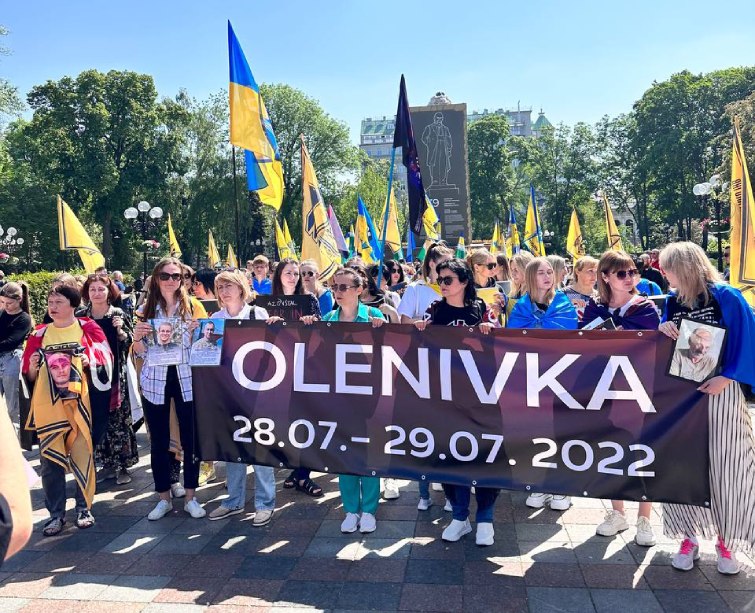
His wife works with the “Olenivka Families Community” and reminds the world of those killed and wounded in the attack.
The organization is gathering all available information about the attack, trying to identify the names of all 193 soldiers who were in the barracks on that tragic night, and is fighting for an international investigation to be launched.
Together with the Dutch organization “OSINT For Ukraine,” activists from the “Community” are looking for people who can participate in the OSINT investigation of the attack. The “Olenivka Families Community” has also created a bot where people can anonymously submit testimonies, photos, and videos related to the attack.
Maria spoke to “UP. Life” about the Russian crime in Olenivka, her love story with her husband, her advocacy work regarding the captured defenders of Mariupol, and her engagement with the international community.
Update: Serhiy Oleksiyovych returned home as part of an exchange on October 18, 2024. Congratulations to him and his family!
My name is Maria. I am the wife of Serhiy Alekseevich, a soldier in the Azov Regiment. Before the full-scale invasion, we lived together in Khmelnytskyi for four years. While my husband was in Mariupol, we got married long-distance.
In addition to fighting for my husband, I work in the IT sector. It was Serhiy who helped me find my path in this profession, since before that I was studying to be a clinical psychologist at the university in Khmelnytskyi.
I can’t tell you about Serhiy’s combat history. Only that he is a fighter in the Azov Regiment, who defended the city of Mariupol starting on February 24 and withdrew from Azovstal on orders from the higher military command.
Serhiy never wanted to upset me; he always tried to support me and lift my spirits. And this was especially evident during the fighting in Mariupol.
Many soldiers who were defending Mariupol shared at least some information with their families about what was happening in the city and how they were feeling. But Serhiy didn’t say anything about that at all; he just wrote that he was alive, healthy, safe, and loved me. He didn’t tell me a single thing about what was happening in Mariupol.
On February 26 of last year, Serhiy proposed to me. We agreed to get married after the victory or after he returned from Mariupol. But on April 20, he wrote that he wanted to marry me remotely, if I agreed.
I already knew then that soldiers had the option to get married remotely. Serhiy asked a fellow soldier, whom they had known for a long time, to help him get everything sorted out. We spent a week trying to figure this out, consulting with lawyers, and driving around the city to various civil registry offices.
The problem was that they wanted confirmation that Serhiy was actually in Mariupol. Since the connection was poor and unreliable, Serhiy didn’t know if he’d be able to join the video call at the right moment. Then they suggested that Serhiy record a video in which he stated that he was in Mariupol and truly wanted to marry me.
Serhiy had no connection for several days, but on the morning of our wedding day, he got online and sent the video. Serhiy’s best man and I went to the registry office, showed the recording, and within 40 minutes, the marriage certificate was ready. Serhiy was very happy, and so was I. That day gave us both a lot of strength and faith that we would definitely be together.
My husband left Azovstal on the first day, May 16, along with the wounded defenders. I should note that from the very beginning of his captivity, Russia did not officially recognize Serhiy as a prisoner of war, even though representatives of the International Committee of the Red Cross were supposed to be present during the evacuation. Serhiy was only officially recognized on August 31 of this year. I hope this is a good sign.
Serhiy and I last spoke on May 13, 2022. At that time, there was no information about a possible surrender, and perhaps Serhiy didn’t know either or didn’t want to upset me. That’s why he didn’t warn me that they were surrendering. I found out from the news. There were rumors about it on May 16, but I didn’t want to believe them. Then the first videos started appearing of the defenders who had left Azovstal, showing them being transported in buses. Later, official statements from government agencies were released.
I watched all the videos of the evacuation from Azovstal, since the Russians were heavily covering this process in their media, and on May 19, I saw a video from the prison in Olenivka in which I recognized Serhiy. It wasn’t an interrogation video: the video showed soldiers who had left Azovstal, talking with representatives of the International Committee of the Red Cross and a member of parliament who had participated in the negotiations regarding the evacuation from Azovstal.
I learned that this was occupied Olenivka. At the end of May, there were two more videos from Olenivka in which I recognized Serhiy. I knew he was in Olenivka, but in June and July I didn’t come across any more videos and thought that perhaps he had been transferred to another penal colony.
I also found out about the attack from Russian news reports. For the first hour, I couldn’t pull myself together; I was afraid for Serhiy, but I also had thoughts that maybe he wasn’t there. I don’t know how I managed to pull myself together so quickly, but I started calling government agencies and the ICRC.
No one answered at the time, except for an investigator from the National Police who tried to verify the information, but it was all in vain. Later, ICRC representatives replied that they would be traveling to the penal colony to provide medical assistance to the wounded, identify the deceased, and determine the circumstances of this tragedy.
On July 30, the Russian Ministry of Defense published lists of the wounded and the dead. I found Serhiy on the list of the wounded. And on August 3, I came across a video of him from the hospital.
After the exchange on September 21, his comrade said that Sergei had been wounded, spent a month in the hospital, and was then sent back to Olenivka. And at the end of September, Sergei, along with other Azov fighters, was transported to Russia. Exactly where—that remains unknown.
I’m trying to find out, but government agencies aren’t providing any answers. I have to constantly monitor Russian news, because they periodically publish videos featuring our soldiers. Unfortunately, the Russians haven’t published anything about him since last August.
In December, I was told that my husband had been seen on the grounds of a penal colony in Russia, but this information was not confirmed. There were more prisoner exchanges after that, but there was no mention of Serhiy.
The “Olenivka Families Community” is a civic organization comprising the relatives of soldiers wounded or killed in the terrorist attack in Olenivka.
I don’t call myself a co-founder, although the initiator, Anna, and I had been communicating for a long time before our community was formed. She wrote to me about her idea—to find the relatives of the wounded and the fallen.
At first, Hanna wanted to bring together only the relatives of those wounded during the terrorist attack, to get a general sense of whether any work was being done in Ukraine. I supported her in this. Then the families of the deceased joined us.
We and the “Association of Families of Azovstal Defenders” are separate organizations. We have several representatives from their organization who are also members of our community; we communicate with them. But we have more information specifically regarding the attack in Olenivka.
We focus specifically on the soldiers who were injured or killed in the attack. Thousands of our military personnel and civilians passed through Olenivka, but 193 people were ultimately taken to the barracks to be executed.
And, for example, when we began our work, we knew that a criminal investigation had been opened in Ukraine regarding the murder of prisoners of war. But witnesses were not questioned regarding the injuries.
I handle quite a few tasks within the community. Officially, I am the manager of the communications department. We have quite a few people, but not everyone, especially after the anniversary of the attack, has the energy to do anything. That’s why there’s a small group of community activists working to ensure that Ukraine doesn’t forget, that the world doesn’t forget, that an international investigation is launched, and that those responsible are held accountable.
The top priority is the return of the defenders wounded during the attack who are still being held captive. We know there are about 120 of them. According to our data, at least 59 of them are seriously wounded, because Russia has included them on the list of the wounded.
We are trying on our own to find the relatives of fighters who were not on any list. These are mostly those who sustained minor injuries or were not sent to hospitals. We know that after the attack, these people were sent to the disciplinary isolation unit (DIU) in Olenivka, and they were held there for about a month. I cannot say for certain whether they received medical care. Of the 193 soldiers who were in that barracks, we still need to identify another 30–40 people.
Unfortunately, since last September, seriously wounded defenders in Olenivka have not been exchanged. On September 21 of last year, 11 people from that list were returned, and the fate of the others is effectively unknown.
This is important because there have been instances where the media reported inaccurately on the attack in Olenivka. A critical error occurred when a forum featuring Dmytro Lubinets took place in July of this year. In response to one of the journalists’ questions, he stated that the bodies of those killed in Olenivka had been returned and that their identification was ongoing. Based on this, virtually all Ukrainian media outlets reported that the bodies of those killed in Olenivka had just been returned. But they had actually been returned back on October 11, 2022.
Another mistake that media representatives are making very often these days… For example, in July of this year, we created a petition to establish days of remembrance and mourning for those killed in the terrorist attack in Olenivka. I am the author of the petition—the wife of a man wounded in Olenivka.
But most journalists wrote that the relatives of the victims had created the petition. In the context of our civic organization, it is still better to say that it was “the families of those killed and wounded in the terrorist attack.”
We are perceived as the families of the deceased, even though we work together. Even at meetings with representatives of various government agencies, we are often addressed as the relatives of the fallen defenders, even though half the room consists of relatives of the wounded.
From the time our community was founded until last month, the leadership of the coordination headquarters did not meet with us very actively. We periodically attended meetings regarding the terrorist attack in Olenivka, but we were always met by consultants who told us things we already knew.
But last month, we met with Dmytro Usov (secretary of the Coordination Headquarters for the Treatment of Prisoners of War – ed.). We discussed the idea of establishing days of remembrance and mourning for those killed in the terrorist attack in Olenivka, and we discussed the issue of prisoner exchanges.
Everyone gives us the same information—that Russia doesn’t want to exchange prisoners. We submit lists for exchange, but Russia exchanges only those it wants.
For the past two months, we have been told about joint medical commissions, the creation of which was initiated by Ukraine. Representatives of the ICRC are to be involved in them. (According to the Geneva Convention, joint medical commissions consist of two doctors from neutral countries and one doctor representing the country holding the prisoners—ed.)
The idea is that there will be “neutral” doctors who will examine the prisoners of war. For example, to determine what illnesses or injuries they have. In this way, this commission could facilitate some progress in the exchange.
My husband was wounded during the defense of Mariupol in April 2022 and during the terrorist attack in Olenivka on July 29, 2022. That is, more than a year has passed, and it is unclear what condition he is in. I hope that the joint commission will be able to exert some influence so that he is at least provided with medical care. But, as far as I know, Russia has not yet agreed to this.
Foreign human rights defenders do not communicate with us on their own. We have initiated meetings with them several times.
In August of this year, with the help of the Coordination Headquarters for the Return of Prisoners of War, we were able to meet with representatives of government agencies responsible for various areas of international activity.
We developed a brief plan on how to proceed so that the International Criminal Court and other authorized bodies would take up the case of the terrorist attack in Olenivka.
Our representatives traveled to Geneva. We spoke with representatives of the ICRC at their headquarters and visited the UN office.
At that time, we were not provided with any information about the terrorist attack. They only said that they were aware of it. However, for example, the International Committee of the Red Cross cannot investigate any war crimes because this is not specified in its mandate. And they reported that Russia was not allowing access to the prison colony in Olenivka.
We were told that a fact-finding mission had been launched to investigate the killings of prisoners of war. It lasted a few months, and it was simply disbanded because Russia did not grant access to the crime scene.
We see no point in reviving it, because its sole purpose was to gain access to Olenivka. They did not plan to visit the wounded or provide them with assistance. This is completely pointless, because over a year has passed, and we are absolutely certain that there is no longer any evidence against Russia there.
In September, representatives of our organization traveled to Geneva again. This trip was much more packed with meetings; we were able to speak before the Swiss Parliament, visit the International Committee of the Red Cross, attend a UN event regarding the terrorist attack in Olenivka, and observe UN sessions.
We were able to reiterate that Russia is not complying with any norms of international humanitarian law whatsoever, and is killing and torturing our people.
Of course, we do not have high hopes for international organizations. But we still need to make it clear to them that Russia is an aggressor state, a terrorist state that constantly commits war crimes.
In early September, we submitted a letter to the UN International Commission of Inquiry on War Crimes, written jointly with Ukrainian human rights organizations that are assisting us (the Regional Center for Human Rights, the Media Initiative for Human Rights, and the Ukrainian Helsinki Human Rights Union).
We are currently focusing our efforts on gathering evidence for the International Criminal Court in The Hague and for the UN International Court of Justice. We are looking for ways to provide testimony not only regarding the attack in Olenivka, but also regarding various war crimes in general.
However, in this criminal case, the investigator has been working and is currently working only on the deaths. We, as a community, are trying to resolve this issue so that the terrorist attack is investigated comprehensively, including with regard to the wounded.
I don’t want people to think that the terrorist attack in Olenivka is connected only to the fallen defenders. Of course, 54 people killed in the attack is a very tragic number.
But we need to understand that there are people who survived this attack, and they may still be in danger. Because we still haven’t figured out the logic behind moving these specific people to a separate barracks.
We hope that prisoner exchanges will resume and we will be able to find out how our loved ones are doing. Because even the list of the deceased has not been fully confirmed, not all bodies have been identified yet, and the investigation is ongoing.
Right now, Serhiy is the only thing keeping me going. I constantly look back at our conversations, our photos, and remember our life together.
Serhiy is a very interesting person to talk to—you can discuss any topic with him. He was very well-read. He wasn’t just interested in military service; he studied programming and was training to become a psychologist.
He was supposed to finish his bachelor’s degree last year. The university is waiting for him to take his final exams. He even wanted to pursue a master’s degree in psychology. Serhiy was always reading books, taking courses, loved self-improvement, and wanted to learn something new.
Serhiy also loves animals very much. He used to treat stray animals, bringing them home to feed and warm them up. He even brought me a cat he’d rescued from the street. He’s been living with us for 5 years now—he’s also waiting for Serhiy to return from captivity.
I believe that my husband and I have a future together. To make that happen, I have to fight for it with all my strength, as much as possible, and I simply don’t have the right to give up.
Serhiy defended Mariupol while completely surrounded for nearly three months, and he has been in captivity for almost 17 months now. That’s nearly 20 months in horrific conditions, under constant stress and pressure.
Of course, there are moments when you don’t know what to do anymore, as if you’ve already done everything you could. But you have to keep fighting. Everything will be fine when he returns home.
It is very important to talk about prisoners of war and to help their families. They left Azovstal on orders from the country’s top military leadership. Government agencies must fight for them.
Likewise, Ukrainian society must not forget about them. We need to write about them or at least not ignore them when you see these posts or interviews. Try to share them, or at least read them and understand the horror in which the families of prisoners of war live, knowing absolutely nothing about their loved ones, parents, or husbands.
Our soldiers in captivity are “tried” for fabricated crimes practically every day, but not all such trials are covered. These are soldiers from completely different units.
We cannot remain silent, because the defenders of Mariupol were promised that they would be exchanged within 3–4 months. But so far, this promise has not been kept at all. A year ago, everyone was talking about them—both Ukrainians and our international partners.
Now, unfortunately, interest has waned somewhat, even though the defenders of Mariupol were defending all of us. They sacrificed themselves and their freedom to prevent the Russian army from advancing further.
Not forgetting them is, unfortunately, not enough. I ask that we speak of them.
Author: Olena Barsukova
"The last time I heard from my beloved was last year, after the prisoner exchange on September 21. At that time, my husband’s comrade-in-arms, who had been released from captivity, called me and said that Serhiy had survived the terrorist attack,” says 25-year-old Maria Alekseevich from Khmelnytskyi Oblast.
She is the wife of 29-year-old Azov soldier Serhiy Alekseevich, who defended Mariupol from February 24 to May 16 of last year.
The soldier was wounded in the leg and left Azovstal along with other defenders on orders from military leadership.
Serhiy and his comrades were held at Colony No. 120 in the temporarily occupied town of Olenivka. But on the night of July 28–29, 2022, Russian occupiers carried out a terrorist attack: 193 prisoners of war, according to preliminary lists, were transferred to a hangar, which was blown up during the night.
Serhiy survived but was wounded. He has been in captivity for nearly 17 months.
His wife works with the “Olenivka Families Community” and reminds the world of those killed and wounded in the attack.
The organization is gathering all available information about the attack, trying to identify the names of all 193 soldiers who were in the barracks on that tragic night, and is fighting for an international investigation to be launched.
Together with the Dutch organization “OSINT For Ukraine,” activists from the “Community” are looking for people who can participate in the OSINT investigation of the attack. The “Olenivka Families Community” has also created a bot where people can anonymously submit testimonies, photos, and videos related to the attack.
Maria spoke to “UP. Life” about the Russian crime in Olenivka, her love story with her husband, her advocacy work regarding the captured defenders of Mariupol, and her engagement with the international community.
Update: Serhiy Oleksiyovych returned home as part of an exchange on October 18, 2024. Congratulations to him and his family!
Finding Love in Mariupol and a Long-Distance Marriage
My name is Maria. I am the wife of Serhiy Alekseevich, a soldier in the Azov Regiment. Before the full-scale invasion, we lived together in Khmelnytskyi for four years. While my husband was in Mariupol, we got married long-distance.
In addition to fighting for my husband, I work in the IT sector. It was Serhiy who helped me find my path in this profession, since before that I was studying to be a clinical psychologist at the university in Khmelnytskyi.
I can’t tell you about Serhiy’s combat history. Only that he is a fighter in the Azov Regiment, who defended the city of Mariupol starting on February 24 and withdrew from Azovstal on orders from the higher military command.
Serhiy never wanted to upset me; he always tried to support me and lift my spirits. And this was especially evident during the fighting in Mariupol.
Many soldiers who were defending Mariupol shared at least some information with their families about what was happening in the city and how they were feeling. But Serhiy didn’t say anything about that at all; he just wrote that he was alive, healthy, safe, and loved me. He didn’t tell me a single thing about what was happening in Mariupol.
On February 26 of last year, Serhiy proposed to me. We agreed to get married after the victory or after he returned from Mariupol. But on April 20, he wrote that he wanted to marry me remotely, if I agreed.
I already knew then that soldiers had the option to get married remotely. Serhiy asked a fellow soldier, whom they had known for a long time, to help him get everything sorted out. We spent a week trying to figure this out, consulting with lawyers, and driving around the city to various civil registry offices.
The problem was that they wanted confirmation that Serhiy was actually in Mariupol. Since the connection was poor and unreliable, Serhiy didn’t know if he’d be able to join the video call at the right moment. Then they suggested that Serhiy record a video in which he stated that he was in Mariupol and truly wanted to marry me.
Serhiy had no connection for several days, but on the morning of our wedding day, he got online and sent the video. Serhiy’s best man and I went to the registry office, showed the recording, and within 40 minutes, the marriage certificate was ready. Serhiy was very happy, and so was I. That day gave us both a lot of strength and faith that we would definitely be together.
Maria found out about his captivity from the news
My husband left Azovstal on the first day, May 16, along with the wounded defenders. I should note that from the very beginning of his captivity, Russia did not officially recognize Serhiy as a prisoner of war, even though representatives of the International Committee of the Red Cross were supposed to be present during the evacuation. Serhiy was only officially recognized on August 31 of this year. I hope this is a good sign.
Serhiy and I last spoke on May 13, 2022. At that time, there was no information about a possible surrender, and perhaps Serhiy didn’t know either or didn’t want to upset me. That’s why he didn’t warn me that they were surrendering. I found out from the news. There were rumors about it on May 16, but I didn’t want to believe them. Then the first videos started appearing of the defenders who had left Azovstal, showing them being transported in buses. Later, official statements from government agencies were released.
I watched all the videos of the evacuation from Azovstal, since the Russians were heavily covering this process in their media, and on May 19, I saw a video from the prison in Olenivka in which I recognized Serhiy. It wasn’t an interrogation video: the video showed soldiers who had left Azovstal, talking with representatives of the International Committee of the Red Cross and a member of parliament who had participated in the negotiations regarding the evacuation from Azovstal.
I learned that this was occupied Olenivka. At the end of May, there were two more videos from Olenivka in which I recognized Serhiy. I knew he was in Olenivka, but in June and July I didn’t come across any more videos and thought that perhaps he had been transferred to another penal colony.
I also found out about the attack from Russian news reports. For the first hour, I couldn’t pull myself together; I was afraid for Serhiy, but I also had thoughts that maybe he wasn’t there. I don’t know how I managed to pull myself together so quickly, but I started calling government agencies and the ICRC.
No one answered at the time, except for an investigator from the National Police who tried to verify the information, but it was all in vain. Later, ICRC representatives replied that they would be traveling to the penal colony to provide medical assistance to the wounded, identify the deceased, and determine the circumstances of this tragedy.
On July 30, the Russian Ministry of Defense published lists of the wounded and the dead. I found Serhiy on the list of the wounded. And on August 3, I came across a video of him from the hospital.
After the exchange on September 21, his comrade said that Sergei had been wounded, spent a month in the hospital, and was then sent back to Olenivka. And at the end of September, Sergei, along with other Azov fighters, was transported to Russia. Exactly where—that remains unknown.
I’m trying to find out, but government agencies aren’t providing any answers. I have to constantly monitor Russian news, because they periodically publish videos featuring our soldiers. Unfortunately, the Russians haven’t published anything about him since last August.
In December, I was told that my husband had been seen on the grounds of a penal colony in Russia, but this information was not confirmed. There were more prisoner exchanges after that, but there was no mention of Serhiy.
The Olenivka Families Community: Who Is Fighting for the Dead and Wounded
The “Olenivka Families Community” is a civic organization comprising the relatives of soldiers wounded or killed in the terrorist attack in Olenivka.
I don’t call myself a co-founder, although the initiator, Anna, and I had been communicating for a long time before our community was formed. She wrote to me about her idea—to find the relatives of the wounded and the fallen.
At first, Hanna wanted to bring together only the relatives of those wounded during the terrorist attack, to get a general sense of whether any work was being done in Ukraine. I supported her in this. Then the families of the deceased joined us.
We and the “Association of Families of Azovstal Defenders” are separate organizations. We have several representatives from their organization who are also members of our community; we communicate with them. But we have more information specifically regarding the attack in Olenivka.
We focus specifically on the soldiers who were injured or killed in the attack. Thousands of our military personnel and civilians passed through Olenivka, but 193 people were ultimately taken to the barracks to be executed.
And, for example, when we began our work, we knew that a criminal investigation had been opened in Ukraine regarding the murder of prisoners of war. But witnesses were not questioned regarding the injuries.
I handle quite a few tasks within the community. Officially, I am the manager of the communications department. We have quite a few people, but not everyone, especially after the anniversary of the attack, has the energy to do anything. That’s why there’s a small group of community activists working to ensure that Ukraine doesn’t forget, that the world doesn’t forget, that an international investigation is launched, and that those responsible are held accountable.
The top priority is the return of the defenders wounded during the attack who are still being held captive. We know there are about 120 of them. According to our data, at least 59 of them are seriously wounded, because Russia has included them on the list of the wounded.
We are trying on our own to find the relatives of fighters who were not on any list. These are mostly those who sustained minor injuries or were not sent to hospitals. We know that after the attack, these people were sent to the disciplinary isolation unit (DIU) in Olenivka, and they were held there for about a month. I cannot say for certain whether they received medical care. Of the 193 soldiers who were in that barracks, we still need to identify another 30–40 people.
Unfortunately, since last September, seriously wounded defenders in Olenivka have not been exchanged. On September 21 of last year, 11 people from that list were returned, and the fate of the others is effectively unknown.
Public Outreach and Media Errors
Our work is multifaceted. For example, it involves public outreach. We manage social media accounts, publish important information about the attack and our work, and periodically analyze Ukrainian media coverage.This is important because there have been instances where the media reported inaccurately on the attack in Olenivka. A critical error occurred when a forum featuring Dmytro Lubinets took place in July of this year. In response to one of the journalists’ questions, he stated that the bodies of those killed in Olenivka had been returned and that their identification was ongoing. Based on this, virtually all Ukrainian media outlets reported that the bodies of those killed in Olenivka had just been returned. But they had actually been returned back on October 11, 2022.
Another mistake that media representatives are making very often these days… For example, in July of this year, we created a petition to establish days of remembrance and mourning for those killed in the terrorist attack in Olenivka. I am the author of the petition—the wife of a man wounded in Olenivka.
But most journalists wrote that the relatives of the victims had created the petition. In the context of our civic organization, it is still better to say that it was “the families of those killed and wounded in the terrorist attack.”
We are perceived as the families of the deceased, even though we work together. Even at meetings with representatives of various government agencies, we are often addressed as the relatives of the fallen defenders, even though half the room consists of relatives of the wounded.
Interaction with the government
From the time our community was founded until last month, the leadership of the coordination headquarters did not meet with us very actively. We periodically attended meetings regarding the terrorist attack in Olenivka, but we were always met by consultants who told us things we already knew.
But last month, we met with Dmytro Usov (secretary of the Coordination Headquarters for the Treatment of Prisoners of War – ed.). We discussed the idea of establishing days of remembrance and mourning for those killed in the terrorist attack in Olenivka, and we discussed the issue of prisoner exchanges.
Everyone gives us the same information—that Russia doesn’t want to exchange prisoners. We submit lists for exchange, but Russia exchanges only those it wants.
For the past two months, we have been told about joint medical commissions, the creation of which was initiated by Ukraine. Representatives of the ICRC are to be involved in them. (According to the Geneva Convention, joint medical commissions consist of two doctors from neutral countries and one doctor representing the country holding the prisoners—ed.)
The idea is that there will be “neutral” doctors who will examine the prisoners of war. For example, to determine what illnesses or injuries they have. In this way, this commission could facilitate some progress in the exchange.
My husband was wounded during the defense of Mariupol in April 2022 and during the terrorist attack in Olenivka on July 29, 2022. That is, more than a year has passed, and it is unclear what condition he is in. I hope that the joint commission will be able to exert some influence so that he is at least provided with medical care. But, as far as I know, Russia has not yet agreed to this.
Communication with the UN and the ICRC
Foreign human rights defenders do not communicate with us on their own. We have initiated meetings with them several times.
In August of this year, with the help of the Coordination Headquarters for the Return of Prisoners of War, we were able to meet with representatives of government agencies responsible for various areas of international activity.
We developed a brief plan on how to proceed so that the International Criminal Court and other authorized bodies would take up the case of the terrorist attack in Olenivka.
Our representatives traveled to Geneva. We spoke with representatives of the ICRC at their headquarters and visited the UN office.
At that time, we were not provided with any information about the terrorist attack. They only said that they were aware of it. However, for example, the International Committee of the Red Cross cannot investigate any war crimes because this is not specified in its mandate. And they reported that Russia was not allowing access to the prison colony in Olenivka.
We were told that a fact-finding mission had been launched to investigate the killings of prisoners of war. It lasted a few months, and it was simply disbanded because Russia did not grant access to the crime scene.
We see no point in reviving it, because its sole purpose was to gain access to Olenivka. They did not plan to visit the wounded or provide them with assistance. This is completely pointless, because over a year has passed, and we are absolutely certain that there is no longer any evidence against Russia there.
In September, representatives of our organization traveled to Geneva again. This trip was much more packed with meetings; we were able to speak before the Swiss Parliament, visit the International Committee of the Red Cross, attend a UN event regarding the terrorist attack in Olenivka, and observe UN sessions.
We were able to reiterate that Russia is not complying with any norms of international humanitarian law whatsoever, and is killing and torturing our people.
Of course, we do not have high hopes for international organizations. But we still need to make it clear to them that Russia is an aggressor state, a terrorist state that constantly commits war crimes.
In early September, we submitted a letter to the UN International Commission of Inquiry on War Crimes, written jointly with Ukrainian human rights organizations that are assisting us (the Regional Center for Human Rights, the Media Initiative for Human Rights, and the Ukrainian Helsinki Human Rights Union).
We are currently focusing our efforts on gathering evidence for the International Criminal Court in The Hague and for the UN International Court of Justice. We are looking for ways to provide testimony not only regarding the attack in Olenivka, but also regarding various war crimes in general.
What are the families of the dead and wounded demanding?
The Prosecutor General's Office has opened a criminal investigation "into the deaths and injuries of varying severity" sustained by prisoners of war as a result of the explosion in Olenivka (under Article 438 of the Criminal Code of Ukraine, “Violation of the Laws and Customs of War” – ed.).However, in this criminal case, the investigator has been working and is currently working only on the deaths. We, as a community, are trying to resolve this issue so that the terrorist attack is investigated comprehensively, including with regard to the wounded.
I don’t want people to think that the terrorist attack in Olenivka is connected only to the fallen defenders. Of course, 54 people killed in the attack is a very tragic number.
But we need to understand that there are people who survived this attack, and they may still be in danger. Because we still haven’t figured out the logic behind moving these specific people to a separate barracks.
We hope that prisoner exchanges will resume and we will be able to find out how our loved ones are doing. Because even the list of the deceased has not been fully confirmed, not all bodies have been identified yet, and the investigation is ongoing.
"I simply don’t have the right to give up"
Right now, Serhiy is the only thing keeping me going. I constantly look back at our conversations, our photos, and remember our life together.
Serhiy is a very interesting person to talk to—you can discuss any topic with him. He was very well-read. He wasn’t just interested in military service; he studied programming and was training to become a psychologist.
He was supposed to finish his bachelor’s degree last year. The university is waiting for him to take his final exams. He even wanted to pursue a master’s degree in psychology. Serhiy was always reading books, taking courses, loved self-improvement, and wanted to learn something new.
Serhiy also loves animals very much. He used to treat stray animals, bringing them home to feed and warm them up. He even brought me a cat he’d rescued from the street. He’s been living with us for 5 years now—he’s also waiting for Serhiy to return from captivity.
I believe that my husband and I have a future together. To make that happen, I have to fight for it with all my strength, as much as possible, and I simply don’t have the right to give up.
Serhiy defended Mariupol while completely surrounded for nearly three months, and he has been in captivity for almost 17 months now. That’s nearly 20 months in horrific conditions, under constant stress and pressure.
Of course, there are moments when you don’t know what to do anymore, as if you’ve already done everything you could. But you have to keep fighting. Everything will be fine when he returns home.
Talk about the defenders of Mariupol!
It is very important to talk about prisoners of war and to help their families. They left Azovstal on orders from the country’s top military leadership. Government agencies must fight for them.
Likewise, Ukrainian society must not forget about them. We need to write about them or at least not ignore them when you see these posts or interviews. Try to share them, or at least read them and understand the horror in which the families of prisoners of war live, knowing absolutely nothing about their loved ones, parents, or husbands.
Our soldiers in captivity are “tried” for fabricated crimes practically every day, but not all such trials are covered. These are soldiers from completely different units.
We cannot remain silent, because the defenders of Mariupol were promised that they would be exchanged within 3–4 months. But so far, this promise has not been kept at all. A year ago, everyone was talking about them—both Ukrainians and our international partners.
Now, unfortunately, interest has waned somewhat, even though the defenders of Mariupol were defending all of us. They sacrificed themselves and their freedom to prevent the Russian army from advancing further.
Not forgetting them is, unfortunately, not enough. I ask that we speak of them.
This is an automatic translation generated by DeepL.