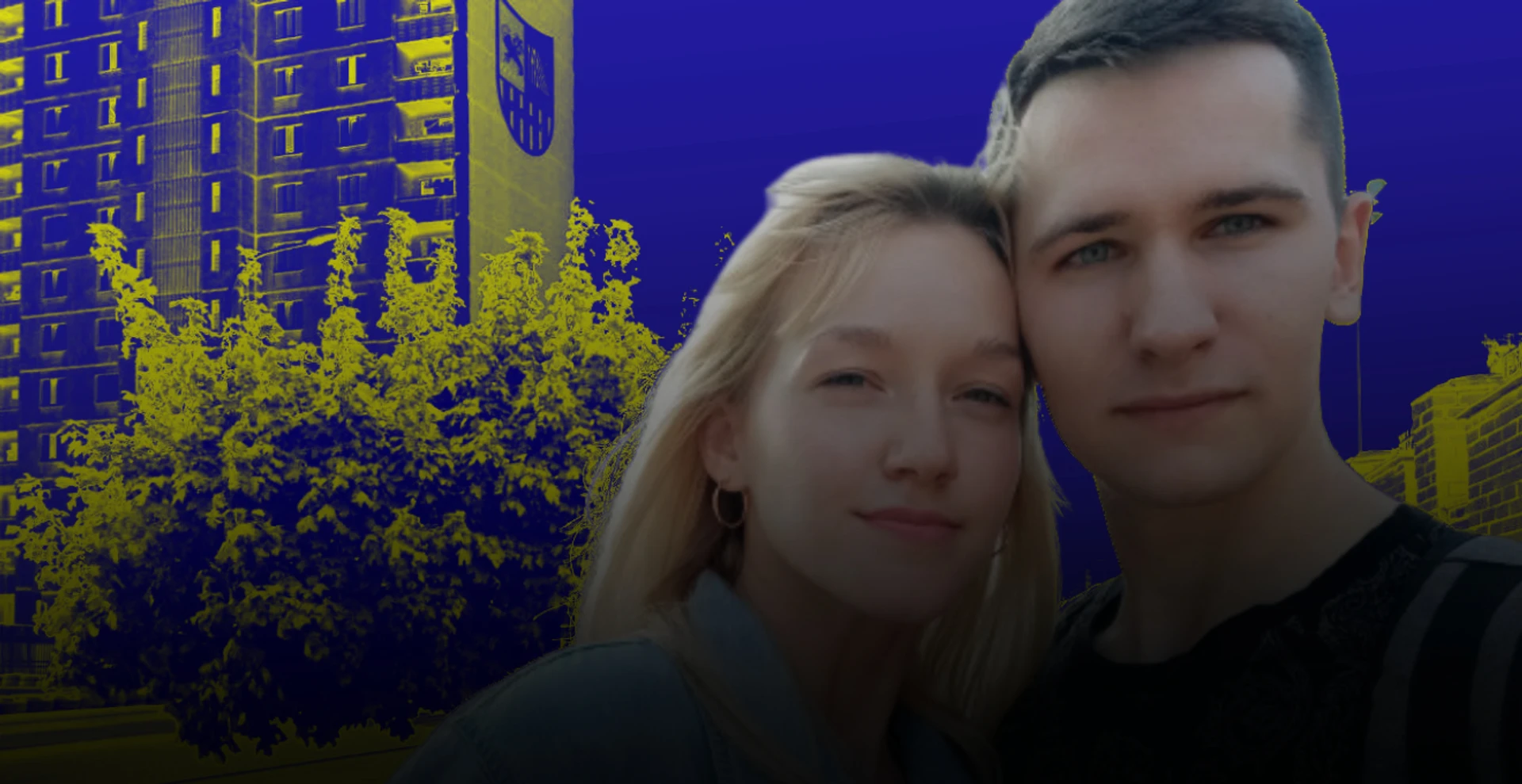
"I write messages, but I don't get a response". A love story shared by occupation and captivity
Source: Ukrainska Pravda
Author: Olga Kyrylenko
"Hello, my name is Anastasia. I want to tell you about my life under occupation in Izyum and about my boyfriend, who defended Mariupol."
That’s how the conversation between 21-year-old Anastasia Bugera and Ukrayinska Pravda journalists began a few weeks ago.
The full-scale invasion didn’t just change her life—it turned it upside down. Anastasia’s hometown of Izyum in the Kharkiv region was occupied by the Russians, and her boyfriend, Konstantin Ivanov, fought in the fiercest and most tragic battle of this war—for Mariupol. He was taken prisoner by the Russians at Azovstal.
When the Russians came to her house, Anastasia hid in the sofa. Together with her family, she spent five long months under occupation.
Today, she continues to wait for her boyfriend and calls on international organizations to do more to secure the release of all Ukrainian defenders from captivity.
Below is Anastasia’s own account.
The first shelling of Izyum and the car stolen by the
Russians I came to Izyum to visit my parents for the New Year’s holidays, then stayed a little longer due to the rise in COVID-19 cases, and then the war began. At 4 a.m. on February 24, I woke up to the sounds of explosions.
My parents and I immediately started gathering essential items, documents, and medicine and taking them to the basement. Later, my boyfriend—a soldier who was in Mariupol at the time of the full-scale invasion—called me. I was crying, and he told me he was close by and that everything would be okay.
But we just didn’t know yet what lay ahead for us.
For several days, we helped the Ukrainian military in Izyum: together with other residents, we cooked meals for them and brought them food. Instead of returning to Kharkiv for classes, I spent my birthday in a cold basement—wearing several pairs of pants, sweaters, a warm jacket, and wrapped in blankets.
Just the night before, on the night of February 27–28, Russian forces shelled Izyum for the first time. And they weren’t targeting military sites, but a building with civilians and a supermarket. From that moment on, February 28, the shelling never stopped.
On March 1, our heating went out. Even though we were stoking the fireplace, the house was still cold. We slept fully clothed and kept a jacket nearby so we could quickly grab it and run to the basement if the shelling started.
For several weeks, the Russians constantly bombed Izyum from the air.
During the explosions, the door to our basement, even though it was tightly shut, kept flying open. In less than an hour, we could hear ten aerial bombs go off.
On March 3, they bombed the “tower” that supplied electricity, water, and communications—so we were left without any means of communication. We knew nothing of what was happening in the world. At all.
We had to walk to the well several times a day to get water; it was about 200 meters away from us. The locals helped each other however they could. Some brought bread, others brought humanitarian aid. One day, Russian troops shelled the place where civilians were receiving bread… many people were killed.
Stores and pharmacies were closed. We drove to the nearest neighboring town for food and medicine, but there was nothing there either. We couldn’t drive back home because the bridge had been blown up. We left the car with friends and walked back.
As we later found out, our car—and not just ours—was taken by Russian soldiers. They punctured all the tires, stole everything inside, and when they couldn’t fix it, they left it in the bushes.
Hiding in the sofa
When the Russians occupied part of the city, we heard their shells being fired and falling on the other side, where Ukrainian soldiers were stationed. They fired a lot.
Every time we left the house, it could have been our last. One family was moving from the house to the basement during the shelling and didn’t make it in time… Everyone died—the mother, sister, grandmother, and grandfather; only a 4-year-old boy survived.
Every evening I asked myself—will I wake up? Will there be a tomorrow? And every morning I told myself: “I’m alive, thank you.” Later, local residents found a spot with cell service, and that’s when I learned that my boyfriend was under constant shelling in Mariupol, in a city that was almost completely surrounded. I wanted to scream...
When the Russians fully occupied Izyum, they drove through the streets in their vehicles, went into every house, and checked everything. I hid in the sofa. I was forced to hide in my own country, do you understand? After the atrocities in Bucha and Irpin, it was very scary.
Russian shells were falling everywhere. One landed right across from our house; glass from the window hit my leg and, miraculously, didn’t reach an artery. I got four stitches; now this scar of war is with me forever.
After a while, I managed to get online and saw that Konstantin had sent me a video—it took me three days to download it. In it, he said that Mariupol had been completely surrounded and that he was at Azovstal. He also said they had no food.
They had no strength left, were losing consciousness from hunger, but continued to defend each of us, continued to fight. Thanks to them, we are alive. They held off a much larger and stronger enemy. Azovstal was under constant shelling.
A little while later, I found out that my boyfriend was a prisoner of war, and captivity means torture. I knew all this because in Izyum, too, they took men away—they beat them, ran electricity through them; some returned barely alive, and some never returned at all.
I still feel devastated.
Escaping the Occupation, Videos from Captivity, and Waiting
A few weeks before I left, planes and helicopters started flying over Izyum; they did it often and very, very low.
At first, we threw ourselves to the ground because we didn’t know if they were going to bomb us. We were terrified. They flew in circles or flew to bomb eastern Ukraine. Sometimes it seemed like they could hit the roof of the house.
Recently, with the help of the Ukrainian Red Cross, I managed to escape from five months of hell under occupation. Five months of constant fear, gunfire, and the “Russian world.”
Once I was on free Ukrainian territory, I stood there and cried silently. There is no forgiveness for them.
There is another reason to cry now—I can now watch videos from Mariupol, Azovstal, where my boyfriend was… As well as videos from captivity posted by the Russians—in them, he is beaten, emaciated, traumatized. During his entire time in captivity, he was never given the chance to make a phone call. I haven’t received any news from him since April 24.
How much longer will the defenders of Azovstal remain in captivity? Their families are waiting for them at home. We are proud of everyone who ended up there; we are shouting to the whole world, “Help!” Help us bring our loved ones home! Why are international organizations shirking their responsibilities? Is it not clear that the lives and health of Ukrainian servicemen are now in their hands?
And that the blood of those killed in Olenivka is also on their hands.
When I get scared, I hug the doll named Alisa that Konstantin gave me. More precisely, I imagine that I’m hugging not her, but him. Alice is always by my side. But I want to finally hold my boyfriend’s hand, be close to him, and tell him, “I love you.” Those three simple words.
I call and text him all the time, but I don’t get a reply. I know his phone is turned off, but I keep doing it.
I keep believing and waiting.
This is an automatic translation generated by DeepL.