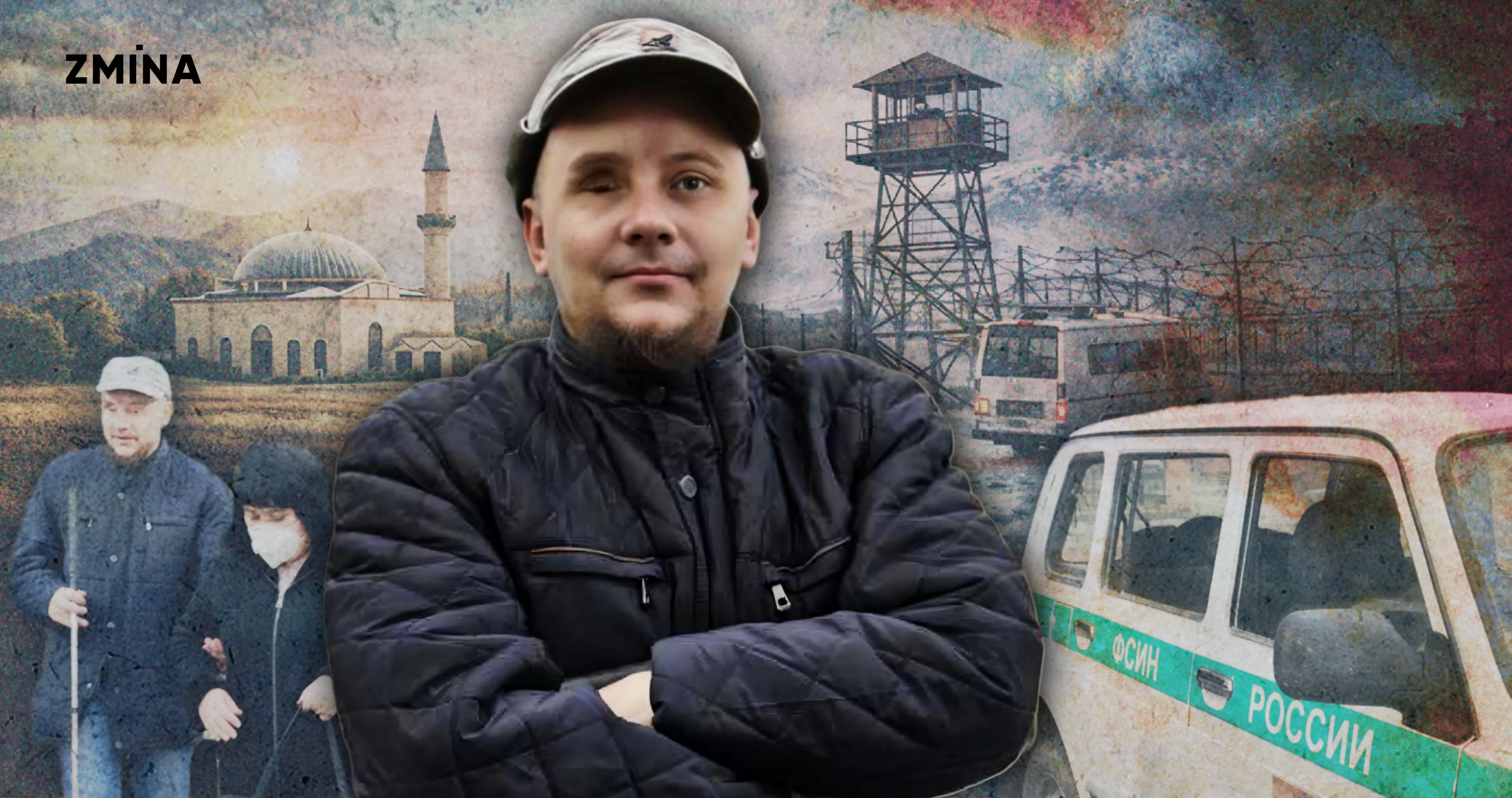
"Mom, I don't want to go back there...": blind political prisoner Sizikov was released from the colony for health reasons, and then this decision was canceled
Source: Zmina
Author: Vladislav Yesipenko
The case of Crimean political prisoner Oleksandr Sizikov is one of the most cynical examples of persecution by the Russian occupiers. After all, the man has a first-degree disability—following an accident in 2009, he completely lost his sight and requires constant assistance from others. Despite this, the occupying authorities in Crimea accused him of terrorism and sentenced him to 17 years in prison, effectively only for peaceful protests against repression.
Oleksandr Sizikov was born in 1984 in Simferopol and later moved with his family to the village of Turgenivka in the Bakhchysarai district. In 2002, he enrolled at Sevastopol National Technical University, majoring in “Automation and Computer-Integrated Technologies.” In 2006, he converted to Islam. After an accident left him blind, his fellow villagers and Imam Edem Smailov helped him with daily life until the FSB detained the imam himself and accused him of terrorism.
Sizikov could not come to terms with the imam’s arrest, so with the help of two elderly women, he staged solo protests in April 2019 and May 2020 and attended court proceedings against arrested Muslims.
Oleksandr was detained on July 7, 2020, following searches of his friends’ homes. The FSB accused Sizikov of “establishing a Hizb ut-Tahrir terrorist cell” in 2015. As evidence, the Russian security service cited books belonging to the religious-political organization found during the search. However, they were not even printed in Braille.
The trial lasted nearly three years; throughout this time, Alexander was under house arrest, as even under Russian law, his health condition did not permit detention in a pretrial detention center. But in May 2023, the Southern District Military Court in Rostov-on-Don sentenced Alexander Sizikov to 17 years in a penal colony. His defense called the decision not only cruel but also illegal, since Sizikov, who is blind and has a first-degree disability, could not serve his sentence in prison. But the Russian Federation’s Military Court of Appeals ignored this circumstance, and the man was transferred from Crimea to Minusinsk in the Krasnoyarsk Krai of the Russian Federation. The Russians send political prisoners from the occupied territories to this prison, known for its harsh conditions, including such well-known public figures as Nariman Dzhelial and Osman Arifmemetov.
Alexander survived the difficult transfer, but his condition worsened. While already in prison, Sizikov was admitted to a hospital in Krasnoyarsk, where, following an examination, he was diagnosed with stage 3 hypertension and confirmed to have completely lost his sight—conditions that, under Russian law, make serving a sentence in a penal colony impossible. So, in May 2025, the Minusinsk City Court ruled to release Sizikov from his sentence on health grounds.
Alexander was happy to return home; he was recovering and making plans for the future. But on October 21, 2025, the Krasnoyarsk Regional Court overturned the decision to release Sizikov and ordered him returned to prison.
His mother, Olena, spoke about what Alexander had to endure in prison, how he adapted to life at home after prison, and the circumstances of his new detention.
According to Elena, when Alexander returned home, he was euphoric, made many plans, and got busy with household chores. However, it took him a whole month to adjust to life on the outside.
For a long time after wearing prison shoes, his feet hurt, so at home he was happy to be able to walk barefoot.
He had trouble finding his way around the house, and his body had a hard time adjusting to home-cooked food; he suffered from digestive problems for a long time.
“But he was still happy, walking around all cheerful. He even wanted to go to a chess competition…”—his mother recalls.
But on October 22, 2025, just as the family was getting ready for bed, police officers climbed over the fence and burst into the house:
“The lights in the house weren’t on; I heard movement in the yard. I went out and saw about 20 thugs standing in my yard. Among them was an FSB officer named Tamerlan. A few days before the arrest, he had driven Sasha home from the mosque in his car…”
Olena believes that all of this was planned. After all, during that ride, Tamerlan tried to provoke Alexander. He said: “On Wednesday we took four Muslim women; what do you think of that?” Alexander then snapped back at him. The FSB officer also told Alexander that he was a kafir (an Islamic term for a person who does not believe in Allah. – Ed.).
And then it turned out that this Tamerlan was the one in charge during Alexander’s arrest at home, says his mother.
Then the FSB agents gave Olena a piece of paper without any seals, on which investigator Lukyanchenko reported that they had found a cache of explosives and ammunition somewhere in the woods, and the investigator suspected that Alexander was involved in this.
“I said, ‘This is some kind of nonsense—do you want to put Sasha in jail on a new charge?’ They replied that based on this piece of paper, they had to conduct a search, and they would simply take Sasha in for questioning as a suspect. Even though there were no warrants or search orders. Can you imagine, these 20 thugs are in our house with a fake piece of paper… I told them then: ‘If you didn’t bring any bullets with you to plant in our house, everything will be fine,’—Olena recalls.
At 1 a.m., after the FSB officers, along with the witnesses they had brought with them, conducted the search, Oleksandr was taken to the temporary detention center in Bakhchysarai. The next day, he was brought from the detention center to court and sentenced to 10 days in jail for allegedly resisting authorities.
“You see, a blind person, according to their version, was fighting with the police…”—Olena exclaims indignantly.
And while she and her lawyer were traveling to Simferopol to bring the original documents, the investigator had already cobbled together another case. That same day, Oleksandr was taken to the Bakhchysarai Hospital, where he was examined by “an ophthalmologist, a general practitioner, and another doctor.” Based on the results of the examination, they concluded that Sizikov could be held in custody for 10 days. So, based on this conclusion, he was transferred to the Simferopol Pretrial Detention Center.
“They didn’t even want to accept him there, but according to Sasha, an FSB officer called there and they processed him immediately… Even though his warm clothes, medications, food, and hygiene supplies were all left at the Bakhchysarai temporary detention center. I then spent two days going back and forth to retrieve those items,” says the political prisoner’s mother.
According to her, Oleksandr had a disability certificate with him, but a local police officer named Serhiy Serhiyovych Zaitsev simply stole it from Sasha.
Alexander’s lawyer also discovered that “judge” Elena Yesina of the Bakhchisaray Court refused for three days to process Sizikov’s complaint regarding his inability to remain in custody due to his disability and did not forward it to Simferopol. But then Oleksandr was quickly transferred from the Bakhchysarai temporary detention center to the Simferopol pretrial detention center. Because, according to the law, he had to be released.
His mother asked: “Why weren’t the lawyer and I notified? Why wasn’t a social worker called?” But the police gave no substantive answer to this.
At Simferopol Pretrial Detention Center No. 1, Oleksandr was held in a special unit (cells for two people, which are under special guard and control. – Ed.). There he was to await transfer to that very camp in Minusinsk.
His mother could only communicate with Oleksandr through letters via “Zonatelecom.” Although Oleksandr had a phone with a SIM card, the detention center administration did not grant permission for calls.
“Employees of the Federal Penitentiary Service told me during a conversation that he is under a special regime and is not allowed to make calls or receive packages. During all this time, I’ve had only one brief visit with him,” she complains.
According to his mother, Alexander was held in complete isolation at the detention center, and she couldn’t even send him warm clothes before his transfer to Siberia.
Her son also managed to tell her that when they brought him at night from the Bakhchisaray temporary detention center to the Simferopol pretrial detention center and he began to get out of the prison transport, the guards started shouting: “Attention! We’re letting the kraken out!” And they were laughing as they did so.
“Can you imagine what it’s like for a blind person to endure all this abuse?” his mother asks indignantly.
Olena is deeply worried that Oleksandr will have to face cruel treatment in the penal colony again.
After all, when he was in Minusinsk, despite his disability and blindness, no accommodations were made for him regarding the prison regime. He walked with his work detail to the prison cafeteria, was forced to stand in all prison roll calls, and had to do morning exercises with everyone else. This was despite the fact that he has stage 3 hypertension and suffers from constant headaches.
Additionally, some inmates in the colony bullied Oleksandr: they would supposedly “jokingly” crumble cookies into his plate, and sometimes, when he walked down the hallway, they would hit him in the face with a rolled-up towel. But more than anything, of course, he felt pressure from the prison administration.
There were times when prison staff threatened that they would first ruin his health and then make him a “target.” That is, they promised to transfer him to a cell where he would be raped.”
At the same time, almost all inmates in the Minusinsk prison had health problems, especially the Ukrainian political prisoners. After all, they were not provided with adequate medical care. Meanwhile, Oleksandr has stage 3 hypertension, which, if left untreated, can lead to a stroke. Meanwhile, Sizikov was only prescribed a diet appropriate for his health condition toward the end of his previous stay in the colony.
He also has a titanium plate in his head from an accident, so he must wear a hat at all times. And temperature fluctuations are very dangerous for Oleksandr; during such times, he suffers from headaches, so he must always have his medication with him.
His mother says that in prison, Oleksandr tried to defend his rights in accordance with the internal regulations and other instructions, though he wasn’t always successful.
“I want to say that Sanka is holding up well mentally, he’s not giving up—he’s a real champ! But at the same time, he tells me, ‘Mom, I don’t want to go back there,’” says Olena.
Despite efforts by his family and lawyer to prevent the Crimean man’s re-imprisonment, Oleksandr was transferred on December 1 from the Simferopol pretrial detention center to the Minusinsk prison in the Krasnoyarsk Krai, a transfer that lasted over two months last time. Information about his transfer arrives with a significant delay. As of December 25, Sizikov was in Volgograd, Russia. Alexander’s family and friends are currently sending appeals to law enforcement, judicial, and penitentiary authorities in the Russian Federation, as well as to the Human Rights Commissioner, demanding the immediate release of Alexander Sizikov or the replacement of his sentence with a non-custodial measure. After all, continued imprisonment poses a risk to his life.
Author: Vladislav Yesipenko
The case of Crimean political prisoner Oleksandr Sizikov is one of the most cynical examples of persecution by the Russian occupiers. After all, the man has a first-degree disability—following an accident in 2009, he completely lost his sight and requires constant assistance from others. Despite this, the occupying authorities in Crimea accused him of terrorism and sentenced him to 17 years in prison, effectively only for peaceful protests against repression.
Oleksandr Sizikov was born in 1984 in Simferopol and later moved with his family to the village of Turgenivka in the Bakhchysarai district. In 2002, he enrolled at Sevastopol National Technical University, majoring in “Automation and Computer-Integrated Technologies.” In 2006, he converted to Islam. After an accident left him blind, his fellow villagers and Imam Edem Smailov helped him with daily life until the FSB detained the imam himself and accused him of terrorism.
Sizikov could not come to terms with the imam’s arrest, so with the help of two elderly women, he staged solo protests in April 2019 and May 2020 and attended court proceedings against arrested Muslims.
Oleksandr was detained on July 7, 2020, following searches of his friends’ homes. The FSB accused Sizikov of “establishing a Hizb ut-Tahrir terrorist cell” in 2015. As evidence, the Russian security service cited books belonging to the religious-political organization found during the search. However, they were not even printed in Braille.
The trial lasted nearly three years; throughout this time, Alexander was under house arrest, as even under Russian law, his health condition did not permit detention in a pretrial detention center. But in May 2023, the Southern District Military Court in Rostov-on-Don sentenced Alexander Sizikov to 17 years in a penal colony. His defense called the decision not only cruel but also illegal, since Sizikov, who is blind and has a first-degree disability, could not serve his sentence in prison. But the Russian Federation’s Military Court of Appeals ignored this circumstance, and the man was transferred from Crimea to Minusinsk in the Krasnoyarsk Krai of the Russian Federation. The Russians send political prisoners from the occupied territories to this prison, known for its harsh conditions, including such well-known public figures as Nariman Dzhelial and Osman Arifmemetov.
Alexander survived the difficult transfer, but his condition worsened. While already in prison, Sizikov was admitted to a hospital in Krasnoyarsk, where, following an examination, he was diagnosed with stage 3 hypertension and confirmed to have completely lost his sight—conditions that, under Russian law, make serving a sentence in a penal colony impossible. So, in May 2025, the Minusinsk City Court ruled to release Sizikov from his sentence on health grounds.
Alexander was happy to return home; he was recovering and making plans for the future. But on October 21, 2025, the Krasnoyarsk Regional Court overturned the decision to release Sizikov and ordered him returned to prison.
His mother, Olena, spoke about what Alexander had to endure in prison, how he adapted to life at home after prison, and the circumstances of his new detention.
According to Elena, when Alexander returned home, he was euphoric, made many plans, and got busy with household chores. However, it took him a whole month to adjust to life on the outside.
For a long time after wearing prison shoes, his feet hurt, so at home he was happy to be able to walk barefoot.
He had trouble finding his way around the house, and his body had a hard time adjusting to home-cooked food; he suffered from digestive problems for a long time.
“But he was still happy, walking around all cheerful. He even wanted to go to a chess competition…”—his mother recalls.
But on October 22, 2025, just as the family was getting ready for bed, police officers climbed over the fence and burst into the house:
“The lights in the house weren’t on; I heard movement in the yard. I went out and saw about 20 thugs standing in my yard. Among them was an FSB officer named Tamerlan. A few days before the arrest, he had driven Sasha home from the mosque in his car…”
Olena believes that all of this was planned. After all, during that ride, Tamerlan tried to provoke Alexander. He said: “On Wednesday we took four Muslim women; what do you think of that?” Alexander then snapped back at him. The FSB officer also told Alexander that he was a kafir (an Islamic term for a person who does not believe in Allah. – Ed.).
And then it turned out that this Tamerlan was the one in charge during Alexander’s arrest at home, says his mother.
Then the FSB agents gave Olena a piece of paper without any seals, on which investigator Lukyanchenko reported that they had found a cache of explosives and ammunition somewhere in the woods, and the investigator suspected that Alexander was involved in this.
“I said, ‘This is some kind of nonsense—do you want to put Sasha in jail on a new charge?’ They replied that based on this piece of paper, they had to conduct a search, and they would simply take Sasha in for questioning as a suspect. Even though there were no warrants or search orders. Can you imagine, these 20 thugs are in our house with a fake piece of paper… I told them then: ‘If you didn’t bring any bullets with you to plant in our house, everything will be fine,’—Olena recalls.
At 1 a.m., after the FSB officers, along with the witnesses they had brought with them, conducted the search, Oleksandr was taken to the temporary detention center in Bakhchysarai. The next day, he was brought from the detention center to court and sentenced to 10 days in jail for allegedly resisting authorities.
“You see, a blind person, according to their version, was fighting with the police…”—Olena exclaims indignantly.
And while she and her lawyer were traveling to Simferopol to bring the original documents, the investigator had already cobbled together another case. That same day, Oleksandr was taken to the Bakhchysarai Hospital, where he was examined by “an ophthalmologist, a general practitioner, and another doctor.” Based on the results of the examination, they concluded that Sizikov could be held in custody for 10 days. So, based on this conclusion, he was transferred to the Simferopol Pretrial Detention Center.
“They didn’t even want to accept him there, but according to Sasha, an FSB officer called there and they processed him immediately… Even though his warm clothes, medications, food, and hygiene supplies were all left at the Bakhchysarai temporary detention center. I then spent two days going back and forth to retrieve those items,” says the political prisoner’s mother.
According to her, Oleksandr had a disability certificate with him, but a local police officer named Serhiy Serhiyovych Zaitsev simply stole it from Sasha.
Alexander’s lawyer also discovered that “judge” Elena Yesina of the Bakhchisaray Court refused for three days to process Sizikov’s complaint regarding his inability to remain in custody due to his disability and did not forward it to Simferopol. But then Oleksandr was quickly transferred from the Bakhchysarai temporary detention center to the Simferopol pretrial detention center. Because, according to the law, he had to be released.
His mother asked: “Why weren’t the lawyer and I notified? Why wasn’t a social worker called?” But the police gave no substantive answer to this.
At Simferopol Pretrial Detention Center No. 1, Oleksandr was held in a special unit (cells for two people, which are under special guard and control. – Ed.). There he was to await transfer to that very camp in Minusinsk.
His mother could only communicate with Oleksandr through letters via “Zonatelecom.” Although Oleksandr had a phone with a SIM card, the detention center administration did not grant permission for calls.
“Employees of the Federal Penitentiary Service told me during a conversation that he is under a special regime and is not allowed to make calls or receive packages. During all this time, I’ve had only one brief visit with him,” she complains.
According to his mother, Alexander was held in complete isolation at the detention center, and she couldn’t even send him warm clothes before his transfer to Siberia.
Her son also managed to tell her that when they brought him at night from the Bakhchisaray temporary detention center to the Simferopol pretrial detention center and he began to get out of the prison transport, the guards started shouting: “Attention! We’re letting the kraken out!” And they were laughing as they did so.
“Can you imagine what it’s like for a blind person to endure all this abuse?” his mother asks indignantly.
Olena is deeply worried that Oleksandr will have to face cruel treatment in the penal colony again.
After all, when he was in Minusinsk, despite his disability and blindness, no accommodations were made for him regarding the prison regime. He walked with his work detail to the prison cafeteria, was forced to stand in all prison roll calls, and had to do morning exercises with everyone else. This was despite the fact that he has stage 3 hypertension and suffers from constant headaches.
Additionally, some inmates in the colony bullied Oleksandr: they would supposedly “jokingly” crumble cookies into his plate, and sometimes, when he walked down the hallway, they would hit him in the face with a rolled-up towel. But more than anything, of course, he felt pressure from the prison administration.
There were times when prison staff threatened that they would first ruin his health and then make him a “target.” That is, they promised to transfer him to a cell where he would be raped.”
At the same time, almost all inmates in the Minusinsk prison had health problems, especially the Ukrainian political prisoners. After all, they were not provided with adequate medical care. Meanwhile, Oleksandr has stage 3 hypertension, which, if left untreated, can lead to a stroke. Meanwhile, Sizikov was only prescribed a diet appropriate for his health condition toward the end of his previous stay in the colony.
He also has a titanium plate in his head from an accident, so he must wear a hat at all times. And temperature fluctuations are very dangerous for Oleksandr; during such times, he suffers from headaches, so he must always have his medication with him.
His mother says that in prison, Oleksandr tried to defend his rights in accordance with the internal regulations and other instructions, though he wasn’t always successful.
“I want to say that Sanka is holding up well mentally, he’s not giving up—he’s a real champ! But at the same time, he tells me, ‘Mom, I don’t want to go back there,’” says Olena.
Despite efforts by his family and lawyer to prevent the Crimean man’s re-imprisonment, Oleksandr was transferred on December 1 from the Simferopol pretrial detention center to the Minusinsk prison in the Krasnoyarsk Krai, a transfer that lasted over two months last time. Information about his transfer arrives with a significant delay. As of December 25, Sizikov was in Volgograd, Russia. Alexander’s family and friends are currently sending appeals to law enforcement, judicial, and penitentiary authorities in the Russian Federation, as well as to the Human Rights Commissioner, demanding the immediate release of Alexander Sizikov or the replacement of his sentence with a non-custodial measure. After all, continued imprisonment poses a risk to his life.
This is an automatic translation generated by DeepL.