"Khokhly, we are tired of beating you". Azov soldier 'Yuzhny' about 2 years of torture in Taganrog, humor of prisoners and his own system of survival
Source: Ukrainska Pravda
Author: Olena Barsukova
"Glory to Ukraine, guys. Whoever returns home, tell us what’s happening in Taganrog”—Mykhailo Chaplia came across this message of unknown origin at Taganrog Pretrial Detention Center No. 2. Where exactly it was hidden—it’s not time to say yet.
Mykhailo, a tall, wiry man from Kharkiv with a lively sense of humor, resembles the main character of Ivan Bagryany’s book *The Garden of Gethsemane*.
Some of the events in that book, Mykhailo literally had to live through. The Russians starved him, tortured him with electric shocks, broke his ribs, locked him in a tiny basement, and tried to extract absurd “confessions.”
Mykhailo Chaplia (“Yuzhny”) is an ultras fan of the “Metalist” football club and an officer of “Azov,” having dedicated nearly 10 years of his life to service.
Since March 2015, he served in tank reconnaissance; from 2017, he was an APC driver, and later a staff officer. He defended Mariupol and, in May 2022, left Azovstal as an “honorary prisoner.”
For the first four months, he was held in a penal colony in Olenivka, and at the end of September 2022, he was transferred to the Taganrog pretrial detention center, where he spent 24 months.
The Russian city of Taganrog is not just a place name, but a synonym for the torture conveyor belt created by the Russian Federation. Here, people are “broken,” with confessions to fabricated crimes beaten out of them so they can be brought “ready” to trial.
“Taganrog is the perfect place for Russians because there is no oversight there. Dostoevsky had a term for this: ‘administrative ecstasy,’ when people simply revel in power. That’s exactly what it is,” says “Yuzhny,” recalling the brutality of the guards and investigators there.
“Yuzhny” told UP. Life about two years of torture and femicide in Taganrog, the “Telegin system,” humor in captivity, and the biggest surprise after his return.
“When you arrive in Taganrog, they beat you like a piece of meat”
Taganrog, September 2022.
All shifts of guards, along with Russian “special forces,” gathered for the “reception” of new prisoners. Armed with batons, sticks, and stun guns, they were supposed to beat several hundred prisoners running down the corridor.
“On the very first night, the guys’ bodies were dragged out on sheets,” recalls Mykhailo.
"Yuzhny" was relatively lucky back then. Just cracked ribs and broken fingers. But many of his comrades "got it" worse—their ribs pierced their lungs from the blows. Some of the prisoners died from pneumothorax.
"When you arrive in Taganrog, they shock you with electricity, beat you like a piece of meat, and stomp on you. Whether you scream 'I’ll sign everything' or not, they just beat you without asking. You do 200–500 squats. You can’t squat anymore because of the inflammation in your muscles, but you do it anyway.
Then you go out for a ‘walk,’ but before that, they beat you up. You have to do everything very quickly, in sync. And if you can’t—they’ll quickly “teach” you,” recalls Mykhailo.
When “Yuzhny” arrived in Taganrog, the general regime at the Olenivka colony began to seem like a children’s camp to him. A brutal, but at least predictable camp, where prisoners of war could walk around the grounds, talk to each other, and see the sun. All these “privileges” disappeared in Taganrog.
Prisoners had to walk in a “G” shape: head down, hands behind their backs. Looking up was forbidden, as was speaking without permission. Even if asked a question, you first had to ask: “Sir, may I answer?”
Every movement—a walk, a shower, an interrogation—was accompanied by beatings. Not only the guards but also Russian special forces took part in the abuse.
“New special forces arrive—they’re curious where the Azov guys are. They’re shown, ‘Look, there they are.’ I’m an Azov fighter from Kharkiv, a staff officer, a soccer fan—I get the full treatment. A dog grabs you in the hallway, and if you flinch, they hit you with a stun gun.
One of the guys was bitten by the dog until he bled during the intake process; his uniform was torn to shreds. When he asked to have it replaced, the ‘civilian boss’ started: ‘Wow, what’s wrong with your hands and feet? Why are you covered in blood?’ The other guards laugh. Then they say, “Listen, why are you ruining your uniform?” and start beating him for it.
When they were forbidden from beating us, they started torturing us with stun guns so badly that one guy next to me couldn’t take it anymore and just screamed, “I beg you, please, you can beat me with your hands and feet.” That’s the state they drive people into.”
A floor made of 12 planks, a bench, a table, a toilet—I spent 17 of the 24 months I was in Taganrog in a cell like this in the “Yuzhny” basement.
Across from the cell in the hallway is the guards’ “latrine,” which they deliberately did not flush. Next to it is a shower, which turns into yet another arena of torture.
Prisoners are taken there once a week under the blows of batons and stun guns. But if you’re “lucky” enough to be called in for interrogation at that time, you won’t be able to wash until the following week.
The cells constantly reek of urine and sweat. All around is dampness, stench, and mold. But, surprisingly, “Yuzhny” was lucky enough not to contract tuberculosis.
“There’s no soap, no toilet paper. At first, we had one cup for two—you used it to drink and to wash yourself,” recalls Mykhailo.
The prisoners constantly dreamed of food. “Yuzhny” craved borscht, cheesecakes, roast duck, crucian carp, burgers, apples, oatmeal cookies, and kefir most of all.
Instead, they had to eat other “delicacies”: sauerkraut with water, semolina porridge with raw herring or with a meat substitute, if they were lucky. Before his capture, Mykhailo weighed 105 kilograms; after his release, he weighed 58.
"They feed you worse than a dog. But you have no choice but to eat the shells, scales, and tails. You have to eat everything very quickly, wash the dishes, and hand them back to the balandor (the prisoner who distributes the food—ed.)," the man recalls.
For a while, the prisoners managed to scratch short messages into the bottoms of their plates. These words gave them more strength than the gruel they were fed. But then the administration found out about it and began to erase the inscriptions.
Walls have ears.
“Yuzhny” understood the meaning of this phrase in Taganrog.
When it was quiet in the special block, the cell walls “listened” to Mykhailo’s prayers, while he eavesdropped on the guards’ conversations about side jobs, their escapades with prostitutes, and the hanging of Ukrainian female prisoners.
The silence was broken by the screams of prisoners or loud Russian music—“The White Army, the Black Baron,” “Arise, Vast Country,” and other hits from the Bolshevik era. The music was a form of torture in itself. Once, it played all night long.
The guards asked the prisoners, “Do you like the music?” and they had to answer “yes.” But in moments of silence, the man learned to pick up on every rustle on the floors and the different tones in the torturers’ voices.
“You try to tell by the voice who’s taking over the post. You imagine what the person looks like, their build. You have to sense every breath and gesture to understand how to behave. It’s like a very interesting book that you want to read but can’t,” recalls “Yuzhny.” The female guards were just as brutal as the men: they tortured prisoners for show to curry favor with their “colleagues.”
"I was already used to feminine forms and was very surprised when I had to address a girl as 'citizen-superior.' I wanted to say ‘female citizen,’ but when another guy addressed her that way, she told him, ‘We’re not in your Gayrope,’ the soldier recalls.
Among all the guards, there was only one—a rather authoritative one—who didn’t touch the prisoners. Although once even the most zealous torturers told the prisoners: “We’re tired of beating you.” But they didn’t stop.
"In Taganrog, it’s forbidden to look out the window. But in one of the cells, someone was constantly staring out. The Russians had gotten to the point where they’d say: ‘Ukrainians, are you all idiots? We beat you every day, five or six times. Our hands and feet already hurt. Don’t you understand that you’re not supposed to look out there? We’re tired of beating you,” the soldier recounts.
The medical staff were a bit more humane than the guards. One young man, who was wounded during the terrorist attack in “Barrack 200,” was even allowed by a doctor to sit on the bed instead of standing in the cell.
But access to the meager medical care depended on the guards’ mood. "Yuzhny" learned to distinguish the particularly cruel ones and didn’t ask for anything when they came on shift:
"If you ask to see a medical worker, they’ll ask you what hurts. When the shift is bad, you shouldn’t even bother asking. If you say your stomach hurts, they’ll start beating you in the stomach.
—Does it hurt anymore?
—Not at all, Mr. Chief.
That’s the kind of treatment.”
“We need the truth,” said representatives of the Russian Investigative Committee as they conducted “passionate” interrogations of prisoners in Taganrog.
“They need plausible stories. It’s not enough to just sign a piece of paper with the charges; you have to come up with a crime yourself,” says “Yuzhny.” At first, they wanted to pin the killings of civilians on Mikhail, but he was an APC driver, not a gunner. Then they tried to frame him for the arson of the Trade Union House in Odessa on May 2, 2014.
But on that day, “Yuzhny” wasn’t even in Odesa, a fact he had repeatedly mentioned in interviews with propagandists even before Taganrog.
"I endured it all the time and didn’t take the blame for anything, but I think they just couldn’t find any ‘witnesses’ against me. In reality, they’ll pin anything on you if they find a false witness among the other prisoners. It doesn’t depend on your willpower…
Only there do you realize that they’re humiliating you, beating you, torturing you simply because you’re Ukrainian. Those who think, “I’m a civilian, this doesn’t apply to me,” are mistaken. For Russians, a civilian means a spotter; a soldier means a terrorist.
All Ukrainians are subject to screening—they must be turned inside out and dried out. The Russians will tie you up upside down, beat you with stun guns, and torture you with “tapiks.” Both girls and boys—it makes no difference to them,” says “Yuzhny.” Mykhailo understood that he might not live to see the exchange, but he recalled Bruce Lee’s phrase: “Be water.” That is, adapt to the conditions in which you find yourself.
Mentally, the soldier prepared himself for two and a half years of captivity. That’s pretty much how it turned out.
“Anyone who tried to cheer themselves up by thinking the exchange would happen tomorrow was mistaken. Unfortunately, there were suicides. About two weeks before my exchange, a guy from the neighboring cell pried a shard of glass from under the threshold and slashed his arms and stomach. He miraculously survived—they pumped his stomach and took him somewhere.
It’s the worst feeling when you try to cheer a guy up—‘bro, everything will be okay, we’ll all get out’—and then you find out—another one cut himself, another one couldn’t take it anymore...
“I didn’t think about suicide because I wasn’t interested in dying. I wanted to come out a winner. I was kept going by the thought that I’d get out anyway and keep living, while they’d be left in this shit,” the man shares.
During his captivity, “Yuzhny” read many Russian classics: Dostoevsky, Pushkin, Lermontov.
“When there was a normal shift, we could swap books. But not always. Once I asked for a Bible, and they brought me Mayakovsky. I asked for Alexei Tolstoy—they brought me Leo Tolstoy,” the soldier recalls.
The works of Russian writer Alexei Tolstoy (a distant relative of Leo Tolstoy) had captivated “Yuzhny” back in Olenivka, where he had read the book *The Ordeal*. In this trilogy, there is a character named Ivan Telegin—a former nobleman and officer who is arrested first by the Bolsheviks and then by the White Guards.
To keep from going mad in prison, Telegin did 100 exercises in the morning, at noon, and before bed. While in captivity, "Yuzhny" identified with him and decided to follow his example—performing a set of physical exercises every morning, afternoon, and evening.
Mykhailo came up with the name “Telegin System” himself when he asked his comrades who were being released from captivity: “Give the Associate Professor my regards from Telegin,” because “the Associate Professor” (Vladislav Dutchak) had trained with “Yuzhny” back in Olenivka.
This strategy came in handy in Taganrog. In a cramped cell where one could barely turn around, “Yuzhny” would do push-ups, squats, and planks.
The man knew that during inspections or interrogations, the guards would torture him with exhausting exercises, so he toughened himself up to the point where, at some point, it became easier for him to repeat them. Moreover, self-discipline helped keep his spirits up.
“The body gets used to exhaustion. But this requires a special mindset—not just doing squats on a whim. Because if you do 20 squats like that, you’ll run out of breath, and your knees will start to creak. I did these exercises to show that a person can do anything. My goal was to survive.
I knew I’d have to face the next test anyway; they’d force me to do it, and I’d endure it. Each time, I did better and better. They told me to do 200 squats—and I did them. They told me to do the splits—I did the splits. And they found it funny; it amused them. One would brag to the other: “Look how I taught him.”
It’s hard and painful because
they’d beaten my joints to a pulp. Of course, that inspired them to push my pain threshold even further. But then they saw that I wasn’t making a sound, and they lost interest,” the soldier says.
Even in the hell that was Taganrog, funny situations would arise. Sometimes we managed to troll the guards. The main thing was that they didn’t catch on.
Once, Mikhail managed to make a joke when the Russians asked if he knew about the leader of the “Wagnerites,” Yevgeny Prigozhin:
“I found out about the capture of Bakhmut when they shouted, ‘Our guys took Artemovsk.’” The feeding trough opens, they shout:
– Do you know who Prigozhin is?
– Sir, may I speak?
– I permit it.
– He’s the husband of the singer Valeria.
– Are you out of your mind?
– I couldn’t possibly know that, sir.
“Yuzhny” also gave nicknames to some of the torture chamber’s workers. For example, the “balandora” was called “Kolya-Pyramid” because he stacked plates of food in a pyramid, one on top of the other.
September 13, 2024.
Ukraine brought home 49 prisoners of war, among whom was “Yuzhny.”
– Guys, where are you from?
– From captivity.
– Is “Azov” coming back?
– They are coming back.
In this viral video, “Yuzhny” is seen alongside his comrade “Nikopol.” Thin but smiling, they are holding a flag.
Mykhailo sensed that the exchange was approaching. In the summer of 2024, only 6–7 people remained at the outpost where he was stationed. The Russians began transporting prisoners out of Taganrog. At the time, Mykhailo thought the men were being taken for an exchange, though in reality, most of them faced trials and transfers to prisons.
One day in September 2024, the guards told “Yuzhny” to come out and change clothes. They issued one light-weight and one heavy-weight “talon” to wear on his feet. They didn’t take his wedding ring or cross.
Two prisoners were taken from Taganrog, and several dozen more were taken from other prisons. Most of them thought they were being transported to another prison. But “Yuzhny” realized he was going home: during prisoner transfers, they weren’t beaten or tortured, and that only happens during prisoner exchanges.
On the train, the man made another unexpected discovery.
“On the special train from Rostov to Voronezh, I was traveling with border guard Jafar, Azov fighter ‘Arn,’ and police officer Misha. They were sitting in different seats, but I noticed they were wearing the same shoes—blue sneakers, the kind worn by our guards and prison guards.
I asked the guys where they got those shoes, and they said, ‘The Red Cross gave them to us.’ That’s when I realized those sneakers had been brought to us. The Russians had simply ‘looted’ everything. “The Red Cross gave us one ‘Maria’ cookie and 2–3 pieces of candy,” recalls “Yuzhny.”
Mykhailo returned home exactly two weeks before his 37th birthday. His wife Sevindzh, with whom he has been together for 10 years, was waiting for him at home. While in captivity, he constantly thought about his beloved, and when he finally saw her, it was as if they had never been apart.
"I immediately started asking who among my relatives was alive and how things were in Kharkiv. My grandmother had passed away during that time. I had planned to come home even before the full-scale war began, but I never made it…
For the first five days after I got out, my eyes were red from the light because I hadn’t seen the sun for two years. But it’s an incredible rush when you feel the wind caressing your cheek. “That’s what freedom is,” the soldier recalls warmly.
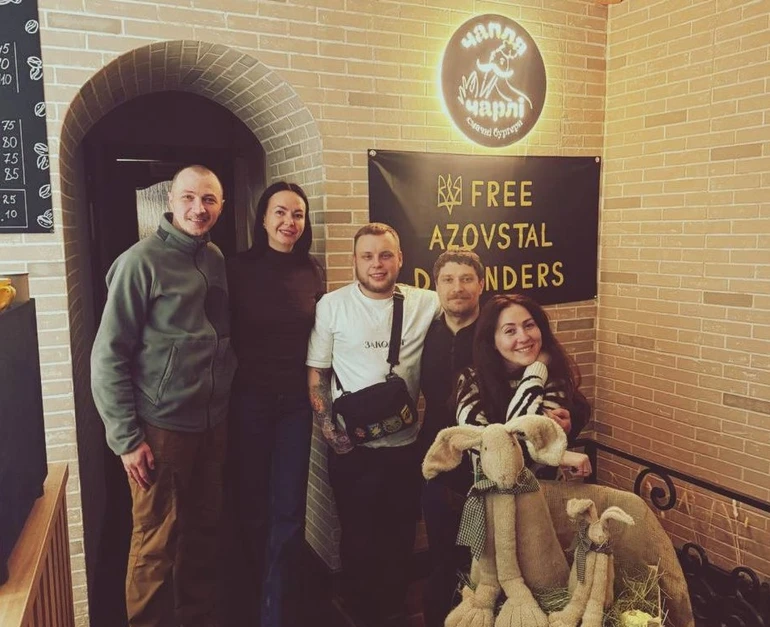
But the biggest surprise for “Yuzhny” was the “Charlie the Heron” café—a long-held dream of his that his beloved brought to life while waiting for him to return from captivity. The café’s symbol is a heron with a mustache, just like “Yuzhny’s,” and the menu features the delicious burgers he’d been craving.
“Yuzhny” is currently undergoing long-term rehabilitation. His plans include opening several “Charlie the Heron” locations in other cities, continuing his service, and helping other soldiers returning from Russian torture chambers.
“Only someone who has been there can describe the profound metaphysics of captivity. We found ourselves in an absurd looking-glass world and sat there for years. But now I thank God that I sat there exactly like that, because I hit rock bottom and pushed off from there. I did not dishonor the honor of an Azov soldier, an officer, a Ukrainian, or a Slobozhansky. And I believe that I emerged from there a victor."
Mykhailo Chaplia
Author: Olena Barsukova
"Glory to Ukraine, guys. Whoever returns home, tell us what’s happening in Taganrog”—Mykhailo Chaplia came across this message of unknown origin at Taganrog Pretrial Detention Center No. 2. Where exactly it was hidden—it’s not time to say yet.
Mykhailo, a tall, wiry man from Kharkiv with a lively sense of humor, resembles the main character of Ivan Bagryany’s book *The Garden of Gethsemane*.
Some of the events in that book, Mykhailo literally had to live through. The Russians starved him, tortured him with electric shocks, broke his ribs, locked him in a tiny basement, and tried to extract absurd “confessions.”
Mykhailo Chaplia (“Yuzhny”) is an ultras fan of the “Metalist” football club and an officer of “Azov,” having dedicated nearly 10 years of his life to service.
Since March 2015, he served in tank reconnaissance; from 2017, he was an APC driver, and later a staff officer. He defended Mariupol and, in May 2022, left Azovstal as an “honorary prisoner.”
For the first four months, he was held in a penal colony in Olenivka, and at the end of September 2022, he was transferred to the Taganrog pretrial detention center, where he spent 24 months.
The Russian city of Taganrog is not just a place name, but a synonym for the torture conveyor belt created by the Russian Federation. Here, people are “broken,” with confessions to fabricated crimes beaten out of them so they can be brought “ready” to trial.
“Taganrog is the perfect place for Russians because there is no oversight there. Dostoevsky had a term for this: ‘administrative ecstasy,’ when people simply revel in power. That’s exactly what it is,” says “Yuzhny,” recalling the brutality of the guards and investigators there.
“Yuzhny” told UP. Life about two years of torture and femicide in Taganrog, the “Telegin system,” humor in captivity, and the biggest surprise after his return.
“When you arrive in Taganrog, they beat you like a piece of meat”
Taganrog, September 2022.
All shifts of guards, along with Russian “special forces,” gathered for the “reception” of new prisoners. Armed with batons, sticks, and stun guns, they were supposed to beat several hundred prisoners running down the corridor.
“On the very first night, the guys’ bodies were dragged out on sheets,” recalls Mykhailo.
"Yuzhny" was relatively lucky back then. Just cracked ribs and broken fingers. But many of his comrades "got it" worse—their ribs pierced their lungs from the blows. Some of the prisoners died from pneumothorax.
"When you arrive in Taganrog, they shock you with electricity, beat you like a piece of meat, and stomp on you. Whether you scream 'I’ll sign everything' or not, they just beat you without asking. You do 200–500 squats. You can’t squat anymore because of the inflammation in your muscles, but you do it anyway.
Then you go out for a ‘walk,’ but before that, they beat you up. You have to do everything very quickly, in sync. And if you can’t—they’ll quickly “teach” you,” recalls Mykhailo.
When “Yuzhny” arrived in Taganrog, the general regime at the Olenivka colony began to seem like a children’s camp to him. A brutal, but at least predictable camp, where prisoners of war could walk around the grounds, talk to each other, and see the sun. All these “privileges” disappeared in Taganrog.
Prisoners had to walk in a “G” shape: head down, hands behind their backs. Looking up was forbidden, as was speaking without permission. Even if asked a question, you first had to ask: “Sir, may I answer?”
Every movement—a walk, a shower, an interrogation—was accompanied by beatings. Not only the guards but also Russian special forces took part in the abuse.
“New special forces arrive—they’re curious where the Azov guys are. They’re shown, ‘Look, there they are.’ I’m an Azov fighter from Kharkiv, a staff officer, a soccer fan—I get the full treatment. A dog grabs you in the hallway, and if you flinch, they hit you with a stun gun.
One of the guys was bitten by the dog until he bled during the intake process; his uniform was torn to shreds. When he asked to have it replaced, the ‘civilian boss’ started: ‘Wow, what’s wrong with your hands and feet? Why are you covered in blood?’ The other guards laugh. Then they say, “Listen, why are you ruining your uniform?” and start beating him for it.
When they were forbidden from beating us, they started torturing us with stun guns so badly that one guy next to me couldn’t take it anymore and just screamed, “I beg you, please, you can beat me with your hands and feet.” That’s the state they drive people into.”
“You have no choice but to eat shells, scales, and tails.” Living Conditions
A floor made of 12 planks, a bench, a table, a toilet—I spent 17 of the 24 months I was in Taganrog in a cell like this in the “Yuzhny” basement.
Across from the cell in the hallway is the guards’ “latrine,” which they deliberately did not flush. Next to it is a shower, which turns into yet another arena of torture.
Prisoners are taken there once a week under the blows of batons and stun guns. But if you’re “lucky” enough to be called in for interrogation at that time, you won’t be able to wash until the following week.
The cells constantly reek of urine and sweat. All around is dampness, stench, and mold. But, surprisingly, “Yuzhny” was lucky enough not to contract tuberculosis.
“There’s no soap, no toilet paper. At first, we had one cup for two—you used it to drink and to wash yourself,” recalls Mykhailo.
The prisoners constantly dreamed of food. “Yuzhny” craved borscht, cheesecakes, roast duck, crucian carp, burgers, apples, oatmeal cookies, and kefir most of all.
Instead, they had to eat other “delicacies”: sauerkraut with water, semolina porridge with raw herring or with a meat substitute, if they were lucky. Before his capture, Mykhailo weighed 105 kilograms; after his release, he weighed 58.
"They feed you worse than a dog. But you have no choice but to eat the shells, scales, and tails. You have to eat everything very quickly, wash the dishes, and hand them back to the balandor (the prisoner who distributes the food—ed.)," the man recalls.
For a while, the prisoners managed to scratch short messages into the bottoms of their plates. These words gave them more strength than the gruel they were fed. But then the administration found out about it and began to erase the inscriptions.
"Drug addict, professor, member of the Territorial Defense Forces." Neighbors
In the cells of the basement special block—a “melting pot” of prisoners of war and civilians. Among those held there were Vladimir Baranyuk, commander of the 36th Marine Brigade; the mayor of Kherson; a Colombian man who didn’t speak Russian; and dozens of other random people.
"For a while, a drug addict with hepatitis from Luhansk, a member of the Territorial Defense Forces from Mariupol with lung cancer, and two men from Melitopol—one of whom is a professor— and the other couldn’t tell his right from his left. That’s how absurd it was,” says “Yuzhny.”
The man from occupied Luhansk was elderly and had hepatitis. He hoped the Russians would believe in his innocence and let him go, but their “justice” knew no mercy.
“They threw a drug addict named Seryoga into my cell. They accused him of being a spotter and tortured him brutally. He had two shocker burns so large you could fit a pinky finger in them. His legs were purple and swollen so badly that they became inflamed. They didn’t give a damn that he had already started wetting himself.”
Mykhailo “nursed” his cellmate for about a month. He asked the guards not to take him out into the hallway, carried him on his shoulders, and helped him wash up. But there was no soap, so it was twice as hard.
“I’d ask the bath attendant, ‘Sir, please,’ and he’d tell me to ‘f*ck off’—ten times over. But they beat me up all the time anyway, so I kept going. At some point, I annoyed him so much that he just threw some soap into my cell—a small bar, all covered in pubic hair, but at least it was something,” the man says.
In the end, “Yuzhny” paid the price for looking out for his neighbor: he was beaten, and the man from Luhansk was transferred to another cell.
The man from occupied Luhansk was elderly and had hepatitis. He hoped the Russians would believe in his innocence and let him go, but their “justice” knew no mercy.
“They threw a drug addict named Seryoga into my cell. They accused him of being a spotter and tortured him brutally. He had two shocker burns so large you could fit a pinky finger in them. His legs were purple and swollen so badly that they became inflamed. They didn’t give a damn that he had already started wetting himself.”
Mykhailo “nursed” his cellmate for about a month. He asked the guards not to take him out into the hallway, carried him on his shoulders, and helped him wash up. But there was no soap, so it was twice as hard.
“I’d ask the bath attendant, ‘Sir, please,’ and he’d tell me to ‘f*ck off’—ten times over. But they beat me up all the time anyway, so I kept going. At some point, I annoyed him so much that he just threw some soap into my cell—a small bar, all covered in pubic hair, but at least it was something,” the man says.
In the end, “Yuzhny” paid the price for looking out for his neighbor: he was beaten, and the man from Luhansk was transferred to another cell.
“You Ukrainians, we’re tired of beating you.” The guards
Walls have ears.
“Yuzhny” understood the meaning of this phrase in Taganrog.
When it was quiet in the special block, the cell walls “listened” to Mykhailo’s prayers, while he eavesdropped on the guards’ conversations about side jobs, their escapades with prostitutes, and the hanging of Ukrainian female prisoners.
The silence was broken by the screams of prisoners or loud Russian music—“The White Army, the Black Baron,” “Arise, Vast Country,” and other hits from the Bolshevik era. The music was a form of torture in itself. Once, it played all night long.
The guards asked the prisoners, “Do you like the music?” and they had to answer “yes.” But in moments of silence, the man learned to pick up on every rustle on the floors and the different tones in the torturers’ voices.
“You try to tell by the voice who’s taking over the post. You imagine what the person looks like, their build. You have to sense every breath and gesture to understand how to behave. It’s like a very interesting book that you want to read but can’t,” recalls “Yuzhny.” The female guards were just as brutal as the men: they tortured prisoners for show to curry favor with their “colleagues.”
"I was already used to feminine forms and was very surprised when I had to address a girl as 'citizen-superior.' I wanted to say ‘female citizen,’ but when another guy addressed her that way, she told him, ‘We’re not in your Gayrope,’ the soldier recalls.
Among all the guards, there was only one—a rather authoritative one—who didn’t touch the prisoners. Although once even the most zealous torturers told the prisoners: “We’re tired of beating you.” But they didn’t stop.
"In Taganrog, it’s forbidden to look out the window. But in one of the cells, someone was constantly staring out. The Russians had gotten to the point where they’d say: ‘Ukrainians, are you all idiots? We beat you every day, five or six times. Our hands and feet already hurt. Don’t you understand that you’re not supposed to look out there? We’re tired of beating you,” the soldier recounts.
The medical staff were a bit more humane than the guards. One young man, who was wounded during the terrorist attack in “Barrack 200,” was even allowed by a doctor to sit on the bed instead of standing in the cell.
But access to the meager medical care depended on the guards’ mood. "Yuzhny" learned to distinguish the particularly cruel ones and didn’t ask for anything when they came on shift:
"If you ask to see a medical worker, they’ll ask you what hurts. When the shift is bad, you shouldn’t even bother asking. If you say your stomach hurts, they’ll start beating you in the stomach.
—Does it hurt anymore?
—Not at all, Mr. Chief.
That’s the kind of treatment.”
"You have to come up with a crime yourself." Investigations and Trials
“We need the truth,” said representatives of the Russian Investigative Committee as they conducted “passionate” interrogations of prisoners in Taganrog.
“They need plausible stories. It’s not enough to just sign a piece of paper with the charges; you have to come up with a crime yourself,” says “Yuzhny.” At first, they wanted to pin the killings of civilians on Mikhail, but he was an APC driver, not a gunner. Then they tried to frame him for the arson of the Trade Union House in Odessa on May 2, 2014.
But on that day, “Yuzhny” wasn’t even in Odesa, a fact he had repeatedly mentioned in interviews with propagandists even before Taganrog.
"I endured it all the time and didn’t take the blame for anything, but I think they just couldn’t find any ‘witnesses’ against me. In reality, they’ll pin anything on you if they find a false witness among the other prisoners. It doesn’t depend on your willpower…
Only there do you realize that they’re humiliating you, beating you, torturing you simply because you’re Ukrainian. Those who think, “I’m a civilian, this doesn’t apply to me,” are mistaken. For Russians, a civilian means a spotter; a soldier means a terrorist.
All Ukrainians are subject to screening—they must be turned inside out and dried out. The Russians will tie you up upside down, beat you with stun guns, and torture you with “tapiks.” Both girls and boys—it makes no difference to them,” says “Yuzhny.” Mykhailo understood that he might not live to see the exchange, but he recalled Bruce Lee’s phrase: “Be water.” That is, adapt to the conditions in which you find yourself.
Mentally, the soldier prepared himself for two and a half years of captivity. That’s pretty much how it turned out.
“Anyone who tried to cheer themselves up by thinking the exchange would happen tomorrow was mistaken. Unfortunately, there were suicides. About two weeks before my exchange, a guy from the neighboring cell pried a shard of glass from under the threshold and slashed his arms and stomach. He miraculously survived—they pumped his stomach and took him somewhere.
It’s the worst feeling when you try to cheer a guy up—‘bro, everything will be okay, we’ll all get out’—and then you find out—another one cut himself, another one couldn’t take it anymore...
“I didn’t think about suicide because I wasn’t interested in dying. I wanted to come out a winner. I was kept going by the thought that I’d get out anyway and keep living, while they’d be left in this shit,” the man shares.
“I asked for Alexei Tolstoy—they brought me Leo.” The Telegin-Chaplin System
During his captivity, “Yuzhny” read many Russian classics: Dostoevsky, Pushkin, Lermontov.
“When there was a normal shift, we could swap books. But not always. Once I asked for a Bible, and they brought me Mayakovsky. I asked for Alexei Tolstoy—they brought me Leo Tolstoy,” the soldier recalls.
The works of Russian writer Alexei Tolstoy (a distant relative of Leo Tolstoy) had captivated “Yuzhny” back in Olenivka, where he had read the book *The Ordeal*. In this trilogy, there is a character named Ivan Telegin—a former nobleman and officer who is arrested first by the Bolsheviks and then by the White Guards.
To keep from going mad in prison, Telegin did 100 exercises in the morning, at noon, and before bed. While in captivity, "Yuzhny" identified with him and decided to follow his example—performing a set of physical exercises every morning, afternoon, and evening.
Mykhailo came up with the name “Telegin System” himself when he asked his comrades who were being released from captivity: “Give the Associate Professor my regards from Telegin,” because “the Associate Professor” (Vladislav Dutchak) had trained with “Yuzhny” back in Olenivka.
This strategy came in handy in Taganrog. In a cramped cell where one could barely turn around, “Yuzhny” would do push-ups, squats, and planks.
The man knew that during inspections or interrogations, the guards would torture him with exhausting exercises, so he toughened himself up to the point where, at some point, it became easier for him to repeat them. Moreover, self-discipline helped keep his spirits up.
“The body gets used to exhaustion. But this requires a special mindset—not just doing squats on a whim. Because if you do 20 squats like that, you’ll run out of breath, and your knees will start to creak. I did these exercises to show that a person can do anything. My goal was to survive.
I knew I’d have to face the next test anyway; they’d force me to do it, and I’d endure it. Each time, I did better and better. They told me to do 200 squats—and I did them. They told me to do the splits—I did the splits. And they found it funny; it amused them. One would brag to the other: “Look how I taught him.”
It’s hard and painful because
they’d beaten my joints to a pulp. Of course, that inspired them to push my pain threshold even further. But then they saw that I wasn’t making a sound, and they lost interest,” the soldier says.
"Gallows humor"
Even in the hell that was Taganrog, funny situations would arise. Sometimes we managed to troll the guards. The main thing was that they didn’t catch on.
Once, Mikhail managed to make a joke when the Russians asked if he knew about the leader of the “Wagnerites,” Yevgeny Prigozhin:
“I found out about the capture of Bakhmut when they shouted, ‘Our guys took Artemovsk.’” The feeding trough opens, they shout:
– Do you know who Prigozhin is?
– Sir, may I speak?
– I permit it.
– He’s the husband of the singer Valeria.
– Are you out of your mind?
– I couldn’t possibly know that, sir.
“Yuzhny” also gave nicknames to some of the torture chamber’s workers. For example, the “balandora” was called “Kolya-Pyramid” because he stacked plates of food in a pyramid, one on top of the other.
Exchange. Freedom. Charlie the Heron
September 13, 2024.
Ukraine brought home 49 prisoners of war, among whom was “Yuzhny.”
– Guys, where are you from?
– From captivity.
– Is “Azov” coming back?
– They are coming back.
In this viral video, “Yuzhny” is seen alongside his comrade “Nikopol.” Thin but smiling, they are holding a flag.
Mykhailo sensed that the exchange was approaching. In the summer of 2024, only 6–7 people remained at the outpost where he was stationed. The Russians began transporting prisoners out of Taganrog. At the time, Mykhailo thought the men were being taken for an exchange, though in reality, most of them faced trials and transfers to prisons.
One day in September 2024, the guards told “Yuzhny” to come out and change clothes. They issued one light-weight and one heavy-weight “talon” to wear on his feet. They didn’t take his wedding ring or cross.
Two prisoners were taken from Taganrog, and several dozen more were taken from other prisons. Most of them thought they were being transported to another prison. But “Yuzhny” realized he was going home: during prisoner transfers, they weren’t beaten or tortured, and that only happens during prisoner exchanges.
On the train, the man made another unexpected discovery.
“On the special train from Rostov to Voronezh, I was traveling with border guard Jafar, Azov fighter ‘Arn,’ and police officer Misha. They were sitting in different seats, but I noticed they were wearing the same shoes—blue sneakers, the kind worn by our guards and prison guards.
I asked the guys where they got those shoes, and they said, ‘The Red Cross gave them to us.’ That’s when I realized those sneakers had been brought to us. The Russians had simply ‘looted’ everything. “The Red Cross gave us one ‘Maria’ cookie and 2–3 pieces of candy,” recalls “Yuzhny.”
Mykhailo returned home exactly two weeks before his 37th birthday. His wife Sevindzh, with whom he has been together for 10 years, was waiting for him at home. While in captivity, he constantly thought about his beloved, and when he finally saw her, it was as if they had never been apart.
"I immediately started asking who among my relatives was alive and how things were in Kharkiv. My grandmother had passed away during that time. I had planned to come home even before the full-scale war began, but I never made it…
For the first five days after I got out, my eyes were red from the light because I hadn’t seen the sun for two years. But it’s an incredible rush when you feel the wind caressing your cheek. “That’s what freedom is,” the soldier recalls warmly.
But the biggest surprise for “Yuzhny” was the “Charlie the Heron” café—a long-held dream of his that his beloved brought to life while waiting for him to return from captivity. The café’s symbol is a heron with a mustache, just like “Yuzhny’s,” and the menu features the delicious burgers he’d been craving.
“Yuzhny” is currently undergoing long-term rehabilitation. His plans include opening several “Charlie the Heron” locations in other cities, continuing his service, and helping other soldiers returning from Russian torture chambers.
“Only someone who has been there can describe the profound metaphysics of captivity. We found ourselves in an absurd looking-glass world and sat there for years. But now I thank God that I sat there exactly like that, because I hit rock bottom and pushed off from there. I did not dishonor the honor of an Azov soldier, an officer, a Ukrainian, or a Slobozhansky. And I believe that I emerged from there a victor."
Mykhailo Chaplia
This is an automatic translation generated by DeepL.