"It Was the Gulag of the 21st Century" – Priests from the Rescue Vessel "Sapphire" on Their Time in Russian Captivity
Source: MIPL
Author: Maria Klymik
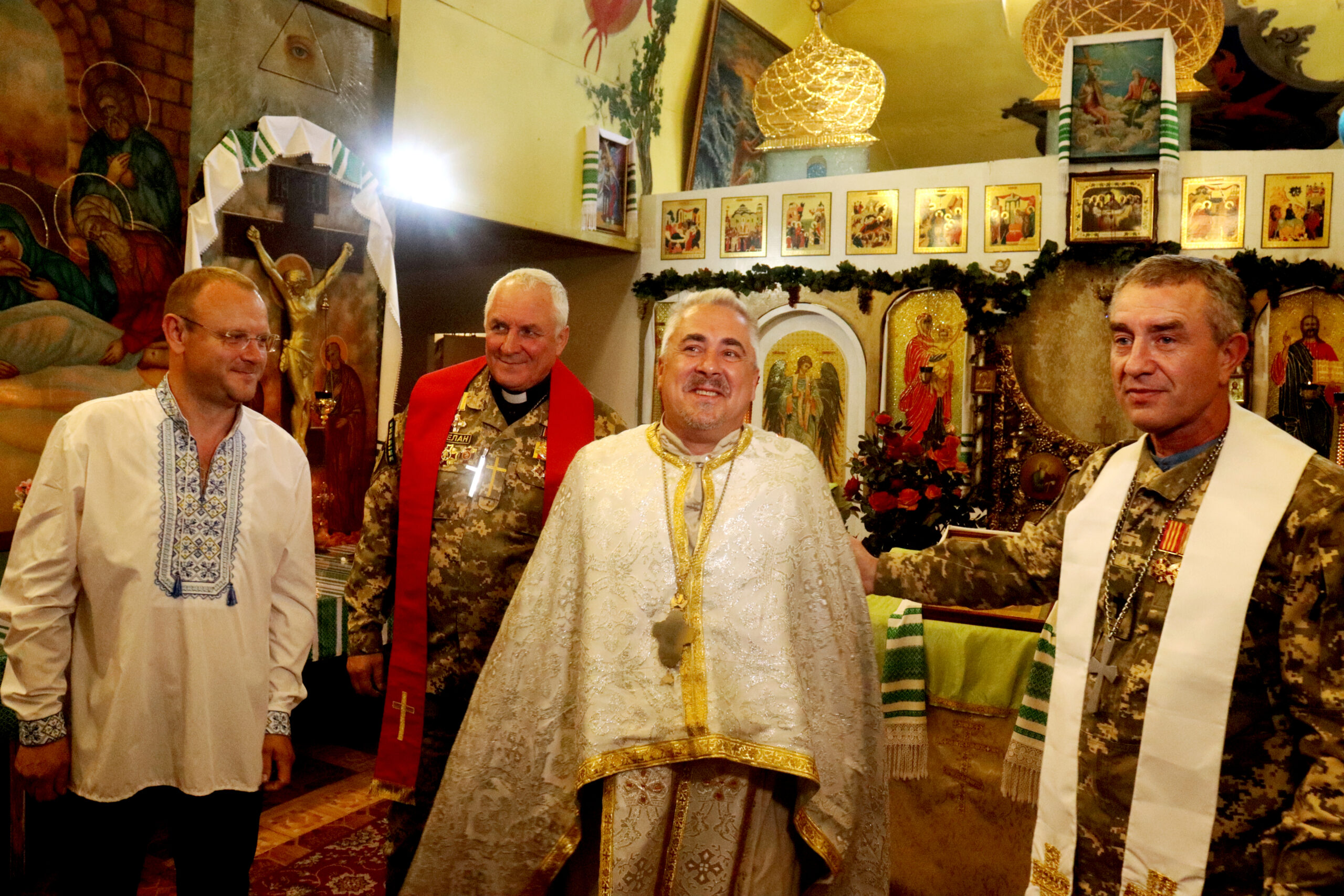
Three priests of different denominations—chaplains Oleksandr Chokov, Leonid Bolgarov, and Vasyl Vyrozub—along with pediatrician Ivan Tarasenko were all taken prisoner by the Russians near Zmiinyi Island. They were taken to occupied Crimea and later to Russian territory. After their release, the men remained silent for some time so as not to endanger other captives. But now they have decided to share their stories, at least in part. A journalist from the International Center for Human Rights met with them at the Holy Trinity Church of the Orthodox Church of Ukraine in Odesa.
Captured
According to Russian Coordinates
“Oleksandr Chokov called me and said that the commander had asked him to retrieve the bodies of our guys from Zmiinyi; he needed help. I agreed. I gathered large trash bags for the bodies, because we didn’t have anything else for such a situation. Then Father Vasyl Vyrozub found special body bags. We were told that the Russians were providing a safe passage—we could reach the island and retrieve the bodies,” says Leonid Bolgarov, a military chaplain and pastor of the Christian Reformed Church.
“In 2015–2016, I served on the front lines, and afterward I spoke with many volunteers,” says Ivan Tarasenko, a pediatric anesthesiologist. “On February 25, I also received a call asking me to go retrieve the bodies of the fallen. They said it was important to have a doctor on the mission.”
So Tarasenko, Vyrozub, a priest of the OCU, and the evangelical priests Bolgarov and Chokov found themselves aboard the search-and-rescue vessel “Sapphire.”
On February 26, the “Sapphire” set sail for Zmiinyi Island. According to preliminary information, the bodies of 13 Ukrainian border guards were there; they had allegedly been killed following a massive shelling of the island by Russian forces on the first day of the full-scale invasion of Ukraine. At that time, there were no reports that marines were also on the island. As it later turned out, there were a total of about 80 military personnel.
That evening, the “Sapphire” departed from the seaport of Odesa using coordinates provided by the Russian side. It dropped anchor near Zmiinyi Island. The captain of the “Sapphire” announced that Russian military personnel were going to board the ship for an inspection.
“They told us to stay in our cabins. I was with Chokov,” recalls Leonid Bolgarov. “People in uniform came into the cabin and ordered us to put our hands behind our heads. They led us out onto the deck at gunpoint and made us kneel. We stood there like that for about half an hour. Then they took us to the stern. They allowed us to take photos. We even took a photo of Zmiinyi Island. They only forbade us from photographing their ships. Next, they collected all our personal belongings. We stayed on deck for two hours, then they took us to the mess hall, where they kept us until evening.”
The chaplains were kept separate from the “Sapphire” crew.
“For two days, we received no information. Later, they told us that everyone on Zmiinyi was alive, and that we, like them, had been taken prisoner,” says Dr. Ivan Tarasenko.
Oleksandr Chokov adds: “We were told that there were no agreements between Ukraine and Russia. That they needed to verify our identities, since it was unclear why and for what purpose we had come. Perhaps we were spies or intelligence agents.”
On February 27, the priests and the doctor were put on a small boat and transported to the Russian maritime tugboat *Shakhtar*.
Priests Held Hostage: A Tactic of Influence and Intimidation
“We realized that this was the same vessel used to transport soldiers from Zmiinyi, because we found a Marine Corps chevron on the tugboat,” says Bolgarov.
Everyone was taken to Sevastopol in occupied Crimea. There, military police and Russian television were waiting for them.
“They took us to the guardhouse (8 Bakinskaya Street—ed. MIPL). We were interrogated the entire next day. Their journalists ‘interviewed’ us. Among them was a young woman who introduced herself as a blogger from Kherson; she spoke very good Ukrainian, but it was clear whose side she was on,” Bolgarov continues.
Ivan Tarasenko was placed in a solitary confinement cell, while the priests were put in a tiny room with bunk beds, bars on the windows, and a hole in the floor serving as a toilet. They remained in these conditions for 11 days.
The Journey to Russia
“On March 12, we were reunited with the soldiers from Zmiinyi and the ‘Sapphire’ team. They put us on buses. We already thought we were going home. Their ensign even said, ‘Congratulations on your long journey home.’ But they didn’t take us home,” Bolgarov recounts.
They took us to a military airfield in Simferopol. We were put on an IL-76 transport plane. In addition to the “Sapphire” crew and soldiers from Zmiinyi, there were civilians from Kherson on board. In total—about 200 people.
The plane landed in Kursk, Russia.
“The ramp came down—we saw the night, snow, and lots of police vans. They put us in them—35 to 37 people in each—and drove us somewhere for three and a half hours,” recalls Leonid Bolgarov.
At first, the captives were taken to a tent city in the town of Shebekino in the Belgorod region, located 7 km from the border with Ukraine.
“Clearly, this was a town that had been built for ‘refugees’ from Ukraine. But when they realized there were no refugees, they began using it to temporarily hold prisoners. We saw how the tents were surrounded with barbed wire. It was our own people, from Donetsk, who did this. They even shouted at us that they were from the ‘DPR’ and that ‘they’d bite our heads off,’” the doctor recalls.
“They told us to forget our last names”
“While the Russian military at ‘Sapphire’ and in Crimea treated us more or less normally, we were treated very harshly at the prisoner-of-war camp. They made everyone get down on their knees and beat us,” says Chokov, chaplain of the 35th Separate Marine Brigade named after Rear Admiral M. Ostrogradsky. “Imagine standing for two hours in the freezing cold at –22°C. When I could no longer stand it and stood up, a Russian soldier hit me hard. I said to him, ‘Why are you hitting a priest?’ He then fell as if in a daze. Then he took my hand, led me into a tent where everyone was being photographed and fingerprinted. ‘What’s your name?’ he asked. I replied, “Oleksandr Venediktovich Chokov.” “Now your number is 27.” That’s when I realized I had ended up in the 21st-century Gulag.”
Everyone in the camp was assigned a serial number. The prisoners were addressed only by their numbers.
Leonid Bolgarov was given number 139, and Ivan Tarasenko was given number 140.
The priests say that afterward, everyone was held in tents, with 20–25 people in each. Military personnel and civilians—who were often detained for no reason, such as while taking out the trash or walking their dogs—were held together.
It was very cold in the camp. When the men were taken prisoner, temperatures in Ukraine were above freezing, and they had no warm clothing. The only way to stay warm was near the potbelly stoves.
“Anything but captivity”: Most soldiers from Zmiinyi are in Russian territory and occupied Crimea
In Shebekino, the priests, a doctor, and other servicemen from Zmiinyi spent between four and six days. Each was transported from there separately. Chokov was taken first, followed by Vyrozub and Tarasenko, with Bolgarov being the last to leave.
The distance from Shebekino to Kursk is about 200 km
“They told us they’d prepared a place for us where it was warm and we could wash up and change clothes. Instead, they cut our hair, washed us, and gave us prison uniforms. They gave us towels only after we were in the cell—we had to get dressed while still wet,” says Leonid Bolgarov.
The Ukrainians ended up in Pretrial Detention Center No. 2 in Stary Oskol, Belgorod Oblast.
“It was a three-story building with a basement and a punishment cell inside it,” says Ivan Tarasenko. “They took us out for a walk for 5–10 minutes. But they weren’t so much interested in letting us walk as they were in mocking us. To go for a walk, we had to go up to the top floor of the detention center, where there were rooms without ceilings but with bars at the top. To get there, we had to run up steep stairs. If anyone moved slowly, the guards used force. They would set dogs on the soldiers just for fun.”
Every cell had video surveillance, and guards stood outside the doors. We weren’t allowed to sit on the beds—we had to walk around the cell the whole time. The food was terrible—they gave us boiled sauerkraut and boiled dough. There was almost no medical care. The day began at 6:00 a.m. with the Russian national anthem and ended at 10:00 p.m. We had to listen to Russian patriotic songs or Russian radio the whole time.
“While the Russian national anthem was playing, we all had to stand at attention. I sang the Ukrainian national anthem quietly, and Father Vasyl prayed. He crossed himself and bowed his head. He was reprimanded several times, and on March 31, they took him away from us,” says Leonid Bolgarov, a military chaplain and pastor of the Christian Reformed Church. “Everyone hoped that maybe they’d let him go. But for some reason, I thought they’d taken him away in solitary confinement. We haven’t seen him since.”
So every morning, the men prayed at Pretrial Detention Center No. 2 in Stary Oskol
At every new detention facility, they took everyone’s fingerprints and blood samples, performed chest X-rays, and interrogated them constantly.
“We spoke with various investigators, not just FSB agents,” recalls Ivan Tarasenko, a pediatric anesthesiologist. “Since I’m a former ATO participant, I was interrogated by the Russian Investigative Committee, which specialized exclusively in ATO military personnel. We were accused—and I personally—of killing civilians in Donbas. I kept repeating: ‘I was a doctor, I didn’t shoot anyone, I provided medical care to the soldiers.’ But they weren’t interested in that. They said they’d find a reason to make sure I served my 15 years in prison.”
Psychological Pressure
They constantly searched the detention center cells. Not to find anything—nothing new could possibly appear there—but to show that the prisoners were nobodies.
“One day they came into the cell and said there was going to be a search. They took everyone out into the hallway. One by one, they brought us back into the cell, stripped us, and inspected everything. Then they tore open the mattresses. Well, what do you call them? Bags stuffed with cotton. Then they ordered us to get dressed and make the bed. A few seconds later, the whole thing happened all over again,” recalls Bolgarov.
The chaplain was in the cell with three other detainees.
“The radio was on the whole time, reporting on Gostomel, Bucha, and Mariupol. They’d say that Russian troops aren’t fighting the civilian population, that the Russians are organizing safe corridors for civilians, while Ukrainians are taking Russian soldiers prisoner, mocking them, torturing them, cutting off their fingers and other body parts, and gouging out their eyes. They even find witnesses somewhere! And then we went outside and saw the truth… And it just didn’t make sense,” says Chokov.
Grab your things—we’re leaving
“On the morning of April 8, they told us, ‘Grab your things and get out.’ You take your mattress, your bedding—everything they gave you,” the doctor recounts.
That day, they saw Father Vyrozub again.
“They gave us some of our belongings, but not all of them. They put us in a holding cell. We heard: ‘Vyrozub, come in!’ We were overjoyed; we thought they were releasing him with us. They told him to change into civilian clothes. But five minutes later, they made him put on a prison uniform again with the word ‘solitary confinement’ written on it. He was in solitary confinement the whole time, where they tormented him terribly—beating and torturing him. “They wanted him to cooperate with them,” says Bolgarov.
That evening, everyone except Vyrozub was taken from Stary Oskol to Kursk. There, all the prisoners spent the night in a cell. In the morning, Chokova, Bolgarov, and Tarasenko were taken in a police van to a military airfield.
“They put us on an AN-26. We made one stop in Rostov, where they picked up more people. Then we landed in Simferopol. Guards were with us the whole time,” adds Tarasenko. “In Simferopol, they transferred us to KAMAZ trucks. Later, they transferred us to other vehicles; some guys from Zmiinyi were with us as well. In total, there were about 30 people.”
The exchange took place in the Zaporizhzhia region.
Ivan Tarasenko, Leonid Bolgarov, and Oleksandr Chokov spent 43 days in Russian captivity; Father Vasyl Vyrozub spent 68 days and was exchanged on May 6.
Author: Maria Klymik
Three priests of different denominations—chaplains Oleksandr Chokov, Leonid Bolgarov, and Vasyl Vyrozub—along with pediatrician Ivan Tarasenko were all taken prisoner by the Russians near Zmiinyi Island. They were taken to occupied Crimea and later to Russian territory. After their release, the men remained silent for some time so as not to endanger other captives. But now they have decided to share their stories, at least in part. A journalist from the International Center for Human Rights met with them at the Holy Trinity Church of the Orthodox Church of Ukraine in Odesa.
Captured
According to Russian Coordinates
“Oleksandr Chokov called me and said that the commander had asked him to retrieve the bodies of our guys from Zmiinyi; he needed help. I agreed. I gathered large trash bags for the bodies, because we didn’t have anything else for such a situation. Then Father Vasyl Vyrozub found special body bags. We were told that the Russians were providing a safe passage—we could reach the island and retrieve the bodies,” says Leonid Bolgarov, a military chaplain and pastor of the Christian Reformed Church.
“In 2015–2016, I served on the front lines, and afterward I spoke with many volunteers,” says Ivan Tarasenko, a pediatric anesthesiologist. “On February 25, I also received a call asking me to go retrieve the bodies of the fallen. They said it was important to have a doctor on the mission.”
So Tarasenko, Vyrozub, a priest of the OCU, and the evangelical priests Bolgarov and Chokov found themselves aboard the search-and-rescue vessel “Sapphire.”
On February 26, the “Sapphire” set sail for Zmiinyi Island. According to preliminary information, the bodies of 13 Ukrainian border guards were there; they had allegedly been killed following a massive shelling of the island by Russian forces on the first day of the full-scale invasion of Ukraine. At that time, there were no reports that marines were also on the island. As it later turned out, there were a total of about 80 military personnel.
That evening, the “Sapphire” departed from the seaport of Odesa using coordinates provided by the Russian side. It dropped anchor near Zmiinyi Island. The captain of the “Sapphire” announced that Russian military personnel were going to board the ship for an inspection.
“They told us to stay in our cabins. I was with Chokov,” recalls Leonid Bolgarov. “People in uniform came into the cabin and ordered us to put our hands behind our heads. They led us out onto the deck at gunpoint and made us kneel. We stood there like that for about half an hour. Then they took us to the stern. They allowed us to take photos. We even took a photo of Zmiinyi Island. They only forbade us from photographing their ships. Next, they collected all our personal belongings. We stayed on deck for two hours, then they took us to the mess hall, where they kept us until evening.”
The chaplains were kept separate from the “Sapphire” crew.
“For two days, we received no information. Later, they told us that everyone on Zmiinyi was alive, and that we, like them, had been taken prisoner,” says Dr. Ivan Tarasenko.
Oleksandr Chokov adds: “We were told that there were no agreements between Ukraine and Russia. That they needed to verify our identities, since it was unclear why and for what purpose we had come. Perhaps we were spies or intelligence agents.”
On February 27, the priests and the doctor were put on a small boat and transported to the Russian maritime tugboat *Shakhtar*.
Priests Held Hostage: A Tactic of Influence and Intimidation
“We realized that this was the same vessel used to transport soldiers from Zmiinyi, because we found a Marine Corps chevron on the tugboat,” says Bolgarov.
Everyone was taken to Sevastopol in occupied Crimea. There, military police and Russian television were waiting for them.
“They took us to the guardhouse (8 Bakinskaya Street—ed. MIPL). We were interrogated the entire next day. Their journalists ‘interviewed’ us. Among them was a young woman who introduced herself as a blogger from Kherson; she spoke very good Ukrainian, but it was clear whose side she was on,” Bolgarov continues.
Ivan Tarasenko was placed in a solitary confinement cell, while the priests were put in a tiny room with bunk beds, bars on the windows, and a hole in the floor serving as a toilet. They remained in these conditions for 11 days.
The Journey to Russia
“On March 12, we were reunited with the soldiers from Zmiinyi and the ‘Sapphire’ team. They put us on buses. We already thought we were going home. Their ensign even said, ‘Congratulations on your long journey home.’ But they didn’t take us home,” Bolgarov recounts.
They took us to a military airfield in Simferopol. We were put on an IL-76 transport plane. In addition to the “Sapphire” crew and soldiers from Zmiinyi, there were civilians from Kherson on board. In total—about 200 people.
The plane landed in Kursk, Russia.
“The ramp came down—we saw the night, snow, and lots of police vans. They put us in them—35 to 37 people in each—and drove us somewhere for three and a half hours,” recalls Leonid Bolgarov.
At first, the captives were taken to a tent city in the town of Shebekino in the Belgorod region, located 7 km from the border with Ukraine.
“Clearly, this was a town that had been built for ‘refugees’ from Ukraine. But when they realized there were no refugees, they began using it to temporarily hold prisoners. We saw how the tents were surrounded with barbed wire. It was our own people, from Donetsk, who did this. They even shouted at us that they were from the ‘DPR’ and that ‘they’d bite our heads off,’” the doctor recalls.
“They told us to forget our last names”
“While the Russian military at ‘Sapphire’ and in Crimea treated us more or less normally, we were treated very harshly at the prisoner-of-war camp. They made everyone get down on their knees and beat us,” says Chokov, chaplain of the 35th Separate Marine Brigade named after Rear Admiral M. Ostrogradsky. “Imagine standing for two hours in the freezing cold at –22°C. When I could no longer stand it and stood up, a Russian soldier hit me hard. I said to him, ‘Why are you hitting a priest?’ He then fell as if in a daze. Then he took my hand, led me into a tent where everyone was being photographed and fingerprinted. ‘What’s your name?’ he asked. I replied, “Oleksandr Venediktovich Chokov.” “Now your number is 27.” That’s when I realized I had ended up in the 21st-century Gulag.”
Everyone in the camp was assigned a serial number. The prisoners were addressed only by their numbers.
Leonid Bolgarov was given number 139, and Ivan Tarasenko was given number 140.
The priests say that afterward, everyone was held in tents, with 20–25 people in each. Military personnel and civilians—who were often detained for no reason, such as while taking out the trash or walking their dogs—were held together.
It was very cold in the camp. When the men were taken prisoner, temperatures in Ukraine were above freezing, and they had no warm clothing. The only way to stay warm was near the potbelly stoves.
“Anything but captivity”: Most soldiers from Zmiinyi are in Russian territory and occupied Crimea
In Shebekino, the priests, a doctor, and other servicemen from Zmiinyi spent between four and six days. Each was transported from there separately. Chokov was taken first, followed by Vyrozub and Tarasenko, with Bolgarov being the last to leave.
The distance from Shebekino to Kursk is about 200 km
“They told us they’d prepared a place for us where it was warm and we could wash up and change clothes. Instead, they cut our hair, washed us, and gave us prison uniforms. They gave us towels only after we were in the cell—we had to get dressed while still wet,” says Leonid Bolgarov.
The Ukrainians ended up in Pretrial Detention Center No. 2 in Stary Oskol, Belgorod Oblast.
“It was a three-story building with a basement and a punishment cell inside it,” says Ivan Tarasenko. “They took us out for a walk for 5–10 minutes. But they weren’t so much interested in letting us walk as they were in mocking us. To go for a walk, we had to go up to the top floor of the detention center, where there were rooms without ceilings but with bars at the top. To get there, we had to run up steep stairs. If anyone moved slowly, the guards used force. They would set dogs on the soldiers just for fun.”
Every cell had video surveillance, and guards stood outside the doors. We weren’t allowed to sit on the beds—we had to walk around the cell the whole time. The food was terrible—they gave us boiled sauerkraut and boiled dough. There was almost no medical care. The day began at 6:00 a.m. with the Russian national anthem and ended at 10:00 p.m. We had to listen to Russian patriotic songs or Russian radio the whole time.
“While the Russian national anthem was playing, we all had to stand at attention. I sang the Ukrainian national anthem quietly, and Father Vasyl prayed. He crossed himself and bowed his head. He was reprimanded several times, and on March 31, they took him away from us,” says Leonid Bolgarov, a military chaplain and pastor of the Christian Reformed Church. “Everyone hoped that maybe they’d let him go. But for some reason, I thought they’d taken him away in solitary confinement. We haven’t seen him since.”
So every morning, the men prayed at Pretrial Detention Center No. 2 in Stary Oskol
At every new detention facility, they took everyone’s fingerprints and blood samples, performed chest X-rays, and interrogated them constantly.
“We spoke with various investigators, not just FSB agents,” recalls Ivan Tarasenko, a pediatric anesthesiologist. “Since I’m a former ATO participant, I was interrogated by the Russian Investigative Committee, which specialized exclusively in ATO military personnel. We were accused—and I personally—of killing civilians in Donbas. I kept repeating: ‘I was a doctor, I didn’t shoot anyone, I provided medical care to the soldiers.’ But they weren’t interested in that. They said they’d find a reason to make sure I served my 15 years in prison.”
Psychological Pressure
They constantly searched the detention center cells. Not to find anything—nothing new could possibly appear there—but to show that the prisoners were nobodies.
“One day they came into the cell and said there was going to be a search. They took everyone out into the hallway. One by one, they brought us back into the cell, stripped us, and inspected everything. Then they tore open the mattresses. Well, what do you call them? Bags stuffed with cotton. Then they ordered us to get dressed and make the bed. A few seconds later, the whole thing happened all over again,” recalls Bolgarov.
The chaplain was in the cell with three other detainees.
“The radio was on the whole time, reporting on Gostomel, Bucha, and Mariupol. They’d say that Russian troops aren’t fighting the civilian population, that the Russians are organizing safe corridors for civilians, while Ukrainians are taking Russian soldiers prisoner, mocking them, torturing them, cutting off their fingers and other body parts, and gouging out their eyes. They even find witnesses somewhere! And then we went outside and saw the truth… And it just didn’t make sense,” says Chokov.
Grab your things—we’re leaving
“On the morning of April 8, they told us, ‘Grab your things and get out.’ You take your mattress, your bedding—everything they gave you,” the doctor recounts.
That day, they saw Father Vyrozub again.
“They gave us some of our belongings, but not all of them. They put us in a holding cell. We heard: ‘Vyrozub, come in!’ We were overjoyed; we thought they were releasing him with us. They told him to change into civilian clothes. But five minutes later, they made him put on a prison uniform again with the word ‘solitary confinement’ written on it. He was in solitary confinement the whole time, where they tormented him terribly—beating and torturing him. “They wanted him to cooperate with them,” says Bolgarov.
That evening, everyone except Vyrozub was taken from Stary Oskol to Kursk. There, all the prisoners spent the night in a cell. In the morning, Chokova, Bolgarov, and Tarasenko were taken in a police van to a military airfield.
“They put us on an AN-26. We made one stop in Rostov, where they picked up more people. Then we landed in Simferopol. Guards were with us the whole time,” adds Tarasenko. “In Simferopol, they transferred us to KAMAZ trucks. Later, they transferred us to other vehicles; some guys from Zmiinyi were with us as well. In total, there were about 30 people.”
The exchange took place in the Zaporizhzhia region.
Ivan Tarasenko, Leonid Bolgarov, and Oleksandr Chokov spent 43 days in Russian captivity; Father Vasyl Vyrozub spent 68 days and was exchanged on May 6.
This is an automatic translation generated by DeepL.