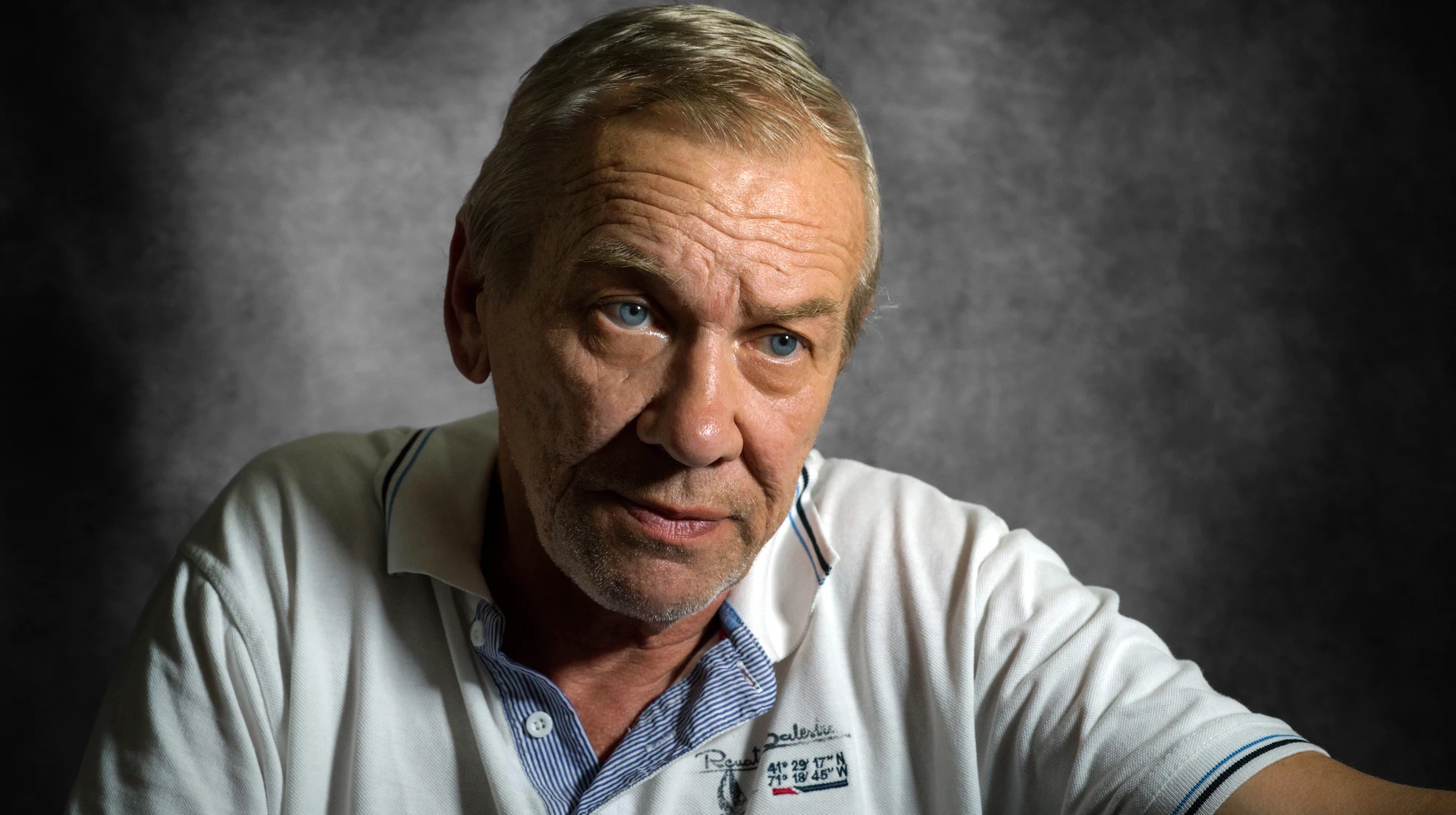
"I was a 'dill' for the Russians". The life of a 64-year-old doctor, antiquarian and partisan from Donetsk who was held captive for 7 years
Source: Ukrainska Pravda
Author: Olena Barsukova
"I'm a dentist. You know, the kind without any teeth myself. They knocked them all out—those dogs," says 64-year-old Donetsk native Ihor Kiryanenko.
He jokes and apologizes for the prison slang that sometimes slips into his speech—seven years in captivity have taken their toll.
The doctor and political prisoner from Donetsk, whom the occupiers imprisoned for his pro-Ukrainian stance, was released as part of an exchange on August 14, 2025.
His knocked-out teeth, gaunt physique, and ruined health are reminders of the years spent behind barbed wire.
Yet despite everything, Igor’s sense of humor and charisma fill the hospital room where we met him with light.
On his wrist is a blue-and-yellow bracelet. Nearby in the closet is a shopping bag labeled “Donetsk” and a black embroidered shirt, a gift he received after his release.
Igor spoke to “UP. Life” about his underground activities and torture in Donetsk, ideological disputes and adventures in the Makiivka colony, as well as his exchange and dreams after returning.
Ihor Kyryanenko worked as a dentist, ran a successful medical practice, and had an unusual hobby: he initially collected old medals and later used bank cards. Ihor assembled Ukraine’s largest collection, “The History of Banking in Cards”: 4,500 cards from 200 banks.
When the Russian-Ukrainian war began in 2014, Ihor stayed in Donetsk with his wife to care for his brother, who has a disability. He immediately closed his business. He hoped the Russians and separatists would be driven out quickly.
It soon became clear that the occupation would last a long time: repression and extortion began. Pro-Russian collaborators looted his warehouse—they stole a bunch of medical equipment, even a glucometer and a blood pressure monitor.
After a year of living under occupation, Ihor began gathering information on local security forces and passing it on to the Ukrainian military.
“I started helping Ukraine little by little starting in the winter of 2015. I figured out how to do it on my own and reached out myself. They wouldn’t have taken me into the army anymore, but I wanted to help bring victory closer somehow. I’d seen all these robberies; it wasn’t the first time I’d clashed with them.
I didn’t do anything particularly serious. I couldn’t shoot or blow anyone up. I was just trying to be useful. I wanted it to end sooner, the man says.
Igor opened an antique shop across from the occupying “Ministry of State Security” (MGB). And although he often crossed paths with the occupying security forces, he managed to avoid arousing suspicion.
“It’s a convenient location. They’d come in for tea or coffee, checking to make sure there were no explosives. There were checks there. But I was working, and everything was going fine,” the man says.
Neither his wife nor his friends had any idea about his activities. But secrets can’t be kept forever.
On December 30, 2018, Igor was detained as he was driving to the store. At the occupation “department for combating organized crime,” they began beating a confession out of him regarding his collaboration with the SBU: they beat him and choked him with a plastic bag.
“I’m driving in the morning; there’s a car ahead of me. Another one was parked on the shoulder. The road was wide; no one was in the way. The car in front suddenly pulled up alongside the other one and stopped. I stopped too. And then—two more on the sides, one from behind. Twenty masked men jumped out of a minibus. I thought, “Who are they taking?” But it was me.
They dragged me out, hit me in the face several times, slammed my face into the asphalt, and put a bag over my head. That’s how my “journey” began.
They took me to the OBOP. I was in a bag, tied up, and couldn’t see anything. Dogs were barking; I didn’t understand what had happened. I lost consciousness from a blow to the head,” recalls Igor.
When he came to, Igor found himself being interrogated. “Tell us about your ties to Ukrainian counterintelligence,” the Russians insisted.
“What connections? You’ve got me mixed up with someone else,” Igor tried to protest.
Then his captors took him to “Izolyatsia,” where they electrocuted him using a TA-57 field telephone—a “tapik.”
– They doused me with water, attached wires to my ears and genitals. They “gave me” a heart attack with the tapik. They twisted my fingers—now one is crooked. My ribs are broken,” the man lists the consequences of the abuse.
After the first round of torture, the Russians went to Igor’s store and searched his home. They took money, gold, and antiques.
The man recalls: “The MGB agents didn’t even record what they seized; they just laughed: ‘We’ve caught a fat goose.’”
– The hardest day was January 1st or 2nd, after the holidays. They were drunk, binging, dragging me back and forth across the office floor. They beat me up a bit, then dragged me into a corner. And I was tied up, my head in a bag, unable to see anything.
I hear: click-clack-click, the girls have arrived. Apparently, there was a table there—they’re drinking, laughing. Then they say: “Okay, girls, go have a smoke for now, we’ve got a guy here we want to talk to.”
They dragged me out into the middle and beat me again. “The problem is that when a person is drunk, they don’t control the force of their blows,” the man says.
For the next 10 days, they beat a “confession” out of Igor, even though there was no evidence. In addition to Russian militants, masked FSB representatives would come.
“I was in a sack; I couldn’t see who was hitting me, but I could hear Russian being spoken. One hit me in the face, knocking out all my teeth with some kind of metal—probably pliers. Another one hit me on the head with some kind of oar. But what kind of oar would you find in an office? Maybe a stick or a book.
I’m a doctor; I’ve read a lot, seen a lot, and in our youth we all got into fights. But I couldn’t even imagine such perverted torture,” Kiryanenko shares.
Igor had been beaten so badly that when they brought him from the OBOP to the temporary detention center, the “administration” there refused to admit him. The man’s body was completely bruised and bloodied—even those who searched him were shocked.
“They said, ‘No, we won’t take him. He’ll kick the bucket here, and we’ll be held responsible.’ They argued for a long time, then called an ambulance. The doctors took a look and concluded that I wouldn’t die anytime soon.
They forced me to write that I had fallen down the stairs. My hands wouldn’t obey me; I couldn’t write it myself—they wrote it for me, and I just signed it. But the blood remained on the paper; they didn’t let me wash my hands,” recalls the man.
Kiryanenko was taken from the detention center for interrogations. At first, they accused him of “links to Ukrainian counterintelligence,” but under torture they tried to pin fantastical crimes on him as well: first the murder of Zakharchenko, then “Motorola.” – I ran a consignment shop: people would bring in items, I’d put them up for sale and take a 20% cut. [Russian] soldiers would often come in; I’d buy their medals and documents. I kept their information because I wrote everything down. I took a photo of one of them, a Brazilian—his chest was covered in medals, and I was curious. Then he disappeared somewhere. They tried to frame me, claiming that I was the one who “turned him in,” the partisan smiles.
To persuade Igor to cooperate, the occupiers wanted to bring his two sons out of the territories under their control. The man remained calm: he knew the children wouldn’t fall into a trap.
But when Igor was arrested, they took his wife to the detention center as well. She spent 31 days in captivity. When the “investigators” started threatening to harm her, Igor couldn’t take it anymore.
“One of them said, ‘We’ve got his wife! Come on, let’s bring her here, lay her out on the table, he’ll watch the “movie”—and he’ll tell us everything.’ I realized there was no point in resisting any longer. I said, “Okay, guys, go ahead, I’ll sign everything.” They tried to pin a whole bunch of stuff on me,” Igor recounts.
Igor was ordered to write a waiver of his right to a lawyer—“based on personal convictions.” Later, when the partisan was already in pretrial detention, his relatives hired a defense attorney.
“The lawyer said straight out: ‘If I start making a move, I’ll end up on the bunk next to you, or right here behind the wall.’ But he was a great messenger,” Igor smiles.
The man spent the next few years in Pretrial Detention Center No. 5. The conditions were harsh: prisoners were held in damp, windowless cells, with mold all around.
At the “trial,” Kiryanenko stated that he had been physically and psychologically tortured. The Russians set up a sham commission, which, however, never once examined the prisoner.
“I’m a doctor, I tell them: check me. I used to have blood pressure like an astronaut, and my heart is healthy. Do an ECG—you’ll see changes; take an X-ray—you’ll see broken ribs. The response: ‘The commission conducted an investigation; there was no torture,’” the man says.
The “prosecutor” demanded 23 years in prison, but in the end, the “sentence” was lighter. The occupation “court” sentenced Igor to 12 years in prison. They said, “He’ll be exchanged anyway.”
In 2021, Kiryanenko was transferred to Makiyivka Colony No. 32. There, he met his colleagues—doctors Igor Nazarenko and Yuriy Shapovalov, whom the occupiers had imprisoned for their pro-Ukrainian stance.
Igor spent his time reading books, watching TV, and playing backgammon and chess. He didn’t want to work for the Russians—he avoided it at all costs.
“People were in prison for different reasons. There were those who supported Ukraine until the very last day, and there were deserters, and those who took Russian passports. I was a “die-hard Ukrop” to the Russians and a separatist; I wore a blue and yellow rubber band.
In prison, I constantly argued for what I believed in, but I never hurt a single person,” notes Ihor.
Then, for “bad behavior,” they transferred him to a barracks where prisoners serving criminal sentences are held. They threw a few political prisoners in there—for “re-education.”
“To be honest, it might have been easier there. I realized that this hierarchy, these ‘rules’—there’s a lot of fairness in them. Gossip and intrigue aren’t welcome.”
There were people in our cell who had fought for the ‘DPR’; I argued with them—it even came to a fight. One time, a friend and I got into a really heated argument. We went to the senior officer, who was supposed to sort out our situation. And then he starts talking about me: “He’s a Ukrainian!”
The senior officer asks [my opponent]:
– Did you serve in the army? Where did you take your oath?
– In the Ukrainian army.
– And then you fought in the “DPR”?
– Well, yeah.
– So you switched sides. And this guy kept sticking to his guns, just like he always does.
I didn’t feel any pressure because of my political views. That’s why it’s a shame that so many people took Russian passports.
Igor was offered a Russian passport six times, and he refused every single time. Once, representatives from the pension fund came to the colony and calculated a pension of over 100,000 rubles, but with one condition—you had to be a “citizen of the Russian Federation.”
At first, Igor joked that he wasn’t ready for this “honorary title,” and then he refused outright.
“Am I supposed to sell myself for money? I say: ‘Guys, think about it yourselves: your country destroyed my country, my home, my business, my family, my health, and you even put me in prison. How do you expect me to apply for this passport?”
When Russia launched a full-scale war against Ukraine, the prisoners immediately heard explosions: the Russians were firing artillery from the colony’s walls.
With the full-scale war came more propaganda to the colony as well. Once, the prisoners managed to catch a Ukrainian channel on the TV in the barracks, but then everything was blocked.
However, through Russian television, the prisoners learned about the de-occupation of Kherson and the sinking of the flagship of the Russian fleet—the cruiser “Moscow.” Every scrap of information in prison is worth its weight in gold, just like cigarettes.
— Skabeeva was, so to speak, our “icon of information.” “Black Mouth”—that’s what we called her among ourselves. Of course, we knew she was lying. When they showed foreign news segments, it was obvious even from the translation: they’d say one thing, but the translation would be something else entirely.
I don’t know English myself, but we had a guy who was good at translating. So he’d listen—translating correctly—while the on-air announcer was saying something completely different. Phrases were conveyed differently. We noticed this very clearly,” says Kiryanenko.
In 2023–2024, the number of Ukrainian prisoners of war in the colony increased, particularly defenders of Mariupol. They were held separately from the “political prisoners,” so communication was almost impossible, with rare exceptions.
“We talked with the Azov guys when we went to the ‘cross.’ Those guys are tough. Of course, I’m glad I made it home, to freedom. But it would have been better if they had exchanged the Azov guys,” Igor believes.
“I’ll save up for an ‘Abrams’ and come back.” Freedom
Igor says that all these years he never lost faith in Ukraine, often got into arguments with the administration, and when asked if he would return to Donetsk, he once replied: “I’ll save up for an ‘Abrams’ and come back.”
However, after seven years, Igor has already gotten used to prison life. He took the news of the exchange as a joke—he didn’t even stop playing backgammon. But then he heard, “Igor, seriously, pack your things for the exchange!”
He wanted to take his clothes, books, and some notes with him, but the Russians wouldn’t let him.
On August 14, 2025, Igor, along with 83 other Ukrainians, set foot on territory controlled by Ukraine. The sight of people holding Ukrainian flags as they came out to meet the bus after the exchange brought tears to the man’s eyes.
— As we were driving from Chernihiv, people kept coming out along the road—some handing us things, others waving at us. I look: some old man who can barely walk, but he’s there to greet us. That’s so heartwarming!
“I want to thank everyone who fought for us, everyone who helped make the exchange happen,” Igor says, moved.
The hardest part after being released is returning to independent life and catching up on all the political events, the man says. It’s important to him that society remembers that Donetsk Oblast is Ukrainian land.
“If they give up Donetsk, I don’t know how to go on living. There are many pro-Ukrainian people there, even in the detention centers. They’re with us in spirit,” Igor shares.
Now he wants to be of service to Ukraine, though he doesn’t know what he’ll do next. Seven lost years of his life and his ruined health will likely prevent him from returning to medical practice.
— I’ve lost everything. In Donetsk, I had it all—a home, a business. And now I have nothing. If I were younger, it wouldn’t be so bad, but as it is—my age, my ailments, and no savings left. “I always said, ‘I don’t need help; just don’t get in my way—I’ll handle everything myself.’ But I don’t have the strength for that anymore. At first, I was too ashamed to even think about it, but I’ll probably have to ask some organizations [for help],” Kiryanenko reflects.
Now the man dreams of living in Kyiv, having his own home, and seeing his brother again, whom he previously managed to evacuate abroad.
And now Igor is once again rebuilding his collection of used bank cards. He has many interesting specimens to collect.
Author: Olena Barsukova
"I'm a dentist. You know, the kind without any teeth myself. They knocked them all out—those dogs," says 64-year-old Donetsk native Ihor Kiryanenko.
He jokes and apologizes for the prison slang that sometimes slips into his speech—seven years in captivity have taken their toll.
The doctor and political prisoner from Donetsk, whom the occupiers imprisoned for his pro-Ukrainian stance, was released as part of an exchange on August 14, 2025.
His knocked-out teeth, gaunt physique, and ruined health are reminders of the years spent behind barbed wire.
Yet despite everything, Igor’s sense of humor and charisma fill the hospital room where we met him with light.
On his wrist is a blue-and-yellow bracelet. Nearby in the closet is a shopping bag labeled “Donetsk” and a black embroidered shirt, a gift he received after his release.
Igor spoke to “UP. Life” about his underground activities and torture in Donetsk, ideological disputes and adventures in the Makiivka colony, as well as his exchange and dreams after returning.
"They tortured me with electricity, attached wires to my genitals, and knocked out my teeth." What is it like to be a partisan in Donetsk?
Ihor Kyryanenko worked as a dentist, ran a successful medical practice, and had an unusual hobby: he initially collected old medals and later used bank cards. Ihor assembled Ukraine’s largest collection, “The History of Banking in Cards”: 4,500 cards from 200 banks.
When the Russian-Ukrainian war began in 2014, Ihor stayed in Donetsk with his wife to care for his brother, who has a disability. He immediately closed his business. He hoped the Russians and separatists would be driven out quickly.
It soon became clear that the occupation would last a long time: repression and extortion began. Pro-Russian collaborators looted his warehouse—they stole a bunch of medical equipment, even a glucometer and a blood pressure monitor.
After a year of living under occupation, Ihor began gathering information on local security forces and passing it on to the Ukrainian military.
“I started helping Ukraine little by little starting in the winter of 2015. I figured out how to do it on my own and reached out myself. They wouldn’t have taken me into the army anymore, but I wanted to help bring victory closer somehow. I’d seen all these robberies; it wasn’t the first time I’d clashed with them.
I didn’t do anything particularly serious. I couldn’t shoot or blow anyone up. I was just trying to be useful. I wanted it to end sooner, the man says.
Igor opened an antique shop across from the occupying “Ministry of State Security” (MGB). And although he often crossed paths with the occupying security forces, he managed to avoid arousing suspicion.
“It’s a convenient location. They’d come in for tea or coffee, checking to make sure there were no explosives. There were checks there. But I was working, and everything was going fine,” the man says.
Neither his wife nor his friends had any idea about his activities. But secrets can’t be kept forever.
On December 30, 2018, Igor was detained as he was driving to the store. At the occupation “department for combating organized crime,” they began beating a confession out of him regarding his collaboration with the SBU: they beat him and choked him with a plastic bag.
“I’m driving in the morning; there’s a car ahead of me. Another one was parked on the shoulder. The road was wide; no one was in the way. The car in front suddenly pulled up alongside the other one and stopped. I stopped too. And then—two more on the sides, one from behind. Twenty masked men jumped out of a minibus. I thought, “Who are they taking?” But it was me.
They dragged me out, hit me in the face several times, slammed my face into the asphalt, and put a bag over my head. That’s how my “journey” began.
They took me to the OBOP. I was in a bag, tied up, and couldn’t see anything. Dogs were barking; I didn’t understand what had happened. I lost consciousness from a blow to the head,” recalls Igor.
When he came to, Igor found himself being interrogated. “Tell us about your ties to Ukrainian counterintelligence,” the Russians insisted.
“What connections? You’ve got me mixed up with someone else,” Igor tried to protest.
Then his captors took him to “Izolyatsia,” where they electrocuted him using a TA-57 field telephone—a “tapik.”
– They doused me with water, attached wires to my ears and genitals. They “gave me” a heart attack with the tapik. They twisted my fingers—now one is crooked. My ribs are broken,” the man lists the consequences of the abuse.
After the first round of torture, the Russians went to Igor’s store and searched his home. They took money, gold, and antiques.
The man recalls: “The MGB agents didn’t even record what they seized; they just laughed: ‘We’ve caught a fat goose.’”
– The hardest day was January 1st or 2nd, after the holidays. They were drunk, binging, dragging me back and forth across the office floor. They beat me up a bit, then dragged me into a corner. And I was tied up, my head in a bag, unable to see anything.
I hear: click-clack-click, the girls have arrived. Apparently, there was a table there—they’re drinking, laughing. Then they say: “Okay, girls, go have a smoke for now, we’ve got a guy here we want to talk to.”
They dragged me out into the middle and beat me again. “The problem is that when a person is drunk, they don’t control the force of their blows,” the man says.
For the next 10 days, they beat a “confession” out of Igor, even though there was no evidence. In addition to Russian militants, masked FSB representatives would come.
“I was in a sack; I couldn’t see who was hitting me, but I could hear Russian being spoken. One hit me in the face, knocking out all my teeth with some kind of metal—probably pliers. Another one hit me on the head with some kind of oar. But what kind of oar would you find in an office? Maybe a stick or a book.
I’m a doctor; I’ve read a lot, seen a lot, and in our youth we all got into fights. But I couldn’t even imagine such perverted torture,” Kiryanenko shares.
Igor had been beaten so badly that when they brought him from the OBOP to the temporary detention center, the “administration” there refused to admit him. The man’s body was completely bruised and bloodied—even those who searched him were shocked.
“They said, ‘No, we won’t take him. He’ll kick the bucket here, and we’ll be held responsible.’ They argued for a long time, then called an ambulance. The doctors took a look and concluded that I wouldn’t die anytime soon.
They forced me to write that I had fallen down the stairs. My hands wouldn’t obey me; I couldn’t write it myself—they wrote it for me, and I just signed it. But the blood remained on the paper; they didn’t let me wash my hands,” recalls the man.
"The commission conducted an investigation: there was no torture." The Show Trial
Kiryanenko was taken from the detention center for interrogations. At first, they accused him of “links to Ukrainian counterintelligence,” but under torture they tried to pin fantastical crimes on him as well: first the murder of Zakharchenko, then “Motorola.” – I ran a consignment shop: people would bring in items, I’d put them up for sale and take a 20% cut. [Russian] soldiers would often come in; I’d buy their medals and documents. I kept their information because I wrote everything down. I took a photo of one of them, a Brazilian—his chest was covered in medals, and I was curious. Then he disappeared somewhere. They tried to frame me, claiming that I was the one who “turned him in,” the partisan smiles.
To persuade Igor to cooperate, the occupiers wanted to bring his two sons out of the territories under their control. The man remained calm: he knew the children wouldn’t fall into a trap.
But when Igor was arrested, they took his wife to the detention center as well. She spent 31 days in captivity. When the “investigators” started threatening to harm her, Igor couldn’t take it anymore.
“One of them said, ‘We’ve got his wife! Come on, let’s bring her here, lay her out on the table, he’ll watch the “movie”—and he’ll tell us everything.’ I realized there was no point in resisting any longer. I said, “Okay, guys, go ahead, I’ll sign everything.” They tried to pin a whole bunch of stuff on me,” Igor recounts.
Igor was ordered to write a waiver of his right to a lawyer—“based on personal convictions.” Later, when the partisan was already in pretrial detention, his relatives hired a defense attorney.
“The lawyer said straight out: ‘If I start making a move, I’ll end up on the bunk next to you, or right here behind the wall.’ But he was a great messenger,” Igor smiles.
The man spent the next few years in Pretrial Detention Center No. 5. The conditions were harsh: prisoners were held in damp, windowless cells, with mold all around.
At the “trial,” Kiryanenko stated that he had been physically and psychologically tortured. The Russians set up a sham commission, which, however, never once examined the prisoner.
“I’m a doctor, I tell them: check me. I used to have blood pressure like an astronaut, and my heart is healthy. Do an ECG—you’ll see changes; take an X-ray—you’ll see broken ribs. The response: ‘The commission conducted an investigation; there was no torture,’” the man says.
The “prosecutor” demanded 23 years in prison, but in the end, the “sentence” was lighter. The occupation “court” sentenced Igor to 12 years in prison. They said, “He’ll be exchanged anyway.”
“I was a ‘damned Ukrainian.’ I wore a blue and yellow rubber band.” Makiivka
In 2021, Kiryanenko was transferred to Makiyivka Colony No. 32. There, he met his colleagues—doctors Igor Nazarenko and Yuriy Shapovalov, whom the occupiers had imprisoned for their pro-Ukrainian stance.
Igor spent his time reading books, watching TV, and playing backgammon and chess. He didn’t want to work for the Russians—he avoided it at all costs.
“People were in prison for different reasons. There were those who supported Ukraine until the very last day, and there were deserters, and those who took Russian passports. I was a “die-hard Ukrop” to the Russians and a separatist; I wore a blue and yellow rubber band.
In prison, I constantly argued for what I believed in, but I never hurt a single person,” notes Ihor.
Then, for “bad behavior,” they transferred him to a barracks where prisoners serving criminal sentences are held. They threw a few political prisoners in there—for “re-education.”
“To be honest, it might have been easier there. I realized that this hierarchy, these ‘rules’—there’s a lot of fairness in them. Gossip and intrigue aren’t welcome.”
There were people in our cell who had fought for the ‘DPR’; I argued with them—it even came to a fight. One time, a friend and I got into a really heated argument. We went to the senior officer, who was supposed to sort out our situation. And then he starts talking about me: “He’s a Ukrainian!”
The senior officer asks [my opponent]:
– Did you serve in the army? Where did you take your oath?
– In the Ukrainian army.
– And then you fought in the “DPR”?
– Well, yeah.
– So you switched sides. And this guy kept sticking to his guns, just like he always does.
I didn’t feel any pressure because of my political views. That’s why it’s a shame that so many people took Russian passports.
Igor was offered a Russian passport six times, and he refused every single time. Once, representatives from the pension fund came to the colony and calculated a pension of over 100,000 rubles, but with one condition—you had to be a “citizen of the Russian Federation.”
At first, Igor joked that he wasn’t ready for this “honorary title,” and then he refused outright.
“Am I supposed to sell myself for money? I say: ‘Guys, think about it yourselves: your country destroyed my country, my home, my business, my family, my health, and you even put me in prison. How do you expect me to apply for this passport?”
When Russia launched a full-scale war against Ukraine, the prisoners immediately heard explosions: the Russians were firing artillery from the colony’s walls.
With the full-scale war came more propaganda to the colony as well. Once, the prisoners managed to catch a Ukrainian channel on the TV in the barracks, but then everything was blocked.
However, through Russian television, the prisoners learned about the de-occupation of Kherson and the sinking of the flagship of the Russian fleet—the cruiser “Moscow.” Every scrap of information in prison is worth its weight in gold, just like cigarettes.
— Skabeeva was, so to speak, our “icon of information.” “Black Mouth”—that’s what we called her among ourselves. Of course, we knew she was lying. When they showed foreign news segments, it was obvious even from the translation: they’d say one thing, but the translation would be something else entirely.
I don’t know English myself, but we had a guy who was good at translating. So he’d listen—translating correctly—while the on-air announcer was saying something completely different. Phrases were conveyed differently. We noticed this very clearly,” says Kiryanenko.
In 2023–2024, the number of Ukrainian prisoners of war in the colony increased, particularly defenders of Mariupol. They were held separately from the “political prisoners,” so communication was almost impossible, with rare exceptions.
“We talked with the Azov guys when we went to the ‘cross.’ Those guys are tough. Of course, I’m glad I made it home, to freedom. But it would have been better if they had exchanged the Azov guys,” Igor believes.
“I’ll save up for an ‘Abrams’ and come back.” Freedom
Igor says that all these years he never lost faith in Ukraine, often got into arguments with the administration, and when asked if he would return to Donetsk, he once replied: “I’ll save up for an ‘Abrams’ and come back.”
However, after seven years, Igor has already gotten used to prison life. He took the news of the exchange as a joke—he didn’t even stop playing backgammon. But then he heard, “Igor, seriously, pack your things for the exchange!”
He wanted to take his clothes, books, and some notes with him, but the Russians wouldn’t let him.
On August 14, 2025, Igor, along with 83 other Ukrainians, set foot on territory controlled by Ukraine. The sight of people holding Ukrainian flags as they came out to meet the bus after the exchange brought tears to the man’s eyes.
— As we were driving from Chernihiv, people kept coming out along the road—some handing us things, others waving at us. I look: some old man who can barely walk, but he’s there to greet us. That’s so heartwarming!
“I want to thank everyone who fought for us, everyone who helped make the exchange happen,” Igor says, moved.
The hardest part after being released is returning to independent life and catching up on all the political events, the man says. It’s important to him that society remembers that Donetsk Oblast is Ukrainian land.
“If they give up Donetsk, I don’t know how to go on living. There are many pro-Ukrainian people there, even in the detention centers. They’re with us in spirit,” Igor shares.
Now he wants to be of service to Ukraine, though he doesn’t know what he’ll do next. Seven lost years of his life and his ruined health will likely prevent him from returning to medical practice.
— I’ve lost everything. In Donetsk, I had it all—a home, a business. And now I have nothing. If I were younger, it wouldn’t be so bad, but as it is—my age, my ailments, and no savings left. “I always said, ‘I don’t need help; just don’t get in my way—I’ll handle everything myself.’ But I don’t have the strength for that anymore. At first, I was too ashamed to even think about it, but I’ll probably have to ask some organizations [for help],” Kiryanenko reflects.
Now the man dreams of living in Kyiv, having his own home, and seeing his brother again, whom he previously managed to evacuate abroad.
And now Igor is once again rebuilding his collection of used bank cards. He has many interesting specimens to collect.
This is an automatic translation generated by DeepL.