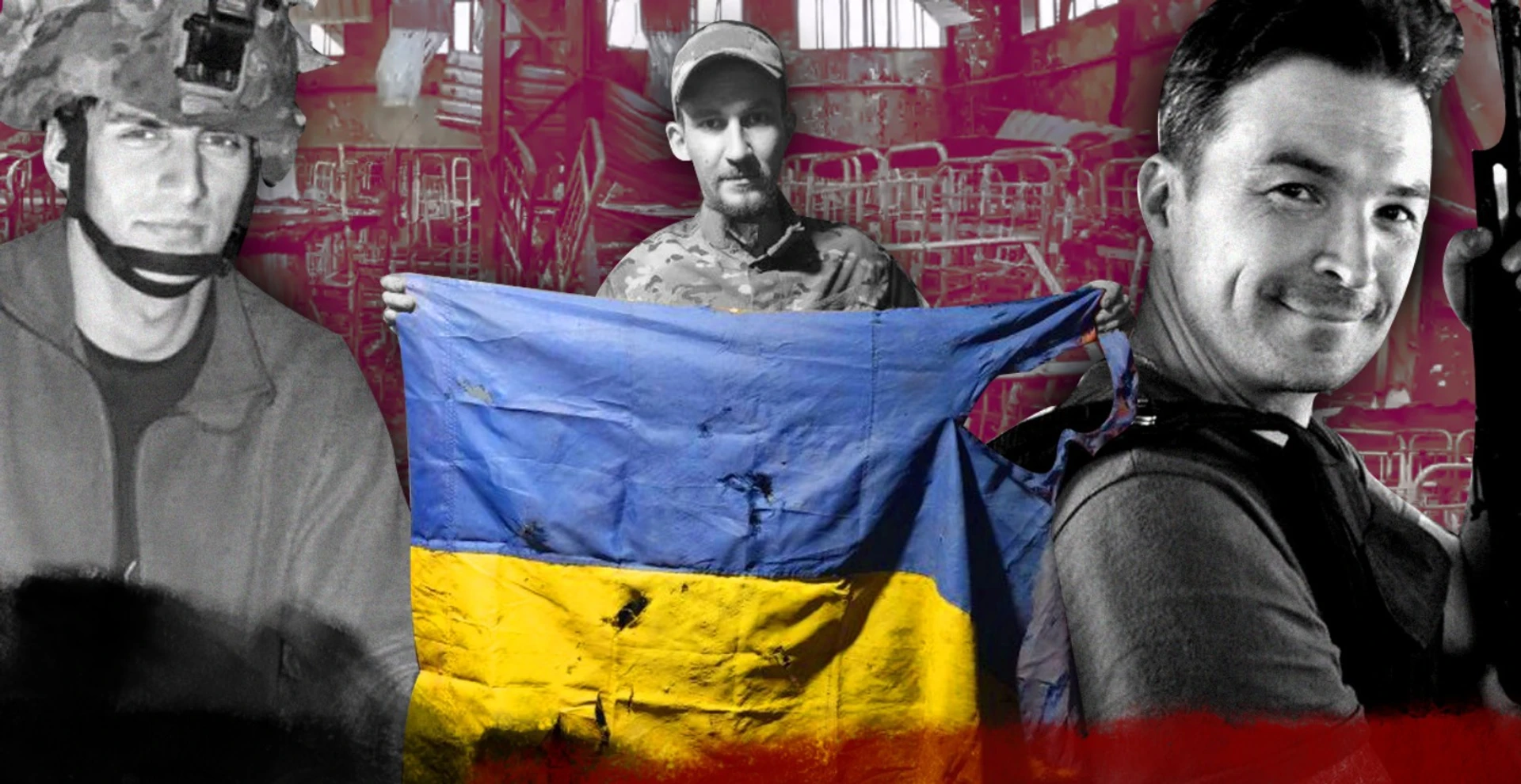
"Sometimes I think that Oleksiy is lying sick in captivity. Hope smolders in my soul." In memory of the Azovs killed in Olenivka
Source: Ukrainska Pravda
Author: Olena Barsukova
A year ago, on the night of July 28–29, the occupiers treacherously killed at least 53 defenders of Mariupol. The Russians blew up a barracks in Olenivka, where 193 Azov prisoners of war had been transferred the day before.
For several hours, the enemy prevented doctors from reaching the site of the attack—even those who were being held in Olenivka.
Later, propagandists published a list with the names of 46 killed, but the actual number of casualties was higher. Some of the wounded died on the way to the hospital.
After the tragedy, the grieving families were met with inaction from the ICRC and the UN—none of the “human rights defenders” arrived at the scene of the crime, and the mission was quickly disbanded.
In the fall, Russia returned the bodies of the victims, but most were in such a horrific condition that they could not be identified without DNA analysis.
Now the families of the Azov soldiers are asking the state to at least establish Days of Remembrance for those who died as a result of the terrorist attack.
"Ukrainska Pravda. Life," together with the "Association of Families of Azovstal Defenders," honors the memory of the heroes on the anniversary of the tragedy.
Here are just a few stories about them.
Oleksiy Kysilishyn, "Lev"
Oleksiy Kysilishyn—a soldier and animal rights activist from Mariupol—is now forever 26 years old.
The soldier’s story is told by his father, Oleksandr, with the call sign “Sarmat,” who nine years ago was sent to a “basement” in Horlivka for his pro-Ukrainian stance and joined the “Azov” battalion in 2015.
Father and son were best friends—together they defended Mariupol, fought at Azovstal, and surrendered on orders.
Oleksiy began serving before his father—at age 17, he joined the army without his family’s knowledge.
"In the summer of 2014, my son said, 'I’m going to Kyiv to apply to veterinary school.' Oleksiy was very passionate about animals; it was his lifelong dream. And then he sent me a photo from the Azov selection camp. Later, we served together in a mortar division,” his father recounts.
Oleksiy remained with Azov until the end of 2015, and when active combat operations subsided, he began working in animal welfare at a makeshift shelter in Mariupol and at the Wildlife Rescue Center in the Kyiv region.
During the full-scale invasion, Oleksiy was in Mariupol and decided to return to Azov. His father told him to take his family and leave, but the young man was categorically against it—he was eager to join the fight.
“Starting on February 24, there were times when we wouldn’t see each other for a month because we were in different sectors. But the rest of the time, we were together. I constantly asked through mutual acquaintances how my boy was doing,” his father recalls.
After March 6, father and son moved to the left bank of Mariupol and actively participated in the fighting, holding back enemy tanks and armored personnel carriers.
Oleksii had about 15 people under his command, even though he was just an ordinary soldier. “Sarmat” recalls that during the defense of Mariupol, ranks didn’t matter—only actions did.
“Oleksiy’s call sign was ‘Lion’ because he’s a Leo by zodiac sign, and at home we always called him Leva. The commander of the first battalion, “Sukhar,” whose heart gave out after he was taken prisoner, once told Oleksii: ‘It’s no coincidence that you chose the call sign “Lion,” because you fight like a lion.’
I respected 'Sukhar' very much. That was the highest praise for me as a father," says Oleksandr.
During the defense of the left bank, Oleksii’s back gave out due to the heavy strain—he couldn’t stand or walk, so he was taken away for treatment. During this time, many fighters died at the front lines, and “Lion” blamed himself for having survived.
As the encirclement around Mariupol closed in, the fighters retreated to the Azovstal steelworks, which became their stronghold. Father and son continued to carry out combat missions, delivering food, water, and fuel for generators to the front lines.
On May 11, Oleksiy was once again a hair’s breadth from death—a Russian aerial bomb struck the “Store 10” bunker.
“I will remember this day for the rest of my life, just like a birthday. It was the first time I cried. There was smoke and fire. We were helping others escape and couldn’t see each other.
I lost track of Oleksiy and thought he had burned alive in that bunker, and he thought the same about me. Then, a few hours later, I was told that my boys were under the blast furnaces, alive,” recalls the father.
The soldiers retreated to another bunker, and on May 16–17, the commander of “Redis” announced an agreement on their withdrawal.
“Denis Prokopenko is a man of such authority that if he had come and said, ‘That’s it, guys, we’re going into our final battle,’ we would have followed him—to hell or to heaven. He said, ‘A difficult decision has been made; we are going into captivity.’
There was an agreement that the Red Cross would be present and that the Geneva Convention would be observed. We carried out the order,” says “Sarmat.”
The defenders of Azovstal began to leave gradually, because in addition to Azov, there were marines, patrol police, and border guards at the plant—a total of over 2,000 fighters.
Oleksiy and his father left on May 18, and two days later they were sent to Colony No. 120 in Olenivka. The men lived together in a barracks housing over 200 people.
“On the morning of July 27, I was transferred to the Donetsk pretrial detention center, while Oleksiy and some other guys were taken to an industrial hangar where equipment used to be repaired. It was blown up on the night of the 28th into the 29th,” says his father.
On the same day, “Sarmat” learned about the explosion, and in mid-August, an old friend of his was placed in the same cell and confirmed the news of his son’s death.
"I still had hope that he was mistaken. But when they were taking us for the exchange, they said it was definitely true. I was released from captivity with the guy who pulled him out of that barracks and tried to administer first aid. They pulled Oleksiy out and tried to stop the bleeding, but there was nothing they could do.
And these guys (the occupiers—ed.) were standing nearby, laughing and pointing their fingers. The first medics, our captured soldiers, showed up an hour or an hour and a half after the attack. They simply weren’t allowed in. Although the whole area was buzzing after the explosion, no one was sleeping. Everyone heard our boys’ screams,” says Oleksandr.
On September 21, “Sarmat” returned to Ukraine as part of one of the largest prisoner exchanges, and in October, the Russians returned his son’s body.
In February 2023, the animal welfare organization UAnimals posthumously awarded Oleksii Kysilishyn the first “All-Ukrainian Animal Welfare Award.”
His parents were presented with the award and promised that after the de-occupation, there would be an animal welfare center in Mariupol named after their son.
“Oleksiy was determined and stubborn. At the same time, he was very kind. Especially when he was helping animals,” notes Oleksandr.
In the yard of their home in Mariupol, the young man set up a shelter for rescued animals, including exotic pets. He also had his own dog.
“He would go out to lakes and rivers to rescue animals and birds. We had foxes, swans, puppies, and owls in our yard. Once he went to rescue a jackal that had gotten lost in Mariupol.
But he was most fascinated by snakes and spiders, for which he set aside a separate room. To be honest, I hardly ever went in there,” his father recalls.
For a while, Oleksiy worked as a keeper at Natalia Popova’s Wildlife Rescue Center. On the same grounds, at the “Magnat” equestrian sports complex, worked a girl named Viktoria, with whom Oleksiy fell in love.
Even at Azovstal, Oleksiy tried to save animals, sharing his last bits of food with them. Also, a few days before his release, he proposed to his beloved Victoria via text message.
“I told him, ‘Come back, I’m really waiting for you, and we’ll figure everything out together.’ “Even though we hadn’t met in person, we had so many shared interests. We were very close friends,” says Viktoria.
Oleksiy didn’t have any children, but after his release from captivity, he wanted to become a father as soon as possible. Unfortunately, even his “four-legged children” didn’t survive the war.
“The dog died back in March. We gave her to the shelter run by the Ukrainian Kennel Club, to the head of the Mariupol branch. Now that monster has switched sides to the Russians and has already forgotten that she is Ukrainian. According to her, there was an airstrike on the shelter and all the dogs died.
We released the fox into the wild because we had no other choice. But the spiders and snakes, unfortunately, froze to death—the electricity and gas had been cut off. “We managed to treat and release the swan, Oleksiy,” says the father.
The man still cannot accept his son’s death and sometimes wonders if the DNA test was wrong.
"Sometimes I think that Oleksiy is lying sick in captivity. Hope still flickers in my soul, even though there are witnesses…
Right now, my greatest wish is for some girl to come forward and say she has a child by Oleksiy. I would do anything for them,” adds the father.
"Sarmat" returned to active duty in February and plans to fight until victory, until the Ukrainian flag flies over Horlivka. In March, he buried his son in the Chernihiv region.
"Ironically, Oleksiy died in Olenivka, Donetsk Oblast, but was buried in Olenivka, Chernihiv Oblast. I had been planning to move there for a long time after finishing my service. I will be close to Oleksiy,” says his father.
Serhiy Petrenko, “Bashnya”
Serhiy Petrenko, call sign “Tower,” was a patriot and soldier from Kyiv who died a month before his 26th birthday.
“Tower” joined Azov in 2017, right after graduating from university. During his student years, he attended patriotic lectures and preparatory courses, and then went to take the physical fitness test for Azov.
He failed the first time due to pneumonia, but after treatment, he became a mortar operator—standing at 195 cm tall, he was immediately accepted for this position.
In his final year, Serhiy worked as an instructor at the Yevhen Konovalets Military School. Nine months before the full-scale war began, he met the love of his life—32-year-old Olya.
She worked in kindergartens, had been helping Azov soldiers since 2014, and last year became a co-founder of the “Association of Families of Azovstal Defenders.” Olya recalls the romantic story of how they met:
“Serhiy was participating in a CrossFit competition. I came with my dog to support my friend Piston and met him. You could say that my dog Viking introduced us. While I was talking to my friend, my dog had already started playing with Serhiy’s ball.
It was love at first sight. We had been together for nine months before the full-scale war began. Once I asked him if we were dating, and he said, “Olya, I’m going to marry you.”
“The Tower” had been defending Mariupol
since February 24, taking part in street battles. On March 25, his friend “Piston” (Maksym Kagal) was killed, and Serhiy was wounded.
“From what I’ve heard from acquaintances, Serhiy fought with great honor in Mariupol. As they say, he ‘gave it his all.’ Then he was wounded in his right foot. They treated him at the Azovstal field hospital.
At first, he didn’t tell me about the injury; I found out from his friends. He didn’t complain at all—he just said he felt bad because the guys were fighting and he needed to be with them, but because of his injury, he couldn’t run,” says Olya.
Right after the fighters withdrew to Azovstal, the couple communicated frequently, but in April, Starlink signals became increasingly scarce, and the Russians were pounding the plant with everything they had. The connection was unstable—Serhiy could only message Olya once every 7–10 days.
They planned to evacuate the wounded Serhiy from Mariupol by helicopter during evacuation flights, but that flight never took place. However, the only thing that upset “Bashnya” was that he couldn’t fight.
“It meant a lot to me that Serhiy didn’t overreact or get worked up. He constantly reassured me that he would return and our plans for the future would come true. We dreamed of living in a little house in the woods somewhere in the Carpathians after the victory, and of traveling a lot.
We discussed in our messages what our children would be like (whether they would be as tall as he was), what our grandchildren would be like. “We always planned for the future during the hardest, darkest times,” says Olya.
Serhiy wanted to live in Ukraine, but he looked up to the U.S. Marine Corps. At Azovstal, he wrote Olia a huge list of what he needed to buy in terms of uniforms and lost equipment.
“He said, ‘It’s very important for me to know that my gear is waiting for me at home.’ And, of course, I started ordering uniforms from America,” Olia recalls.
The day before leaving Azovstal, Serhiy wrote that he didn’t want to leave, but Olya persuaded him to save his life.
“He wrote that he would go only for the sake of our love. When he got in touch from Olenivka, we just exchanged the words: ‘I love you, I’m waiting.’ He wished me a happy birthday on July 18, 2022. Eleven days later, my life ended when his heart stopped as a result of a terrorist attack,” Olia says.
On July 29, the young woman was in the hospital because her friend’s partner, who was also being held captive, had gone into labor. Olya’s phone started ringing off the hook; news of the attack appeared in the Azov chat rooms.
“When they posted photos and videos, everyone was looking through them, searching for their loved ones. There were horrific images of burned bodies on beds, and it was hard to tell who was where. Rashka posted the only list on her Telegram channel. To this day, this list has not been confirmed by either side, but in principle, it matches the DNA tests.
I saw my Serhiy’s name on the morning of July 30. “I fell to the floor, cried uncontrollably, and everything just stopped; I felt numb inside,” Olia recalls.
For the first three days, there was no confirmed information, and the ICRC was simply ineffective—even though it was supposed to guarantee the prisoners’ safety.
Until September, the young woman convinced herself that a mistake had been made and that the list couldn’t have been compiled so quickly. But after the exchanges, Azov fighters confirmed that they had witnessed Serhiy’s death.
In October, the Russian side handed over the bodies. Among the dead were several prisoners who had been considered wounded. When the first DNA match appeared, her hopes faded.
Olya saw a photo of her beloved and identified him at the morgue. But Serhiy has not yet been buried, as the family is waiting for a second DNA analysis.
"Serhiy is the best thing that has ever happened in my life. He is a reliable friend and brother-in-arms. Even though he was serious and stern in public, he had an incredibly kind heart, and he really opened up in our relationship. Even while at Azovstal and when he got in touch from captivity, he always asked about me and emphasized that he loved me very much, that everything would be okay.
I don’t like it when people tell me that life goes on and I’ll have new relationships. Serhiy is my life and my universe. I am certain that there will never be another man by my side,” Olya shares.
Addressing civilians, the young woman asks them to remember the heroes of Mariupol.
"Hundreds of thousands of people have lost their partners and loved ones so that we could live in a free Ukraine. For people like me, life ended when my beloved died. There is only existence.
But Ukrainians should live with as much dignity as possible, support the military, and remember the price paid. And live so that all of this was not in vain,” the young woman says.
Now, “Bashnya’s” fiancée is doing everything she can to bring every Azovstal defender home from captivity.
“For Serhiy, Azov was like a second family. I want them to survive and return home as soon as possible.
And if other worlds exist—I dream of meeting Serhiy," adds Olya.
Dmytro Krukovskyi, “Electrician”
38-year-old Dmytro Krukovskyi was born in Bila Tserkva. He loved sports from childhood and practiced track and field, but then suffered a knee injury, so he was unable to continue training.
In 2001, Dmytro enrolled in the Institute of Computer Technologies at the National Aviation University, majoring in programming. Until 2014, he worked as an auto electrician and was on a first-name basis with technology.
The soldier’s sister, Lyudmila, recalls that her brother was interested in cars and could fix things that no one else could. He also had a keen sense of justice and a kind heart.
“Dima was very kind, had lots of friends, was always there to help everyone, and the girls loved him. He was quick-witted and had a knack for fixing things.
In 2007, he got married, and a year later his daughter Anastasia was born, but after nine years, he and his wife divorced. When the Maidan protests began, he volunteered. Dima didn’t do his mandatory military service because of his knee, and when he decided to join the ATO, he really wanted to be in the ‘Azov’ unit,” says Lyudmila.
Dmytro wasn’t accepted for a combat position because of his bad knee, so he began serving in the repair company—that’s where he got the call sign “Electrician.”
Together with the engineering team, he developed a multifunctional “Buggy” and repaired military equipment on the front lines.
After his contract ended, he stayed in Mariupol. He met the love of his life and started his own business.
“The couple decided to go into business: they bought apartments, renovated them themselves, and rented them out. His girlfriend worked with furniture, and Dima himself was very handy.
When he arrived at the end of September 2021, he said, ‘Let’s finish the apartment, and then we’ll relax and enjoy life.’ We planned to go on vacation in March. Unfortunately, it didn’t work out,” Lyudmila says.
On February 22, Dmytro warned his family that an attack was likely imminent. His comrades called “Elektryka” back to duty, and he himself wanted to serve with his men again; he had great respect for “Redis” and the Azov command in general.
Starting February 24, he was in the village of Sartana, and then in Mariupol. Once a week, he called his family to reassure them.
“Dima said he was alive and was able to send a few videos from Sartana or Mariupol. These were very short and infrequent calls, because he had to travel 40 minutes from his position to make a call.
We talked more when they ended up at Azovstal. He was very upset that his friends were dying. When they went on missions, he told me they’d get out of tough situations and come under fire. He said the guys from Azov were doing the impossible.
And when asked about the situation, he always joked it off. He never lost heart,” his sister recalls.
“Elektrika” stayed in Mariupol to be close by, but the couple couldn’t manage to see each other.
They met for the last time on February 26, when Dmytro and his comrades brought her drinking water. When they spoke on the phone at the end of April, it was the happiest day of Dmytro’s life, his sister says.
The defenders of Azovstal held their ground for three months under constant enemy fire, amid shortages of medicine, water, and food. The cooks tried to make soup or pasta from whatever food was left. One of the tastiest dishes for Dmytro Krukovskyi was “paska”—a flatbread baked in the basement on Easter.
"The Electrician" said that the hospital was short on medicine and there were many wounded.
Before leaving, Dmytro wrote to his mother that they had been promised good conditions, food, and a release within 2–3 months, but that there would be no contact with him. The family hoped for assurances that his life would be spared.
“We were more or less at ease knowing he had saved his life. He appeared in many videos and photos on the bus. We were worried, but there was a sense of calm because we could see he was okay—we just had to wait.
Then, from Olenivka, he called several times late at night. He said he was fine and that he loved everyone. On July 10, he called again and said we’d see each other soon. He would call just before the exchange. We were really looking forward to it. There were no exchanges. And then this news…” – Lyudmila recalls.
Lyudmila’s family didn’t know if the lists of the dead were true. The Azov support service did everything possible to help the families, but international organizations provided no information.
"When the guys were leaving Azovstal, the Red Cross was there, and they filled out forms for everyone so they could be identified. But as it turned out, those forms were lost, and many of the guys weren’t even on the Red Cross lists.
They worked very unprofessionally. My brother hadn’t been identified by the Red Cross before the attack, even though he was in all the videos and had filled out everything. And this is the situation for many,” says Lyudmila.
Her sister tried to recognize her brother in photos or videos from Olenivka, but there were several guys there with similar builds. Also, Dmytro didn’t have any tattoos.
Back in September, when some of the Azov fighters were released from captivity, Lyudmila received a call from a fellow fighter named “Elektrik.”
“He had been with Dima in Azov since 2015 and saw that Dima had definitely been killed. He was right in the epicenter of the explosion. He was lying on a cot next to their commander,” the woman says.
After the attack, Lyudmila was in a state of depression, but she didn’t tell her mother, who has a heart condition, about the tragedy until the very end.
On June 7, Dmytro Krukovskyi was buried in the Alley of Heroes in Bila Tserkva. The soldier’s sister continues to fight for every prisoner.
Yevhen Pashnyuk-Pashnev, “Zhim”
Yevhen Pashnyuk-Pashnev was born in the village of Velyka Oleksandrivka in the Kherson region. He had a younger sister, who is now 18, and a brother who also became a soldier.
"Zhim" served for nearly 11 years and died a year before his 30th birthday.
"My husband says there will never be another child like Zhenya. At a year and a half, he was talking; at five, he was reading. He was very smart, did well in school, and joked around with everyone.
As a child, he loved books—he read everything by Jack London and adored *Tom Sawyer*. He started writing poetry and getting into music during his college years, when rap was really popular,” recalls the deceased’s mother, Natalia.
After finishing school, Yevgeny joined the Internal Troops and served in the National Guard in Kherson. He worked night shifts, spent some time training dogs, and raised his four-legged friend, Baks.
Whenever someone suggested he leave the service, Natalya’s son would always joke that he had “military metastases in his head.”
In the fall of 2021, "Azov" announced a recruitment drive. Before the full-scale invasion, in January 2022, Yevgen passed an interview and soon found himself in Mariupol. The soldier was very proud that “Radish” himself had shaken his hand.
“He said, ‘Why didn’t I go there sooner? Mom, the guys there are so cool—I’d follow them through fire and water.’ I’ve always been proud of him,” recalls Natalia.
On the morning of February 24, Yevhen called and told his mother to leave, and to destroy all his military belongings.
Natalia wanted to wait for her children at home, but her native village was quickly occupied.
When the searches began, Natalia decided to leave and take her 17-year-old daughter with her. Fortunately, no one in the village knew that Yevhen was in the Azov Regiment, but then the Russians began searching for his younger brother, who was studying at the Kharkiv Military Academy.
The family moved to Kryvyi Rih and occasionally received news from Yevhen. He told them how the Azov fighters helped civilians, giving away their last Snickers bars and water.
At Azovstal, Yevgen proposed to his girlfriend Angelina, whom he had known since childhood. Angelina planned to move to Mariupol to be with her beloved, waited for him to be released from captivity, and attended rallies organized by the families of Azovstal defenders.
Yevhen had previously planned to move abroad, but in March he told his fiancée that he wanted to live only in Ukraine.
"I’m not leaving here. I’ll defend it to the very end—those were his words. At Azovstal, he told me: ‘We have a prisoner, so we drag him around with us everywhere; there’s nowhere to leave him. We feed him; I give him a cigarette to smoke.”
“I told him, ‘Son, they’re Russians,’ because I’d already seen what they’d done back home. But Yevhen was so kind-hearted; he couldn’t have hurt anyone on purpose. And what they did to him in captivity…”—Natalia’s voice breaks.
On April 6, Yevgeny went on Instagram and posted a selfie—now it’s the only photo from Azovstal that the family has left.
Before leaving the steel plant, he called his parents and gave them the order to “raise his sister Nastya like a princess.”
“He said, ‘Don’t hurt my little fly.’ Nastya and Yevgeny are 12 years apart, but they were always on the same wavelength. She went with me to all the protests and took it very hard,” adds his mother, Natalia.
Also, thanks to a video on TikTok, Yevgeny’s family saw how he helped save a fellow soldier.
The mother of another soldier made a video about her wounded son—showing how an unknown Azov soldier helped carry him as they were leaving Azovstal.
In this video, Natalia recognized her Yevgeny.
"This boy was exchanged on June 29; he’s from Kryvyi Rih. He said that in March, his legs were shot through. They didn’t heal properly, so he couldn’t even stand. Some man was carrying him out, but he hurt his own leg and couldn’t carry him anymore.
And, he says, an Azov soldier ran past me. Without a word, he picked him up, slung him over his shoulder, and carried him away,” says Natalia.
While in captivity, Yevgeny called his girlfriend and parents, kept everyone’s spirits up, and repeated like a mantra, “They don’t beat us, they don’t torture us.” The last time Yevgen spoke with his parents was on June 20—he asked his sister to apply only to the school she wanted to attend.
“Zhenya never asked for anything in his life, never complained that he was suffering. And then he tells me, ‘Mom, I really want some cookies. Remember, Grandma used to bake those ‘triangles’ for me with kefir. I want them so much.” I still can’t get those cookies out of my head...
It hurts the most when they say the boys surrendered. But they would never have surrendered in their lives; they came out on orders. Zhenya told me that everyone has one bullet for themselves,” recalls Natalia.
On July 29, the mother learned about the attack from social media—she ran out of the minibus and started crying. The next day, Angelina’s mother called her in tears and said that Zhenya was on the list.
The first DNA match was in February, and the second was confirmed on June 22.
Yevgeny Pashnyuk-Pashnev was buried at the Berkovets Cemetery in Kyiv alongside three fellow soldiers from Kherson who had transferred to the Azov Regiment at different times.
“Zhyma’s” mother is fighting to establish Days of Mourning and Remembrance for those killed in Olenivka on July 28–29.
Dmytro Bukaryov, “Bilotur”
Dmytro Bukaryov was a former SBU officer who fought with Azov starting in December 2014, defended Azovstal, and died at the age of 51.
Dmytro grew up in Cherkasy with his sister Lada from the age of two. He studied at the Naval Department of the Baltic State Technical University in Russia and received his second higher education last year at the National University of Defense of Ukraine.
In Cherkasy, he worked as a design engineer at the Fotoprylad manufacturing plant. In the late 1990s, he took the oath of office and served in the SBU until August 2005.
After that, “Bilotur” tried his hand at various professions: engineer, head of security, and journalist. When the Russians occupied Crimea in 2014, he couldn’t stand idly by.
“Dima immediately submitted an application to rejoin the SBU. He argued that the country now needs such experienced specialists. But there was some chaos in the Security Service at the time; his application was lost, so he joined the “Azov” regiment—which was then a brigade—as a regular private. When "Azov" became part of the National Guard, Dima was reinstated to the rank of major," his sister says.
Dmytro Bukaryov chose “Azov” for its ideology, as well as because many Rodnovers served there—the soldier had studied various religions for a long time, became fascinated with Rodnoverie, and took the corresponding name—“Bilotur.”
Dmytro had been fighting since December 2014; he became the commander of the artillery unit within the battalion tactical group and participated in the Shyrokyne operation.
Lada recalls that what her brother valued most about "Azov" was the mutual respect among all soldiers, the sense of brotherhood, and the adoption of "NATO" standards instead of the Soviet "military culture."
Dmytro shared his love for his unit on social media:
"How did I end up at war among the volunteers? Having been educated in Russia and understanding Russians to some extent, I knew as early as the 1990s that a war between Russia and Ukraine would happen. I also knew I couldn’t stay on the sidelines of these events, because I love my land, my country, and my daughters…
I ended up in the Azov volunteer unit, which I’m very happy about. Because here, true military tough guys have gathered in the best Cossack traditions,” wrote “Bilotur.”
In recent years, Dmytro lived mostly in Mariupol, but he continued to help his family and called them often. From the start of the full-scale war, he immediately took up the defense of the city.
The soldier never complained; he only joked and tried to reassure his family, even when ammunition was scarce and he could only manage half a cup of oatmeal a day.
Dmytro celebrated his 51st birthday at Azovstal. Lada adds that her brother was ready to fight to the very end. When the fighters left the steel plant, Dmytro sent his sister the geolocation of the detention center and never got in touch again.
“Dmytro didn’t write or call from captivity. It was dangerous, first and foremost, for the prisoners. When a relative spoke publicly about receiving a call, the prisoners paid a heavy price for it. And Dima knew that this was a risk both for him and for his family,” Lada explains.
"Bilotur" was the deputy commander of the artillery unit of the National Guard’s "Azov" special forces detachment, so his relatives hoped that he and the rest of the command staff might have been taken directly to Russia. But after seeing the photos of the body, Lada lost hope.
“When I saw his last name on the list of the dead, at first I cried for a very long time, then I started convincing myself that he couldn’t have been in that barracks. In September, when a few people were released, they confirmed to me that Dima had been there.
And then came that blow again. The ground fell out from under my feet, and I started to panic. I lived on hope until the first confirmation, then until the second. When I finally looked at the photo of the body myself, I recognized him. And then, unfortunately, there was no hope left,” recalls Dmytro’s sister.
Dmytro is survived by his 20-year-old daughters, his mother, his sister, and his nephew, who is also on the front lines.
“I named my son Dmytro after my brother. I always wrote that my only dream was for both Dmytros to return alive. Unfortunately, we have already lost one Dima. Many of his comrades remain in captivity under horrific conditions, with no communication. I would like our government and the international community to do everything possible to bring them home.
Our community of families in Olenivka also demands that the investigation into the terrorist attack be reopened, because, unfortunately, the case has been closed. But crimes that go unpunished breed even more evil,” Lada emphasizes.
Dmytro Bukaryov was buried in Cherkasy on July 8.
“He was such a bright person. He took care of his mom, me, my son, and his daughters. He did all his good deeds just because, not for praise. He gave attention, kindness, and care just because. When the first prisoners were released, the guys also said that he was like a father to them, teaching them everything.
It’s so precious to have a loved one who’s always there for you, who gives you advice, who loves you unconditionally. “I still don’t know how to go on without him,” says Lada.
This is an automatic translation generated by DeepL.