"I miss his fried potatoes and the word 'kitty': 5 stories about lovers who were separated by captivity
Source: Ukrainska Pravda
Author: Olena Barsukova
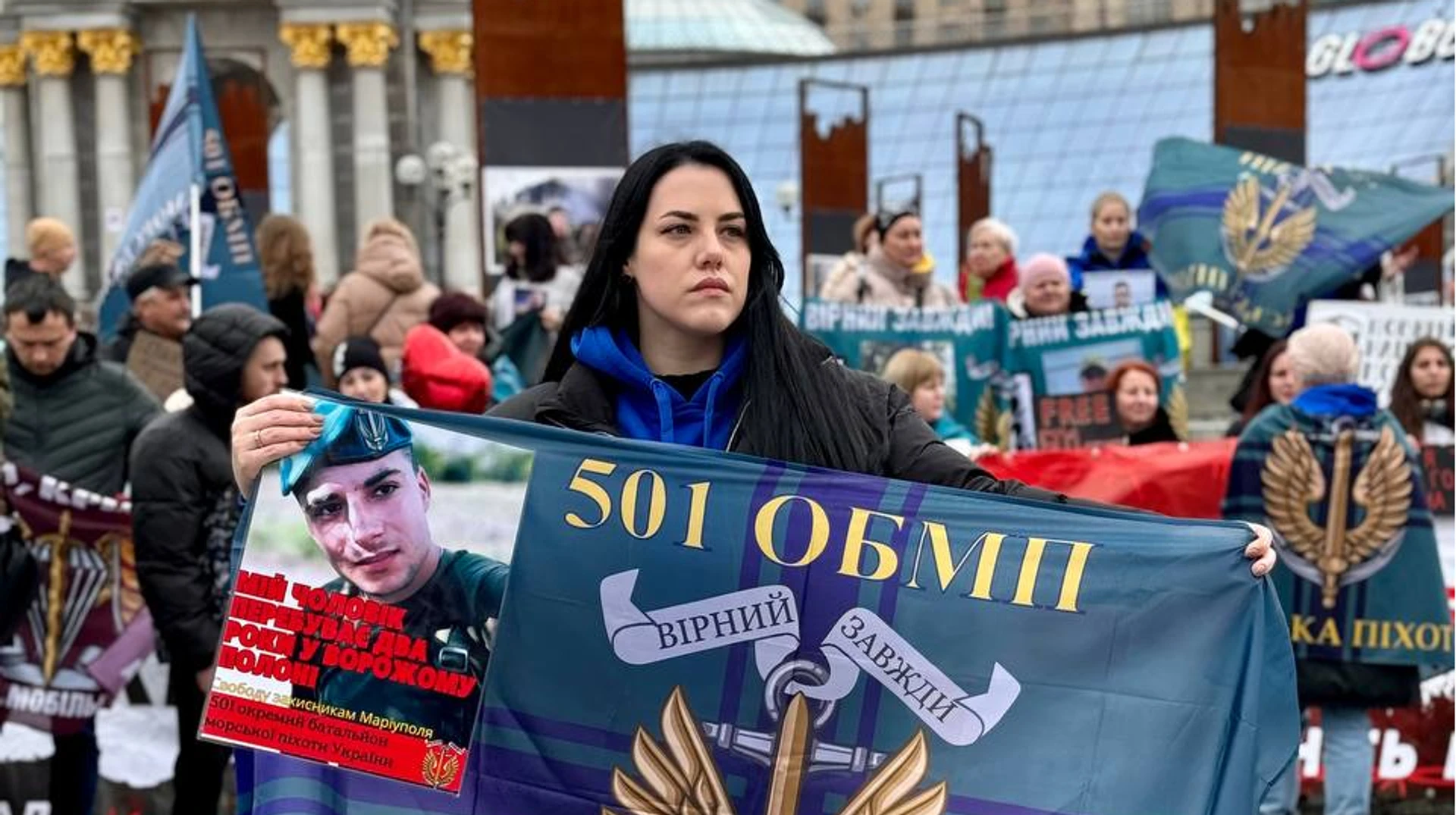
Hearing a loved one’s voice on the phone, “introducing” a newborn baby to his dad, hugging him and smelling his familiar scent… All of this is a tremendous luxury for the wives of the captured defenders of Mariupol, as they have been living apart for three years.
More than 2.5 years have passed since April 12, 2022, when the largest number of fighters from the 36th Separate Marine Brigade named after Rear Admiral Bilinsky were taken prisoner.
A little earlier, on April 4, soldiers from the 501st Separate Marine Battalion, who also participated in the defense of Mariupol, were taken prisoner.
Since then, hundreds of soldiers have found themselves in various parts of Russia and in the occupied territories. For three years now, the Russians have been torturing them, trying them on trumped-up charges, and killing them.
Meanwhile, the defenders’ families are coming together in civic organizations, raising children, developing their communities, and fighting for the captives despite despair, fear, and a lack of understanding from society.
Sometimes, letters containing declarations of love, poems, or even just a brief “I’m alive and well” bring comfort to these women. But not all prisoners are allowed to correspond.
“Ukrainska Pravda. Life" tells the stories of five wives of marines about their third year of separation, news from captivity, their struggle, and everything that gives them the strength to hold on.
"For you, my little moon"—that’s how Marine Leonid Bulava signed the portrait of his fiancée Svitlana, drawn while in captivity.
The drawings and letters are the only solace for 28-year-old Svitlana, who has been waiting for her beloved to return from captivity for three years.
The families of the captured defenders of Mariupol usually do not receive letters, so Svitlana is relatively lucky. The price of this “privilege” is a sham trial and an illegal sentence.
On November 11, 2024, the occupiers “sentenced” Leonid Bulava to 15.5 years in prison. He and seven other mortar gunners from the 501st Separate Marine Battalion were accused of “destroying critical infrastructure” in Mariupol and “cruel treatment of civilians.”
But more on that later.
Svitlana and Leonid met in 2018, and they haven’t been apart for long since then. The girl is from Mariupol, and her boyfriend served in Berdyansk, so she lived between two cities.
"I understood that a relationship with a soldier means constant separation, but when you fall so deeply in love, you accept everything. I stood by him like a rock. In 2021, he proposed to me, and we planned our wedding for 2022. I picked a venue by the sea, a dress...
My mom jokes that I’ve ‘been stuck in the fiancée phase’ for too long, but I hope we’ll fix that soon,” the woman says.
When Russia launched a full-scale war, Leonid was in Shyrokyne, and Svitlana was in Mariupol. He immediately told his fiancée to evacuate to a safe place, so she left for the Ternopil region with her mom and younger brother.
The Marine tried to call his fiancée for at least a few minutes, but once he went off the grid for a week. Svitlana was terrified and couldn’t tear herself away from the phone. At the time, she had no idea that the hardest part was yet to come.
"When they were at the Illich Plant, he just said, 'I’m alive, everything’s fine.' I couldn’t get any details out of him. He last called me on March 26, the day before my birthday.
He said, ‘Darling, I’ll call you tomorrow, I’ll find a connection, I’ll get in wherever I can.’ But on March 27, the network went down along the entire Azov coast. I haven’t heard his voice since then,” the woman says.
On April 4, a video appeared on Russian social media—267 marines had been taken prisoner at the Illich Plant. Among the soldiers in the video, Svitlana recognized her husband.
In the first few months after that, Svitlana didn’t want to get out of bed and just cried. She first heard news about her beloved when a young man who had spent six months in the same cell with him returned from captivity.
“When that young man called, tears poured down my face. He told me they had been driven all over Russia. In Taganrog, they were constantly interrogated, beaten very badly, had dogs set on them, and were tortured with stun guns. He even joked, ‘After all this, we could become electricians.’
But he told me that my
husband was holding on. And I realized that I have to become even stronger," says Svitlana.
According to information Svitlana learned from other marines, her husband was held in Olenivka in the occupied part of Donetsk Oblast, in Taganrog in Rostov Oblast, in Bryansk and Vladimir Oblasts, and then in Donetsk.
In April 2024, it became clear that Leonid was “under investigation”—he was transferred to the Donetsk pretrial detention center.
Although the Geneva Conventions provide for the right of prisoners of war to communicate with their families, the Russian Federation effectively grants this right only to those who have been unlawfully convicted. Svitlana learned from the mother of another prisoner of war that she would be able to correspond with her husband if she sent him the forms on which he would write.
"In his letter, Lyonya asked if I had changed my mind about getting married. He also said he’d been thinking about ‘letting me go’ so I wouldn’t waste my youth, but I scolded him for such thoughts. I constantly remind Lyonya that I love him very much and will wait for him, no matter how much time passes.
I collect all the letters he sends me. We’ve joked that we’re writing a story for our grandchildren and great-grandchildren, so they can one day read about how Grandma waited for Grandpa to return from captivity. Although when I say that, I still can’t quite believe that I’m that grandma,” says Svitlana.
Since 2022, there has always been a packed bag in Svitlana’s hallway in case she has to quickly meet Leonid after an exchange. She buys her husband new clothes for every season and looks forward to their reunion. The Marine’s large family—his parents, brother, and sisters—is also waiting for him at home.
The young woman shares that she feels pain after every exchange when her beloved isn’t on the lists. But it becomes even more painful when she has to reply “no, he wasn’t exchanged” to dozens of messages from people.
Yet despite the emotional ups and downs, Svitlana fights against despair: she is pursuing a second degree in psychology, attends yoga classes to relieve emotional stress, and constantly raises awareness about prisoners of war at weekly rallies in Chernivtsi, Ternopil, and Kyiv.
"The first year, I wasn’t really living—I was just existing. But at some point, my mom said, ‘Pull yourself together; it’s much worse for him there—you have to fight for him.’ And something just clicked for me. I started going to meetings at the Coordination Headquarters, to rallies, and began looking for any information.
In his letter, Lyonya wrote that he felt my love and support. Even when he thought he wanted to die, some unknown force saved him. And I realized that I hadn’t held myself together for nothing. I’m sure the guys there feel that we’re fighting.
When Lyonya comes back, I’ll cry on his shoulder. I can picture hugging him, breathing in his scent, and being the happiest person in the world. But for now, I’m a strong girl,” says Svitlana.
Anna Bey met her beloved Pavlo in Zaporizhzhia 10 years ago, when she was 17. And although it wasn’t love at first sight, Pavlo’s sense of humor and kindness won Anna’s heart.
Now she is raising their 8-year-old son, Danil. But Pavlo couldn’t take the boy to his first day of school because he has been held captive for over 2.5 years.
“I’ve learned to hide my tears from my child. When it gets too much, I leave the house, cry it out, and then come back. I tell my son that his dad will definitely come home,” Anna shares.
Her husband, Senior Seaman Pavlo Bey of the 501st Marine Infantry Battalion, participated in the defense of Mariupol from February 24 to April 4, 2022. For over a month, her husband carried out combat missions in the city, but in early April he received an order to move to the Illich Plant.
Pavlo wrote to Anna that he dreamed of having a second child and would definitely return home, and then contact was lost. Like many other wives of marines, Anna learned of his capture through social media.
"I didn’t see my husband in the videos the Russians were posting, and I didn’t understand what was happening. In Russian groups, I saw a photo of a dead young man who looked very much like Pasha.
I barely calmed down by evening when I saw that the young man wasn’t my Pasha after all. So I just waited,” the woman recalls.
Pavlo wasn’t on the internal lists of the dead and wounded, so Anna believed her husband was alive. That belief and her young son by her side helped her hold on. Only after 4.5 months of uncertainty did the International Committee of the Red Cross confirm that Pavlo was being held captive.
When other marines began returning home, Anna learned about the brutal treatment of prisoners of war in Russia. In the prison camp where Pavlo was held, prisoners were tortured with electric shocks and forced to stand for 16 hours a day.
In January 2023, Anna was told that her husband had been seen in the Tula region. And in 2024, a man who had shared a cell with Pavel in Mordovia returned from captivity.
Mordovia is “notorious” for its penal colonies with extremely harsh conditions for prisoners—the bodies of marines tortured in this region have been returned to Ukraine on multiple occasions.
"Several people from our group of eight prisoners were in Mordovia. They were forced to stand for at least 16 hours. They were only allowed to sit down during meals. But you can imagine what the food was like there, considering that my husband weighed 95 kg before his capture, and by May of this year—about 60 kg at a height of 1.88 m.
My husband was the tallest in the cell, and he had the most severe problems with his legs. He’s doing a little better now, but he still has plenty of issues. His teeth are falling out, he has varicose veins, and problems with his right hand. “In September 2022, it was broken, and it started to fester, but my husband wasn’t given proper medical care,” says Anna.
After extracting a “confession” from Pavlo, the Russians transferred him to the Donetsk pretrial detention center. In May 2024, Anna saw him in a photo for the first time in 2.5 years.
In the gaunt and exhausted man, who looked much older than his age, Anna recognized her beloved. It turned out that Pavlo Bey, like Leonid Bulava, is one of eight mortar gunners whom the Russian Federation is trying on trumped-up charges.
“The charges they’re facing are simply absurd. The Russians forced them to ‘confess’ to ‘cruel treatment of civilians.’ And I remember an incident from March when my husband called me and said, ‘We’re going from house to house, and I’m just begging people to leave because there will be fighting here,’" Anna comments.
On November 11, 2024, a Donetsk “court” handed down an unlawful sentence to Pavlo—15 years and 3 months in prison. The only benefit of Pavlo’s new “status” was the ability to correspond with his family.
“At first, he was pessimistic, depressed. In one of his letters, he suggested we get a divorce so I wouldn’t wait for him. He wrote, ‘At least you should live.’ I burst into tears and replied that there would be no divorce while he was in captivity. I’ll wait for him, and then he can decide. After that, he said the opposite—that he would carry me in his arms when he returned.
“I sent Pasha photos of our little one so he could see him for the first time in 2.5 years. Our son has come to look even more like him,” the woman says.
Despite the joy of receiving letters, the nearly three-year separation hurts Anna deeply. And little Danylo misses his dad—he constantly imagines skating with him and building a treehouse.
Anna regularly attends events to raise awareness about prisoners of war, and at every exchange, she hopes to see her family’s surname on the lists.
“It’s like being on a ship—you’re constantly rocking. It’s all supposedly fine because you know your husband is alive, but then it hits you and you want to see him at home right this very second.
I constantly remember Pasha’s strong arms. When he came home, he’d hug me, and I was so small compared to him… Now Pasha asks me to buy something for myself, to treat myself somehow, but I don’t need anything. Just to hear him say, ‘I’m home,’ and to hug him—that’s all I want,” Anya shares.
Victoria Sobchuk is the wife of Marine Andriy Sobchuk, who lives in Mykolaiv and is raising two children. Her 6-year-old son Mark and 2-year-old daughter Margarita have blue eyes, are always smiling, and look just like their dad.
Mark is already in school, and Rita can say a few words. Only the Marine himself doesn’t get to see his children grow up, as he has been held captive in Russia for over 1,000 days.
“Andriyko is so kind, attentive, and determined. That’s what won me over,” says the woman as she recalls meeting her beloved.
Victoria is from the Cherkasy region, and her husband is from Donetsk. The couple met in Odesa six years ago, when Viktoria was working as a cook and Andriy was serving in the Marine Corps.
The couple quickly got married and settled in Mykolaiv, but due to his service, they traveled all over southern Ukraine.
Before the full-scale war began, the couple lived in Mariupol, but Andriy persuaded his pregnant wife to leave the city with their older son. Almost three years have passed since then, but Viktoria has still not been reunited with her beloved.
"I was five months pregnant when he was surrounded at the Illich Plant. I had such nervous breakdowns that it’s hard to even think about them now.
Andriy could only write to me late at night. He said they were running out of food and had no ammunition. The guys, of course, were surviving as best they could. I kept telling him that help was on the way, but he didn’t believe it anymore,” the woman recalls.
While the marines of the 36th Marine Brigade were stationed at the Illich Plant, Viktoria constantly tried to cheer her husband up: she sent him ultrasound photos and planned a happy future together with her beloved and their children.
“We talked about our daughter and even argued over her name: he wanted to name her Margarita, and I wanted to name her Anabel. In the end, I decided to name our daughter Rita, just as he wanted,” Victoria shares.
Once, Andriy’s former comrade told Victoria that her husband would be home by the time she gave birth. However, that prediction did not come true.
Andriy was taken prisoner on April 12, but for a long time he was considered missing in action. It wasn’t until the summer of 2023 that the ICRC officially confirmed his status as a prisoner of war.
ICRC representatives helped Andriy exchange short messages with his wife. That’s how the Marine learned the name of his newborn daughter.
Later, Andriy’s comrades from the 36th Marine Brigade told Viktoria about the torture he endured in captivity. She learned that Andriy had been held in Taganrog and then in the city of Pakino in the Vladimir region.
“The first year was the hardest. I was alone with a small child, I knew nothing. Then I started telling myself that just a little longer—and he’d be home. I still have panic attacks and breakdowns. But I try to cry at night, when the children are asleep,” the woman shares.
Victoria constantly thinks of Andriy—his sea-blue eyes, their vacations together, and their trips to the countryside. Although Andriy doesn’t receive any letters, his wife hopes that he feels her love despite the distance.
Victoria tells the children how much Andriy loves them, showing them his photos and videos. Little Margarita reaches out for her father, even though she has never seen him. And 6-year-old Mark is constantly making plans he wants to carry out after his dad returns.
"Mark often dreams about Andriy. He dreams about them swimming in the sea and fishing. My son misses him terribly. Even in his letter to Santa Claus, he wrote that he doesn’t want gifts—he just wants his dad to be home.
And I dream of finally seeing my Andriy. I hope he isn’t thinking negative thoughts and believes that we’re really waiting for him. Over the years, our love has only grown stronger. I love him very much and am waiting for him,” adds Viktoria.
"The bandage over his left eye confirmed that he was my fiancé"
Violetta Sukhorebrova, 24, is a co-founder of the "Power of the Marines" association and head of the "Condemned but Not Forgotten" civic organization, which brings together relatives of unlawfully convicted Ukrainians.
In August 2023, her fiancé, Dmytro Shegai, was sentenced to 22 years in prison on fabricated charges of “killing civilians” in Mariupol.
“Our story began in 2017. We started chatting on social media, even though we had seen each other before but hadn’t dared to approach one another. At the time, he was doing his mandatory military service. Nothing particularly romantic—we just felt that we were good together,” recalls Violetta.
In December 2021, Dmytro was sent to Shyrokyne. He hasn’t seen his beloved since then.
A week before the full-scale invasion, Dmytro bought an engagement ring. In March 2022, he was supposed to come home on a 10-day leave and marry Violetta, but the full-scale war thwarted the couple’s plans.
Dmytro was in Shyrokyne when the full-scale invasion began, while Violetta was in Berdiansk. On the first day, she left the city, and her beloved later moved to the outskirts of Mariupol.
At the end of March, Dmytro was sent to a makeshift hospital at the Illich Plant due to a shrapnel wound to his eye. Although on March 18, the Marine had spoken with his girlfriend and assured her that he was fine. He said nothing about losing his eye—only now, in his letters, does he refer to himself as a “one-eyed pirate.” On April 12, Dmytro was taken prisoner along with several other soldiers from the 501st Battalion who had not left the factory grounds on April 4. Violetta had hoped to welcome her fiancé home in a few weeks, but he has been in captivity for nearly 33 months.
“I looked through so many videos and photos, but he wasn’t anywhere to be found. I never stopped searching. After four months, I was finally able to see him, but then there was no news for a whole year.
I remember the day I saw the video of his ‘trial’ on Russian Telegram channels as if it were today. My feelings were mixed: fear that he might not be returned now, and joy that he was alive. At first, I didn’t even recognize him: he was in terrible shape, very thin. But the bandage over his left eye confirmed that it was my fiancé,” says Violetta.
In addition to losing his eye, while in captivity, he “contracted” tuberculosis and a hydro-pneumothorax (an accumulation of fluid and air in the pleural cavity resulting from a chest injury).
He is currently in a medical-correctional facility in occupied Donetsk Oblast. According to Violetta, her fiancé’s condition has improved because the treatment of prisoners in the hospital is significantly better than in the penal colonies.
Dmytro has already been able to send his beloved two letters, in which he wrote that he carried his engagement ring with him the entire time during the defense of Mariupol, but was unable to keep it. He also shared that he misses his cats—the fluffy ones nicknamed Kishka and Snizhana—who now live with Violetta in Kyiv.
Violetta is looking for ways to speed up her husband’s return. She participates in many initiatives of the “Power of the Marines” association and also raises awareness about unlawfully convicted soldiers.
Writing letters to her beloved and communicating with people who find themselves in the same predicament as she does helps her.
“Dmytro and I wrote to each other about how much we love each other and how much we look forward to seeing each other. These letters with declarations of love are my main source of support.
Being the wife of a prisoner of war is a difficult struggle with fear and uncertainty, constantly checking the news, the pain of separation, waiting for a call or news from those released from captivity, and searching for information. But you just have to hold onto hope and believe yourself that your loved one will return,” the young woman says.
30-year-old Yelyzaveta Vanzhula is a resident of the village of Novopetrivka in the Mykolaiv region and the fiancée of sailor Serhiy Kucher.
The couple met in 2018, when Liza was working as an agronomist and Serhiy as a combine operator. Yelyzaveta’s son, Illia, quickly started calling Serhiy “Dad,” and a year later, the couple welcomed their daughter, Varvara.
"Serhiy is incredibly kind. He took great care of the children, and they were drawn to him. He never once raised his voice, and he would scold me if I raised my voice at them. He also always brought home all the cats and dogs—he wanted to take them all in,” recalls Yelizaveta.
However, their peaceful and idyllic life was interrupted by the great war. On February 24, 2022, Serhiy voluntarily enlisted in the army and went to defend Mariupol as part of the 501st Battalion.
“I tried to talk him out of it, but he went anyway. I’m just glad I managed to put some warm socks and sweets in his backpack…
I learned the news about Mariupol from the TV. Serhiy would just tell me how much he loved me, and that as soon as he returned, we would officially get married and have a wedding ceremony. We talked about having a third child,” recalls Liza.
In March, Yelyzaveta found herself under occupation with her two children and parents. She was lucky that on February 24, she managed to buy food, which then kept the whole family alive for several weeks.
The village was constantly filled with the sound of rumbling and explosions, and heavy military vehicles were stationed in the streets. Yelyzaveta recalls: one day, the occupiers were transporting bound local men in one of the armored personnel carriers.
Villagers were already talking about how the Russians were looking for soldiers’ wives and raping them. And when Yelyzaveta was told that the Russians had found out about her family, she decided to flee.
"We were lucky that our house was a bit on the outskirts, so they didn’t come straight to us. I knew we had to make our way through the gardens and fields because they already knew about us. In a village, someone always lets something slip…
I immediately gathered the children, grabbed a bag with documents, and even put a hamster in my pocket, but, unfortunately, I lost it. At first, we hid in people’s basements. The children were freezing, crying—it was just horrible. Then a relative gave us his car and some gas. We drove along dirt roads where there were no checkpoints. We only found out later that those roads were mined, but somehow we made it," the woman recalls.
Shortly after Yelyzaveta left the occupied territory, Serhiy was taken prisoner. He could no longer contact his beloved, but she recognized him by his hands and the cover of his passport in one of the photos published by the Russians.
Then came three months of uncertainty, until, in the summer of 2022, a former cellmate of Serhiy called Yelyzaveta.
“This man had been in the same cell as Serhiy and had memorized my phone number. He said that Sergei is holding up well and says he’s lucky to have his wife. I burst into tears,” Yelizaveta recalls.
The woman heard the next news about her beloved after the exchange on September 21, 2022, when Mariana Mamonova returned from captivity. The medical worker said she had treated Serhiy at the hospital at the Illich Plant.
In January 2023, Yelyzaveta learned from another comrade that some of the letters she had written had reached Serhiy. And in 2024, she received her first message directly from Serhiy—a letter from a penal colony in Mordovia.
“I wrote to him that we had returned home and that I was rebuilding our house. And he said that my letters warmed his soul,” says Yelyzaveta, holding back tears.
To help other women affected by the war, Yelyzaveta organized a kind of “resilience hub” in her community called “Novopetrivska Woman.”
With the funds from the grant, Yelyzaveta will set up a movie theater, a bookstore, a yoga studio, and other spaces where women can spend time together and support one another. After all, Liza herself lacks support and care.
“Serhiy is my love. I miss his fried potatoes. I miss him calling me ‘kitty.’ I miss his laughter. It saddens me that many families don’t appreciate their happiness when their loved ones are nearby,” the woman shares.
Seven-year-old Ilya and five-year-old Varvara are also eagerly awaiting their dad. Both the children and their mother are seeing a psychologist to cope with the separation.
“Of course, I’ve had breakdowns. I ended up in the hospital, got back on my feet, then fell again. But I know I can’t give up because I have two children. Right now, I’m trying to do all the housework so that Serhiy doesn’t have to do anything. My only dream is for him to recover. I even took massage classes to help him with that.
After every exchange, I try to be happy for the families who were lucky. And I live with the belief that soon I’ll be lucky too,” the woman adds.
Author: Olena Barsukova
Hearing a loved one’s voice on the phone, “introducing” a newborn baby to his dad, hugging him and smelling his familiar scent… All of this is a tremendous luxury for the wives of the captured defenders of Mariupol, as they have been living apart for three years.
More than 2.5 years have passed since April 12, 2022, when the largest number of fighters from the 36th Separate Marine Brigade named after Rear Admiral Bilinsky were taken prisoner.
A little earlier, on April 4, soldiers from the 501st Separate Marine Battalion, who also participated in the defense of Mariupol, were taken prisoner.
Since then, hundreds of soldiers have found themselves in various parts of Russia and in the occupied territories. For three years now, the Russians have been torturing them, trying them on trumped-up charges, and killing them.
Meanwhile, the defenders’ families are coming together in civic organizations, raising children, developing their communities, and fighting for the captives despite despair, fear, and a lack of understanding from society.
Sometimes, letters containing declarations of love, poems, or even just a brief “I’m alive and well” bring comfort to these women. But not all prisoners are allowed to correspond.
“Ukrainska Pravda. Life" tells the stories of five wives of marines about their third year of separation, news from captivity, their struggle, and everything that gives them the strength to hold on.
Svitlana Chepeleva
"In his letter, Lyonya wrote that even when he thought about death, some unknown force saved him""For you, my little moon"—that’s how Marine Leonid Bulava signed the portrait of his fiancée Svitlana, drawn while in captivity.
The drawings and letters are the only solace for 28-year-old Svitlana, who has been waiting for her beloved to return from captivity for three years.
The families of the captured defenders of Mariupol usually do not receive letters, so Svitlana is relatively lucky. The price of this “privilege” is a sham trial and an illegal sentence.
On November 11, 2024, the occupiers “sentenced” Leonid Bulava to 15.5 years in prison. He and seven other mortar gunners from the 501st Separate Marine Battalion were accused of “destroying critical infrastructure” in Mariupol and “cruel treatment of civilians.”
But more on that later.
Svitlana and Leonid met in 2018, and they haven’t been apart for long since then. The girl is from Mariupol, and her boyfriend served in Berdyansk, so she lived between two cities.
"I understood that a relationship with a soldier means constant separation, but when you fall so deeply in love, you accept everything. I stood by him like a rock. In 2021, he proposed to me, and we planned our wedding for 2022. I picked a venue by the sea, a dress...
My mom jokes that I’ve ‘been stuck in the fiancée phase’ for too long, but I hope we’ll fix that soon,” the woman says.
When Russia launched a full-scale war, Leonid was in Shyrokyne, and Svitlana was in Mariupol. He immediately told his fiancée to evacuate to a safe place, so she left for the Ternopil region with her mom and younger brother.
The Marine tried to call his fiancée for at least a few minutes, but once he went off the grid for a week. Svitlana was terrified and couldn’t tear herself away from the phone. At the time, she had no idea that the hardest part was yet to come.
"When they were at the Illich Plant, he just said, 'I’m alive, everything’s fine.' I couldn’t get any details out of him. He last called me on March 26, the day before my birthday.
He said, ‘Darling, I’ll call you tomorrow, I’ll find a connection, I’ll get in wherever I can.’ But on March 27, the network went down along the entire Azov coast. I haven’t heard his voice since then,” the woman says.
On April 4, a video appeared on Russian social media—267 marines had been taken prisoner at the Illich Plant. Among the soldiers in the video, Svitlana recognized her husband.
In the first few months after that, Svitlana didn’t want to get out of bed and just cried. She first heard news about her beloved when a young man who had spent six months in the same cell with him returned from captivity.
“When that young man called, tears poured down my face. He told me they had been driven all over Russia. In Taganrog, they were constantly interrogated, beaten very badly, had dogs set on them, and were tortured with stun guns. He even joked, ‘After all this, we could become electricians.’
But he told me that my
husband was holding on. And I realized that I have to become even stronger," says Svitlana.
According to information Svitlana learned from other marines, her husband was held in Olenivka in the occupied part of Donetsk Oblast, in Taganrog in Rostov Oblast, in Bryansk and Vladimir Oblasts, and then in Donetsk.
In April 2024, it became clear that Leonid was “under investigation”—he was transferred to the Donetsk pretrial detention center.
Although the Geneva Conventions provide for the right of prisoners of war to communicate with their families, the Russian Federation effectively grants this right only to those who have been unlawfully convicted. Svitlana learned from the mother of another prisoner of war that she would be able to correspond with her husband if she sent him the forms on which he would write.
"In his letter, Lyonya asked if I had changed my mind about getting married. He also said he’d been thinking about ‘letting me go’ so I wouldn’t waste my youth, but I scolded him for such thoughts. I constantly remind Lyonya that I love him very much and will wait for him, no matter how much time passes.
I collect all the letters he sends me. We’ve joked that we’re writing a story for our grandchildren and great-grandchildren, so they can one day read about how Grandma waited for Grandpa to return from captivity. Although when I say that, I still can’t quite believe that I’m that grandma,” says Svitlana.
Since 2022, there has always been a packed bag in Svitlana’s hallway in case she has to quickly meet Leonid after an exchange. She buys her husband new clothes for every season and looks forward to their reunion. The Marine’s large family—his parents, brother, and sisters—is also waiting for him at home.
The young woman shares that she feels pain after every exchange when her beloved isn’t on the lists. But it becomes even more painful when she has to reply “no, he wasn’t exchanged” to dozens of messages from people.
Yet despite the emotional ups and downs, Svitlana fights against despair: she is pursuing a second degree in psychology, attends yoga classes to relieve emotional stress, and constantly raises awareness about prisoners of war at weekly rallies in Chernivtsi, Ternopil, and Kyiv.
"The first year, I wasn’t really living—I was just existing. But at some point, my mom said, ‘Pull yourself together; it’s much worse for him there—you have to fight for him.’ And something just clicked for me. I started going to meetings at the Coordination Headquarters, to rallies, and began looking for any information.
In his letter, Lyonya wrote that he felt my love and support. Even when he thought he wanted to die, some unknown force saved him. And I realized that I hadn’t held myself together for nothing. I’m sure the guys there feel that we’re fighting.
When Lyonya comes back, I’ll cry on his shoulder. I can picture hugging him, breathing in his scent, and being the happiest person in the world. But for now, I’m a strong girl,” says Svitlana.
Anna Bey
"I’ve learned to hide my tears from my child"Anna Bey met her beloved Pavlo in Zaporizhzhia 10 years ago, when she was 17. And although it wasn’t love at first sight, Pavlo’s sense of humor and kindness won Anna’s heart.
Now she is raising their 8-year-old son, Danil. But Pavlo couldn’t take the boy to his first day of school because he has been held captive for over 2.5 years.
“I’ve learned to hide my tears from my child. When it gets too much, I leave the house, cry it out, and then come back. I tell my son that his dad will definitely come home,” Anna shares.
Her husband, Senior Seaman Pavlo Bey of the 501st Marine Infantry Battalion, participated in the defense of Mariupol from February 24 to April 4, 2022. For over a month, her husband carried out combat missions in the city, but in early April he received an order to move to the Illich Plant.
Pavlo wrote to Anna that he dreamed of having a second child and would definitely return home, and then contact was lost. Like many other wives of marines, Anna learned of his capture through social media.
"I didn’t see my husband in the videos the Russians were posting, and I didn’t understand what was happening. In Russian groups, I saw a photo of a dead young man who looked very much like Pasha.
I barely calmed down by evening when I saw that the young man wasn’t my Pasha after all. So I just waited,” the woman recalls.
Pavlo wasn’t on the internal lists of the dead and wounded, so Anna believed her husband was alive. That belief and her young son by her side helped her hold on. Only after 4.5 months of uncertainty did the International Committee of the Red Cross confirm that Pavlo was being held captive.
When other marines began returning home, Anna learned about the brutal treatment of prisoners of war in Russia. In the prison camp where Pavlo was held, prisoners were tortured with electric shocks and forced to stand for 16 hours a day.
In January 2023, Anna was told that her husband had been seen in the Tula region. And in 2024, a man who had shared a cell with Pavel in Mordovia returned from captivity.
Mordovia is “notorious” for its penal colonies with extremely harsh conditions for prisoners—the bodies of marines tortured in this region have been returned to Ukraine on multiple occasions.
"Several people from our group of eight prisoners were in Mordovia. They were forced to stand for at least 16 hours. They were only allowed to sit down during meals. But you can imagine what the food was like there, considering that my husband weighed 95 kg before his capture, and by May of this year—about 60 kg at a height of 1.88 m.
My husband was the tallest in the cell, and he had the most severe problems with his legs. He’s doing a little better now, but he still has plenty of issues. His teeth are falling out, he has varicose veins, and problems with his right hand. “In September 2022, it was broken, and it started to fester, but my husband wasn’t given proper medical care,” says Anna.
After extracting a “confession” from Pavlo, the Russians transferred him to the Donetsk pretrial detention center. In May 2024, Anna saw him in a photo for the first time in 2.5 years.
In the gaunt and exhausted man, who looked much older than his age, Anna recognized her beloved. It turned out that Pavlo Bey, like Leonid Bulava, is one of eight mortar gunners whom the Russian Federation is trying on trumped-up charges.
“The charges they’re facing are simply absurd. The Russians forced them to ‘confess’ to ‘cruel treatment of civilians.’ And I remember an incident from March when my husband called me and said, ‘We’re going from house to house, and I’m just begging people to leave because there will be fighting here,’" Anna comments.
On November 11, 2024, a Donetsk “court” handed down an unlawful sentence to Pavlo—15 years and 3 months in prison. The only benefit of Pavlo’s new “status” was the ability to correspond with his family.
“At first, he was pessimistic, depressed. In one of his letters, he suggested we get a divorce so I wouldn’t wait for him. He wrote, ‘At least you should live.’ I burst into tears and replied that there would be no divorce while he was in captivity. I’ll wait for him, and then he can decide. After that, he said the opposite—that he would carry me in his arms when he returned.
“I sent Pasha photos of our little one so he could see him for the first time in 2.5 years. Our son has come to look even more like him,” the woman says.
Despite the joy of receiving letters, the nearly three-year separation hurts Anna deeply. And little Danylo misses his dad—he constantly imagines skating with him and building a treehouse.
Anna regularly attends events to raise awareness about prisoners of war, and at every exchange, she hopes to see her family’s surname on the lists.
“It’s like being on a ship—you’re constantly rocking. It’s all supposedly fine because you know your husband is alive, but then it hits you and you want to see him at home right this very second.
I constantly remember Pasha’s strong arms. When he came home, he’d hug me, and I was so small compared to him… Now Pasha asks me to buy something for myself, to treat myself somehow, but I don’t need anything. Just to hear him say, ‘I’m home,’ and to hug him—that’s all I want,” Anya shares.
Victoria Sobchuk
"My son wrote that he doesn’t want gifts, but for his dad to be home"Victoria Sobchuk is the wife of Marine Andriy Sobchuk, who lives in Mykolaiv and is raising two children. Her 6-year-old son Mark and 2-year-old daughter Margarita have blue eyes, are always smiling, and look just like their dad.
Mark is already in school, and Rita can say a few words. Only the Marine himself doesn’t get to see his children grow up, as he has been held captive in Russia for over 1,000 days.
“Andriyko is so kind, attentive, and determined. That’s what won me over,” says the woman as she recalls meeting her beloved.
Victoria is from the Cherkasy region, and her husband is from Donetsk. The couple met in Odesa six years ago, when Viktoria was working as a cook and Andriy was serving in the Marine Corps.
The couple quickly got married and settled in Mykolaiv, but due to his service, they traveled all over southern Ukraine.
Before the full-scale war began, the couple lived in Mariupol, but Andriy persuaded his pregnant wife to leave the city with their older son. Almost three years have passed since then, but Viktoria has still not been reunited with her beloved.
"I was five months pregnant when he was surrounded at the Illich Plant. I had such nervous breakdowns that it’s hard to even think about them now.
Andriy could only write to me late at night. He said they were running out of food and had no ammunition. The guys, of course, were surviving as best they could. I kept telling him that help was on the way, but he didn’t believe it anymore,” the woman recalls.
While the marines of the 36th Marine Brigade were stationed at the Illich Plant, Viktoria constantly tried to cheer her husband up: she sent him ultrasound photos and planned a happy future together with her beloved and their children.
“We talked about our daughter and even argued over her name: he wanted to name her Margarita, and I wanted to name her Anabel. In the end, I decided to name our daughter Rita, just as he wanted,” Victoria shares.
Once, Andriy’s former comrade told Victoria that her husband would be home by the time she gave birth. However, that prediction did not come true.
Andriy was taken prisoner on April 12, but for a long time he was considered missing in action. It wasn’t until the summer of 2023 that the ICRC officially confirmed his status as a prisoner of war.
ICRC representatives helped Andriy exchange short messages with his wife. That’s how the Marine learned the name of his newborn daughter.
Later, Andriy’s comrades from the 36th Marine Brigade told Viktoria about the torture he endured in captivity. She learned that Andriy had been held in Taganrog and then in the city of Pakino in the Vladimir region.
“The first year was the hardest. I was alone with a small child, I knew nothing. Then I started telling myself that just a little longer—and he’d be home. I still have panic attacks and breakdowns. But I try to cry at night, when the children are asleep,” the woman shares.
Victoria constantly thinks of Andriy—his sea-blue eyes, their vacations together, and their trips to the countryside. Although Andriy doesn’t receive any letters, his wife hopes that he feels her love despite the distance.
Victoria tells the children how much Andriy loves them, showing them his photos and videos. Little Margarita reaches out for her father, even though she has never seen him. And 6-year-old Mark is constantly making plans he wants to carry out after his dad returns.
"Mark often dreams about Andriy. He dreams about them swimming in the sea and fishing. My son misses him terribly. Even in his letter to Santa Claus, he wrote that he doesn’t want gifts—he just wants his dad to be home.
And I dream of finally seeing my Andriy. I hope he isn’t thinking negative thoughts and believes that we’re really waiting for him. Over the years, our love has only grown stronger. I love him very much and am waiting for him,” adds Viktoria.
Violetta Sukhorebrova
"The bandage over his left eye confirmed that he was my fiancé"
Violetta Sukhorebrova, 24, is a co-founder of the "Power of the Marines" association and head of the "Condemned but Not Forgotten" civic organization, which brings together relatives of unlawfully convicted Ukrainians.
In August 2023, her fiancé, Dmytro Shegai, was sentenced to 22 years in prison on fabricated charges of “killing civilians” in Mariupol.
“Our story began in 2017. We started chatting on social media, even though we had seen each other before but hadn’t dared to approach one another. At the time, he was doing his mandatory military service. Nothing particularly romantic—we just felt that we were good together,” recalls Violetta.
In December 2021, Dmytro was sent to Shyrokyne. He hasn’t seen his beloved since then.
A week before the full-scale invasion, Dmytro bought an engagement ring. In March 2022, he was supposed to come home on a 10-day leave and marry Violetta, but the full-scale war thwarted the couple’s plans.
Dmytro was in Shyrokyne when the full-scale invasion began, while Violetta was in Berdiansk. On the first day, she left the city, and her beloved later moved to the outskirts of Mariupol.
At the end of March, Dmytro was sent to a makeshift hospital at the Illich Plant due to a shrapnel wound to his eye. Although on March 18, the Marine had spoken with his girlfriend and assured her that he was fine. He said nothing about losing his eye—only now, in his letters, does he refer to himself as a “one-eyed pirate.” On April 12, Dmytro was taken prisoner along with several other soldiers from the 501st Battalion who had not left the factory grounds on April 4. Violetta had hoped to welcome her fiancé home in a few weeks, but he has been in captivity for nearly 33 months.
“I looked through so many videos and photos, but he wasn’t anywhere to be found. I never stopped searching. After four months, I was finally able to see him, but then there was no news for a whole year.
I remember the day I saw the video of his ‘trial’ on Russian Telegram channels as if it were today. My feelings were mixed: fear that he might not be returned now, and joy that he was alive. At first, I didn’t even recognize him: he was in terrible shape, very thin. But the bandage over his left eye confirmed that it was my fiancé,” says Violetta.
In addition to losing his eye, while in captivity, he “contracted” tuberculosis and a hydro-pneumothorax (an accumulation of fluid and air in the pleural cavity resulting from a chest injury).
He is currently in a medical-correctional facility in occupied Donetsk Oblast. According to Violetta, her fiancé’s condition has improved because the treatment of prisoners in the hospital is significantly better than in the penal colonies.
Dmytro has already been able to send his beloved two letters, in which he wrote that he carried his engagement ring with him the entire time during the defense of Mariupol, but was unable to keep it. He also shared that he misses his cats—the fluffy ones nicknamed Kishka and Snizhana—who now live with Violetta in Kyiv.
Violetta is looking for ways to speed up her husband’s return. She participates in many initiatives of the “Power of the Marines” association and also raises awareness about unlawfully convicted soldiers.
Writing letters to her beloved and communicating with people who find themselves in the same predicament as she does helps her.
“Dmytro and I wrote to each other about how much we love each other and how much we look forward to seeing each other. These letters with declarations of love are my main source of support.
Being the wife of a prisoner of war is a difficult struggle with fear and uncertainty, constantly checking the news, the pain of separation, waiting for a call or news from those released from captivity, and searching for information. But you just have to hold onto hope and believe yourself that your loved one will return,” the young woman says.
Yelyzaveta Vanzhula
"I miss his fried potatoes and the word 'kitty'30-year-old Yelyzaveta Vanzhula is a resident of the village of Novopetrivka in the Mykolaiv region and the fiancée of sailor Serhiy Kucher.
The couple met in 2018, when Liza was working as an agronomist and Serhiy as a combine operator. Yelyzaveta’s son, Illia, quickly started calling Serhiy “Dad,” and a year later, the couple welcomed their daughter, Varvara.
"Serhiy is incredibly kind. He took great care of the children, and they were drawn to him. He never once raised his voice, and he would scold me if I raised my voice at them. He also always brought home all the cats and dogs—he wanted to take them all in,” recalls Yelizaveta.
However, their peaceful and idyllic life was interrupted by the great war. On February 24, 2022, Serhiy voluntarily enlisted in the army and went to defend Mariupol as part of the 501st Battalion.
“I tried to talk him out of it, but he went anyway. I’m just glad I managed to put some warm socks and sweets in his backpack…
I learned the news about Mariupol from the TV. Serhiy would just tell me how much he loved me, and that as soon as he returned, we would officially get married and have a wedding ceremony. We talked about having a third child,” recalls Liza.
In March, Yelyzaveta found herself under occupation with her two children and parents. She was lucky that on February 24, she managed to buy food, which then kept the whole family alive for several weeks.
The village was constantly filled with the sound of rumbling and explosions, and heavy military vehicles were stationed in the streets. Yelyzaveta recalls: one day, the occupiers were transporting bound local men in one of the armored personnel carriers.
Villagers were already talking about how the Russians were looking for soldiers’ wives and raping them. And when Yelyzaveta was told that the Russians had found out about her family, she decided to flee.
"We were lucky that our house was a bit on the outskirts, so they didn’t come straight to us. I knew we had to make our way through the gardens and fields because they already knew about us. In a village, someone always lets something slip…
I immediately gathered the children, grabbed a bag with documents, and even put a hamster in my pocket, but, unfortunately, I lost it. At first, we hid in people’s basements. The children were freezing, crying—it was just horrible. Then a relative gave us his car and some gas. We drove along dirt roads where there were no checkpoints. We only found out later that those roads were mined, but somehow we made it," the woman recalls.
Shortly after Yelyzaveta left the occupied territory, Serhiy was taken prisoner. He could no longer contact his beloved, but she recognized him by his hands and the cover of his passport in one of the photos published by the Russians.
Then came three months of uncertainty, until, in the summer of 2022, a former cellmate of Serhiy called Yelyzaveta.
“This man had been in the same cell as Serhiy and had memorized my phone number. He said that Sergei is holding up well and says he’s lucky to have his wife. I burst into tears,” Yelizaveta recalls.
The woman heard the next news about her beloved after the exchange on September 21, 2022, when Mariana Mamonova returned from captivity. The medical worker said she had treated Serhiy at the hospital at the Illich Plant.
In January 2023, Yelyzaveta learned from another comrade that some of the letters she had written had reached Serhiy. And in 2024, she received her first message directly from Serhiy—a letter from a penal colony in Mordovia.
“I wrote to him that we had returned home and that I was rebuilding our house. And he said that my letters warmed his soul,” says Yelyzaveta, holding back tears.
To help other women affected by the war, Yelyzaveta organized a kind of “resilience hub” in her community called “Novopetrivska Woman.”
With the funds from the grant, Yelyzaveta will set up a movie theater, a bookstore, a yoga studio, and other spaces where women can spend time together and support one another. After all, Liza herself lacks support and care.
“Serhiy is my love. I miss his fried potatoes. I miss him calling me ‘kitty.’ I miss his laughter. It saddens me that many families don’t appreciate their happiness when their loved ones are nearby,” the woman shares.
Seven-year-old Ilya and five-year-old Varvara are also eagerly awaiting their dad. Both the children and their mother are seeing a psychologist to cope with the separation.
“Of course, I’ve had breakdowns. I ended up in the hospital, got back on my feet, then fell again. But I know I can’t give up because I have two children. Right now, I’m trying to do all the housework so that Serhiy doesn’t have to do anything. My only dream is for him to recover. I even took massage classes to help him with that.
After every exchange, I try to be happy for the families who were lucky. And I live with the belief that soon I’ll be lucky too,” the woman adds.
This is an automatic translation generated by DeepL.