"I dream of living to see my grandson's exchange". The story of an Azov man's family who has been waiting for him to be released from captivity for 3 years
Source: Ukrainska Pravda
Author: Olena Barsukova
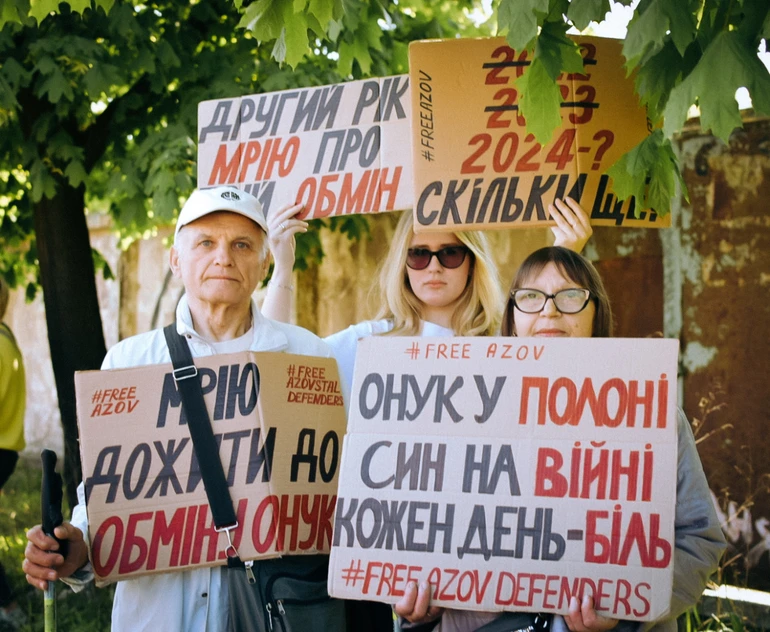
70-year-old Tamara holds a sign reading “My grandson is in captivity. My son is on the front lines. Every day is pain,” while 76-year-old Volodymyr holds one that says “I dream of living to see my grandson returned.”
They are the grandparents of 30-year-old Bohdan, a soldier with the Azov Battalion and a defender of Mariupol, who has been held in Russian torture chambers for over three years.
A year ago, when we first met this family, Tamara’s sign read “Grandson in captivity. Son at war," but one word had to be replaced.
On March 29, 2025, Bohdan’s uncle, Vyacheslav Kitsinenko, was killed at the front, never having waited for his nephew’s return. Now Tamara and Volodymyr must endure not only separation from their grandson but also the loss of their own child.
To bring Bogdan’s release closer, every Sunday they attend rallies in Kyiv to raise awareness about the captives.
Bogdan’s grandfather has bad legs, but he uses trekking poles to stay on his feet for at least an hour during the rally. He says that when he thinks about the pain his grandson is enduring in captivity, his own discomfort doesn’t seem so bad.
"When I was young, I ran a lot, but now my legs are failing me. But those poles help. At some rallies, we stood for two hours.
I want to give society and the government at least a little push so they take action. Only society can demand that the prisoner exchange be accelerated. I’m showing that even with my bad legs, I came here so that you would do something!” says Volodymyr.
Bogdan fell into enemy hands on May 20, 2022, when the defenders of Azovstal left the steel plant’s territory, following orders from higher command. He was one of the last soldiers to leave the plant.
The Russian side promised to abide by the Geneva Conventions, to spare the prisoners’ lives, not to torture them, and to allow them to communicate with their families. The soldiers were supposed to be exchanged within a few months.
However, Russia violated all these agreements: the occupiers “cut off” the prisoners from the outside world, began subjecting them to brutal torture, and on July 28–29, killed 53 Azov soldiers by blowing up a barracks in Olenivka.
Bogdan’s grandparents lost everything in Chasiv Yar, while his beloved Kateryna escaped from Mariupol. Now they live in Kyiv and hope for a prisoner exchange every minute, knowing nothing about the fate of their defender.
Last spring, “Ukrainska Pravda. Life" spoke with Bohdan’s family about two years of agonizing waiting.
Today we are publishing this interview again—to remind everyone of the Azov soldier and his comrades, for whom the hell of captivity has now stretched to three years.
Tamara and Volodymyr have been together for 50 years. They have lived in Chasovyi Yar in the Donetsk region for almost all of that time. Their eldest grandson, Bohdan, was born there.
The young man graduated from high school in Mariupol, then attended a construction technical school, and later decided to join Azov. He didn’t pass the selection the first time because of a knee injury, but he made it into the regiment on his second try. His family recalls that they were surprised by Bohdan’s decision to join “Azov” at the time, because he had a very calm temperament and never spoke of military service.
“I’m from Mariupol myself; I got married and moved to Chasiv Yar. My daughter grew up here, then the kids got married, and Bohdan was born. When he was little, he was always with us, and then he’d come visit every vacation. He was so calm: he loved to draw, build with Legos… Then he grew up and at 20 decided to join Azov. We were in shock…
He didn’t talk much about the war. But he always came to visit us—for his birthday, for ours, and in the summer. We have beautiful nature here, forests, ponds. It’s lovely in Chasovyi Yar, which probably doesn’t exist anymore,” says Bohdan’s grandmother, Tamara.
On February 21, 2022, Bohdan was supposed to celebrate his 27th birthday and, as always, planned to visit his grandparents. But on February 24, a full-scale war began, and the young man went to defend Mariupol. The son of Tamara and Volodymyr, Bohdan’s uncle, also joined the army.
At first, Tamara and Volodymyr set up a shelter in the basement, where they hid from the shelling. But realizing that the war would last a long time, the couple decided to leave the frontline city. First, they made it to Uzhhorod on an evacuation train, and then to Slovakia.
Bogdan’s mother, Tetiana, returned to Ukraine as soon as he was taken prisoner. The Azov soldier’s grandparents began attending peace rallies while still in Bratislava, and then also returned to Kyiv to wait for their grandson.
“We decided to wait for the exchange here in Kyiv. After all, no one is going to bring them to Slovakia. Maybe we can help our country and our soldiers in some way,” says Volodymyr.
“We couldn’t just sit around. We just couldn’t hold back and came back, rented an apartment, and immediately started going to the rallies. We think maybe at least someone will see us and help. The more people there are at the rallies, the more they’ll listen to us. There’s nothing else we can do at our age…
Katya told us that some of the captives had returned; she met with them. But no one is saying anything specific. We know they’re being tortured. When I found out about Olenivka—it’s just… I cry every night. “We wait for the exchange every day,” adds Tamara.
Bogdan’s grandparents ask for one thing—to save their grandson from captivity.
“I remember his birthday—February 21. We were so looking forward to him coming. Grandma, as always, starts preparing six months before her grandson’s arrival. And then the war broke out. When we spoke, he said, ‘Grandma, I’ll come.’ Those words are still ringing in my ears…
[The Azov soldiers] were defending their homeland. Mariupol is our home; I was born there. And now there’s nothing left. There’s no home, there’s war everywhere. I just want to live out my days on this earth and see Bohdan,” says Tamara.
The couple dreams of gathering as a large family around one table—with everyone present. Grandfather Volodymyr said that he prays for this every day, and also silently asks Bohdan to endure everything and return to Ukraine.
“I am an Orthodox Christian. Every day I pray to God that Bohdan will return alive and well. Several times a day. I think God will hear me.
I dream of living to see my grandson exchanged. And I will live to see it. That’s how it will be, if you have faith,” adds the Azov soldier’s grandfather.
One of those waiting for Bohdan’s release from captivity is his girlfriend, 29-year-old Kateryna from Mariupol. Katya met Bohdan back in school—they used to play Counter-Strike together. The teenagers dated for a few months and broke up, but then life brought them back together in 2016. Kateryna was 20, and Bohdan was 21. He was already serving in Azov.
“In 2016, we started talking more and more. It’s not that he was very pushy, but he never strayed from his goal. His goal was to win my heart. And he succeeded…
I’ve never met a kinder person than him. And I’m not saying this just because he’s my boyfriend; it’s simply my assessment of him as a person. He is very sensitive, attentive, caring, honest, and calm," the girl recalls.
Bogdan proposed to Kateryna three months after they started dating, but the couple never got married. The couple lived together for six years in Mariupol with two cats—a Kurilian Bobtail named Simba and a stray cat named Zeus, whom a soldier had taken in.
"I said 'yes' to Bohdan, but 'let’s wait, because I’m still in school.' At the time, I viewed official marriage as something not really necessary: if people love each other, why do we need a stamp in a passport? Now I think differently.
We lived together for six years without getting married. And now I’ve run into a bunch of problems because I’m an unofficial wife. "I have very few rights. Even to write a letter somewhere or get a reply, you have to be an official relative," says Katya.
The last time she saw her boyfriend was on February 21, when he was allowed home for a single day. Katya bought Bohdan’s favorite cake, and the couple celebrated his 27th birthday together.
“I asked him then, ‘What if we never see each other again…’ And now it’s been over three years since we’ve seen each other. We don’t even talk,” she says.
The couple was in Mariupol when the full-scale invasion began. A week before the war broke out, Bogdan started urging Katya to leave for western Ukraine. The girl didn’t want to leave and couldn’t even pack an “emergency bag,” but just in case, she bought a lot of cat food.
On February 24, Bohdan was already at the base, while Katya was awake and heard the first explosions coming from the occupied Donetsk region during the night. Then very loud explosions rang out near her home. Bohdan insisted that Katya and her family leave the city immediately—and in doing so, he saved their lives.
Katya’s father initially wanted to stay, but since Bogdan had been asking her to leave for a whole week prior, her family agreed to evacuate.
“I believe we’re alive only thanks to Bogdan. Because the building where we lived with him was bombed. The first stairwell collapsed; many people died there, and our apartment was the first to catch fire.
My parents also had their own home. It was hit three times directly. Before the war, we agreed that if we lost contact, we would all meet there. “If we had actually gone there instead of leaving, we wouldn’t be alive today,” says Katya.
The young woman evacuated her family from Mariupol on the very first day of the war. First, she went to Kremenchuk, and then to Zakarpattia.
“Bogdan kept texting me: ‘Move to the other side of the Dnipro!’ At first, we wanted to go to my brother’s place near Kyiv, in Hostomel. It seemed safer outside the city. But then we decided to head west; kind people gave us a big house in Zakarpattia.
But it was very hard for me to be around people because they didn’t understand my state of mind—they didn’t have anyone at war. I had panic attacks; I cried constantly. I lived with my phone; I slept with my phone,” the girl recalls.
Communication with Bohdan was very sporadic. The soldier wrote to Katya that he was alive and asked her to send photos of food, while the girl tried to support him and distract him with pictures of cats.
"Bogdan asked, 'When I log in, please send me photos of food.' At Azovstal, he wrote that he had severe concussions, couldn’t sleep, and had a headache. The guys later said he was shaking from the concussions. He also said he weighed 53 kilograms at 1.80 meters tall. He was just a skeleton…
I tried to support Bohdan by sending him photos of our cats, because he loves them so much. He even had cats at the base that he and the guys took care of. “Even when he didn’t have a signal, I always wrote him long messages about my day,” Katya recalls.
At the end of April, contact with Bohdan was lost. But one day, his comrade’s sister passed on a message to Katya that Bohdan was alive and loved her very much.
And on May 9, the soldier wrote to Katya that he had 10 minutes to talk. That was the longest conversation the couple had during the defense of Mariupol.
“I knew things were bad and he was saying goodbye. He told me how much he loved me. He wrote: ‘Just in case, live your life normally, know that I’ve always loved you and still do—you’re the best thing that ever happened to me.’
Of course, Bohdan dreamed of surviving, but he was always a realist. I think the guys didn’t believe they’d make it out of that hell,” says Katya.
Bogdan was one of the last to leave Azovstal. His girlfriend didn’t know this—she only saw that the other Azov soldiers’ wives were talking about an evacuation and “3–4 months of captivity.” And then Kateryna was given false information that Bohdan was missing in action.
“When they were taken into captivity, they wrote to me that he was missing in action. That was the only time the International Committee of the Red Cross helped me, because a few days later they called and said he had been released and had filled out their prisoner-of-war form.
They also told me, ‘Don’t worry, everything is fine; he’s under our protection now.’ I thought, ‘Wow, that’s so cool.’ Everyone thought back then that this meant something and that the prisoners would be treated well. “I couldn’t even imagine what was really happening there,” says Kateryna.
A few days after the call from the ICRC, Bogdan called the girl from Olenivka. Those few minutes of a secret conversation were the last time Katya heard her beloved’s voice. After that, she received information only from her husband’s comrades who had been released from captivity.
“I learned about Bogdan’s torture from his comrades who served with him and had already been exchanged. It’s horrific torture. Besides starving them, beating them every day, and not letting them contact their families, there are forms of torture that are much worse.
In May 2023, a guy who had been in the same cell as Bohdan was released. At first, he didn’t want to tell me this because he was afraid of how I would handle the information. I couldn’t even imagine such torture. You don’t see things like that in horror movies,” Katya shares.
In September 2024, another released fighter told Katya that he had been imprisoned with her fiancé in Taganrog, but in June the Russians took Bohdan out of the cell, and contact was lost.
This information is the latest update the Azov soldier’s family has received.
Kateryna doesn’t know if her fiancé is alive right now, but she is doing everything she can to save him.
In particular, she participates in all the campaigns and events organized by the “Association of Families of Azovstal Defenders,” aimed at raising awareness about the prisoners.
She is waiting for a prisoner exchange and dreams that Bohdan will return alive. And that is the only thing that gives her the strength to hold on.
"Many people live under the illusion that everything is fine in captivity, that the prisoners are just sitting around and resting. But over there, the guys are being beaten to death. And that’s why I’m so afraid that something might have happened to him.
Before, I wouldn’t even let myself think about it, but now I can’t ignore the fact that I have no information about him. More than anything, I don’t want him to die. I’d just like to fall asleep and wake up when he’s back,” Katya shares.
The young woman says she has called the ICRC many times, describing the torture in detail, but has received no further response. She is outraged that human rights activists cannot come and check whether the captured Azov soldiers are alive.
But Katya hasn’t lost hope and asks everyone to remember the defenders of Azovstal, attend rallies, and speak out about the torture and killings of Ukrainian soldiers in Russian prisons.
"I hope that both our government and all the other [countries] helping us with the exchanges are doing everything in their power to ensure these exchanges take place and our boys return alive. But it doesn’t depend solely on them. There is Russia, which doesn’t want to give our boys back…
I’m just living with the dream that Bohdan will be in the next exchange. I want to be with him so that he’s finally safe. I dream that they’ll stop torturing him, that he’ll be able to eat and sleep normally. That is the only goal that motivates me to live," the young woman adds.
About 850 Azov defenders of Mariupol remain in Russian captivity. Their families beg for only one thing—their rescue.
Author: Olena Barsukova
70-year-old Tamara holds a sign reading “My grandson is in captivity. My son is on the front lines. Every day is pain,” while 76-year-old Volodymyr holds one that says “I dream of living to see my grandson returned.”
They are the grandparents of 30-year-old Bohdan, a soldier with the Azov Battalion and a defender of Mariupol, who has been held in Russian torture chambers for over three years.
A year ago, when we first met this family, Tamara’s sign read “Grandson in captivity. Son at war," but one word had to be replaced.
On March 29, 2025, Bohdan’s uncle, Vyacheslav Kitsinenko, was killed at the front, never having waited for his nephew’s return. Now Tamara and Volodymyr must endure not only separation from their grandson but also the loss of their own child.
To bring Bogdan’s release closer, every Sunday they attend rallies in Kyiv to raise awareness about the captives.
Bogdan’s grandfather has bad legs, but he uses trekking poles to stay on his feet for at least an hour during the rally. He says that when he thinks about the pain his grandson is enduring in captivity, his own discomfort doesn’t seem so bad.
"When I was young, I ran a lot, but now my legs are failing me. But those poles help. At some rallies, we stood for two hours.
I want to give society and the government at least a little push so they take action. Only society can demand that the prisoner exchange be accelerated. I’m showing that even with my bad legs, I came here so that you would do something!” says Volodymyr.
Bogdan fell into enemy hands on May 20, 2022, when the defenders of Azovstal left the steel plant’s territory, following orders from higher command. He was one of the last soldiers to leave the plant.
The Russian side promised to abide by the Geneva Conventions, to spare the prisoners’ lives, not to torture them, and to allow them to communicate with their families. The soldiers were supposed to be exchanged within a few months.
However, Russia violated all these agreements: the occupiers “cut off” the prisoners from the outside world, began subjecting them to brutal torture, and on July 28–29, killed 53 Azov soldiers by blowing up a barracks in Olenivka.
Bogdan’s grandparents lost everything in Chasiv Yar, while his beloved Kateryna escaped from Mariupol. Now they live in Kyiv and hope for a prisoner exchange every minute, knowing nothing about the fate of their defender.
Last spring, “Ukrainska Pravda. Life" spoke with Bohdan’s family about two years of agonizing waiting.
Today we are publishing this interview again—to remind everyone of the Azov soldier and his comrades, for whom the hell of captivity has now stretched to three years.
"I dream of living to see my grandson exchanged. And I will live to see it."
Tamara and Volodymyr have been together for 50 years. They have lived in Chasovyi Yar in the Donetsk region for almost all of that time. Their eldest grandson, Bohdan, was born there.
The young man graduated from high school in Mariupol, then attended a construction technical school, and later decided to join Azov. He didn’t pass the selection the first time because of a knee injury, but he made it into the regiment on his second try. His family recalls that they were surprised by Bohdan’s decision to join “Azov” at the time, because he had a very calm temperament and never spoke of military service.
“I’m from Mariupol myself; I got married and moved to Chasiv Yar. My daughter grew up here, then the kids got married, and Bohdan was born. When he was little, he was always with us, and then he’d come visit every vacation. He was so calm: he loved to draw, build with Legos… Then he grew up and at 20 decided to join Azov. We were in shock…
He didn’t talk much about the war. But he always came to visit us—for his birthday, for ours, and in the summer. We have beautiful nature here, forests, ponds. It’s lovely in Chasovyi Yar, which probably doesn’t exist anymore,” says Bohdan’s grandmother, Tamara.
On February 21, 2022, Bohdan was supposed to celebrate his 27th birthday and, as always, planned to visit his grandparents. But on February 24, a full-scale war began, and the young man went to defend Mariupol. The son of Tamara and Volodymyr, Bohdan’s uncle, also joined the army.
At first, Tamara and Volodymyr set up a shelter in the basement, where they hid from the shelling. But realizing that the war would last a long time, the couple decided to leave the frontline city. First, they made it to Uzhhorod on an evacuation train, and then to Slovakia.
Bogdan’s mother, Tetiana, returned to Ukraine as soon as he was taken prisoner. The Azov soldier’s grandparents began attending peace rallies while still in Bratislava, and then also returned to Kyiv to wait for their grandson.
“We decided to wait for the exchange here in Kyiv. After all, no one is going to bring them to Slovakia. Maybe we can help our country and our soldiers in some way,” says Volodymyr.
“We couldn’t just sit around. We just couldn’t hold back and came back, rented an apartment, and immediately started going to the rallies. We think maybe at least someone will see us and help. The more people there are at the rallies, the more they’ll listen to us. There’s nothing else we can do at our age…
Katya told us that some of the captives had returned; she met with them. But no one is saying anything specific. We know they’re being tortured. When I found out about Olenivka—it’s just… I cry every night. “We wait for the exchange every day,” adds Tamara.
Bogdan’s grandparents ask for one thing—to save their grandson from captivity.
“I remember his birthday—February 21. We were so looking forward to him coming. Grandma, as always, starts preparing six months before her grandson’s arrival. And then the war broke out. When we spoke, he said, ‘Grandma, I’ll come.’ Those words are still ringing in my ears…
[The Azov soldiers] were defending their homeland. Mariupol is our home; I was born there. And now there’s nothing left. There’s no home, there’s war everywhere. I just want to live out my days on this earth and see Bohdan,” says Tamara.
The couple dreams of gathering as a large family around one table—with everyone present. Grandfather Volodymyr said that he prays for this every day, and also silently asks Bohdan to endure everything and return to Ukraine.
“I am an Orthodox Christian. Every day I pray to God that Bohdan will return alive and well. Several times a day. I think God will hear me.
I dream of living to see my grandson exchanged. And I will live to see it. That’s how it will be, if you have faith,” adds the Azov soldier’s grandfather.
"Many people live under the illusion that everything is fine in captivity. But the boys are being beaten to death there."
One of those waiting for Bohdan’s release from captivity is his girlfriend, 29-year-old Kateryna from Mariupol. Katya met Bohdan back in school—they used to play Counter-Strike together. The teenagers dated for a few months and broke up, but then life brought them back together in 2016. Kateryna was 20, and Bohdan was 21. He was already serving in Azov.
“In 2016, we started talking more and more. It’s not that he was very pushy, but he never strayed from his goal. His goal was to win my heart. And he succeeded…
I’ve never met a kinder person than him. And I’m not saying this just because he’s my boyfriend; it’s simply my assessment of him as a person. He is very sensitive, attentive, caring, honest, and calm," the girl recalls.
Bogdan proposed to Kateryna three months after they started dating, but the couple never got married. The couple lived together for six years in Mariupol with two cats—a Kurilian Bobtail named Simba and a stray cat named Zeus, whom a soldier had taken in.
"I said 'yes' to Bohdan, but 'let’s wait, because I’m still in school.' At the time, I viewed official marriage as something not really necessary: if people love each other, why do we need a stamp in a passport? Now I think differently.
We lived together for six years without getting married. And now I’ve run into a bunch of problems because I’m an unofficial wife. "I have very few rights. Even to write a letter somewhere or get a reply, you have to be an official relative," says Katya.
The last time she saw her boyfriend was on February 21, when he was allowed home for a single day. Katya bought Bohdan’s favorite cake, and the couple celebrated his 27th birthday together.
“I asked him then, ‘What if we never see each other again…’ And now it’s been over three years since we’ve seen each other. We don’t even talk,” she says.
The couple was in Mariupol when the full-scale invasion began. A week before the war broke out, Bogdan started urging Katya to leave for western Ukraine. The girl didn’t want to leave and couldn’t even pack an “emergency bag,” but just in case, she bought a lot of cat food.
On February 24, Bohdan was already at the base, while Katya was awake and heard the first explosions coming from the occupied Donetsk region during the night. Then very loud explosions rang out near her home. Bohdan insisted that Katya and her family leave the city immediately—and in doing so, he saved their lives.
Katya’s father initially wanted to stay, but since Bogdan had been asking her to leave for a whole week prior, her family agreed to evacuate.
“I believe we’re alive only thanks to Bogdan. Because the building where we lived with him was bombed. The first stairwell collapsed; many people died there, and our apartment was the first to catch fire.
My parents also had their own home. It was hit three times directly. Before the war, we agreed that if we lost contact, we would all meet there. “If we had actually gone there instead of leaving, we wouldn’t be alive today,” says Katya.
The young woman evacuated her family from Mariupol on the very first day of the war. First, she went to Kremenchuk, and then to Zakarpattia.
“Bogdan kept texting me: ‘Move to the other side of the Dnipro!’ At first, we wanted to go to my brother’s place near Kyiv, in Hostomel. It seemed safer outside the city. But then we decided to head west; kind people gave us a big house in Zakarpattia.
But it was very hard for me to be around people because they didn’t understand my state of mind—they didn’t have anyone at war. I had panic attacks; I cried constantly. I lived with my phone; I slept with my phone,” the girl recalls.
Communication with Bohdan was very sporadic. The soldier wrote to Katya that he was alive and asked her to send photos of food, while the girl tried to support him and distract him with pictures of cats.
"Bogdan asked, 'When I log in, please send me photos of food.' At Azovstal, he wrote that he had severe concussions, couldn’t sleep, and had a headache. The guys later said he was shaking from the concussions. He also said he weighed 53 kilograms at 1.80 meters tall. He was just a skeleton…
I tried to support Bohdan by sending him photos of our cats, because he loves them so much. He even had cats at the base that he and the guys took care of. “Even when he didn’t have a signal, I always wrote him long messages about my day,” Katya recalls.
At the end of April, contact with Bohdan was lost. But one day, his comrade’s sister passed on a message to Katya that Bohdan was alive and loved her very much.
And on May 9, the soldier wrote to Katya that he had 10 minutes to talk. That was the longest conversation the couple had during the defense of Mariupol.
“I knew things were bad and he was saying goodbye. He told me how much he loved me. He wrote: ‘Just in case, live your life normally, know that I’ve always loved you and still do—you’re the best thing that ever happened to me.’
Of course, Bohdan dreamed of surviving, but he was always a realist. I think the guys didn’t believe they’d make it out of that hell,” says Katya.
Bogdan was one of the last to leave Azovstal. His girlfriend didn’t know this—she only saw that the other Azov soldiers’ wives were talking about an evacuation and “3–4 months of captivity.” And then Kateryna was given false information that Bohdan was missing in action.
“When they were taken into captivity, they wrote to me that he was missing in action. That was the only time the International Committee of the Red Cross helped me, because a few days later they called and said he had been released and had filled out their prisoner-of-war form.
They also told me, ‘Don’t worry, everything is fine; he’s under our protection now.’ I thought, ‘Wow, that’s so cool.’ Everyone thought back then that this meant something and that the prisoners would be treated well. “I couldn’t even imagine what was really happening there,” says Kateryna.
A few days after the call from the ICRC, Bogdan called the girl from Olenivka. Those few minutes of a secret conversation were the last time Katya heard her beloved’s voice. After that, she received information only from her husband’s comrades who had been released from captivity.
“I learned about Bogdan’s torture from his comrades who served with him and had already been exchanged. It’s horrific torture. Besides starving them, beating them every day, and not letting them contact their families, there are forms of torture that are much worse.
In May 2023, a guy who had been in the same cell as Bohdan was released. At first, he didn’t want to tell me this because he was afraid of how I would handle the information. I couldn’t even imagine such torture. You don’t see things like that in horror movies,” Katya shares.
In September 2024, another released fighter told Katya that he had been imprisoned with her fiancé in Taganrog, but in June the Russians took Bohdan out of the cell, and contact was lost.
This information is the latest update the Azov soldier’s family has received.
Kateryna doesn’t know if her fiancé is alive right now, but she is doing everything she can to save him.
In particular, she participates in all the campaigns and events organized by the “Association of Families of Azovstal Defenders,” aimed at raising awareness about the prisoners.
She is waiting for a prisoner exchange and dreams that Bohdan will return alive. And that is the only thing that gives her the strength to hold on.
"Many people live under the illusion that everything is fine in captivity, that the prisoners are just sitting around and resting. But over there, the guys are being beaten to death. And that’s why I’m so afraid that something might have happened to him.
Before, I wouldn’t even let myself think about it, but now I can’t ignore the fact that I have no information about him. More than anything, I don’t want him to die. I’d just like to fall asleep and wake up when he’s back,” Katya shares.
The young woman says she has called the ICRC many times, describing the torture in detail, but has received no further response. She is outraged that human rights activists cannot come and check whether the captured Azov soldiers are alive.
But Katya hasn’t lost hope and asks everyone to remember the defenders of Azovstal, attend rallies, and speak out about the torture and killings of Ukrainian soldiers in Russian prisons.
"I hope that both our government and all the other [countries] helping us with the exchanges are doing everything in their power to ensure these exchanges take place and our boys return alive. But it doesn’t depend solely on them. There is Russia, which doesn’t want to give our boys back…
I’m just living with the dream that Bohdan will be in the next exchange. I want to be with him so that he’s finally safe. I dream that they’ll stop torturing him, that he’ll be able to eat and sleep normally. That is the only goal that motivates me to live," the young woman adds.
About 850 Azov defenders of Mariupol remain in Russian captivity. Their families beg for only one thing—their rescue.
This is an automatic translation generated by DeepL.