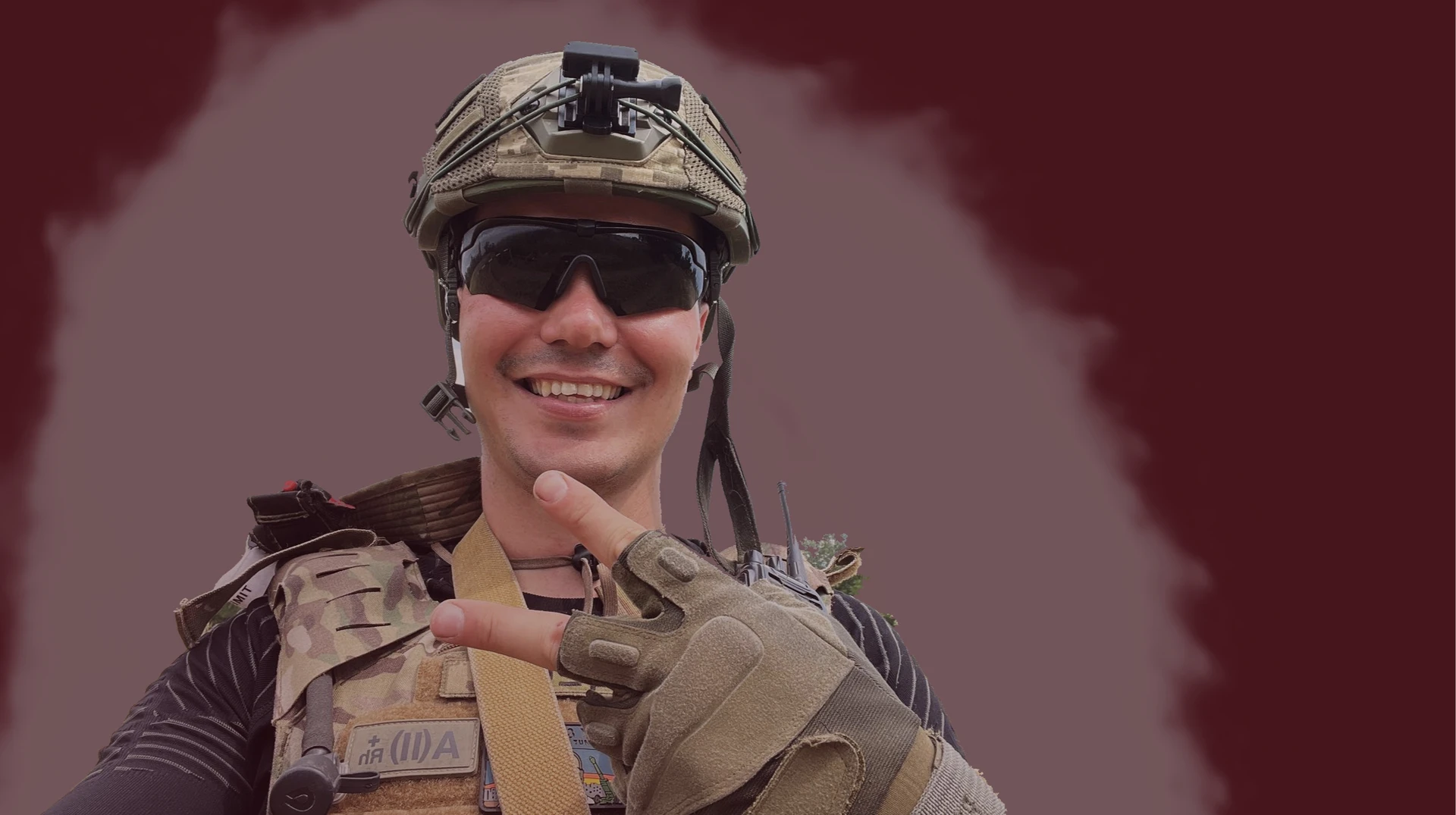
"I consider it a Godly thing to do." The story of a chaplain and IT specialist from Luhansk who became an FPV drone operator
Source: Ukrainska Pravda
Author: Tetiana Plyatsok
For a third of his life, Viktor, a member of the UP Club, has lived side by side with war. In 2014, he lived in the center of Luhansk with his wife and young child and was a direct witness to the pro-European Maidan and an eyewitness to how strangers—later called “separatists”—began to be brought into the city.
Over the next 10 years, he faced separation from his family, volunteer work, captivity, and persecution for his faith.
He became an internally displaced person, living 800 kilometers from his home. When full-scale war broke out, Viktor continued to work, combining his job with volunteering and military chaplaincy, until he decided to choose the path of a soldier—he enlisted in the Defense Forces and became an FPV drone operator.
Upon joining the military, Viktor chose the call sign “Gideon,” which translates to “mighty warrior.” According to the biblical story, Gideon, with a small army of about 300 men, defeated an invading army of many thousands.
"UP. Life" asked Viktor about his decade-long personal war, his journey from IT volunteer to soldier, and God’s place on the front lines.
When the first unrest broke out, Viktor took his relatives to the Khmelnytskyi region, while he himself returned to his hometown to evacuate the locals.
For four months, the man lived under occupation, transporting people to safe territory for free, passing through separatist checkpoints each time. At the same time, he began cooperating with Ukrainian intelligence. After one of his conversations with Ukrainian intelligence, the occupiers stopped Viktor’s car and took him in for questioning.
"I was accused of collaborating with Ukrainian intelligence and bringing sabotage groups into Luhansk during the evacuation. I immediately confirmed my cooperation with intelligence, but the part about sabotage groups was untrue. And even under torture, the occupiers failed to get the answer they wanted to hear,” “Gideon” recounted.
The man hoped they would interrogate him and release him, since he saw his actions as an act of sacrifice, not a crime:
“I believed I was engaged in, as they say, a holy cause. I was evacuating children and the elderly from under the shelling… But they locked me in a basement. Right in the center of Luhansk, in the former SBU building.
They told me I would be there until the end of the war.”
For the first two weeks, Viktor was considered missing. He had no idea how long he would spend “in the basement” or what to expect.
His faith sustained him. Even today, Viktor identifies himself first and foremost as a believer. And it was his spiritual practices that kept him going during the inhuman torture. He also provided moral support to the people who were in the same cell with him.
The Christian had to pay a heavy price for his faith. One of the methods of psychological torture in captivity was “spiritual conversations” with a Russian Orthodox priest.
Viktor is a Protestant, which particularly displeased “Stalin”—that was the call sign of the Russian priest who did everything possible to “convert” “Gideon.” In particular, he “exorcised” demons from him.
While Viktor was considered missing in action, his wife traveled to Luhansk from the western part of the country and began searching for her husband: first at morgues, and then at so-called prisons where captives were held.
The woman miraculously found out where Viktor was being held and, for several weeks, came to the “basement” every day to bring him food. After some time—likely due to a strange coincidence and the woman’s persistent efforts—Viktor was released from captivity.
“When I was released, I asked my wife where we were going, and she replied that we were going to Schyastia (a city in the Donetsk region—ed.).
‘Schyastia? But it’s occupied,’ I said.
“No, it’s not occupied,” my wife replied.
“So it turned out they’d been lying to me the whole time I was in captivity. After all, the Russians had assured us that Schyastia was now theirs.”
According to Viktor, being an IDP—both in 2014 and now—is no easy task. Landlords were suspicious of people from Luhansk and Donetsk. They might refuse if they saw a Luhansk region registration in the passport.
A man who had left behind an apartment in downtown Luhansk and all the comforts of life was forced to work as a handyman to provide for his family. Eventually, Viktor decided to enter the lucrative field of information technology (IT), which he worked in until early 2023.
A few days before the full-scale invasion, Viktor took his family abroad, and on the 27th, he returned to the Kyiv region and began doing the same thing he had done eight years earlier, when war first knocked on his door—evacuating people. In total, Viktor managed to transport over two hundred people to safety.
On March 13, 2022, the volunteer came under fire for the first time near Irpin. At that time, Russian troops were shelling the famous bridge.
"Shelling is underway; I’m hiding in a trench with the soldiers. Five or six civilians are walking nearby, and I run out of the hole amid the whistling of bullets and take the civilians into my car to drive them away.
Among those people was a family with a pregnant woman who was expecting a son. They were walking from Irpin to Kyiv. The couple said they would name the child Viktor, in my honor,” the man recalls.
Before the Russian invasion began, the IT specialist was also a pastor at a Protestant church, so when the war broke out, Viktor became a military chaplain on a volunteer basis. He received a special certificate and was able to travel to the front lines to provide spiritual care.
The pastor visited soldiers at their positions along the entire front line. The chaplain’s main tasks are spiritual, educational, and psychological work; this is specifically outlined in the documents.
“I worked with both military personnel and civilians. However, after a trip to Bakhmut in 2023, I completely stopped working with civilians. This happened after a conversation with a person in Bakhmut who was waiting for the ‘Russian world,’” adds Viktor.
According to him, the hardest part of war is losing people you know, but it’s even harder to listen to people who remain in the combat zone and realize they’re waiting for the Russians to liberate them.
According to Gideon’s observations, a significant portion of the people he met during the war believe in God:
“They read psalms and prayers. When we left our position, I would pray before we went out and say ‘Amen.’ Not once did I hear anyone object to prayer.”
The chaplain shared a story of a Christian miracle: during the fighting in the East, while under heavy fire, the soldiers in his unit began reciting Psalm 90 together, which includes the words, “A thousand may fall at your side, and ten thousand at your right hand, but it will not come near you.”
A mine flew near the soldiers, landed 15 meters away from them, and did not explode.
According to Viktor, the most common requests he receives from soldiers as a chaplain are about war fatigue, especially among those who have served for over a year—the soldiers are eagerly awaiting the demobilization law.
“The massive shelling of Ukraine was taking a heavy toll on me mentally. I understood that Russia was waging war against civilians, and there was nothing I could do to influence that,” the man explained his decision.
It took the already active servicemember about a month to master his new profession. Viktor became an FPV drone operator:
“I don’t view the work of an FPV operator as eliminating or destroying Russians. I see it as saving the lives of our guys. Because when I take out a tank or a mortar or any equipment with a drone—that always saves the lives of our guys, whom the Russians could have killed or wounded.
I consider this a God-given mission, and I plan to keep doing it as long as I can."
For Viktor, being a soldier means fulfilling his duty to Ukraine.
"I don’t hate Russians. I would fight just as hard against any nation that invaded Ukraine. If you don’t see them as ordinary people, it’s easier to eliminate them. I treat this as a job.
It’s a duty to the country—to protect it,” says the soldier.
One of the things that kept “Gideon” in civilian life was his high-paying IT job, but for Victor, there are no economic, cultural, or other fronts besides the military one: “There’s the front line and the rear. And that’s it."
According to him, even from a financial standpoint, a drone operator can be far more valuable to the state:
"I’m an FPV pilot, and our crew managed to take out a $3 million tank. An average IT specialist in the third tax bracket pays up to $5,000 in taxes a year.
If we compare the numbers, no volunteer—excluding large charitable foundations—will be able to raise as much money for the military as a skilled FPV pilot can inflict damage on the enemy."
Viktor is currently serving in hot spots on the front lines. He considers himself lucky and tries to improve himself in his free time, particularly by reading books in English. He also runs a Telegram channel where he talks about his journey from an IT specialist to a soldier.
“I’m very happy; I’m where I belong,” concludes “Gideon,” the soldier, as we wrap up our conversation.
Author: Tetiana Plyatsok
For a third of his life, Viktor, a member of the UP Club, has lived side by side with war. In 2014, he lived in the center of Luhansk with his wife and young child and was a direct witness to the pro-European Maidan and an eyewitness to how strangers—later called “separatists”—began to be brought into the city.
Over the next 10 years, he faced separation from his family, volunteer work, captivity, and persecution for his faith.
He became an internally displaced person, living 800 kilometers from his home. When full-scale war broke out, Viktor continued to work, combining his job with volunteering and military chaplaincy, until he decided to choose the path of a soldier—he enlisted in the Defense Forces and became an FPV drone operator.
Upon joining the military, Viktor chose the call sign “Gideon,” which translates to “mighty warrior.” According to the biblical story, Gideon, with a small army of about 300 men, defeated an invading army of many thousands.
"UP. Life" asked Viktor about his decade-long personal war, his journey from IT volunteer to soldier, and God’s place on the front lines.
The First Months of the War: Occupation, Captivity, and Persecution for His Faith
"In April 2014, the first battle took place in Luhansk, and the occupation of the city began. Before that, every Sunday we had a march of thousands of people supporting Ukraine: they came out with Ukrainian flags and chanted pro-Ukrainian slogans… And then, literally overnight, a large number of strangers who supported Russia appeared in the city,” recalls the Luhansk resident.When the first unrest broke out, Viktor took his relatives to the Khmelnytskyi region, while he himself returned to his hometown to evacuate the locals.
For four months, the man lived under occupation, transporting people to safe territory for free, passing through separatist checkpoints each time. At the same time, he began cooperating with Ukrainian intelligence. After one of his conversations with Ukrainian intelligence, the occupiers stopped Viktor’s car and took him in for questioning.
"I was accused of collaborating with Ukrainian intelligence and bringing sabotage groups into Luhansk during the evacuation. I immediately confirmed my cooperation with intelligence, but the part about sabotage groups was untrue. And even under torture, the occupiers failed to get the answer they wanted to hear,” “Gideon” recounted.
The man hoped they would interrogate him and release him, since he saw his actions as an act of sacrifice, not a crime:
“I believed I was engaged in, as they say, a holy cause. I was evacuating children and the elderly from under the shelling… But they locked me in a basement. Right in the center of Luhansk, in the former SBU building.
They told me I would be there until the end of the war.”
For the first two weeks, Viktor was considered missing. He had no idea how long he would spend “in the basement” or what to expect.
His faith sustained him. Even today, Viktor identifies himself first and foremost as a believer. And it was his spiritual practices that kept him going during the inhuman torture. He also provided moral support to the people who were in the same cell with him.
The Christian had to pay a heavy price for his faith. One of the methods of psychological torture in captivity was “spiritual conversations” with a Russian Orthodox priest.
Viktor is a Protestant, which particularly displeased “Stalin”—that was the call sign of the Russian priest who did everything possible to “convert” “Gideon.” In particular, he “exorcised” demons from him.
While Viktor was considered missing in action, his wife traveled to Luhansk from the western part of the country and began searching for her husband: first at morgues, and then at so-called prisons where captives were held.
The woman miraculously found out where Viktor was being held and, for several weeks, came to the “basement” every day to bring him food. After some time—likely due to a strange coincidence and the woman’s persistent efforts—Viktor was released from captivity.
“When I was released, I asked my wife where we were going, and she replied that we were going to Schyastia (a city in the Donetsk region—ed.).
‘Schyastia? But it’s occupied,’ I said.
“No, it’s not occupied,” my wife replied.
“So it turned out they’d been lying to me the whole time I was in captivity. After all, the Russians had assured us that Schyastia was now theirs.”
Starting over. The path of an IDP
At first, the couple went to the Khmelnytskyi region, but after just two months, they moved to the Kyiv region.According to Viktor, being an IDP—both in 2014 and now—is no easy task. Landlords were suspicious of people from Luhansk and Donetsk. They might refuse if they saw a Luhansk region registration in the passport.
A man who had left behind an apartment in downtown Luhansk and all the comforts of life was forced to work as a handyman to provide for his family. Eventually, Viktor decided to enter the lucrative field of information technology (IT), which he worked in until early 2023.
War 2.0. The Chaplain’s Path
In early February 2022, “Gideon’s” family began actively preparing for war.A few days before the full-scale invasion, Viktor took his family abroad, and on the 27th, he returned to the Kyiv region and began doing the same thing he had done eight years earlier, when war first knocked on his door—evacuating people. In total, Viktor managed to transport over two hundred people to safety.
On March 13, 2022, the volunteer came under fire for the first time near Irpin. At that time, Russian troops were shelling the famous bridge.
"Shelling is underway; I’m hiding in a trench with the soldiers. Five or six civilians are walking nearby, and I run out of the hole amid the whistling of bullets and take the civilians into my car to drive them away.
Among those people was a family with a pregnant woman who was expecting a son. They were walking from Irpin to Kyiv. The couple said they would name the child Viktor, in my honor,” the man recalls.
Before the Russian invasion began, the IT specialist was also a pastor at a Protestant church, so when the war broke out, Viktor became a military chaplain on a volunteer basis. He received a special certificate and was able to travel to the front lines to provide spiritual care.
The pastor visited soldiers at their positions along the entire front line. The chaplain’s main tasks are spiritual, educational, and psychological work; this is specifically outlined in the documents.
“I worked with both military personnel and civilians. However, after a trip to Bakhmut in 2023, I completely stopped working with civilians. This happened after a conversation with a person in Bakhmut who was waiting for the ‘Russian world,’” adds Viktor.
According to him, the hardest part of war is losing people you know, but it’s even harder to listen to people who remain in the combat zone and realize they’re waiting for the Russians to liberate them.
According to Gideon’s observations, a significant portion of the people he met during the war believe in God:
“They read psalms and prayers. When we left our position, I would pray before we went out and say ‘Amen.’ Not once did I hear anyone object to prayer.”
The chaplain shared a story of a Christian miracle: during the fighting in the East, while under heavy fire, the soldiers in his unit began reciting Psalm 90 together, which includes the words, “A thousand may fall at your side, and ten thousand at your right hand, but it will not come near you.”
A mine flew near the soldiers, landed 15 meters away from them, and did not explode.
According to Viktor, the most common requests he receives from soldiers as a chaplain are about war fatigue, especially among those who have served for over a year—the soldiers are eagerly awaiting the demobilization law.
"I have no hatred for Russians." The Warrior’s Path
Until early 2024, Viktor combined his main job as an IT specialist with military chaplaincy. But at the end of 2023, he finally decided to become a soldier.“The massive shelling of Ukraine was taking a heavy toll on me mentally. I understood that Russia was waging war against civilians, and there was nothing I could do to influence that,” the man explained his decision.
It took the already active servicemember about a month to master his new profession. Viktor became an FPV drone operator:
“I don’t view the work of an FPV operator as eliminating or destroying Russians. I see it as saving the lives of our guys. Because when I take out a tank or a mortar or any equipment with a drone—that always saves the lives of our guys, whom the Russians could have killed or wounded.
I consider this a God-given mission, and I plan to keep doing it as long as I can."
For Viktor, being a soldier means fulfilling his duty to Ukraine.
"I don’t hate Russians. I would fight just as hard against any nation that invaded Ukraine. If you don’t see them as ordinary people, it’s easier to eliminate them. I treat this as a job.
It’s a duty to the country—to protect it,” says the soldier.
One of the things that kept “Gideon” in civilian life was his high-paying IT job, but for Victor, there are no economic, cultural, or other fronts besides the military one: “There’s the front line and the rear. And that’s it."
According to him, even from a financial standpoint, a drone operator can be far more valuable to the state:
"I’m an FPV pilot, and our crew managed to take out a $3 million tank. An average IT specialist in the third tax bracket pays up to $5,000 in taxes a year.
If we compare the numbers, no volunteer—excluding large charitable foundations—will be able to raise as much money for the military as a skilled FPV pilot can inflict damage on the enemy."
Viktor is currently serving in hot spots on the front lines. He considers himself lucky and tries to improve himself in his free time, particularly by reading books in English. He also runs a Telegram channel where he talks about his journey from an IT specialist to a soldier.
“I’m very happy; I’m where I belong,” concludes “Gideon,” the soldier, as we wrap up our conversation.
This is an automatic translation generated by DeepL.