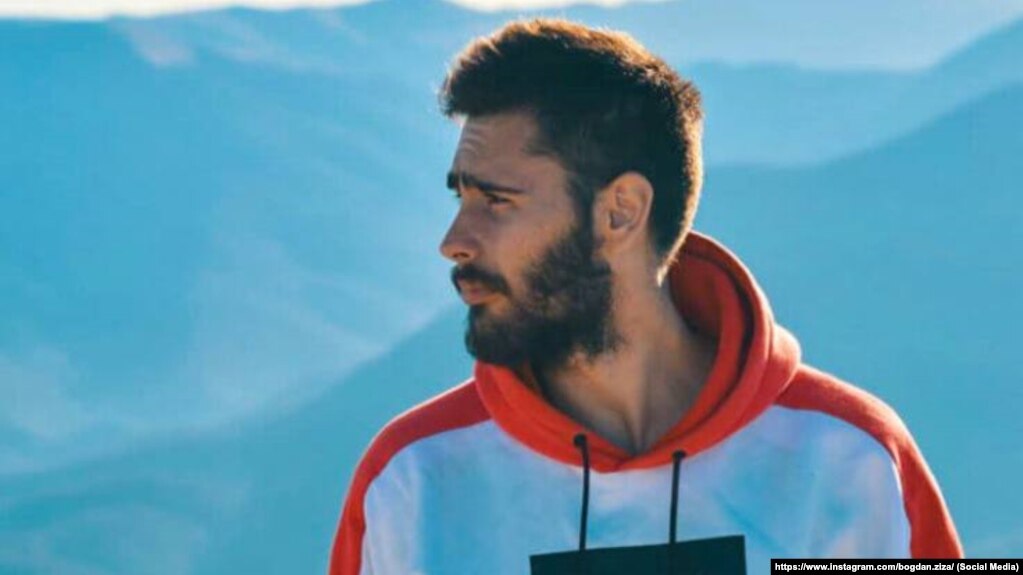
"He took the horrors of Bucha very painfully". The story of Crimean Bohdan Ziza, convicted by Russia for "terrorism"
Source: Radio Free Europe/Radio
Liberty Author: Anzhelika Brushevska
On May 16, 2022, after seeing a photo online of the Russian administration building in Yevpatoria, splattered with blue and yellow paint, Oleksandra Barkova forwarded it to her cousin, who lives on the Crimean Peninsula annexed by Russia, with the words, “You’ve got partisans now.” Her brother never read her message, even though they had been in constant contact before. On May 18, Oleksandra typed her brother’s name—Bogdan Ziza—into Google and came across a video released by the Russian-controlled TV channel “Crimea 24.”
In it, her brother confesses to his actions and repents. Oleksandra Barkova describes watching this video as “one of the most terrifying moments” of her life.
The Crimean artist’s sister told Krym.Realii about what Bogdan was like as a child, why he didn’t leave Crimea, and how he decided to take part in the anti-war protest.
In June 2023, a Russian court sentenced Crimean artist Bohdan Zizu to 15 years in prison on terrorism charges. Prior to this, he had spent nearly a year in the Simferopol pretrial detention center. After the verdict was announced, Bohdan was to be transferred to a prison in Russia. For a long time, his family did not know where he was. In January, his sister Oleksandra learned that Bohdan Zizu had been placed in a prison in the Russian city of Vladimir—known as the “Vladimir Central.”
For English subtitles, please enable captions in the video settings and select Auto-translate → English.
Liberty Author: Anzhelika Brushevska
On May 16, 2022, after seeing a photo online of the Russian administration building in Yevpatoria, splattered with blue and yellow paint, Oleksandra Barkova forwarded it to her cousin, who lives on the Crimean Peninsula annexed by Russia, with the words, “You’ve got partisans now.” Her brother never read her message, even though they had been in constant contact before. On May 18, Oleksandra typed her brother’s name—Bogdan Ziza—into Google and came across a video released by the Russian-controlled TV channel “Crimea 24.”
In it, her brother confesses to his actions and repents. Oleksandra Barkova describes watching this video as “one of the most terrifying moments” of her life.
The Crimean artist’s sister told Krym.Realii about what Bogdan was like as a child, why he didn’t leave Crimea, and how he decided to take part in the anti-war protest.
In June 2023, a Russian court sentenced Crimean artist Bohdan Zizu to 15 years in prison on terrorism charges. Prior to this, he had spent nearly a year in the Simferopol pretrial detention center. After the verdict was announced, Bohdan was to be transferred to a prison in Russia. For a long time, his family did not know where he was. In January, his sister Oleksandra learned that Bohdan Zizu had been placed in a prison in the Russian city of Vladimir—known as the “Vladimir Central.”
For English subtitles, please enable captions in the video settings and select Auto-translate → English.
“Violence is unacceptable to him”
Oleksandra says she and her brother were close since childhood; they could understand each other “without saying a word.” She recalls that as a child, Bohdan was very active. He drew, practiced parkour, and when Oleksandra and her family came to visit Yevpatoria, he would put on real performances.
“And it was always so sweet and so cool. He was a very positive kid, even though he had to go through a lot as a child. He had a very difficult situation with his parents; they died young. And I remember that my mom and I were always amazed that Bohdan was so positive, cool, and open to the world,” says Oleksandra.
After Russia’s annexation of the Crimean Peninsula, Oleksandra stopped visiting Crimea, while Bohdan stayed there to care for his grandmother. He lived in Yevpatoria and was passionate about photography, graffiti, and parkour. He often posted poems and videos on philosophical themes on his social media. In 2021, Bohdan traveled to northern Russia for several months in search of work. He worked there in a warehouse and filmed a series of videos during his trip. In one of them, he explained that he had left Crimea “because it’s hard to find a well-paying job.”
Bogdan stayed in touch with his sister Oleksandra online. He was in Crimea when Russia’s full-scale invasion of Ukraine began, and he became a pillar of support for his sister. Her parents and sister spent several months in the Zaporizhzhia region, which was occupied by Russian troops.
“Starting on February 24 (2022—Ed.), we were in touch with him literally 24/7. In fact, throughout the entire full-scale war, he was the one person with whom I could allow myself a moment of weakness… And I remember that after we all found out, after we saw the horrors of Bucha, Irpin, and Gostomel—when we saw all of that—Bogdan had, well, I won’t say a nervous breakdown, but he took it very hard. He’s generally a very empathetic person, and for him, violence is unacceptable. And I can say that it affected him—in a bad way, of course,” Oleksandra recalls.
15 years in prison for blue and yellow paint
One of the first to react to Bohdan Ziza’s anti-war protest was Alexander Loskutov, acting head of the Russian administration in Yevpatoria, who called the Crimean man’s actions “an act of vandalism.”
In addition to using blue and yellow paint, Ziza threw a bottle containing a flammable mixture at the building. No one was injured as a result of Bogdan’s actions, but the Crimean man was detained almost immediately. As a result, he was charged under articles related to committing a terrorist act, preparing for one, and inciting terrorism. The artist was also added to the list of terrorists and extremists.
I wanted to do at least something that would ease my inner pain a
little bit. Bogdan Ziza
little bit. Bogdan Ziza
While already in the Simferopol pretrial detention center, Bohdan Ziza explained his action in an interview with Krym.Realii: “Since the war began, I’ve withdrawn into myself and haven’t communicated with anyone except my sister and friends from Ukraine. I observed the reactions of friends and acquaintances from Crimea and Russia: how each behaved and how they reacted to the war. I am very disappointed in those around me. Realizing that posting something online wouldn’t accomplish anything, and also feeling very tired of all the horrors, of the public silence, and, above all, of my own silence, I wanted to do at least something that would ease my inner pain even a little. I decided to draw the attention of as many people as possible and did so in the way that has become familiar to me, a method that has always helped me in difficult psychological states—through paint.”
Bogdan insisted that there was no terrorism in his actions. He filmed his anti-war protest on his phone and planned to upload it online later.
After his arrest, video clips appeared, in particular, on the Telegram channel of the pro-Russian Crimean blogger Alexander Talipov, who regularly posts data, photos, and videos of pro-Ukrainian citizens in Crimea and organizes campaigns to harass them.
Crimea.Realities has the full version of the video of Bohdan Ziza’s anti-war protest.
In June 2023, the Russian Southern District Military Court in Rostov-on-Don sentenced the artist from Yevpatoria to 15 years in a general-regime penal colony. The Russian prosecutor had sought an 18-year prison term for Bogdan.
Bogdan Ziza – political prisoner
If you write any posts on social media or repost content, you will be tried as “terrorists”
Viktoria Nesterenko
Human rights activists have recognized Bohdan Ziza’s case as politically motivated and the Crimean himself as a political prisoner.
“On the one hand, this is the persecution of a single person—specifically, his pro-Ukrainian political stance. On the other hand, it is persecution and a trial intended to show other residents of the occupied territories what will happen to them: the same thing that happened to Bohdan. If you use Ukrainian symbols, if you write any posts on social media, or share content, you will be tried as ‘terrorists,’“ says Viktoria Nesterenko, a project manager at the ZMINA Human Rights Center, in a comment to Krym.Realii.
Bogdan Ziza’s relatives are certain that the young man’s apologies in the video were recorded under duress and that violence was used against him.
“In that video, you can see that his T-shirt is torn, he looks dazed… And then, when he was already in the Simferopol pretrial detention center and we had some contact with him, in one of his letters—which he secretly passed on through his lawyer, because such things aren’t usually allowed through—he wrote that he had indeed been tortured. Moreover, this information is in his case file,” says Oleksandra Barkova, Bohdan’s cousin.
Oleksandra also points out that photography and video recording were prohibited at all sessions of the Russian court. She suspects this was done intentionally—to conceal Bohdan’s actual condition. Barkova says that after one of the hearings, she was told that “Bogdan had a large bruise covering half his face.”
After the verdict was announced—15 years in prison—Bogdan Ziza demanded that the Russian authorities release political prisoners and went on a hunger strike.
I regret that I don’t have the opportunity to help my loved ones in Ukraine. Otherwise, I acted according to my conscience.
Bogdan Ziza
Bogdan Ziza
Here is an excerpt from his speech that day: “Do I regret what I did? I regret that I went too far and my actions provided grounds for a violation of the terrorism law. I regret that my grandmother will be left without the care she needs. She has no one else but me. I regret that I don’t have the opportunity to help my loved ones who are currently in Ukraine. Otherwise, I acted according to my conscience.”
Bogdan ended his hunger strike after 17 days. During that time, he lost 10 kilograms, and his health deteriorated. Oleksandra says that “he was literally exhausted; he couldn’t climb the stairs.” During his hunger strike, Bohdan was placed in solitary confinement, which also negatively affected his condition.
The process of returning political prisoners home is not easy
As of the end of December 2023, the Permanent Mission of the President of Ukraine in Crimea had recorded 191 Ukrainian political prisoners, 123 of whom are Crimean Tatars.
According to human rights activists, bringing Ukrainian citizens home is not easy. First of all, due to the lack of a mechanism for exchanging civilians.
“There are prisoners of war, there are civilian captives, and there are political prisoners. That is, these are three different categories... As for prisoners of war, in principle, everything is clear there. And international humanitarian law applies in this regard—sometimes we exchange prisoners of war. But there have been no exchanges or returns of political prisoners for four years now,” says Viktoria Nesterenko, project manager at the ZMINA Human Rights Center.
According to the human rights activist, the only option currently available is for human rights defenders to work at the international level and involve “third parties”—countries that can influence Russia.
“Because there are no Russian civilians in Ukraine whom we could exchange to make it (the exchange – Ed.) an equal one,” Nesterenko told Krym.Realii.
Oleksandra, Bogdan Zzia’s cousin, continues to fight for him and organizes various campaigns in his support. She is proud of her brother.
“It’s an absolute miracle to me that he continues to fight even behind
bars” Oleksandra Barkova
bars” Oleksandra Barkova
“One of his most striking acts after his imprisonment was that he began speaking Ukrainian in court… When you see that a person is there, under those conditions, surrounded by such a terrible environment—Russians—and he’s fighting, he continues to speak out. It’s an absolute miracle to me that he continues to fight even behind bars,” says Barkova.
The last time Oleksandra spoke with Bohdan in person was almost two years ago—before his arrest. Now their communication consists of messages sent through lawyers and a few letters that Bohdan was able to send. Here is one of them.
This is an automatic translation generated by DeepL.