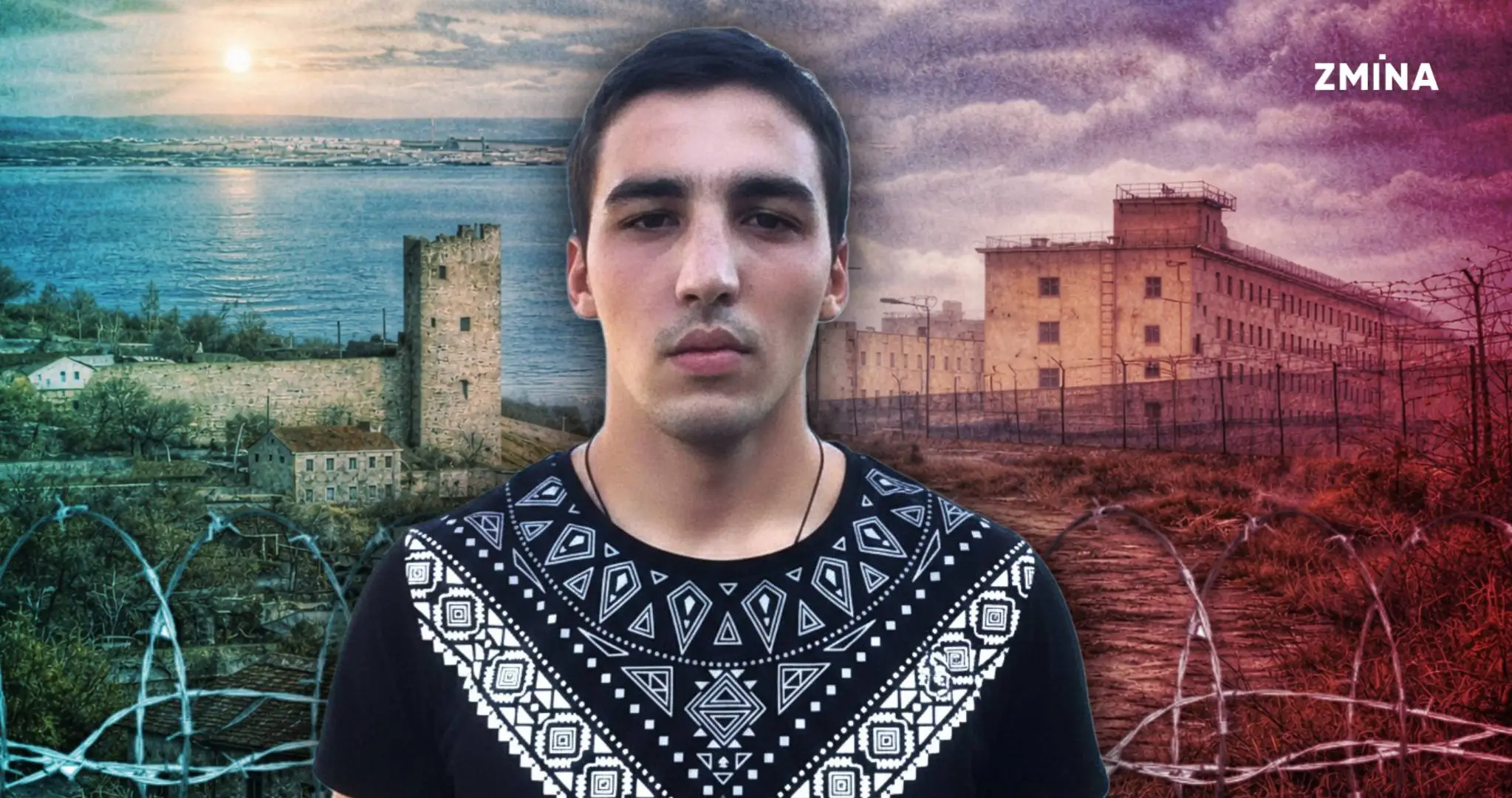
"Often crossed the administrative border with a Ukrainian passport": yesterday student Mamut Belyalov was sentenced to 12 years in Crimea
Source: Zmina
Author: Natalia Adamovich
In December 2025, a Russian court of cassation “reduced” the sentence of Mamut Belyalov, a resident of the village of Ichki (which the Russians call Sovetsky) in occupied Crimea: The 27-year-old Crimean Tatar had his 12-year prison sentence, imposed by the occupation court in November 2024, reduced to 11 and a half years, and his fine of 350,000 rubles reduced to 300,000.
Such actions have become routine for the Russian judicial system, which tries to pretend it has anything to do with justice. Given that Belyalov did not admit his guilt in court, this “review” of the sentence looks like a mockery.
The political prisoner’s family never believed for a single day in the guilt of Mamut, whom the Russians accused of “possessing weapons and plotting the murder” of Vadim Volchenko, the former head of Crimea’s illegal Ministry of Resorts and Tourism. From the moment the Crimean Tatar was detained, his family has never stopped fighting for his release. His family is pinning their hopes on an exchange and Mamut’s return, as his health has significantly deteriorated in detention.
Mamut Belyalov’s sister, Fadme, shared the young political prisoner’s story with ZMINA.
Mamut Belyalov was detained on September 9, 2022, in occupied Feodosia; he was 23 years old at the time. On the night of September 10, Mamut was transferred to Simferopol and placed in Pretrial Detention Center No. 1. From the moment of his detention until May 2024, a “pre-trial investigation” was underway; throughout this time, the Crimean man’s detention was extended every two months.
After the pre-trial investigation was completed, the case was sent to court. In August 2024, a jury trial took place, during which the “judges” effectively ignored the indisputable facts and evidence presented by the defense confirming the suspect’s innocence.
In November 2024, the occupiers handed down a guilty verdict against Belyalov: 12 years of imprisonment, a fine of 350,000 rubles, one year of administrative supervision with the obligation to register at his place of residence, as well as an obligation to pay Volchenko moral compensation in the amount of 1 million rubles.
Until December 2024, Belyalov was held in Pretrial Detention Center No. 1 in Simferopol. On December 28, 2024, he was transferred to Krasnodar and then to Volgograd (Russian Federation). The transfer process lasted about two months.
From Volgograd, the Crimean Tatar was sent to Penal Colony No. 19 of the Federal Penitentiary Service of Russia in the city of Surovikino. However, in practice, he continued to be held in conditions similar to those of a pretrial detention center, meaning he was unable to leave his cell.
On April 8, 2024, an appeal hearing was held in Volgograd, following which the sentence was upheld.
In late July 2025, Belyalov was transferred to a regular prison regime, but about a month later he was again transported to the occupied peninsula and placed in Simferopol Pretrial Detention Center No. 2, where he remains to this day. Why? His family does not know. They even learned unofficially that he was back in Crimea. The family also knows nothing about the occupiers’ future plans regarding Mamut.
“We know that he has been interrogated all this time, of course without a lawyer. After his transfer to Simferopol, his parents managed to see him only twice,” the political prisoner’s sister, Fadme, told ZMINA.
Mamut’s family sends him packages regularly, but they’re only allowed to do so once every three months.
Fadme herself has seen her brother only once since his arrest—in April 2023, during another court hearing to extend his detention.
“We weren’t allowed to look in his direction or speak to him. He was sitting in a cage, and we were in the courtroom. That’s all. That hearing lasted literally two minutes,” the woman says.
She does not believe Mamut is guilty. But she is certain she understands why the occupiers decided to make him a “criminal.” The Crimean Tatar was under the occupiers’ surveillance, just like everyone who demonstrated a pro-Ukrainian stance in Crimea after the annexation, and even more so—those who constantly crossed the administrative border into territories controlled by Ukraine.
“In 2017, Mamut enrolled at Kherson Agrarian University, majoring in ‘cadastral affairs and geodesy.’ All the time leading up to his arrest, we crossed the administrative border with Ukrainian passports. We were constantly interrogated: ‘Why don’t you get Russian citizenship?’” recalls Fadme.
Of course, the brother and sister couldn’t say outright that they were against it. They said they were students, constantly studying, and that they didn’t have time to get a passport… They were usually held at the checkpoint the longest and questioned the most.
Mamut lived in Kherson until 2022, then returned to Crimea because of his father’s illness. He wanted to eventually leave for the government-controlled territory, but didn’t make it in time.
At the time of her older brother’s arrest, Fadme was still in Crimea, living separately in another city, while her parents and Mamut were in the village of Ichki. In a few days, she was supposed to quit her job and return home. But her parents arrived early, picked her up, and told her that her brother had been detained by officers of the Russian FSB.
“During the occupation, we saw how methodically Russian security forces were taking young people away, charging them with some absurd charges, and depriving them of their freedom. First they took one, then another… Of course, we were afraid that this would happen to our family too. Unfortunately, we were right,” says the Crimean Tatar woman.
From that moment on, the fight for his release began. Mamut was detained in Feodosia, then taken to Simferopol. There, he was held in solitary confinement for six months.
His parents were allowed to see their son, but they never knew the date of the next visit.
“For the detention center staff, there is no law; for them, their word is law. Whatever they decide, that’s how it will be: visits are allowed today, but not tomorrow. I remember that once every one or two months they were allowed to see him for half an hour; the rest of the time, Mamut was alone. He was constantly taken in for interrogations,” said Fadme.
The Crimean Tatar did have a lawyer, a so-called state-appointed one, who made no effort whatsoever to defend his rights. On the contrary, he urged him to take the blame, arguing that cooperating with the authorities would give him a chance at a less severe sentence. Mamut refused.
In the spring of 2025, his parents hired independent lawyers for their son. However, according to the political prisoner’s sister, Crimean lawyers are often afraid to contradict FSB officers.
“For example, when my brother fell ill, we asked them to find out about medicine, food, or some household items—why isn’t he allowed to receive them? It’s all within the law. They replied, ‘No, we can’t; it’s not allowed.’ “My parents have achieved more on their own than with the help of lawyers,” says Fadme.
She adds: “Fear is what best characterizes the situation on the occupied peninsula.”
While in detention, the health of this previously healthy young man has deteriorated. He developed vitamin deficiency, and Mamut recently suffered from a urinary tract infection. However, according to him, he did not receive any real medical care.
Only when he already had a high fever and was severely weakened, and his parents persistently appealed to lawyers and investigators, did they begin to give him some medication. When asked what kind of medication it was, he never received an answer, Belyalova’s sister said.
“I am a medical professional myself and I don’t understand those medical staff who supposedly provide assistance to prisoners but in reality do nothing. To me, this is simply some kind of dystopia. Right now, Mamut is feeling more or less normal. But if there’s a sudden flare-up or just some kind of illness, it’s pointless to hope that someone there will help him properly, according to medical protocol.”
Mamut’s parents consulted with their daughter about which medications they could send to their son, taking his complaints into account.
“I clinically suspected an illness and compiled a list of over-the-counter medications: herbal remedies, antiseptics—not even antibacterials. And they didn’t even let those through,” said Fadme.
Mamut says almost nothing about the conditions of his detention in the pretrial detention center.
“He’s the kind of person who can’t and doesn’t like to complain. We didn’t even learn from him that he was tortured at the time of his arrest, but from Nariman Dzhelal. Later, when his parents met with Mamut, they asked if it was true. And he made it clear to us that it was,” says the Crimean Tatar woman.
The family is doing everything they can to help free their son and brother. Fadme appealed to the Coordination Headquarters for the Treatment of Prisoners of War, traveled with the Crimean Tatar Resource Center to the OSCE conference in Warsaw, where she spoke about her brother and the repression against dissidents in occupied Crimea, and wrote to the International Red Cross and the Verkhovna Rada Commissioner for Human Rights…
Every day, his family waits for good news and refuses to give up, because it is impossible to accept that a loved one has been imprisoned for four years for something he did not do.
Author: Natalia Adamovich
In December 2025, a Russian court of cassation “reduced” the sentence of Mamut Belyalov, a resident of the village of Ichki (which the Russians call Sovetsky) in occupied Crimea: The 27-year-old Crimean Tatar had his 12-year prison sentence, imposed by the occupation court in November 2024, reduced to 11 and a half years, and his fine of 350,000 rubles reduced to 300,000.
Such actions have become routine for the Russian judicial system, which tries to pretend it has anything to do with justice. Given that Belyalov did not admit his guilt in court, this “review” of the sentence looks like a mockery.
The political prisoner’s family never believed for a single day in the guilt of Mamut, whom the Russians accused of “possessing weapons and plotting the murder” of Vadim Volchenko, the former head of Crimea’s illegal Ministry of Resorts and Tourism. From the moment the Crimean Tatar was detained, his family has never stopped fighting for his release. His family is pinning their hopes on an exchange and Mamut’s return, as his health has significantly deteriorated in detention.
Mamut Belyalov’s sister, Fadme, shared the young political prisoner’s story with ZMINA.
Mamut Belyalov was detained on September 9, 2022, in occupied Feodosia; he was 23 years old at the time. On the night of September 10, Mamut was transferred to Simferopol and placed in Pretrial Detention Center No. 1. From the moment of his detention until May 2024, a “pre-trial investigation” was underway; throughout this time, the Crimean man’s detention was extended every two months.
After the pre-trial investigation was completed, the case was sent to court. In August 2024, a jury trial took place, during which the “judges” effectively ignored the indisputable facts and evidence presented by the defense confirming the suspect’s innocence.
In November 2024, the occupiers handed down a guilty verdict against Belyalov: 12 years of imprisonment, a fine of 350,000 rubles, one year of administrative supervision with the obligation to register at his place of residence, as well as an obligation to pay Volchenko moral compensation in the amount of 1 million rubles.
Until December 2024, Belyalov was held in Pretrial Detention Center No. 1 in Simferopol. On December 28, 2024, he was transferred to Krasnodar and then to Volgograd (Russian Federation). The transfer process lasted about two months.
From Volgograd, the Crimean Tatar was sent to Penal Colony No. 19 of the Federal Penitentiary Service of Russia in the city of Surovikino. However, in practice, he continued to be held in conditions similar to those of a pretrial detention center, meaning he was unable to leave his cell.
On April 8, 2024, an appeal hearing was held in Volgograd, following which the sentence was upheld.
In late July 2025, Belyalov was transferred to a regular prison regime, but about a month later he was again transported to the occupied peninsula and placed in Simferopol Pretrial Detention Center No. 2, where he remains to this day. Why? His family does not know. They even learned unofficially that he was back in Crimea. The family also knows nothing about the occupiers’ future plans regarding Mamut.
“We know that he has been interrogated all this time, of course without a lawyer. After his transfer to Simferopol, his parents managed to see him only twice,” the political prisoner’s sister, Fadme, told ZMINA.
Mamut’s family sends him packages regularly, but they’re only allowed to do so once every three months.
Fadme herself has seen her brother only once since his arrest—in April 2023, during another court hearing to extend his detention.
“We weren’t allowed to look in his direction or speak to him. He was sitting in a cage, and we were in the courtroom. That’s all. That hearing lasted literally two minutes,” the woman says.
She does not believe Mamut is guilty. But she is certain she understands why the occupiers decided to make him a “criminal.” The Crimean Tatar was under the occupiers’ surveillance, just like everyone who demonstrated a pro-Ukrainian stance in Crimea after the annexation, and even more so—those who constantly crossed the administrative border into territories controlled by Ukraine.
“In 2017, Mamut enrolled at Kherson Agrarian University, majoring in ‘cadastral affairs and geodesy.’ All the time leading up to his arrest, we crossed the administrative border with Ukrainian passports. We were constantly interrogated: ‘Why don’t you get Russian citizenship?’” recalls Fadme.
Of course, the brother and sister couldn’t say outright that they were against it. They said they were students, constantly studying, and that they didn’t have time to get a passport… They were usually held at the checkpoint the longest and questioned the most.
Mamut lived in Kherson until 2022, then returned to Crimea because of his father’s illness. He wanted to eventually leave for the government-controlled territory, but didn’t make it in time.
At the time of her older brother’s arrest, Fadme was still in Crimea, living separately in another city, while her parents and Mamut were in the village of Ichki. In a few days, she was supposed to quit her job and return home. But her parents arrived early, picked her up, and told her that her brother had been detained by officers of the Russian FSB.
“During the occupation, we saw how methodically Russian security forces were taking young people away, charging them with some absurd charges, and depriving them of their freedom. First they took one, then another… Of course, we were afraid that this would happen to our family too. Unfortunately, we were right,” says the Crimean Tatar woman.
From that moment on, the fight for his release began. Mamut was detained in Feodosia, then taken to Simferopol. There, he was held in solitary confinement for six months.
His parents were allowed to see their son, but they never knew the date of the next visit.
“For the detention center staff, there is no law; for them, their word is law. Whatever they decide, that’s how it will be: visits are allowed today, but not tomorrow. I remember that once every one or two months they were allowed to see him for half an hour; the rest of the time, Mamut was alone. He was constantly taken in for interrogations,” said Fadme.
The Crimean Tatar did have a lawyer, a so-called state-appointed one, who made no effort whatsoever to defend his rights. On the contrary, he urged him to take the blame, arguing that cooperating with the authorities would give him a chance at a less severe sentence. Mamut refused.
In the spring of 2025, his parents hired independent lawyers for their son. However, according to the political prisoner’s sister, Crimean lawyers are often afraid to contradict FSB officers.
“For example, when my brother fell ill, we asked them to find out about medicine, food, or some household items—why isn’t he allowed to receive them? It’s all within the law. They replied, ‘No, we can’t; it’s not allowed.’ “My parents have achieved more on their own than with the help of lawyers,” says Fadme.
She adds: “Fear is what best characterizes the situation on the occupied peninsula.”
While in detention, the health of this previously healthy young man has deteriorated. He developed vitamin deficiency, and Mamut recently suffered from a urinary tract infection. However, according to him, he did not receive any real medical care.
Only when he already had a high fever and was severely weakened, and his parents persistently appealed to lawyers and investigators, did they begin to give him some medication. When asked what kind of medication it was, he never received an answer, Belyalova’s sister said.
“I am a medical professional myself and I don’t understand those medical staff who supposedly provide assistance to prisoners but in reality do nothing. To me, this is simply some kind of dystopia. Right now, Mamut is feeling more or less normal. But if there’s a sudden flare-up or just some kind of illness, it’s pointless to hope that someone there will help him properly, according to medical protocol.”
Mamut’s parents consulted with their daughter about which medications they could send to their son, taking his complaints into account.
“I clinically suspected an illness and compiled a list of over-the-counter medications: herbal remedies, antiseptics—not even antibacterials. And they didn’t even let those through,” said Fadme.
Mamut says almost nothing about the conditions of his detention in the pretrial detention center.
“He’s the kind of person who can’t and doesn’t like to complain. We didn’t even learn from him that he was tortured at the time of his arrest, but from Nariman Dzhelal. Later, when his parents met with Mamut, they asked if it was true. And he made it clear to us that it was,” says the Crimean Tatar woman.
The family is doing everything they can to help free their son and brother. Fadme appealed to the Coordination Headquarters for the Treatment of Prisoners of War, traveled with the Crimean Tatar Resource Center to the OSCE conference in Warsaw, where she spoke about her brother and the repression against dissidents in occupied Crimea, and wrote to the International Red Cross and the Verkhovna Rada Commissioner for Human Rights…
Every day, his family waits for good news and refuses to give up, because it is impossible to accept that a loved one has been imprisoned for four years for something he did not do.
This is an automatic translation generated by DeepL.