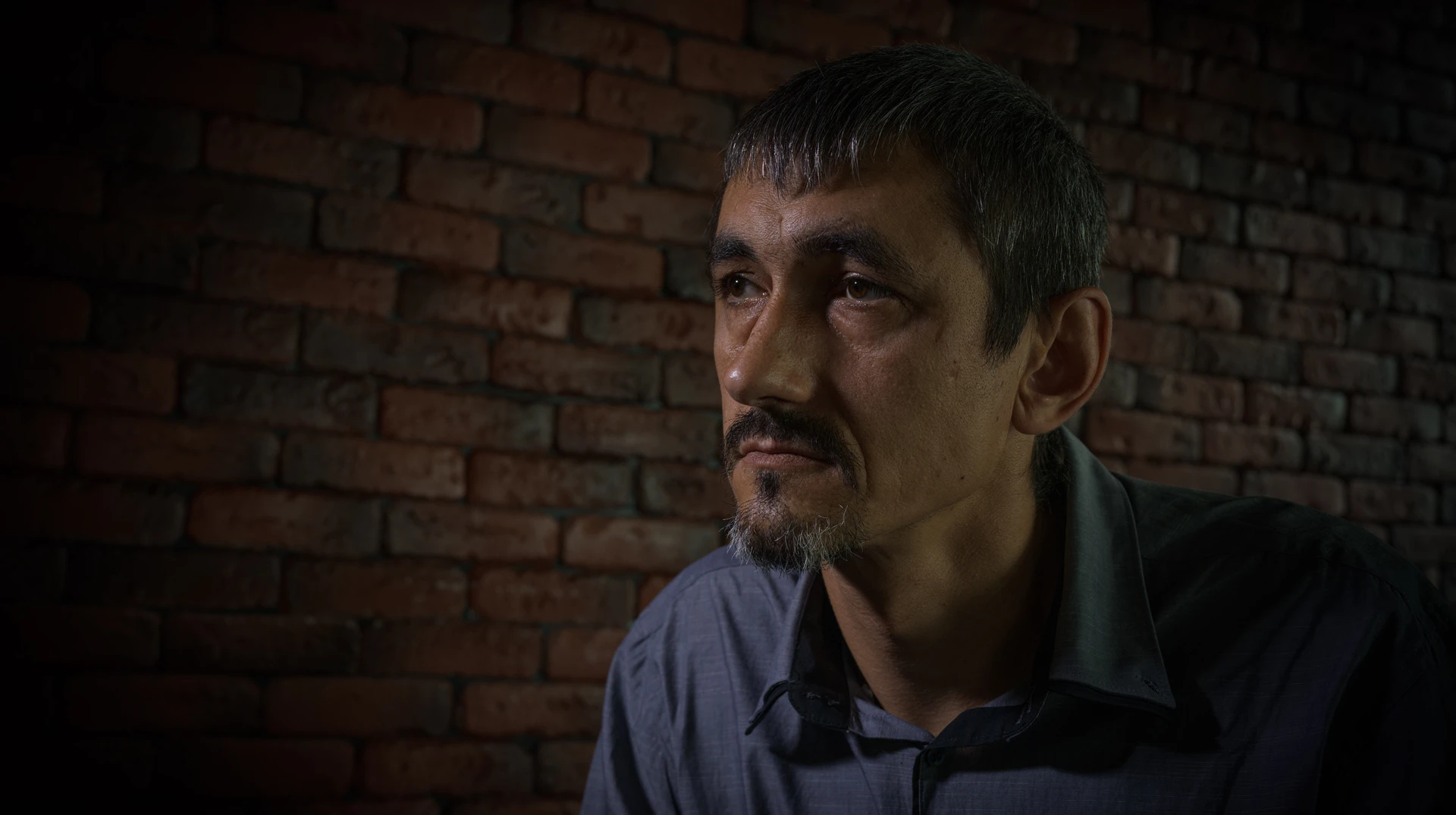
He calls torture a "spectrum of procedures" and prison a "sanatorium". The story of a Kherson resident who created the first men's network of torture chamber "graduates"
Source: Ukrainska Pravda
Author: Olena Barsukova
"Two Buryats beat me 'for not knowing the Ukrainian language.' They said a phrase in Ukrainian and asked what it meant. I replied, 'I don't know.' ‘Oh, you don’t know Ukrainian?’ And they dragged me out of the basement into a room where they beat me for about twenty minutes,” says 40-year-old Oleksiy Sivak, apologizing for his Russian-language remarks. It’s hard for him to switch to Ukrainian, but he tries to speak it during the interview.
Oleksiy is a former sailor from Kherson who spent 17 years at sea. In February 2022, he was supposed to travel to Odesa to set sail on his next voyage, but the occupation derailed his plans. His wife and his disabled mother-in-law were at home, so he never left the occupied city.
The hope for a swift de-occupation gave him resolve: Oleksii attended pro-Ukrainian rallies, posted anti-Russian flyers, and, together with like-minded people, made effigies of “dead Russians” so that the occupiers would not feel at ease in the city. Almost immediately, he began volunteering—together with his neighbor Roman, he delivered food and essential supplies to the elderly.
On August 24, 2022, Ukraine’s Independence Day, the activists hung a Ukrainian flag in the city. The next day, the Russians seized them both.
Oleksii was beaten and detained in front of his wife. He spent the next 59 days in basements until fate took a turn for the better: there wasn’t enough room in the truck that was supposed to transport the captives to Russia. Oleksiy was released.
After his release from captivity and the de-occupation of Kherson, he and a neighbor searched for his freed cellmates and formed sporadic “self-support groups.” Over time, these small gatherings grew into the civil society organization “Alumni”—Ukraine’s first network of civilian men who had survived torture and captivity.
The name of the network came about by chance: when former cellmates were gathering, Oleksii’s wife joked, “What’s going on here, an alumni reunion?” Later, he learned that the English word “Alumni” can refer to both university students and former prisoners. So they decided to keep the ironic name.
Today, “Alumni” helps civilians who have survived captivity: from filling out applications and providing legal consultations to offering psychological support and “peer-to-peer” groups. The organization also collaborates with prosecutors and investigators in war crimes cases to document the testimonies of former captives.
"Graduates" were among those responsible for Russia being mentioned in the UN Secretary-General’s report as a state that systematically uses sexual violence against prisoners.
In an interview with "UP. Life," the founder spoke about the "graduates'" experiences, dark humor and mutual support groups, the difficulties in establishing the status of civilian prisoners of war, and the importance of remembering all war crimes committed by the Russian Federation, not just sexual violence (SNPK).
Important: This material contains descriptions of sexual violence and torture and may be traumatic.
How do “Graduates” help men who have survived captivity?
– We help every man with whatever he comes to us with: we fill out the application together, refer him to a lawyer, or simply listen. The NGO was founded as a platform for men to speak out publicly. Because everywhere else, they supposedly offer help to victims, but when you reach out—it’s mostly about women and children.
Our focus is specifically on civilian men. For over a year now, “peer-to-peer” meetings have been taking place in Zaporizhzhia, Kyiv, and Kherson. Sometimes we get together just to chat, discuss common problems, and laugh about what we’ve been through. We try to move on with our lives. We’re constantly being treated as “victims,” so we gather among ourselves—no outsiders.
Waiters are sometimes surprised by our jokes, or when they hear that we’re having a “reunion.” Because our group consists of men aged 20 to 70.
We send the guys who are already more stable and active at the meetings to training sessions with a psychologist and psychoeducation. Because when new participants join us, there can be different reactions at the meetings. The others need to be prepared.
Our logo is this: a brotherly hand that pulls you to the bright side. The group shares its positivity. There was a time when one person said: “I thought I’d gone through the end of the world, but after sitting with you, I hear—the guys are laughing, and their situation was 10 times worse than mine.”
– You mentioned that you feel victimized. Where does this feeling come from?
– Everywhere in society, even in humanitarian organizations. Our country is currently going through an experience the world has never seen before. Everyone came to us with their own past experiences, but here it’s completely different. No matter how many human rights trainings I’ve attended through my work—it’s incomparable [to the needs here]. There’s a war going on; we need to use different methods. Rather, we should be teaching the world now.
– What kind of attitude is lacking on the part of the very human rights organizations or institutions that provide support?
– There needs to be a victim-centered approach. Many talk about it, but few actually apply it. Law enforcement agencies and the prosecutor’s office are even adapting to new developments, but civil society organizations aren’t always doing so. Aid comes from donors, but donors aren’t allocating funds for what’s actually needed.
This is also a major problem for our organizations: there’s no long-term support. There are also organizations that simply use victims as a resource—hence the victimization and the reluctance to seek help. Those same international workers come, looking for cases of rape and sexual violence. But we went through such a complex series of procedures in the basement that the sexual and non-sexual violence they document and shout about is just a small part of what they did to us there…
They come to a man and start asking about sexual violence. But he had such a complex that he doesn’t know what constitutes sexual violence and what doesn’t. He barely survived; they had to pump his stomach.
– What kind of pain do the men come to you with?
– Hundreds of different prisons, thousands of different stories. When it comes to penetration torture or rape, very few of the men survived. The [Russians] operated mobile crematoriums. Those who survived were mostly tortured with electric shocks to their genitals.
One of the men was so badly tortured that he couldn’t go to the bathroom for a week; everything was swollen. A "corridor guard" came into the cell, slashed him with a knife, and that was it.
It wasn’t like they dragged you down to the basement, led you by the arm, and sat you down. They started beating you right in the hallway, hitting you wherever they could. They beat you with batons and kicked you. At the same time, wires from the “taper” were attached to your ears, genitals, and fingers. It’s a whole ordeal. Someone sits there, taking notes, asking questions. In the corner, the “seniors” are drinking coffee.
Once you’re in the basement itself, within literally a minute you’re no longer in your right mind. Everything human shuts down there; you’re just surviving. I “left my body” and watched as they beat me from above.
We [in Kherson] ended up in torture chambers where there were Russian interrogators, and there were even worse [places] than ours—where the military units were. If we had a sort of “school” where they “Russified” us and beat information out of us, then there they simply tormented people.
For example, we have a man with many children whose village was under occupation for nine months. For 8.5 months, they took him away every morning, beat him, brought him back in the evening, and threw him out. The village was surrounded—where could you go with children? And [after de-occupation] they come to him: “Were you raped?” – And yet the topic of sexual violence is shrouded in shame and taboo. Why do you think that is?
– Sexualized torture is used to humiliate a man as much as possible. It’s a difficult philosophical question as to why it’s hard for men to speak up. Again, society as a whole has shaped this attitude: for example, any mother or grandmother, when a boy falls, will say, “Don’t cry, you’re a boy.” Speaking of our investigation—why should men open up if we’re being charged under Article 438 (Violation of the Laws and Customs of War) anyway? Whether a shell hit your house, a shell hit your car, or a Russian soldier raped you.
When we started talking about justice, men began to open up. According to statistics, out of over a thousand who applied for interim reparations, 70% were men. The interim reparations project showed that when you explain to men that sexual and gender-based violence (SGBV) isn’t just rape—it’s a whole range of different experiences—and that they’ll receive assistance, payments, and ongoing support, then they see the point.
I didn’t really hide anything. I went straight to the investigators and told them everything that had happened to me. I didn’t specifically go in for SGBV, but for war crimes—unlawful detention, inhuman treatment, and so on.
But when they come to the men and start asking only about sexual violence—that’s simply downplaying what they’ve been through.
– And why, in your opinion, do they single out sexual violence like that?
– Because they consider it the worst thing that can happen. I was talking to someone from the international community: “Where are the scales that determine who suffered more and who suffered less?” If we’re talking about the occupation, I’d say 40% of the population living under occupation experienced the SNPC. There were dozens of checkpoints, and there were all kinds of stories there.
I endured 59 days of torture, even though I was taken down to the basement for interrogation only four times. Someone was being beaten downstairs around the clock; I waited around the clock for my turn to be beaten; the door could open at any moment—and I had to shout “Glory to Putin and Shoigu” or sing the Russian national anthem. Or just in the middle of the night, when there was nothing else to do, [the guards] would throw a baton into the corridor—whichever cell it landed in, that’s the one they’d beat.
You lie there, listening to a woman being tortured down in the basement, and you don’t know—is that your wife or not? They’d bring you into the cell, say, “You’re next,” and not come for you for a day. Sometimes it was better if they took you right away, “processed” you, and threw you into a cell.
Some guys didn’t eat properly for months. Some were kept in a storage room with no toilet—no windows, no light—and had to relieve themselves in a bottle. But they ask about the SNPC.
They could make you sit and watch someone else being tortured, and that’s considered “not particularly suffering.” Although, honestly, psychological trauma is much worse than physical. At least physical trauma is visible in some way.
They did whatever they wanted to our bodies. I, for example, am thin and flexible; I used to play sports. They twisted me into a pretzel, into a knot, and beat me with a stun gun while doing so. I simply can’t describe what it was like there. And when people are only interested in the fact that they attached wires to my genitals and that’s it…
– Did talking about the pain you endured bring you relief?
– Not exactly relief. For me, the goal was to document the Russian Federation’s crimes. Silence implies that it never happened. I believe I should contribute my share to the collective effort against these war crimes. We do have the Shaim List initiative—it’s a small result, but at least Russia was mentioned and threatened with inclusion on it.
– What difficulties did you encounter when creating Ukraine’s first network of men who survived captivity?
– No one was prepared for such a large number of affected men. Furthermore, both internationally and nationally, “civilian prisoners” are not accounted for anywhere and are almost never included in prisoner exchanges.
If you have relatives who can pass on information, you might end up on some kind of registry, but otherwise you just disappear into the prisons. The scariest thing for me was when I almost got sent on a transport [to Russia]. There are these slave labor brigades, to put it bluntly, that travel across Russia for various jobs, and there are only rumors about them.
The hardest thing for us civilians is to prove to our government that we were detained. The Ministry of Development has a commission that establishes the fact of unlawful detention. First of all, it’s absurd that some commission under the ministry establishes the fact of unlawful detention when we have investigators, police, and prosecutors. And right now I have 46 people who were denied. Some have been denied five times, others three. For some, the fact of detention isn’t confirmed because there isn’t enough evidence of a pro-Ukrainian stance.
We try to help each other and provide psychological support. And when a person applies to this commission 5 or 6 times—one year, then another—it takes a psychological toll on them, because they spent a year in a basement proving they weren’t a spy, and now they have to prove to their own people that they aren’t a traitor.
We’ve followed the law our whole lives, paid our taxes, and in 2022 we were simply left to fend for ourselves. We went out against the tanks with pitchforks, the guys with rifles and air guns. And now prove it… No one took a selfie when the train was derailed.
And even if I didn’t do anything, I was a citizen of my country, in my city, at home. Neither the police nor anyone else protected me. [The Russians] came, put a bag over my head, beat me in front of my family, and took me away.
And among international journalists, there’s a small percentage—thank God, a small one—who ask, “Didn’t they give you a lawyer?” I joke: “Yeah, he was sitting in the next cell.” “What about the Red Cross?” Yeah, with a bag over my head.
– How does the commission justify denying you status?
– The commission starts citing those sections of the law where you have to prove your pro-Ukrainian stance or defense of territorial integrity.
I have a few cellmates with whom we were held together for several months. When my case was approved, I wrote in the explanatory note that this man was in our cell and demonstrated a pro-Ukrainian stance. Denied.
For example, one was detained during a document check on suspicion of collusion or something else—his case was approved. There is another who attended pro-Ukrainian rallies—he was denied. The commission didn’t have enough votes.
We don’t know the reason—[the Ministry of Reintegration] isn’t engaging with us fully. Now, we might write some kind of collective appeal to the Human Rights Commissioner.
Because even those civilians who were released in an exchange are immediately picked up by volunteers and taken to medical facilities. But I was simply kicked out because there wasn’t enough room in the police van when they were fleeing from Kherson. Some were taken out into the fields to be shot, but they couldn’t bring themselves to do it. Some from that side miraculously manage to escape, across the river, by back roads.
And by the time you gather this stack of documents, submit it to the commission, and they review it—that takes at least a year. For a whole year, the person has no protection at all; they can’t access any services. And the commission even starts turning people down. A person needs to receive assistance as quickly as possible. But here, they’re simply left to fend for themselves.
I know someone who even has papers from the FSB stating that he was released—they gave him these so he could pass through the checkpoints. And they didn’t verify his status.
– Tell us how your community members help each other.
– We have this principle: when I help someone, I always ask—I helped you, so you help someone else. Right now, there are communities in Zaporizhzhia, Odesa, Kharkiv, and Kyiv. Those who were in captivity before 2022 have now regained their confidence and are sticking together as well.
One guy didn’t come to our meetings—after being held captive, he was afraid to leave the house. We just ordered him some sushi and slipped in a note, just like in a prison cell—“a care package.” He was happy. That “care package” got him to the next meeting.
Someone comes in and says, “I’ve finally unloaded here,” and starts helping others. To me, every guy is a hero. I’m proud of every one of them.
– What helped you the most in your recovery?
– I’ve always lived for my family. My wife was by my side. We also have a mother with a disability, so it’s all about mutual support here.
And work helped, too. I work from 5 a.m. to midnight. The interim reparations program supported me, and I managed to get the “Graduates” network up and running.
– What kinds of problems do the guys share when they return, specifically in the context of family?
– In our case, most of the guys—98%, I’d say—don’t live with their wives because they’re abroad. That’s because they’re all from dangerous regions: Kherson, Zaporizhzhia, and the Kharkiv region. So the main problem is distance. And those who are nearby support one another.
– What is difficult about returning to civilians who haven’t gone through what you have?
– A lack of understanding. For example, at work, when I was working, someone would say to me, “Why did you end up there?” I’d reply, “I was hanging flags.” – “You had nothing better to do; I didn’t end up there.” I say, “Dude, it just hasn’t happened to you yet.”
Another friend found out about the amount of reparations and said, “Why didn’t you turn me in? We were in it together.” Friends downplay the whole thing, and you can’t really tell your relatives much either. That’s why I only “vent” to those closest to me.
– Have you encountered a lack of understanding of the context from foreigners?
– I remember there was this foreign freelance journalist. And she was grilling this one man so intensely about sexual violence: “Do you have any X-rays?”
I sat there half the night in that state… I should have just given him a therapy session.
The man had been through 9 or 12 prisons—Hola Prystan, Henichesk, Crimea, and then further into Russia. He was ready to talk, but now he doesn’t want to give interviews.
– Your name is the result of dark humor. What other examples of dark humor have been helpful to you?
– At the very least, I call torture a “spectrum of procedures,” and prison a “sanatorium,” where “tapik” replaces the hookah. Not everyone will understand this.
In the cells, there was torture 24 hours a day—a few hours of physical torture, the rest of the time psychological. It was only through this dark humor, sometimes whispered, that we survived.
We recall with humor how people ended up [in captivity]. Like when they threw a drunk guy into someone’s cell at 3 a.m.—and he was banging on the door, asking for “salt for the tomato.” It’s funny to us now, but back then the door would open and they’d beat up the whole cell.
We have a saying among ourselves: “NATO in the house” (instead of “evening in the house”—ed.). There’s a shift toward prison slang; we can’t do without it anymore. Sometimes the waiters’ hair stands on end from such “graduates.”
– Have all your former cellmates returned from prison?
– When the Russians were fleeing Kherson, I’d say they took away about 60% of the people from all of Kherson’s torture chambers. There just wasn’t enough room for me. And among my cellmates, I’ve probably only found a quarter of them. The rest were scattered. I know there are guys in Henichesk, and some are in Russia. A lot of them were taken away, and we’ve lost track of them.
– How many “graduates” have filed complaints with the prosecutor’s office regarding war crimes?
– First and foremost, we help every man file a report with the investigators. We explain that this is a contribution to the common cause. If we don’t file reports, it’s as if it never happened.
Our Kherson police department is held up as a model for investigating war crimes; since 2023, we’ve established cooperation with prosecutors and investigators.
– Have there been any initial results in the form of convictions?
– I don’t know about that. In my case, only the “corridor guards” have been identified, and I think technical hearings are currently underway. I just don’t have enough time to figure out where my case stands. The verdict will be rendered in absentia, and if necessary, the prosecutors will find me and notify me.
Civil society organizations collect data and then disappear. One guy here is setting a new record: his testimony has been documented 19 times by various organizations. My story was documented twice, and then they disappeared.
– Tell us more about the “shame list” initiative. There is a UN shame list regarding crimes against children, and you were the first to call for the creation of one regarding sexual violence. Does this document exist now?
– No, there is no shame list at the moment. Russia was only mentioned in Secretary-General Guterres’s report. They warned that if nothing changes, it will be added to the shame list next year. They expressed yet
another “concern.” Work on this has been ongoing since 2024. Our network had prepared an amateur appeal to the UN in Ukrainian. Then we came together as four organizations: on December 29, Alumni, “SEMA Ukraine,” and “Come on, Sisters.” We wrote a letter of appeal to Secretary-General Guterres. We were supported by [Government Commissioner for Gender Policy] Kateryna Levchenko; then foundations took up our initiative and drafted their own legally substantiated appeal.
At least Russia was included in the report as a country that uses CSTF as a weapon of war. Many people and organizations worked on this. And our initiative is just one of many that led to this.
But no matter how much the Secretary-General takes credit for this, people will still suffer; they will still be raped and killed under occupation. So this is a very small achievement for me.
– What is your main goal right now as the head of the organization?
– Like a samurai: there is a path, but no goal... (laughs)
One of our initial goals is to speak up for those people who are still in prison. I understand: if I were taken to Russia, I wouldn’t be able to speak out strongly. That’s why we need to be the voices of those guys. We need to do everything possible to ensure that the public learns about the civilians and that the state begins to provide full assistance. And on the international level—to make Russia answer for its actions.
– Do you believe that this is possible?
– Faith dies first, love second. For now, we live on hope.
This is an automatic translation generated by DeepL.