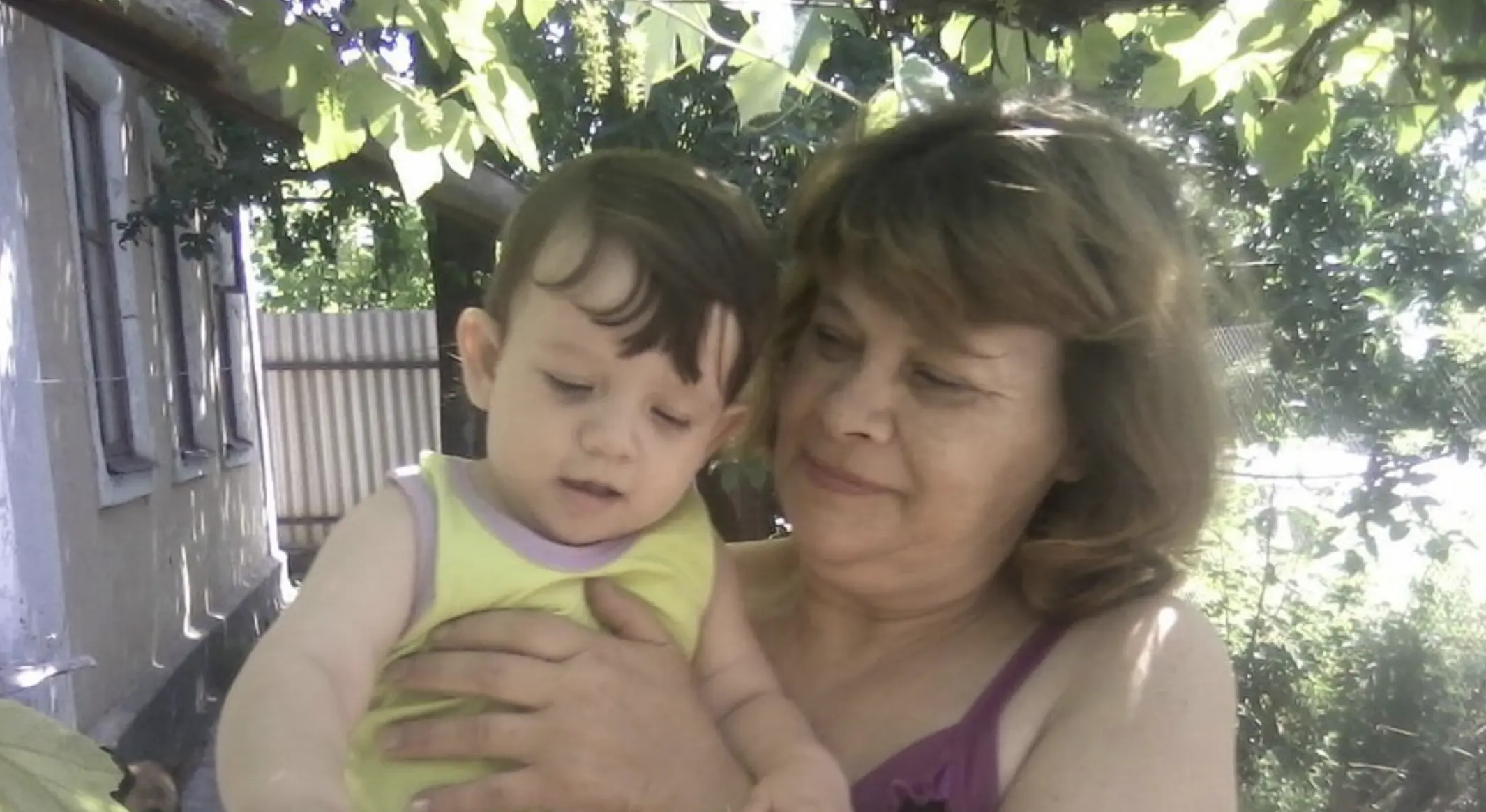
"Grandma, can I call you Mom?" The story of a woman who crossed the borders of four countries for her grandson
Source: Suspilne
Author: Natalia Fedorova
Suspilne Donbas has prepared a series of articles titled “Stories That Move You.” The protagonists of this project are internally displaced persons—people who had to leave their homes and jobs, keeping only their cherished belongings and photo albums featuring pictures of different generations of their families in their memories.
This woman was born in Mariupol; she went to school there and worked there. Circumstances led her to move to Uzhhorod with her younger son in 2017. A mother of four children and grandmother of three, she is now retired. She had to endure the shelling in 2014, watching shells fly over the heads of the city’s residents… And in 2022—she had to appeal to the Office of the President of Ukraine, cross borders, and evacuate her wounded grandson. A crucial rescue operation took place, and everything worked out for the Ukrainians. Olena Matviienko tells Suspilne about what she had to go through, and how hope and faith in victory give her strength.
“Only I can do
this” — Olena, how did you find out that your grandson was in occupied Donetsk?
“On the evening of March 26, my middle son—he’s 36 and lives in Austria—called me. He said, ‘I’m going to send a video to my younger brother right now, but Mom, please don’t watch it.’ It was a video featuring Ilyusha, my grandson, filmed in Donetsk by a crew from the Russian company “Mars Media” for a Russian audience. The story was about how doctors in Donetsk were saving a boy—an orphan from Mariupol. A distant relative of ours saw this story in Lipetsk, Russia, copied it, and sent it to my oldest son in Austria. “Well, of course, I immediately sensed that something terrible had happened. And, of course, I watched the video,” Olena pauses, as tears make it hard for her to speak. Then she continues: “I saw my 10-year-old grandson, Ilyusha. The boy is lying wounded in Donetsk, and a journalist is interviewing him… The little boy says that his mother—who is my daughter—has been killed. I screamed and cried. But suddenly I realized—I had to pull myself together immediately and do something urgently, find a way out, help Ilyusha. And only I can do that! By March 27, I was already running around to all the authorities to get Ilyusha out of Donetsk.” It’s hard not to notice that Olena Mykolayivna knows how to manage her emotions. Life has forced this woman to be strong and rely on her own strength. And she’s been through so much...
After that, there was no contact with anyone
— So you had no idea what had happened to your family until you saw that TV report from occupied Donetsk?
“The last time I heard my daughter’s voice was on March 13,” the woman recalls. — It was a very brief conversation: ‘Mom, I’m still alive, I’m in the basement. But I won’t call again!” After that, I couldn’t get in touch with anyone,”—and she repeats once more: “No one!”
She says she has so many friends in Mariupol, but she couldn’t reach any of them. Not even her granddaughter, who was studying at a university in Kharkiv and had come to stay with her mother when the war began. “The last thing I heard from her was: ‘Grandma, we’re hiding in a basement on the Left Bank near the Budivelnykiv Cultural Center. My granddaughter’s father, my eldest son, was a paratrooper who served in the Armed Forces of Ukraine. He died of a terminal illness in 2014. I still don’t know anything about my granddaughter,” Ms. Olena sighs.
She then admits that while she was in Uzhhorod, she couldn’t even imagine that such terrible events could happen in eastern Ukraine. Since 2014, Mariupol had been unsettled; shelling was often heard, as the city was located near the “line of contact.” But the city was being rebuilt; it was developing.
“When I arrived in Mariupol in 2021, I didn’t recognize my city. Mariupol had become more beautiful. All the public transportation—buses and trolleybuses—was new. All the buildings had been repaired and restored. There were lots of flowers and illuminated fountains.”
When the bombing of Mariupol began on February 24, Olena immediately called her daughter and told her they needed to leave the outskirts and head to the city center. She, Natalia, and Ilya stayed at a hotel for six days until March 2, when communication and electricity were cut off. Then they moved closer to the city council building. There, they hid in the basement of a twelve-story building for twelve nights.
“The city center had already been destroyed, so my daughter decided to return to her home on the outskirts of the city. For about three hours, she and her son walked under heavy fire. They had no idea that their home had been bombed,” the grandmother now knows about these events from her grandson’s account. It’s hard to recount such terrible events. But it must be done, because these are testimonies to the war crimes of the Russian army, Olena believes.
She now knows that a neighbor took in her 10-year-old grandson and her daughter. On March 20, an explosion went off right next to the house. Ilya and Natalia suffered severe injuries. The neighbor dragged the injured children into the basement. Ilya’s mother had a shrapnel wound to the head—the boy had multiple injuries to his limbs and forearms. Natalia died in front of her son.
That night, Russian soldiers entered the basement and said it was an evacuation. First, the wounded boy was taken to Novoazovsk, then to Donetsk, to a hospital.
“In Donetsk, the boy received medical care. His left thigh had been completely torn off, and there was a large piece of shrapnel in his right leg. They performed the first surgery without anesthesia and removed that large piece of shrapnel. The boy told me, ‘Grandma, I felt everything, I saw everything, I remembered everything. It hurt so much.’ And then they performed two skin graft surgeries on him. At first, they wanted to amputate his leg, but then the doctors noticed that he could move his toes. They saved his leg and began treating it. But even in Kyiv, they were only able to remove four shrapnel fragments; they couldn’t remove the other eleven. “There are eleven shrapnel fragments in his leg, but they’re small. They can’t perform any more surgeries—everything there has already been cut up,” Olena laments.
“I’m sure everything worked out for us because this story became known all over the world.”
— How did you manage to get to Donetsk and bring your grandson to Kyiv?
“How did I get to Donetsk? Valeria Gabor—the director of the charity organization ‘Uzhhorod Strength Charitable Foundation’—helped me with everything. All the documents were prepared for me as early as March 28. We reached out to the Office of the President, and Deputy Prime Minister—Minister for the Reintegration of the Temporarily Occupied Territories of Ukraine—Iryna Vereshchuk got involved right away.”
Olena Matviienko emphasizes that she communicated with Iryna Andriivna personally. For example, Ms. Iryna called the woman and explained: “Olena Mykolayivna, you won’t be traveling alone. You’ll be traveling with the girl’s grandfather from Chernivtsi; he’s also going to pick up his granddaughter. Get ready right away—a car will be here shortly.”
“So on April 17, we left Kyiv by car,” says Olena Matviienko, — then we took a train to Poland, from Poland a flight to Turkey, from Turkey a flight to Moscow, from Moscow a train to Rostov, and from Rostov by car to the so-called ‘DPR.’ And there, on April 24, Oleksandr picked up his granddaughter, and I picked up my grandson.” Already on the way, the boy told his grandmother that “some men” were taking Mariupol children—orphans—from a hospital in Donetsk to Moscow.
“Everything worked out for us because this story became known around the world, gained widespread attention, and international human rights and children’s rights organizations learned about the situation. So many organizations were involved, so many countries!” emphasizes Ms. Olena. “I’m so grateful to everyone who helped Ilya and me get back! These are many different people from different countries, including high-ranking officials and citizens from various professions!”
They took the same complicated route back to Ukraine. Ilya still couldn’t walk, so they arranged for a large vehicle so he could lie down inside. Then, in Kyiv, Ilya and his grandmother were taken to “Okhmatdyt.” The boy was treated there for a month and a half.
“It was like a miracle!” Olena finally smiles, as these are fond memories. “I’d look at my grandson, and he was getting better—I’d see his leg straighten out, I’d see him stand on his heels, and he started squatting. You can’t imagine how happy I am that my grandson has started walking! Thank you to the doctors at “Okhmatdyt”! After the hospital, we returned to Uzhhorod,” adds Olena. “I’m continuing his treatment; I change Ilyusha’s bandages myself. “No, he’s not running yet—he’s still limping—but the most important thing is that he’s back to a normal life. There are still reasons to worry, though, because the boy had a concussion, and he needs to work with a psychologist…”
“I’m both your mom and your grandma
now” — Olena, please tell us about your current living conditions and your plans for the future.
“It’s good that the child has calmed down; he feels safe and at peace here in Uzhhorod. Ilyusha feels protected by his biological uncle—my younger son. Serhiy, my younger son, is 18 years old. He’s currently preparing to apply to Uzhhorod University. Ilyusha jokes, ‘Serhiyko isn’t my uncle—he’s my brother!’ And I’ll do everything I can to make sure my grandson is healthy and happy. Ilyusha feels our immense love!” says Olena Mykolayivna with confidence. And she gives this example: “Once, Ilya asked, ‘Grandma, can I call you Mom?’ I replied, ‘Yes, you can. Right now, I’m both your mom and your grandma.’”
"My son and I couldn’t believe that my daughter had died until my friend from Mariupol took a photo of my daughter’s grave and then sent it to us. It’s in the courtyard of the building where Natalia and Ilya used to live. Now it’s a ruined house on the outskirts of Mariupol. My apartment and my son’s apartment in our hometown have also been destroyed.”
In Uzhhorod, they live in a dormitory. They say it’s cozy there and that they’ve renovated it. It consists of two spacious rooms, a separate entrance, a bathroom, and a small hallway. They cook on an electric stove. “And we also have pets—a very smart cat and two hamsters. Ilyusha is absolutely thrilled with them,” says the courageous woman Olena Matviienko. “My grandson really likes Uzhhorod, so we decided that we’ll live right here. Of course, we’d like to get an apartment, but this issue—compensation for our destroyed home in Mariupol—is something we’ll only address after victory. The most important thing is that Ilya is with us now!”
This is an automatic translation generated by DeepL.