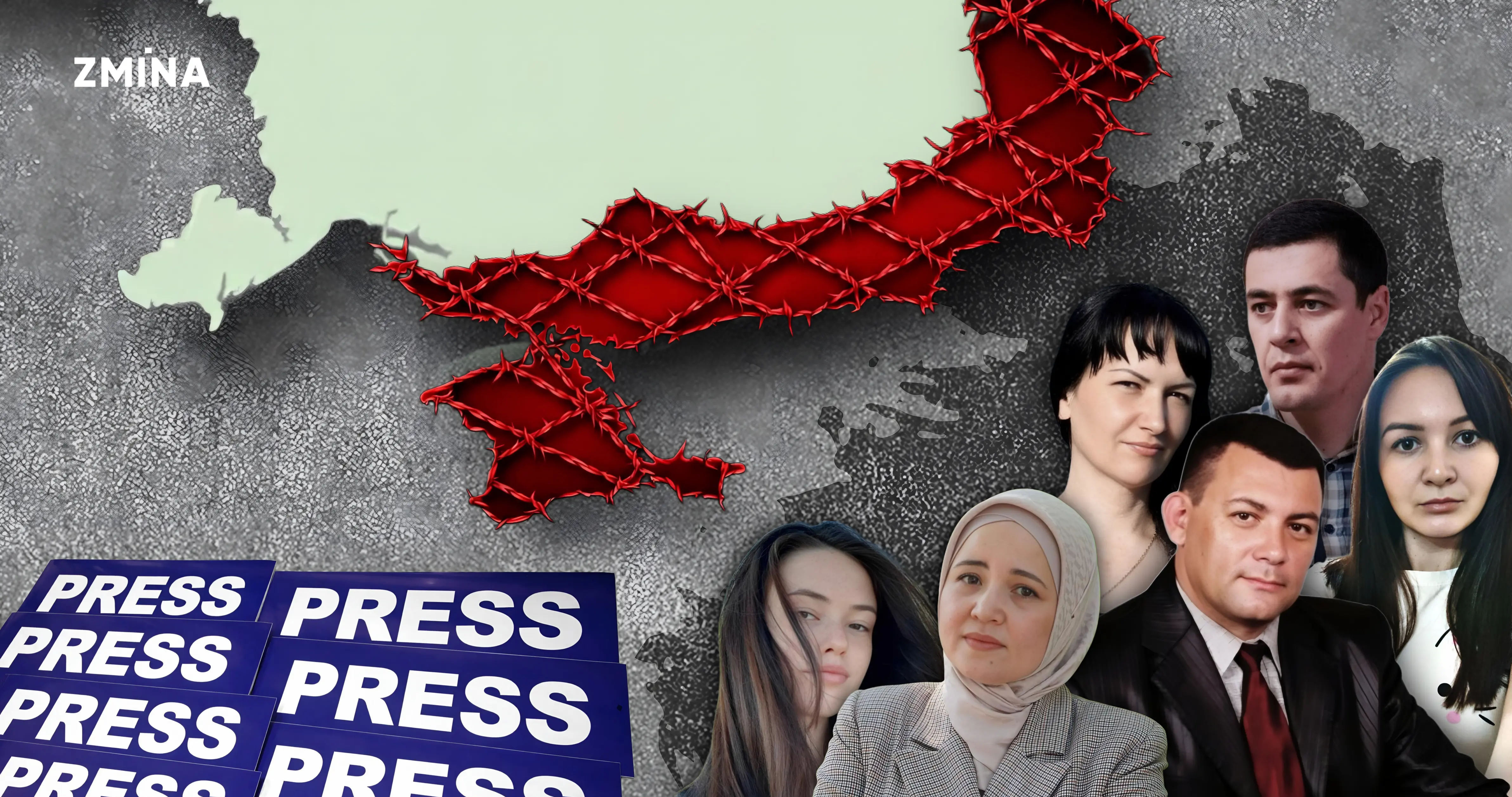
Freedom of Speech in the Occupied Territories: Repression and New Mechanisms of Pressure in 2025
Source: Zmina
Author: Oleksandra Yefimenko
In 2025, the state of freedom of speech in the occupied territories of Ukraine continues to deteriorate rapidly. The occupying authorities are employing new mechanisms of pressure: blocking social media, administrative and criminal cases against journalists, economic persecution of the media, and intimidation of the relatives of imprisoned journalists.
And while some journalists are returning home after imprisonment, most independent media outlets have come under the full control of the occupiers or have shut down. After 2022, many left the occupied territories, as Russian authorities introduced new regulations regarding “fake news” and the discrediting of the Russian army, and also restricted media advertising.
Viktoria Nesterenko, a human rights activist and project manager at the organization ZMINA, explains that the mechanisms for suppressing freedom of speech in 2025 have become more sophisticated:
“The Russian occupying authorities are constantly looking for new ways to control the information space. They block social media, intimidate journalists, and persecute those who hold pro-Ukrainian views. This persecution includes physical threats, administrative fines, criminal cases, and even pressure on journalists’ relatives. This creates an atmosphere of fear and self-censorship among citizens.”
One of the key cases in 2025 was the persecution of Crimean Tatar journalist Lutfiye Zudieva, who was added to the list of foreign agents. This imposed on her the obligation to submit regular financial reports and reports on her activities. Regional media outlets face similar pressure, such as the newspaper “Kyrym,” which is published in the Crimean Tatar language and covers human rights issues.
“In 2025, we recorded the first instance of a journalist in the occupied territories being added to the list of foreign agents. This is both economic and psychological pressure: from the obligation to report to the occupiers to regular searches and administrative cases. The occupying authorities cannot directly ban the activities of independent journalists, so they invent new mechanisms of pressure. This is a signal to everyone still working under occupation that any criticism could cost them their personal freedom,” says Viktoria Nesterenko.
Another sign of pressure has been the blocking and closure of independent media, as well as restrictions on journalists’ access to the courts. As the human rights activist notes, systematic persecution encompasses not only administrative and criminal cases but also economic methods:
“Restrictions on advertising for media outlets, blocking websites and social media—these are effective ways to deprive journalists of financial resources. Declining revenues force newsrooms to close, and even those that remain cannot operate fully. There have also been documented cases where journalists and their families are subjected to additional harassment to influence their work from a distance.”
Among other alarming trends is the deterioration of conditions for political prisoner-journalists. Human rights defenders have documented cases of denial of medical care, restricted access to basic services, and inadequate food. For example, Amet Suleimanov requires regular medical procedures, yet parcels containing the necessary medications do not reach him. Similar problems are observed with Iryna Danilovych and Remzi Bekirov: the former previously complained about lights that were constantly on, making it impossible to sleep, while the latter is frequently sent by the prison administration to solitary confinement with poor food conditions.
“We see a systemic problem with the Russian Federation’s penitentiary system and in the temporarily occupied territories: detention conditions remain hazardous to health. The administration of prisons and detention centers does not meet basic needs, and human rights mechanisms often do not work. This creates additional pressure on journalists who are already facing administrative and criminal prosecution,” comments Viktoria Nesterenko.
Despite the difficult situation, some journalists have nevertheless returned home or completed their sentences. In 2025, UNIAN journalist Dmytro Khylyuk and Mariupol journalist Mark Kaliush were successfully returned as part of prisoner exchanges. This is an important signal that even under such conditions, certain international and human rights mechanisms can work.
Also, in June 2025, Vladislav Yesipenko, a freelance journalist for the “Crimea.Realities” project (Radio Free Europe/Radio Liberty) and the ICTV television channel, was released after four years and three months of unlawful detention in Crimea. He was detained back in March 2021 on charges of allegedly storing and manufacturing explosive devices—the occupation court initially sentenced him to six years in a penal colony, and the appeals court reduced the term to five. Yesypenko served his sentence under the “one year for one and a half” system at Kerch Colony No. 2 and was released after serving his full term. Therefore, this case cannot be considered a complete victory, despite active advocacy for his release, particularly on international platforms.
However, thanks to the assistance of human rights defenders and foreign partners, Yesipenko managed to avoid re-arrest and new charges, which were often applied to other political prisoners—as in the cases of Hennadiy Lymeshko or military expert and journalist Dmytro Shtyblikov. The latter was due to be released after completing a five-year sentence in the case of the so-called Crimean saboteurs on November 8, 2021, but on the same day he was transferred to Rostov-on-Don and faced new charges of “treason.” On April 29, 2022, the Ukrainian was sentenced to 19 years and 6 months in a strict-regime penal colony. Russian media portray Dmytro as a “high-ranking spy for the Main Intelligence Directorate of the Ministry of Defense.”
“Although freedom of speech in the occupied territories is generally only getting worse, the return of some journalists is an important sign for the entire media community. It demonstrates that the occupiers’ pressure is not unlimited and that international support can have an effect. At the same time, we see that many people remain at risk, and new mechanisms of pressure continue to emerge,” says Nesterenko.
For instance, journalists in occupied Melitopol are facing persecution. The administrator of the Telegram channel “Melitopol Is Ukraine,” Yana Suvorova, whom Russia has been holding hostage since August 2023, was sentenced on October 23, 2025, to 14 years of imprisonment in a general-regime penal colony under the charges of “Organization of and participation in a terrorist group,” “Terrorist act,” and “Espionage.” Journalist Anastasia Glukhovska was initially held in the basement of the “Ruslan-Komplekt” enterprise, which the occupiers had turned into a torture chamber, where, according to witnesses, she was subjected to electric shock torture and violence. It recently came to light that Irina Levchenko, a journalist from Melitopol who was detained along with her husband in May 2023, was transferred from the Donetsk pretrial detention center to a detention facility in Simferopol, likely in preparation for her trial.
Also, in December 2025, the Russian Federation’s court of cassation denied a request to reduce the prison term of Ukrainian journalist Hennadiy Osmak from Henichesk, upholding the original sentence of three years and two months. Over the course of two months, he was transferred to Colony No. 6 in the village of Melechovo (Vladimir Oblast, Russian Federation), where he was subjected to physical and psychological torture. Osmak has no access to diabetes medication—his family is prohibited from sending him medicine, which seriously threatens his life.
Freedom of speech issues in 2025 reflect the occupiers’ systematic policy: information control, economic pressure, persecution of journalists, and restrictions on access to basic resources. However, Viktoria Nesterenko emphasizes that even minimal achievements—such as the return of individual journalists or a partial improvement in detention conditions—serve as a signal to the community and remind us of the importance of international support.
Author: Oleksandra Yefimenko
In 2025, the state of freedom of speech in the occupied territories of Ukraine continues to deteriorate rapidly. The occupying authorities are employing new mechanisms of pressure: blocking social media, administrative and criminal cases against journalists, economic persecution of the media, and intimidation of the relatives of imprisoned journalists.
And while some journalists are returning home after imprisonment, most independent media outlets have come under the full control of the occupiers or have shut down. After 2022, many left the occupied territories, as Russian authorities introduced new regulations regarding “fake news” and the discrediting of the Russian army, and also restricted media advertising.
Viktoria Nesterenko, a human rights activist and project manager at the organization ZMINA, explains that the mechanisms for suppressing freedom of speech in 2025 have become more sophisticated:
“The Russian occupying authorities are constantly looking for new ways to control the information space. They block social media, intimidate journalists, and persecute those who hold pro-Ukrainian views. This persecution includes physical threats, administrative fines, criminal cases, and even pressure on journalists’ relatives. This creates an atmosphere of fear and self-censorship among citizens.”
New Cases of Pressure in 2025
One of the key cases in 2025 was the persecution of Crimean Tatar journalist Lutfiye Zudieva, who was added to the list of foreign agents. This imposed on her the obligation to submit regular financial reports and reports on her activities. Regional media outlets face similar pressure, such as the newspaper “Kyrym,” which is published in the Crimean Tatar language and covers human rights issues.
“In 2025, we recorded the first instance of a journalist in the occupied territories being added to the list of foreign agents. This is both economic and psychological pressure: from the obligation to report to the occupiers to regular searches and administrative cases. The occupying authorities cannot directly ban the activities of independent journalists, so they invent new mechanisms of pressure. This is a signal to everyone still working under occupation that any criticism could cost them their personal freedom,” says Viktoria Nesterenko.
Another sign of pressure has been the blocking and closure of independent media, as well as restrictions on journalists’ access to the courts. As the human rights activist notes, systematic persecution encompasses not only administrative and criminal cases but also economic methods:
“Restrictions on advertising for media outlets, blocking websites and social media—these are effective ways to deprive journalists of financial resources. Declining revenues force newsrooms to close, and even those that remain cannot operate fully. There have also been documented cases where journalists and their families are subjected to additional harassment to influence their work from a distance.”
Threats to the health and detention of journalists
Among other alarming trends is the deterioration of conditions for political prisoner-journalists. Human rights defenders have documented cases of denial of medical care, restricted access to basic services, and inadequate food. For example, Amet Suleimanov requires regular medical procedures, yet parcels containing the necessary medications do not reach him. Similar problems are observed with Iryna Danilovych and Remzi Bekirov: the former previously complained about lights that were constantly on, making it impossible to sleep, while the latter is frequently sent by the prison administration to solitary confinement with poor food conditions.
“We see a systemic problem with the Russian Federation’s penitentiary system and in the temporarily occupied territories: detention conditions remain hazardous to health. The administration of prisons and detention centers does not meet basic needs, and human rights mechanisms often do not work. This creates additional pressure on journalists who are already facing administrative and criminal prosecution,” comments Viktoria Nesterenko.
Positive Developments and Negative Trends
Despite the difficult situation, some journalists have nevertheless returned home or completed their sentences. In 2025, UNIAN journalist Dmytro Khylyuk and Mariupol journalist Mark Kaliush were successfully returned as part of prisoner exchanges. This is an important signal that even under such conditions, certain international and human rights mechanisms can work.
Also, in June 2025, Vladislav Yesipenko, a freelance journalist for the “Crimea.Realities” project (Radio Free Europe/Radio Liberty) and the ICTV television channel, was released after four years and three months of unlawful detention in Crimea. He was detained back in March 2021 on charges of allegedly storing and manufacturing explosive devices—the occupation court initially sentenced him to six years in a penal colony, and the appeals court reduced the term to five. Yesypenko served his sentence under the “one year for one and a half” system at Kerch Colony No. 2 and was released after serving his full term. Therefore, this case cannot be considered a complete victory, despite active advocacy for his release, particularly on international platforms.
However, thanks to the assistance of human rights defenders and foreign partners, Yesipenko managed to avoid re-arrest and new charges, which were often applied to other political prisoners—as in the cases of Hennadiy Lymeshko or military expert and journalist Dmytro Shtyblikov. The latter was due to be released after completing a five-year sentence in the case of the so-called Crimean saboteurs on November 8, 2021, but on the same day he was transferred to Rostov-on-Don and faced new charges of “treason.” On April 29, 2022, the Ukrainian was sentenced to 19 years and 6 months in a strict-regime penal colony. Russian media portray Dmytro as a “high-ranking spy for the Main Intelligence Directorate of the Ministry of Defense.”
“Although freedom of speech in the occupied territories is generally only getting worse, the return of some journalists is an important sign for the entire media community. It demonstrates that the occupiers’ pressure is not unlimited and that international support can have an effect. At the same time, we see that many people remain at risk, and new mechanisms of pressure continue to emerge,” says Nesterenko.
For instance, journalists in occupied Melitopol are facing persecution. The administrator of the Telegram channel “Melitopol Is Ukraine,” Yana Suvorova, whom Russia has been holding hostage since August 2023, was sentenced on October 23, 2025, to 14 years of imprisonment in a general-regime penal colony under the charges of “Organization of and participation in a terrorist group,” “Terrorist act,” and “Espionage.” Journalist Anastasia Glukhovska was initially held in the basement of the “Ruslan-Komplekt” enterprise, which the occupiers had turned into a torture chamber, where, according to witnesses, she was subjected to electric shock torture and violence. It recently came to light that Irina Levchenko, a journalist from Melitopol who was detained along with her husband in May 2023, was transferred from the Donetsk pretrial detention center to a detention facility in Simferopol, likely in preparation for her trial.
Also, in December 2025, the Russian Federation’s court of cassation denied a request to reduce the prison term of Ukrainian journalist Hennadiy Osmak from Henichesk, upholding the original sentence of three years and two months. Over the course of two months, he was transferred to Colony No. 6 in the village of Melechovo (Vladimir Oblast, Russian Federation), where he was subjected to physical and psychological torture. Osmak has no access to diabetes medication—his family is prohibited from sending him medicine, which seriously threatens his life.
Freedom of speech issues in 2025 reflect the occupiers’ systematic policy: information control, economic pressure, persecution of journalists, and restrictions on access to basic resources. However, Viktoria Nesterenko emphasizes that even minimal achievements—such as the return of individual journalists or a partial improvement in detention conditions—serve as a signal to the community and remind us of the importance of international support.
This is an automatic translation generated by DeepL.