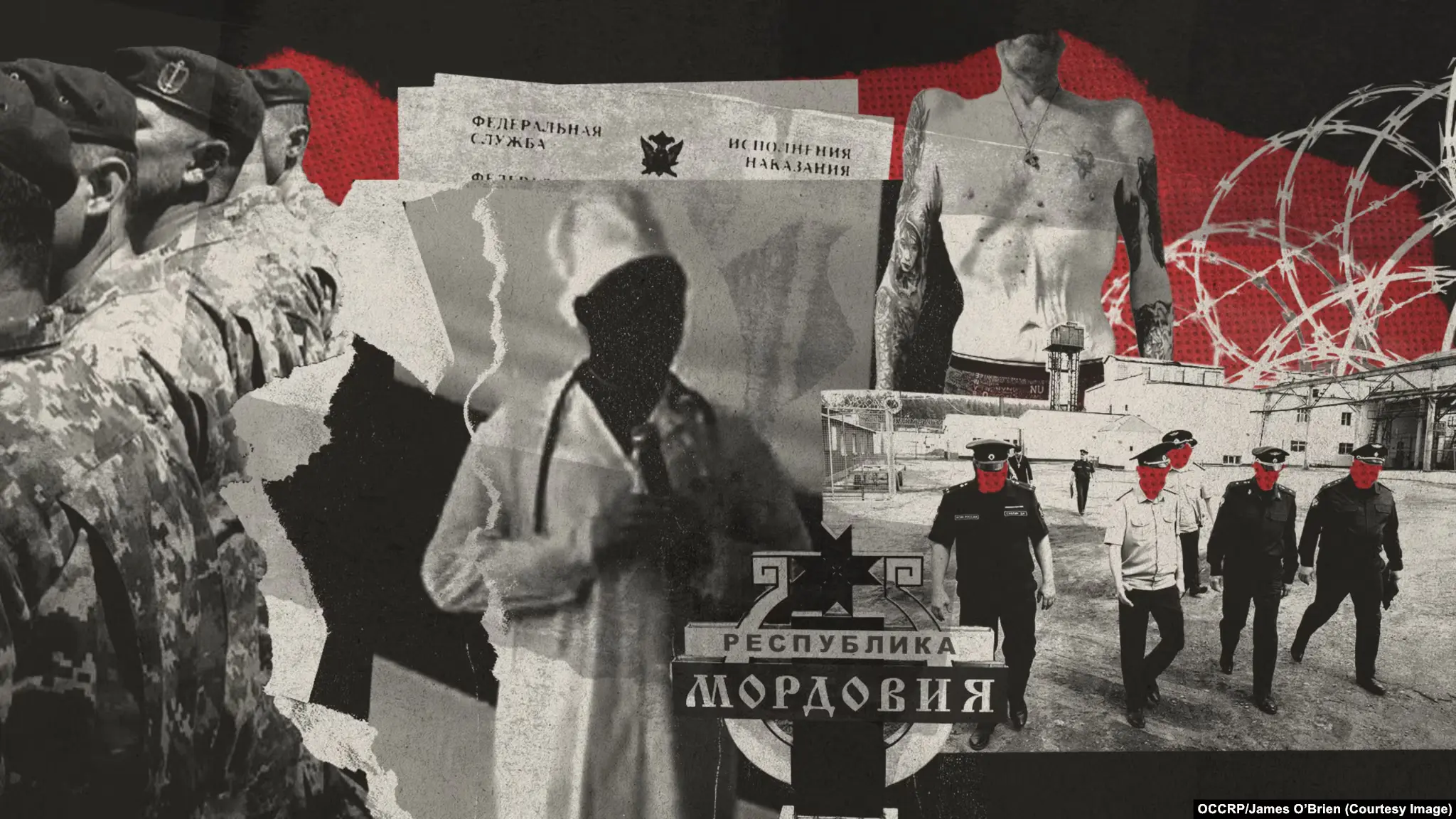
"Dr. Evil". A doctor who tortured Ukrainian prisoners of war in one of the most closed colonies in Mordovia (investigation)
Source: Radio Free Europe/Radio Liberty
Authors: Olga Ivleva, Kira Tolstyakova
Colony No. 10 in Mordovia (a republic within Russia) is a maximum-security facility characterized by strict control and complete isolation of inmates. Since the start of Russia’s full-scale invasion, Ukrainian prisoners of war have been brought there. “Schemes” spoke with several former captives who were held there from February 2023 to April 2025. They described the systematic—both psychological and physical—abuse they endured.
What they remember most is “Dr. Evil”—as the prisoners nicknamed the colony’s doctor, who humiliated and tortured them and refused to provide medical care—which in some cases could have led to the deaths of several Ukrainian prisoners.
Thanks to these testimonies and data from open sources, “Schemes” was able to identify this medical professional.
In their investigation, “Schemes” describes how one of the most secretive prisons in Mordovia operates, how prisoners of war are held there without legal status, and what forms of regular torture take place there. In addition to “Dr. Evil,” the journalists also name other medical staff, employees, and management responsible for what took place within the walls of the Mordovian facility.
For English subtitles, please enable captions in the video settings and select Auto-translate → English.
Authors: Olga Ivleva, Kira Tolstyakova
Colony No. 10 in Mordovia (a republic within Russia) is a maximum-security facility characterized by strict control and complete isolation of inmates. Since the start of Russia’s full-scale invasion, Ukrainian prisoners of war have been brought there. “Schemes” spoke with several former captives who were held there from February 2023 to April 2025. They described the systematic—both psychological and physical—abuse they endured.
What they remember most is “Dr. Evil”—as the prisoners nicknamed the colony’s doctor, who humiliated and tortured them and refused to provide medical care—which in some cases could have led to the deaths of several Ukrainian prisoners.
Thanks to these testimonies and data from open sources, “Schemes” was able to identify this medical professional.
In their investigation, “Schemes” describes how one of the most secretive prisons in Mordovia operates, how prisoners of war are held there without legal status, and what forms of regular torture take place there. In addition to “Dr. Evil,” the journalists also name other medical staff, employees, and management responsible for what took place within the walls of the Mordovian facility.
For English subtitles, please enable captions in the video settings and select Auto-translate → English.
Mordovia – “The Republic of Camps.” Historical Context
Prisoners of Colony No. 10
Colony No. 10 is located in the village of Udarnoye in the Zubovo-Polyansky District of the Republic of Mordovia, which has a population of about three thousand people. The media has reported little about this facility, but the brutality of its staff was known long before Ukrainians arrived there.“Union of Prisoners,” 2012:
“During a search, guards beat two prisoners (...) the latter suffered a traumatic brain injury. After the search ended, the prison guards sprayed ‘cheremkha’ gas into the cells through the ‘feeding hatches.’
Radio Free Europe/Radio Liberty Russian Service, 2014:
“The beating ended when the victims were on the verge of losing consciousness. (...) The prison doctors did not document the physical injuries and did not provide medical assistance to the victims.”
Since then, the cruelty, violence, and torture have not diminished. Only now—it is directed at Ukrainian prisoners. This includes sexual violence—threats of rape, beatings focused on the genitals, and psychological torture, such as simulated executions. Physical torture: prisoners were constantly beaten, often on the back and kidneys, for the slightest offense or even for no reason at all.
“Electric shock torture, standing for 18 hours a day, horrific wounds down to the bone that are festering. All the conditions they are subjected to throughout the day are aimed at destroying their health, destroying their personality. And every action, every aspect of their regime is designed to make things worse, so that today they are one step closer to death,” says Anastasia Savova, co-founder of the “Marine Corps Strength” association.
According to data from open Russian sources, this facility is designed to hold approximately 850 people. Among them are convicted Russian citizens, but they are in the minority. According to information from the Coordination Headquarters for the Treatment of Prisoners of War, as of April 2025, there were about seven hundred Ukrainians there. Among them are many marines who defended Mariupol.
From sources in law enforcement agencies, “Schemes” obtained data on 177 Ukrainian prisoners of war who managed to return from the 10th colony.
Analyzing this information, we found that the first prisoners from Ukraine were brought there on June 26, 2022. The largest shipment (according to data as of April 2025—ed.) took place six months later. At that time, in February 2023, 109 prisoners were brought to the colony at once.
“Schemes” noted that it was during that period that the colony was actively purchasing balaclavas, loudspeakers, video surveillance cameras, and communication devices.
And it was then, in February 2023, that Pavlo Afisov found himself among the prisoners in Mordovia. He is an officer of the 36th Separate Marine Brigade, originally from Chernihiv.
He was taken prisoner in April 2022 during an attempt to break out of Mariupol. He was 22 years old at the time. The Russian army surrounded his group a few kilometers from the city—near the village of Stary Krym.
Afisov spent 920 days in captivity, or 2.5 years. Of those, more than a year and a half were spent in Colony No. 10. He only learned that he had been in Mordovia after the prisoner exchange.
“As soon as I said I was from the 36th Separate Marine Brigade, that I was an officer, a contract soldier—and contract soldiers are their ‘favorite category’—they immediately started beating me. I didn’t count the blows, I tried not to scream, but after 10 or 12 blows, I had no strength left. I apologize for the language—they were beating the shit out of me. And they said, ‘This is for Mariupol,’” recalls Pavlo Afisov.
His journey to the penal colony went like this:
the camp in Olenivka → transfer to Taganrog → from there by plane to Tver → pretrial detention center in Kashin → the village of Udarnoye, Mordovia, where he was brought on February 10, 2023.
On the same day as Afisov, Oleksandr Kirienko, a sniper and senior sergeant of the same 36th Marine Brigade, was also brought to the Mordovian facility.
— I found out I was in Mordovia after I had already been exchanged. There, when you sign documents—like a protocol—they put a sheet of paper on top of the “header” so we couldn’t see who the investigator was, which colony, or which region. On the mattresses and pillows, where there was a brand—everything was cut off, torn out. So there wouldn’t be a single number or letter anywhere,” Kirienko said.
“Did they want to hide all of this that badly?” asked the Schemes journalist.
“Yes, it was like the Gestapo there.”
Oleksandr is from Poltava Oblast and has been serving since 2014. At the time of the full-scale invasion, he was in Mariupol: first at his brigade’s positions, and later, while retreating, he reached the Illich Steel Plant with his unit. Intense fighting was taking place there. That is where they were taken prisoner.
Oleksandr’s route was as follows:
Sartana → Olenivka → Taganrog → Kashin → February 10, 2023 – a penal colony in Mordovia.
During the same period, National Guard soldier Nikita Pikulik was transported to the Mordovian penal colony via a similar route.
He is from Zaporizhzhia, served near Mariupol, and then, along with his comrades, also ended up at the Illich Plant. But, unlike Oleksandr Kirienko, he managed to escape from there. However, later, already in the Zaporizhzhia area, he was captured by Russian special forces. Pikulik spent nearly a year in the 10th colony.
“All the staff always wore balaclavas; they tried to hide their faces. Given the horror unfolding in Mordovia, I wasn’t surprised that they were hiding their faces,” said Nikita Pikulik.
Yulian Pylypei is a Marine Corps company commander. He is originally from Rivne. He was taken prisoner in April 2022 during an attempt to break through to Zaporizhzhia.
He was transported to Mordovia as follows:
from Sartana → to Donetsk → then transferred to Taganrog → from there to Novozybkov in the Bryansk region → and finally to Udarnoye—this was on March 25, 2024.
He recalls how he was greeted upon arrival at the Mordovian colony:
“My cell door opens, about three men rush in, and a fourth—a dog handler with a dog—was outside. They ask, ‘Did you serve time?’ I reply, ‘I don’t understand.’ They said, ‘Did you sit without a command?’ I said again that I didn’t understand. And immediately some slippers were thrown at me, then they started beating my back with a rubber baton. A second one came over and started shocking my arm with a stun gun. The others beat me with their feet, hands, and batons. And he just kept coming over and zapping me with the stun gun every 10 seconds. I had a lot of scars—some healed, some remained. They took me out into the hallway and forced me to shout that I was… a bad word, as we call them. They said, “Repeat: you’re a f***er.” I replied, “No way, I’m Julian.” And this went on for 10–15 minutes. Then they said, “That’s it, crawl back into the cell.” I crawled in; everything hurt. And that’s when I realized—this is Mordovia.”
Using satellite photos and testimonies from former prisoners, “Schemes” was able to determine exactly how Colony No. 10 operates. An industrial block is located in a separate part of the territory. In another part are the administrative building, the dining hall, and the exercise yards where prisoners are taken.
The colony itself consists of four buildings. The first, the largest—that’s where Afisov and Kirienko were held. Pikulyk was held in the third. The fourth building houses separate isolation cells and is used to hold the sick. Pylypei was held there.
According to the prisoners’ testimonies, the second building is not only used to hold prisoners but also to conduct the so-called “intake”—the initial procedures upon the prisoners’ arrival—and interrogations. The medical unit is also located here.
“Those released from captivity who were transported to Mordovia in the winter describe how they were forced to strip completely naked and were paraded naked between the barracks. They were forced to sit in the snow and on the cold floor while their hair was cut. All of this was accompanied by constant beatings and the use of stun guns. This ‘intake’ process can last anywhere from one to six or seven hours,” says Maria Klymik, a documentarian with the Media Initiative for Human Rights.
“We were on our feet the entire time from 6:00 a.m. to 10:00 p.m.”
Physical and psychological abuse of Ukrainians continued around the clock at Colony No. 10.
Pavlo Afisov:
“We stood from exactly 6:00 a.m. until 10:00 p.m. We weren’t allowed to sit down at all; we stood in one spot.”
Yulian Pylypey:
“The anthem (the Russian one—ed.) plays seven times a day. And they force you to keep your hand over your heart. I had a simple life hack—I kept my hand on my collar. And they look at the camera, and it seems like I’m keeping my hand over my heart, but the heart and the collar are different things. The radio plays the same thing every day. The playlist is the same. It turns on at six in the morning and turns off at ten at night. It’s set for 16 hours. They play songs like: ‘I’m Russian, Just to Piss Off the Whole World,’ then ‘Nuclear Dust,’ ‘Unwind the *sshole,’ and so on.”
Nikita Pikulyk:
“They used stun guns, rubber batons, and clubs. There was even a wooden hammer that they sometimes carried with them. Plastic pipes.”
Pavlo Afisov:
“There were times when they suffocated us with a trash bag, almost to the point of losing consciousness. It’s very scary and unpleasant because in that moment you lose contact with the outside world and start to suffocate. You try to pull the bag off with your hands—they hit you on the hands, they hit you with a stun gun. And yet, in your head, you somehow think: ‘Damn, it can’t all end like this, can it?’”
Oleksandr Kirienko:
“You have to stay on your feet until ten o’clock at night. There was a white line on the floor, and we lined up like on a parade ground. There was video surveillance in the cells. We line up and stand. To the toilet—on command, once every three or four hours. God forbid you step away from that line. They’re constantly watching—and the punishment squad comes running right away.”
One of the “entertainments” for the prison staff was setting service dogs on us.
“We first encountered this about four months into our stay in Mordovia. During one of the morning inspections, they forced us to crawl out of the cell—and at that moment, they simply let the service dog loose on us—it wasn’t on a leash, and no one was holding it. It wasn’t wearing a muzzle to keep it from biting us. The dog reacted to sudden movements, and since we were crawling, he tried to grab and bite each of us, switching from one to the other. He mostly bit our hands and legs. Because of this, the guys suffered very serious injuries—wounds that fester and will never heal on their own under such conditions,” Pikulyk said.
“While you’re on all fours, the dog starts sniffing you—your legs, your butt, and so on. And then he just says to it: ‘Go ahead.’ ‘Go ahead gently, or go ahead however you like.’ I experienced this myself once. The dog came up, sniffed, picked a spot, and bit me on the buttock. I heard it bite someone in the balls. Some were bitten until they bled,” said Afisov.
Deaths in the colony
Beatings, the use of stun guns, suffocation, psychological abuse, lack of proper food and medical care—for several Ukrainians, Colony No. 10 became a place from which they never returned.
This is what former prisoners told journalists in personal correspondence:
“My cellmate died right in front of me—from dystrophy. He died because his legs were severely gangrenous and he had heart problems.”
“In the neighboring cell was one of our prisoners, about 70 years old. They took him away during a raid—and he was never returned.”
“I can say with absolute certainty only about my cellmate: he died right before my eyes due to systematic torture.”
According to sources from “Schemes” within law enforcement agencies, two servicemen died in this penal colony in 2023, and two in 2024. Mainly due to pneumonia, general exhaustion, and prolonged malnutrition or starvation (cachexia).
One of the deceased was 45-year-old Andriy Pronin. He was a senior rifleman in a platoon of one of the battalions of the 79th Separate Airborne Assault Brigade. He was taken prisoner in the spring of 2022 in Lyman, Donetsk Oblast.
“Schemes” found a photo of him taken by the Russian propaganda outlet “RIA Novosti” during that period: in it, Pronin is in a temporary prisoner-of-war camp.
Later, in June 2022, Russian Telegram channels began circulating a video of him—in which he was apparently forced to complain about the command.
Two people immediately confirmed to journalists that he had died in a Mordovian penal colony: Alexander Kirienko, who was in the cell next to him, and Pavel Afisov, who was in the cell next to his.
“I know for sure about Andriy Gennadiyovych Pronin. He was in the cell across from me, in cell 20. And I was in cell 21. In the first building. We heard him screaming very loudly,” Afisov said.
Kirienko recalls that the man was very ill:
“I walked into cell 20 and immediately realized which one of them was sick. I hadn’t even introduced myself to them yet. When I arrived there, I weighed 56 kilograms. This sick man, Andriy, was half my size. That’s how severely his body was emaciated. Just like the concentration camps shown in World War II. He could barely stand, but they wouldn’t let him sit down anyway, no matter how bad he felt.”
The prisoners asked the doctors for help—but to no avail.
“We were already knocking on the door ourselves and asking the doctor, ‘Take a look at Pronin.’ He looked at him and said, ‘We fed him—what am I supposed to do?’ They closed the door, and that was it,” recalls Kirienko.
He believed until the very end that he would be included in an exchange.
In his final days, Pronin could no longer eat.
“He started refusing food. We thought he might hang on a little longer and perhaps somehow make it to the exchange. On April 18, he went to bed at lights out. And on April 19, we all got up, and he was still lying there. We lifted the blankets, and he was already cold; he hadn’t moved. He believed until the very end that he would be included in the exchange, that he would buy a car, and he said his daughter was waiting at home,” Kirienko said.
Another family—that of Volodymyr Yukhymenko—also did not live to see the return of another Mordovian captive. He had served in the ATO since 2015 and was stationed in Donetsk Oblast.
“He was a Father with a capital F. He was a Man with a capital M. He was a Son with a capital S. Vladimir and I don’t have children together, but I have my own, and he has his daughter. And he showed such tenderness that my son, who was six years old at the time, said, ‘Mom, this uncle is right for us.’ I asked, ‘Why is he right for us?’ And my son said, ‘He’s not greedy.’ That’s exactly what he was like—he loved to work. He had a walnut orchard, a fruit orchard, and a vegetable garden. He was supposed to have everything and plenty of it,” says Yevheniia Lastovetska, the wife of Volodymyr Yukhymenko.
A month before the full-scale invasion, her husband was deployed to the Zaporizhzhia sector; he was in a security company. He was holding the line near the city of Tokmak, where, in April 2022, he was taken prisoner.
His wife, Yevheniia, describes his subsequent route based on accounts from his comrades:
after Tokmak, where the family lost contact with him, he was taken to Crimea → then to a penal colony in the city of Borisoglebsk (Voronezh Oblast) → then to a penal colony in Pakino (Vladimir Oblast) → and finally, on June 26, 2023, he was brought to Mordovia.
While in prison, the man began to experience mental health issues.
“We started telling the warden that something needed to be done about him. But for the first two weeks after we told them, all they did to him was beat him. And they beat him as brutally as possible. He was just green.” First purple, then completely green,” recalls Valentin Polyansky, a Marine and Vladimir Yukhimenko’s cellmate at Colony No. 10 in Mordovia.
“Just because of the way he was acting?” asked a journalist from “Schemes.”
“Yes. They thought he was pretending, as if he wanted to break the regime.”
Yukhymenko was held in Mordovia for two months in the second wing of the colony along with Marine Valentin Polyansky. Every day, he recalls, Vladimir’s condition worsened.
After yet another blow, the cartilage in Vova’s ear was completely
knocked out “When we’d run into the cell from a check, our slippers would often fly off because of all the beatings. And if one of your cellmates didn’t pick up your slippers, or you didn’t pick them up yourself, they’d turn you back into the corridor and ask, ‘Whose is this?’ They’d hit you on the ears with a slipper. And after one of these ‘manipulations,’ Vova’s ear swelled up badly. Like a wrestler’s broken ear, only it was also inflamed and the blood had clotted right inside. After another blow, the cartilage in Vova’s ear was completely knocked out. That is, it had no framework at all; it just lay there, nothing but skin,” Poliansky said.
Eventually, Vladimir was strapped to the bed—first in a sitting position, then, when he could no longer support himself, lying down.
“By evening, we simply couldn’t take him to the bathroom anymore. I mean, before we used to support him under the arms, but now we had to carry him in our arms just to get him to the bathroom. He basically wasn’t responding at all anymore. We’d ask, “Vova, do you need to go to the bathroom? Vova, do you want to eat?” His eyes were half-closed; he barely answered us, didn’t communicate with us at all. He could barely speak. We had to put our ear right up to his lips just to hear anything. He said, “It’s burning really badly.”
“That was the worst thing for me to hear—that they didn’t provide medical care, but tied him up. It wasn’t even about treating him, but simply returning him to us in Ukraine, as if to say, ‘Do whatever you want with him now.’ They knew he no longer posed a threat to them,” says Yuhimenko’s wife, Yevheniia.
The date of Volodymyr’s death officially recorded by the Russian side is September 1, 2023.
It was only later that a Ukrainian forensic examination revealed pneumonia, numerous beatings, fractures, and hemorrhages.
“There are some truly horrific things described here. And talking about it is both very painful and difficult,” says Yevheniia Yukhymenko, his wife, as she flips through the pages of the forensic report.
“It was a shock for all of us, because his body… It was like studying the years 1932–1933 in history class. Unfortunately, I couldn’t immediately say that this was my Volodya. Although I recognized him by his hand and told the children, ‘This is our dad,’” the woman said.
“And what happened?” the journalist asked.
“The phalanges on his right hand are missing; that happened before he was captured. We saw abrasions on his forehead, above his eyes, and all over his body. We started examining the entire body because everyone immediately said, ‘No, this isn’t ours.’ But we submitted a DNA test. And then the phone rang. I see it’s from the investigator. I pick up the phone, and she says, “Please accept my condolences. Unfortunately, it’s yours. The match is 99.99%.”
“I understood that he might lose weight, that there would be a lot of health problems. I understood all that. But that they’d kill him there? No, I didn’t want to believe it. I didn’t want to, and even today I don’t want to believe that it’s him. It seems to me that as long as I live, I’ll be waiting for him to come home,” says Yevheniia Lastovetska.
“Doctor Evil”
It was the medical staff of the 10th colony that “Schemes” decided to focus on in this investigation. After all, doctors are the ones who should be providing care to the sick, especially those in critical condition. The prisoners remembered one of them most vividly—a man nicknamed “Doctor Evil.”
The prisoners came up with the nickname themselves, since no one knew the doctor’s real name.
“I thought things couldn’t get any worse. But when they brought me in—I don’t know, you can’t even call him a human being—he started waving a stun gun around and hit me several times. He started threatening me, saying, ‘Hurry up, don’t be slow.’ He raised his voice very loudly. He acted like a big commander and said that we, excuse my language, were ‘stinking scum’ and didn’t deserve to be treated with respect,” recalls Pavlo Afisov.
Sometimes the prisoners also called him “Doctor Shocker.”
“He stops me, and I see he’s wearing a white coat. I think, ‘He’s a doctor; he’s going to say something.’ I told them I suspected I had tuberculosis. And he says to me, ‘What do you need to shout?’ But I don’t know—it’s my first time there. And he zaps me with the stun gun—zap! I stand there silent. He says again, ‘What are you supposed to shout?’ And he shocks me again. He started yelling profanities at me. I asked him what exactly I was supposed to shout. He says, ‘Glory to Russian medicine!’ I shout that. And he, so I’d ‘remember,’ shocked me again. I looked at him—he was wearing a white coat, like a doctor—and wondered why he was so cruel. It was only later that I found out there was this “Dr. Shocker” there,” said Oleksandr Savov.
Savov is a marine with the 36th Brigade, originally from the Mykolaiv region. He defended Mariupol from the very first days. He is currently undergoing rehabilitation. On May 16, 2022, following orders, he left Azovstal and was taken prisoner.
After being transported through several Ukrainian and Russian towns, he was taken to Mordovia; he arrived at the 10th colony in August 2024. He spent six months there. Savov was imprisoned in the second building, where Polyansky and Yukhimenko were also held.
“Schemes” decided to ask Savov specifically about “Doctor Evil”—after all, he had been released from captivity this past spring. And, the journalists hoped, he would be able to describe him more accurately.
But it turned out that this particular doctor was well remembered by all the subjects of this investigation:
Pavlo Afisov:
“He zapped one with a stun gun, then another, then a third, and started yelling: ‘Now get down on your haunches and quack. Walk like a goose toward the cell and quack.” Or he’d say, “Let’s start the motorcycle.” And he’d start prodding us with the stun gun again. He wasn’t treating us; he was beating us with the stun gun. When he came in, he’d force the whole ward to shout, ‘Glory to Russian medicine.’ Or he’d shout, “Pepsi,” and we’d have to go, “Shh, aaa.” Or he’d shout, “Yogurt,” and we’d shout back, “Danone.” I don’t know—the guy was about 40—where he got such sick habits from, it’s a mystery.”
Yulian Pylypei:
“We had to say something from Soviet or American cartoons or from some movies. Or ‘you do squats,’ ‘you stand on your head,’ ‘you crawl,’ ‘you’re in a trench, shoot with an automatic rifle, throw a grenade’—we had to act all that out. It’s so humiliating. Every time this doctor walks in, the camera turns on, and he says, ‘On your knees, you f***er.’ Then: ‘Hand out, you b****.’ And he just zaps your hand with a stun gun because he didn’t like something.”
Nikita Pikulyk:
“When he walked into the hallway, you could tell right away it was him. He has a way of speaking like a completely mentally ill person. Because he can scream, then speak calmly—and he had these mood swings quite often. He had duties, but he only performed them for show. He was supposed to show up, but whether to provide assistance was entirely up to him. When people asked him for pills, he’d say, ‘Okay, I’ll give you a pill.’ But to get the pill, you had to stick your hand through a small window in the door. And he’d shock the patients’ hands with a stun gun instead of providing medical care. I don’t know how someone like that ended up in the medical field. The guards, the Federal Penitentiary Service staff, or the special forces—with them, everything was clear. But this attitude on the part of the medical staff was incomprehensible to us.”
Pavel Afisov:
“He gets some f***ing aesthetic pleasure out of seeing you on all fours in front of him, your hands raised, your eyes closed, with nothing left—and at the same time, he kicks you between the legs, in the ribs, in the liver, beats you with a rubber baton, and shocks you with a stun gun. And he even says that people like us ‘deserve genocide.’
It was this doctor whom Valentin Polyansky—a cellmate of Vladimir Yukhimenko, who was beaten to death in the colony—turned to for help.
“We told him, ‘Dr. Evil’: ‘Chief, you can see he has an ear.’ And he said, ‘Well, guard on duty, hit him in the ear,’” recalls the serviceman.
Identification
The only thing the journalists knew at that point was that “Doctor Evil” was a medic, a paramedic. So they began their search on the website of the Federal Penitentiary Service of Mordovia.From there, they learned that Colony No. 10 in Udarnoye is served by a medical unit with the same number, 10, which, in turn, is a branch of Medical Unit No. 13.
On the social media pages of this Russian institution, “Schemes” found photos and videos from events and celebrations where all medical staff were shown with their faces uncovered.
The journalists selected general photos and began showing them not only to the soldiers they had interviewed but to all the prisoners who had previously been held in Colony No. 10 and whose contact information Schemes had managed to obtain.
That amounts to nearly 150 people in total. Not everyone responded, but the majority pointed to one of the medical workers—he was an active participant in union protests and was friends with many employees of the Mordovian colony on social media.
However, the military personnel interviewed by journalists were unsure whether this was indeed “Dr. Evil.” After all, he wore a medical mask and, according to some accounts, sometimes a balaclava with a skull painted on it. The prisoners, meanwhile, had bags over their heads. Only a few of them managed to catch a glimpse of the medic—in those rare moments when he pulled his mask down from his face.
To be absolutely certain, “Schemes” found a video where he can not only be clearly seen but, most importantly, heard. They sent it to everyone.
And the responses poured in.
Journalists also showed the video of this doctor during interviews with Pylyp, Kirienko, and Afisov. They confirmed: the man in the video is “Doctor Evil.”
His name is Ilya Sorokin. He is 34 years old. He is married and has two daughters.
He was born and lives in the Mordovian village of Potma, in a house on Chervonoarmiysky Lane, nearly 30 kilometers from the penal colony.
Until recently, he openly listed his place of work on his social media pages as “Medical Unit No. 13 of the Federal Penitentiary Service of Russia.”
Leaked data from Russian databases reveals Sorokin’s income at this unit prior to the full-scale invasion: in 2018, he earned nearly 560,000 rubles. And in 2021—680,000 rubles (approximately $9,000).
In 2022, Sorokin posted a photo of a certificate: he was awarded “for conscientious fulfillment of civic duties and active participation in the life of the collective.” The document explicitly states that he works at the medical unit serving Colony No. 10.
“He received the ‘best paramedic’ award,” said a journalist from “Schemes” to Pavel Afisov, showing him a photo of Sorokin with the certificate.
“This ‘best paramedic’ comes on shift, and you tell the guard: ‘Please let me speak to the doctor.’” Instead of the guard, he himself replies: “Yes, yes, go ahead. Open the cell.” They open the cell for him—and he speaks in such a pleasant, cultured voice. The guard on duty says that someone has a toothache or a headache, or an upset stomach, and asks if he can have a pill. He replies: “Yes, yes, of course, give me your hand.” And he simply takes a stun gun and hits them in the palm. Then he calls the cell guards on duty—the one standing there today and the one who will be there tomorrow—hits them in the hands with the stun gun, and says: “You today—for speaking up. And you—for tomorrow, so you don’t speak up.” That’s the ‘best medic,’ said the former prisoner of war.
What else is known about Sorokin?
According to an analysis of his social media and relatives, he has a typical Russian family: his father is nostalgic for the USSR and Stalin, and his sister is married to a paratrooper from Tula.
Sorokin himself participates in the May 9 parades carrying portraits of his relatives, wearing a Soviet uniform and “St. George’s ribbons.” He visited Crimea after the occupation. Today, his social media profiles feature covers with Z-symbolism and expressions of support for the Russian army.
In 2023, Sorokin posted a photo with a soldier and captioned it: “My godson has returned from the army.”
The only comment under the photo is from Sergei Muimarov, the deputy warden of the prison colony: “Well done!!! Let’s get him to work for us... He won’t regret it, you know that yourself!!!”
Journalists contacted Sorokin.
“Ukrainian servicemen who returned from captivity at Mordovian Colony No. 10 have accused you of mocking them, torturing them, and failing to provide proper medical care during their time there…”
“That can’t be true,” Sorokin replied. “I don’t work there.”
“You don’t work there?” the journalist asked again, but the doctor hung up.
When they tried to call him again, he rejected the call and later blocked the number.
The fact that Sorokin is a doctor at the penal colony was confirmed by Tetyana Zhuravleva, a human resources specialist at Medical Unit No. 13. When asked if Sorokin works there, she said yes and noted that he would return to work after completing his military service.
As “Schemes” discovered, Sorokin enlisted at the end of 2024. He took the call sign “Doctor” and is likely currently serving in the Russian Federation’s army logistics forces. He regularly meets with colleagues from the medical unit, receiving assistance for his unit from them—specifically, equipment, medications, and camouflage nets. Which, as it turned out, are supplied by his home colony, No. 10.
Other doctors and colony officials
One might get the impression that Ilya Sorokin, aka “Doctor Evil,” is the only doctor who tormented Ukrainians in the Mordovian colony. But that is not the case. According to the prisoners’ testimonies, not a single medical professional there provided them with proper care; often, it was merely a charade combined with torture.“Medical care was mostly for show. My cellmates, whose legs were rotting, were given at most bandages and furacilin,” says Nikita Pikulyk.
“There were two women, one of whom was very cruel. She said several times that it would be better if we just died, or ‘Well, go ahead and die, I don’t give a f**k.’ We begged her: ‘My leg is rotting, please give me a piece of bandage.’ And she replied: ‘Let it rot, I don’t give a f**k,’” recalls Julian Pylypei.
Using photos, videos from open sources, job postings, and testimonies from prisoners, “Schemes” also identified other employees of the 13th Medical Unit.
Among them are Oleksandr Levin, a colonel in the internal service and deputy head of the unit responsible for medical care for prisoners; nurse Anastasia Demidova; and doctor Yevhen Nikitin. Their supervisor, like Sorokina’s, is Galina Mokshanova—the head of the 13th Medical Unit, with the rank of colonel.
Along with individual medical staff, “Schemes” also identified the prison employees who ensured the unit’s operations: those who provided security, recruited staff, and were responsible for discipline and daily life in the camp. Perhaps not all of them resorted to physical violence against the prisoners—but, in particular, they created the conditions under which all of this became possible.
And, of course, we cannot fail to mention the camp’s leadership. According to the prisoners themselves, they not only knew what was happening but also issued the relevant orders.
“It was all on their orders. The guards said this repeatedly. Like, we didn’t come up with the regime. It’s an order.”
“They gave that order themselves; they spoke openly about it. The guys heard screams outside the window—someone was being forced to do it, but he didn’t want to touch anyone, saying it wasn’t part of his duties. They threatened him with dismissal.”
As of 2022, the head of the colony was Serhiy Zabaikin.
He was later replaced in this position by Oleksandr Hnutov—who had previously been Zabaikin’s deputy and became the acting head. He subsequently made this position official and, according to the colony’s website, remains in office to this day.
“In your opinion, did the prison administration know what was going on?” asked a journalist from “Schemes” to Afisov.
“I think so, 100%.”
“The warden and his deputy are aware of everything that happens in the prison,” replied Pylypei.
“They knew, because without a directive from above, ordinary staff members wouldn’t have been able to do such horrific things. Surveillance cameras were everywhere—in the cells, hallways, and courtyards. That didn’t stop anyone. There was constant humiliation and abuse,” says Pikulyk.
“Schemes” sent inquiries to the administration of Colony No. 10 and the Mordovia Republic Office of the Federal Penitentiary Service of the Russian Federation, requesting comment on the facts established by the journalists.
There are no official camps for Ukrainian prisoners of war in Russia—they are held in prisons without legal status and, for the most part, without access to human rights defenders. These colonies are like “black holes” from which almost no information comes out. That is why documenting crimes in the colonies is not just a matter of gathering facts.
“Drawing the international community’s attention to the treatment of prisoners of war is extremely important. And to continue reminding the Russian Federation of its obligations under international law to adhere to the very clear protections set forth in the Geneva Conventions regarding prisoners of war,” says Daniel Belle, head of the UN Human Rights Monitoring Mission in Ukraine, in a comment to “Schemes.”
“In Mordovia, each of us constantly had thoughts of suicide because the conditions we were subjected to were so horrific. The only thing that kept us going was the belief that we would be released, that our families and loved ones were waiting for us. We also relied on each other’s support; it was through our faith and mutual support that we managed to hold on,” Pikulik shares.
Pylypei adds: “We sang carols on the first and second days of Christmas, which we unfortunately spent there. There were some guys there, also from western Ukraine, where these traditions are more common, and they knew a few carols by heart too. We knew what day it was, so we just sat down and quietly started singing together. There were eight of us then. And while we were singing, they knocked on our cell, saying, ‘Shut up, f*ckers, f*ck you.’ We fell silent for a second—and then continued singing, more quietly, but we sang. Because the moral and spiritual side, while in captivity, is the most important. You have to maintain that strength of spirit, and you sing, you remember.”
Hundreds of Ukrainian soldiers remain in Mordovian Colony No. 10 to this day.
This is an automatic translation generated by DeepL.