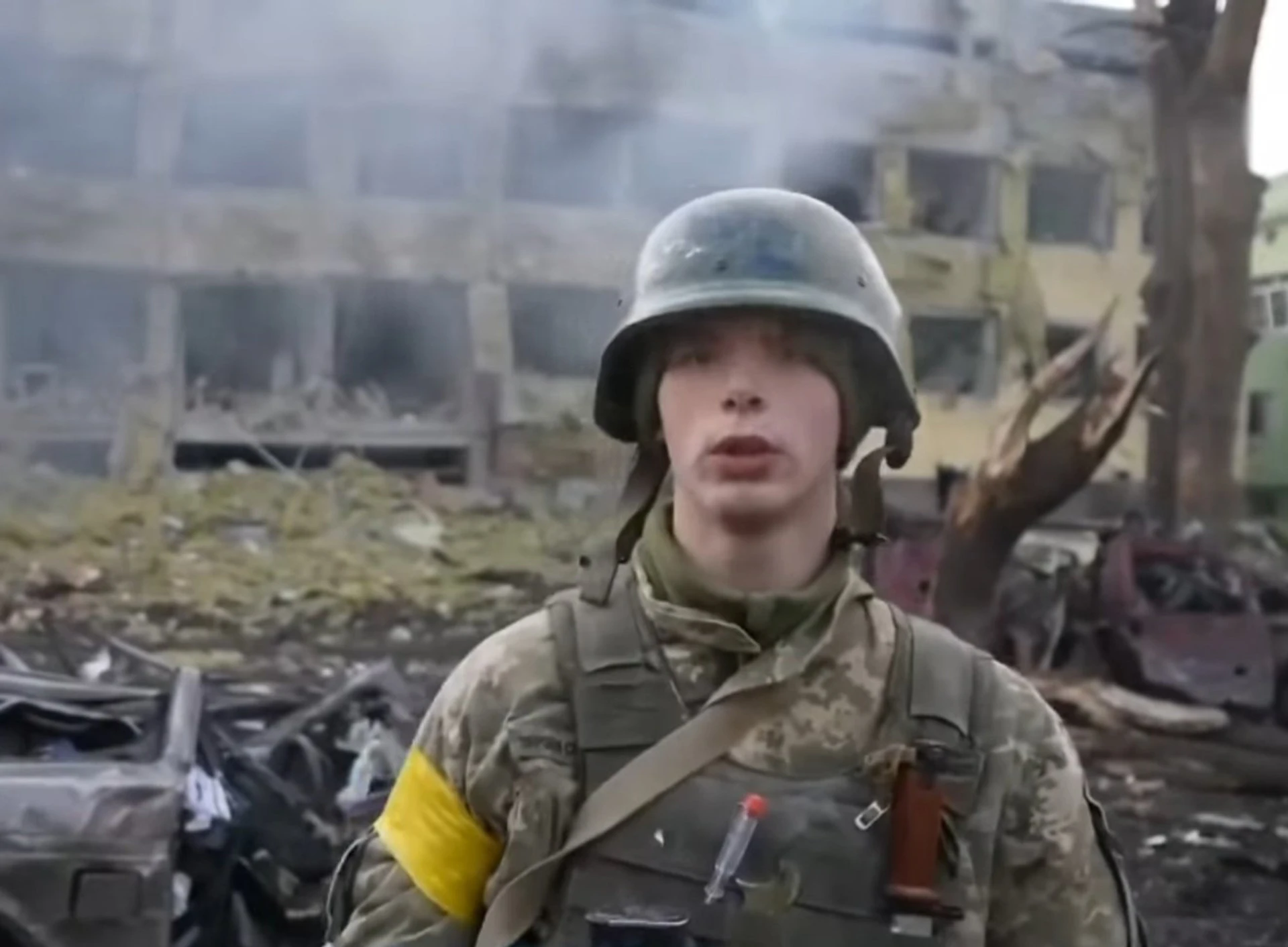
Officially missing, but in reality - in captivity. The story of a 19-year-old marine who defended Mariupol
Source: Ukrainska Pravda
Author: Viktoria Andreyeva
On his 18th birthday, Mykyta went to the military registration and enlistment office. The young man clutched a stack of documents with enthusiasm; a week later, he packed his things and left to serve.
In the army, he was given the call sign “Zhyvchyk” because he was always smiling and cheering everyone up.
A few months later, he signed a contract with the Ukrainian Navy. It was late 2021.
The young soldier spent New Year’s Eve in a trench, and instead of the usual fireworks, he heard the first explosions on the front lines. Due to Russia’s full-scale invasion, his unit was sent to Mariupol.
In late April, “Zhivchik’s” group was unable to break through to the main body of the 36th Marine Brigade as they were leaving the Illich Steel Plant.
The Ministry of Defense listed “Zhivchik” and his comrades as missing in action. However, his mother recognized him in a video of a column of prisoners on the Russian channel “Union.” Journalists from the aggressor country were filming a column of Ukrainian soldiers being led to vehicles. She was overcome with despair, joy, and helplessness: what to do, whom to notify, and how to bring her son home?
The story of one of the youngest fighters was told by his mother, fellow soldiers, and civilians he had rescued. Andriy Novak, an attorney at the Miller law firm, explained what to do if a relative has been taken prisoner and where to send the information.
He earned his call sign through his life stance
Mykita Tatianko was an ordinary, carefree young man from Zaporizhzhia who attended a military-patriotic club.
“As a child, he was a bit chubby, so he fought off those ‘extra pounds’ through judo, hand-to-hand combat, basketball, boxing, and sambo—and he won. His coaches said he had good physical attributes. But he couldn’t find his place anywhere,” says his mother, Lora.
At school, he was also described as a talented but “incredibly lazy” boy.
He enrolled in a vocational school to become a welder and sailor, but dropped out due to a conflict with his instructor. That’s when Mykyta finally decided to join the army.
He chose the Airborne Assault Unit in Mykolaiv; the most interesting classes were in tactical medicine. He asked a lot of questions and was eager to learn how to save lives.
On Larisa’s birthday (in late January), her son called from the trenches. His platoon was in Shyroke, in the Donetsk region, on the front line. But that didn’t stop him from cheering up his mom with a bouquet of roses.
She recounts this memory with particular warmth:
“He calls me and says, ‘Mom, don’t go to sleep yet.’” A little while later, the intercom rang—apparently, a courier with a package. I got scared; my son is in the military—what if it was a sabotage attempt... But it was just a courier with a bouquet and a card that said ‘To Mom on Her Birthday.’
He also sent a video greeting. He showed me the trench, and then introduced me to Laura—his assault rifle. He named it after me—so it wouldn’t let me down and would be a pleasure to take care of.”
Mom spoke very warmly about her son during our conversation. But she also mentioned a few times the arguments that happen in every family. Laura says that a few years ago, Mykyta started resolving conflicts and everyday squabbles with a smile and a kind word.
“He’s very charismatic and kind. His smile is disarming. He’s always smiling, telling stories. That’s why his nickname is ‘Zhivchik’,” the woman says with a smile.
Read also: From the front lines to the ring, from the ring to the front lines: the story of an athlete who took up arms to defend his country
After four long days, they wrote that he was a prisoner of war
When Mykyta was transferred to Mariupol, he asked his mom to get passports and leave at the first sign of danger. At the very least—to the west of the country.
Later, when they were surrounded, he said: “Mom, I’ve seen a lot in Mariupol. And I really want you to live. The news doesn’t show even 10% of all the horrors. The trap can snap shut quickly. You won’t even have time to realize it. Don’t worry about me—I knew where I was going.”
Lora cried and screamed, but there was nothing she could do.
Mykita called home once every 4–5 days because there was only one spot in the city where he could get a signal. He had to run several blocks to get there.
“I knew he was taking a risk when he ran to call me, but a mother’s heart still begged him to send messages more often,” says Laura.
The last time his mother heard her son’s voice, she sensed in her heart that something was wrong. He asked how she was and immediately said he loved her very much.
“I tensed up and asked what had happened. He replied, ‘Nothing, I just love you so much, you can’t imagine.’
Mykita continued, ‘I know people need me here. I don’t regret anything, because I consciously chose this path. I ask only one thing: that you live and take care of your sister. That you both live! I came here only for you. So that we wouldn’t have a war. I don’t know how much I’ve done, but—as much as I could,” the woman recounts the conversation with her son.
Then Laura began begging Mykyta to promise to come back. But he replied that he couldn’t, because it’s “a shithole” there.
One of the reasons behind his decision to sign a contract with the Armed Forces of Ukraine was Mykyta’s desire to help with the family’s financial issues. Two years ago, his father died of cancer after a long and expensive treatment.
“I don’t need that money, I said, the main thing is that you stay alive. My son replied that it wasn’t up to him. And then I heard explosions, and the connection cut out,” the woman said.
Then there was a week of silence. Then a message suddenly came on WhatsApp from an unknown number: “Mom, I’m alive and well, your eagle Zhyvchyk.”
And two
photos. She replied that she loved him too. The message was read, but there was no reply.
The mother deleted all the messages for safety, but kept that unknown number.
“A week later, I sent a request to that contact asking that if they knew anything about my son, they should give me the information. After four long days, they wrote to me that he was a prisoner of war," says Lora.
The mother began looking for confirmation. She didn’t sleep for several days; her eyes were red and sore from staring at the screen nonstop. In one of the videos showing soldiers in Mariupol surrendering, she saw a young man who looked like her son.
Read also: "I’m afraid Dad will be killed in the war." How to talk to a child about fears and help them accept reality
People began contacting Laura, promising to have Mykyta call his mom once they escaped from hell.
Saved a woman from suicide
Ksenia met “Zhivchik” on the day a residential neighborhood in Mariupol came under fire. That day, her relatives were wounded and killed.
The young soldier helped the woman stay strong emotionally. So when she managed to escape to territory controlled by Ukraine, she began searching for the young soldier on social media. A few days after Ksenia posted her message, Nikita’s mother wrote to her, saying he was being held captive.
On March 12, residential neighborhoods in Mariupol were pounded by Grad rockets. She was hiding in an apartment with her family, but a shell hit the building. Her 16-year-old son and her sister’s husband were killed instantly.
Her mother, niece, sister, and Ksenia herself were wounded.
“They had critical bleeding; I had a relatively minor injury and a concussion,” the woman says.
When the shelling subsided, a neighbor ran over to Ksenia. He wanted to make sure everyone was okay. Miraculously, the man’s car had survived, so he drove them all to the pediatric trauma unit, as it was the only hospital under Ukrainian control that was still operating.
“As soon as we ‘arrived,’ the belt around my mom’s leg had already loosened. A soldier (it was Mykyta) approached us and tightened the makeshift tourniquet made from the belt with a carabiner. That’s how he saved my mother,” the woman continues.
All of Ksenia’s relatives were immediately taken in for surgery, while she waited her turn, as there were many patients that day.
"I was in a state of shock: I wanted to take my own life because half of my family had died right before my eyes, and I didn’t know if the other half would survive.
But before I could do that, I really wanted to smoke a cigarette. I didn’t have one because they were in short supply. In the hospital lobby, I saw a soldier. It was Mykyta. He was holding boxes filled with all sorts of “goodies” for the children—books, pencils, coloring books. I walked up to him and asked for a cigarette,” recalls the Mariupol resident.
He agreed, handed out the gifts to the children, and said, “Let’s go outside.”
The main doors to the hospital were large and made of iron, but because of the shelling, they couldn’t be opened—the shelling was intense. It hadn’t stopped at all since early March. So “Zhyvchik” and Ksenia opened them just a tiny crack.
“We started smoking. Mykita was acting so strangely—sometimes he’d stand sideways to me, other times he’d come very close. I didn’t immediately understand why.
He was shielding me with his body because he was wearing body armor, and I wasn’t,” Ksenia recalls.
Between puffs, he asked what had happened, and Ksenia gave a brief account.
“Mykita looked at me intently and said, ‘Look how many wounded there are—we have to help people. You can’t do anything bad to yourself.’ I hadn’t told him about my plan; he probably just “read” it.
And I probably would have ignored all such “advice,” but he reminded me so much of my son. Then he patted me on the shoulder and said, ‘We need you here—let’s go help,’” Ksenia says, her voice full of gratitude.
She approached the doctors, asked about her family’s condition, and how she could help. The medical staff said they were critically short-staffed—some nurses and orderlies hadn’t shown up for work or had gone on a shift and not returned. No one knew if they were alive or had left. She stayed for four days: washing floors, changing bandages.
At night, two soldiers always remained in the hospital to guard the civilians.
"I was very afraid to sleep in the ward, so I asked Mykyta to bring a mattress and leave it in the hallway, since there are no windows there. The shelling at night isn’t just loud—it’s a full-scale light-and-sound ‘show.’ He came by a few times to check on me, and by morning the soldiers had been relieved.
I saw him one more time, just a glimpse, as he was carrying bottles of saline solution that had been left at their base. “Mykita ran past; I didn’t even have time to talk to him again,” she adds.
The only thing that brought him down was the 200th
Marik (name changed)—a doctor who operated on and saved the wounded in Mariupol—met Mykyta at the hospital.
“He was part of the military personnel guarding the hospital in burning Mariupol. When Russian aircraft struck the maternity ward, Mykyta was the first to rush in to help the wounded.
At the hospital, he helped transport and move the wounded, as well as with all the other heavy work. He helped take the 300s down to the basement during shelling, board up windows with sacks, and more,” says Marik.
During the rare breaks between the arrival of the wounded, they would go out for smoke breaks and talk about life. Mykita asked a lot of questions about how to treat the wounded, about various illnesses and conditions. He said he was so interested in all things medical that he wanted to become a doctor after the war.
“Whether it was shelling from artillery or airstrikes, he never lost his spirits; he smiled and joked. The only thing that brought him down was the 200s. He kept asking what else could be done to improve our chances,” the doctor recalls.
The last time Marik and “Zhyvchik” spoke was the day after the Russians bombed the military hospital.
At that time, Mykyta said that the medics should leave the hospital because they were civilians, and therefore had a chance. When asked what the young soldier would do, he replied: “I’m a soldier; I’ll stand my ground until the very end.”
“Zhivchik” gave me his mother’s phone number.
“He asked me to call her once I got out, to tell her that he wasn’t afraid and was brave, that he loved her. I didn’t get out until a month later.
I called her on the very first day. She told me she’d seen him in propaganda videos, but wasn’t sure it was him. I recognized him for sure and confirmed it,” the doctor notes bitterly.
Marik added that through third parties in the occupied territories, his mother learned that the conditions of detention are horrific. They’re holding 20 people in a cell meant for two. Food is served once a day. Water is minimal, and they aren’t taken outside. The prisoners’ health is poor, and the unsanitary conditions are appalling.
Gratitude for raising her son right
One of the young men who was in the TRO and led the hospital security in the city center also contacted Larisa.
"Good afternoon. I want to express my sincere gratitude to you for raising your son Mykyta. I had the honor of working alongside him at Hospital No. 3 in Mariupol. [...]
I am truly grateful to God for having had the honor of meeting him. He was just as worried about you as you were, because there was no communication, and he couldn’t tell you that he was all right and how much he loves you. Thank you once again for raising your son so well,” he wrote.
And in a private conversation with Laura, the young man shared that in Mariupol they were given a daily ration, and Mykyta would give his can of stew to other people.
The man tried to explain to him that people can be selfish, and they might hoard their rations while he goes hungry. But Mykyta remained steadfast.
Once he replied in a way that deeply impressed the guard: “Maybe she has 10 hungry mouths at home? I’ll find something.”
“That’s just like my son—he’d give away the shirt off his back. According to his comrade, he did the same with military first-aid kits—he’d give his own if needed,” says Laura.
But what impressed her most was that this man thanked her for raising her son.
“First and foremost, I’m a mom. So I was proud of my son when he passed the movie audition. I was proud when he took second place in sambo at the regional level. And I was very proud when all the other kids were out playing, but Mykyta—every summer since he was 13—was working.
I’m getting to know my son from a different perspective now. What his fellow soldiers tell me… I don’t believe my son is capable of such things. And I’m even prouder of him! It turns out I didn’t really know him,” says Mykyta’s mother.
The Ministry of Defense considers him missing in action, not a prisoner of war
When Larisa found confirmation that her son was a prisoner of war, she went to the military registration and enlistment office.
According to her, they wouldn’t even let her inside the building. Eventually, she obtained the contact numbers of officials and agencies responsible for prisoners of war. In addition, she contacted all the hotlines, but these agencies did not even acknowledge receipt of her personal information.
The military commissariat maintains records of all servicemembers’ personal files, explains Andriy Novak, an attorney at the Miller law firm.
Therefore, employees of this agency are required to report those who have died, gone missing, been captured, or taken hostage.
According to the law on the legal status of missing persons, the military commissar must notify the family that a person is missing or in captivity no later than seven days after the incident.
"There is no legislative order or act in Ukraine for civilians on how to transfer a person from the list of missing persons to the list of prisoners of war.
There is an order from the Ministry of Defense and an instruction from the Ministry of Internal Affairs regarding the organization of personnel records. But these documents concern only internal processes," he adds.
Therefore, relatives of those missing in action and prisoners of war must contact:
"All these agencies operate in parallel, so it is advisable to contact and send information to all of them.
It is advisable to provide confirmation: this could be a screenshot from a video showing prisoners being led away, an article where the Russians mention him, or an audio recording of a phone call," explains the lawyer.
However, the list of military personnel held captive must be confirmed by the Russians. Unfortunately, they do not include everyone on the list, and it is impossible to influence this.
"The Red Cross has no legal authority to exchange prisoners. But they should monitor the conditions and treatment of the prisoners." Red Cross volunteers can cooperate with government agencies and oversee the exchange procedures. That is, they can act as an independent body to prevent manipulation regarding the number of prisoners of war," explains Andriy Novak.
Until representatives of the aggressor country confirm that "Zhyvchik" and other soldiers who surrendered in occupied Mariupol or at other positions are prisoners of war, the Ministry of Defense cannot grant them that status.
Author: Viktoria Andreyeva
On his 18th birthday, Mykyta went to the military registration and enlistment office. The young man clutched a stack of documents with enthusiasm; a week later, he packed his things and left to serve.
In the army, he was given the call sign “Zhyvchyk” because he was always smiling and cheering everyone up.
A few months later, he signed a contract with the Ukrainian Navy. It was late 2021.
The young soldier spent New Year’s Eve in a trench, and instead of the usual fireworks, he heard the first explosions on the front lines. Due to Russia’s full-scale invasion, his unit was sent to Mariupol.
In late April, “Zhivchik’s” group was unable to break through to the main body of the 36th Marine Brigade as they were leaving the Illich Steel Plant.
The Ministry of Defense listed “Zhivchik” and his comrades as missing in action. However, his mother recognized him in a video of a column of prisoners on the Russian channel “Union.” Journalists from the aggressor country were filming a column of Ukrainian soldiers being led to vehicles. She was overcome with despair, joy, and helplessness: what to do, whom to notify, and how to bring her son home?
The story of one of the youngest fighters was told by his mother, fellow soldiers, and civilians he had rescued. Andriy Novak, an attorney at the Miller law firm, explained what to do if a relative has been taken prisoner and where to send the information.
He earned his call sign through his life stance
Mykita Tatianko was an ordinary, carefree young man from Zaporizhzhia who attended a military-patriotic club.
“As a child, he was a bit chubby, so he fought off those ‘extra pounds’ through judo, hand-to-hand combat, basketball, boxing, and sambo—and he won. His coaches said he had good physical attributes. But he couldn’t find his place anywhere,” says his mother, Lora.
At school, he was also described as a talented but “incredibly lazy” boy.
He enrolled in a vocational school to become a welder and sailor, but dropped out due to a conflict with his instructor. That’s when Mykyta finally decided to join the army.
He chose the Airborne Assault Unit in Mykolaiv; the most interesting classes were in tactical medicine. He asked a lot of questions and was eager to learn how to save lives.
On Larisa’s birthday (in late January), her son called from the trenches. His platoon was in Shyroke, in the Donetsk region, on the front line. But that didn’t stop him from cheering up his mom with a bouquet of roses.
She recounts this memory with particular warmth:
“He calls me and says, ‘Mom, don’t go to sleep yet.’” A little while later, the intercom rang—apparently, a courier with a package. I got scared; my son is in the military—what if it was a sabotage attempt... But it was just a courier with a bouquet and a card that said ‘To Mom on Her Birthday.’
He also sent a video greeting. He showed me the trench, and then introduced me to Laura—his assault rifle. He named it after me—so it wouldn’t let me down and would be a pleasure to take care of.”
Mom spoke very warmly about her son during our conversation. But she also mentioned a few times the arguments that happen in every family. Laura says that a few years ago, Mykyta started resolving conflicts and everyday squabbles with a smile and a kind word.
“He’s very charismatic and kind. His smile is disarming. He’s always smiling, telling stories. That’s why his nickname is ‘Zhivchik’,” the woman says with a smile.
Read also: From the front lines to the ring, from the ring to the front lines: the story of an athlete who took up arms to defend his country
After four long days, they wrote that he was a prisoner of war
When Mykyta was transferred to Mariupol, he asked his mom to get passports and leave at the first sign of danger. At the very least—to the west of the country.
Later, when they were surrounded, he said: “Mom, I’ve seen a lot in Mariupol. And I really want you to live. The news doesn’t show even 10% of all the horrors. The trap can snap shut quickly. You won’t even have time to realize it. Don’t worry about me—I knew where I was going.”
Lora cried and screamed, but there was nothing she could do.
Mykita called home once every 4–5 days because there was only one spot in the city where he could get a signal. He had to run several blocks to get there.
“I knew he was taking a risk when he ran to call me, but a mother’s heart still begged him to send messages more often,” says Laura.
The last time his mother heard her son’s voice, she sensed in her heart that something was wrong. He asked how she was and immediately said he loved her very much.
“I tensed up and asked what had happened. He replied, ‘Nothing, I just love you so much, you can’t imagine.’
Mykita continued, ‘I know people need me here. I don’t regret anything, because I consciously chose this path. I ask only one thing: that you live and take care of your sister. That you both live! I came here only for you. So that we wouldn’t have a war. I don’t know how much I’ve done, but—as much as I could,” the woman recounts the conversation with her son.
Then Laura began begging Mykyta to promise to come back. But he replied that he couldn’t, because it’s “a shithole” there.
One of the reasons behind his decision to sign a contract with the Armed Forces of Ukraine was Mykyta’s desire to help with the family’s financial issues. Two years ago, his father died of cancer after a long and expensive treatment.
“I don’t need that money, I said, the main thing is that you stay alive. My son replied that it wasn’t up to him. And then I heard explosions, and the connection cut out,” the woman said.
Then there was a week of silence. Then a message suddenly came on WhatsApp from an unknown number: “Mom, I’m alive and well, your eagle Zhyvchyk.”
And two
photos. She replied that she loved him too. The message was read, but there was no reply.
The mother deleted all the messages for safety, but kept that unknown number.
“A week later, I sent a request to that contact asking that if they knew anything about my son, they should give me the information. After four long days, they wrote to me that he was a prisoner of war," says Lora.
The mother began looking for confirmation. She didn’t sleep for several days; her eyes were red and sore from staring at the screen nonstop. In one of the videos showing soldiers in Mariupol surrendering, she saw a young man who looked like her son.
Read also: "I’m afraid Dad will be killed in the war." How to talk to a child about fears and help them accept reality
People began contacting Laura, promising to have Mykyta call his mom once they escaped from hell.
Saved a woman from suicide
Ksenia met “Zhivchik” on the day a residential neighborhood in Mariupol came under fire. That day, her relatives were wounded and killed.
The young soldier helped the woman stay strong emotionally. So when she managed to escape to territory controlled by Ukraine, she began searching for the young soldier on social media. A few days after Ksenia posted her message, Nikita’s mother wrote to her, saying he was being held captive.
On March 12, residential neighborhoods in Mariupol were pounded by Grad rockets. She was hiding in an apartment with her family, but a shell hit the building. Her 16-year-old son and her sister’s husband were killed instantly.
Her mother, niece, sister, and Ksenia herself were wounded.
“They had critical bleeding; I had a relatively minor injury and a concussion,” the woman says.
When the shelling subsided, a neighbor ran over to Ksenia. He wanted to make sure everyone was okay. Miraculously, the man’s car had survived, so he drove them all to the pediatric trauma unit, as it was the only hospital under Ukrainian control that was still operating.
“As soon as we ‘arrived,’ the belt around my mom’s leg had already loosened. A soldier (it was Mykyta) approached us and tightened the makeshift tourniquet made from the belt with a carabiner. That’s how he saved my mother,” the woman continues.
All of Ksenia’s relatives were immediately taken in for surgery, while she waited her turn, as there were many patients that day.
"I was in a state of shock: I wanted to take my own life because half of my family had died right before my eyes, and I didn’t know if the other half would survive.
But before I could do that, I really wanted to smoke a cigarette. I didn’t have one because they were in short supply. In the hospital lobby, I saw a soldier. It was Mykyta. He was holding boxes filled with all sorts of “goodies” for the children—books, pencils, coloring books. I walked up to him and asked for a cigarette,” recalls the Mariupol resident.
He agreed, handed out the gifts to the children, and said, “Let’s go outside.”
The main doors to the hospital were large and made of iron, but because of the shelling, they couldn’t be opened—the shelling was intense. It hadn’t stopped at all since early March. So “Zhyvchik” and Ksenia opened them just a tiny crack.
“We started smoking. Mykita was acting so strangely—sometimes he’d stand sideways to me, other times he’d come very close. I didn’t immediately understand why.
He was shielding me with his body because he was wearing body armor, and I wasn’t,” Ksenia recalls.
Between puffs, he asked what had happened, and Ksenia gave a brief account.
“Mykita looked at me intently and said, ‘Look how many wounded there are—we have to help people. You can’t do anything bad to yourself.’ I hadn’t told him about my plan; he probably just “read” it.
And I probably would have ignored all such “advice,” but he reminded me so much of my son. Then he patted me on the shoulder and said, ‘We need you here—let’s go help,’” Ksenia says, her voice full of gratitude.
She approached the doctors, asked about her family’s condition, and how she could help. The medical staff said they were critically short-staffed—some nurses and orderlies hadn’t shown up for work or had gone on a shift and not returned. No one knew if they were alive or had left. She stayed for four days: washing floors, changing bandages.
At night, two soldiers always remained in the hospital to guard the civilians.
"I was very afraid to sleep in the ward, so I asked Mykyta to bring a mattress and leave it in the hallway, since there are no windows there. The shelling at night isn’t just loud—it’s a full-scale light-and-sound ‘show.’ He came by a few times to check on me, and by morning the soldiers had been relieved.
I saw him one more time, just a glimpse, as he was carrying bottles of saline solution that had been left at their base. “Mykita ran past; I didn’t even have time to talk to him again,” she adds.
The only thing that brought him down was the 200th
Marik (name changed)—a doctor who operated on and saved the wounded in Mariupol—met Mykyta at the hospital.
“He was part of the military personnel guarding the hospital in burning Mariupol. When Russian aircraft struck the maternity ward, Mykyta was the first to rush in to help the wounded.
At the hospital, he helped transport and move the wounded, as well as with all the other heavy work. He helped take the 300s down to the basement during shelling, board up windows with sacks, and more,” says Marik.
During the rare breaks between the arrival of the wounded, they would go out for smoke breaks and talk about life. Mykita asked a lot of questions about how to treat the wounded, about various illnesses and conditions. He said he was so interested in all things medical that he wanted to become a doctor after the war.
“Whether it was shelling from artillery or airstrikes, he never lost his spirits; he smiled and joked. The only thing that brought him down was the 200s. He kept asking what else could be done to improve our chances,” the doctor recalls.
The last time Marik and “Zhyvchik” spoke was the day after the Russians bombed the military hospital.
At that time, Mykyta said that the medics should leave the hospital because they were civilians, and therefore had a chance. When asked what the young soldier would do, he replied: “I’m a soldier; I’ll stand my ground until the very end.”
“Zhivchik” gave me his mother’s phone number.
“He asked me to call her once I got out, to tell her that he wasn’t afraid and was brave, that he loved her. I didn’t get out until a month later.
I called her on the very first day. She told me she’d seen him in propaganda videos, but wasn’t sure it was him. I recognized him for sure and confirmed it,” the doctor notes bitterly.
Marik added that through third parties in the occupied territories, his mother learned that the conditions of detention are horrific. They’re holding 20 people in a cell meant for two. Food is served once a day. Water is minimal, and they aren’t taken outside. The prisoners’ health is poor, and the unsanitary conditions are appalling.
Gratitude for raising her son right
One of the young men who was in the TRO and led the hospital security in the city center also contacted Larisa.
"Good afternoon. I want to express my sincere gratitude to you for raising your son Mykyta. I had the honor of working alongside him at Hospital No. 3 in Mariupol. [...]
I am truly grateful to God for having had the honor of meeting him. He was just as worried about you as you were, because there was no communication, and he couldn’t tell you that he was all right and how much he loves you. Thank you once again for raising your son so well,” he wrote.
And in a private conversation with Laura, the young man shared that in Mariupol they were given a daily ration, and Mykyta would give his can of stew to other people.
The man tried to explain to him that people can be selfish, and they might hoard their rations while he goes hungry. But Mykyta remained steadfast.
Once he replied in a way that deeply impressed the guard: “Maybe she has 10 hungry mouths at home? I’ll find something.”
“That’s just like my son—he’d give away the shirt off his back. According to his comrade, he did the same with military first-aid kits—he’d give his own if needed,” says Laura.
But what impressed her most was that this man thanked her for raising her son.
“First and foremost, I’m a mom. So I was proud of my son when he passed the movie audition. I was proud when he took second place in sambo at the regional level. And I was very proud when all the other kids were out playing, but Mykyta—every summer since he was 13—was working.
I’m getting to know my son from a different perspective now. What his fellow soldiers tell me… I don’t believe my son is capable of such things. And I’m even prouder of him! It turns out I didn’t really know him,” says Mykyta’s mother.
The Ministry of Defense considers him missing in action, not a prisoner of war
When Larisa found confirmation that her son was a prisoner of war, she went to the military registration and enlistment office.
According to her, they wouldn’t even let her inside the building. Eventually, she obtained the contact numbers of officials and agencies responsible for prisoners of war. In addition, she contacted all the hotlines, but these agencies did not even acknowledge receipt of her personal information.
The military commissariat maintains records of all servicemembers’ personal files, explains Andriy Novak, an attorney at the Miller law firm.
Therefore, employees of this agency are required to report those who have died, gone missing, been captured, or taken hostage.
According to the law on the legal status of missing persons, the military commissar must notify the family that a person is missing or in captivity no later than seven days after the incident.
"There is no legislative order or act in Ukraine for civilians on how to transfer a person from the list of missing persons to the list of prisoners of war.
There is an order from the Ministry of Defense and an instruction from the Ministry of Internal Affairs regarding the organization of personnel records. But these documents concern only internal processes," he adds.
Therefore, relatives of those missing in action and prisoners of war must contact:
- the military unit;
- the military registration and enlistment office;
- the Ministry of Defense hotlines;
- the Joint Center for the Search and Release of Prisoners of War;
- the Ministry of Internal Affairs hotline;
- the Red Cross.
"All these agencies operate in parallel, so it is advisable to contact and send information to all of them.
It is advisable to provide confirmation: this could be a screenshot from a video showing prisoners being led away, an article where the Russians mention him, or an audio recording of a phone call," explains the lawyer.
However, the list of military personnel held captive must be confirmed by the Russians. Unfortunately, they do not include everyone on the list, and it is impossible to influence this.
"The Red Cross has no legal authority to exchange prisoners. But they should monitor the conditions and treatment of the prisoners." Red Cross volunteers can cooperate with government agencies and oversee the exchange procedures. That is, they can act as an independent body to prevent manipulation regarding the number of prisoners of war," explains Andriy Novak.
Until representatives of the aggressor country confirm that "Zhyvchik" and other soldiers who surrendered in occupied Mariupol or at other positions are prisoners of war, the Ministry of Defense cannot grant them that status.
This is an automatic translation generated by DeepL.