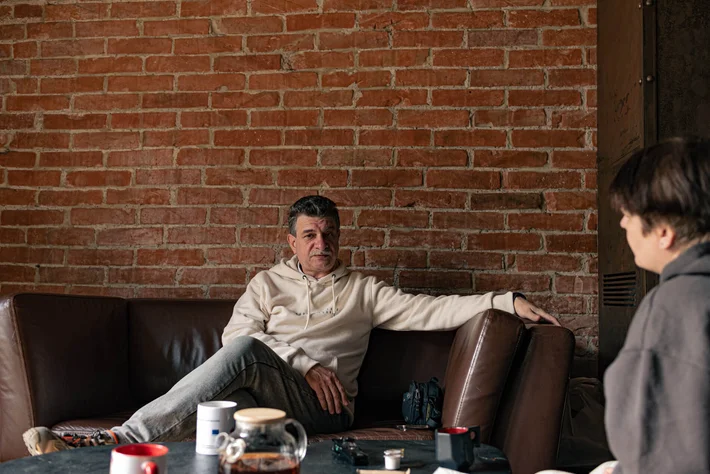
"Captivity is nothing, the worst thing is to see Mariupol dying": the story of Azovstal defender Gennadiy Zbandut
Source: Varosh
Author: Zoryana Popovich
Twenty-two months of captivity did not break his will to live. Hennadiy Zbandut—a volunteer, a defender of Mariupol who went through the hell of Azovstal, Olenivka, and captivity near Luhansk—has today turned a new page in his life here in Uzhhorod. He believes: even after the darkest times, light comes
“Two years before the full-scale war began, I enlisted in the Territorial Defense Forces, in the 109th Brigade, and on February 24, I volunteered to defend my homeland,” says Hennadiy Varosh. “This isn’t the first time I’ve lost everything. First, there was 2014; my family—my wife and daughter—were left behind in Donetsk, along with my business. I came home to my parents, near Mariupol, to start all over again.
On the morning of February 24, I grabbed my pre-packed backpack, said goodbye to my parents, and headed to my brigade, straight to Mariupol, to the Territorial Defense Forces headquarters. There I received my weapon and gear.
— We were near the front line because Mariupol itself was already under fire; an assault was underway. We spent the night with the 109th Brigade, evacuating their headquarters. In the morning, we were sent to a checkpoint at the exit from Mariupol. We spent about half a month there. And even though I had prepared for war, it’s impossible to be fully psychologically ready for these horrors. When I was on guard duty that first night, I could see the whole city. In the early days, Mariupol was still lit up... It was just a beautiful resort town by the sea, crumbling right before my eyes… It was very scary,” says Gennadiy.
According to our hero, the hardest part for him was realizing that civilians were dying; compared to these horrors, captivity doesn’t seem like the worst thing that happened to him.
— The city was destroyed. Out of a population of 400,000, about 100,000 died; these were ordinary civilians who had nothing to do with the war—that’s what’s terrifying! Imagine, as many people died in Mariupol as currently live in Uzhhorod. Just like that—and the people are gone… I lost my comrades, my brothers in arms, every single day. Captivity is nothing! The worst thing for me was seeing civilians die every day. Innocent people were dying by the entire apartment building, by the house. An air raid siren goes off, residents go down to the basement, a rocket hits that building, and they burn alive, screaming because they can’t get out from under the rubble. We hear this and can’t do anything, because there’s fire and rubble everywhere…—recalls Gennadiy.
According to the man, the Russians in Mangush, a village 30 km from Mariupol, created a mass grave for civilians.
“When the fighting ended, the Russians used heavy equipment to dig large trenches and simply dumped the bodies of the townspeople into them,” the man recalls with horror. “It was a mass grave for tens of thousands of civilians. When we were retreating, the entire street was covered in bodies. Some had gone out for water, others to look for food—they were simply shot by snipers. This is genocide.”
On May 16, 2022, Hennadiy Zbandut, along with other defenders of Mariupol, following an order from the President of Ukraine, left the Azovstal territory and surrendered. As an MRI later revealed, he had already sustained a spinal injury by that time. But the man wasn’t worried about his fate—he sensed that a war was coming, sensed that he would survive…
“When I had to choose a call sign, I hesitated between ‘Moltar’ (a tarot reader, since I’ve been doing that for many years) and ‘Greek,’” Gennadiy says. “My mom is Ukrainian, and my dad is Greek, and it was important to show that not only Ukrainians but also Greeks fought for the liberation of Mariupol. That’s why I became ‘The Salted Greek.’ People asked me, why ‘salted’? Because many Greeks were fishermen. A Greek salted by the sea, by war…”
The man spent all 22 months of his captivity in a barracks near Luhansk. There, he says, he was given the nickname “Shaman”: back at Azovstal, he used to tell fortunes for anyone who wanted one.
— My cards burned up just a few days after the first airstrike on our checkpoint. They bombed us to smithereens with missiles there. All my gear, all my belongings, burned up. Later, I found a single deck of cards in the rubble of a store on Prospekt Myru in Mariupol, and later the guys gave me another one—this was already at Azovstal. But in Olenivka, of course, they were taken away, and I had to rely on my instincts without maps…
After a month in Olenivka, Hennadiy and his comrades from Azovstal were transferred to the Luhansk region, where he remained the entire time until the prisoner exchange. It was a zone for particularly dangerous criminals convicted of murder.
— On the first day of our stay in Olenivka, a Red Cross mission arrived to inspect our living conditions. I had actually been a volunteer with them myself at one point and worked as an economist for the organization in Mariupol. We had a decent barracks; it had been renovated before our arrival. Conditions in the other barracks were simply horrific, but ours were more or less okay, so that’s why they showed us that one. “That was the first and last time any mission came to see us,” says Gennadiy.
The former prisoner describes the appalling conditions of detention, the brutality of the Russian army, and the humiliation the prisoners endure every day.
“They treated us like animals. Prisoners from Luhansk who were serving time for murder were considered human beings in the eyes of the guards, but we were nobody. Weekly “searches” were standard procedure. While this was still bearable in the summer, it was unbearable in the winter—several times a week, they drove us out into the street with batons. We stood for several hours, motionless, in the freezing cold. Then, just as before, they drove us back into the barracks with batons; we stood there naked for about an hour… This was “normal” life for prisoners,” the man shares.
Gennadiy explains that a key focus for the Russians was “recruiting” Ukrainian soldiers and forcing them into collaboration and defection to the enemy’s side.
— Our guys were taken for interrogations, tortured, and forced to sign agreements to work for the Russian forces. If they refused, criminal cases were opened against them. “But back in Olenivka, I said I was a volunteer and that I’d gone to defend my homeland,” Gennadiy continues. “They were pressuring our guys to sign an agreement to work for Russia. Then they… were transferred to another cell. There were guys like that in several barracks; we called them ‘refuseniks.’” When a conflict over this issue broke out in our barracks, the camp administration decided to move them to a separate area. They thought that if they betrayed their homeland, they would go home, but instead they were dressed in Russian uniforms and taken to the training ground. They trained in shooting with assault rifles and mortars; they were interviewed by Russian television; they talked about how much they loved Russia, how they would kill Ukrainians… And then they were put back in their prison uniforms and brought back to the barracks… They are still there.
Gennadiy says that during his time in captivity, he thought only of the future; that is what kept him going and gave him hope.
— I understood that I had to go through this phase of my life, that it wasn’t forever. I lived for the future.
About 400 Ukrainian soldiers were held in the barracks at Azovstal alongside Gennadiy Zbandut; they were gradually returned to Ukraine in small groups as part of prisoner exchanges. The largest exchange at that time, in which our interviewee was included, took place on February 8, 2024—on that day, Ukraine brought home another 100 defenders from Russian captivity. Among the rescued servicemen were 49 soldiers of the National Guard of Ukraine, 25 border guards, and 26 servicemen of the Armed Forces of Ukraine, including 11 members of the Territorial Defense Forces.
“The day before, there was a commotion among us. Usually, this happened when people were being transported to another location, but our barracks leader whispered to me that this was going to be an exchange,” recalls Hennadiy Zbandut. “They took several dozen men from each barracks. The journey home took a day and a half. They lined us up, blindfolded us with tape, and loaded us into covered KamAZ trucks. It was very cold, but our spirits were high. They drove us to the airfield for a long time, then we stood by the plane for a long time; they blew something very cold on us, we nearly froze to death there… Some people collapsed unconscious, unable to endure it.
Then the prisoners were loaded onto a cargo plane. According to Gennadiy, they were lying on the floor; there was no water or toilet.
— I was near the cockpit and heard that they weren’t giving permission to take off for a long time, but eventually, after a few hours, we did take off. Then we landed somewhere, and they threw us into police vans. My leg was broken… And just before the border, they transferred us to comfortable buses to show off how nice they were,” the man tells us. “It was the Kursk region. Two buses: ours and a Russian one. We, who were returning from captivity, and the Russians who had been brought for the exchange. Interestingly, we were all in high spirits, while they looked dejected—they had it much better with us than we did with them…
When the bus carrying those released from captivity drove through Ukrainian towns, people came out to the road with flags, waving and shining their phone lights.
“Of course, we didn’t stop, but it really struck me and moved me! This is our homeland!” Of course, tears welled up,” the man recalls.
Gennadiy didn’t call his family at home to tell them he was returning; he says there was no one to call… his mother, wife, and daughter remained under occupation, in Yalta and Donetsk. His father couldn’t bear the fact that his son had gone to war as a volunteer; he died on Easter 2022… But Gennadiy continues to communicate with his mother.
Uzhhorod: From the Far East to the West
Hennadiy Zbandut arrived in Uzhhorod in 2024, after his treatment. Surprisingly, even though he had never been here before, he had been dreaming of the city since 2014. He had injured his spine back at Azovstal, so he underwent five surgeries over the course of a year. While undergoing treatment at a military hospital in Bila Tserkva, he remotely purchased an apartment in Uzhhorod.
— Something family-related drew me here. I know that my great-grandmother on my mother’s side was from somewhere in the Carpathians—exactly where is unknown; that information has been lost. So I bought the apartment “sight unseen.” (ed. — laughs). I walked into my apartment with the keys and papers, but there was almost nothing there—I needed furniture, dishes, groceries… I got on the bus and asked when the stop near “Epicenter” was, and by the time I got there, the whole bus was already giving me advice: where to buy what, since there are two “Epicenters” in Uzhhorod. I was very pleased by how sincere the people were; from day one, they offered to help me,” says Hennadiy.
The man has a very positive impression of the people and the city: unlike many displaced people from the east of the country who moved to Western Ukraine, he wasn’t worried about the local mindset or language:
— Six months ago, I switched completely to Ukrainian, and now I speak only that language. My Ukrainian still needs some work, but when people tell me, ‘Why are you struggling? Speak Russian!’ I say, ‘No, no, no, I speak Ukrainian.’ There are four fundamental factors that define a nation: history, culture, language, and territory. If all these elements are present, then it is a nation,” the man says.
In Uzhhorod, Hennadiy Zbandut maintains close ties with the “I Am Mariupol” hub. There, as well as at the “Vdoma” Veterans’ Space, he learned about training programs and grants, and with the support of the Uzhhorod City Council, he is taking several training and professional development courses in massage, kinesiotaping, and blade therapy.
*This material was prepared as part of the Dutch-Slovak-Ukrainian project “Strengthening the Rule of Law at the Local/Regional Level in Ukraine: The Case of Zakarpattia Oblast,” which is being implemented with the support of the Government of the Kingdom of the Netherlands under the MATRA program, a key Dutch program supporting social transformation.
The project is implemented by the Institute for Central European Strategy (ICES) in collaboration with the Dutch organization Foundation of Justice, Integrity and Anti-Corruption (FJIAC) and the Slovak Transparency International Slovensko (TI SK), in partnership with the Transcarpathian Regional State Administration and the Regional Council.
**This material does not reflect the position or opinion of the grant project’s implementers or donors. Varosh is solely responsible for the content of its publications.
Author: Zoryana Popovich
An ethnic Greek, a Ukrainian soldier who fought in the battles for Mariupol, a Russian prisoner of war, and started a new life in Transcarpathia
Twenty-two months of captivity did not break his will to live. Hennadiy Zbandut—a volunteer, a defender of Mariupol who went through the hell of Azovstal, Olenivka, and captivity near Luhansk—has today turned a new page in his life here in Uzhhorod. He believes: even after the darkest times, light comes
The city was crumbling before my eyes! It was terrifying...
“Two years before the full-scale war began, I enlisted in the Territorial Defense Forces, in the 109th Brigade, and on February 24, I volunteered to defend my homeland,” says Hennadiy Varosh. “This isn’t the first time I’ve lost everything. First, there was 2014; my family—my wife and daughter—were left behind in Donetsk, along with my business. I came home to my parents, near Mariupol, to start all over again.
On the morning of February 24, I grabbed my pre-packed backpack, said goodbye to my parents, and headed to my brigade, straight to Mariupol, to the Territorial Defense Forces headquarters. There I received my weapon and gear.
— We were near the front line because Mariupol itself was already under fire; an assault was underway. We spent the night with the 109th Brigade, evacuating their headquarters. In the morning, we were sent to a checkpoint at the exit from Mariupol. We spent about half a month there. And even though I had prepared for war, it’s impossible to be fully psychologically ready for these horrors. When I was on guard duty that first night, I could see the whole city. In the early days, Mariupol was still lit up... It was just a beautiful resort town by the sea, crumbling right before my eyes… It was very scary,” says Gennadiy.
According to our hero, the hardest part for him was realizing that civilians were dying; compared to these horrors, captivity doesn’t seem like the worst thing that happened to him.
— The city was destroyed. Out of a population of 400,000, about 100,000 died; these were ordinary civilians who had nothing to do with the war—that’s what’s terrifying! Imagine, as many people died in Mariupol as currently live in Uzhhorod. Just like that—and the people are gone… I lost my comrades, my brothers in arms, every single day. Captivity is nothing! The worst thing for me was seeing civilians die every day. Innocent people were dying by the entire apartment building, by the house. An air raid siren goes off, residents go down to the basement, a rocket hits that building, and they burn alive, screaming because they can’t get out from under the rubble. We hear this and can’t do anything, because there’s fire and rubble everywhere…—recalls Gennadiy.
According to the man, the Russians in Mangush, a village 30 km from Mariupol, created a mass grave for civilians.
“When the fighting ended, the Russians used heavy equipment to dig large trenches and simply dumped the bodies of the townspeople into them,” the man recalls with horror. “It was a mass grave for tens of thousands of civilians. When we were retreating, the entire street was covered in bodies. Some had gone out for water, others to look for food—they were simply shot by snipers. This is genocide.”
22 months in captivity
On May 16, 2022, Hennadiy Zbandut, along with other defenders of Mariupol, following an order from the President of Ukraine, left the Azovstal territory and surrendered. As an MRI later revealed, he had already sustained a spinal injury by that time. But the man wasn’t worried about his fate—he sensed that a war was coming, sensed that he would survive…
“When I had to choose a call sign, I hesitated between ‘Moltar’ (a tarot reader, since I’ve been doing that for many years) and ‘Greek,’” Gennadiy says. “My mom is Ukrainian, and my dad is Greek, and it was important to show that not only Ukrainians but also Greeks fought for the liberation of Mariupol. That’s why I became ‘The Salted Greek.’ People asked me, why ‘salted’? Because many Greeks were fishermen. A Greek salted by the sea, by war…”
The man spent all 22 months of his captivity in a barracks near Luhansk. There, he says, he was given the nickname “Shaman”: back at Azovstal, he used to tell fortunes for anyone who wanted one.
— My cards burned up just a few days after the first airstrike on our checkpoint. They bombed us to smithereens with missiles there. All my gear, all my belongings, burned up. Later, I found a single deck of cards in the rubble of a store on Prospekt Myru in Mariupol, and later the guys gave me another one—this was already at Azovstal. But in Olenivka, of course, they were taken away, and I had to rely on my instincts without maps…
After a month in Olenivka, Hennadiy and his comrades from Azovstal were transferred to the Luhansk region, where he remained the entire time until the prisoner exchange. It was a zone for particularly dangerous criminals convicted of murder.
— On the first day of our stay in Olenivka, a Red Cross mission arrived to inspect our living conditions. I had actually been a volunteer with them myself at one point and worked as an economist for the organization in Mariupol. We had a decent barracks; it had been renovated before our arrival. Conditions in the other barracks were simply horrific, but ours were more or less okay, so that’s why they showed us that one. “That was the first and last time any mission came to see us,” says Gennadiy.
The former prisoner describes the appalling conditions of detention, the brutality of the Russian army, and the humiliation the prisoners endure every day.
“They treated us like animals. Prisoners from Luhansk who were serving time for murder were considered human beings in the eyes of the guards, but we were nobody. Weekly “searches” were standard procedure. While this was still bearable in the summer, it was unbearable in the winter—several times a week, they drove us out into the street with batons. We stood for several hours, motionless, in the freezing cold. Then, just as before, they drove us back into the barracks with batons; we stood there naked for about an hour… This was “normal” life for prisoners,” the man shares.
Gennadiy explains that a key focus for the Russians was “recruiting” Ukrainian soldiers and forcing them into collaboration and defection to the enemy’s side.
— Our guys were taken for interrogations, tortured, and forced to sign agreements to work for the Russian forces. If they refused, criminal cases were opened against them. “But back in Olenivka, I said I was a volunteer and that I’d gone to defend my homeland,” Gennadiy continues. “They were pressuring our guys to sign an agreement to work for Russia. Then they… were transferred to another cell. There were guys like that in several barracks; we called them ‘refuseniks.’” When a conflict over this issue broke out in our barracks, the camp administration decided to move them to a separate area. They thought that if they betrayed their homeland, they would go home, but instead they were dressed in Russian uniforms and taken to the training ground. They trained in shooting with assault rifles and mortars; they were interviewed by Russian television; they talked about how much they loved Russia, how they would kill Ukrainians… And then they were put back in their prison uniforms and brought back to the barracks… They are still there.
Gennadiy says that during his time in captivity, he thought only of the future; that is what kept him going and gave him hope.
— I understood that I had to go through this phase of my life, that it wasn’t forever. I lived for the future.
Release: a day and a half until home
About 400 Ukrainian soldiers were held in the barracks at Azovstal alongside Gennadiy Zbandut; they were gradually returned to Ukraine in small groups as part of prisoner exchanges. The largest exchange at that time, in which our interviewee was included, took place on February 8, 2024—on that day, Ukraine brought home another 100 defenders from Russian captivity. Among the rescued servicemen were 49 soldiers of the National Guard of Ukraine, 25 border guards, and 26 servicemen of the Armed Forces of Ukraine, including 11 members of the Territorial Defense Forces.
“The day before, there was a commotion among us. Usually, this happened when people were being transported to another location, but our barracks leader whispered to me that this was going to be an exchange,” recalls Hennadiy Zbandut. “They took several dozen men from each barracks. The journey home took a day and a half. They lined us up, blindfolded us with tape, and loaded us into covered KamAZ trucks. It was very cold, but our spirits were high. They drove us to the airfield for a long time, then we stood by the plane for a long time; they blew something very cold on us, we nearly froze to death there… Some people collapsed unconscious, unable to endure it.
Then the prisoners were loaded onto a cargo plane. According to Gennadiy, they were lying on the floor; there was no water or toilet.
— I was near the cockpit and heard that they weren’t giving permission to take off for a long time, but eventually, after a few hours, we did take off. Then we landed somewhere, and they threw us into police vans. My leg was broken… And just before the border, they transferred us to comfortable buses to show off how nice they were,” the man tells us. “It was the Kursk region. Two buses: ours and a Russian one. We, who were returning from captivity, and the Russians who had been brought for the exchange. Interestingly, we were all in high spirits, while they looked dejected—they had it much better with us than we did with them…
When the bus carrying those released from captivity drove through Ukrainian towns, people came out to the road with flags, waving and shining their phone lights.
“Of course, we didn’t stop, but it really struck me and moved me! This is our homeland!” Of course, tears welled up,” the man recalls.
Gennadiy didn’t call his family at home to tell them he was returning; he says there was no one to call… his mother, wife, and daughter remained under occupation, in Yalta and Donetsk. His father couldn’t bear the fact that his son had gone to war as a volunteer; he died on Easter 2022… But Gennadiy continues to communicate with his mother.
Uzhhorod: From the Far East to the West
Hennadiy Zbandut arrived in Uzhhorod in 2024, after his treatment. Surprisingly, even though he had never been here before, he had been dreaming of the city since 2014. He had injured his spine back at Azovstal, so he underwent five surgeries over the course of a year. While undergoing treatment at a military hospital in Bila Tserkva, he remotely purchased an apartment in Uzhhorod.
— Something family-related drew me here. I know that my great-grandmother on my mother’s side was from somewhere in the Carpathians—exactly where is unknown; that information has been lost. So I bought the apartment “sight unseen.” (ed. — laughs). I walked into my apartment with the keys and papers, but there was almost nothing there—I needed furniture, dishes, groceries… I got on the bus and asked when the stop near “Epicenter” was, and by the time I got there, the whole bus was already giving me advice: where to buy what, since there are two “Epicenters” in Uzhhorod. I was very pleased by how sincere the people were; from day one, they offered to help me,” says Hennadiy.
The man has a very positive impression of the people and the city: unlike many displaced people from the east of the country who moved to Western Ukraine, he wasn’t worried about the local mindset or language:
— Six months ago, I switched completely to Ukrainian, and now I speak only that language. My Ukrainian still needs some work, but when people tell me, ‘Why are you struggling? Speak Russian!’ I say, ‘No, no, no, I speak Ukrainian.’ There are four fundamental factors that define a nation: history, culture, language, and territory. If all these elements are present, then it is a nation,” the man says.
In Uzhhorod, Hennadiy Zbandut maintains close ties with the “I Am Mariupol” hub. There, as well as at the “Vdoma” Veterans’ Space, he learned about training programs and grants, and with the support of the Uzhhorod City Council, he is taking several training and professional development courses in massage, kinesiotaping, and blade therapy.
*This material was prepared as part of the Dutch-Slovak-Ukrainian project “Strengthening the Rule of Law at the Local/Regional Level in Ukraine: The Case of Zakarpattia Oblast,” which is being implemented with the support of the Government of the Kingdom of the Netherlands under the MATRA program, a key Dutch program supporting social transformation.
The project is implemented by the Institute for Central European Strategy (ICES) in collaboration with the Dutch organization Foundation of Justice, Integrity and Anti-Corruption (FJIAC) and the Slovak Transparency International Slovensko (TI SK), in partnership with the Transcarpathian Regional State Administration and the Regional Council.
**This material does not reflect the position or opinion of the grant project’s implementers or donors. Varosh is solely responsible for the content of its publications.
This is an automatic translation generated by DeepL.