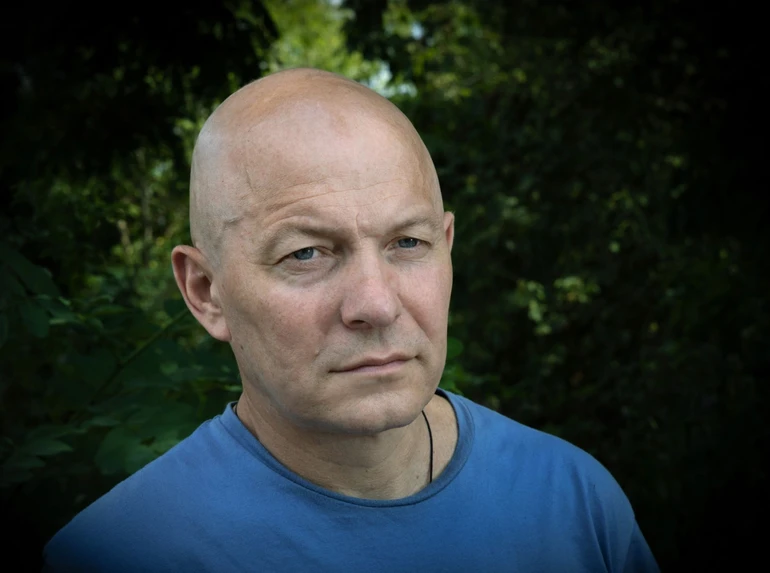
A corridor of death and prayer between torture. The life of the only chaplain of Azovstal who was held captive for 3 years
Source: Ukrainska Pravda
Author: Olena Barsukova
He will shield you with his shoulders, and under his wings you will find refuge. His truth will surround you like a shield; you will not fear the terrors of the night.
Neither the arrow that flies by day, nor the pestilence that stalks in the darkness, nor the plague, nor the midday demon.
A thousand may fall at your side, and ten thousand at your right hand; but it will not come near you.
Psalm 90:4-7
Vasyl Fedorenko recited these lines at Azovstal while praying for his comrades in the “Dzherelo” bunker.
Vasyl is an officer of the 23rd Marine Guard Detachment of the State Border Guard Service and the sole chaplain at Azovstal.
On May 16, 2022, on orders from higher command, he left the plant grounds along with other defenders of Mariupol.
At first, he was held in Olenivka, and in October 2022, he was transferred to one of the most brutal detention facilities in Russia—Pretrial Detention Center No. 2 in Kamyshin, Volgograd Oblast.
On June 14, after three years and one month in captivity, Vasyl returned home as part of an exchange of seriously ill prisoners.
On the duality of life as a priest and a soldier, the “Gulag-style” corridor of death and survival in Kamyshin, visits from a priest of the Russian Orthodox Church, and prayers in his cell, his first Easter feast, and the return he never believed would happen, Vasyl told “UP. Life.”
A Priest from the Village of Terpinnia
Vasyl was born on July 20, 1974, in the village of Terpinnia, Melitopol District, Zaporizhzhia Oblast.
This is northern Tavria, the Wild Field—a region with a Cossack past, which was Russified by the Soviet authorities in the 20th century and is now occupied by Russia.
Vasyl grew up in a patriotic family, but he first heard the Ukrainian language only in second grade.
After school, he enrolled in a teacher training college in Pokrovsk, where he underwent a “transformation of consciousness” in both religious and Ukrainian-centric terms. He mastered the Ukrainian language and was baptized in 1990.
After completing his studies and mandatory military service, Vasyl worked as a drafting teacher, but when his hours were reduced, he joined the Simferopol Border Guard Detachment on a contract basis in 2001.
“In 2013, I was assigned a service apartment in Kerch. Overjoyed, my mother-in-law brought all the grandchildren from the Rivne region to the seaside. It was summer, warm, and everyone was happy. Life was just getting started. And then came 2014,” he recalls.
The Russian occupation of Crimea came as a shock to Vasyl. He used to wonder why Crimean Tatars didn’t celebrate May 9 and why Ukrainians protested against Russian military bases, but in 2014, it all clicked.
Although the Russians promised sky-high salaries and sent his former comrades to “persuade” him, Vasyl remained true to his oath.
Together with a group of border guards, he went to Kherson. He then served in Lysychansk, and in 2019 became an officer in the 23rd Coast Guard Detachment in Mariupol.
When a tumor was found in his thigh, he sought healing through his faith. So, at the age of 47, he decided to become a priest of the Orthodox Church of Ukraine, combining his military service with his ministry.
Vasyl served at the Church of Petro Mohyla, which had been completely decorated with Petrykivka paintings two years before the war began. Construction of the upper church of the Dormition of the Mother of God was supposed to be completed in 2022. It was not to be…
When the war began, Vasyl’s coast guard unit was at the ship repair yard in Mariupol. On March 15, 2022, he managed to conduct one last liturgy.
He witnessed Russian forces shelling Ukrainian soldiers from the largest church of the Ukrainian Orthodox Church of the Moscow Patriarchate in the historic center of Mariupol.
Then the unit’s new commander asked Vasyl—the head of occupational safety on the official roster—to serve as the unit’s field chaplain, since he held the rank of deacon.
“I blessed the soldiers with the cross and icons, handed out prosphora, and prayed for them. When the guys were heading out to their positions, I handed out crosses. It gave them moral strength,” the man recalls.
One day in March 2022, Vasyl visited the Donetsk Border Guard Detachment’s base and the “Azovstal” field hospital, where he prayed for both the living and the dead. At the time, he did not yet know that Azovstal would soon become his refuge as well.
During urban combat, the chaplain had to take up arms. Marine border guards, together with an Azov fighter, took part in defending the “Gora” position near Flotskaya Street—there was a ceramics factory dump there, a strategic high ground between the Berdyansk Highway and the Mariupol airport.
“A priest must not shed blood, but defending one’s country is not a sin. We must defend ourselves, because they deny our right to exist.
How could I not take up arms? A certain sector of the defense also depended on me—I carried out this work,” says the chaplain.
There, under fire at the position, Vasyl’s “baptism of fire” took place, as well as the actual baptism of an Azov soldier who asked the chaplain to perform the rite.
In the end, the soldiers repelled the attack on “The Hill” and then withdrew from the position before the enemy completely destroyed it.
“There are three places where I felt God’s breath upon me: the altar during the liturgy, the operating room when you’re lying on the surgical table, and the front lines when you’re in battle. In these three places, I felt the same way. And I had no fear. Fear comes later,” Vasyl recalls.
The Kalmius River in the Moonlight and Survival at Azovstal
On April 14, the border guards were ordered to withdraw to the area of the police headquarters on Nakhimov Street. And on the night of April 15—to break through to Azovstal.
“We clung to the back of the APC like ants. The younger ones made their way to Azovstal on foot,” says Vasyl.
Along the way, Russian artillery fired on the convoy of vehicles. Suddenly, their armored personnel carrier fell off a half-collapsed bridge, and Vasyl found himself in the water, barely managing to hold his breath.
As he submerged, he saw the predawn moonlight shining through the clear waters of the Kalmius River—a scene straight out of a movie.
By the time he managed to swim to the surface, he no longer had his tactical gloves or his rifle—only his prayer book and the documents close to his body remained.
“For me, it was a sign that captivity was coming. The Lord took everything—my weapon, my prayer books, and my vestments,” Vasyl reflects.
Several soldiers who were riding in the troop compartment of the APC drowned. The chaplain suffered a broken arm and numerous bruises, but under fire he made it to the steel mill grounds.
He had to spend the next month in a basement where the floor was covered with a thick layer of graphite dust that the soldiers would be coughing up all summer.
At the “Dzherelo” bunker, the wounded Vasyl helped however he could: he gathered firewood for cooking meals that the border guards had obtained at the plant, and led morning and evening prayers, reading Psalms 26, 50th, and 90th Psalms and “Hail, Holy Virgin.”
“I didn’t meet any non-believers in the war. We prayed morning and evening from my prayer book. People asked me to; they felt the need for it. It strengthened us,” says Vasyl.
On May 15, Azov commander Denys Prokopenko informed the fighters of the order—to surrender as “honorary prisoners.”
Russia promised the Azovstal defenders an exchange in 3–4 months, decent living conditions, contact with their families, and supervision by the ICRC. None of these promises were kept.
“We had to kneel on gravel all night.” Captivity in a Gulag-like atmosphere
The morning of May 17 did not bode well. Vasyl sat on the bus and looked at the barbed wire surrounding the former 120th colony in Olenivka.
The thought kept running through his head: “When will I get out of here?” but after the first search, he decided to leave that question up to God.
“Looting began in Olenivka: the Russians were searching phones for cards to withdraw money.
They stripped us and forced us to squat. All hygiene items—even a bar of soap—were thrown away. They took our belts and shoelaces. They left my prayer book,” Vasyl recounts.
The barracks on the first floor, where the border guards were housed, were very cramped. Some soldiers lay on the floor, on pallets, sleeping mats, or whatever rags they could find.
Vasyl lay down on the second bunk and slept almost continuously for the first three days: after the cold basements of Azovstal, he was at least able to warm up.
Within a few days, the camp was filled with Azov fighters: in total, over 2,500 Azovstal defenders were housed in the cramped barracks.
In the following months, Vasyl heard the screams of other prisoners being tortured on more than one occasion. The man himself got off with light kicks—the Russians weren’t particularly interested in him during interrogations.
After the major prisoner exchange on September 21, the “transfers” began. The soldiers hoped they were being taken for an exchange, but other prisons lay ahead.
On October 2, 2022, it was Vasyl’s barracks’ turn. The destination was Pretrial Detention Center No. 2 in Kamyshin.
“They took our warm clothes. They said it would be hot on the road. They pulled fleece hats over our eyes and tightly wrapped our heads with duct tape; our hands were tied in front. They threw our jackets in the back of the KamAZ trucks and made us sit in a ‘herringbone’ formation,” Vasyl describes that “journey.”
The military police spoke to the captives using profanity and could strike them with a baton for any movement.
For the men who had tattoos of Ukrainian symbols, the Russians beat their limbs and broke wooden planks over their knees. But, as it turned out, even more brutal treatment lay ahead.
The transport trucks carrying the Ukrainians arrived in Kamyshin in the evening. Ahead, a “reception” or “corridor of death” awaited the soldiers.
On both sides of the exhausted people stood special forces and prison guards with stun guns, batons, and other instruments of torture.
“They’re hitting me with a stun gun. I jump into the crowd, then someone jumps on me because they’re being zapped with a stun gun too. I’m knocked off my feet. Then some guy grabs me by the collar and drags me somewhere, my eyes blindfolded.
I remember being hit in the stomach and legs. And the one dragging me kicked me so hard in the liver and spleen that the pain made me see stars,” Vasyl recounts.
After this abuse, the prisoners were kept outside all night awaiting the morning “registration.”
“All night we had to kneel on fine gravel, in the rain. Even though I was wearing a Canadian multicam uniform, and my pants were as thick as canvas, my knees were covered in blood. One officer fell into a coma for a week and a half after this ‘inspection’—I don’t know what became of him,” Vasyl recalls.
In the cell where Vasyl was placed, there were 5–6 people at various times. The prisoners were allowed to communicate only in whispers. Sometimes they were beaten for turning their heads or for smiling, but at least they were allowed to sit, not just stand.
At first, the food seemed a little better to Vasyl than in Olenivka, but there was still not enough of it.
“The first year, there were even small cutlet-like things. If there wasn’t enough for everyone, we split it evenly. We had to eat quickly, wash the dishes, and hand them back to the balandor (the prisoner who distributes the food—ed.). You just gobble down the food like a pelican,” the soldier recounts.
Every day in the detention center began the same way: wake-up, singing the Russian national anthem, breakfast, roll call at 8 a.m., a report while standing at attention, and singing Russian songs.
“The hardest thing in the detention center was getting through ‘bath day,’ which was regularly accompanied by beatings with rubber batons, plastic pipes, wooden sticks, heavy boots, and a stun gun.
You don’t go there to wash, but to endure the abuse. Very rarely, when the bath attendant isn’t there and someone else runs the bathhouse, then that day is normal,” Vasyl shares.
Every day, the chaplain prayed silently to God. At some point, his cellmates asked him to whisper a prayer for everyone: first every Sunday, then every day.
The prayer was accompanied by the distant sound of a church bell, which the prisoners sometimes heard, but more often, completely different sounds echoed through the corridor—the so-called “political information.”
"The Russians played songs very loudly: 'Victory Day,' Shaman’s 'I Am Russian,' 'Smuglyanka,' 'Katyusha,' 'Three Tankers,' and then 'The History of the Russian State' sung by Yuri Shevchuk. I even heard Brezhnev’s voice—I don’t know at which congress. It’s such a sense of déjà vu that it’s just horrifying.
Then there was a concert on the floor for the guards for some holiday. We heard a women’s ensemble perform “Katyusha” and “Smuglyanka” for them, and how they clapped along to those songs. “Mentally, they’re still stuck in the Soviet Union,” the chaplain recalls.
According to Vasyl, the prison guards treated the Russian prisoners no better than they treated the Ukrainian prisoners.
“There were one or two decent guards among them, but they had to hide it. The system forces you to become like everyone else. Otherwise, you’ll end up with us, on the other side.
That’s the paradox of Russia. There was Nuremberg for Nazi Germany, but not for communism. Everyone knows what happened in Auschwitz, but no one has condemned what happened in Magadan. The heads of veterans’ organizations in Russia were not war veterans, but veterans who had been guards in the Gulag.
And now these organizations are filled with people who want to “re-educate” the “Khokhlov” instead of going to the front. That is their state policy toward Ukrainians,” Vasyl reflects.
“A woman from Switzerland was crying.” A performance for ICRC representatives
In the fall of 2023, a delegation from the International Committee of the Red Cross visited Kamyshin for the first time. That day, the prisoners were given a larger food ration.
For the first time, books appeared in Vasyl’s cell, including world classics: Jack London, “Robinson Crusoe,” and “The Three Musketeers” in Russian. But according to Vasyl, that was the end of the visit’s positive effects.
“I didn’t have any contact with the Red Cross, thankfully. The guys didn’t know how to talk to them. If they said something they shouldn’t have, the guards beat them.
On the very day the Red Cross was leaving the detention center, they were treated to a ‘sweet life’ with batons in the hallway—just so everyone could hear.
In one of the cells, the guys remembered a woman from Switzerland who was crying. She understood that they were putting on a ‘show’ for her. “On the last day [of the visit], she shook each of the guys’ hands and wished them luck,” Vasyl shares.
According to the soldier, the administration forbade them not only from filing complaints with the ICRC, but even from sending letters or cards to their relatives.
“If they offer to let you write a letter to your relatives, and you don’t need anything, and everything is fine with you—send the letters through the administration,” the guards instructed the prisoners.
In reality, the Ukrainian soldiers were in complete informational isolation.
In December 2024, the detention center administration ordered Vasyl to write a letter to his wife under their dictation. He was warned: if he wrote anything differently, the letter would never reach its destination.
Vasyl did everything as he was told, but his wife never received a single word from him.
The chaplain himself received his first and last letter on December 28, 2024, from some Russian “human rights commissioner,” under video surveillance.
The man felt relieved to learn that his wife had left for Germany with their daughter. This is the only information he was able to obtain during his three years of captivity.
“The guys asked [the ICRC], ‘Is the war still going on?’ They were told that the Red Cross has no right to answer such questions because they are not parties to the conflict,” says the chaplain.
"When I heard the words of the Gospel, I cried." A Russian Orthodox priest and Easter in captivity
Even in the hell of captivity, the chaplain tried to offer spiritual support to his comrades as best he could. While still in captivity in Olenivka, he baptized a Marine and a member of the Territorial Defense Forces who wished to be baptized.
And in December 2024, to the prisoners’ surprise, a priest of the Russian Orthodox Church appeared at the threshold of a cell in the Kamyshin pretrial detention center. Vasyl saw him in different cells twice—both times, he “blessed” the prisoners and sprinkled them with holy water.
“The door opens, and we hear the command: ‘Stand at attention, raise your heads, open your eyes.’ We were surprised. We expected the Red Cross to have arrived, but it was a priest with a wooden cross.
He asks, ‘Are you baptized?’—in Russian. And everyone comes forward; he touches everyone’s head with the cross and blesses them. We were, of course, surprised—it was the first time a priest had come to us. “I suppose it was part of their information campaign, a form of ‘denazification,’” says Vasyl.
After that visit, copies of the Gospel in Russian were distributed to every cell. And that was the greatest gift for Vasyl.
“My eyesight had deteriorated; I couldn’t read. The guys read it. When I heard the words from the Gospel—I cried,” the man shares.
Starting on January 19, 2025, Russian prison guards slightly changed their attitude toward the prisoners: every morning they began conducting “body searches”—a formal imitation of an inspection— and during meals, they began playing the news from Russia’s “Channel One.”
Easter 2025 in prison was special: for the first
time in three years, Vasyl ate a chicken egg. At the same time, the prisoners were given a small piece of Easter cake, about 8–10 grams.
At the end of May, they began weighing the prisoners. Vasyl was critically underweight, so he was transferred to a separate cell with the “half-dead.” The prisoners began to be fed a little better and were no longer tortured.
“Let’s put it this way: they no longer beat you just because you were a ‘Cossack,’” the man recalls.
“My dream was to eat my fill of bread.” Exchange and Freedom
Back at Azovstal, the commander of the 23rd detachment had already briefed his fighters with advice on surviving in German camps during World War II.
Don’t wait for an exchange, but at the same time don’t lose hope in it—just live one day at a time. These principles saved Vasyl more than once in captivity.
The man didn’t believe he would ever return home, but in May, exchanges began under Turkish agreements.
The military uniforms had become soggy and rotten after the first night of “acceptance”—the remnants of those rags were washed and given to the prisoners to mend.
“On May 25, they gave me a uniform, but deep down I didn’t believe I would be exchanged. And that’s exactly what happened: officers were excluded from the exchange at that time.
About a week later, they woke us up in the middle of the night, took us to the Volgograd airport, but sent us back. The next time, a few days later, they sent us again,” recalls the chaplain.
On June 14, Vasyl, along with the other prisoners, was finally brought to the border with Belarus. Until the very last moment, the soldiers couldn’t believe they had been exchanged until they heard the first greetings in Ukrainian.
“When we got on the Ukrainian bus and sang the anthem ‘Ukraine Has Not Yet Perished…’—I’ll never forget that,” the man says.
For the first time in three years, Vasyl called his wife. Later, already in the hospital, he hugged his children.
“It’s impossible to put these feelings into words, because I had already given up hope of being exchanged… It’s like a raw nerve—joy and tears, everything in my throat,” the chaplain shares. “Back in Mariupol, I asked my daughter to send me a photo of herself on Telegram. I just wanted to see what she looked like, because I didn’t think I’d make it out alive.”
Vasyl watched videos of rallies in support of prisoners of war with amazement and spoke with the families of his comrades who are still in captivity.
On Facebook, he happened to find Pavlo, a soldier who had accompanied him to a prayer service for those who died at Azovstal that distant spring of 2022.
The chaplain was relieved to learn that Pavlo had also been through captivity and survived.
Vasyl is currently undergoing rehabilitation and trying to restore his damaged health. In captivity, he lost over 20 kilograms—and that’s even with the “special rations” in the sick bay.
“We all found ourselves in a different reality, like in the afterlife. What we missed most was human life, just a piece of bread. We had a dream—to eat our fill of bread. All our guys there are on the brink of life and death,” says Vasyl.
On June 26, Metropolitan Epifaniy awarded the chaplain the Order of Archangel Michael. In July, the man finally celebrated his 51st birthday as a free man.
Vasyl wants to return to ministry, but admits—for some reason, it’s harder to pray in the hospital than it was in captivity.
“Being in a stressful situation, in survival mode, somehow simplifies spiritual life. It lays it bare, like a nerve. Faith is the only thing that remains, because you lose everything…
Everyday comforts bring their own spiritual trials, but I think everything is happening according to God’s will. Right now, the main thing is to recover physically," the man shares.
Vasyl says he doesn’t ask himself questions like: how can God allow evil, why doesn’t He punish the Russians.
"There is a form of gratitude to God—giving thanks for everything. I survived Azovstal, I survived Mariupol. That is my price," he believes.
After rehabilitation, the man plans to return to military service as a chaplain—that is his calling.
On the front lines, a lot depends on the psychological state of the soldiers, and religious rituals support them in the hardest moments.
“It’s important that our hearts don’t harden and that evil doesn’t fill us. We may feel righteous anger—that’s normal. The main thing is that we change spiritually. And may everyone begin with the salvation of their own soul, regardless of their faith—whether Christian, Muslim, or Buddhist,” adds Father Vasyl.
This is an automatic translation generated by DeepL.