"Azov and Azovstal, captivity, Olenivka, torture in the detention center, exchange and the first tiramisu on the outside - Svetlana Vorova (call sign "Gracia") tells about 11 months of captiv
Source: Ukrainska Pravda
Author: Yevhen Safonov
"You all need to be raped so you can give birth to Russians," the guards said. Svitlana Vorova ("Azov") on 11 months of captivity
In February 2015, 28-year-old Azov fighter Oleksandr Kutuzakiy, call sign “Kutuz,” set out with a comrade on another raid near Shyrokyne. They were supposed to deliver ammunition to the front lines and retrieve the wounded from there.
The vehicle carrying the Ukrainian fighters was ambushed and shot up. The bodies of the soldiers, which had been in the hands of Kadyrov’s forces for some time, were returned mutilated. At his mother’s request, “Kutuz” was buried in an open casket—so that people could see the brutality of the occupiers. Oleksandr was posthumously awarded the Order “For Courage” (3rd Class).
Fifteen-year-old Yakov Kutuzakiy was deeply affected by the loss of his older brother. So when, in 2020, he learned of his mother, Svitlana Vorova’s, intention to enlist in the army, he nearly had a breakdown. However, she had made up her mind to carry on her eldest son’s legacy—and joined Azov.
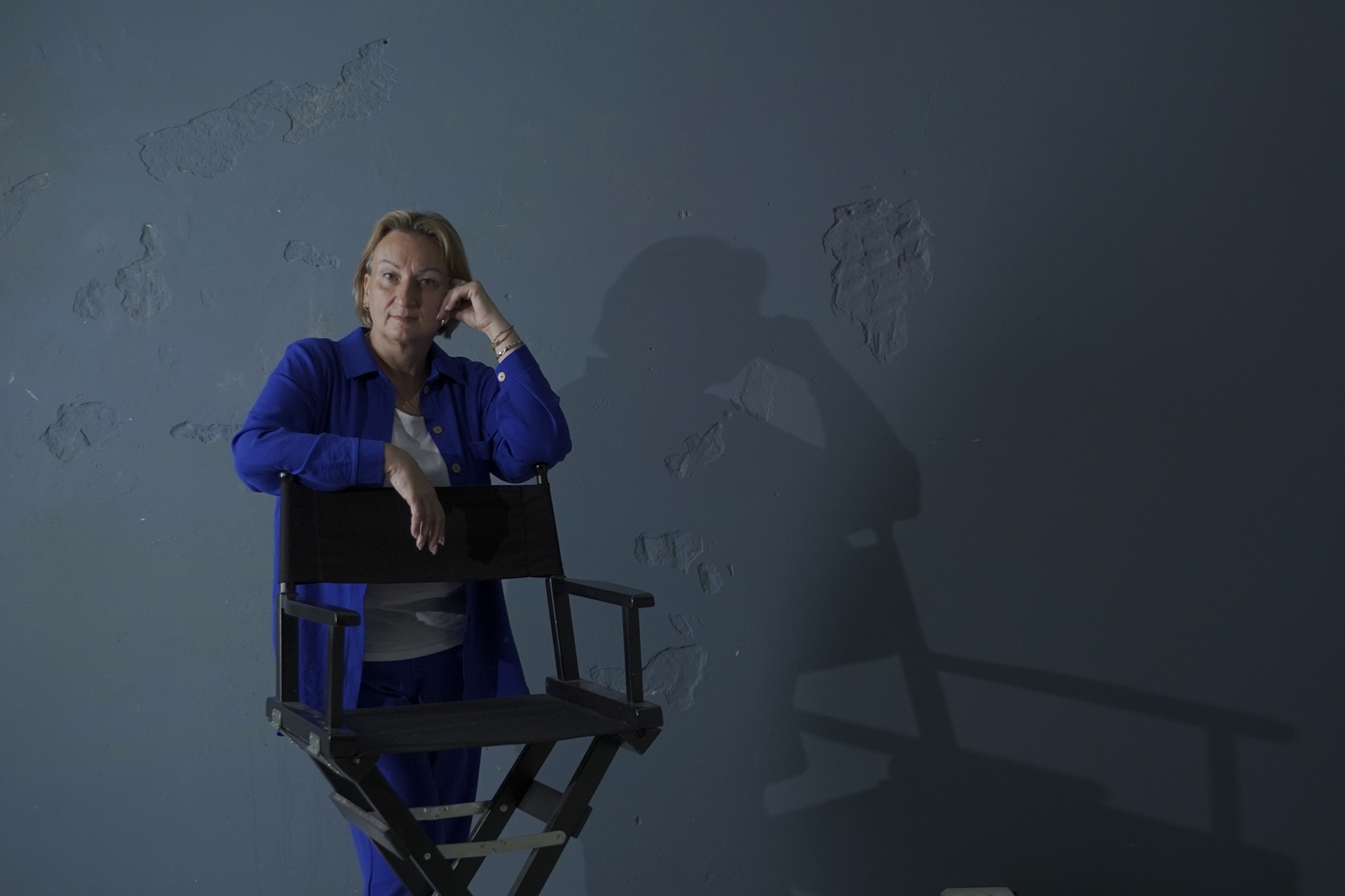
We meet her in Kyiv, in the lobby of a clinic where Svitlana is undergoing rehabilitation after 11 months in captivity. She wears a tailored pantsuit, her wavy hair styled neatly. The 55-year-old woman’s gaze remains calm and focused, even when she smiles. A fragment of a tattoo is visible beneath the lapel of her jacket.
“I promised myself while I was still in captivity that once I got out, I’d get a tattoo of a viburnum. And there’s supposed to be a map of Ukraine here too,” Svitlana unbuttoned the top button of her shirt. “It says ‘unbreakable’ here, but I’m going to add ‘steel’ and ‘free’ too.”
Before joining the military, Svitlana Vorova, a native of Odesa, worked as an engineer in the technical department at Ukrzaliznytsia. In the Azov Regiment, she became a clerk in the logistics department. She had to move from Odesa to the unit’s deployment location, in Urzuf.
On February 24, 2022, Svitlana was there.
– We left for Mariupol, to Azovstal, after the alarm sounded. The entire regiment was sent there. We were there for 86 days, until the day we were taken prisoner.
There were at least 150 people in one bunker. After the bunkers with the kitchen were blown up, they stopped bringing us anything. We got organized with the girls and started cooking and cleaning up the trash. We did everything we could so that the guys could focus on their combat missions and not worry about everyday issues. We baked bread, cooked meals, and cleaned. We took out the trash.
We were bombed very heavily—from ships, from tanks, from the air. There were moments when I even wrote to my children, saying goodbye to them. Many bunkers were bombed. Many soldiers, my friends, died. Some were simply burned alive.
The evacuation from Azovstal, interrogations, the explosion in Olenivka
– How did you find out that you would have to surrender?
– From the commander. He spoke with the commander-in-chief and received an order (to surrender weapons – UP) to preserve the regiment, or rather, the part of the regiment that was still left.
– How did you react to this order?
– On the one hand, there was joy: you survived. On the other hand, you don’t know what to expect. We understood that we would be mistreated. We were prepared for the worst, but hoped that Russia would comply with the Geneva Convention.
The withdrawal began on May 17; our soldiers left each bunker separately, in whole columns.
Our bunker was the last to leave, on May 20. First five at a time, then ten. They searched us, took our personal belongings, and escorted us to the buses.
And these buses took us to Olenivka. There, all the girls were placed in the DIZO. This is a disciplinary isolation unit, a six-person cell where there were sometimes 25 of us, sometimes more, up to 30. Two girls slept on each of the six bunks. And everyone else slept on the floor. Like sardines, side by side.
There was also a toilet in the cell. It was completely unsanitary, and there was no water. They gave us jugs of industrial water through a feed slot (a small opening in the door). We tried to strain it and let it settle so we could drink it. And we also tried to wash ourselves a little, wash our faces, at least wash our hands, because it was a nightmare. (Because of the unsanitary conditions) the girls had constant diarrhea and intestinal disorders.
Once a week—well, that’s in the best-case scenario—they took us to the shower. And it was a race against time. They’d take 5 or 10 of us to the shower—we had 5–10 minutes for everyone. During that time, we had to wash ourselves and air out some clothes. Which, of course, we then hung up in our own cell. Olenivka is a nightmare.
– Did you have any communication with the guards?
– With the administration—no. But the guards talked to us. Well, more often than not they just taunted us, but they talked. They constantly said that nobody needed us. They insulted us all the time, using profanity, calling us both “chickens” and “Azov prostitutes.”
– What did you talk about among yourselves?
– We discussed everything: recipes, and what kind of families everyone had. We talked about our dreams. I encouraged the girls to talk about the future. One evening I said, “Girls, let’s say our night prayers.” They said, “You read it, Gracia, and we’ll repeat after you.” And in our cell, we had this tradition—once we started, we kept reading the “Our Father” until the day of our exchange.
– Is Gracia your call sign?
– Yes. They told me to pick a call sign when I joined the army. I had a few options, but they were already taken. And then I thought, why not Gracia?
– Can you recall the call signs of the others?
– Khana, Dika, Ginger. I also had a friend, Romashka, who was also the mother of a fallen soldier. And she died too, unfortunately. She loved flowers, especially daisies—that’s how she got that call sign.
– What did they feed you?
– In Olenivka? You can hardly call it “fed.” Except maybe the bread our girls baked. The camp commander ordered us to form baking shifts so the girls could go to the bakery and bake bread. That was the only tasty thing there. Everything else—water with a piece of potato floating in it—how can you call that food? Porridge with unpeeled fish cooked in it, with spines, bones, and everything. No oil, no salt, nothing.
In total, over 11 months of captivity, I lost 30 kilograms.
– Were there interrogations?
– In Olenivka—yes. As I said, we were in the disciplinary isolation unit. Our guys were in the barracks. So, those whom the Russians suspected of being snipers, or whose tattoos they didn’t like—some had nationalist tattoos, coats of arms, portraits of Bandera—they sent them to the disciplinary isolation unit with us.
And we had a shift of “DNE” guys, very brutal ones, who severely tormented the guys. Very severely. They beat them, wrapped their hands and feet in duct tape, and continued to torment them. They beat them with stun guns. We could only hear them screaming and moaning. We heard everything, day and night.
After one of the interrogations, they carried one guy out on a stretcher, dead—they said he’d supposedly taken his own life. But we heard how the “DNR guys” would go into his cell in the middle of the night repeatedly, beat him, throw him around, and torment him as much as they could.
— And didn’t they take the girls in for interrogations?
— They did. But aside from insulting and shoving us, they didn’t beat us like that. That didn’t happen in Olenivka. At most, they might have hit us on the shins or the back. As far as I know, there was no sexual harassment either. Only in words—they’d say: “We should rape all of you so you’ll give birth to Russians for us.”
– What did the investigators ask you about?
– They were looking for snipers, asking who was doing what, all that. But personally, they were interested in our opinions, what we think about, how we reason. And what drives us in our struggle.
They asked me how I feel about Russians. I said, well, I feel fine about them. I feel fine about reasonable Russians. And if a person is reasonable, it doesn’t matter what nationality they are or where they live. But they just don’t want to understand that they’ve come to another country.
– How did you survive the explosion in Olenivka?
– They (the guards – UP) were walking around very cheerfully right before the explosion. And then the explosion. Panic. Or rather, it felt like they were faking panic. From their behavior, it was clear that it wasn’t our people, you understand? And we heard where the shots were coming from. We heard the guys moaning, screaming.
– How do you explain to yourself why they did this?
– To break us. They tried to convince us that it was our guys who did it.
We didn’t fall for it. Because, as I said, we could hear very clearly where the shots were coming from.
It’s hard to believe that our guys would be shelling us. Why would they do that?
Solitary confinement, mouse hunting, torture by Gazmanov, blue and yellow threads on the radiator
– What helped you endure captivity?
– You know, at first we held up better when there were a lot of us in the cell. Although we often lost heart, because we were constantly asking ourselves: “When will you be exchanged?”, “Why haven’t you been exchanged yet?”, “What’s happening in Ukraine?”
Although in Olenivka we could hear the guards talking among themselves. And we also watched their moods. When they were in a bad mood, it seemed like our guys were giving them a hard time. But when they were in high spirits, our guys were the ones getting it.
But when they transferred us to Russia on September 27, there was a complete information vacuum. At first, they kept us in cells of three, and starting in January—in pairs. Being with just one person 24/7 is tough. We’ve already talked about everything: books, all our affairs, hobbies—everything, everything, everything. It’s mentally tough.
We looked out the window, and when the sky was clear and the sun was setting, we saw the blue sky and the orange-yellow sunset. What do you think we saw? Of course, our flag. We’d say: look at that sunset. That’s Ukraine! Everything will be okay.
[BANNER2]
By order of the detention center warden, they sometimes showed us Soviet films. Good movies. “The Queen of the Gas Station,” “Wedding in Malinovka”—in these movies, everyone wears embroidered shirts, you know? “Only Old Men Go to Battle,” for example. The part where Bykov says: “You flew over my Ukraine; there, the sky is bluer, and the grass is greener.”
That gave us strength. Maybe the Russians didn’t understand that. The head of the detention center allowed us to read books. Of course, they were all in Russian. We weren’t allowed to speak Ukrainian at all. And we couldn’t speak out loud—only in whispers. But we read. In seven months, we read a hundred books.
When I wasn’t reading, I scrubbed the walls. I was moved to five different cells in Russia. I scrubbed all the walls, all the floors, and all the toilets in those cells. They constantly demanded that I clean.
– Were you in solitary confinement?
– Well, in Olenivka, I was in what they called solitary confinement. It was just a cell with harsher conditions: they kept 10 people in a 2.5-by-2.5-meter room. And while in a regular cell we were taken out into the yard once a week to walk around and get some fresh air, from solitary confinement we were taken out once every three weeks, and sometimes even once a month.
The small window facing the street was covered with sheet metal with Z-shaped holes drilled in it. Inside was a two-tier bunk bed. Two people slept on each bunk, while the others slept on the floor, under the bunk, on the toilet railing, on the table, or on a bench. I slept under the bunk.
The floor was concrete. We asked for them, and sometimes they gave us mattresses. Though you couldn’t really call them mattresses—they were just rags stuffed with cotton, dirty and moldy. Mice ran all over us. We caught those mice; that was our entertainment.
In Russia, the solitary confinement cell in the detention center was different; it was a single-person cell, 1.5 by 3 meters, with a small window near the ceiling that you couldn’t reach, and it was barred, with a strong draft blowing through it.
It was early February, with snow and rain; the single-pane window had cracks, and it was very cold—we shivered from the cold both day and night. Because of this, it was impossible to fall asleep, and in the morning, on command, they’d wake you up and force you to carry the mattress into a separate room. The cot would be raised and locked by the guards so you couldn’t sit on it.
Besides the bunk, the cell had a toilet, a sink, and a small table with a chair. But you weren’t allowed to sit at all. That is, you could sit only when the guard wasn’t around. As soon as he approaches, you have to stand by the door and greet him. And fulfill his whims: sing the Russian anthem, sing Russian songs, do squats, mop the floor. We probably washed the floor ten times a day, if not more. It was such a form of abuse.
One girl—she had pretty long hair—the Russians started cutting her hair just because she looked toward the door, toward the peephole. But the clippers broke. So, I guess it was her luck that they didn’t shave her head completely.
– You’re not allowed to look at the door?
– No. You’re not allowed to talk out loud, you’re not allowed to look at the door. Even when they come over, you’re not allowed to look. You can’t go to the window and look out into the yard.
– Why were you held in solitary confinement? Was that a punishment?
– Yes. In Olenivka, it was punishment for answering the prison warden in a way he didn’t expect. He really wanted us to give an interview, but I said my family doesn’t watch Russian TV. He didn’t like that, so he ordered that I be taken to cell number six in the disciplinary isolation unit. And I spent a month and a half there.
Another girl ended up in solitary confinement because she asked the warden if we would really be given compote made from the cherries that grew on the colony grounds. Nava, Ptashka, and other girls were also in that same solitary confinement cell.
And in Russia, they put us in solitary confinement because the girl who was with me—Olena—and I were hanging strings on the radiator. Two threads, blue and yellow. It just so happened that we had each pulled them out at different times from the towels they gave us for mopping the floor. Well, we hung those threads on the radiator to mark the day of the week. A few months later, they found those strings. They said we were embroidering the Ukrainian flag, and that was it—they put us in solitary confinement for a week.
– You’re saying they made you do squats there?
– Yes. At least fifty, at most a thousand times.
– And did they count?
– Yes. They ordered us to count out loud. Loudly, so they could hear us. The girls did push-ups twenty to fifty times. They forced us to learn the Russian anthem and sing it over and over. There were days when we sang it ten times. Russian songs that they first played on the radio, and then forced us to sing. Gazmanova, Babkina—I just hate them after that. It’s torture. It’s psychological and moral torture of people.
– All this time, you had no contact with your family. So you had no idea what was happening in Ukraine?
– Sometimes they took us out for interrogations with the investigators. And they listed the cities that [the Russians] had supposedly captured. They said they would take Odesa soon. But we had no confirmation of that. And we couldn’t tell them anything either, because we didn’t know what was happening.
At the time we were taken into captivity, the city was being heavily bombed—I was riding on a bus and saw Mariupol in ruins. I just burst into tears.
The exchange, the first tiramisu in freedom, dreams of shelling
– Can you recall the day you found out about the exchange?
– We waited for the exchange every day, but we didn’t know until the very last moment when it would happen. Even when they woke us up and started calling us out by name from the cell, we didn’t know why.
It was in the middle of the night. They call your name, you go out, and your cellmate stays behind—how is that possible? I say, “Lenochka, just in case, let’s stick together.” We memorized our loved ones’ phone numbers. If I get out, I have to call her family and tell them everything is fine. The same goes for her.
And then they gave us our things and told us not to take anything else. So you don’t understand what’s happening: they’re taking you somewhere, but no one says where. Although there were some guards who whispered that we were being taken for an exchange.
It was a complete surprise, but we’d been expecting this surprise, you see, every single second. So as soon as it actually happened, it felt like a dream. Even when we arrived at the border, we had already been exchanged, transferred to other buses, and our soldier came in and said, “Ukraine welcomes you.” And you look at him and don’t understand if it’s true, or maybe the Russians have changed their clothes and are just mocking us.
– What were your first days in Ukraine like?
– My children came to see me right away. When I saw them, I was overjoyed. They were crying and said, “Mom, you’ve gotten so small.” I said, “Yes, but I’m alive and well, everything’s fine, I’ll gain weight.”
– In captivity, you were deprived of almost everything. What was the first thing you treated yourself to once you were free?
– You know, when we were in captivity, Lena and I dreamed all the time—it just so happened that we have similar tastes—about a sweet cheese dessert. My favorite is tiramisu. Of course, I told the girls that. And when we ended up in the hospital, the first thing the girls brought was a dessert cake—tiramisu.
– Do you have dreams?
– I do. Shelling, bombing. I still feel anxious. When the thunder is loud, I can’t sleep. Because it sounds like explosions to me. And I still can’t ride the subway alone. Because the sound of the train as it approaches is like a fighter jet flying by to me.
– You’re undergoing rehabilitation now. What’s next?
– To serve. To continue the work. I’ll serve until they kick me out (smiles).
The kids? They know their mom is an independent woman, and things will still go the way she says.
This is an automatic translation generated by DeepL.