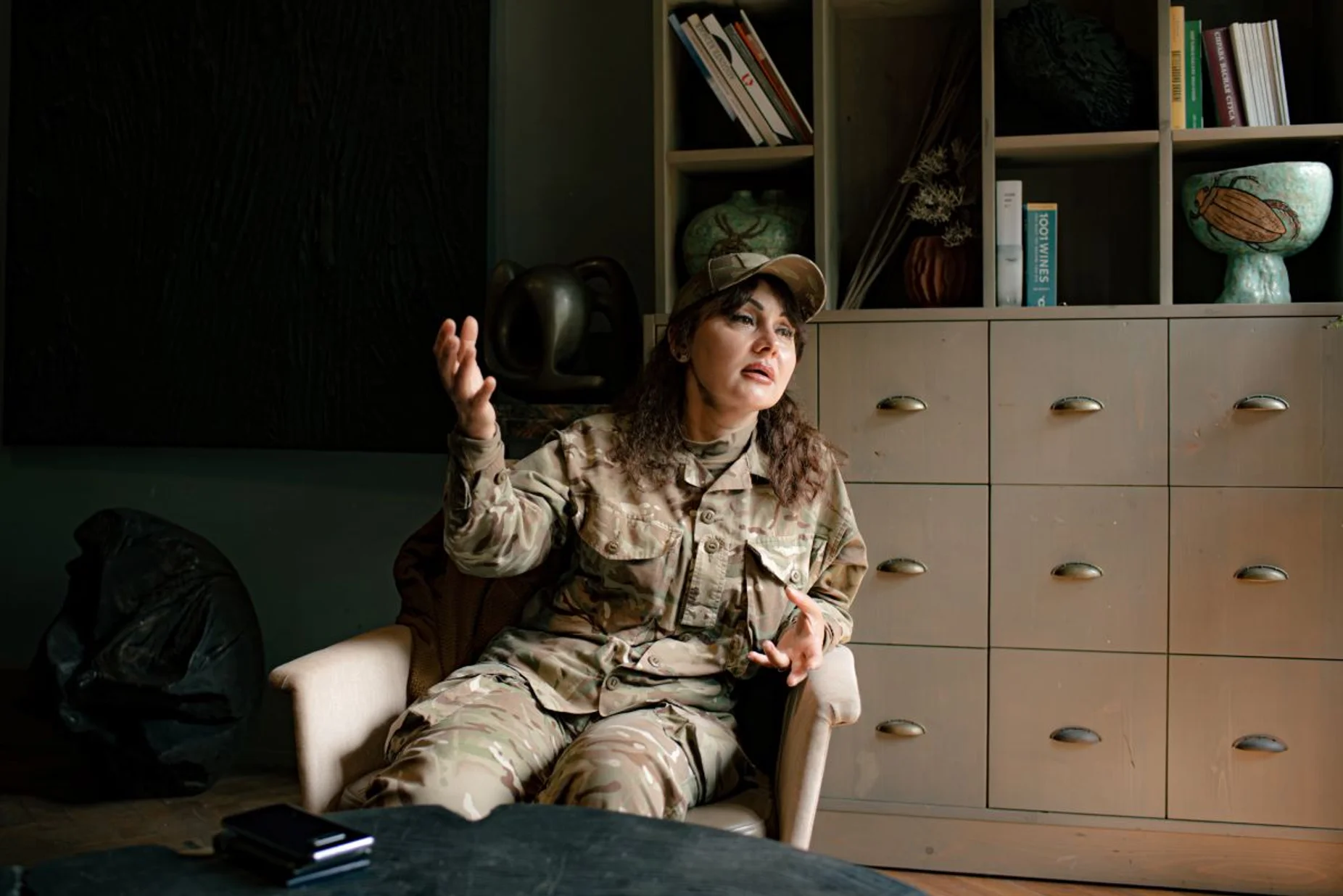
ATO, Azov, 11.5 months of captivity and return to service. The story of a combat medic from Uzhhorod Halyna Zaitseva
Source: Varosh
Author: Tetiana Klym-Kashuba
Galina Zaitseva has been in the military for 10 years. Mobilized in 2015, she served in the ATO/JFO with the 128th Brigade. Then came her transfer to Azov and the first bombs of full-scale war that fell on Mariupol. Azovstal. Capture by the Russians. Olenivka and Taganrog. Exchange after 11.5 months of captivity. Rehabilitation. And... a return to duty.
We meet with Galina a few days before her return to the front lines.
– When we were released from Russian captivity—there were 24 of us women at the time—they asked us: who wants to speak, to tell their story? I flatly refused. “I suppose it’s a way of protecting my mental health,” says Galina Zaitseva, a combat medic from Uzhhorod, as we get to know each other.
Beautiful, poised, full of inner nobility, calm. But her eyes—that distinctive gaze of people who have endured severe trials—immediately speak volumes.
“February 20, 2014, the day Russia launched its hybrid military aggression against Ukraine, was a turning point for me. “I remember crying out of despair, injustice, and pain as I read reports about the events in Crimea and realized that my country had been attacked,” recalls Galina Zaitseva.
Both of her grandfathers were in the military; from a young age, Galina grew up surrounded by conversations about the army and discipline. There was a lot of military literature at home, and people connected to the army often gathered for visits. And one of her childhood pastimes was taking shooting lessons at the range.
However, when the time came to choose a career for herself, Galina settled on medicine. Once she saw a nurse in a white coat, and she herself wanted to become an “angel” who greets patients in hospital rooms when they come to.
“As a child, I studied piano at music school, and my teacher suggested I make a career out of music. But my mom said, ‘My Galya isn’t going to work as a music teacher for 90 hryvnias a month.’ Later, in difficult situations—when I worked in the ICU in the 1990s without any pay at all, at Azovstal, and in captivity—I often recalled that phrase.
After first earning a medical degree and later a teaching degree, she worked in the intensive care unit for nine years, then served as head nurse at a psychoneurological clinic. In early 2009, she retired after completing her years of service. Her pension was meager—800 hryvnias—but there was room and opportunity for growth. So she got a job at one of the local companies.
“Starting in February 2014, I spent a year mulling over the decision to join the military. A sense of duty, instilled in me since childhood, constantly reminded me: even as a retiree, as a medical professional, I am subject to military service. But general mobilization hadn’t been announced, and I had a family, a child,” recalls Galina Zaitseva.
In the end, my restlessness got the better of me: in 2015, she signed a contract, and by April 2016, she had already headed to the ATO zone as part of the 128th Transcarpathian Mountain Assault Brigade.
– In the 128th Brigade, I served as a paramedic in the medical company. We were severely understaffed at the time: while the authorized strength was supposed to be 150, there were actually only 60 of us. One person was doing the work of three, and the workload was enormous. I was responsible for three battalions.
The tasks of a combat medic include providing emergency care, rapid evacuation, and escorting the wounded to the hospital while monitoring their condition. Among other things, I went out on demining missions with sappers—providing medical support in case something happened.
Now combat medics work according to established protocols, but back then we were just learning how to operate in wartime conditions. It was a great stroke of luck to manage to transport the wounded in time. My experience in the ICU and my specialized education came in very handy: fortunately, I was able to transport the wounded and save lives. So, after joining the army as a soldier, I was promoted to junior sergeant fairly quickly,” says Galina Zaitseva.
She recalls how she first came home after spending six months in the combat zone and couldn’t get over the contrast for a long time. She felt as if she had stepped into another dimension. In the war in the east of the country, people had been dying, equipment had been burning, and the ground had been shaking from explosions for the second year in a row. But in peaceful areas, people would ask Galina dismissively about her UBD certificate, asking where and for how much she had bought it.
“My first leave in December 2015 was a shock to me: there was such a huge gap between the front lines and civilian life in Ukraine. Once I tried to use my combatant ID on public transportation, and they demanded that I prove I was a veteran. After that, I always studied the person closely, trying to figure out how they would react to the ID. And I often decided not to use it—my mental and emotional well-being was more important to me.
It was infuriating how many people didn’t understand what was really happening, and that we are actually ensuring the peace and the life they are able to live. Unfortunately, Ukrainians didn’t understand the priority and necessity of the army for a long time; they didn’t realize that if the Russians came here, we’d all be slaves.
In 2021, Galina Zaitseva decided to transfer to another unit. By that time, she had already served for four years as the head of the medical station for the tank battalion of the 128th Brigade.
– A tank battalion means caponiers (defensive fortifications – ed.), dugouts, constant swamps, and pits. You’re always out in the fields, in the damp, in the cold. You move between positions with 5 kg of black soil caked to your feet.
Where haven’t we been stationed during that time: Pisky, Vodyane, Karlivka, Memrik, Chasiv Yar, Zaitseve, Maiorsk… We could be at a position for 8–9 months, and then spend 2–3 months at the PPD (permanent deployment point—ed.) in Uzhhorod. I felt how little time there was for socializing: I’d arrive craving civilian life and feel like a wild animal—I literally had to figure out what a QR code was and how to use it. It seemed to me that people were looking at me strangely, that I wasn’t dressing right or speaking right. And my health started to suffer.
At that time, the 128th Brigade had already been stationed near Mariupol for several years. In her free time, Galina often visited the city and got to know it well, so she decided to transfer to the 555th Hospital. However, there were no openings at the hospital; instead, they needed medics at the National Guard unit—the Azov Brigade.
“At first I hesitated, because Azov requires excellent physical and military training. But then I thought: I don’t smoke (I’d quit long ago), I don’t drink, I’m a decent shot, and I run 6 km every morning. So I decided to give it a try—and they accepted me. I completed my training and started working as a paramedic at the medical station.
Since then, I’ve seen every day why Azov is recognized as one of the best units in the world in terms of training and self-discipline. The guys would go to the gym for training as early as 4 a.m., and an hour later, they’d go for a run. Medical care in the unit is at a very high level: there are constant training sessions and drills. “Azov” is the first unit in the Ukrainian army to begin performing blood transfusions as needed during the pre-hospital phase. By the way, we also performed blood transfusions at “Azovstal”…
Galina Zaitseva was in Mariupol when the full-scale invasion began. On February 24, 2022, at 3:35 a.m., she was awakened by a powerful explosion: the first bombs had fallen on the city. The first thing she did was jump out of bed, trying to shield her pets in their cage: two parrots and a chinchilla.
“One of the parrots found me back in 2017 in the ATO zone: we were serving near Volnovakha at the time, and in March he flew in from somewhere in a residential area 2 km away across the field to our position. The guys found him exhausted on the ground near the dugout, warmed him up, fed him, and brought him to me. A week later, it turned out that the bird could talk: that’s how we found out his name was Richard—Richka-ptichka. From then on, he went everywhere with me to the positions, and later I found him a girlfriend—Vincessa. Later, I also got a chinchilla.
After making sure the animals were safe, I called home to tell my family to take care of themselves and each other—and then I headed to the hospital. From the start of the invasion, intense work was underway at the 555th Military Hospital in Mariupol: collecting data on the wounded, identifying them, and assessing the nature of their injuries. The first casualties were military personnel and civilians...
On March 15, the hospital was continuously receiving the wounded, and surgeries were underway. One of the Russian bombs fell near the hospital. The explosion destroyed part of the building and blew out the windows and doors in the other part. That same day, the staff received orders to evacuate: without water and electricity, the facility could not function or provide care to the wounded. And, in general, it was dangerous to stay there. So, on March 17, Galina Zaitseva found herself at Azovstal.
From the first days of the war, Azovstal was being converted into a bunker to serve as a fortress in case of a ring encirclement: “Although we hoped until the very end that there would be a breakthrough and we would be unblocked—rumors about this were circulating— But the encirclement only tightened every day.”
At Azovstal, Galina spent the next two months in the “Zhelezak” bunker. All this time, Azovstal was under constant, heavy shelling—the Russians were firing with every weapon at their disposal, including military aircraft.
– They shelled us with Grad rockets, from tanks, and with self-propelled artillery units. But the scariest thing was the warning of a massive airstrike: some bombs pierced the bunker. And you walk around in anticipation, wondering: will it fall on you or fly past?
There could be up to 30 shelling incidents in a single day. Our bunker had six holes. Shelling is like the sky falling. Wounded people are buried next to you, and they lie under the rubble. And you lie there too, pressed against the floor, breathing in a heavy, hot cloud—a bomb filled with TNT has fallen. There’s no air as such—just something thick and scorching that chokes the breath out of you. And at some point, you simply lose consciousness from hypoxia. I’ve said goodbye to life like that a few times already.
…And then you come to, feel yourself over—are you okay?—and immediately jump up. And from there you hear: “Little River,” you see a chinchilla running around. And that’s it—you go back to work, run to the guys. The animals “kept” me going, and I kept them…
In the early days, one of the bombs that fell on our bunker destroyed the food supply. So for almost the entire time at Azovstal, we were essentially starving. Every day, young National Guard soldiers brought us 100 grams of porridge from another bunker, “Jupiter.” We survived on that, waiting for the guys as if they were gods—they brought this food under constant shelling, risking their own lives.
The defense of Mariupol and Azovstal lasted 86 days—until May 16, 2022. On May 19, Galina Zaitseva, along with one of the last groups of 13 people, left Azovstal and was taken into Russian captivity. Carrying a cage with parrots and a chinchilla in her hands.
– It was raining; we walked out. After the Russians inspected us, I tried to give my pets to a Red Cross representative so she could send them to my sister. But she said she didn’t have the authority to do so. They wouldn’t let us call our families either—they just took our phone numbers and then notified them themselves about our release from captivity.
The prisoners were immediately taken to Olenivka. On the bus, among the military men, there were two women—Galina Zaitseva and Kateryna Polishchuk, known as “Ptashka.” Galina would spend her first days in a prison cell in Olenivka with her.
We traveled to Olenivka via Mariupol at night—in the darkness, the Russians tried to hide the traces of their crimes in the city.
—Blood, pain, stench, misery, a city of corpses and severed limbs. A city of ruined and burned-out buildings—that is what the Russians have turned the once-thriving Mariupol into. I grew to love this city very much while I lived here. I had friends here, my own circle of friends. I still can’t bring myself to ask, to look: are the people I once knew still alive? Where are they, what has become of them? I’m afraid to find out that they’re gone, and I don’t know how I’ll handle it. And in this uncertainty, I live in the hope that they are all right...
Galina Zaitseva was held in Olenivka for 4.5 months. Immediately upon arrival, the cage with the animals was taken away. She hasn’t seen them since: the guards first taunted her, claiming they had killed her pets, and then said they had given the parakeets and the chinchilla to a kindergarten.
The doctor recalls how there was never enough air in the cell: 11 women were imprisoned in a small prison cell. Food was brought twice a day, sometimes at night. For a month, the prisoners were given a little bread every morning, and for lunch—a bowl of hot water as a “first course” and shredded cabbage leaves as a “second course.”
After Olenivka, Galina and the other prisoners were transferred to a prison in Taganrog, Russia.
In general, she speaks reluctantly about her captivity: she fears putting her fellow prisoners in danger. After all, the Russians are still holding more than 800 Azov soldiers captive.
She mentions in passing that there were threats with a stun gun, beatings, and humiliating formations with hands tied behind their backs and heads bowed to the floor. She recalls her shock when she was kicked by an officer: having grown up in a military family, she couldn’t comprehend how an officer could raise his hand against a female prisoner of war.
They also applied psychological pressure: since the prisoners were cut off from information, they were constantly told that “Ukraine had fallen” and been divided. They were intimidated with threats of execution. They weren’t allowed to sit or lie down—they had to either stand or walk around the cell at all times.
They also weren’t allowed to look out the window: doing so could result in having their heads shaved. Galina and the other captives defied this ban at their own risk as they welcomed 2023 in prison: they climbed onto the bunk and watched the fireworks through the window…
In May 2023, on Easter, after 11.5 months in Russian captivity, Galina Zaitseva returned home as part of a routine prisoner exchange.
– I have deep faith in God, in the power of prayer, and in the sign of the cross. For some reason, I was certain that we would be exchanged before Easter, and that’s exactly what happened. In March, they started feeding us better—they gave us two loaves of bread a day. Only later did it become clear that they wanted to “fatten us up” before the exchange. The exchange itself took place on April 10. The border, then the Sumy region, and then Kyiv: hospitals, rehabilitation.
– What were your first feelings and thoughts after the exchange?
– Oh my God, I felt like I was out of my mind! I hugged everyone I saw. At the border in Sumy Oblast, I ran up to a border guard and asked, “What’s your name?” He said, “Volodymyr.” And I was so happy: “I’m being greeted by the ruler of peace—that’s wonderful!” He said, “My granddaughter was born last night.” And I told him, “That’s a good sign! A girl means victory for the feminine gender!” My grandmother always said: when boys are born—it’s a sign of war, but when girls are born—it’s a sign of peace…
The first thing I ate after being released was something sweet: that’s my passion and love. Then I bought sweets in the stores and distributed them among the hospital wards.
Upon returning home from the hospital, I experienced a crash from the adrenaline rush—severe joint pain, difficulty walking, and the onset of migraines. I also had to take antidepressants: I completed the prescribed course.
Galina Zaitseva spent 5 months recovering. And by fall, she was back on duty: on September 20, she left for the Lyman-Kupiansk sector and took up her post.
I ask her if she ever considered returning to civilian life. After all, military personnel released from captivity are entitled to discharge from military service.
She replies: as long as the war is going on, a medic must be where she is needed.
– The war is still going on. I can’t stand on the sidelines right now. I don’t know what it is: conscience, a mission, a sense of duty? As long as martial law is in effect and you can be useful to your country, you have no right to step aside. The threat hasn’t gone anywhere; it’s still very real. When they tell me: “That’s it, the war is over, victory and peace—we don’t need you anymore,” I’ll leave.
Everyone has to do their part. We, as soldiers, are doing ours right now. Any civilized state, if it wants to exist and preserve its sovereignty, must have its own defense system. The military is one of its indispensable parts. And every person who cares about the fate of the country, about their own future and the future of their children, must respect the military.
The military is the guarantee of our shared future. Do you want to be a slave? Well, then disregard the military, and you will be a slave. If, of course, you survive.
*This material was prepared as part of the Dutch-Slovak-Ukrainian project “Strengthening the Rule of Law at the Local/Regional Level in Ukraine: The Case of Zakarpattia Oblast,” which is implemented with the support of the Government of the Kingdom of the Netherlands under the MATRA program, a key Dutch program supporting social transformation.
The project is implemented by the Institute for Central European Strategy (ICES) in collaboration with the Dutch organization Foundation for Justice, Integrity and Anti-Corruption (FJIAC) and the Slovak Transparency International Slovensko (TI SK) in partnership with the Transcarpathian Regional State Administration and the Regional Council.
**This material does not reflect the position or opinion of the grant project’s implementers or donors. Varosh is solely responsible for the content of its publications.
Author: Tetiana Klym-Kashuba
A special project on inner strength, a combat career, and returning to the military after captivity
Galina Zaitseva has been in the military for 10 years. Mobilized in 2015, she served in the ATO/JFO with the 128th Brigade. Then came her transfer to Azov and the first bombs of full-scale war that fell on Mariupol. Azovstal. Capture by the Russians. Olenivka and Taganrog. Exchange after 11.5 months of captivity. Rehabilitation. And... a return to duty.
We meet with Galina a few days before her return to the front lines.
– When we were released from Russian captivity—there were 24 of us women at the time—they asked us: who wants to speak, to tell their story? I flatly refused. “I suppose it’s a way of protecting my mental health,” says Galina Zaitseva, a combat medic from Uzhhorod, as we get to know each other.
Beautiful, poised, full of inner nobility, calm. But her eyes—that distinctive gaze of people who have endured severe trials—immediately speak volumes.
An Angel in a White Coat
“February 20, 2014, the day Russia launched its hybrid military aggression against Ukraine, was a turning point for me. “I remember crying out of despair, injustice, and pain as I read reports about the events in Crimea and realized that my country had been attacked,” recalls Galina Zaitseva.
Both of her grandfathers were in the military; from a young age, Galina grew up surrounded by conversations about the army and discipline. There was a lot of military literature at home, and people connected to the army often gathered for visits. And one of her childhood pastimes was taking shooting lessons at the range.
However, when the time came to choose a career for herself, Galina settled on medicine. Once she saw a nurse in a white coat, and she herself wanted to become an “angel” who greets patients in hospital rooms when they come to.
“As a child, I studied piano at music school, and my teacher suggested I make a career out of music. But my mom said, ‘My Galya isn’t going to work as a music teacher for 90 hryvnias a month.’ Later, in difficult situations—when I worked in the ICU in the 1990s without any pay at all, at Azovstal, and in captivity—I often recalled that phrase.
After first earning a medical degree and later a teaching degree, she worked in the intensive care unit for nine years, then served as head nurse at a psychoneurological clinic. In early 2009, she retired after completing her years of service. Her pension was meager—800 hryvnias—but there was room and opportunity for growth. So she got a job at one of the local companies.
“Starting in February 2014, I spent a year mulling over the decision to join the military. A sense of duty, instilled in me since childhood, constantly reminded me: even as a retiree, as a medical professional, I am subject to military service. But general mobilization hadn’t been announced, and I had a family, a child,” recalls Galina Zaitseva.
In the end, my restlessness got the better of me: in 2015, she signed a contract, and by April 2016, she had already headed to the ATO zone as part of the 128th Transcarpathian Mountain Assault Brigade.
ATO/JFO: “It was a great stroke of luck to get the wounded man back alive”
– In the 128th Brigade, I served as a paramedic in the medical company. We were severely understaffed at the time: while the authorized strength was supposed to be 150, there were actually only 60 of us. One person was doing the work of three, and the workload was enormous. I was responsible for three battalions.
The tasks of a combat medic include providing emergency care, rapid evacuation, and escorting the wounded to the hospital while monitoring their condition. Among other things, I went out on demining missions with sappers—providing medical support in case something happened.
Now combat medics work according to established protocols, but back then we were just learning how to operate in wartime conditions. It was a great stroke of luck to manage to transport the wounded in time. My experience in the ICU and my specialized education came in very handy: fortunately, I was able to transport the wounded and save lives. So, after joining the army as a soldier, I was promoted to junior sergeant fairly quickly,” says Galina Zaitseva.
She recalls how she first came home after spending six months in the combat zone and couldn’t get over the contrast for a long time. She felt as if she had stepped into another dimension. In the war in the east of the country, people had been dying, equipment had been burning, and the ground had been shaking from explosions for the second year in a row. But in peaceful areas, people would ask Galina dismissively about her UBD certificate, asking where and for how much she had bought it.
“My first leave in December 2015 was a shock to me: there was such a huge gap between the front lines and civilian life in Ukraine. Once I tried to use my combatant ID on public transportation, and they demanded that I prove I was a veteran. After that, I always studied the person closely, trying to figure out how they would react to the ID. And I often decided not to use it—my mental and emotional well-being was more important to me.
It was infuriating how many people didn’t understand what was really happening, and that we are actually ensuring the peace and the life they are able to live. Unfortunately, Ukrainians didn’t understand the priority and necessity of the army for a long time; they didn’t realize that if the Russians came here, we’d all be slaves.
“Azov”: I decided to try—and they took me
In 2021, Galina Zaitseva decided to transfer to another unit. By that time, she had already served for four years as the head of the medical station for the tank battalion of the 128th Brigade.
– A tank battalion means caponiers (defensive fortifications – ed.), dugouts, constant swamps, and pits. You’re always out in the fields, in the damp, in the cold. You move between positions with 5 kg of black soil caked to your feet.
Where haven’t we been stationed during that time: Pisky, Vodyane, Karlivka, Memrik, Chasiv Yar, Zaitseve, Maiorsk… We could be at a position for 8–9 months, and then spend 2–3 months at the PPD (permanent deployment point—ed.) in Uzhhorod. I felt how little time there was for socializing: I’d arrive craving civilian life and feel like a wild animal—I literally had to figure out what a QR code was and how to use it. It seemed to me that people were looking at me strangely, that I wasn’t dressing right or speaking right. And my health started to suffer.
At that time, the 128th Brigade had already been stationed near Mariupol for several years. In her free time, Galina often visited the city and got to know it well, so she decided to transfer to the 555th Hospital. However, there were no openings at the hospital; instead, they needed medics at the National Guard unit—the Azov Brigade.
“At first I hesitated, because Azov requires excellent physical and military training. But then I thought: I don’t smoke (I’d quit long ago), I don’t drink, I’m a decent shot, and I run 6 km every morning. So I decided to give it a try—and they accepted me. I completed my training and started working as a paramedic at the medical station.
Since then, I’ve seen every day why Azov is recognized as one of the best units in the world in terms of training and self-discipline. The guys would go to the gym for training as early as 4 a.m., and an hour later, they’d go for a run. Medical care in the unit is at a very high level: there are constant training sessions and drills. “Azov” is the first unit in the Ukrainian army to begin performing blood transfusions as needed during the pre-hospital phase. By the way, we also performed blood transfusions at “Azovstal”…
Full-scale invasion
Galina Zaitseva was in Mariupol when the full-scale invasion began. On February 24, 2022, at 3:35 a.m., she was awakened by a powerful explosion: the first bombs had fallen on the city. The first thing she did was jump out of bed, trying to shield her pets in their cage: two parrots and a chinchilla.
“One of the parrots found me back in 2017 in the ATO zone: we were serving near Volnovakha at the time, and in March he flew in from somewhere in a residential area 2 km away across the field to our position. The guys found him exhausted on the ground near the dugout, warmed him up, fed him, and brought him to me. A week later, it turned out that the bird could talk: that’s how we found out his name was Richard—Richka-ptichka. From then on, he went everywhere with me to the positions, and later I found him a girlfriend—Vincessa. Later, I also got a chinchilla.
After making sure the animals were safe, I called home to tell my family to take care of themselves and each other—and then I headed to the hospital. From the start of the invasion, intense work was underway at the 555th Military Hospital in Mariupol: collecting data on the wounded, identifying them, and assessing the nature of their injuries. The first casualties were military personnel and civilians...
On March 15, the hospital was continuously receiving the wounded, and surgeries were underway. One of the Russian bombs fell near the hospital. The explosion destroyed part of the building and blew out the windows and doors in the other part. That same day, the staff received orders to evacuate: without water and electricity, the facility could not function or provide care to the wounded. And, in general, it was dangerous to stay there. So, on March 17, Galina Zaitseva found herself at Azovstal.
Azovstal: It felt like the sky was falling
From the first days of the war, Azovstal was being converted into a bunker to serve as a fortress in case of a ring encirclement: “Although we hoped until the very end that there would be a breakthrough and we would be unblocked—rumors about this were circulating— But the encirclement only tightened every day.”
At Azovstal, Galina spent the next two months in the “Zhelezak” bunker. All this time, Azovstal was under constant, heavy shelling—the Russians were firing with every weapon at their disposal, including military aircraft.
– They shelled us with Grad rockets, from tanks, and with self-propelled artillery units. But the scariest thing was the warning of a massive airstrike: some bombs pierced the bunker. And you walk around in anticipation, wondering: will it fall on you or fly past?
There could be up to 30 shelling incidents in a single day. Our bunker had six holes. Shelling is like the sky falling. Wounded people are buried next to you, and they lie under the rubble. And you lie there too, pressed against the floor, breathing in a heavy, hot cloud—a bomb filled with TNT has fallen. There’s no air as such—just something thick and scorching that chokes the breath out of you. And at some point, you simply lose consciousness from hypoxia. I’ve said goodbye to life like that a few times already.
…And then you come to, feel yourself over—are you okay?—and immediately jump up. And from there you hear: “Little River,” you see a chinchilla running around. And that’s it—you go back to work, run to the guys. The animals “kept” me going, and I kept them…
In the early days, one of the bombs that fell on our bunker destroyed the food supply. So for almost the entire time at Azovstal, we were essentially starving. Every day, young National Guard soldiers brought us 100 grams of porridge from another bunker, “Jupiter.” We survived on that, waiting for the guys as if they were gods—they brought this food under constant shelling, risking their own lives.
The defense of Mariupol and Azovstal lasted 86 days—until May 16, 2022. On May 19, Galina Zaitseva, along with one of the last groups of 13 people, left Azovstal and was taken into Russian captivity. Carrying a cage with parrots and a chinchilla in her hands.
– It was raining; we walked out. After the Russians inspected us, I tried to give my pets to a Red Cross representative so she could send them to my sister. But she said she didn’t have the authority to do so. They wouldn’t let us call our families either—they just took our phone numbers and then notified them themselves about our release from captivity.
The prisoners were immediately taken to Olenivka. On the bus, among the military men, there were two women—Galina Zaitseva and Kateryna Polishchuk, known as “Ptashka.” Galina would spend her first days in a prison cell in Olenivka with her.
We traveled to Olenivka via Mariupol at night—in the darkness, the Russians tried to hide the traces of their crimes in the city.
—Blood, pain, stench, misery, a city of corpses and severed limbs. A city of ruined and burned-out buildings—that is what the Russians have turned the once-thriving Mariupol into. I grew to love this city very much while I lived here. I had friends here, my own circle of friends. I still can’t bring myself to ask, to look: are the people I once knew still alive? Where are they, what has become of them? I’m afraid to find out that they’re gone, and I don’t know how I’ll handle it. And in this uncertainty, I live in the hope that they are all right...
Olenivka – Taganrog. 11.5 months in captivity
Galina Zaitseva was held in Olenivka for 4.5 months. Immediately upon arrival, the cage with the animals was taken away. She hasn’t seen them since: the guards first taunted her, claiming they had killed her pets, and then said they had given the parakeets and the chinchilla to a kindergarten.
The doctor recalls how there was never enough air in the cell: 11 women were imprisoned in a small prison cell. Food was brought twice a day, sometimes at night. For a month, the prisoners were given a little bread every morning, and for lunch—a bowl of hot water as a “first course” and shredded cabbage leaves as a “second course.”
After Olenivka, Galina and the other prisoners were transferred to a prison in Taganrog, Russia.
In general, she speaks reluctantly about her captivity: she fears putting her fellow prisoners in danger. After all, the Russians are still holding more than 800 Azov soldiers captive.
She mentions in passing that there were threats with a stun gun, beatings, and humiliating formations with hands tied behind their backs and heads bowed to the floor. She recalls her shock when she was kicked by an officer: having grown up in a military family, she couldn’t comprehend how an officer could raise his hand against a female prisoner of war.
They also applied psychological pressure: since the prisoners were cut off from information, they were constantly told that “Ukraine had fallen” and been divided. They were intimidated with threats of execution. They weren’t allowed to sit or lie down—they had to either stand or walk around the cell at all times.
They also weren’t allowed to look out the window: doing so could result in having their heads shaved. Galina and the other captives defied this ban at their own risk as they welcomed 2023 in prison: they climbed onto the bunk and watched the fireworks through the window…
In May 2023, on Easter, after 11.5 months in Russian captivity, Galina Zaitseva returned home as part of a routine prisoner exchange.
The Easter exchange, rehabilitation, and return to duty
– I have deep faith in God, in the power of prayer, and in the sign of the cross. For some reason, I was certain that we would be exchanged before Easter, and that’s exactly what happened. In March, they started feeding us better—they gave us two loaves of bread a day. Only later did it become clear that they wanted to “fatten us up” before the exchange. The exchange itself took place on April 10. The border, then the Sumy region, and then Kyiv: hospitals, rehabilitation.
– What were your first feelings and thoughts after the exchange?
– Oh my God, I felt like I was out of my mind! I hugged everyone I saw. At the border in Sumy Oblast, I ran up to a border guard and asked, “What’s your name?” He said, “Volodymyr.” And I was so happy: “I’m being greeted by the ruler of peace—that’s wonderful!” He said, “My granddaughter was born last night.” And I told him, “That’s a good sign! A girl means victory for the feminine gender!” My grandmother always said: when boys are born—it’s a sign of war, but when girls are born—it’s a sign of peace…
The first thing I ate after being released was something sweet: that’s my passion and love. Then I bought sweets in the stores and distributed them among the hospital wards.
Upon returning home from the hospital, I experienced a crash from the adrenaline rush—severe joint pain, difficulty walking, and the onset of migraines. I also had to take antidepressants: I completed the prescribed course.
Galina Zaitseva spent 5 months recovering. And by fall, she was back on duty: on September 20, she left for the Lyman-Kupiansk sector and took up her post.
I ask her if she ever considered returning to civilian life. After all, military personnel released from captivity are entitled to discharge from military service.
She replies: as long as the war is going on, a medic must be where she is needed.
– The war is still going on. I can’t stand on the sidelines right now. I don’t know what it is: conscience, a mission, a sense of duty? As long as martial law is in effect and you can be useful to your country, you have no right to step aside. The threat hasn’t gone anywhere; it’s still very real. When they tell me: “That’s it, the war is over, victory and peace—we don’t need you anymore,” I’ll leave.
Everyone has to do their part. We, as soldiers, are doing ours right now. Any civilized state, if it wants to exist and preserve its sovereignty, must have its own defense system. The military is one of its indispensable parts. And every person who cares about the fate of the country, about their own future and the future of their children, must respect the military.
The military is the guarantee of our shared future. Do you want to be a slave? Well, then disregard the military, and you will be a slave. If, of course, you survive.
*This material was prepared as part of the Dutch-Slovak-Ukrainian project “Strengthening the Rule of Law at the Local/Regional Level in Ukraine: The Case of Zakarpattia Oblast,” which is implemented with the support of the Government of the Kingdom of the Netherlands under the MATRA program, a key Dutch program supporting social transformation.
The project is implemented by the Institute for Central European Strategy (ICES) in collaboration with the Dutch organization Foundation for Justice, Integrity and Anti-Corruption (FJIAC) and the Slovak Transparency International Slovensko (TI SK) in partnership with the Transcarpathian Regional State Administration and the Regional Council.
**This material does not reflect the position or opinion of the grant project’s implementers or donors. Varosh is solely responsible for the content of its publications.
This is an automatic translation generated by DeepL.