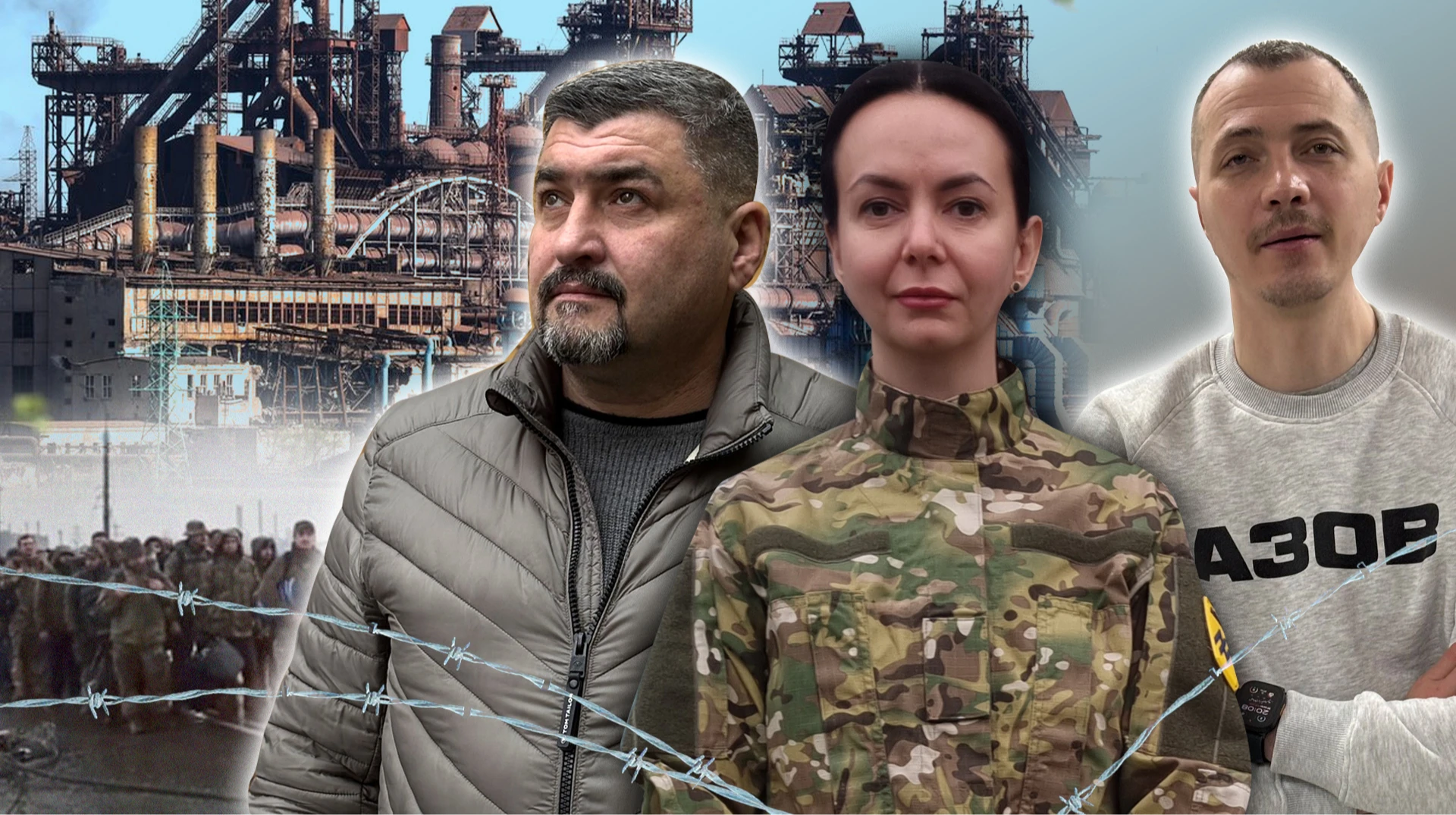
The Archipelago of Torture, or How Russians Mock Ukrainian Prisoners. Testimonies
Source: Ukrainska Pravda
Author: Maryna Kumeda
"They beat me with a water bottle—on my back, on my head, on my legs. They pretended to cut off my fingers with scissors. The only thing they said was, 'We’re doing this out of respect for your age. But tomorrow, if you say what you said today, we’ll just kill you,” recalls 56-year-old Oleg Onyshko, a former soldier of the 109th Brigade of the Territorial Defense Forces.
On January 3, 2024, Oleg returned from 19 months of captivity in Olenivka, Taganrog, and Kursk.
He traveled three hours by bus to Ternopil for our interview to testify: “This terrorist state is a member of the UN Security Council and claims to respect international humanitarian law.”
Franco-Ukrainian journalist Marina Kumeda and French journalist Pierre Alonzo interviewed 13 military personnel, including one woman, who spent between 1.5 and 28 months in captivity in the occupied territories of Ukraine and in the Russian Federation. Those interviewed are soldiers and officers from various units: the Territorial Defense Forces, the National Guard, the Marine Corps, and the 12th Brigade of the National Guard “Azov” (military unit 3057), ranging in age from 25 to 61.
Most were captured at Azovstal, some while wounded. All of them, except for one wounded soldier who was taken to a hospital, report torture and cruel treatment.
In this article, we present the testimonies of Ukrainian servicemen regarding the conditions under which they were held.
From Azovstal to Olenivka: Surrender
Approximately 2,500 prisoners left Azovstal between May 16 and 20, in accordance with agreements with Russian authorities, under the supervision of the UN and the International Committee of the Red Cross.
“Azov” commander Redis drew up a list of demands—21 points. Perhaps 2–3 of them were met," says 62-year-old surgeon Yevgen Gerasymenko, who flew to Mariupol by helicopter and performed surgeries at Azovstal. "There were about 300 wounded, of whom 52–55 were unable to move on their own."
A 40-year-old marine from the 503rd “Tarantul” Battalion, wounded by naval artillery fire, was taken to a hospital in Donetsk: he had seven broken ribs, a pneumothorax, a torn muscle in his leg, and a concussion.
He recalls: “There was no differentiation: sometimes the more seriously wounded—even some who were bedridden—were sent to Olenivka, while those with minor injuries (such as a minor eye injury) were sent to the hospital.”
The surrender process went smoothly, according to all accounts.
“It was a completely civilized process; it looked like a theatrical performance. They checked our clothes, tattoos, ranks, and positions. They weren’t brutal. As soon as no one was looking, things got worse," shared 30-year-old Arseniy Fedosyuk, a scout with the Azov Regiment.
Not everyone had contact with the international observers who were supposed to inform their relatives.
"I understand that Red Cross representatives were filming on their phones. No one approached us—me and my comrades—to take our photos or fill out the forms,” testified 38-year-old Azov press officer Artem Dubyna, who was released after 28 months of captivity with severe injuries to his face and neck, having lost approximately 20 kilograms due to physical exhaustion.
At the time of their release, the Azov soldiers expected “honorable captivity” and an exchange after 3–4 months of screening.
“It was important for us to hear that there were certain guarantees: that we would not be interrogated or tortured,” says Valeria Subotina, a 36-year-old Azov press officer released in April 2023, the only female officer in the brigade.
Oleksandr Demenko, a 25-year-old soldier with the 15th Special Operations Brigade named after Bohdan Zavada, recalls: “Our emotions were very mixed. There was a little joy that they weren’t shooting at us anymore. We didn’t know what lay ahead.”
The former Volnovakha Penitentiary No. 120, designed to hold 1,100 people, took in over 2,000 prisoners. Those interviewed complain about the lack of space and poorly organized logistics, the small amount of food, and dinner at 3 a.m.
Yevhen Herasymenko says with a smile: “I always try to see the positive side of things. We were given two minutes to eat. Wheat groats were simply doused with boiling water. There were 6–7 spoonfuls of porridge. It was so scalding hot that we burned our mouths. At the end, they shoved bread down our throats. The guards stopped us and made us do squats until we finished eating. All movement was done at a run—they turned us into athletes.”
Arseniy Fedosyuk, a 30-year-old scout with the Azov Regiment, recalls a “constant feeling of hunger”: “I think it was 500 calories a day, if you combine all the meals. The porridge was of poor quality, with stones and debris, but we still ate every portion.” Arseniy lost 10 kilograms in 7 months and weighed 62 kilograms upon his return.
Anatoliy Mikheev, a 27-year-old officer with the Azov Regiment, recalls: “A fire truck would draw water from the river, and they gave us that muddy water to drink. We drank it because we had to survive somehow.”
33-year-old medical service paramedic Oleksandr Demchenko, who weighed 120 kilograms before his capture, spent 127 days in Olenivka and weighed only 64 kilograms on the day of the exchange, September 21.
My first encounter with the prison system without international oversight brought a new realization, says a 30-year-old soldier with the call sign “Roger” from the Azov Special Operations Unit: “They started undressing us. And for me, that was the first turning point, when I, a man, was standing naked on the street, without underwear, in front of some other people.”
Anatoliy Mikheev confirms: “They took us for so-called interrogation by FSB representatives. I understand that there were agreements not to touch us at first. They could have beaten us a little, because there’s no Red Cross here and they can do whatever they want to us.”
In barracks designed for 60–80 people, they housed 300–400. There wasn’t enough space, and many slept on pallets, on the floor, in the bathroom, or outside within the barracks.
Oleksandr Demchenko adds: “They took all our gold jewelry, money, watches, nice tactical clothing, combat boots—everything they liked. Once, we sat on the parade ground completely naked for about 4–6 hours while they searched for our phones.”
The Azov soldiers were moved to separate barracks and placed under special conditions, recalls surgeon Yevgen Gerasymenko: "When we were taken out for meals, there were 8–10 guards; when it was Azov’s turn, they brought out entire shifts of the Federal Penitentiary Service (FSIN) and dogs. Thirty people were escorted by 300 guards. They did this for about two weeks, and then, apparently, they got tired of it, and started bringing food to the barracks instead. They didn’t go out at all.”
For some, the interrogations began immediately—in particular, for Valeria Subotina, the very next day. Valeria, whose husband died defending Azovstal, wasn’t beaten in Olenivka, but they used specific methods of pressure:
“They tried to confuse my thoughts. They told me that my husband hadn’t died—he’d just left the country, that no one was waiting for me in Ukraine. I’d go back to my cell and ask the female medics if anyone had actually seen his face. On top of that, they don’t let you sleep because they blast Russian music. You slowly start to lose your mind.”
During interrogations, Valeria was forced to confess to the murders of civilians and give an interview to the Russian press. This is a practice others have also mentioned.
“They wanted you to say what they wanted. I was in shock when they started saying that we were the aggressors, that we were going to attack Russia,” recalls Subotina.
After one such interrogation, Valeria was punished by being sent to solitary confinement for 41 days under harsher conditions: Cell No. 6 in the disciplinary isolation unit (DIU), measuring 2 by 3 meters and designed for two people, held 12 women, including a 70-year-old volunteer medic with the call sign “Khreshchena.”
After the Azov commanders were transferred to Moscow, constant inspections and brutality during interrogations began, says Azov press officer Artem Dubyna:
“There were instances of torture (threats to kill, tying people by various body parts to a rope—including the genitals—and pulling), and they began taking people in for interrogations where physical force was used.”
At the DIZO, Valeria recalls, if not everyone was physically tortured, they certainly witnessed it:
“The second floor of the DIZO consists of cells where the boys were brought and punished—essentially beaten. We heard everything. The girls couldn’t take it and would faint from the boys’ screams. They pounded on the doors, not knowing how to get attention so they’d stop beating them. Some girls were forced to scrub the cells clean of blood. One day we saw them carry out a dead boy; his eyes were wide open.” The Olenivka Uprising
At the end of July, people were gathered from three Azov barracks to be relocated to a former production workshop at the colony, where a new barracks had been hastily set up. 52-year-old artilleryman Gennadiy Kharchenko recalls: “They explained to us that repairs were supposed to take place. Guys were selected from each barracks—but if there were repairs, they would have moved the entire barracks.”
The rules there were different from those in other barracks: a ban on leaving the premises after lights-out at 10 p.m., and watching how the work was being carried out.
Gennadiy wonders how everyone fell asleep before midnight on the night of July 28–29, 2022, before the explosion, unlike on previous days:
“Most of the guys woke up only after the first explosion, but there were some who woke up after the second. There was a very high temperature, fire, and—what was striking—a large number of casualties at the same time. As an artilleryman, I have repeatedly seen that when a shell hits a large crowd, there are many wounded and far fewer killed. Here it was the opposite—almost all the guys died at the same time, and there were significantly fewer wounded."
Gennadiy had shrapnel wounds and second-degree burns.
Azov fighters from other barracks wanted to provide medical assistance, but they were not allowed to do so for several hours. The wounded tore their clothes to use as bandages.
“Because no help was provided, several guys died,” Gennady recalls. In the morning, the wounded began to be transported away in trucks.
Anatoly Mikheev from a neighboring barracks recalls: “We heard screams. When a person is burning alive, with a limb torn off, and it’s not one person screaming, not ten, but a hundred—it’s a horror movie.”
Anatoly speaks of a “terrorist attack” in which “people were simply destroyed” and hopes for the international community’s attention: “My best friend, Sergey Petrenko, died there.”
Russian authorities accused the Ukrainian side of firing a HIMARS rocket. However, Artem Dubyna points out that their barracks were used as cover during the shelling of Ukrainian positions with “Grad” rockets, and insists that there was no response from the Ukrainians. He, Anatoly Mikheev, and other Azov fighters in neighboring barracks did not hear the sound of incoming shells.
Gennadiy returned to the barracks to inspect it: “Everything was completely burned out, but there were no craters. We were later shown Russian propaganda footage—at the site where HIMARS debris was supposedly found, there was nothing. I saw this myself and can swear to it. They appeared there later.” On January 5, 2023, UN Secretary-General António Guterres disbanded the fact-finding mission regarding the explosion at the Olenivka penal colony, which had been established on August 3, 2022. He explained his decision by citing the lack of opportunities to deploy the mission.
Investigations by the Associated Press, the Kyiv Independent, and the UN point to Russia’s involvement in orchestrating the explosion. More than 50 prisoners were killed, fewer than 30 have returned from captivity, and the remaining 130 wounded in the explosion remain in captivity.
Taganrog: “Welcome to Hell”
Prisoners were transferred from Olenivka to other locations in the occupied territories and to the Russian Federation. Anatoliy Mikheev was transferred to a prison known for its most brutal conditions—Taganrog Pretrial Detention Center No. 2:
“Representatives of the FSB arrived and said, ‘Well, guys, are you ready to go home?’ They put us in police vans, tied our hands very tightly, put a bag over our heads, and secured it with duct tape. Afterward, we had bruises under our eyes, our noses were crushed, our fingers didn’t work, and it took months for them to heal.”
Artem Dubyna recalls the scattered gravel on the floor and the peculiar way the Azov soldiers were transported: “The first one sits down [on the floor], hands tied; the next one sits in front of him—they throw his arms over his neck to hold him down. That’s how they drove us all day to Taganrog.” “Welcome to hell,” Oleg Onishko heard upon arriving here on May 24.
“A week in Taganrog sums up all the horrors that occur in captivity in general,” says Oleksandr Demenko, who spent one week of his 20-month captivity there.
The brutal conditions began with the intake process. Anatoliy Mikheev recalls: “We realized we hadn’t come for an exchange when we heard the Russian national anthem. The Kamaz’s tarp opened, and we heard the dogs barking: ‘Let’s get these f*ckers out of there. What, is Azov here? We’re gonna f*cking deal with them right now.”
“They threw us out of the truck like trash—you fall to the floor, and they start beating you with sticks, their feet, and stun guns, forcing us to line up in a group. We had to stand pressed up against each other, holding our hands above our heads for several hours. Our arms went numb and dropped—they beat us even harder. Those on the edges got it worse. I was really unlucky—I was on the edge for a long time,” says Artem Dubyna, who arrived in Taganrog on September 26, 2022. “For those who lost consciousness, they called in what they called a ‘medic’—he would shock the person with a stun gun until they came to and got back into line.”
We had to move on our bellies or bent over in a ‘G’ shape, head down, hands behind our backs, and looking at our feet. In the shower, they used a police stun gun, which causes convulsions and leaves burns.
Artem recalls: “You had to undress very quickly (they’d beat you if you hesitated), wash up, and go out naked to the place where they hand out prison uniforms. They don’t give you time to dry off. You have to get dressed very quickly—but your body is wet, and the clothes won’t stay on. The first time, I was hit in the chest and on the head with a baton (blood started flowing) because I was getting dressed too slowly.” Anatoly Mikheev hurried to put on whatever they threw at him: “For a year and a half, I wore size 43 shoes instead of size 46.”
Valeria Subotina also recalls: “Everyone standing in those hallways chases you and beats you with a stick or their hands. They hit hard, but you’re on adrenaline and don’t feel it much yet. They took me into an office and forced me to strip naked. They hit me on the chest, on the butt. They humiliated me. They threw giant underwear at me. It kept falling down, and I tried to hold it up somehow—my body was bent over, my arms raised. They call you “Azov bitch,” “prostitute.”
The new regime had many rules, and violations were punished.
“You had to walk with your hands behind your back and bent at a 90-degree angle. You weren’t allowed to look at the prison staff or speak without being told to. If you raised your head, you’d immediately get hit on the back with a wooden mallet,” says Oleg Onishko.
“We had to say ‘thank you, Russian Federation’ for everything, even for the beatings,” recalls Valeria Subotina.
Prisoners must address FSIN (Federal Penitentiary Service) staff as “Citizen Chief.”
After being struck with a hammer, Artem Dubyna said: “Citizen Chief, please allow me to take my clothes with me so I can get dressed later.”
“As soon as the cell door opens,
you have to assume this posture. All movement must be done this way. You cannot stand upright—this is punished very severely,” Artem adds.
“They fed us just enough so we wouldn’t starve to death. Food was served in a single bowl; they didn’t give us spoons, so we had to drink it or scoop it up with bread. Buckwheat husks steamed with boiling water—we called it ‘swamp mud,’ says Oleg Onyshko.
"Roger" recalls bread cut into pieces of varying sizes, which caused arguments: "In the cell, we would agree among ourselves and take turns: today I get a loaf, tomorrow you do. The guard on duty divided the food equally.”
Constant propaganda pressure was exerted on the prisoners—they had to know and recite on demand the poem “Forgive Us, Dear Russians,” the meaning of the Russian coat of arms and flag, the powers of the president, and the text of the Russian national anthem. Mistakes were punished.
As in many other institutions, the twice-daily inspection was an opportunity to mock and beat people.
Anatoly Mikheev recalls: “The neighboring cell opens, and we hear: ‘Whores, bitches, prostitutes, faggots, get out.’ We know they’re beating them right now. In a few minutes, they’ll be beating us.”
During the inspection, the guard on duty reports on the cell’s condition, and everyone is led out into the hallway. The guards inspect the cell and tap the beds with hammers. Next, each prisoner is searched.
“You stand against the wall, turn your hands out, lower your head, and spread your legs as wide as possible—during these searches, the prisoners are constantly beaten,” says Artem Dubyna.
Valeria recalls: "By the time you're almost doing the splits, you fall. The girls were crying. Your legs turn blue because they're constantly hitting you with their boots."
They beat us so hard, says Anatoly Mikheev, “that tiles fall off, just like in a Jackie Chan movie.”
“Then the adrenaline wears off, and your head starts to hurt because they were banging your head against the wall; you start going to the bathroom covered in blood. They broke three of my ribs. I could only sleep on my left side. To be honest, I didn’t even want to live after that,” Mikheev recalls.
Roger recalls the cell inspections this way: “We lay there like rugs, and they walked all over us.” They found a small nail in Valeria’s cell, possibly from the floor: “They punished us by driving it into each of our hands.”
They beat the wounded too, recalls Anatoly Mikheev about a cellmate with a bullet wound through his nose: “It was very hard for him to eat; he couldn’t feel anything on that side. He couldn’t sleep properly. He was gasping for air. He couldn’t see out of that eye. They beat him too because he was from the sniper unit, even though he had a concussion.”
Anatoly was interrogated over 15 times while in captivity: “Only 2–3 times was I lucky enough to get an interrogator who didn’t torment me. Everything else was torture and beatings. They doused me with cold water, then shocked my hands with a stun gun. They tied my hands and feet to a pole for 10–15 minutes: ‘Want us to take you for a ride on a moped?’—and then they started beating me in the kidneys and ribs. Then they’d sit me on a chair, tie me up, and start shocking me with a stun gun. I lost consciousness a couple of times, and they’d bring me back with the stun gun. They’d put a bag over my head and do what they called “suffocation”—blowing cigarette smoke into it."
Artem Dubyna also recalls “needles under the fingernails.” Valeria Subotina was beaten and forced to confess to crimes; they stripped her naked, threatened to rape her, and said they would leave her in Russia if she became pregnant. Later, they tried to persuade her to stay so she could “publicly declare that an ‘Azov’ officer had remained”—they offered her the position of “rector of the university where she studied” in Mariupol.
“After such interrogations, we hid pieces of glass [from broken surveillance cameras] on the floor in case what they were saying started to happen,” she adds.
56-year-old Oleg Onyshko notes that he was beaten by employees of the Federal Penitentiary Service (FSIN), whom they called “dogs”: “They beat me with a water bottle: on my back, on my head, on my legs. They pretended to cut off my fingers with scissors. The only thing they said was: ‘This is out of respect for your age, but tomorrow, if you say what you said today, we’ll just kill you.’
Arseniy Fedosyuk recalls his interrogations: “The first day was entirely devoted to torture. When I returned to the cell during the lunch break, one of my legs was completely covered in bruises. The beatings with a metal-plastic pipe resumed after the lunch break. They don’t break bones; they hit the muscles. Ten blows to the leg, ten blows to the back of the head.”
Arseniy was beaten for three days straight and forced to testify in criminal cases against his comrades: “On the first day, they beat me so badly that they even got a little scared. I lost consciousness several times and couldn’t speak because of the blows to the back of my head. I could barely breathe. I was just a few steps away from death, but they didn’t want me to die. When someone dies in captivity, it’s not a big problem, but it’s still a problem for the administration. They might lose their bonus. "There’s paperwork to be done."
In addition to being forbidden to speak Ukrainian, Artem Dubyna was beaten repeatedly on the head and face for using the Ukrainian letter “G,” so that he would never use it again—“in Russian, there is only a soft ‘G’.”
“They beat me so badly that I conducted the entire subsequent interrogation without using a single letter ‘g.’ They set the stun gun to full power so that the burns would remain and not heal for many months,” adds Artem Dubyna.
Artem was left with scars on his back.
The Russians humiliated the prisoners in various ways.
“They’d cut our hair, then stop, probably so we’d look as ugly as possible. They shaved us the same way,” says Roger.
They called us “stinky Ukrainians,” recalls Valeria Subotina: “You’re constantly wet and sweaty, but they only let you shower once every one or two weeks for five minutes, and they’re always yelling at you. When they inspect us, they pull up our pant legs, and if there’s hair on your legs, they tell you to pull it out with your hands because they find it disgusting to look at us. It’s a constant reminder that they’re human, and we’re animals—smelly, ugly, old, and scary. If you braid your hair, you’re punished for braiding dirty, greasy hair. There’s no right answer. You’re constantly punished, and you feel a constant threat that you’ll be beaten."
Archipelago
According to the testimonies of many former prisoners, several places stand out for their particularly brutal treatment, although elements of it are present everywhere. Among themselves, the prisoners later called these places “death camps.”
After several days in Olenivka, Oleksandra Teteriatnykova was transferred along with 200 others to Pretrial Detention Center No. 2 in the city of Ryazhsk, Ryazan Oblast. At the reception area, they were forced to stand and move around on their knees, which caused their knees to become raw.
Anatoly Mikheev, after 15 months in Taganrog, was transferred in December 2023 to Kirovsk Colony No. 33 in the occupied territories.
“They made everyone kneel in the snow, shouting: ‘Are there any officers here? This f*cker goes first.’ They immediately shoved me in the back; I fell to my knees. They dragged me by the leg; I fell. One stepped on my arm, the other on the other. I don’t remember anything after that. They started beating me with sticks, and I passed out,” recalls Anatoly Mikheev.
Here, they broke his ribs again.
During interrogations, in addition to military intelligence, they questioned medical officer Alexander Demchenko about castrations, organ transplants, and biological laboratories. Valeria Subotina recalls how they obsessively searched for a female sniper, saw scars on her legs during frequent undressing and photographing, and “any scar to them meant you had carried out a combat mission, even though almost everyone from Azovstal had injuries.”
Oleg Onishko, like others, notes a difference in the behavior of various security forces: “In Kursk, the Investigative Committee staff and FSB agents treated us humanely; they even let the guys smoke. But the FSIN guards beat us constantly. My kidneys were bruised, my legs were beaten so badly I could barely move—I was covered in bruises.”
In a year and a half in this prison, Oleg “saw only two people who treated the prisoners humanely.” One special forces officer brought soap, toothbrushes, and toothpaste before the shower, and gave us 10 minutes instead of 30 seconds. Another one didn’t let them beat us, saying: “You can only bully them because they can’t fight back. You are protected by the law, but they are not."
In Kamyshin, Volgograd Oblast, Artem Dubina recalls constant video surveillance: "No more than one person is allowed to stand up at a time—if someone needs to use the restroom, no one else is allowed to stand. It’s forbidden to walk in front of the camera. If we did something against the rules—they’d immediately call us over the intercom, and more often than not, it ended with an extra beating in the bathhouse. Or they’d take us to a room without a camera and beat us there.”
The lights weren’t turned off at night.
Anatoly Mikheev: “Our legs were swelling from hunger, a lack of protein, and other micronutrients.” Due to the poor quality of the food and undercooked bread, the prisoners suffered from constant diarrhea and stomach problems.
Oleg Onishko: “In Kursk, they were already giving us 3 slices of bread (2 black and 1 white), whereas in Taganrog—2. For breakfast—porridge, half a slice of white bread, and tea without sugar. Lunch was Russian cabbage soup without sautéed vegetables or seasoning—just cabbage and potato peels. Pasta or porridge without fat. Barely sweet fruit jelly and a slice of black bread. Dinner usually consisted of sauerkraut, tea, and half a slice of white bread."
Oleksandr Demenko recalls how they drank water with maggots in Horlivka.
"Their favorite form of torture was music. In the hallway, there was a player with a one-hour flash drive that played on a loop for 16 hours. It had the Russian anthem, ‘Victory Day,’ and ‘Uncle Vova, We’re With You’—we had to sing these three songs as soon as it started playing. During those eighteen months in Kursk, I came to hate Vysotsky and Tsoi,” recalls Oleg Onishko.
Showers were available in various places once a week or less frequently. There was a shortage of toothbrushes.
“I won’t even mention toothpaste. There was no toilet paper. We used water. We had lice, bedbugs, and scabies all the time. Scabies is the worst thing there is. When the eggs hatch, your skin itches terribly: you can’t sleep—I had scratched my stomach and legs raw,” says Oleksandr Demenko about Horlivka, recalling that “we treated it with water and soap, hoping it would dry out the sores.” One of Demenko’s fellow inmates actually died of gangrene after scratching a wound.
Medical care was almost nonexistent. Oleg Onyshko, who has scars on his leg from scabies, suffered from bouts of chronic bronchitis:
“I asked for help once, saying, ‘I’m suffocating’—the cell suffered for it. They rolled up the mattresses, blankets, and pillows onto their shoulders—and you run out of the cell. We ran four times. Then an FSIN employee asked, ‘Well, has the shortness of breath gone away yet?’ He also recalls that during his year and a half in Kursk, he was taken out for a walk only once due to suspected tuberculosis, even though criminal convicts were taken out twice a day and allowed to walk freely.
The prisoners wanted to work and have the opportunity to move around, even though the work was sometimes exhausting or even pointless.
Valeria Subotina worked grueling 8-hour shifts at the Olenivka bakery with heavy equipment that made her fingers go numb and burn, but “it was a chance to see the street for the first time in a long time.”
Anatoly Mikheev recalls how, at Kirov Colony No. 33, in temperatures of -20 , they “uprooted stumps,” “dug the ground,” and “hauled iron rails” in light clothing, and, looking at his swollen, frostbitten nose and earlobes, the guards called him a “drunk.”
“There were some useful things too: the guys cooked meals, made woodwork, repaired and glazed windows, and built benches,” he adds.
In Kamensk-Shakhtinsky, the major who picked on Roger prevented him from going to work, considering him a threat to the guards. The same major, upon seeing prisoners in the kitchen hiding leftover bread in a milk carton for their comrades working in the trash, forced them to “eat food scraps from a barrel of slop and raw herring bones” for two weeks. The major stood over them, gloating and shouting: “Are you full yet, you f*cks?”
Oleg Onishko was allowed to write a letter at the Kursk colony, but his wife never received it. Many did not receive replies from their families.
“To get a letter, the person who received it had to perform certain actions: do push-ups, squats, sing, or recite poems. They didn’t just hand the letter over to anyone,” he says.
Anatoly Mikheev recalls that at the Kirov colony, they completely shaved his head and the hair on his legs and arms, and added, “Since you’re Azov fighters, we’ll shave your eyebrows too.” Many testimonies point to greater cruelty toward those prisoners considered more professional and effective—Azov fighters, marines, contract soldiers—as well as toward prisoners who displayed patriotic behavior (through language, tattoos, or statements).
Artem Dubyna notes that in Kamyshin, prisoners were beaten for tattoos of “pagan gods, drawings, and crosses,” and how one Russian special forces soldier approached a prisoner and showed him his Kolovrat tattoo, for which Ukrainians were beaten. In his cell, a fellow prisoner with “Azov” symbols was forced to scrub his tattoo off with a pebble and a towel. The trident on Valeria’s body was interpreted as a fascist symbol.
“In Kamyshin, they used an Esmarch tourniquet to strangle people. It got to the point where a person would start wheezing, kicking their legs, close to death. There were bruises all over the neck,” recalls Artem Dubyna. “During interrogations here, they used a tapik (a Soviet field telephone): ‘When they turn it on, it feels like all your bones are breaking and your muscles are tearing. During one such interrogation, I banged my head against the floor to somehow drown out the pain. The capillaries in my eyes had burst; everything was covered in blood. Everyone goes through this.”
Convicted criminals often served the prisoners of war: in the kitchen, during registration and shaving, and sometimes humiliated them, recalls Artem, who was struck several times.
The conditions of detention in the Republic of Mordovia are particularly harsh. Alexander Teteryatnikov spent 11 months in Colony No. 10.
The 47-year-old ambulance driver at the 61st Military Hospital recalls his grandfather, a Hero of the Soviet Union, and his father, who survived the Siege of Leningrad; he speaks Russian, mixing in Ukrainian words, holds back tears, and continues his story about “632 days of captivity you’ll never forget,” of which this camp turned out to be the worst.
“It was all the same as in Ryazhsk, but 100 times worse,” says Oleksandr. “At roll call, we had to run, imitating a ‘bee, a tractor, a motorcycle.’ The next day, ‘all hell broke loose.’
Every morning they were led out into the hallway and beaten, regardless of age or injuries: ‘If you so much as utter a single Ukrainian word—your native tongue—it’s absolute horror. They beat us for not knowing the Russian national anthem or the Russian language (there were many of us like that), for being contract soldiers, and for having higher salaries. It bothered them that we wanted a better life."
For nine months, from 6 a.m. to 10 p.m., we had to stand, and we weren’t even allowed to whisper: “For the first two months, we couldn’t even scratch our heads. If the camera caught you, they’d take you out into the hallway and beat the whole cell.”
Prisoners had to memorize the Russian national anthem and its length (“649 letters, 115 words”). They were given a change of clothes after six months. During interrogations, they were forced to confess to the murder of civilians, and four of their teeth were knocked out. During inspections, guards always wore balaclavas and brought dogs that bit at their legs and buttocks.
The shower had cold water and almost no soap, and “they beat you for smelling bad.” Water was given to drink on a schedule. Using the toilet required permission. Medical care was kept to a minimum. Oleksandr recalls: when you dared to ask for medicine, you would stick your hand through an open door: “If the doctor wasn’t in the mood, they’d grab your hand and beat you until you said, ‘It doesn’t hurt anymore. Thank you.’”
According to one interviewee, in Taganrog and Kamyshin, they were threatened with and subjected to sexual violence. In Taganrog, they used a hard object and threatened to push it further in; in Kamyshin, they threatened to insert a device into the anus and blow in construction foam.
All former captives return from captivity having lost a significant amount of weight. Anatoly Mikheev lost 31 kilograms of muscle mass—upon his return from captivity, he weighed 57 kilograms. Alexander Demchenko lost 47 kilograms. Oleksandr Teteriatnikov lost 50 kilograms.
In addition, the captives suffer from digestive issues, cystitis, and damaged teeth. They experience psychological problems that make it difficult to find work and strain their relationships with family members: panic attacks, and disorders in eating and sexual behavior.
Valeria Subotina returned with 20% vision in one eye and joined the effort to create a support hub for soldiers returning from captivity.
A Targeted Policy
Maksym Butkevych, a 47-year-old journalist and human rights activist, spent 27 months in captivity. During one of his interrogations, he was told he would be convicted: “It’s no problem for us to find something to charge you with.” Maksym was sentenced to 13 years for violence against civilians.
Azov artilleryman Gennadiy Kharchenko was sentenced in the Donetsk pretrial detention center to 24 years for destroying private homes and causing minor bodily harm to civilians; he received an additional year for protesting after the verdict. The very next day, he was summoned for another interrogation.
Confessions to crimes against civilians, looting, and the destruction of Mariupol were extracted under torture during interrogations from other detainees as well.
Maksym Butkevych, having observed the conditions of captivity from the inside, believes that the Russian side is not merely “violating general conventions here and there. They are completely undermining and rendering international humanitarian law null and void.”
According to the Coordination Headquarters for the Treatment of Prisoners of War, 4,131 people—military and civilian prisoners—have been released from Russian detention facilities since the start of the invasion.
The Office of the United Nations High Commissioner for Human Rights (OHCHR) in Ukraine, based on a survey of 174 prisoners of war conducted from March 2023 to August 2024, indicates that “Russian authorities subject Ukrainian prisoners of war to widespread and systematic torture and ill-treatment.” This was confirmed by 169 of the 174 respondents.
Despite some variations in detention conditions—such as “temporary improvements linked, in particular, to visits by high-ranking officials or following orders from the facility’s administration”—the OHCHR spokesperson in Ukraine confirmed in response to an inquiry that “overall, the situation has not improved.”
Petro Yatsenko, spokesperson for the Coordination Headquarters, considers the system of treatment of prisoners of war to be part of state policy:
“Russian propaganda portrays Ukrainians as Nazis, inciting hatred that seeps down to prison guards. Russian propaganda was initiated by the Russian government; the Russian chain of command transmits orders to lower levels. Although we lack direct evidence of official orders regarding cruel treatment, the widespread prevalence of torture indicates a deliberate policy.”
Maksym Butkevych agrees: “Instructions were given; some liked it, others didn’t. A special group launched a conveyor belt of fabricated criminal cases. It is clear that they acted on orders and were created to replicate Stalinist practices. In the neighboring Poltava region in 1938, my great-grandfather was arrested, accused of espionage, forced to confess under torture, and then shot as an enemy of the people. He was rehabilitated, and I read his case file. Eighty years later, in a neighboring region, I faced a similar charge under torture, although I was “only” sentenced to 13 years, not shot. The same mechanism continues to operate, which means there are no guarantees that would put an end to this practice.”
The research was carried out with the support of a grant from the German N-Ost Foundation, funded by the European Union.
Some of the interviews were organized with the help of Army Inform.
The interviews were conducted with the participation of Pierre Alonzo.
“It was all the same as in Ryazhsk, but 100 times worse,” says Oleksandr. “At roll call, we had to run, imitating a ‘bee, a tractor, a motorcycle.’ The next day, ‘all hell broke loose.’
Every morning they were led out into the hallway and beaten, regardless of age or injuries: ‘If you so much as utter a single Ukrainian word—your native tongue—it’s absolute horror. They beat us for not knowing the Russian national anthem or the Russian language (there were many of us like that), for being contract soldiers, and for having higher salaries. It bothered them that we wanted a better life."
For nine months, from 6 a.m. to 10 p.m., we had to stand, and we weren’t even allowed to whisper: “For the first two months, we couldn’t even scratch our heads. If the camera caught you, they’d take you out into the hallway and beat the whole cell.”
Prisoners had to memorize the Russian national anthem and its length (“649 letters, 115 words”). They were given a change of clothes after six months. During interrogations, they were forced to confess to the murder of civilians, and four of their teeth were knocked out. During inspections, guards always wore balaclavas and brought dogs that bit at their legs and buttocks.
The shower had cold water and almost no soap, and “they beat you for smelling bad.” Water was given to drink on a schedule. Using the toilet required permission. Medical care was kept to a minimum. Oleksandr recalls: when you dared to ask for medicine, you would stick your hand through an open door: “If the doctor wasn’t in the mood, they’d grab your hand and beat you until you said, ‘It doesn’t hurt anymore. Thank you.’”
According to one interviewee, in Taganrog and Kamyshin, they were threatened with and subjected to sexual violence. In Taganrog, they used a hard object and threatened to push it further in; in Kamyshin, they threatened to insert a device into the anus and blow in construction foam.
All former captives return from captivity having lost a significant amount of weight. Anatoly Mikheev lost 31 kilograms of muscle mass—upon his return from captivity, he weighed 57 kilograms. Alexander Demchenko lost 47 kilograms. Oleksandr Teteriatnikov lost 50 kilograms.
In addition, the captives suffer from digestive issues, cystitis, and damaged teeth. They experience psychological problems that make it difficult to find work and strain their relationships with family members: panic attacks, and disorders in eating and sexual behavior.
Valeria Subotina returned with 20% vision in one eye and joined the effort to create a support hub for soldiers returning from captivity.
A Targeted Policy
Maksym Butkevych, a 47-year-old journalist and human rights activist, spent 27 months in captivity. During one of his interrogations, he was told he would be convicted: “It’s no problem for us to find something to charge you with.” Maksym was sentenced to 13 years for violence against civilians.
Azov artilleryman Gennadiy Kharchenko was sentenced in the Donetsk pretrial detention center to 24 years for destroying private homes and causing minor bodily harm to civilians; he received an additional year for protesting after the verdict. The very next day, he was summoned for another interrogation.
Confessions to crimes against civilians, looting, and the destruction of Mariupol were extracted under torture during interrogations from other detainees as well.
Maksym Butkevych, having observed the conditions of captivity from the inside, believes that the Russian side is not merely “violating general conventions here and there. They are completely undermining and rendering international humanitarian law null and void.”
According to the Coordination Headquarters for the Treatment of Prisoners of War, 4,131 people—military and civilian prisoners—have been released from Russian detention facilities since the start of the invasion.
The Office of the United Nations High Commissioner for Human Rights (OHCHR) in Ukraine, based on a survey of 174 prisoners of war conducted from March 2023 to August 2024, indicates that “Russian authorities subject Ukrainian prisoners of war to widespread and systematic torture and ill-treatment.” This was confirmed by 169 of the 174 respondents.
Despite some variations in detention conditions—such as “temporary improvements linked, in particular, to visits by high-ranking officials or following orders from the facility’s administration”—the OHCHR spokesperson in Ukraine confirmed in response to an inquiry that “overall, the situation has not improved.”
Petro Yatsenko, spokesperson for the Coordination Headquarters, considers the system of treatment of prisoners of war to be part of state policy:
“Russian propaganda portrays Ukrainians as Nazis, inciting hatred that seeps down to prison guards. Russian propaganda was initiated by the Russian government; the Russian chain of command transmits orders to lower levels. Although we lack direct evidence of official orders regarding cruel treatment, the widespread prevalence of torture indicates a deliberate policy.”
Maksym Butkevych agrees: “Instructions were given; some liked it, others didn’t. A special group launched a conveyor belt of fabricated criminal cases. It is clear that they acted on orders and were created to replicate Stalinist practices. In the neighboring Poltava region in 1938, my great-grandfather was arrested, accused of espionage, forced to confess under torture, and then shot as an enemy of the people. He was rehabilitated, and I read his case file. Eighty years later, in a neighboring region, I faced a similar charge under torture, although I was “only” sentenced to 13 years, not shot. The same mechanism continues to operate, which means there are no guarantees that would put an end to this practice.”
The research was carried out with the support of a grant from the German N-Ost Foundation, funded by the European Union.
Some of the interviews were organized with the help of Army Inform.
The interviews were conducted with the participation of Pierre Alonzo.
This is an automatic translation generated by DeepL.