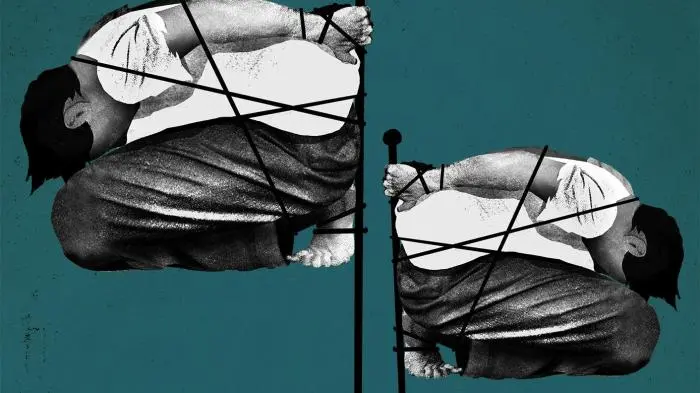
"You do not exist" Arbitrary detention, enforced disappearances and torture in eastern Ukraine
Source: Human Rights Watch / Amnesty International
Introduction
In April 2015, 39-year-old Vadym was riding a commuter bus home to Donetsk, the capital of the self-proclaimed Donetsk People’s Republic, in eastern Ukraine. The bus had departed from the city of Sloviansk, which is under the control of Ukrainian authorities. At a Ukrainian military checkpoint, a soldier ordered him to get off the bus. Armed men in camouflage without identification marks tied Vadym’s hands behind his back, put a bag over his head, forced him to his knees, calling him a “separatist bandit,” and began interrogating him about his connections in Sloviansk. Then they shoved him into the back seat of a car and took him to a base where there were many armed men. There, he was held in custody for three days without any acknowledgment of his detention, and was interrogated and tortured. Later, Vadym was transferred to another location of unlawful detention, apparently run by personnel of the Security Service of Ukraine (SBU). There, Vadym spent another six weeks in custody without any contact with the outside world, and also without any acknowledgment of his detention. During his detention, those who interrogated Vadym tortured him with electric shocks, burned him with cigarettes, and beat him, trying to force him to confess to collaborating with Russian-backed separatists. Eventually, he was released. Vadym returned to Donetsk and was detained by the local de facto authorities, who suspected that he had been recruited by the SBU during his detention. He spent two months cut off from the outside world in an unofficial detention facility in central Donetsk, where he was again subjected to torture and humiliation.
Both Ukrainian government authorities and pro-Russian separatist forces in eastern Ukraine unlawfully held civilians in custody for extended periods without contact with the outside world, including with relatives and lawyers. In some cases, disappearances were accompanied by unlawful detention, meaning that the authorities refused to acknowledge the fact of detention or failed to provide information about the person’s fate and whereabouts. Most detainees were subjected to torture or other forms of human rights violations. Some were denied medical treatment for injuries sustained while in custody.
In cases documented by Amnesty International and Human Rights Watch, Ukrainian authorities and pro-Ukrainian armed groups detained civilians on suspicion of ties to Russian-backed separatists, while separatist forces detained civilians, accusing them of supporting or spying for the Ukrainian authorities. Vadym’s situation is unique because, of all the people we interviewed, he is the only one who was secretly detained and tortured first by one side, then by the other.
Amnesty International and Human Rights Watch have documented in detail nine cases of prolonged unlawful detention of civilians in unofficial places of detention by Ukrainian authorities and nine cases of prolonged unlawful detention of civilians by pro-Russian separatists. This report describes cases that occurred primarily in 2015 and the first half of 2016.
Persons detained by the warring parties in eastern Ukraine are protected by international human rights law and international humanitarian law, which unequivocally prohibit unlawful detention, torture, and other degrading treatment. In accordance with international standards, allegations of torture and cruel treatment must be investigated, and if there is sufficient evidence, the perpetrators must be brought to justice. Detainees must be provided with adequate food, water, clothing, shelter, and medical care.
In nearly all of the eighteen documented cases, the issue of the detainees’ release was discussed at some point by the relevant party in connection with a prisoner exchange; in nine of the eighteen cases, the detainees were exchanged. This suggests that both parties may be holding civilians in custody as a form of “currency” for prisoner exchanges.
It is difficult to estimate the total number of civilians who have been victims of the violence documented in this report, however, the “Report on the Human Rights Situation in Ukraine from February 16 to May 15, 2016,” published in June 2016 by the Office of the United Nations High Commissioner for Human Rights (OHCHR), it is stated that “unlawful detention, torture, and degrading treatment remain commonplace in the region.” This indicates that these problems are far more widespread than the limited number of cases documented by Amnesty International and Human Rights Watch.
In most of the nine cases we documented, pro-government forces, including so-called volunteer battalions, initially detained civilians and then handed them over to the SBU, which ultimately transferred them to the judicial system. Some were later exchanged for individuals detained by separatists, while others were released without trial.
In three cases, described in detail in this report, the SBU allegedly facilitated enforced disappearances by unlawfully detaining citizens for periods ranging from six weeks to fifteen months. One detainee was exchanged, while the other two were simply released without investigation. In the case of these two detainees, there are no official documents at all regarding their detention.
A UN report issued in June 2016 notes that cases of torture and detention in isolation from the outside world that drew the organization’s attention “are largely linked to the SBU,” and the SBU unit in Kharkiv was specifically mentioned as a possible unofficial detention site.
According to the results of our research, Amnesty International and Human Rights Watch assert that SBU units in Kharkiv, Kramatorsk, Izyum, and Mariupol have unlawfully detained civilians. We have received compelling evidence from multiple sources that, as of June 2016, at least 16 people remain in secret detention at the SBU branch in Kharkiv. Ukrainian authorities have denied using any detention facilities other than official pretrial detention centers in Kyiv and stated that they have no information regarding the alleged violations by the SBU documented in this report.
Most of those interviewed told Amnesty International that they had been tortured even before being transferred to SBU facilities. Some also claim that after being transferred to the SBU, they were beaten, subjected to electric shocks, and threatened with rape, death, and retaliation against their families in order to extract information or force them to confess to criminal activities related to separatism.
Amnesty International and Human Rights Watch have documented nine cases in which pro-Russian separatists held civilians incommunicado for weeks, or even months, without charging them; the most recent such cases date back to early 2016; in most cases, the detainees were subjected to ill-treatment. At the time of writing, two people remain in custody awaiting “judicial investigations” into their cases.
In the self-proclaimed Donetsk People’s Republic (DPR) and the Luhansk People’s Republic (LPR), local law enforcement agencies operate without any restrictions or checks, illegally arresting people and holding them in their own detention facilities. Four detainees, whose cases were documented by Amnesty International and Human Rights Watch, were at one point taken to a pretrial detention center, where two of them were allowed to contact a lawyer, but overall, the absence of the rule of law in separatist-controlled territories violates the rights of detainees, depriving them of any means of legal and effective recourse.
Restricted Access for Independent Observers
In May 2016, a delegation from the UN Subcommittee on Prevention of Torture canceled its visit to Ukraine because it was unable to gain access to detention facilities controlled by both the SBU and the separatists. The head of the delegation, Malcolm Evans, speaking about SBU detention facilities, emphasized that the group of observers was denied access to “places where, according to numerous reports, people were being held illegally, and where torture and ill-treatment of detainees had occurred.”
The separatist authorities did not respond to numerous requests from the Office of the UN High Commissioner for Human Rights to grant access to detention facilities, and representatives of other international organizations working to protect human rights in places of detention have told Human Rights Watch and Amnesty International that they have no access to places of detention in separatist-controlled territories. Nils Muižnieks, the Council of Europe Commissioner for Human Rights, noted in his report following a visit in March 2016 that relevant interlocutors in Donetsk told him that “local legislation” currently does not permit inspections of places of detention.
Amnesty International and Human Rights Watch conducted a total of 40 meetings with victims and witnesses of ill-treatment, their family members, the victims’ lawyers, representatives of international organizations working in eastern Ukraine, representatives of the Ukrainian authorities, representatives of the DPR, representatives of official and unofficial groups involved in prisoner exchange negotiations, and other sources of information.
All meetings with victims took place after their release. Four of them asked Amnesty International and Human Rights Watch not to publish details of their cases for fear of reprisals, but allowed the information they provided to be used to create a database for analysis. Our researchers conducted all interviews individually, in private, in Russian or Ukrainian. Where possible, Amnesty International and Human Rights Watch also collected medical information, legal documents, and photographs from potential torture victims, as well as from family members of people who remain behind bars. Every person interviewed was informed of the purpose of the interview and voluntarily agreed to participate. Amnesty International and Human Rights Watch did not offer any financial incentives to any of the interviewees to persuade them to speak. Most of the interviewees wished to remain anonymous out of fear of reprisals against them or their families.
This report concerns ill-treatment exclusively of civilians. It does not describe cases of unlawful detention that occurred prior to spring 2015 (although both organizations reported numerous instances of unlawful detention and torture in the region in 2014 and early 2015).
During their joint mission, Amnesty International and Human Rights Watch met with a representative of the Human Rights Commissioner in the DPR. Delegates from the organizations also sought to meet with representatives of the de facto prosecutor’s office, but were denied a meeting.
On June 3, Amnesty International and Human Rights Watch sent a letter to the head of the Security Service of Ukraine (SBU), in which we summarized the findings of our research, asked about the veracity of allegations regarding the existence of unofficial detention sites operated by the SBU within its territory, and posed several specific questions regarding some of the documented cases. The SBU’s written response, dated June 17, 2016, is quoted in this report.
On February 21, 2014, as a result of the Euromaidan protest movement, then-President of Ukraine Viktor Yanukovych was removed from power. Following Yanukovych’s removal, Russian armed forces seized and eventually occupied Crimea, and around the same time, armed clashes broke out in some cities and villages in eastern Ukraine between people who supported the protests in Kyiv and their opponents.
By mid-March, armed anti-government groups, which initially called themselves “self-defense groups,” had seized administrative buildings in several cities and towns in the Donetsk and Luhansk regions. Their demands ranged from regional autonomy within a federalized Ukraine to full independence or even annexation to the Russian Federation.
In April 2014, separatist forces proclaimed the creation of the “Donetsk People’s Republic” (DPR) and the “Luhansk People’s Republic” (LPR) and established control over some settlements in both regions.
In mid-April 2014, the Security Service of Ukraine and the Ministry of Internal Affairs launched military operations against the insurgents; the government called this an “anti-terrorist operation.” On May 11, anti-Kyiv groups declared victory in the “referendums” they had organized on the independence of the Donetsk and Luhansk regions. On May 16, First Deputy Prosecutor General of Ukraine Mykola Golomsha stated that, according to Ukrainian law, “the two self-proclaimed republics, the so-called Donetsk and Luhansk, are terrorist organizations.”
From the very beginning of the armed clashes, the Russian authorities demonstrated their support for the separatists, and their influence on them was evident. As the conflict continued into August, compelling evidence emerged (including reports and satellite imagery from NATO) of the direct involvement of Russian armed forces in military operations, which transformed the conflict between Russian and Ukrainian forces into an international armed conflict, subject to the relevant laws of international humanitarian law.
In February 2015, a ceasefire agreement was reached during negotiations in Minsk with the participation of international mediators, which reduced the number of casualties, but at the same time, numerous clashes along the front line and artillery shelling from both sides continued.
The conflict led to a complete breakdown of law and order in the territories controlled by the separatists. The separatists resorted to beatings, attacks, and threats against anyone suspected of supporting the Ukrainian government, including journalists, local officials, political and religious activists, and committed several extrajudicial killings. They also forced detainees into forced labor and abducted civilians, using them as hostages and demanding ransoms for their release.
Members of the Ukrainian armed forces and armed groups also subjected detainees to torture and other forms of ill-treatment, and used them as hostages in prisoner exchanges between the warring parties. There have been reports of torture and other shocking abuses by the so-called Ukrainian volunteer battalions “Aidar” and “Azov.” As of spring 2015, most volunteer battalions had been formally integrated into the official structures of the Ministry of Defense and the National Guard of Ukraine. However, the Right Sector, a far-right movement, as well as some other groups, retained their status as paramilitary organizations. Members of these organizations operate in close cooperation with the official Ukrainian armed forces but are not subordinate to or accountable to them.
Between April 2014 and May 2016, as a result of mortar, rocket, and artillery attacks in the Donetsk and Luhansk regions, more than 9,000 people were killed and more than 21,000 wounded—including civilians, soldiers of the Ukrainian armed forces, and members of anti-government forces. Both separatist and pro-government forces violated the laws and customs of war, conducting indiscriminate attacks in areas where civilians live, endangering their lives and failing to take necessary precautions during artillery attacks in and near civilian areas.
In November 2014, Ukrainian authorities suspended social spending—that is, budgets for schools and hospitals, pensions, and insurance—in territory controlled by separatists. Between July and December 2015, the de facto authorities controlling parts of the Donetsk and Luhansk regions denied access to the region to most humanitarian and human rights organizations and expelled them from the territory of the DPR and LPR.
In several reports, the UN Human Rights Monitoring Mission in Ukraine noted a consistent link between unlawful detention and prisoner exchanges. For example, in February 2015, it was noted that “the unlawful detention of civilians, including for the purpose of prisoner exchanges, remains part of hostilities.” Under international law, the detention of civilians for the purpose of exchange constitutes a form of unlawful detention and hostage-taking, which is expressly prohibited by international law.
Ukrainian law enforcement agencies reported that they had released “militants suspected of terrorism or related crimes.” From a legal standpoint, such “exchanges” involve a conflict of laws, as there are no legal grounds for releasing criminal offenders before the conclusion of criminal proceedings against them. It appears that this very issue is at the root of some of the violations described below, and it is precisely because of this that the SBU has been holding certain citizens in custody unofficially and without public notice, as they can be exchanged without documents certifying the transfer and without the need to resolve the accompanying legal complications.
The armed conflict between the separatists (non-state armed forces) and the Ukrainian army is not of an international nature, falling under Article 3 of the General Provisions of the 1949 Geneva Conventions and Protocol II on non-international armed conflicts, to which Ukraine is also a signatory. Protocol II provides guidelines on guarantees for the protection of civilians during non-international armed conflicts, as referred to in Article 3 of the Convention.
Prisoners of war from each side of the conflict in eastern Ukraine are protected by international human rights law and international humanitarian law. The prohibition of torture and other acts of cruelty is one of the fundamental principles of both bodies of law. According to Article 3 of the General Provisions of the 1949 Geneva Conventions and Protocol II, prisoners of the parties to the conflict must be protected against “violence to life and person, in particular all forms of murder, mutilation, and torture.” The provision also prohibits “outrages upon human dignity, in particular humiliating and degrading treatment.” Torture and cruel, inhuman, or degrading treatment or punishment are also prohibited by the International Covenant on Civil and Political Rights (ICCPR) and the European Convention on Human Rights (ECHR).
Torture is also classified as a war crime under international humanitarian law in all conflicts. Both international human rights law and international humanitarian law require the investigation of cases of torture and other forms of ill-treatment and—where there is evidence—the initiation of legal proceedings against those responsible. Detainees must be provided with sufficient food and water, clothing, shelter, and medical care.
Introduction
In April 2015, 39-year-old Vadym was riding a commuter bus home to Donetsk, the capital of the self-proclaimed Donetsk People’s Republic, in eastern Ukraine. The bus had departed from the city of Sloviansk, which is under the control of Ukrainian authorities. At a Ukrainian military checkpoint, a soldier ordered him to get off the bus. Armed men in camouflage without identification marks tied Vadym’s hands behind his back, put a bag over his head, forced him to his knees, calling him a “separatist bandit,” and began interrogating him about his connections in Sloviansk. Then they shoved him into the back seat of a car and took him to a base where there were many armed men. There, he was held in custody for three days without any acknowledgment of his detention, and was interrogated and tortured. Later, Vadym was transferred to another location of unlawful detention, apparently run by personnel of the Security Service of Ukraine (SBU). There, Vadym spent another six weeks in custody without any contact with the outside world, and also without any acknowledgment of his detention. During his detention, those who interrogated Vadym tortured him with electric shocks, burned him with cigarettes, and beat him, trying to force him to confess to collaborating with Russian-backed separatists. Eventually, he was released. Vadym returned to Donetsk and was detained by the local de facto authorities, who suspected that he had been recruited by the SBU during his detention. He spent two months cut off from the outside world in an unofficial detention facility in central Donetsk, where he was again subjected to torture and humiliation.
Both Ukrainian government authorities and pro-Russian separatist forces in eastern Ukraine unlawfully held civilians in custody for extended periods without contact with the outside world, including with relatives and lawyers. In some cases, disappearances were accompanied by unlawful detention, meaning that the authorities refused to acknowledge the fact of detention or failed to provide information about the person’s fate and whereabouts. Most detainees were subjected to torture or other forms of human rights violations. Some were denied medical treatment for injuries sustained while in custody.
In cases documented by Amnesty International and Human Rights Watch, Ukrainian authorities and pro-Ukrainian armed groups detained civilians on suspicion of ties to Russian-backed separatists, while separatist forces detained civilians, accusing them of supporting or spying for the Ukrainian authorities. Vadym’s situation is unique because, of all the people we interviewed, he is the only one who was secretly detained and tortured first by one side, then by the other.
Amnesty International and Human Rights Watch have documented in detail nine cases of prolonged unlawful detention of civilians in unofficial places of detention by Ukrainian authorities and nine cases of prolonged unlawful detention of civilians by pro-Russian separatists. This report describes cases that occurred primarily in 2015 and the first half of 2016.
Persons detained by the warring parties in eastern Ukraine are protected by international human rights law and international humanitarian law, which unequivocally prohibit unlawful detention, torture, and other degrading treatment. In accordance with international standards, allegations of torture and cruel treatment must be investigated, and if there is sufficient evidence, the perpetrators must be brought to justice. Detainees must be provided with adequate food, water, clothing, shelter, and medical care.
In nearly all of the eighteen documented cases, the issue of the detainees’ release was discussed at some point by the relevant party in connection with a prisoner exchange; in nine of the eighteen cases, the detainees were exchanged. This suggests that both parties may be holding civilians in custody as a form of “currency” for prisoner exchanges.
It is difficult to estimate the total number of civilians who have been victims of the violence documented in this report, however, the “Report on the Human Rights Situation in Ukraine from February 16 to May 15, 2016,” published in June 2016 by the Office of the United Nations High Commissioner for Human Rights (OHCHR), it is stated that “unlawful detention, torture, and degrading treatment remain commonplace in the region.” This indicates that these problems are far more widespread than the limited number of cases documented by Amnesty International and Human Rights Watch.
Violations by Ukrainian authorities
In most of the nine cases we documented, pro-government forces, including so-called volunteer battalions, initially detained civilians and then handed them over to the SBU, which ultimately transferred them to the judicial system. Some were later exchanged for individuals detained by separatists, while others were released without trial.
In three cases, described in detail in this report, the SBU allegedly facilitated enforced disappearances by unlawfully detaining citizens for periods ranging from six weeks to fifteen months. One detainee was exchanged, while the other two were simply released without investigation. In the case of these two detainees, there are no official documents at all regarding their detention.
A UN report issued in June 2016 notes that cases of torture and detention in isolation from the outside world that drew the organization’s attention “are largely linked to the SBU,” and the SBU unit in Kharkiv was specifically mentioned as a possible unofficial detention site.
According to the results of our research, Amnesty International and Human Rights Watch assert that SBU units in Kharkiv, Kramatorsk, Izyum, and Mariupol have unlawfully detained civilians. We have received compelling evidence from multiple sources that, as of June 2016, at least 16 people remain in secret detention at the SBU branch in Kharkiv. Ukrainian authorities have denied using any detention facilities other than official pretrial detention centers in Kyiv and stated that they have no information regarding the alleged violations by the SBU documented in this report.
Most of those interviewed told Amnesty International that they had been tortured even before being transferred to SBU facilities. Some also claim that after being transferred to the SBU, they were beaten, subjected to electric shocks, and threatened with rape, death, and retaliation against their families in order to extract information or force them to confess to criminal activities related to separatism.
Abuses by Russian-backed separatists
Amnesty International and Human Rights Watch have documented nine cases in which pro-Russian separatists held civilians incommunicado for weeks, or even months, without charging them; the most recent such cases date back to early 2016; in most cases, the detainees were subjected to ill-treatment. At the time of writing, two people remain in custody awaiting “judicial investigations” into their cases.
In the self-proclaimed Donetsk People’s Republic (DPR) and the Luhansk People’s Republic (LPR), local law enforcement agencies operate without any restrictions or checks, illegally arresting people and holding them in their own detention facilities. Four detainees, whose cases were documented by Amnesty International and Human Rights Watch, were at one point taken to a pretrial detention center, where two of them were allowed to contact a lawyer, but overall, the absence of the rule of law in separatist-controlled territories violates the rights of detainees, depriving them of any means of legal and effective recourse.
Restricted Access for Independent Observers
In May 2016, a delegation from the UN Subcommittee on Prevention of Torture canceled its visit to Ukraine because it was unable to gain access to detention facilities controlled by both the SBU and the separatists. The head of the delegation, Malcolm Evans, speaking about SBU detention facilities, emphasized that the group of observers was denied access to “places where, according to numerous reports, people were being held illegally, and where torture and ill-treatment of detainees had occurred.”
The separatist authorities did not respond to numerous requests from the Office of the UN High Commissioner for Human Rights to grant access to detention facilities, and representatives of other international organizations working to protect human rights in places of detention have told Human Rights Watch and Amnesty International that they have no access to places of detention in separatist-controlled territories. Nils Muižnieks, the Council of Europe Commissioner for Human Rights, noted in his report following a visit in March 2016 that relevant interlocutors in Donetsk told him that “local legislation” currently does not permit inspections of places of detention.
Key Recommendations
Amnesty International and Human Rights Watch are calling on the Ukrainian government and the de facto authorities of the self-proclaimed DPR and LPR to immediately put an end to enforced disappearances and unlawful detentions, as well as incommunicado detention. They also recommend adopting a zero-tolerance policy toward the use of torture and ill-treatment of detainees. The parties to the conflict must inform all forces under their control of the consequences under international law of ill-treatment of detainees, ensure thorough investigations into all allegations of torture and ill-treatment of detainees, and hold those responsible to account.Research
Methodology
This report is based on the findings of a joint investigation conducted by Amnesty International and Human Rights Watch, which included: a week-long trip to separatist-controlled areas of Donetsk Oblast in May 2016, two trips to government-controlled areas of Donetsk Oblast in February–March 2016, as well as a thorough review of documentation and interviews conducted in person in Kyiv or via telephone/Skype.Methodology
Amnesty International and Human Rights Watch conducted a total of 40 meetings with victims and witnesses of ill-treatment, their family members, the victims’ lawyers, representatives of international organizations working in eastern Ukraine, representatives of the Ukrainian authorities, representatives of the DPR, representatives of official and unofficial groups involved in prisoner exchange negotiations, and other sources of information.
All meetings with victims took place after their release. Four of them asked Amnesty International and Human Rights Watch not to publish details of their cases for fear of reprisals, but allowed the information they provided to be used to create a database for analysis. Our researchers conducted all interviews individually, in private, in Russian or Ukrainian. Where possible, Amnesty International and Human Rights Watch also collected medical information, legal documents, and photographs from potential torture victims, as well as from family members of people who remain behind bars. Every person interviewed was informed of the purpose of the interview and voluntarily agreed to participate. Amnesty International and Human Rights Watch did not offer any financial incentives to any of the interviewees to persuade them to speak. Most of the interviewees wished to remain anonymous out of fear of reprisals against them or their families.
This report concerns ill-treatment exclusively of civilians. It does not describe cases of unlawful detention that occurred prior to spring 2015 (although both organizations reported numerous instances of unlawful detention and torture in the region in 2014 and early 2015).
During their joint mission, Amnesty International and Human Rights Watch met with a representative of the Human Rights Commissioner in the DPR. Delegates from the organizations also sought to meet with representatives of the de facto prosecutor’s office, but were denied a meeting.
On June 3, Amnesty International and Human Rights Watch sent a letter to the head of the Security Service of Ukraine (SBU), in which we summarized the findings of our research, asked about the veracity of allegations regarding the existence of unofficial detention sites operated by the SBU within its territory, and posed several specific questions regarding some of the documented cases. The SBU’s written response, dated June 17, 2016, is quoted in this report.
Background: The Armed Conflict in Eastern Ukraine
On February 21, 2014, as a result of the Euromaidan protest movement, then-President of Ukraine Viktor Yanukovych was removed from power. Following Yanukovych’s removal, Russian armed forces seized and eventually occupied Crimea, and around the same time, armed clashes broke out in some cities and villages in eastern Ukraine between people who supported the protests in Kyiv and their opponents.
By mid-March, armed anti-government groups, which initially called themselves “self-defense groups,” had seized administrative buildings in several cities and towns in the Donetsk and Luhansk regions. Their demands ranged from regional autonomy within a federalized Ukraine to full independence or even annexation to the Russian Federation.
In April 2014, separatist forces proclaimed the creation of the “Donetsk People’s Republic” (DPR) and the “Luhansk People’s Republic” (LPR) and established control over some settlements in both regions.
In mid-April 2014, the Security Service of Ukraine and the Ministry of Internal Affairs launched military operations against the insurgents; the government called this an “anti-terrorist operation.” On May 11, anti-Kyiv groups declared victory in the “referendums” they had organized on the independence of the Donetsk and Luhansk regions. On May 16, First Deputy Prosecutor General of Ukraine Mykola Golomsha stated that, according to Ukrainian law, “the two self-proclaimed republics, the so-called Donetsk and Luhansk, are terrorist organizations.”
From the very beginning of the armed clashes, the Russian authorities demonstrated their support for the separatists, and their influence on them was evident. As the conflict continued into August, compelling evidence emerged (including reports and satellite imagery from NATO) of the direct involvement of Russian armed forces in military operations, which transformed the conflict between Russian and Ukrainian forces into an international armed conflict, subject to the relevant laws of international humanitarian law.
In February 2015, a ceasefire agreement was reached during negotiations in Minsk with the participation of international mediators, which reduced the number of casualties, but at the same time, numerous clashes along the front line and artillery shelling from both sides continued.
The conflict led to a complete breakdown of law and order in the territories controlled by the separatists. The separatists resorted to beatings, attacks, and threats against anyone suspected of supporting the Ukrainian government, including journalists, local officials, political and religious activists, and committed several extrajudicial killings. They also forced detainees into forced labor and abducted civilians, using them as hostages and demanding ransoms for their release.
Members of the Ukrainian armed forces and armed groups also subjected detainees to torture and other forms of ill-treatment, and used them as hostages in prisoner exchanges between the warring parties. There have been reports of torture and other shocking abuses by the so-called Ukrainian volunteer battalions “Aidar” and “Azov.” As of spring 2015, most volunteer battalions had been formally integrated into the official structures of the Ministry of Defense and the National Guard of Ukraine. However, the Right Sector, a far-right movement, as well as some other groups, retained their status as paramilitary organizations. Members of these organizations operate in close cooperation with the official Ukrainian armed forces but are not subordinate to or accountable to them.
Between April 2014 and May 2016, as a result of mortar, rocket, and artillery attacks in the Donetsk and Luhansk regions, more than 9,000 people were killed and more than 21,000 wounded—including civilians, soldiers of the Ukrainian armed forces, and members of anti-government forces. Both separatist and pro-government forces violated the laws and customs of war, conducting indiscriminate attacks in areas where civilians live, endangering their lives and failing to take necessary precautions during artillery attacks in and near civilian areas.
In November 2014, Ukrainian authorities suspended social spending—that is, budgets for schools and hospitals, pensions, and insurance—in territory controlled by separatists. Between July and December 2015, the de facto authorities controlling parts of the Donetsk and Luhansk regions denied access to the region to most humanitarian and human rights organizations and expelled them from the territory of the DPR and LPR.
Prisoner Exchanges
Some of the violations described in this report were committed specifically in connection with prisoner exchanges. Unilateral releases and prisoner exchanges began in the early stages of the conflict in eastern Ukraine. The warring parties agreed to exchange “all for all” as a result of the second round of peace talks held in Minsk in February 2015. However, there is no reliable information regarding the number and identities of prisoners held by both warring parties. The numbers and lists of prisoners provided by the parties contradicted one another. Attempts to exchange “everyone for everyone” were unsuccessful, although exchanges of smaller groups of prisoners continued. It was in the interest of each of the warring parties to hold prisoners in custody for future exchange. Although the second Minsk talks resulted in an agreement to exchange primarily prisoners of war, in reality this process extended to civilians detained on allegations of spying for the enemy. This led to systematic abuses.In several reports, the UN Human Rights Monitoring Mission in Ukraine noted a consistent link between unlawful detention and prisoner exchanges. For example, in February 2015, it was noted that “the unlawful detention of civilians, including for the purpose of prisoner exchanges, remains part of hostilities.” Under international law, the detention of civilians for the purpose of exchange constitutes a form of unlawful detention and hostage-taking, which is expressly prohibited by international law.
Ukrainian law enforcement agencies reported that they had released “militants suspected of terrorism or related crimes.” From a legal standpoint, such “exchanges” involve a conflict of laws, as there are no legal grounds for releasing criminal offenders before the conclusion of criminal proceedings against them. It appears that this very issue is at the root of some of the violations described below, and it is precisely because of this that the SBU has been holding certain citizens in custody unofficially and without public notice, as they can be exchanged without documents certifying the transfer and without the need to resolve the accompanying legal complications.
Legal Framework
International Legal Standards
Both international humanitarian treaty law and customary international humanitarian law govern the armed conflict between armed separatist groups and Ukrainian forces, as well as between Russian and Ukrainian forces. Although the sources—and sometimes the scope—of the law of war for internal and international conflicts differ, international humanitarian law aims to protect the civilian population from the dangers of any armed conflict. Applicable customary international humanitarian law confirms a significant convergence of the two codes.International Legal Standards
The armed conflict between the separatists (non-state armed forces) and the Ukrainian army is not of an international nature, falling under Article 3 of the General Provisions of the 1949 Geneva Conventions and Protocol II on non-international armed conflicts, to which Ukraine is also a signatory. Protocol II provides guidelines on guarantees for the protection of civilians during non-international armed conflicts, as referred to in Article 3 of the Convention.
Prisoners of war from each side of the conflict in eastern Ukraine are protected by international human rights law and international humanitarian law. The prohibition of torture and other acts of cruelty is one of the fundamental principles of both bodies of law. According to Article 3 of the General Provisions of the 1949 Geneva Conventions and Protocol II, prisoners of the parties to the conflict must be protected against “violence to life and person, in particular all forms of murder, mutilation, and torture.” The provision also prohibits “outrages upon human dignity, in particular humiliating and degrading treatment.” Torture and cruel, inhuman, or degrading treatment or punishment are also prohibited by the International Covenant on Civil and Political Rights (ICCPR) and the European Convention on Human Rights (ECHR).
Torture is also classified as a war crime under international humanitarian law in all conflicts. Both international human rights law and international humanitarian law require the investigation of cases of torture and other forms of ill-treatment and—where there is evidence—the initiation of legal proceedings against those responsible. Detainees must be provided with sufficient food and water, clothing, shelter, and medical care.
International humanitarian law recognizes that, in situations of armed conflict, civilians may be temporarily detained for security purposes. However, arbitrary detention is strictly prohibited: parties to an armed conflict are required to have a legal basis for the arrest of civilians and to take necessary precautions. The grounds for detention must be reasonable and non-discriminatory. Under customary international humanitarian law, parties carrying out detentions must follow a specific procedure: for example, they are obligated to ensure that a judicial review is conducted immediately and to allow the arrested person to initiate proceedings during which a court will determine the legality of the detention without delay.Under human rights law in situations of armed conflict, anyone arrested by a state has the right to a judicial review of the legality of their arrest.
Enforced disappearances are considered serious crimes under international law and are prohibited under all circumstances by international human rights law and international humanitarian law. Furthermore, this prohibition requires that cases of alleged enforced disappearances be investigated and that those responsible for the crime be prosecuted in court. Enforced disappearances occur when a person is deprived of liberty by government officials or persons acting with the government’s support, authorization, or consent, followed by a refusal to disclose the person’s fate or whereabouts or to acknowledge the deprivation of liberty, thereby placing the person outside the protection of the law. Ukraine acceded to the International Convention for the Protection of All Persons from Enforced Disappearance on August 14, 2015. The Convention prohibits enforced disappearances and, in particular, imposes an obligation on states to prevent, investigate, and bring to justice all cases of enforced disappearances.
The ECHR and the ICCPR allow member states to suspend the application of certain articles—in other words, to restrict certain rights during a state of emergency, including during armed conflict. In May 2015, Ukraine suspended the application of certain articles, including (relevant to this report) those concerning the right to liberty and security of person and the right to a fair trial, with respect to persons suspected of terrorist acts. However, the treaties also require that any restrictions be necessary, proportionate, and non-discriminatory. Council of Europe Secretary General Thorbjørn Jagland issued a statement that the suspension “does not mean that Ukraine is no longer bound by the European Convention on Human Rights,” and that the European Court of Human Rights will determine the extent to which the suspension of each article is justified.
Pretrial detention is permitted only in pretrial detention centers, which are facilities of the State Penitentiary Service, and at the main guardhouse of the Armed Forces of Ukraine. In “certain cases,” the law permits the short-term detention of suspects “in temporary detention facilities for the purpose of conducting investigative actions.” According to Article 38 of the Criminal Procedure Code of Ukraine, the pre-trial investigation authorities are the National Police (subordinate to the Ministry of Internal Affairs), the Security Service of Ukraine (SBU), the Tax Police (part of the State Fiscal Service), and the State Bureau of Investigations. In reality, however, temporary detention facilities are controlled by the Ministry of Internal Affairs and the SBU. Their management system is structured in accordance with internal procedures and regulations.
In a letter to Amnesty International and Human Rights Watch, the SBU stated that it operates only one such detention center, located in Kyiv. According to the Instructions on the Procedure for Detaining Persons in Specially Designated Places for Temporary Detention by the SBU, the maximum period of detention shall not exceed 10 days. Ukrainian law permits SBU personnel to conduct interrogations, provided that they do not last longer than 8 hours per day and that no investigative actions, including interrogations, are conducted between 10 p.m. and 6 a.m.
Pretrial detention in other pretrial detention facilities may not exceed 6 months for minor and moderate offenses and 12 months for serious offenses, including those related to terrorist activities.
In most of the cases mentioned, pro-government forces, including members of so-called volunteer battalions, handed over the persons they had detained to the Security Service of Ukraine, which ultimately dealt with them within the framework of the general criminal justice system; Some of those arrested were later exchanged for individuals held captive by separatists, while others were released without trial.
In the three cases described below, the SBU held the detainees for periods ranging from 6 weeks to 15 months without contact with the outside world or the opportunity to meet with a lawyer. All three individuals were suspected of pro-separatist activities.
Detention included periods of enforced disappearance of detainees or their prolonged detention without contact with the outside world. Most of those interviewed reported that they were tortured before being transferred to the SBU. Several of them also stated that they were beaten, subjected to electric shocks, and threatened with rape, execution, and retaliation against their families while on SBU premises.
The cases of most of those arrested by Ukrainian authorities were eventually brought before a court and transferred to the general criminal justice system. Nevertheless, the detainees did not appear in court—at a certain point, they were released as part of a prisoner exchange between the parties to the armed conflict. In such cases, the court released them on their own recognizance and with a commitment not to leave their place of residence during the investigation. This arrangement allowed the authorities to remove the detainees from the lists of state prisoners held for exchange, but the individuals were re-arrested upon their return to state territory.
Former prisoners interviewed by Amnesty International and Human Rights Watch described SBU buildings in Kharkiv, Kramatorsk, Izyum, and Mariupol, where they were held in conditions that allow these places to be described as zones of unlawful detention without official acknowledgment of the fact of detention. Concerns regarding enforced disappearances and detentions by the Kharkiv SBU Directorate are well-founded. Two of those held in custody for months, independently of one another, compiled lists of 16 others (15 men and 1 woman) who were still in custody at the time of the narrators’ release. Researchers spoke with two former detainees, Kostyantyn Bezkorovainy and Artem (names changed)—their stories are detailed below. They independently compiled lists of 16 other detainees for Amnesty International and Human Rights Watch. The names on the lists match.
Bezkorovainy and Artem also shared key details regarding the conditions of detention for those on the list. Another person who was also detained at the same facility at the same time as Bezkorovainy and Artem (this person’s story is not included in the report at their request) compiled an identical list and provided additional information about the conditions of detention for the people on the list. The UN report on the human rights situation in Ukraine from February 15 to May 16, 2016, contains data on a similar situation based on the findings of a study by the Office of the UN High Commissioner for Human Rights (OHCHR). It states, in particular, that “as of March 2016, the OHCHR was aware of the names of 15 men and 1 woman who had disappeared at the Kharkiv branch of the SBU.”
In early June 2016, Amnesty International and Human Rights Watch sent a written inquiry to the SBU regarding unconfirmed enforced disappearances, specifically regarding the involvement of SBU officials in Kharkiv, Kramatorsk, Izyum, and Mariupol. The letter also included specific questions regarding the cases of Bekerovayny and Artem, which are documented in this section of the report. In an official response dated June 17, 2016, SBU authorities denied managing any pretrial detention facilities other than the temporary detention center in Kyiv (regarding which Amnesty International or Human Rights Watch had received no reports of enforced disappearances). The letter also stated that the SBU had never detained Bezkorovainy or considered his case, and therefore had no information regarding it. The response ignored the inconsistencies between the SBU spokesperson’s public acknowledgment of the arrest of a man whose details exactly matched those of Bezkorovainy and the subsequent retraction of that information. Regarding Artem, the response letter confirms that his case was investigated by the SBU and that he remained in custody from February 7 to March 12, 2015, when he was released.
The official visit by the delegation of the UN Subcommittee on the Prevention of Torture began in May 2016 and ended prematurely: the authorities did not grant the delegation access to certain correctional facilities. This is only the second time in its history (since 2007) that the Subcommittee has decided to cut short a visit to a country. Delegation head Malcolm Evans stated that the team was unable to “visit certain locations regarding which we had heard numerous and serious allegations of individuals being held in custody and where torture or ill-treatment may have occurred.”
At a press conference on May 26, in response to the Subcommittee’s statement, SBU Head Vasyl Hrytsak noted: “We do not hold anyone in district units. (...) I am confident that we have not violated anything.” The Subcommittee did not name the locations of the alleged detention facilities to which access was denied; but given that the latest OHCHR report notes that the SBU in Kharkiv is suspected of carrying out unofficial detentions, the facility may have been on the Subcommittee’s list of destinations.
The cases discussed below illustrate the unlawful practice of prolonged detention without contact with the outside world in unofficial prisons on the premises of SBU facilities.
Kostyantyn Bezkorovainy (places of detention: Kramatorsk, Izium, Kharkiv)
Kostyantyn Bezkorovainy, 59 years old (at the time of writing), was an active member of the Communist Party of Ukraine (CPU) and an elected member of the city council of his hometown, Kostiantynivka, where he also worked as a dentist. Kostiantynivka was under separatist control for several weeks in 2014 until it was recaptured by the Ukrainian Armed Forces in June 2014. Bezkorovainy is a victim of enforced disappearance. He was unlawfully detained for 15 months without official acknowledgment of his detention at SBU facilities in Kramatorsk, Izyum, and Kharkiv, primarily at the SBU building in Kharkiv.
Forced Abduction and Transport to the SBU Office in Kramatorsk
Bezkorovainy stated that on November 27, 2014, around 4:00 p.m., masked men broke into his home, seized him, and searched the house without a warrant, claiming they had evidence that he was planning to poison the local water supply:
Five or six masked men, one of them armed with an AK-47, broke down the door to the house with a sledgehammer and knocked me to the floor. They did not identify themselves, but instead accused me of being a terrorist and a separatist. Someone pinned me down with his foot and occasionally kicked me in the ribs while the others searched the house...
After finishing the search, the men shoved Bezkorovainy into a tinted cargo van with no license plates. There, they handcuffed the captive and pulled a bag over his head. After a relatively short drive, Bezkorovainy was taken to a basement, given a phone, and forced to call his wife and read a prepared statement: that he would be delayed, because he needed to “speak at a meeting” and stay for “further clarification.” In the evening, Bezkorovainy was brought in for his first interrogation:
Four or five masked men interrogated me. They were all around 30–35 years old, judging by their voices, and all but one spoke with a local accent. They said I was accused of aiding a terrorist organization, but they didn’t provide any documents. One of them hit me in the face and threatened to send “bearded men from the Right Sector” to my wife and daughter... They hit me with something heavy and threatened to rape and shoot me if I didn’t confess.
Bezkorovainy felt so ill during the interrogation that his captors took him to a cell, where two medical workers gave him an injection and stabilized his condition. He then said he was ready to confess to anything. His “investigators” dictated a confession stating that he had planned to poison the local water supply and that he agreed to work as an SBU informant. He was then forced to read this on camera.
The next day, Bezkorovainy heard his wife talking to a guard on the street, asking if her husband was there and begging him to pass on food and clothes. The guard claimed that Bezkorovainy “wasn’t there.” Later, relatives told Bezkorovainy (and confirmed to our researchers) that the facility was, in fact, an SBU building in Kramatorsk, about 35 km from Kostiantynivka.
Transfer to Izyum and Kharkiv
A few days later, on December 3, several armed men in masks transported Bezkorovainy to another building, in the basement of which he spent the night. The next morning, the armed group put him back in a car, this time with two other captives. A bag was placed over his head. Bezkorovainy recognized the sign for the Izyum bus station as they drove away and concluded that he had spent the night in the SBU building in Izyum.
After what seemed like a couple of hours, the car stopped in the city. The guards led Bezkorovainy and the two other captives into a building, and then into a cell. There, one of his cellmates told Bezkorovainy that they were in the SBU building in Kharkiv, explaining that he recognized the place because he had done an internship there.
Nearly 15 months at the Kharkiv SBU office
Bezkorovainy was held in Kharkiv for nearly 15 months. Until his release in February 2016, he was held on the second floor of the facility in five different cells over the entire period. The total number of his cellmates ranged from about 70 at the beginning of his stay in the building to 17, including himself, at the time of his release. People were held in eight cells; the first four housed up to 15 detainees; the others were designed for smaller numbers—up to three people. From December 2014 to May 2015, Bezkorovainy never once left his cell to get some fresh air or exercise. From May 2015 onward, the guards allowed detainees to take short walks in a small fenced-in yard twice a month.
The small size of the facility made it easy for the detainees to get to know one another. The same applied to walks and kitchen duty. Bezkorovainy and Artem met while they were being held at the Kharkiv SBU office.
When Bezkorovainy arrived at the facility, there were a lot of people there. They had to prepare meals for about 70 people. The guards often complained that they were forced to pay for the detainees’ food “out of their own pockets” and repeatedly told Bezkorovainy and other detainees: “You don’t exist” and “No budget funds are even allocated for you.”
At least twice in 15 months—in February and October 2016—unidentified SBU officials told Bezkorovainy that he would soon be exchanged. However, this did not happen.
In the first half of February 2015, guards gathered all the detainees, ordered them to pack their belongings, and then put bags over their heads. The detainees were taken several floors up and ordered to remain silent. When the detainees returned to their cells, they were clean, as if no one had ever lived there. Bezkorovainy claims he heard the guards discussing a visit by representatives of an international organization that same day.
Release
A few days before his release, Bezkorovainy was briefed by an investigator—a short man wearing glasses—who introduced himself as Andriy. Andriy ordered me not to tell anyone that Bezkorovainy had been at the SBU:
“Andriy” told me that I had to tell everyone that I had left Kostyantynivka and gone into hiding for 15 months for personal reasons. He threatened to come after me and my family, even to send the Right Sector after us, if I told anyone what had really happened.
On February 24, 2016, Andriy reported that the prisoner exchange had stopped, but the authorities were ready to release him on the condition that he repeat his “confession” on camera. Bezkorovainy did as he was told. He was again warned not to talk about his captivity. The next day, he was given 200 UAH for travel expenses, taken to the bus station in Kharkiv, and forced to buy a ticket home.
Official Denial of Konstantin Bezkorovainy’s Detention
While Bezkorovainy was being held in custody, his relatives continuously appealed to various government agencies, requesting information about his fate and whereabouts. They were consistently told that government agencies were not detaining Kostyantyn Bezkorovainy, although on at least one occasion the SBU indirectly acknowledged his arrest. The denial of Bezkorovainy’s detention and the repeated refusals to provide information regarding his whereabouts and fate allow the situation to be interpreted as unlawful detention and enforced disappearance.
At a press conference on December 19, 2014, then-SBU spokesperson Markiyan Lyubkivsky stated that counterintelligence services and the SBU had detained a “crazy communist, a member of the local council” from Kostiantynivka who was planning “terrorist attacks.” There is almost no doubt that Lyubkivsky was referring specifically to Bezkorovainy, although he did not mention his name: according to data from the Kostiantynivka City Council, which was examined during the investigation, he was the only man—and the only member of the Communist Party—on the city council at that time.
Nevertheless, the authorities repeatedly and officially denied Bezkorovainy’s detention in their responses to his family. On the day of Bezkorovainy’s detention, his wife filed a complaint with local law enforcement regarding his abduction by a group of unknown men. Additionally, she sent inquiries to several government agencies. On December 28, 2015, she received a response from the Kharkiv branch of the SBU—it stated that in 2014–2015, Bezkorovainy was not under official arrest, was not suspected of any crimes, and his case was not under investigation.
In June 2016, Amnesty International and Human Rights Watch received identical information in response to a joint inquiry: the letter stated that as of June 17, 2016, the SBU Central Directorate had no information regarding Bezkorovainy’s detention or any criminal charges against him.
Bezkorovainy’s wife’s two complaints led to two criminal proceedings: one—an investigation into unlawful deprivation of liberty; the other—abuse of power by law enforcement officials. On April 13, 2016, the Kostiantynivka City Prosecutor’s Office informed Bezkorovainy’s wife that the two cases had been consolidated and transferred to the Donetsk Oblast Military Prosecutor’s Office. She has no information regarding the progress of the case.
Bezkorovainy was warned several times that he could not speak about his detention. On March 4, two men visited him, identifying themselves as investigators from the local police station. They insisted on questioning him and wanted to take photos. He allowed them to take his photo and said he would come to the station the next day to file an official statement. On March 5, at the station, Bezkorovainy told the full story to three law enforcement officials. They warned him that a lawsuit against the Ukrainian authorities could cause problems and tried to convince him to sign a retroactive discharge form from the local clinic (for the first day of his detention). Bezkorovainy refused. He believes that law enforcement officials were trying to close the criminal case and planned to use the letter as evidence that he had gone into hiding voluntarily.
At the time of writing, Bezkorovainy is attempting to return to work and secure an official criminal investigation based on his complaint.
Artem, a pro-separatist activist from Mariupol, disappeared on January 28, 2015, while walking down the street. He was abducted by armed men wearing masks. Artem spent the next 11 days in a basement, where, he claims, he was tortured and subjected to cruel treatment. He was then transferred to the SBU. At that time, his detention was officially recognized, and he was charged with aiding a terrorist organization. After 31 days of pretrial detention, the court ruled to release him on his own recognizance. Significantly, the request to release Artem from custody came from the SBU. But instead of releasing him, SBU officers transferred him to the Kharkiv SBU office, where he was held in isolation from the outside world for 11 months until the prisoner exchange in February 2016.
Detention and Torture
Artem recounted that his captors stopped him on 50th Anniversary of October Street in Mariupol, put a bag over his head, threw him into the back seat of a car, and took him to the basement of a building. Months later, Artem described this building to other detainees in Kharkiv; several of whom said they had also been held and tortured there, and identified it as a sports school near the “Soyuz” movie theater, which militants from the “Azov” volunteer battalion use as a base.
Artem reported that his captors often kept him handcuffed for long periods to a metal bar hanging from the basement ceiling and beat him on the head and stomach, demanding that he “tell everything.” The beatings continued for two days with short breaks. In addition, Artem’s captors ordered the guards to make sure he didn’t sleep at night.
Artem described in detail some of the most horrific moments of his captivity:
On the third day… they brought two bare electrical wires and ran an electric current through my stomach. I was thrashing so violently in convulsions that they had to tie me to a wooden ladder, but even that broke. Then they turned me over and ran the current through my back. After I lost consciousness several times, they took off my pants and ran the current through my genitals... They wanted to know something about small arms, but I told them I had never held a weapon in my hands in my life. They threatened to cut off my thumb, then placed a wet mop on my face and began pouring water on it. It felt like I was drowning. There was a leader there, some kind of official; they called him the Colonel. He wanted to know about my family. I told him my son was only six, and he shouted to the others, “Bring him here—I’ll tear the child to pieces right in front of him!” After that, I told them I’d do whatever they wanted.
Artem’s enforced disappearance lasted 11 months—he was illegally held on the premises of the Kharkiv SBU office, and at the end of this period, he was exchanged for detainees captured by separatist forces on February 20, 2016.
Artem described his cell at the SBU in Kharkiv as follows:
The cell was about eight by eight feet, with bars on the windows and a sheet of plastic behind the bars—so we couldn’t see anything on the street. When they brought me in, there were already 11 detainees in the cell. I stayed there until February 20, 2016. We were fed three times a day: two spoonfuls of oatmeal, a thin slice of bread, and tea. On weekends, we were given only tea for breakfast. At the end of August 2015, the cafeteria refused to cook for us, so we started cooking for ourselves... We were allowed to call a doctor only in emergencies. Although once a man had a stroke that paralyzed half his body, they didn’t call a doctor. Diabetics were given insulin injections only once every two weeks. If fights broke out, the guards would spray pepper spray in the cells. We were not allowed to contact relatives or anyone else.
Artem claims that he met Konstantin Bezkorovainy at the Kharkiv office of the SBU and provides a similar description of the conditions of detention.
Once on territory controlled by the DPR, Artem underwent a forensic medical examination. His medical record documented visible scars from deep wounds on his wrists, confirming his claims of prolonged detention in handcuffs, as well as a knocked-out tooth. The scars were still visible during interviews with researchers from Amnesty International and Human Rights Watch.
Artem did not file any complaints with Ukrainian authorities regarding his enforced disappearance and the cruel treatment he endured—he feared reprisals against his wife and son, who are still in Mariupol. For the same reason, he is afraid to contact his wife and does not know whether she has approached official authorities to request information about his fate and whereabouts.
In the SBU’s official response to a request from Amnesty International and Human Rights Watch dated June 17, 2016, it was noted that Artem was under investigation by the SBU and was held in custody from February 7 to March 12, 2015.
Three men in camouflage without identification marks escorted A. G. to a small booth at the checkpoint, took his phone, and searched him. Among Vadym’s documents, they found a badge with his name and title—organizer of the referendum on secession in Donetsk in May 2014. They tied Vadym’s hands behind his back with his own belt, put a bag over his head, forced him to his knees, calling him a “separatist thug,” and interrogated him about his ties to Sloviansk. They threw him into the back seat of a car and drove off. Vadym was sandwiched between armed soldiers.
Vadym says they drove for two hours, and then they dragged him through a gate next to a checkpoint. They pinned him against a wall; one of them struck him hard in the lower back and shouted, “Greetings from Tyka!” That’s when Vadim realized: his detention was connected to his acquaintance, Marina (name changed), also known as “Tykva.” Marina had joined the DNR intelligence service, and Vadim had been courting her sister Natalia (name changed) at the time. He told Amnesty International and Human Rights Watch that a few weeks earlier, Natalia had hinted to him that any military actions by the Ukrainian army that he might witness while traveling through Ukraine would be of interest to her sister. Vadim called Natalia on his way to Sloviansk and reported that he had seen several Ukrainian tanks and armored personnel carriers.
They attached two bare wires to my fingers and turned the knob on some machine... I heard a crack—an electric current ran through me. I howled in pain... I had a bag over my head, so I couldn’t see them. They kept asking questions. One ordered me to get on my knees and sing the Ukrainian national anthem... They stubbed out cigarettes on my back and stomach. It must have gone on for hours. I lost track of time. Eventually, they left me alone, chained to a bar on the wall. In the morning, a guard approached me, removed my handcuffs, gave me water, and took me to the bathroom. He asked if I could move my left hand. I tried—two fingers were broken… Then it all started again. Judging by the different voices, there were several of them. They took off my handcuffs, shoved me to the floor, and beat me. Then they chained me to the bar again. And they tortured me with electric shocks again. And they beat me again.
Vadym notes that during breaks between interrogations, a sympathetic guard removed one handcuff, allowed him to take off the bag, gave him a cigarette, and left Vadym alone for a short while. Vadym looked around the room: a table not far from the stand, with a stack of documents on it.Vadym reached out for a document—and saw a complete transcript of his conversation with Natalia on April 8, something that looked like a monthly phone bill: a long list of names and phone numbers of everyone who had called him or whom he had called. The man recognized several names that the interrogators had mentioned in their questions and realized he had been in contact with them regarding real estate matters. “As a real estate agent, I talk to a lot of people, but I don’t remember their full names, just the property and the name. So naturally, they seemed suspicious to the interrogators, and they called them separatists or something like that, but I had no idea who all those people were until I saw the printout.”
On the second day of his detention, as Vadym noted, the guards took him to a small, dark garage. To get inside, he had to crawl. The ceiling was very low—it was impossible to stand up straight. The garage was divided in half; behind the partition was another prisoner. In the section assigned to Vadym, there was a bed, a trash can, and a bucket of water. The man behind the partition told Vadym that he had been held there for two months already, and that, judging by snippets of conversations he had overheard among the guards, they were at a Right Sector base.
Hidden in the back seat, Vadym rode for about an hour and a half. He was taken to a building surrounded by many armed soldiers and handed over to the staff. Vadym was taken to the basement, where he spent the next few weeks, handcuffed to a radiator. Vadym said there was nothing in the basement, but he persuaded one of the guards to give him a woolen blanket, on which he then slept. Vadym was interrogated several times, but the interrogators, although they beat him, were not as “brutal” as those at the facility where he had been held previously. Vadym was also questioned about his trip to Sloviansk, his connection to Tikva, his phone call with Natalia, potential accomplices, and “where he hid money and weapons.” On one occasion, they used a stun gun, but generally they contented themselves with beatings.
During interrogations, Vadim remained in the bag, just as he did whenever an officer or guard entered the cell. He often heard the screams of other detainees during interrogations. Sometimes he was brought food twice a day, sometimes only once, and in some cases he was not fed at all for several days. During his six weeks in detention, Vadym was allowed to shave and take a shower only twice. From snippets of conversations between the guards and interrogators, Vadym concluded that he was being held on the premises
Enforced disappearances are considered serious crimes under international law and are prohibited under all circumstances by international human rights law and international humanitarian law. Furthermore, this prohibition requires that cases of alleged enforced disappearances be investigated and that those responsible for the crime be prosecuted in court. Enforced disappearances occur when a person is deprived of liberty by government officials or persons acting with the government’s support, authorization, or consent, followed by a refusal to disclose the person’s fate or whereabouts or to acknowledge the deprivation of liberty, thereby placing the person outside the protection of the law. Ukraine acceded to the International Convention for the Protection of All Persons from Enforced Disappearance on August 14, 2015. The Convention prohibits enforced disappearances and, in particular, imposes an obligation on states to prevent, investigate, and bring to justice all cases of enforced disappearances.
The ECHR and the ICCPR allow member states to suspend the application of certain articles—in other words, to restrict certain rights during a state of emergency, including during armed conflict. In May 2015, Ukraine suspended the application of certain articles, including (relevant to this report) those concerning the right to liberty and security of person and the right to a fair trial, with respect to persons suspected of terrorist acts. However, the treaties also require that any restrictions be necessary, proportionate, and non-discriminatory. Council of Europe Secretary General Thorbjørn Jagland issued a statement that the suspension “does not mean that Ukraine is no longer bound by the European Convention on Human Rights,” and that the European Court of Human Rights will determine the extent to which the suspension of each article is justified.
Ukrainian
Legislation Ukrainian law categorically prohibits torture.
According to the Criminal Procedure Code of Ukraine, law enforcement officials may hold a suspect in custody for 72 hours without filing formal charges, after which a court must either formally authorize pretrial detention in a temporary detention facility or release the suspect. Detainees have the right to be informed of the charges against them and to challenge their detention in court. However, amid the conflict in eastern Ukraine, on August 12, 2014, the government announced amendments to the Law of Ukraine “On Combating Terrorism,” specifically extending the period during which individuals suspected of terrorist activity may be held in custody without charges being filed to 30 days. The decision to hold a person in custody for more than 72 hours falls within the scope of the law; a copy of the “preventive detention” order, signed by the prosecutor, is submitted to the judge along with a motion for a court hearing, which may take place within 30 days. This is precisely what constituted the aforementioned suspension of the application of the ECHR and ICCPR articles. Detaining a person for 30 days before they appear in court violates the ECHR.The European Court of Human Rights has not yet ruled on this provision, but has held that detention without a court hearing, even taking into account the suspension of the articles, violates the Convention. The Court, while recognizing the state of emergency and the possibility of suspending certain articles under such conditions as lawful, ruled that it “cannot agree that there is a need to keep a person in custody for two weeks without judicial intervention.” The court noted that a 30-day period is exceptionally long and increases the risk of unlawful detention and torture of detainees.Legislation Ukrainian law categorically prohibits torture.
Pretrial detention is permitted only in pretrial detention centers, which are facilities of the State Penitentiary Service, and at the main guardhouse of the Armed Forces of Ukraine. In “certain cases,” the law permits the short-term detention of suspects “in temporary detention facilities for the purpose of conducting investigative actions.” According to Article 38 of the Criminal Procedure Code of Ukraine, the pre-trial investigation authorities are the National Police (subordinate to the Ministry of Internal Affairs), the Security Service of Ukraine (SBU), the Tax Police (part of the State Fiscal Service), and the State Bureau of Investigations. In reality, however, temporary detention facilities are controlled by the Ministry of Internal Affairs and the SBU. Their management system is structured in accordance with internal procedures and regulations.
In a letter to Amnesty International and Human Rights Watch, the SBU stated that it operates only one such detention center, located in Kyiv. According to the Instructions on the Procedure for Detaining Persons in Specially Designated Places for Temporary Detention by the SBU, the maximum period of detention shall not exceed 10 days. Ukrainian law permits SBU personnel to conduct interrogations, provided that they do not last longer than 8 hours per day and that no investigative actions, including interrogations, are conducted between 10 p.m. and 6 a.m.
Pretrial detention in other pretrial detention facilities may not exceed 6 months for minor and moderate offenses and 12 months for serious offenses, including those related to terrorist activities.
Enforced disappearances, unlawful detention, and torture committed by Ukrainian authorities
Amnesty International and Human Rights Watch have documented 9 cases of civilians being held in prolonged, secret detention by Ukrainian authorities and members of parliament. Three of these—the most recent and most horrific—are detailed below. Detailed accounts of two other detainees have been omitted from the report at the request of the victims, who fear reprisals. Four cases are not detailed in the report because they pertain to instances of unlawful detention that concluded prior to spring 2015.In most of the cases mentioned, pro-government forces, including members of so-called volunteer battalions, handed over the persons they had detained to the Security Service of Ukraine, which ultimately dealt with them within the framework of the general criminal justice system; Some of those arrested were later exchanged for individuals held captive by separatists, while others were released without trial.
In the three cases described below, the SBU held the detainees for periods ranging from 6 weeks to 15 months without contact with the outside world or the opportunity to meet with a lawyer. All three individuals were suspected of pro-separatist activities.
Detention included periods of enforced disappearance of detainees or their prolonged detention without contact with the outside world. Most of those interviewed reported that they were tortured before being transferred to the SBU. Several of them also stated that they were beaten, subjected to electric shocks, and threatened with rape, execution, and retaliation against their families while on SBU premises.
The cases of most of those arrested by Ukrainian authorities were eventually brought before a court and transferred to the general criminal justice system. Nevertheless, the detainees did not appear in court—at a certain point, they were released as part of a prisoner exchange between the parties to the armed conflict. In such cases, the court released them on their own recognizance and with a commitment not to leave their place of residence during the investigation. This arrangement allowed the authorities to remove the detainees from the lists of state prisoners held for exchange, but the individuals were re-arrested upon their return to state territory.
Former prisoners interviewed by Amnesty International and Human Rights Watch described SBU buildings in Kharkiv, Kramatorsk, Izyum, and Mariupol, where they were held in conditions that allow these places to be described as zones of unlawful detention without official acknowledgment of the fact of detention. Concerns regarding enforced disappearances and detentions by the Kharkiv SBU Directorate are well-founded. Two of those held in custody for months, independently of one another, compiled lists of 16 others (15 men and 1 woman) who were still in custody at the time of the narrators’ release. Researchers spoke with two former detainees, Kostyantyn Bezkorovainy and Artem (names changed)—their stories are detailed below. They independently compiled lists of 16 other detainees for Amnesty International and Human Rights Watch. The names on the lists match.
Bezkorovainy and Artem also shared key details regarding the conditions of detention for those on the list. Another person who was also detained at the same facility at the same time as Bezkorovainy and Artem (this person’s story is not included in the report at their request) compiled an identical list and provided additional information about the conditions of detention for the people on the list. The UN report on the human rights situation in Ukraine from February 15 to May 16, 2016, contains data on a similar situation based on the findings of a study by the Office of the UN High Commissioner for Human Rights (OHCHR). It states, in particular, that “as of March 2016, the OHCHR was aware of the names of 15 men and 1 woman who had disappeared at the Kharkiv branch of the SBU.”
In early June 2016, Amnesty International and Human Rights Watch sent a written inquiry to the SBU regarding unconfirmed enforced disappearances, specifically regarding the involvement of SBU officials in Kharkiv, Kramatorsk, Izyum, and Mariupol. The letter also included specific questions regarding the cases of Bekerovayny and Artem, which are documented in this section of the report. In an official response dated June 17, 2016, SBU authorities denied managing any pretrial detention facilities other than the temporary detention center in Kyiv (regarding which Amnesty International or Human Rights Watch had received no reports of enforced disappearances). The letter also stated that the SBU had never detained Bezkorovainy or considered his case, and therefore had no information regarding it. The response ignored the inconsistencies between the SBU spokesperson’s public acknowledgment of the arrest of a man whose details exactly matched those of Bezkorovainy and the subsequent retraction of that information. Regarding Artem, the response letter confirms that his case was investigated by the SBU and that he remained in custody from February 7 to March 12, 2015, when he was released.
The official visit by the delegation of the UN Subcommittee on the Prevention of Torture began in May 2016 and ended prematurely: the authorities did not grant the delegation access to certain correctional facilities. This is only the second time in its history (since 2007) that the Subcommittee has decided to cut short a visit to a country. Delegation head Malcolm Evans stated that the team was unable to “visit certain locations regarding which we had heard numerous and serious allegations of individuals being held in custody and where torture or ill-treatment may have occurred.”
At a press conference on May 26, in response to the Subcommittee’s statement, SBU Head Vasyl Hrytsak noted: “We do not hold anyone in district units. (...) I am confident that we have not violated anything.” The Subcommittee did not name the locations of the alleged detention facilities to which access was denied; but given that the latest OHCHR report notes that the SBU in Kharkiv is suspected of carrying out unofficial detentions, the facility may have been on the Subcommittee’s list of destinations.
The cases discussed below illustrate the unlawful practice of prolonged detention without contact with the outside world in unofficial prisons on the premises of SBU facilities.
Kostyantyn Bezkorovainy (places of detention: Kramatorsk, Izium, Kharkiv)
Kostyantyn Bezkorovainy, 59 years old (at the time of writing), was an active member of the Communist Party of Ukraine (CPU) and an elected member of the city council of his hometown, Kostiantynivka, where he also worked as a dentist. Kostiantynivka was under separatist control for several weeks in 2014 until it was recaptured by the Ukrainian Armed Forces in June 2014. Bezkorovainy is a victim of enforced disappearance. He was unlawfully detained for 15 months without official acknowledgment of his detention at SBU facilities in Kramatorsk, Izyum, and Kharkiv, primarily at the SBU building in Kharkiv.
Forced Abduction and Transport to the SBU Office in Kramatorsk
Bezkorovainy stated that on November 27, 2014, around 4:00 p.m., masked men broke into his home, seized him, and searched the house without a warrant, claiming they had evidence that he was planning to poison the local water supply:
Five or six masked men, one of them armed with an AK-47, broke down the door to the house with a sledgehammer and knocked me to the floor. They did not identify themselves, but instead accused me of being a terrorist and a separatist. Someone pinned me down with his foot and occasionally kicked me in the ribs while the others searched the house...
After finishing the search, the men shoved Bezkorovainy into a tinted cargo van with no license plates. There, they handcuffed the captive and pulled a bag over his head. After a relatively short drive, Bezkorovainy was taken to a basement, given a phone, and forced to call his wife and read a prepared statement: that he would be delayed, because he needed to “speak at a meeting” and stay for “further clarification.” In the evening, Bezkorovainy was brought in for his first interrogation:
Four or five masked men interrogated me. They were all around 30–35 years old, judging by their voices, and all but one spoke with a local accent. They said I was accused of aiding a terrorist organization, but they didn’t provide any documents. One of them hit me in the face and threatened to send “bearded men from the Right Sector” to my wife and daughter... They hit me with something heavy and threatened to rape and shoot me if I didn’t confess.
Bezkorovainy felt so ill during the interrogation that his captors took him to a cell, where two medical workers gave him an injection and stabilized his condition. He then said he was ready to confess to anything. His “investigators” dictated a confession stating that he had planned to poison the local water supply and that he agreed to work as an SBU informant. He was then forced to read this on camera.
The next day, Bezkorovainy heard his wife talking to a guard on the street, asking if her husband was there and begging him to pass on food and clothes. The guard claimed that Bezkorovainy “wasn’t there.” Later, relatives told Bezkorovainy (and confirmed to our researchers) that the facility was, in fact, an SBU building in Kramatorsk, about 35 km from Kostiantynivka.
Transfer to Izyum and Kharkiv
A few days later, on December 3, several armed men in masks transported Bezkorovainy to another building, in the basement of which he spent the night. The next morning, the armed group put him back in a car, this time with two other captives. A bag was placed over his head. Bezkorovainy recognized the sign for the Izyum bus station as they drove away and concluded that he had spent the night in the SBU building in Izyum.
After what seemed like a couple of hours, the car stopped in the city. The guards led Bezkorovainy and the two other captives into a building, and then into a cell. There, one of his cellmates told Bezkorovainy that they were in the SBU building in Kharkiv, explaining that he recognized the place because he had done an internship there.
Nearly 15 months at the Kharkiv SBU office
Bezkorovainy was held in Kharkiv for nearly 15 months. Until his release in February 2016, he was held on the second floor of the facility in five different cells over the entire period. The total number of his cellmates ranged from about 70 at the beginning of his stay in the building to 17, including himself, at the time of his release. People were held in eight cells; the first four housed up to 15 detainees; the others were designed for smaller numbers—up to three people. From December 2014 to May 2015, Bezkorovainy never once left his cell to get some fresh air or exercise. From May 2015 onward, the guards allowed detainees to take short walks in a small fenced-in yard twice a month.
The small size of the facility made it easy for the detainees to get to know one another. The same applied to walks and kitchen duty. Bezkorovainy and Artem met while they were being held at the Kharkiv SBU office.
When Bezkorovainy arrived at the facility, there were a lot of people there. They had to prepare meals for about 70 people. The guards often complained that they were forced to pay for the detainees’ food “out of their own pockets” and repeatedly told Bezkorovainy and other detainees: “You don’t exist” and “No budget funds are even allocated for you.”
At least twice in 15 months—in February and October 2016—unidentified SBU officials told Bezkorovainy that he would soon be exchanged. However, this did not happen.
In the first half of February 2015, guards gathered all the detainees, ordered them to pack their belongings, and then put bags over their heads. The detainees were taken several floors up and ordered to remain silent. When the detainees returned to their cells, they were clean, as if no one had ever lived there. Bezkorovainy claims he heard the guards discussing a visit by representatives of an international organization that same day.
Release
A few days before his release, Bezkorovainy was briefed by an investigator—a short man wearing glasses—who introduced himself as Andriy. Andriy ordered me not to tell anyone that Bezkorovainy had been at the SBU:
“Andriy” told me that I had to tell everyone that I had left Kostyantynivka and gone into hiding for 15 months for personal reasons. He threatened to come after me and my family, even to send the Right Sector after us, if I told anyone what had really happened.
On February 24, 2016, Andriy reported that the prisoner exchange had stopped, but the authorities were ready to release him on the condition that he repeat his “confession” on camera. Bezkorovainy did as he was told. He was again warned not to talk about his captivity. The next day, he was given 200 UAH for travel expenses, taken to the bus station in Kharkiv, and forced to buy a ticket home.
Official Denial of Konstantin Bezkorovainy’s Detention
While Bezkorovainy was being held in custody, his relatives continuously appealed to various government agencies, requesting information about his fate and whereabouts. They were consistently told that government agencies were not detaining Kostyantyn Bezkorovainy, although on at least one occasion the SBU indirectly acknowledged his arrest. The denial of Bezkorovainy’s detention and the repeated refusals to provide information regarding his whereabouts and fate allow the situation to be interpreted as unlawful detention and enforced disappearance.
At a press conference on December 19, 2014, then-SBU spokesperson Markiyan Lyubkivsky stated that counterintelligence services and the SBU had detained a “crazy communist, a member of the local council” from Kostiantynivka who was planning “terrorist attacks.” There is almost no doubt that Lyubkivsky was referring specifically to Bezkorovainy, although he did not mention his name: according to data from the Kostiantynivka City Council, which was examined during the investigation, he was the only man—and the only member of the Communist Party—on the city council at that time.
Nevertheless, the authorities repeatedly and officially denied Bezkorovainy’s detention in their responses to his family. On the day of Bezkorovainy’s detention, his wife filed a complaint with local law enforcement regarding his abduction by a group of unknown men. Additionally, she sent inquiries to several government agencies. On December 28, 2015, she received a response from the Kharkiv branch of the SBU—it stated that in 2014–2015, Bezkorovainy was not under official arrest, was not suspected of any crimes, and his case was not under investigation.
In June 2016, Amnesty International and Human Rights Watch received identical information in response to a joint inquiry: the letter stated that as of June 17, 2016, the SBU Central Directorate had no information regarding Bezkorovainy’s detention or any criminal charges against him.
Bezkorovainy’s wife’s two complaints led to two criminal proceedings: one—an investigation into unlawful deprivation of liberty; the other—abuse of power by law enforcement officials. On April 13, 2016, the Kostiantynivka City Prosecutor’s Office informed Bezkorovainy’s wife that the two cases had been consolidated and transferred to the Donetsk Oblast Military Prosecutor’s Office. She has no information regarding the progress of the case.
Bezkorovainy was warned several times that he could not speak about his detention. On March 4, two men visited him, identifying themselves as investigators from the local police station. They insisted on questioning him and wanted to take photos. He allowed them to take his photo and said he would come to the station the next day to file an official statement. On March 5, at the station, Bezkorovainy told the full story to three law enforcement officials. They warned him that a lawsuit against the Ukrainian authorities could cause problems and tried to convince him to sign a retroactive discharge form from the local clinic (for the first day of his detention). Bezkorovainy refused. He believes that law enforcement officials were trying to close the criminal case and planned to use the letter as evidence that he had gone into hiding voluntarily.
At the time of writing, Bezkorovainy is attempting to return to work and secure an official criminal investigation based on his complaint.
Artem (name changed; places of detention: Mariupol, Kharkiv)
Artem, a pro-separatist activist from Mariupol, disappeared on January 28, 2015, while walking down the street. He was abducted by armed men wearing masks. Artem spent the next 11 days in a basement, where, he claims, he was tortured and subjected to cruel treatment. He was then transferred to the SBU. At that time, his detention was officially recognized, and he was charged with aiding a terrorist organization. After 31 days of pretrial detention, the court ruled to release him on his own recognizance. Significantly, the request to release Artem from custody came from the SBU. But instead of releasing him, SBU officers transferred him to the Kharkiv SBU office, where he was held in isolation from the outside world for 11 months until the prisoner exchange in February 2016.
Detention and Torture
Artem recounted that his captors stopped him on 50th Anniversary of October Street in Mariupol, put a bag over his head, threw him into the back seat of a car, and took him to the basement of a building. Months later, Artem described this building to other detainees in Kharkiv; several of whom said they had also been held and tortured there, and identified it as a sports school near the “Soyuz” movie theater, which militants from the “Azov” volunteer battalion use as a base.
Artem reported that his captors often kept him handcuffed for long periods to a metal bar hanging from the basement ceiling and beat him on the head and stomach, demanding that he “tell everything.” The beatings continued for two days with short breaks. In addition, Artem’s captors ordered the guards to make sure he didn’t sleep at night.
Artem described in detail some of the most horrific moments of his captivity:
On the third day… they brought two bare electrical wires and ran an electric current through my stomach. I was thrashing so violently in convulsions that they had to tie me to a wooden ladder, but even that broke. Then they turned me over and ran the current through my back. After I lost consciousness several times, they took off my pants and ran the current through my genitals... They wanted to know something about small arms, but I told them I had never held a weapon in my hands in my life. They threatened to cut off my thumb, then placed a wet mop on my face and began pouring water on it. It felt like I was drowning. There was a leader there, some kind of official; they called him the Colonel. He wanted to know about my family. I told him my son was only six, and he shouted to the others, “Bring him here—I’ll tear the child to pieces right in front of him!” After that, I told them I’d do whatever they wanted.
Transfer to the Mariupol SBU Office and to the pretrial detention center
On February 7, the guards transferred Artem from the basement to a makeshift cell in the same building, where they first allowed him to remove the bags from his head. A few hours later, two officers who said they were from the SBU told Artem that they had been looking for him for six days and had ordered the guards not to touch him. They took Artem to the SBU building in Mariupol, where he was held for two days without contact with the outside world. On February 9, SBU officers informed him that the Zhovtnevy Court in Mariupol had ordered 60 days of pretrial detention on charges of “aiding a terrorist organization.” That same day, Artem was transferred to a pretrial detention center in Kamensk. Upon arrival, Artem underwent a medical examination as required by law—medical staff noticed numerous bruises and scratches. A law enforcement officer present during the examination told Artem: “It’s impossible to find those who did this to you: the situation in the city is so [chaotic] right now. So it’s in your best interest to report them as injuries sustained during your arrest.” Artem agreed.Transfer to the Kharkiv SBU Office
On March 12, Artem appeared before a judge, who reviewed and granted the SBU investigator’s motion to release Artem from custody. Nevertheless, on March 13, another enforced disappearance occurred—Artem was not released; he and nine other detainees were transferred to the SBU office in Kharkiv. He was not provided with any official documents or explanations.Artem’s enforced disappearance lasted 11 months—he was illegally held on the premises of the Kharkiv SBU office, and at the end of this period, he was exchanged for detainees captured by separatist forces on February 20, 2016.
Artem described his cell at the SBU in Kharkiv as follows:
The cell was about eight by eight feet, with bars on the windows and a sheet of plastic behind the bars—so we couldn’t see anything on the street. When they brought me in, there were already 11 detainees in the cell. I stayed there until February 20, 2016. We were fed three times a day: two spoonfuls of oatmeal, a thin slice of bread, and tea. On weekends, we were given only tea for breakfast. At the end of August 2015, the cafeteria refused to cook for us, so we started cooking for ourselves... We were allowed to call a doctor only in emergencies. Although once a man had a stroke that paralyzed half his body, they didn’t call a doctor. Diabetics were given insulin injections only once every two weeks. If fights broke out, the guards would spray pepper spray in the cells. We were not allowed to contact relatives or anyone else.
Artem claims that he met Konstantin Bezkorovainy at the Kharkiv office of the SBU and provides a similar description of the conditions of detention.
Once on territory controlled by the DPR, Artem underwent a forensic medical examination. His medical record documented visible scars from deep wounds on his wrists, confirming his claims of prolonged detention in handcuffs, as well as a knocked-out tooth. The scars were still visible during interviews with researchers from Amnesty International and Human Rights Watch.
Artem did not file any complaints with Ukrainian authorities regarding his enforced disappearance and the cruel treatment he endured—he feared reprisals against his wife and son, who are still in Mariupol. For the same reason, he is afraid to contact his wife and does not know whether she has approached official authorities to request information about his fate and whereabouts.
In the SBU’s official response to a request from Amnesty International and Human Rights Watch dated June 17, 2016, it was noted that Artem was under investigation by the SBU and was held in custody from February 7 to March 12, 2015.
Vadym (name changed; two unofficial detention sites in territory controlled by Ukraine, exact locations unknown)
Pro-Kyiv forces were involved in the enforced disappearance of Vadym (39, a real estate agent from Donetsk) in April 2015 near Kurakhove, which is under Ukrainian control. Vadym was held in custody without official acknowledgment of his detention for about six weeks—the first three days in an area believed to be a Right Sector base, then in an area believed to be a potential SBU base, the exact location of which is unknown. The interrogators tortured Vadym in various ways.Detention at a checkpoint and transfer to a suspected Right Sector base
On the morning of April 9, 2015, Vadym boarded a bus to Donetsk in Sloviansk, which was under Ukrainian control, where he had been working the previous day. At the Georgievsky checkpoint near Kurakhov, soldiers collected the passengers’ passports, which is a standard procedure for passing through the checkpoint. An armed man, who had Vadym’s passport, ordered him to get off the bus with his belongings and told the driver to leave without him.Three men in camouflage without identification marks escorted A. G. to a small booth at the checkpoint, took his phone, and searched him. Among Vadym’s documents, they found a badge with his name and title—organizer of the referendum on secession in Donetsk in May 2014. They tied Vadym’s hands behind his back with his own belt, put a bag over his head, forced him to his knees, calling him a “separatist thug,” and interrogated him about his ties to Sloviansk. They threw him into the back seat of a car and drove off. Vadym was sandwiched between armed soldiers.
Vadym says they drove for two hours, and then they dragged him through a gate next to a checkpoint. They pinned him against a wall; one of them struck him hard in the lower back and shouted, “Greetings from Tyka!” That’s when Vadim realized: his detention was connected to his acquaintance, Marina (name changed), also known as “Tykva.” Marina had joined the DNR intelligence service, and Vadim had been courting her sister Natalia (name changed) at the time. He told Amnesty International and Human Rights Watch that a few weeks earlier, Natalia had hinted to him that any military actions by the Ukrainian army that he might witness while traveling through Ukraine would be of interest to her sister. Vadim called Natalia on his way to Sloviansk and reported that he had seen several Ukrainian tanks and armored personnel carriers.
Torture at a suspected Right Sector base
The kidnappers handed Vadym over to other Ukrainian soldiers. He was interrogated for several hours in the basement: they tried to find out about his connections to Tikva and someone else whose name he did not recognize. Vadym was beaten with sticks on his arms, legs, and back; he was punched, kicked, and subjected to electric shocks. They found 20 grams of gold on him (he had planned to make a ring) and cash he had received from a client in Sloviansk. The torturers tried to find out how he was using the funds for separatist activities and where he was keeping everything. Vadym describes the torture in detail:They attached two bare wires to my fingers and turned the knob on some machine... I heard a crack—an electric current ran through me. I howled in pain... I had a bag over my head, so I couldn’t see them. They kept asking questions. One ordered me to get on my knees and sing the Ukrainian national anthem... They stubbed out cigarettes on my back and stomach. It must have gone on for hours. I lost track of time. Eventually, they left me alone, chained to a bar on the wall. In the morning, a guard approached me, removed my handcuffs, gave me water, and took me to the bathroom. He asked if I could move my left hand. I tried—two fingers were broken… Then it all started again. Judging by the different voices, there were several of them. They took off my handcuffs, shoved me to the floor, and beat me. Then they chained me to the bar again. And they tortured me with electric shocks again. And they beat me again.
Vadym notes that during breaks between interrogations, a sympathetic guard removed one handcuff, allowed him to take off the bag, gave him a cigarette, and left Vadym alone for a short while. Vadym looked around the room: a table not far from the stand, with a stack of documents on it.Vadym reached out for a document—and saw a complete transcript of his conversation with Natalia on April 8, something that looked like a monthly phone bill: a long list of names and phone numbers of everyone who had called him or whom he had called. The man recognized several names that the interrogators had mentioned in their questions and realized he had been in contact with them regarding real estate matters. “As a real estate agent, I talk to a lot of people, but I don’t remember their full names, just the property and the name. So naturally, they seemed suspicious to the interrogators, and they called them separatists or something like that, but I had no idea who all those people were until I saw the printout.”
On the second day of his detention, as Vadym noted, the guards took him to a small, dark garage. To get inside, he had to crawl. The ceiling was very low—it was impossible to stand up straight. The garage was divided in half; behind the partition was another prisoner. In the section assigned to Vadym, there was a bed, a trash can, and a bucket of water. The man behind the partition told Vadym that he had been held there for two months already, and that, judging by snippets of conversations he had overheard among the guards, they were at a Right Sector base.
Transportation to an unknown location
The next day, Vadym and his “cellmate” were given a little bread. Then two soldiers came for Vadym and told him to put the bag back on and crawl out of the garage with his hands behind his back. They said they were taking him “to another place,” and that he would “stay alive” if he “behaved like an angel.”Hidden in the back seat, Vadym rode for about an hour and a half. He was taken to a building surrounded by many armed soldiers and handed over to the staff. Vadym was taken to the basement, where he spent the next few weeks, handcuffed to a radiator. Vadym said there was nothing in the basement, but he persuaded one of the guards to give him a woolen blanket, on which he then slept. Vadym was interrogated several times, but the interrogators, although they beat him, were not as “brutal” as those at the facility where he had been held previously. Vadym was also questioned about his trip to Sloviansk, his connection to Tikva, his phone call with Natalia, potential accomplices, and “where he hid money and weapons.” On one occasion, they used a stun gun, but generally they contented themselves with beatings.
During interrogations, Vadim remained in the bag, just as he did whenever an officer or guard entered the cell. He often heard the screams of other detainees during interrogations. Sometimes he was brought food twice a day, sometimes only once, and in some cases he was not fed at all for several days. During his six weeks in detention, Vadym was allowed to shave and take a shower only twice. From snippets of conversations between the guards and interrogators, Vadym concluded that he was being held on the premises
Vadym recalls how, on the morning of what turned out to be the last day of his detention (May 22, 2015), three soldiers entered his cell. One of them (who Vadym thought was the senior-ranking officer) had a video camera. He ordered Vadym to remove the bag and say on camera that “he had been released by Natalia, Marina’s sister, codename Tyka, with the aim of recruiting him for intelligence operations on Ukrainian territory,” and that he was calling on the Ukrainian government to take both of them into custody. The senior-ranking military officers made it clear to Vadym that he would be released if he agreed to cooperate. Vadym did everything as he was asked. The senior officer turned off the camera and ordered him to put the bag back on. Then Vadym was led out of the building, hidden in the back seat of a car, and driven somewhere, passing several checkpoints along the way. When the car finally stopped, Vadym was ordered to get out, lie face down, count to one hundred, and only then get up. They told him they had put 200 hryvnias and his passport in his pocket so he could get home.
A few minutes after they drove off, Vadym got up. He was near the highway. He managed to flag down a taxi. The driver told him it was 8 a.m. on May 22, and he was not far from Kurakhove. On May 23, Vadym returned to Donetsk—where he was immediately detained by the DNR security service on suspicion of working for the SBU.
Disappearances, detention without contact with the outside world, ill-treatment, and torture in separatist-controlled territories
General Information
Amnesty International and Human Rights Watch have documented nine cases in which pro-Russian separatists held civilians in unlawful detention, cut off from the outside world for weeks or months without charge and, in many cases, subjected to ill-treatment. Six such cases are described below.
Four of the six individuals were detained in 2015, and two in early 2016. As of late June 2016, two of the six individuals remained in custody, awaiting trial. The others were released in exchange for individuals held by Ukrainian authorities.
The de facto authorities accused the six individuals of various crimes, such as spying for the Ukrainian government, possession of weapons, and participation in pro-Ukrainian “extremist” organizations.
The de facto authorities held these individuals in Donetsk: in the former SBU building, which now houses the DNR security services; in the former Donetsk Administrative Court of Appeal building, now known as the Ministry of State Security (abbreviated in Russian as MGB); in the premises of the Donetsk State Financial Inspection; in the premises of the Donetsk Tax Inspection; and in the city of Luhansk: on the grounds of the MGB (the former tax inspection building) and on the grounds of a local ammunition factory.
After the authorities of the DNR and LNR “charged” these individuals, relying on clearly fabricated evidence or sometimes even without any real evidence at all, they were sent to temporary detention facilities. Some individuals were allowed access to a lawyer. At the time of this report’s drafting, two of the six individuals were still being held in the Donetsk pretrial detention center awaiting trial, which, in the absence of a criminal justice system, has little chance of being fair. One of the six individuals—the leader of a Donetsk humanitarian organization—was deported from territory controlled by the DPR. Another was released without charges after more than two months in custody. The LPR authorities released two others as part of a “prisoner exchange.”
Insufficient access for independent observers
In its latest report on Ukraine, the Office of the UN High Commissioner presents new evidence of killings, unlawful detentions, and violence in territories controlled by the DPR and LPR. The report condemns the de facto authorities’ refusal to grant representatives of the Office of the UN High Commissioner access to places of detention in the territories under their control. Representatives of other international organizations, including the OSCE, have also expressed their disappointment to us regarding the fact that they were denied access to detention facilities in territories controlled by the DPR and LPR. Nils Muižnieks, the Council of Europe Commissioner for Human Rights, noted in his report following a visit in March 2016 that relevant interlocutors in Donetsk told him that “local legislation” currently does not permit inspections of detention facilities. As of the end of June 2016, the International Committee of the Red Cross also did not have access to places of detention in territories controlled by the DPR and LPR.
Local orders regulating the detention of suspects in the DPR and LPR
The de facto authorities in the DNR have issued orders delegating the power to detain individuals to newly established local bodies. For example, a special order from the DNR Cabinet of Ministers grants the MGB the authority to hold individuals without charge for up to 30 days. In some of the cases listed below, Amnesty International and Human Rights Watch examined materials—specifically, letters from the prosecutor’s office and other authorities — that referred to DNR Cabinet of Ministers Resolution No. 34 of August 8, 2014, “On Urgent Measures Aimed at Protecting the Population from Banditry and Other Manifestations of Organized Crime.” Furthermore, the DNR law “On the Ministry of State Security” states that representatives of this agency may administratively detain individuals attempting to cross the boundaries of “territories subject to a special security regime, particularly high-security facilities and other protected sites, check identity documents, demand explanations, conduct personal searches and inspections of personal belongings, and confiscate them.” (Article 17 “On the Rights of State Security Bodies,” paragraph 19).
In the LPR, the activities of security agencies are regulated by a special order titled “Temporary Operating Procedures for State Security Agencies in the Luhansk People’s Republic,” issued by the de facto head of the self-proclaimed republic, which grants the local MGB disproportionately broad powers and authority.
Many interviewees in the DPR told Amnesty International and Human Rights Watch that the MGB is “the most powerful and terrifying structure,” which “operates without any restrictions or restraints.” Representatives of Amnesty International and Human Rights Watch received similar accounts about the LPR MGB from residents of the city of Luhansk.
Human rights violations in the DPR
Yuriy (real name changed. Place of detention: Donetsk)
Yuriy, a 23-year-old blogger, arrived in the city of Makiivka on December 26, 2015, to spend his winter break with his mom and dad. Yuriy, a former resident of Makiivka, had moved to Kyiv to continue his studies in 2014, when the conflict was just beginning. MGB officers detained him on January 4, 2016, at his parents’ apartment in Makiivka. For the next two months, he was held in custody without contact with the outside world at the MGB facility in Donetsk. In early March, using completely fabricated evidence, he was “charged” with illegal possession of weapons. As of June 2016, he is being held in a Donetsk pretrial detention center pending “trial.” He faces up to four years in prison.
Yuriy’s father told representatives of Amnesty International and Human Rights Watch that his son was home alone when three MGB officers came for him at 3 p.m. on January 4.
My wife returned home around 3:30 or 4 p.m. and noticed a desktop computer in the hallway near the door. She entered the living room and saw our son with three armed soldiers. One was dressed in a military uniform, his face hidden by a black mask. The other two were dressed in civilian clothes. Our son’s T-shirt was torn, and his face was covered in bruises. The soldiers said they were from the MGB. They did not identify themselves in any way or give their names. They said they had come to take Yuriy to the police station for a conversation.
According to Yuriy’s father, the MGB officers searched the apartment, inviting two neighbors to serve as witnesses. Yuriy’s father arrived around 5 p.m., when the search of the apartment was nearly complete. He and his wife signed the search report, which stated that the MGB officers were seizing Yuriy’s personal computer, mobile phone, and several Ukrainian flags that Yuriy kept in the apartment. They did not leave a copy of the report. They only said that the flags were “bad” and led Yuriy down the stairs. His mother begged to be allowed to accompany her son, but they refused.
Yuriy’s parents followed the MGB officers in another car to Donetsk until the MGB vehicle passed through the gates of the MGB compound in central Donetsk.
Around 7 p.m., they saw their son being led across the courtyard by two armed officers. He was handcuffed and had a black bag over his head. The parents approached the guard at the gate to get any information they could. He eventually told them they should leave because their son would be “held in custody for at least three days.”
Three days later, MGB officers informed the parents that they intended to hold Yuriy for another week. Food packages were permitted, but no one provided any explanation for the detention. On January 11, Yuriy’s parents filed a complaint with the DPR Prosecutor’s Office requesting information about their son’s detention. They also met with a representative of the DPR Human Rights Commissioner’s Office, who told them that in this case, the ombudsman would likely be unable to help, since “wartime laws allow the MGB to hold individuals without charge for one month, or even up to two months if necessary.”
Yuriy’s parents continued to visit the MGB every three days, bringing food packages
for their son and begging for any information. They repeatedly asked MGB staff to allow them to find a lawyer for their son, but they were denied this, just as they were denied a meeting with their son.
On February 11, Yuriy’s parents received a letter from the DPR Prosecutor’s Office stating that Yuriy had been detained “on suspicion of involvement in an extremist organization.” The parents asked MGB officials to confirm this, but they refused to provide any information.
Finally, on February 23, Yuriy’s parents received a phone call from an MGB investigator, who informed them that Yuriy was suspected of involvement with the Svoboda party and illegal possession of weapons. The investigator explained that when they searched Yuriy at the MGB station, they found two hand grenades in his jacket pocket, which he had likely brought from Kyiv. The investigator also emphasized that Yuriy had confessed to possessing the grenades.
According to his parents, Yuriy was wearing a T-shirt at home and only put on the jacket when he left the apartment with MGB officers after a search during which no weapons were found. Since the grenades were “found” in the jacket’s pocket, and since it is unlikely that Yuriy would have put on the jacket to go to the MGB knowing there were grenades in the pockets, the MGB’s version of events appears questionable. The fact that Yuriy confessed to possessing the grenades gives reason to believe that this confession may have been made under pressure from threats or even torture.
On March 2 or 3, the de facto authorities brought charges against Yuriy based on his written confession and physical evidence (i.e., the two grenades). He was then transferred to a pretrial detention center in Donetsk. As soon as he was registered there, Yuriy finally gained access to the lawyer his parents had hired for him. The lawyer told the parents that the investigators had dropped the charges of involvement in an extremist organization; instead, Yuriy would face trial on charges of illegal possession of weapons. The lawyer also confirmed that Yuriy had signed a confession regarding the possession of weapons and did not intend to retract it. Despite numerous requests from Yuriy and his parents, detention center staff did not allow him to meet with his family. At the time of this report, Yuriy’s trial is scheduled for late summer in the Makiyivka court.
Igor Kozlovsky (place of detention – Donetsk)
63-year-old Igor Kozlovsky spent a month in detention without any contact with the outside world. He was unlawfully detained on January 27, 2016, and is currently charged with illegal possession of weapons and, possibly, espionage.
I. Kozlovsky (Ph.D.) is known for his pro-Ukrainian views and active participation in an interfaith prayer marathon in 2014. At the time of his detention, Prof. Kozlovsky was working on an article about the impact of armed conflicts on religious communities in eastern Ukraine, an area controlled by separatist forces. In his research, he paid particular attention to the persecution of minority groups and their subsequent displacement from these territories.
On January 27, 2016, between 2:00 and 3:00 p.m., MGB officers surrounded Mr. Kozlovsky near his home in Donetsk, threw him into an SUV, and drove off in an unknown direction. According to witnesses, six military personnel remained at the scene and forcibly entered Mr. Kozlovsky’s apartment.
Prof. Kozlovsky’s son, born in 1979, who has numerous serious health conditions, including Down syndrome and cerebral palsy, was alone in the apartment when the armed soldiers entered. According to Mr. Kozlovsky’s wife, Valentina Kozlovska, Svyatoslav was unable to move and may not have fully understood what was happening. He is still suffering from this psychological trauma, recalling the incident with the words, “bad men came and caused a commotion.”
Ignoring Svyatoslav, MGB officers continued their search of Mr. Kozlovsky’s apartment. His wife was in Kyiv on business at the time. She began to worry that her husband wasn’t answering his phone and asked a distant relative to go to the apartment and check what had happened. She arrived around 10 p.m., when MGB officers were still in the apartment. They allowed the relative to check on Svyatoslav’s well-being and needs at that time. They did not identify themselves, but told the woman that Prof. Kozlovsky had been detained.
On January 28, immediately upon returning to Donetsk, Valentina Kozlovska contacted the local police to request information, but the police told her that such a detention “resembled the work of the MGB” and advised her to speak with MGB representatives. In the morning, she went to the MGB station, where she was confirmed that Prof. Kozlovsky was in custody and that a decision had been made to detain him for 30 days. No information regarding the reasons for Prof. Kozlovsky’s detention was provided. His wife was denied the right to see her husband or to bring him food and personal belongings.
Valentina Kozlovska submitted a request to the MGB regarding her husband’s detention and the illegal search of their apartment (MGB officers seized all electronic devices, some jewelry, and most of their documents). The next day, she filed a complaint with the DNR Ombudsman’s Office. Over the next two days, she repeatedly tried to call the temporary detention center in Donetsk, hoping her husband would be transferred there.
She then gave an interview to the Russian independent online TV channel “Dozhd TV.”
On January 31, she went to the MGB again, where she was hinted that giving interviews was a “bad idea.” An MGB officer reported that Prof. Kozlovsky was still in custody and was being treated well. He also told Valentina Kozlovska that her husband had been detained on suspicion of ties to “Ukrainian nationalists” and for posting several “problematic” messages on social media. He eventually agreed to accept packages of food and clothing from Prof. Kozlovsky’s wife. However, Valentina Kozlovska was denied a visit with her husband for the next four weeks, and he was denied a meeting with a lawyer.
Prof. Kozlovsky was transferred to a pretrial detention center only on February 26—a month after his arrest. He was charged with ties to an extremist organization and illegal possession of weapons. By that time, his wife had managed to hire a lawyer for him. One of Kozlovsky’s cellmates had a cell phone, so Mr. Kozlovsky was able to contact his wife. He told her that the MGB had been holding him in a basement under horrific conditions. He had only a mattress on the floor and no other amenities. Guards brought him food twice a day and took him to the bathroom. He also reported that he had injured his leg and “it now hurts constantly.” According to his wife, her husband was in good health before his detention, and his leg did not hurt, meaning the injury could only have occurred while he was in MGB custody.
Shortly after her husband was transferred to the pretrial detention center, Valentina received the first official response from the MGB regarding her inquiry. In a letter dated February 26, 2016 (the day of Mr. Kozlovsky’s transfer) and signed by “ActingActing Minister of State Security,” it was stated that Prof. Kozlovsky had been “arrested by officers of the DPR State Security Service in accordance with the procedure for administrative arrest and pursuant to paragraphs 1, 3, and 5 of Article 1, Part One of DNR Cabinet of Ministers Resolution No. 34 of August 8, 2014, ‘On Urgent Measures Aimed at Protecting the Population from Banditry and Other Manifestations of Organized Crime’.” The letter also states that on February 26, when the 30-day term of “administrative arrest” was due to expire, Prof. Kozlovsky was charged with the illegal acquisition and/or possession of weapons “in accordance with Article 256 of the DPR Criminal Code.”
In April 2016, Valentina Kozlovska, who had been corresponding with the DPR Prosecutor’s Office regarding her husband’s case all this time, received a letter from the Prosecutor’s Office informing her that the charge of membership in an extremist organization had been dropped, but the charge of illegal possession of weapons remained. In June, during discussions on the exchange of prisoners with Ukrainian officials at a meeting of the subgroup of the Trilateral Contact Group on the settlement of the situation in Donbas in Minsk, DPR representatives mentioned Igor Kozlovsky, referring to him as a “Ukrainian spy” and “weapons manufacturer.” It is likely that the DPR authorities continue to hold Prof. Kozlovsky as a bargaining chip.
As of the end of June, Prof. Kozlovsky remains in a detention center in Donetsk. His wife quit her job to become the sole caregiver for their son.
Marina Cherenkova and the volunteer group “Responsible Citizens”
Marina Cherenkova is a leading activist and one of the founders of the volunteer group “Responsible Citizens,” which was established in the territory controlled by the DPR in 2014 to coordinate the provision and distribution of humanitarian aid to the civilian population affected by the hostilities. While coordinating the delivery of humanitarian aid from Donetsk, the group established contact with Ukrainian and international humanitarian organizations, which aroused suspicion among the DPR authorities.
In early 2016, the MGB detained five founders of the “Responsible Citizens” group—Marina Cherenkova, Enrique Menendez, brothers Yevgeny and Dmitry Shibalov, and Olga Kosse — and expelled them from the territory controlled by the DPR. Although the MGB accused the activists of spying “for Western intelligence services,” no official charges were brought against any of the five group members.
On January 29, 2016, the MGB arrested Cherenkova, held her in custody for 24 days, and then deported her. The three men were deported on February 2 immediately after being interrogated by MGB investigators; Olga Kosse was deported a few days later.
On the evening of January 29, MGB officers took Cherenkova from her home to the MGB building. She managed to send a text message to her colleagues stating that the MGB was detaining her. Over the next three days, she was subjected to enforced disappearance: the MGB held her in its building but denied this fact. Olga Kosse explained: “After we received the message [from Marina], we immediately went to the MGB, but they denied that she had been detained, so we searched everywhere for her...”
According to Kosse, on February 2, apparently on orders from the MGB, Cherenkova called Menendez, the Shibalov brothers, and her, and told them to come to the MGB without providing any additional information:
“We needed to know what was happening with Marina, so we did as we were told. They [MGB employees] took us to the fourth floor; they left me in one room and everyone else in another. The investigator, who introduced himself as Vadim Vasilyevich, took my phone and began going through the information on it. He asked me about our international partners, our contacts in the DPR, and what I thought about the conflict. Then a second investigator, whom they called Zampolit [a Soviet term for a deputy commander responsible for ideology], began threatening me and accusing me of espionage, conspiracy, and preparing another Maidan [protests against the government].
In another room, MGB “investigators” bombarded Menendez and the Shibalov brothers with questions about their international contacts and accused them of espionage. After a seven-hour interrogation, the investigators informed all three that they would be “deported from the DPR.” MGB officers took the three men to their homes so they could pack their belongings in 15 minutes, then to the Olenivka checkpoint, where they were ordered to cross into territory controlled by the Ukrainian government and never return to the DPR.
At the same time, Olga Kosse was allowed to return home. One of the MGB “investigators” informed her that Cherenkova would be held under “administrative arrest” for 30 days and allowed Olga to bring her colleague care packages containing food and clothing. On February 12, however, when Kosse called the investigator to ask if she could bring another care package to the MGB temporary detention center, he agreed to accept the package but told Kosse that she would be deported that same day.
I went to the MGB [detention center] with another care package for Marina. Then several men I had never seen before, in uniforms and carrying automatic weapons, escorted me home, gave me a chance to pack my things, and took me to the Olenivka checkpoint. They did not present any documents. At the checkpoint, I was ordered to cross [into the territory controlled by Ukrainian authorities] and told that I had been added “to the list,” so I should not attempt to return.
Cherenkova spent the next ten days in custody at the MGB’s temporary detention facility. On February 22, MGB officers forced her to leave the territory controlled by the DPR, just as they had done with her colleagues. In a statement regarding Cherenkova’s “deportation,” the MGB noted that this was a “gesture of goodwill… prior to the expiration of her administrative detention and without the initiation of criminal proceedings against her.” The statement also noted that “the swift reaction of Ukraine and U.S. representatives to Cherenkova’s arrest indicates that Western intelligence agencies paid particular attention to Cherenkova’s activities and those of her organization” and that she was “used by foreign intelligence agencies to undermine the security [Donetsk People’s] Republic.”
The “Responsible Citizens” group was forced to cease its activities, despite the population’s urgent need for humanitarian aid. In April 2016, the group resumed its activities of providing and distributing humanitarian aid, but only in the territory of eastern Ukraine controlled by Ukrainian authorities.
Vadym (real name changed, place of detention: Donetsk)
Vadym is a 39-year-old real estate agent from Donetsk, whose detention and suffering from torture in the territory controlled by Ukrainian authorities are described above. On May 25, 2015, the de facto authorities of the DPR took him into custody as soon as he returned home after being released by the Ukrainian side; for over two months, he was held in an unofficial prison, set up by the DNR in the former SBU building in central Donetsk, on suspicion of being recruited by the Ukrainian SBU while imprisoned in territory controlled by Ukrainian authorities. He was released on August 3, 2015. Representatives of the DNR Ministry of Defense’s intelligence service and the MGB were involved in his prolonged unlawful detention, which was accompanied by cruel treatment and beatings.
Detention without contact with the outside world and torture
On May 24, 2015, an acquaintance of Vadym’s in Donetsk, linked to the intelligence department of the DPR Ministry of Defense, told him that the next day, DNR intelligence officers would ask him certain questions, presumably to carry out a “standard procedure for everyone who has returned from Ukrainian captivity.” Vadym agreed, but first underwent a thorough medical examination to document injuries sustained from torture.
On May 25, Vadym arrived at the former SBU building in central Donetsk. A DNR intelligence investigator, who introduced himself as “Dmitry,” asked several questions about his captivity and told him he was under arrest. He did not provide any reason for this decision.
Vadym was locked in a cramped cell with three other inmates; one of them had a cell phone and allowed Vadym to call his mother. Immediately, several armed men rushed into the cell and began shouting, “What the hell are you doing?” They struck him several times with their boots and fists.
Although Vadim had no access to a lawyer and was not allowed to contact the outside world, the guards at the building’s gate accepted food parcels for him from his mother. The cell was 3.5 square meters in size, designed to hold four prisoners. According to Vadym, some of his cellmates had been there for a few days, others for two or three weeks, and one had already been there for several months (at the time of Vadym’s detention). Among his cellmates were those also suspected of “espionage,” young men caught drunk after curfew, and an elderly man who had left his home after dark without identification.
The following month, the guards took Vadim for several interrogations, each conducted by the same investigator, Dmitry, and several other armed officers in camouflage. During the interrogation, Vadim was accused of having been recruited by Ukrainian forces to spy on the DNR forces. Vadim recalls that the man whom the others called Denis was particularly brutal. He yelled at Vadim, punched him in the head, kicked him, ripped a cross necklace from his neck, and threatened to kill Vadim.
Vadim told our staff:
I repeatedly asked them to let me undergo a medical examination. I explained that I intended to file a lawsuit against Ukraine with the European Court of Human Rights, and I needed a full medical examination of my injuries, but they wouldn’t listen… They kept saying that I had been recruited as a spy and a spotter for Ukrainian forces. “Stop telling fairy tales! Why would they have returned your documents and given you money for travel if they hadn’t recruited you? Why did they let you go at all? Better confess if you want to stay alive!”
At the end of June, an investigator from the DNR’s Ministry of State Security nicknamed Ded [in Russian] asked Vadym the same questions as the previous investigators. When Vadim asked how much longer he would remain in custody, the investigator screamed: “As long as it takes! Shut up!” Vadim made a sarcastic remark; the investigator lunged at him, kicking and punching him, and threatening to kill him.
On July 31, another detainee was transferred to Vadim’s cell; he had a phone on him. Vadym called his mother. It was his first contact with a loved one in nearly two months. He learned that unknown armed men in camouflage had searched his office after his detention and taken all electronic equipment from there.
Vadym’s mother also told him that she had immediately filed inquiries regarding his detention with the DNR Ombudsman, the DNR Prosecutor’s Office, and the DNR Ministry of State Security. The latter provided a written response dated July 14, confirming that Vadym was “being held at 62 Shchorsa Street in Donetsk,” but no explanation was given regarding the reasons for his detention. The letter, which is now filed in the case along with other documents and is in the possession of Human Rights Watch, also confirmed that the MGB had transferred the case to the DPR Military Prosecutor’s Office “for a procedural decision.” Vadym’s mother also wrote to the DPR military prosecutor, attaching the MGB letter and requesting her son’s release.
Release and Subsequent Developments
On the evening of August 1, an MGB investigator met with Vadym and informed him that she had “sorted out” his situation and that he could be released. On August 3, Vadym underwent a medical examination at a hospital in Donetsk. By that time, the bruises from the beating (inflicted by Ukrainian military personnel and DNR investigators) had already disappeared, but an X-ray confirmed that two fingers on his left hand had recently been broken.
In December 2015, Vadym filed a complaint with the European Court of Human Rights, accusing both the Ukrainian armed forces and the de facto authorities of the DNR of unlawful detention and cruel and degrading treatment. The case is pending.
Human rights violations in the LPR
Anatoly Polyakov (place of detention: Luhansk)
Anatoly Polyakov, 43, a Russian citizen and outspoken critic of Vladimir Putin, traveled to Ukraine in 2014 to support the Euromaidan in Kyiv. After Euromaidan ended, he organized anti-war protests in Russia, and in Ukraine he participated in a volunteer organization that helped civilians affected by the conflict. Unidentified individuals abducted Polyakov in March 2015 in Luhansk and secretly held him for over nine months, subjecting him to torture.
First Detention
Polyakov arrived in Luhansk on March 12 to assist with a prisoner exchange between the LPR and Ukrainian authorities, as well as to organize the transfer of children to territory controlled by Ukrainian authorities for medical care. He was in the LPR at the invitation of representatives of Igor Plotnitsky, the de facto head of the LPR. On March 14, he was scheduled to meet with Plotnitsky, but instead he was arrested and spent nine months in captivity. He told our staff:
I was on my way to the meeting [with Plotnytskyi] when someone hit me on the back of the head. I lost consciousness. When I came to, I had a bag over my head, my hands were handcuffed to a pipe, and my legs were also chained to the pipe with other plastic handcuffs, so I could only sit in a crouched position. On the first day, no one spoke to me or asked me anything. The next day, the people conducting the interrogation beat me on the head, ears, and groin; they spoke in Ukrainian, a language I don’t know, and beat me even harder if I didn’t understand.
At first, Polyakov’s kidnappers told him that they were pro-Ukrainian saboteurs and wanted a ransom of 100,000 US dollars to release him. They questioned him about his contacts in Ukraine, especially in the eastern part of the country. Polyakov, however, suspected that these people were actually from the LPR’s special services, who had staged this charade so that he would hand over his contacts.
Those who held Polyakov captive for a month in the basement of an unknown building repeatedly interrogated him, brutally beat him, and staged a mock execution. They allowed him no more than 15–20 seconds to use the restroom. At night, his captors removed the handcuffs from his feet, and he could sleep lying on his side, with his hands chained to a pipe. In the morning, someone would again shackle his legs to the pipe so that he could only sit.
A month later, a guard told him that he would be released because “people are looking for him.” They put him in a car, drove him for a few minutes in an unknown direction, and then dumped him on the street with a bag over his head and handcuffs on his hands and feet.
Secret Detention at an Ammunition Factory
Several men who identified themselves as LPR fighters immediately seized Polyakov. They accused him of spying for Ukraine and took him to another basement, where they again tortured him during interrogations, beat him, and staged a mock execution.
They said I was part of the “fifth column” because I had participated in Euromaidan, and they called me an enemy because of my protest activities in Russia. According to them, I am against Putin, and therefore I am a criminal. They forced me to write a will, and then staged a mock execution. They told me to write a note to my family and took me out into the yard. I heard them reload their weapons—a bullet whizzed past my ear. The shot deafened me.
Despite the fact that his captors had a bag over his head, Polyakov could see something. After his release a few months later, from conversations with otherLPR prisoners and residents of Luhansk, Polyakov clearly understood that the basement where he had been held for the second month was located at the Lenin Ammunition Plant in Luhansk, which LPR forces use as their military base.
After a month of Poliakov’s detention at the ammunition factory, Boris Petrenko, deputy head of the MGB investigation unit, informed Poliakov that he was accused of espionage and attempting subversive activities against the LPR. Petrenko took Polyakov to the local MGB office in the former building of the State Tax Service of Ukraine in Luhansk. There, Petrenko handed Polyakov “his confession” for him to sign. In the “confession,” Polyakov is described as working for the Ministry of Defense of Ukraine, organizing terrorist attacks in the LPR, and kidnapping children. After Polyakov refused to sign these documents, he was transferred from the MGB premises to the Luhansk pretrial detention center, where he was held in a cell with 15 other detainees. All of them were local residents or militants accused of robberies or petty crimes. Polyakov spent a month there without being interrogated or subjected to abuse. Then MGB officers returned for Polyakov and, without any explanation, transferred him to the MGB basement. Polyakov describes his prolonged imprisonment:
The room was dusty and dark. Sometimes it was so stuffy that I had to lie by the door to get at least a little air. I was never taken out for a walk. My condition had significantly worsened due to previous beatings: I had several infected wounds oozing pus, but they didn’t take me to a doctor. Sometimes they brought visitors and paraded me in front of them: “Look who we have here—a fifth columnist, a Euromaidan supporter!”
On July 29, 2015, his captors quickly transferred him from the MGB basement to the Luhansk pretrial detention center and said they would exchange him. However, the exchange did not take place, and they returned Polyakov to the MGB basement, where he spent another five months until he was released on December 29, 2015, presumably in exchange for captured pro-Russian separatists.
Maria Varfolomeeva (place of detention – Luhansk)
Maria Varfolomeeva, 31, a freelance journalist from Luhansk, was arrested by LPR security service personnel in January 2015 and held in custody without contact with the outside world for 14 months, first at the LPR Ministry of Internal Affairs, then at the LPR MGB headquarters, until she was transferred to the Luhansk pretrial detention center on charges of participating in an illegal armed group. She was released during a prisoner exchange with the Ukrainian side in March 2016. Varfolomeyeva’s captors repeatedly threatened her with beatings and electric shocks, roughly shoved and dragged her, and mocked her.
On January 9, 2015, LPR security service officers saw Varfolomeyeva photographing a residential building used by Luhansk militants. She was accused of acting as a spotter for Ukrainian artillery, shoved into a car, and taken to the LPR Ministry of Internal Affairs building, where she was held all night. She recalls:
A few minutes after they drove off, Vadym got up. He was near the highway. He managed to flag down a taxi. The driver told him it was 8 a.m. on May 22, and he was not far from Kurakhove. On May 23, Vadym returned to Donetsk—where he was immediately detained by the DNR security service on suspicion of working for the SBU.
Disappearances, detention without contact with the outside world, ill-treatment, and torture in separatist-controlled territories
General Information
Amnesty International and Human Rights Watch have documented nine cases in which pro-Russian separatists held civilians in unlawful detention, cut off from the outside world for weeks or months without charge and, in many cases, subjected to ill-treatment. Six such cases are described below.
Four of the six individuals were detained in 2015, and two in early 2016. As of late June 2016, two of the six individuals remained in custody, awaiting trial. The others were released in exchange for individuals held by Ukrainian authorities.
The de facto authorities accused the six individuals of various crimes, such as spying for the Ukrainian government, possession of weapons, and participation in pro-Ukrainian “extremist” organizations.
The de facto authorities held these individuals in Donetsk: in the former SBU building, which now houses the DNR security services; in the former Donetsk Administrative Court of Appeal building, now known as the Ministry of State Security (abbreviated in Russian as MGB); in the premises of the Donetsk State Financial Inspection; in the premises of the Donetsk Tax Inspection; and in the city of Luhansk: on the grounds of the MGB (the former tax inspection building) and on the grounds of a local ammunition factory.
After the authorities of the DNR and LNR “charged” these individuals, relying on clearly fabricated evidence or sometimes even without any real evidence at all, they were sent to temporary detention facilities. Some individuals were allowed access to a lawyer. At the time of this report’s drafting, two of the six individuals were still being held in the Donetsk pretrial detention center awaiting trial, which, in the absence of a criminal justice system, has little chance of being fair. One of the six individuals—the leader of a Donetsk humanitarian organization—was deported from territory controlled by the DPR. Another was released without charges after more than two months in custody. The LPR authorities released two others as part of a “prisoner exchange.”
Insufficient access for independent observers
In its latest report on Ukraine, the Office of the UN High Commissioner presents new evidence of killings, unlawful detentions, and violence in territories controlled by the DPR and LPR. The report condemns the de facto authorities’ refusal to grant representatives of the Office of the UN High Commissioner access to places of detention in the territories under their control. Representatives of other international organizations, including the OSCE, have also expressed their disappointment to us regarding the fact that they were denied access to detention facilities in territories controlled by the DPR and LPR. Nils Muižnieks, the Council of Europe Commissioner for Human Rights, noted in his report following a visit in March 2016 that relevant interlocutors in Donetsk told him that “local legislation” currently does not permit inspections of detention facilities. As of the end of June 2016, the International Committee of the Red Cross also did not have access to places of detention in territories controlled by the DPR and LPR.
Local orders regulating the detention of suspects in the DPR and LPR
The de facto authorities in the DNR have issued orders delegating the power to detain individuals to newly established local bodies. For example, a special order from the DNR Cabinet of Ministers grants the MGB the authority to hold individuals without charge for up to 30 days. In some of the cases listed below, Amnesty International and Human Rights Watch examined materials—specifically, letters from the prosecutor’s office and other authorities — that referred to DNR Cabinet of Ministers Resolution No. 34 of August 8, 2014, “On Urgent Measures Aimed at Protecting the Population from Banditry and Other Manifestations of Organized Crime.” Furthermore, the DNR law “On the Ministry of State Security” states that representatives of this agency may administratively detain individuals attempting to cross the boundaries of “territories subject to a special security regime, particularly high-security facilities and other protected sites, check identity documents, demand explanations, conduct personal searches and inspections of personal belongings, and confiscate them.” (Article 17 “On the Rights of State Security Bodies,” paragraph 19).
In the LPR, the activities of security agencies are regulated by a special order titled “Temporary Operating Procedures for State Security Agencies in the Luhansk People’s Republic,” issued by the de facto head of the self-proclaimed republic, which grants the local MGB disproportionately broad powers and authority.
Many interviewees in the DPR told Amnesty International and Human Rights Watch that the MGB is “the most powerful and terrifying structure,” which “operates without any restrictions or restraints.” Representatives of Amnesty International and Human Rights Watch received similar accounts about the LPR MGB from residents of the city of Luhansk.
Human rights violations in the DPR
Yuriy (real name changed. Place of detention: Donetsk)
Yuriy, a 23-year-old blogger, arrived in the city of Makiivka on December 26, 2015, to spend his winter break with his mom and dad. Yuriy, a former resident of Makiivka, had moved to Kyiv to continue his studies in 2014, when the conflict was just beginning. MGB officers detained him on January 4, 2016, at his parents’ apartment in Makiivka. For the next two months, he was held in custody without contact with the outside world at the MGB facility in Donetsk. In early March, using completely fabricated evidence, he was “charged” with illegal possession of weapons. As of June 2016, he is being held in a Donetsk pretrial detention center pending “trial.” He faces up to four years in prison.
Yuriy’s father told representatives of Amnesty International and Human Rights Watch that his son was home alone when three MGB officers came for him at 3 p.m. on January 4.
My wife returned home around 3:30 or 4 p.m. and noticed a desktop computer in the hallway near the door. She entered the living room and saw our son with three armed soldiers. One was dressed in a military uniform, his face hidden by a black mask. The other two were dressed in civilian clothes. Our son’s T-shirt was torn, and his face was covered in bruises. The soldiers said they were from the MGB. They did not identify themselves in any way or give their names. They said they had come to take Yuriy to the police station for a conversation.
According to Yuriy’s father, the MGB officers searched the apartment, inviting two neighbors to serve as witnesses. Yuriy’s father arrived around 5 p.m., when the search of the apartment was nearly complete. He and his wife signed the search report, which stated that the MGB officers were seizing Yuriy’s personal computer, mobile phone, and several Ukrainian flags that Yuriy kept in the apartment. They did not leave a copy of the report. They only said that the flags were “bad” and led Yuriy down the stairs. His mother begged to be allowed to accompany her son, but they refused.
Yuriy’s parents followed the MGB officers in another car to Donetsk until the MGB vehicle passed through the gates of the MGB compound in central Donetsk.
Around 7 p.m., they saw their son being led across the courtyard by two armed officers. He was handcuffed and had a black bag over his head. The parents approached the guard at the gate to get any information they could. He eventually told them they should leave because their son would be “held in custody for at least three days.”
Three days later, MGB officers informed the parents that they intended to hold Yuriy for another week. Food packages were permitted, but no one provided any explanation for the detention. On January 11, Yuriy’s parents filed a complaint with the DPR Prosecutor’s Office requesting information about their son’s detention. They also met with a representative of the DPR Human Rights Commissioner’s Office, who told them that in this case, the ombudsman would likely be unable to help, since “wartime laws allow the MGB to hold individuals without charge for one month, or even up to two months if necessary.”
Yuriy’s parents continued to visit the MGB every three days, bringing food packages
for their son and begging for any information. They repeatedly asked MGB staff to allow them to find a lawyer for their son, but they were denied this, just as they were denied a meeting with their son.
On February 11, Yuriy’s parents received a letter from the DPR Prosecutor’s Office stating that Yuriy had been detained “on suspicion of involvement in an extremist organization.” The parents asked MGB officials to confirm this, but they refused to provide any information.
Finally, on February 23, Yuriy’s parents received a phone call from an MGB investigator, who informed them that Yuriy was suspected of involvement with the Svoboda party and illegal possession of weapons. The investigator explained that when they searched Yuriy at the MGB station, they found two hand grenades in his jacket pocket, which he had likely brought from Kyiv. The investigator also emphasized that Yuriy had confessed to possessing the grenades.
According to his parents, Yuriy was wearing a T-shirt at home and only put on the jacket when he left the apartment with MGB officers after a search during which no weapons were found. Since the grenades were “found” in the jacket’s pocket, and since it is unlikely that Yuriy would have put on the jacket to go to the MGB knowing there were grenades in the pockets, the MGB’s version of events appears questionable. The fact that Yuriy confessed to possessing the grenades gives reason to believe that this confession may have been made under pressure from threats or even torture.
On March 2 or 3, the de facto authorities brought charges against Yuriy based on his written confession and physical evidence (i.e., the two grenades). He was then transferred to a pretrial detention center in Donetsk. As soon as he was registered there, Yuriy finally gained access to the lawyer his parents had hired for him. The lawyer told the parents that the investigators had dropped the charges of involvement in an extremist organization; instead, Yuriy would face trial on charges of illegal possession of weapons. The lawyer also confirmed that Yuriy had signed a confession regarding the possession of weapons and did not intend to retract it. Despite numerous requests from Yuriy and his parents, detention center staff did not allow him to meet with his family. At the time of this report, Yuriy’s trial is scheduled for late summer in the Makiyivka court.
Igor Kozlovsky (place of detention – Donetsk)
63-year-old Igor Kozlovsky spent a month in detention without any contact with the outside world. He was unlawfully detained on January 27, 2016, and is currently charged with illegal possession of weapons and, possibly, espionage.
I. Kozlovsky (Ph.D.) is known for his pro-Ukrainian views and active participation in an interfaith prayer marathon in 2014. At the time of his detention, Prof. Kozlovsky was working on an article about the impact of armed conflicts on religious communities in eastern Ukraine, an area controlled by separatist forces. In his research, he paid particular attention to the persecution of minority groups and their subsequent displacement from these territories.
On January 27, 2016, between 2:00 and 3:00 p.m., MGB officers surrounded Mr. Kozlovsky near his home in Donetsk, threw him into an SUV, and drove off in an unknown direction. According to witnesses, six military personnel remained at the scene and forcibly entered Mr. Kozlovsky’s apartment.
Prof. Kozlovsky’s son, born in 1979, who has numerous serious health conditions, including Down syndrome and cerebral palsy, was alone in the apartment when the armed soldiers entered. According to Mr. Kozlovsky’s wife, Valentina Kozlovska, Svyatoslav was unable to move and may not have fully understood what was happening. He is still suffering from this psychological trauma, recalling the incident with the words, “bad men came and caused a commotion.”
Ignoring Svyatoslav, MGB officers continued their search of Mr. Kozlovsky’s apartment. His wife was in Kyiv on business at the time. She began to worry that her husband wasn’t answering his phone and asked a distant relative to go to the apartment and check what had happened. She arrived around 10 p.m., when MGB officers were still in the apartment. They allowed the relative to check on Svyatoslav’s well-being and needs at that time. They did not identify themselves, but told the woman that Prof. Kozlovsky had been detained.
On January 28, immediately upon returning to Donetsk, Valentina Kozlovska contacted the local police to request information, but the police told her that such a detention “resembled the work of the MGB” and advised her to speak with MGB representatives. In the morning, she went to the MGB station, where she was confirmed that Prof. Kozlovsky was in custody and that a decision had been made to detain him for 30 days. No information regarding the reasons for Prof. Kozlovsky’s detention was provided. His wife was denied the right to see her husband or to bring him food and personal belongings.
Valentina Kozlovska submitted a request to the MGB regarding her husband’s detention and the illegal search of their apartment (MGB officers seized all electronic devices, some jewelry, and most of their documents). The next day, she filed a complaint with the DNR Ombudsman’s Office. Over the next two days, she repeatedly tried to call the temporary detention center in Donetsk, hoping her husband would be transferred there.
She then gave an interview to the Russian independent online TV channel “Dozhd TV.”
On January 31, she went to the MGB again, where she was hinted that giving interviews was a “bad idea.” An MGB officer reported that Prof. Kozlovsky was still in custody and was being treated well. He also told Valentina Kozlovska that her husband had been detained on suspicion of ties to “Ukrainian nationalists” and for posting several “problematic” messages on social media. He eventually agreed to accept packages of food and clothing from Prof. Kozlovsky’s wife. However, Valentina Kozlovska was denied a visit with her husband for the next four weeks, and he was denied a meeting with a lawyer.
Prof. Kozlovsky was transferred to a pretrial detention center only on February 26—a month after his arrest. He was charged with ties to an extremist organization and illegal possession of weapons. By that time, his wife had managed to hire a lawyer for him. One of Kozlovsky’s cellmates had a cell phone, so Mr. Kozlovsky was able to contact his wife. He told her that the MGB had been holding him in a basement under horrific conditions. He had only a mattress on the floor and no other amenities. Guards brought him food twice a day and took him to the bathroom. He also reported that he had injured his leg and “it now hurts constantly.” According to his wife, her husband was in good health before his detention, and his leg did not hurt, meaning the injury could only have occurred while he was in MGB custody.
Shortly after her husband was transferred to the pretrial detention center, Valentina received the first official response from the MGB regarding her inquiry. In a letter dated February 26, 2016 (the day of Mr. Kozlovsky’s transfer) and signed by “ActingActing Minister of State Security,” it was stated that Prof. Kozlovsky had been “arrested by officers of the DPR State Security Service in accordance with the procedure for administrative arrest and pursuant to paragraphs 1, 3, and 5 of Article 1, Part One of DNR Cabinet of Ministers Resolution No. 34 of August 8, 2014, ‘On Urgent Measures Aimed at Protecting the Population from Banditry and Other Manifestations of Organized Crime’.” The letter also states that on February 26, when the 30-day term of “administrative arrest” was due to expire, Prof. Kozlovsky was charged with the illegal acquisition and/or possession of weapons “in accordance with Article 256 of the DPR Criminal Code.”
In April 2016, Valentina Kozlovska, who had been corresponding with the DPR Prosecutor’s Office regarding her husband’s case all this time, received a letter from the Prosecutor’s Office informing her that the charge of membership in an extremist organization had been dropped, but the charge of illegal possession of weapons remained. In June, during discussions on the exchange of prisoners with Ukrainian officials at a meeting of the subgroup of the Trilateral Contact Group on the settlement of the situation in Donbas in Minsk, DPR representatives mentioned Igor Kozlovsky, referring to him as a “Ukrainian spy” and “weapons manufacturer.” It is likely that the DPR authorities continue to hold Prof. Kozlovsky as a bargaining chip.
As of the end of June, Prof. Kozlovsky remains in a detention center in Donetsk. His wife quit her job to become the sole caregiver for their son.
Marina Cherenkova and the volunteer group “Responsible Citizens”
Marina Cherenkova is a leading activist and one of the founders of the volunteer group “Responsible Citizens,” which was established in the territory controlled by the DPR in 2014 to coordinate the provision and distribution of humanitarian aid to the civilian population affected by the hostilities. While coordinating the delivery of humanitarian aid from Donetsk, the group established contact with Ukrainian and international humanitarian organizations, which aroused suspicion among the DPR authorities.
In early 2016, the MGB detained five founders of the “Responsible Citizens” group—Marina Cherenkova, Enrique Menendez, brothers Yevgeny and Dmitry Shibalov, and Olga Kosse — and expelled them from the territory controlled by the DPR. Although the MGB accused the activists of spying “for Western intelligence services,” no official charges were brought against any of the five group members.
On January 29, 2016, the MGB arrested Cherenkova, held her in custody for 24 days, and then deported her. The three men were deported on February 2 immediately after being interrogated by MGB investigators; Olga Kosse was deported a few days later.
On the evening of January 29, MGB officers took Cherenkova from her home to the MGB building. She managed to send a text message to her colleagues stating that the MGB was detaining her. Over the next three days, she was subjected to enforced disappearance: the MGB held her in its building but denied this fact. Olga Kosse explained: “After we received the message [from Marina], we immediately went to the MGB, but they denied that she had been detained, so we searched everywhere for her...”
According to Kosse, on February 2, apparently on orders from the MGB, Cherenkova called Menendez, the Shibalov brothers, and her, and told them to come to the MGB without providing any additional information:
“We needed to know what was happening with Marina, so we did as we were told. They [MGB employees] took us to the fourth floor; they left me in one room and everyone else in another. The investigator, who introduced himself as Vadim Vasilyevich, took my phone and began going through the information on it. He asked me about our international partners, our contacts in the DPR, and what I thought about the conflict. Then a second investigator, whom they called Zampolit [a Soviet term for a deputy commander responsible for ideology], began threatening me and accusing me of espionage, conspiracy, and preparing another Maidan [protests against the government].
In another room, MGB “investigators” bombarded Menendez and the Shibalov brothers with questions about their international contacts and accused them of espionage. After a seven-hour interrogation, the investigators informed all three that they would be “deported from the DPR.” MGB officers took the three men to their homes so they could pack their belongings in 15 minutes, then to the Olenivka checkpoint, where they were ordered to cross into territory controlled by the Ukrainian government and never return to the DPR.
At the same time, Olga Kosse was allowed to return home. One of the MGB “investigators” informed her that Cherenkova would be held under “administrative arrest” for 30 days and allowed Olga to bring her colleague care packages containing food and clothing. On February 12, however, when Kosse called the investigator to ask if she could bring another care package to the MGB temporary detention center, he agreed to accept the package but told Kosse that she would be deported that same day.
I went to the MGB [detention center] with another care package for Marina. Then several men I had never seen before, in uniforms and carrying automatic weapons, escorted me home, gave me a chance to pack my things, and took me to the Olenivka checkpoint. They did not present any documents. At the checkpoint, I was ordered to cross [into the territory controlled by Ukrainian authorities] and told that I had been added “to the list,” so I should not attempt to return.
Cherenkova spent the next ten days in custody at the MGB’s temporary detention facility. On February 22, MGB officers forced her to leave the territory controlled by the DPR, just as they had done with her colleagues. In a statement regarding Cherenkova’s “deportation,” the MGB noted that this was a “gesture of goodwill… prior to the expiration of her administrative detention and without the initiation of criminal proceedings against her.” The statement also noted that “the swift reaction of Ukraine and U.S. representatives to Cherenkova’s arrest indicates that Western intelligence agencies paid particular attention to Cherenkova’s activities and those of her organization” and that she was “used by foreign intelligence agencies to undermine the security [Donetsk People’s] Republic.”
The “Responsible Citizens” group was forced to cease its activities, despite the population’s urgent need for humanitarian aid. In April 2016, the group resumed its activities of providing and distributing humanitarian aid, but only in the territory of eastern Ukraine controlled by Ukrainian authorities.
Vadym (real name changed, place of detention: Donetsk)
Vadym is a 39-year-old real estate agent from Donetsk, whose detention and suffering from torture in the territory controlled by Ukrainian authorities are described above. On May 25, 2015, the de facto authorities of the DPR took him into custody as soon as he returned home after being released by the Ukrainian side; for over two months, he was held in an unofficial prison, set up by the DNR in the former SBU building in central Donetsk, on suspicion of being recruited by the Ukrainian SBU while imprisoned in territory controlled by Ukrainian authorities. He was released on August 3, 2015. Representatives of the DNR Ministry of Defense’s intelligence service and the MGB were involved in his prolonged unlawful detention, which was accompanied by cruel treatment and beatings.
Detention without contact with the outside world and torture
On May 24, 2015, an acquaintance of Vadym’s in Donetsk, linked to the intelligence department of the DPR Ministry of Defense, told him that the next day, DNR intelligence officers would ask him certain questions, presumably to carry out a “standard procedure for everyone who has returned from Ukrainian captivity.” Vadym agreed, but first underwent a thorough medical examination to document injuries sustained from torture.
On May 25, Vadym arrived at the former SBU building in central Donetsk. A DNR intelligence investigator, who introduced himself as “Dmitry,” asked several questions about his captivity and told him he was under arrest. He did not provide any reason for this decision.
Vadym was locked in a cramped cell with three other inmates; one of them had a cell phone and allowed Vadym to call his mother. Immediately, several armed men rushed into the cell and began shouting, “What the hell are you doing?” They struck him several times with their boots and fists.
Although Vadim had no access to a lawyer and was not allowed to contact the outside world, the guards at the building’s gate accepted food parcels for him from his mother. The cell was 3.5 square meters in size, designed to hold four prisoners. According to Vadym, some of his cellmates had been there for a few days, others for two or three weeks, and one had already been there for several months (at the time of Vadym’s detention). Among his cellmates were those also suspected of “espionage,” young men caught drunk after curfew, and an elderly man who had left his home after dark without identification.
The following month, the guards took Vadim for several interrogations, each conducted by the same investigator, Dmitry, and several other armed officers in camouflage. During the interrogation, Vadim was accused of having been recruited by Ukrainian forces to spy on the DNR forces. Vadim recalls that the man whom the others called Denis was particularly brutal. He yelled at Vadim, punched him in the head, kicked him, ripped a cross necklace from his neck, and threatened to kill Vadim.
Vadim told our staff:
I repeatedly asked them to let me undergo a medical examination. I explained that I intended to file a lawsuit against Ukraine with the European Court of Human Rights, and I needed a full medical examination of my injuries, but they wouldn’t listen… They kept saying that I had been recruited as a spy and a spotter for Ukrainian forces. “Stop telling fairy tales! Why would they have returned your documents and given you money for travel if they hadn’t recruited you? Why did they let you go at all? Better confess if you want to stay alive!”
At the end of June, an investigator from the DNR’s Ministry of State Security nicknamed Ded [in Russian] asked Vadym the same questions as the previous investigators. When Vadim asked how much longer he would remain in custody, the investigator screamed: “As long as it takes! Shut up!” Vadim made a sarcastic remark; the investigator lunged at him, kicking and punching him, and threatening to kill him.
On July 31, another detainee was transferred to Vadim’s cell; he had a phone on him. Vadym called his mother. It was his first contact with a loved one in nearly two months. He learned that unknown armed men in camouflage had searched his office after his detention and taken all electronic equipment from there.
Vadym’s mother also told him that she had immediately filed inquiries regarding his detention with the DNR Ombudsman, the DNR Prosecutor’s Office, and the DNR Ministry of State Security. The latter provided a written response dated July 14, confirming that Vadym was “being held at 62 Shchorsa Street in Donetsk,” but no explanation was given regarding the reasons for his detention. The letter, which is now filed in the case along with other documents and is in the possession of Human Rights Watch, also confirmed that the MGB had transferred the case to the DPR Military Prosecutor’s Office “for a procedural decision.” Vadym’s mother also wrote to the DPR military prosecutor, attaching the MGB letter and requesting her son’s release.
Release and Subsequent Developments
On the evening of August 1, an MGB investigator met with Vadym and informed him that she had “sorted out” his situation and that he could be released. On August 3, Vadym underwent a medical examination at a hospital in Donetsk. By that time, the bruises from the beating (inflicted by Ukrainian military personnel and DNR investigators) had already disappeared, but an X-ray confirmed that two fingers on his left hand had recently been broken.
In December 2015, Vadym filed a complaint with the European Court of Human Rights, accusing both the Ukrainian armed forces and the de facto authorities of the DNR of unlawful detention and cruel and degrading treatment. The case is pending.
Human rights violations in the LPR
Anatoly Polyakov (place of detention: Luhansk)
Anatoly Polyakov, 43, a Russian citizen and outspoken critic of Vladimir Putin, traveled to Ukraine in 2014 to support the Euromaidan in Kyiv. After Euromaidan ended, he organized anti-war protests in Russia, and in Ukraine he participated in a volunteer organization that helped civilians affected by the conflict. Unidentified individuals abducted Polyakov in March 2015 in Luhansk and secretly held him for over nine months, subjecting him to torture.
First Detention
Polyakov arrived in Luhansk on March 12 to assist with a prisoner exchange between the LPR and Ukrainian authorities, as well as to organize the transfer of children to territory controlled by Ukrainian authorities for medical care. He was in the LPR at the invitation of representatives of Igor Plotnitsky, the de facto head of the LPR. On March 14, he was scheduled to meet with Plotnitsky, but instead he was arrested and spent nine months in captivity. He told our staff:
I was on my way to the meeting [with Plotnytskyi] when someone hit me on the back of the head. I lost consciousness. When I came to, I had a bag over my head, my hands were handcuffed to a pipe, and my legs were also chained to the pipe with other plastic handcuffs, so I could only sit in a crouched position. On the first day, no one spoke to me or asked me anything. The next day, the people conducting the interrogation beat me on the head, ears, and groin; they spoke in Ukrainian, a language I don’t know, and beat me even harder if I didn’t understand.
At first, Polyakov’s kidnappers told him that they were pro-Ukrainian saboteurs and wanted a ransom of 100,000 US dollars to release him. They questioned him about his contacts in Ukraine, especially in the eastern part of the country. Polyakov, however, suspected that these people were actually from the LPR’s special services, who had staged this charade so that he would hand over his contacts.
Those who held Polyakov captive for a month in the basement of an unknown building repeatedly interrogated him, brutally beat him, and staged a mock execution. They allowed him no more than 15–20 seconds to use the restroom. At night, his captors removed the handcuffs from his feet, and he could sleep lying on his side, with his hands chained to a pipe. In the morning, someone would again shackle his legs to the pipe so that he could only sit.
A month later, a guard told him that he would be released because “people are looking for him.” They put him in a car, drove him for a few minutes in an unknown direction, and then dumped him on the street with a bag over his head and handcuffs on his hands and feet.
Secret Detention at an Ammunition Factory
Several men who identified themselves as LPR fighters immediately seized Polyakov. They accused him of spying for Ukraine and took him to another basement, where they again tortured him during interrogations, beat him, and staged a mock execution.
They said I was part of the “fifth column” because I had participated in Euromaidan, and they called me an enemy because of my protest activities in Russia. According to them, I am against Putin, and therefore I am a criminal. They forced me to write a will, and then staged a mock execution. They told me to write a note to my family and took me out into the yard. I heard them reload their weapons—a bullet whizzed past my ear. The shot deafened me.
Despite the fact that his captors had a bag over his head, Polyakov could see something. After his release a few months later, from conversations with otherLPR prisoners and residents of Luhansk, Polyakov clearly understood that the basement where he had been held for the second month was located at the Lenin Ammunition Plant in Luhansk, which LPR forces use as their military base.
After a month of Poliakov’s detention at the ammunition factory, Boris Petrenko, deputy head of the MGB investigation unit, informed Poliakov that he was accused of espionage and attempting subversive activities against the LPR. Petrenko took Polyakov to the local MGB office in the former building of the State Tax Service of Ukraine in Luhansk. There, Petrenko handed Polyakov “his confession” for him to sign. In the “confession,” Polyakov is described as working for the Ministry of Defense of Ukraine, organizing terrorist attacks in the LPR, and kidnapping children. After Polyakov refused to sign these documents, he was transferred from the MGB premises to the Luhansk pretrial detention center, where he was held in a cell with 15 other detainees. All of them were local residents or militants accused of robberies or petty crimes. Polyakov spent a month there without being interrogated or subjected to abuse. Then MGB officers returned for Polyakov and, without any explanation, transferred him to the MGB basement. Polyakov describes his prolonged imprisonment:
The room was dusty and dark. Sometimes it was so stuffy that I had to lie by the door to get at least a little air. I was never taken out for a walk. My condition had significantly worsened due to previous beatings: I had several infected wounds oozing pus, but they didn’t take me to a doctor. Sometimes they brought visitors and paraded me in front of them: “Look who we have here—a fifth columnist, a Euromaidan supporter!”
On July 29, 2015, his captors quickly transferred him from the MGB basement to the Luhansk pretrial detention center and said they would exchange him. However, the exchange did not take place, and they returned Polyakov to the MGB basement, where he spent another five months until he was released on December 29, 2015, presumably in exchange for captured pro-Russian separatists.
Maria Varfolomeeva (place of detention – Luhansk)
Maria Varfolomeeva, 31, a freelance journalist from Luhansk, was arrested by LPR security service personnel in January 2015 and held in custody without contact with the outside world for 14 months, first at the LPR Ministry of Internal Affairs, then at the LPR MGB headquarters, until she was transferred to the Luhansk pretrial detention center on charges of participating in an illegal armed group. She was released during a prisoner exchange with the Ukrainian side in March 2016. Varfolomeyeva’s captors repeatedly threatened her with beatings and electric shocks, roughly shoved and dragged her, and mocked her.
On January 9, 2015, LPR security service officers saw Varfolomeyeva photographing a residential building used by Luhansk militants. She was accused of acting as a spotter for Ukrainian artillery, shoved into a car, and taken to the LPR Ministry of Internal Affairs building, where she was held all night. She recalls: