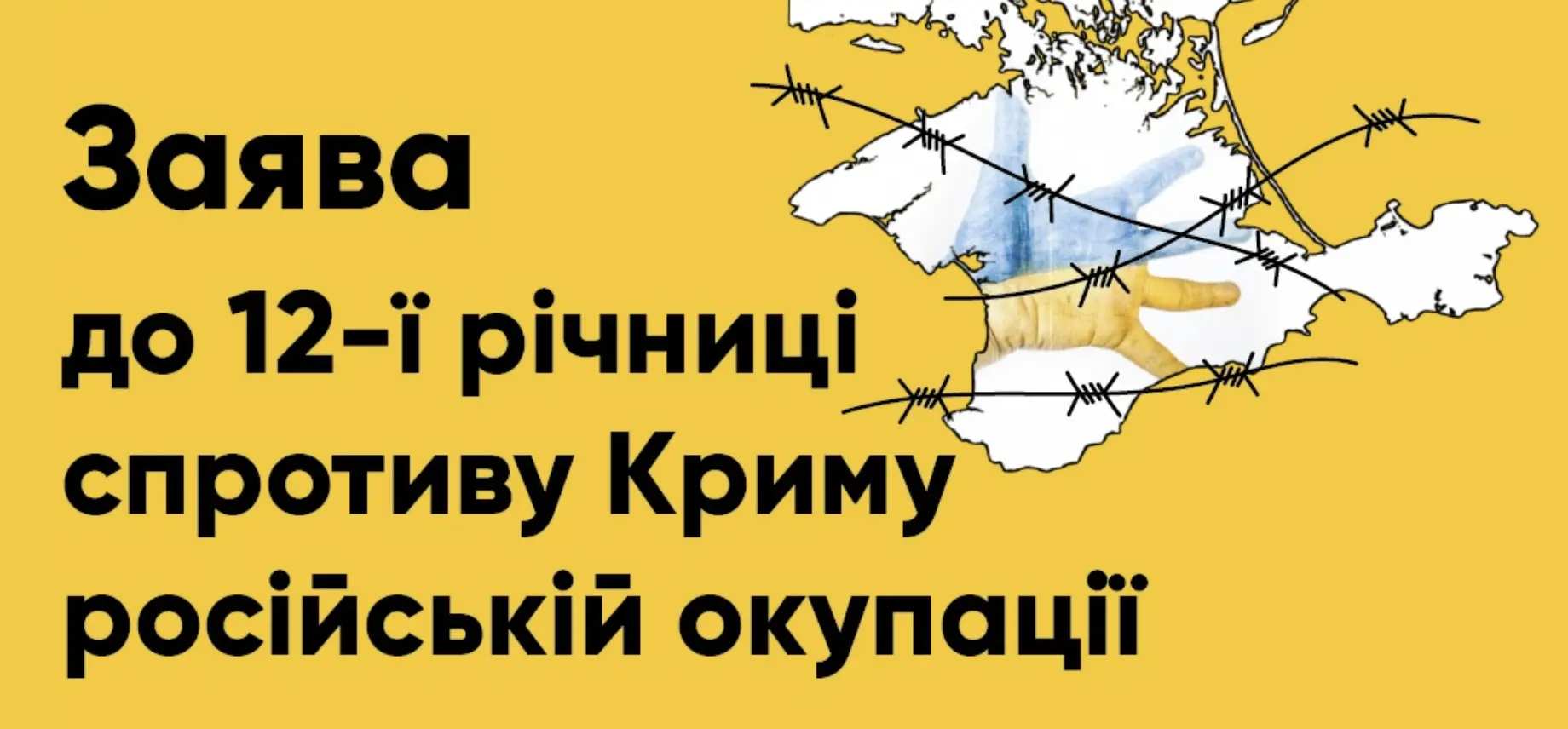
Statement on the 12th anniversary of Crimea's resistance to Russian occupation
Source: Zmina
The Russian Federation’s occupation of the Autonomous Republic of Crimea and the city of Sevastopol has been ongoing since 2014. For 12 years now, the peninsula’s residents have been living under conditions of systematic human rights violations and international crimes. Throughout these 12 years, they have faced repression and persecution for the blue-and-yellow colors, cultural assimilation, militarization, the destruction of their national identity, and coercion to serve the imperial ambitions of the aggressor state. At the same time, throughout these 12 long years, they have resisted, defending their dignity and freedom.
The Russian Federation’s occupation of the Autonomous Republic of Crimea and the city of Sevastopol has been ongoing since 2014. For 12 years now, the peninsula’s residents have been living under conditions of systematic human rights violations and international crimes. Throughout these 12 years, they have faced repression and persecution for the blue-and-yellow colors, cultural assimilation, militarization, the destruction of their national identity, and coercion to serve the imperial ambitions of the aggressor state. At the same time, throughout these 12 long years, they have resisted, defending their dignity and freedom.
On the Day of Crimean Resistance to Russian Occupation, the Crimean House of Human Rights, its member organizations, and the Human Rights Houses Foundation reaffirm their commitment to protecting human rights, fundamental freedoms, and the dignity of all individuals on the peninsula.
The situation in occupied Crimea continues to deteriorate. Reports from international organizations, monitoring bodies, and member organizations of the Crimean House of Human Rights document ongoing violations:
Suppression of political, civil, economic, social, and cultural rights: persecution of individuals for their pro-Ukrainian stance and activism, restrictions on the right to a fair trial, the risk of losing property and businesses if one refuses to obtain Russian documents, limited access to quality medical care, blocking opportunities to study the Ukrainian language and culture, destruction of the cultural heritage of the Crimean Tatars, and a range of other violations.
Forced passportization and demographic changes: The occupying authorities have introduced mandatory issuance of Russian passports as a prerequisite for access to basic rights and services, including visiting a doctor or attending school, while simultaneously implementing a policy of forcibly altering the demographic composition of the peninsula through the resettlement of Russians and the displacement of Ukrainians.
Forced conscription: Between 2015 and 2025, the Russian Federation conducted 22 conscription campaigns on the peninsula, enlisting at least 53,000 people into its armed forces in violation of international law.
Illegal deportation and forced displacement, forced placement of children with Russian citizens: Orphaned children from the occupied Crimean Peninsula were among the first to suffer from illegal adoptions by Russian citizens, accompanied by their removal to the Krasnodar Krai, Krasnoyarsk Krai, Zabaykalsky Krai, the Republic of Adygea, the Leningrad Oblast, and the Moscow Oblast. Over the past 12 years, as part of the “Train of Hope” and “Let’s Fly for the Child” programs, approximately 1,000 children may have ended up in the Russian Federation, where they continue to be raised as “Russian patriots.” As of today, not a single child illegally deported by Russian citizens under this scheme has been returned to their homeland. Impunity for these illegal actions ultimately led to a significant expansion of their scale after the start of the full-scale invasion, turning occupied Crimea into a “transit hub” from which Ukrainian children—primarily from the Kherson and Zaporizhzhia regions—were illegally deported to Russia.
Militarization and political indoctrination of children: over 12 years of occupation, the Russian Federation has built a system of political indoctrination and militarization of children through formal and informal education, children’s and youth movements, military-patriotic clubs, and a network of camps. During the occupation, the number of cadet classes increased 102-fold: from 3 in 2015 to 306 in 2025. This indicates a systematic and deliberate expansion of militarized education as a tool for the Russian Federation to influence children living in the temporarily occupied territories. In addition, the number of children recruited by the Russian Federation into paramilitary movements has increased. The number of “Yunarmiya” participants rose from 1,500 in 2017 to over 14,500, while in the city of Sevastopol it grew from 40 participants in 2016 to more than 17,000.
Instrumentalization of the education system, blocking access to Ukrainian education: Russia has not only replaced educational standards with its own, in violation of international humanitarian law, but has also fully instrumentalized and politicized the educational environment. In the temporarily occupied territory of Ukraine, education has ceased to fulfill its primary function and has instead become a tool for shaping a loyal population and promoting war and service in the Russian army. At the same time, Ukrainians living on the peninsula are deprived of the opportunity to study the Ukrainian language and have no access to Ukrainian education. Ukrainian websites are blocked even when using a VPN, and those who still attempt to pursue Ukrainian education risk facing persecution, threats, and prosecution for their stance.
Persecution of Crimean residents with pro-Ukrainian views, journalists, activists, human rights defenders, and lawyers, as well as religious persecution: people on the peninsula are systematically subjected to arbitrary detention and torture, including through the denial of medical care while in custody, unfair trials on politically motivated charges, and illegal transfer to Russian territory—sometimes thousands of kilometers from their native Crimea. In particular, 17 representatives of the Crimean media are currently behind bars, their only “crime” being the reporting of the truth. The occupying authorities are not deterred by critical health conditions (98 political prisoners require medical care), vulnerable circumstances (about 40 political prisoners are women, including mothers of many children), or advanced age (more than 20 political prisoners are over 60 years old).
Systematic violations of the rights of Ukraine’s indigenous peoples in Crimea: the marginalization and displacement of indigenous peoples from the social and public life of the peninsula constitute a deliberate policy. Crimean Tatars, as one of the peninsula’s indigenous peoples, have been subjected to systematic and disproportionate persecution by the occupying authorities for twelve years: of at least 284 victims of politically motivated persecution, 159 are Crimean Tatars. Searches (up to 70% of which were conducted in the homes of Crimean Tatars), detentions, and criminal proceedings on charges of “extremism” or “terrorism” are used as tools to suppress dissent and resistance, while the practice of illegally relocating victims of politically motivated persecution of Crimean Tatar origin constitutes a form of illegal deportation. The right of indigenous peoples to self-identification, including the ability to establish their own representative institutions and self-governing bodies, has effectively been nullified. The occupying authorities exert pressure on Crimean Tatar religious communities and Muslim organizations, restricting freedom of religion and cultural activities. At the same time, opportunities for education in the Crimean Tatar language and its use in public spaces are being curtailed.
Use of Crimea as a detention site for abducted civilians: Occupied Crimea continues to serve as a place of detention for civilians abducted by Russian authorities in the newly occupied territories, particularly in the Kherson and Zaporizhzhia regions, since the start of the full-scale invasion. Among those detained are orphaned children who were raised at the Kherson Regional Children’s Home.
Destruction and looting of Ukraine’s cultural heritage: Between 2014 and 2026, the Russian Federation issued at least 1,659 permits to Russian archaeologists to conduct illegal archaeological work at immovable cultural heritage sites in the Autonomous Republic of Crimea and the city of Sevastopol. Of these, 152 permits—including those for 24 archaeological expeditions—were issued in 2025 alone. The archaeological work was carried out by researchers from the Crimean Institute of Archaeology of the Russian Academy of Sciences, the Hermitage, the Pushkin State Museum of Fine Arts, Kherson State Pedagogical University, and other institutions. Since 2017, the Russian Federation has damaged over 9,000 square meters of cultural layers and illegally appropriated over 10,000 artifacts. In 2025, 55 fragments of ancient pottery were transported from the Kerch Museum-Reserve to Nizhny Novgorod, and 117 items from the Tauric Chersonesos collection were transferred to the Yekaterinburg History Museum.
Use of Crimea as a military base for attacks: Russia launches missiles and drones from occupied Crimea and the Black Sea. This results in civilian casualties in Ukraine, the destruction of civilian infrastructure, poses a serious threat to regional security in the Black Sea basin, and damages the Black Sea ecosystem. These violations have been ongoing since 2014 and have only intensified in 2025, despite international condemnation. This underscores the urgent need for the international community to take action to address the escalating human rights crisis in Crimea and hold the Russian Federation accountable for its actions.
We call on the international community:
To support the residents of the peninsula who are resisting the occupation, including journalists, activists, human rights defenders, political prisoners, and their families.
To make every effort to secure the release of all Ukrainian political prisoners held in Crimea, including Tofik Abdulgaziev, Bohdan Ziza, Iryna Danilovych, Appaz Kurtamet, and Galina Dovhopola; to ensure their immediate access to adequate medical care; guarantee access to their places of detention for international monitoring mechanisms, in particular the ICRC. Put an end to political repression, religious persecution, enforced disappearances, arbitrary detention, and abuse of the judicial system under the occupation.
Facilitate the safe return and reintegration of deported Ukrainians, particularly children and other vulnerable groups, with the full restoration of their rights and restitution of their property.
Make efforts to end the forced imposition of Russian identity, militarization, ideological indoctrination, and “re-education” of Ukrainian children, insisting on the cessation of the use of Russian educational standards and teaching materials in the temporarily occupied territories, as well as on ensuring access to Ukrainian education and the right of all Ukrainians to preserve and develop their culture, traditions, and identity.
Demand that the occupying state comply with international humanitarian law, cease the forced issuance of passports and the illegal mobilization of residents of the occupied territories, halt the destruction and illegal appropriation of Ukrainian cultural heritage sites, and cease using Crimea as a military base for carrying out armed attacks against Ukraine.
Strengthen targeted diplomatic, humanitarian, political, and economic measures aimed at ending human rights violations in the occupied territories, restoring Ukraine’s territorial integrity, ensuring that those responsible are held accountable, and providing support to victims.
Strengthen mechanisms for monitoring human rights in the temporarily occupied territories, in particular by renewing the reporting mandate of the Office of the UN High Commissioner for Human Rights, with a focus on protecting vulnerable groups, and ensure the provision of necessary support to civil society to continue documenting crimes and violations.
Expand and strengthen the mandate of the Independent International Commission of Inquiry on Ukraine, ensuring it has adequate resources, expanded access, and enhanced cooperation with the OSCE, the Council of Europe, and relevant UN mechanisms to comprehensively document human rights violations and international crimes.
Require the Russian Federation to comply with the rulings of international and regional courts, in particular the International Court of Justice and the European Court of Human Rights; Support the International Criminal Court and its investigation of crimes committed by the Russian Federation against Ukraine; and intensify the application of universal jurisdiction, while promoting broad support for and the successful launch of a Special Tribunal to investigate the Russian Federation’s crime of aggression against Ukraine.
Expand the mandate of the International Commission on Claims Related to Ukraine to include, among the categories of compensable damages, those caused by the Russian Federation since February 20, 2014, particularly in occupied Crimea. This will help ensure justice for victims of violations committed prior to February 24, 2022.
Support the work of the International Crimea Platform, the Coalition for the Return of Ukrainian Children, the Platform for the Release of Civilians Illegally Detained by the Russian Federation, the Register of Damages, the International Claims Commission, and the Compensation Mechanism for Victims since 2014.
We call on all UN member states, international organizations, and civil society to take decisive action. Immediate, coordinated, and consistent measures are necessary to counter the growing human rights violations and international crimes in occupied Crimea. Inaction will only contribute to impunity and further violations of international law. We call for global solidarity and concrete steps—justice and fundamental rights must be restored for the residents of Ukraine’s temporarily occupied territories.
Crimea Human Rights
House Human Rights
Houses Foundation
Regional Human Rights
Center
Almenda Center for Civic
Education
ZMINA Human Rights
Center
Crimean Human Rights Group
CrimeaSOS
Crimean Process
The situation in occupied Crimea continues to deteriorate. Reports from international organizations, monitoring bodies, and member organizations of the Crimean House of Human Rights document ongoing violations:
Suppression of political, civil, economic, social, and cultural rights: persecution of individuals for their pro-Ukrainian stance and activism, restrictions on the right to a fair trial, the risk of losing property and businesses if one refuses to obtain Russian documents, limited access to quality medical care, blocking opportunities to study the Ukrainian language and culture, destruction of the cultural heritage of the Crimean Tatars, and a range of other violations.
Forced passportization and demographic changes: The occupying authorities have introduced mandatory issuance of Russian passports as a prerequisite for access to basic rights and services, including visiting a doctor or attending school, while simultaneously implementing a policy of forcibly altering the demographic composition of the peninsula through the resettlement of Russians and the displacement of Ukrainians.
Forced conscription: Between 2015 and 2025, the Russian Federation conducted 22 conscription campaigns on the peninsula, enlisting at least 53,000 people into its armed forces in violation of international law.
Illegal deportation and forced displacement, forced placement of children with Russian citizens: Orphaned children from the occupied Crimean Peninsula were among the first to suffer from illegal adoptions by Russian citizens, accompanied by their removal to the Krasnodar Krai, Krasnoyarsk Krai, Zabaykalsky Krai, the Republic of Adygea, the Leningrad Oblast, and the Moscow Oblast. Over the past 12 years, as part of the “Train of Hope” and “Let’s Fly for the Child” programs, approximately 1,000 children may have ended up in the Russian Federation, where they continue to be raised as “Russian patriots.” As of today, not a single child illegally deported by Russian citizens under this scheme has been returned to their homeland. Impunity for these illegal actions ultimately led to a significant expansion of their scale after the start of the full-scale invasion, turning occupied Crimea into a “transit hub” from which Ukrainian children—primarily from the Kherson and Zaporizhzhia regions—were illegally deported to Russia.
Militarization and political indoctrination of children: over 12 years of occupation, the Russian Federation has built a system of political indoctrination and militarization of children through formal and informal education, children’s and youth movements, military-patriotic clubs, and a network of camps. During the occupation, the number of cadet classes increased 102-fold: from 3 in 2015 to 306 in 2025. This indicates a systematic and deliberate expansion of militarized education as a tool for the Russian Federation to influence children living in the temporarily occupied territories. In addition, the number of children recruited by the Russian Federation into paramilitary movements has increased. The number of “Yunarmiya” participants rose from 1,500 in 2017 to over 14,500, while in the city of Sevastopol it grew from 40 participants in 2016 to more than 17,000.
Instrumentalization of the education system, blocking access to Ukrainian education: Russia has not only replaced educational standards with its own, in violation of international humanitarian law, but has also fully instrumentalized and politicized the educational environment. In the temporarily occupied territory of Ukraine, education has ceased to fulfill its primary function and has instead become a tool for shaping a loyal population and promoting war and service in the Russian army. At the same time, Ukrainians living on the peninsula are deprived of the opportunity to study the Ukrainian language and have no access to Ukrainian education. Ukrainian websites are blocked even when using a VPN, and those who still attempt to pursue Ukrainian education risk facing persecution, threats, and prosecution for their stance.
Persecution of Crimean residents with pro-Ukrainian views, journalists, activists, human rights defenders, and lawyers, as well as religious persecution: people on the peninsula are systematically subjected to arbitrary detention and torture, including through the denial of medical care while in custody, unfair trials on politically motivated charges, and illegal transfer to Russian territory—sometimes thousands of kilometers from their native Crimea. In particular, 17 representatives of the Crimean media are currently behind bars, their only “crime” being the reporting of the truth. The occupying authorities are not deterred by critical health conditions (98 political prisoners require medical care), vulnerable circumstances (about 40 political prisoners are women, including mothers of many children), or advanced age (more than 20 political prisoners are over 60 years old).
Systematic violations of the rights of Ukraine’s indigenous peoples in Crimea: the marginalization and displacement of indigenous peoples from the social and public life of the peninsula constitute a deliberate policy. Crimean Tatars, as one of the peninsula’s indigenous peoples, have been subjected to systematic and disproportionate persecution by the occupying authorities for twelve years: of at least 284 victims of politically motivated persecution, 159 are Crimean Tatars. Searches (up to 70% of which were conducted in the homes of Crimean Tatars), detentions, and criminal proceedings on charges of “extremism” or “terrorism” are used as tools to suppress dissent and resistance, while the practice of illegally relocating victims of politically motivated persecution of Crimean Tatar origin constitutes a form of illegal deportation. The right of indigenous peoples to self-identification, including the ability to establish their own representative institutions and self-governing bodies, has effectively been nullified. The occupying authorities exert pressure on Crimean Tatar religious communities and Muslim organizations, restricting freedom of religion and cultural activities. At the same time, opportunities for education in the Crimean Tatar language and its use in public spaces are being curtailed.
Use of Crimea as a detention site for abducted civilians: Occupied Crimea continues to serve as a place of detention for civilians abducted by Russian authorities in the newly occupied territories, particularly in the Kherson and Zaporizhzhia regions, since the start of the full-scale invasion. Among those detained are orphaned children who were raised at the Kherson Regional Children’s Home.
Destruction and looting of Ukraine’s cultural heritage: Between 2014 and 2026, the Russian Federation issued at least 1,659 permits to Russian archaeologists to conduct illegal archaeological work at immovable cultural heritage sites in the Autonomous Republic of Crimea and the city of Sevastopol. Of these, 152 permits—including those for 24 archaeological expeditions—were issued in 2025 alone. The archaeological work was carried out by researchers from the Crimean Institute of Archaeology of the Russian Academy of Sciences, the Hermitage, the Pushkin State Museum of Fine Arts, Kherson State Pedagogical University, and other institutions. Since 2017, the Russian Federation has damaged over 9,000 square meters of cultural layers and illegally appropriated over 10,000 artifacts. In 2025, 55 fragments of ancient pottery were transported from the Kerch Museum-Reserve to Nizhny Novgorod, and 117 items from the Tauric Chersonesos collection were transferred to the Yekaterinburg History Museum.
Use of Crimea as a military base for attacks: Russia launches missiles and drones from occupied Crimea and the Black Sea. This results in civilian casualties in Ukraine, the destruction of civilian infrastructure, poses a serious threat to regional security in the Black Sea basin, and damages the Black Sea ecosystem. These violations have been ongoing since 2014 and have only intensified in 2025, despite international condemnation. This underscores the urgent need for the international community to take action to address the escalating human rights crisis in Crimea and hold the Russian Federation accountable for its actions.
We call on the international community:
To support the residents of the peninsula who are resisting the occupation, including journalists, activists, human rights defenders, political prisoners, and their families.
To make every effort to secure the release of all Ukrainian political prisoners held in Crimea, including Tofik Abdulgaziev, Bohdan Ziza, Iryna Danilovych, Appaz Kurtamet, and Galina Dovhopola; to ensure their immediate access to adequate medical care; guarantee access to their places of detention for international monitoring mechanisms, in particular the ICRC. Put an end to political repression, religious persecution, enforced disappearances, arbitrary detention, and abuse of the judicial system under the occupation.
Facilitate the safe return and reintegration of deported Ukrainians, particularly children and other vulnerable groups, with the full restoration of their rights and restitution of their property.
Make efforts to end the forced imposition of Russian identity, militarization, ideological indoctrination, and “re-education” of Ukrainian children, insisting on the cessation of the use of Russian educational standards and teaching materials in the temporarily occupied territories, as well as on ensuring access to Ukrainian education and the right of all Ukrainians to preserve and develop their culture, traditions, and identity.
Demand that the occupying state comply with international humanitarian law, cease the forced issuance of passports and the illegal mobilization of residents of the occupied territories, halt the destruction and illegal appropriation of Ukrainian cultural heritage sites, and cease using Crimea as a military base for carrying out armed attacks against Ukraine.
Strengthen targeted diplomatic, humanitarian, political, and economic measures aimed at ending human rights violations in the occupied territories, restoring Ukraine’s territorial integrity, ensuring that those responsible are held accountable, and providing support to victims.
Strengthen mechanisms for monitoring human rights in the temporarily occupied territories, in particular by renewing the reporting mandate of the Office of the UN High Commissioner for Human Rights, with a focus on protecting vulnerable groups, and ensure the provision of necessary support to civil society to continue documenting crimes and violations.
Expand and strengthen the mandate of the Independent International Commission of Inquiry on Ukraine, ensuring it has adequate resources, expanded access, and enhanced cooperation with the OSCE, the Council of Europe, and relevant UN mechanisms to comprehensively document human rights violations and international crimes.
Require the Russian Federation to comply with the rulings of international and regional courts, in particular the International Court of Justice and the European Court of Human Rights; Support the International Criminal Court and its investigation of crimes committed by the Russian Federation against Ukraine; and intensify the application of universal jurisdiction, while promoting broad support for and the successful launch of a Special Tribunal to investigate the Russian Federation’s crime of aggression against Ukraine.
Expand the mandate of the International Commission on Claims Related to Ukraine to include, among the categories of compensable damages, those caused by the Russian Federation since February 20, 2014, particularly in occupied Crimea. This will help ensure justice for victims of violations committed prior to February 24, 2022.
Support the work of the International Crimea Platform, the Coalition for the Return of Ukrainian Children, the Platform for the Release of Civilians Illegally Detained by the Russian Federation, the Register of Damages, the International Claims Commission, and the Compensation Mechanism for Victims since 2014.
We call on all UN member states, international organizations, and civil society to take decisive action. Immediate, coordinated, and consistent measures are necessary to counter the growing human rights violations and international crimes in occupied Crimea. Inaction will only contribute to impunity and further violations of international law. We call for global solidarity and concrete steps—justice and fundamental rights must be restored for the residents of Ukraine’s temporarily occupied territories.
Crimea Human Rights
House Human Rights
Houses Foundation
Regional Human Rights
Center
Almenda Center for Civic
Education
ZMINA Human Rights
Center
Crimean Human Rights Group
CrimeaSOS
Crimean Process
This is an automatic translation generated by DeepL.