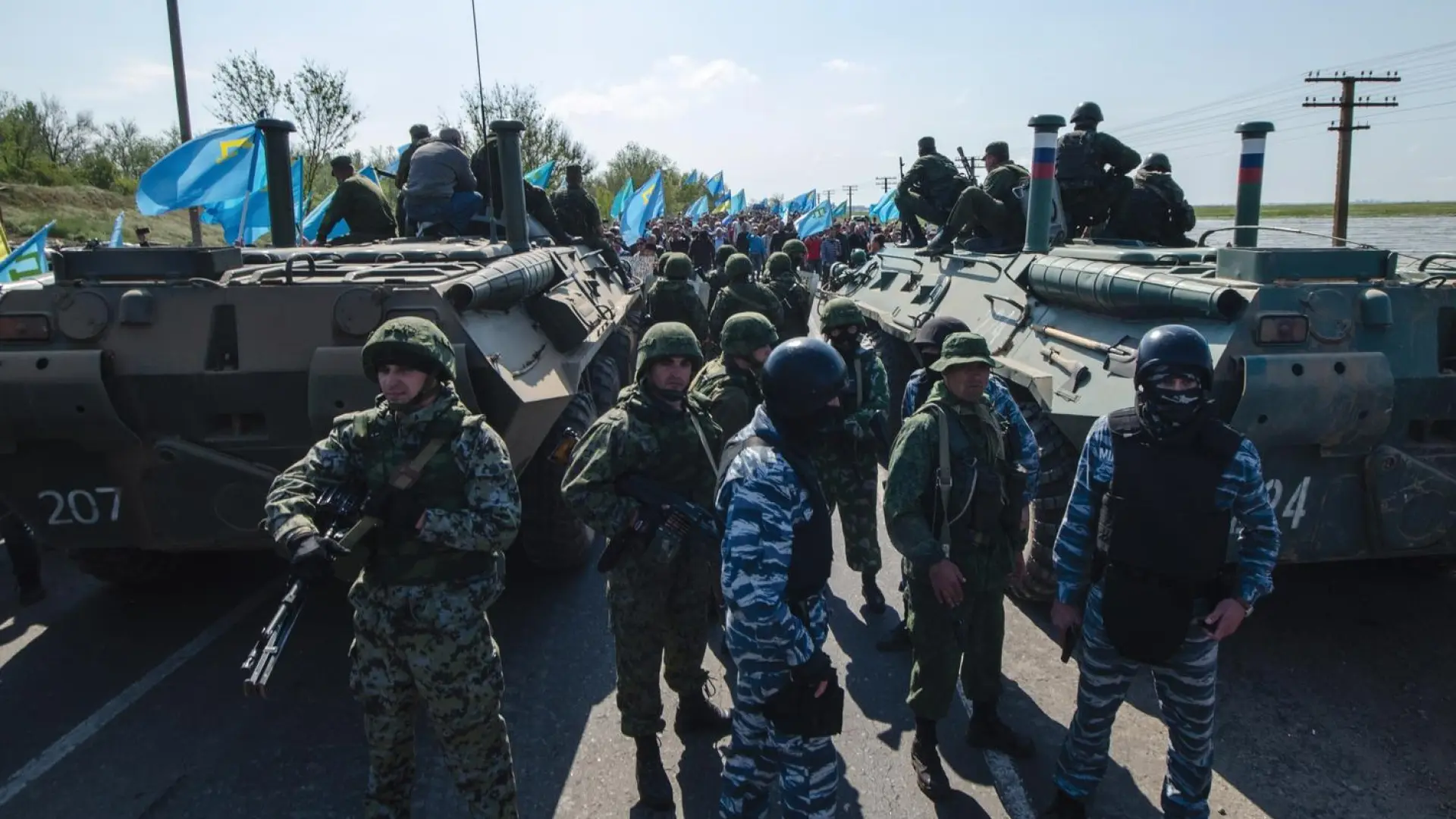
Disregard for human rights. Abuses in Crimea
Source: Human Rights Watch
Summary Recommendations
To the authorities exercising de facto control over the Crimean Peninsula and the Russian Federation
To the UN, the OSCE, the Council of Europe, and their member states
To the Government of Ukraine
I. Persecution of Crimean Tatars and pro-Ukrainian activists
General Information
Enforced Disappearances
Repression of the Crimean Tatar Mejlis and Associated Individuals
Persecution and Detention of Crimean Activists
Searches of the offices of the Mejlis and the newspaper “Avdet,” the court case against the “Crimea” Foundation
Searches of homes, mosques, and madrasas
Abuses by self-defense forces
II. Repression of pro-Ukrainian and Crimean Tatar media
Use of anti-extremism legislation to suppress criticism
III. Introduction of Russian citizenship in Crimea
Violations of the rules of occupation
Discrimination against residents with Ukrainian citizenship
Risk of expulsion from Crimea
Travel between Crimea and mainland Ukraine
IV. Applicable law
International humanitarian law
International human rights standards
Summary Recommendations
To the authorities exercising de facto control over the Crimean Peninsula and the Russian Federation
To the UN, the OSCE, the Council of Europe, and their member states
To the Government of Ukraine
I. Persecution of Crimean Tatars and pro-Ukrainian activists
General Information
Enforced Disappearances
Repression of the Crimean Tatar Mejlis and Associated Individuals
Persecution and Detention of Crimean Activists
Searches of the offices of the Mejlis and the newspaper “Avdet,” the court case against the “Crimea” Foundation
Searches of homes, mosques, and madrasas
Abuses by self-defense forces
II. Repression of pro-Ukrainian and Crimean Tatar media
Use of anti-extremism legislation to suppress criticism
III. Introduction of Russian citizenship in Crimea
Violations of the rules of occupation
Discrimination against residents with Ukrainian citizenship
Risk of expulsion from Crimea
Travel between Crimea and mainland Ukraine
IV. Applicable law
International humanitarian law
International human rights standards
Summary
Following the signing of the “Treaty on the Accession of the Republic of Crimea to the Russian Federation” between the Crimean authorities and Russia, and the adoption on March 20, 2014, by the Russian State Duma of the law “On the Admission of the Republic of Crimea to the Russian Federation and the Formation of New Constituent Entities within the Russian Federation,” the authorities of Russia and Crimea began the process of integrating the peninsula into the Russian legislative and political sphere. This process includes the extension of Russian laws concerning citizenship, media registration, and “countering extremism,” particularly regarding banned literature.
In particular, relying on Russian anti-extremism legislation that is insufficiently detailed and overly broadly formulated, Crimean authorities issued several “anti-extremist” warnings to the Mejlis—the representative body of the Crimean Tatars—and also banned the Crimean Tatar community from holding mass public gatherings. Between August and October of this year, the authorities conducted thorough, and in several cases, unauthorized searches of mosques and madrasas, as well as searches of Crimean Tatars’ private homes, including the homes of Mejlis members. According to the official version, the searches were conducted to detect “drugs, weapons, and banned literature.” They involved not only local police and the Russian FSB but also dozens of unidentified armed individuals wearing masks.
The authorities are putting pressure on pro-Ukrainian and Crimean Tatar media outlets, raiding newsrooms, shutting down some media outlets, and threatening others with closure.
The FSB and the Crimean Prosecutor’s Office have issued official and unofficial warnings to leading Crimean Tatar publications regarding the inadmissibility of publishing “extremist” materials and have summoned editors “for a conversation,” threatening them with denial of re-registration under Russian law should they maintain an “anti-Russian editorial policy.”
The authorities continue to support so-called self-defense units—armed paramilitary groups that formed in Crimea by the end of February and were likely involved in enforced disappearances, beatings, and, in at least one case, the torture of pro-Ukrainian activists in March. These units continue to illegally detain and beat pro-Ukrainian activists in Crimea. The authorities are taking no measures either to deter these forces from committing violations or to investigate such cases. Instead, steps were taken in June to legalize the self-defense units and grant them additional powers. In July, Crimea’s de facto Prime Minister Sergey Aksyonov submitted a bill to the Crimean parliament granting amnesty to all members of the self-defense units for actions committed between February and April 2014. At the time this report was prepared, a similar bill on amnesty for actions committed between February 2014 and January 2015 was under consideration in the Russian State Duma, with the exception of those committed “for the purpose of enrichment or other mercenary motives.”
The violations listed above were documented in this report. The report is based on research conducted in Crimea during October 2014, during which a Human Rights Watch staff member met with journalists, activists, lawyers, representatives of civil society, and the Crimean Tatar community, including the leadership of the Mejlis and the Spiritual Administration of Muslims of Crimea. We also conducted telephone interviews with people who had left Crimea for mainland Ukraine. The report also draws on materials previously published following a research trip to Crimea in March 2014.
On November 6, Human Rights Watch sent a letter to the Crimean authorities outlining the findings of our research. As of the publication of this report, we have not received a response.
Human Rights Watch believes that, under international law, Russia has been the occupying power in Crimea since at least late February 2014, and assesses its actions in accordance with the norms of international humanitarian law regarding occupation. Russia is an occupying power because it exercises effective control over Crimea without the consent of the Ukrainian government and in the absence of a legally recognized transfer of sovereignty to Russia. The referendum held by local authorities without the consent of the Government of Ukraine and without broad recognition by the international community, as well as Russia’s unilateral actions following that referendum, cannot be considered to meet the criteria of international law regarding the transfer of sovereignty, by which the state of military occupation would be deemed to have ceased.
International human rights standards also apply to Crimea and must be enforced, including all treaties ratified by Russia, such as the European Convention on Human Rights and the International Covenant on Civil and Political Rights. In accordance with the rules of occupation, Russia is obligated to take all measures within its power to restore and ensure public order and security, to the extent possible, while respecting the laws of Crimea and Ukraine in force prior to March 2014, unless insurmountable obstacles prevent this. Russia is also responsible for violations of humanitarian law and international human rights law committed by local authorities or forces under its control and is obligated to prevent such violations and prosecute them.
Russia insists that it is not an occupying power because the local Crimean authorities (without having the necessary authority to do so—Human Rights Watch) requested to join the Russian Federation, and this request was granted by the Russian parliament. Therefore, it acts as if Crimea were part of Russia and extends the application of Russian federal law to the peninsula, contrary to the presumption binding on an occupying power to respect the laws existing in the occupied country, which must be observed unless there are insurmountable obstacles to doing so.
In this report, Human Rights Watch uses the term “authorities” to refer to those forces in Crimea that effectively exercise control over the peninsula and bear de facto responsibility for governance and administration, regardless of the legal status of such agents under Ukrainian or Russian law.
In accordance with its longstanding policy on the laws of armed conflict, Human Rights Watch maintains a neutral position regarding decisions by parties to a conflict to use military force or to occupy another country or region. However, we seek to ensure respect for international norms governing the conduct of war and occupation.
Recommendations
To the authorities exercising de facto control over the Crimean Peninsula and the Russian Federation
To the authorities exercising de facto control over the Crimean Peninsula and the Russian Federation
- Ensure prompt, effective, and impartial investigations into all allegations of human rights violations by the police and other auxiliary forces operating in the region since February 2014.
- Dissolve all self-defense units; regular internal affairs units should not include members of self-defense units who are alleged to have been involved in human rights violations.
- Ensure that any amnesty for members of self-defense units does not apply to serious human rights violations such as those described in this report.
- Cease the persecution of members of the Crimean Tatar community under the pretext of “combating extremism.”
- Cease any unjustified interference with media freedom and ensure that the media can reflect a plurality of views, even if they do not support Russia’s actions in Crimea; immediately cease and publicly condemn all physical attacks on journalists and acts of intimidation against them.
- Ensure access to Crimea for independent groups, humanitarian and intergovernmental organizations to monitor human rights without imposing unjustified restrictions based on the point of entry.
- Reverse the process under which Ukrainian citizens were forced to choose between Russian and Ukrainian citizenship; ensure that no citizen of Ukraine is subjected to direct or indirect coercion to accept Russian citizenship and that the decision to retain Ukrainian citizenship does not result in any negative consequences, including discriminatory ones.
- Ensure that all individuals have the opportunity to make a fully informed choice of citizenship by providing access to clear and accurate information about the requirements of Russian citizenship, as well as the consequences of choosing citizenship.
- Refrain from taking any measures that could deprive Crimean residents who have retained Ukrainian citizenship of the rights they enjoyed prior to March 2014.
To the UN, OSCE, Council of Europe, and their member states
- To demand that UN Security Council members adopt a resolution under Chapter VI of the UN Charter, strongly urging the full implementation of the recommendations regarding the situation in Crimea as set forth in the reports of the UN Mission on Human Rights in Ukraine.
- Demand the immediate provision of unimpeded access to Crimea for relevant UN mechanisms, particularly those dealing with enforced disappearances (the Working Group on Enforced or Involuntary Disappearances, the Special Rapporteur on extrajudicial, summary, or arbitrary executions, and the Special Rapporteur on torture), as well as the Special Rapporteur on the situation of human rights defenders.
- The OSCE Special Monitoring Mission, whose mandate covers the entire territory of Ukraine, must be granted immediate access to establish a permanent presence in Crimea and to operate unimpeded in reporting on the situation on the peninsula.
- Urge the OSCE Chairperson-in-Office (Switzerland) to organize a public discussion on Crimea at the OSCE Ministerial Meeting on December 4–5, 2014.
- OSCE member states should urgently consider organizing informal and open briefings on Crimea for the Permanent Council, involving civil society and other international organizations, to shed light on the situation and discuss the international response.
- Demand immediate and unimpeded access to Crimea for other relevant human rights mechanisms of the OSCE, the UN, and the Council of Europe.
- Express concern regarding the human rights violations documented in this report, as well as in the regular reports of the UN Mission on Human Rights in Ukraine and in the October 2014 report of the Council of Europe Commissioner for Human Rights. Urge the de facto authorities of Crimea and the Russian Federation to promptly implement the recommendations addressed to them.
- Urge Ukraine to reaffirm its declaration of April 17, 2014, under Article 12 (3) of the Rome Statute regarding the recognition of the jurisdiction of the International Criminal Court (ICC) on the territory of Ukraine—but without any time limits—as well as to ratify the Rome Statute as soon as possible, including by resolving any issues that hinder ratification.
The Government of Ukraine
- To reaffirm the statement of April 17, 2014, regarding Article 12(3) of the ICC’s Rome Statute on the recognition of the ICC’s jurisdiction over alleged crimes committed on the territory of Ukraine—but without limiting the scope of jurisdiction to the period from November 21, 2013, to February 22, 2014. Ensure the swiftest possible transition to ratification of the Rome Statute, including by resolving any issues that hinder ratification.
I. Persecution of Crimean Tatars and Pro-Ukrainian Activists
General Information
In 1944, the Soviet authorities accused all Crimean Tatars in Crimea of collaborating with the Nazis and, as a form of collective punishment, deported the entire community—estimated at approximately 240,000 people at the time—to remote regions of the USSR. In the following months, more than half of those deported died from starvation and disease. In the mid-1980s, Crimean Tatars were allowed to return to their historical homeland, but the authorities did not take any concrete measures to facilitate their return or provide compensation for lost property. In April 2014, the Ukrainian parliament officially recognized the Crimean Tatars as an indigenous people of Ukraine. That same month, Russian President Vladimir Putin signed a decree on the political, cultural, and economic rehabilitation of the Crimean Tatars.
According to the latest Ukrainian census, in 2001 Crimean Tatars accounted for about 12% of Crimea’s population.
According to the latest Ukrainian census, in 2001 Crimean Tatars accounted for about 12% of Crimea’s population.
Enforced Disappearances
Human Rights Watch has previously documented at least 15 incidents in Crimea dating back to March 2014 in which Crimean Tatars or pro-Ukrainian activists were victims of enforced disappearances or abductions, or went missing. Two were later found dead. The actual number of enforced disappearances appears to be higher.
For example, Human Rights Watch reported the disappearance on September 27 of cousins Islam Jepparov and Jevdet Islamov. They were last seen being pushed into a minibus by two men in black uniforms. At the time of this report, the criminal investigation into their disappearance had yielded no results.
During the last week of May, pro-Ukrainian activists Leonid Korzh, Timur Shaimardanov, and Seiran Zinedin disappeared within a few days of one another. According to their relatives, two of them had conflicts with the “self-defense forces” in March. Their relatives and lawyers say their whereabouts remain unknown, and the investigation into their disappearances has made no progress.
On September 29, Crimean Tatar Edem Asanov disappeared while on his way to work in Yevpatoria, approximately 60 km from Simferopol. He was not politically active, but from time to time he discussed the problems of the Crimean Tatars on his page on the social network “VKontakte.” Six days later, police found Asanov hanged in one of the abandoned houses in Yevpatoria. The circumstances of his death remain unclear.
On October 3, 23-year-old Eskender Apselyamov went missing. Relatives told Human Rights Watch that he left home for work but never arrived. Relatives’ attempts to locate him were unsuccessful. The police have launched an investigation.
In March, Human Rights Watch documented the disappearance and murder of Crimean Tatar activist Reshat Ametov. This case will be discussed in detail below.
For example, Human Rights Watch reported the disappearance on September 27 of cousins Islam Jepparov and Jevdet Islamov. They were last seen being pushed into a minibus by two men in black uniforms. At the time of this report, the criminal investigation into their disappearance had yielded no results.
During the last week of May, pro-Ukrainian activists Leonid Korzh, Timur Shaimardanov, and Seiran Zinedin disappeared within a few days of one another. According to their relatives, two of them had conflicts with the “self-defense forces” in March. Their relatives and lawyers say their whereabouts remain unknown, and the investigation into their disappearances has made no progress.
On September 29, Crimean Tatar Edem Asanov disappeared while on his way to work in Yevpatoria, approximately 60 km from Simferopol. He was not politically active, but from time to time he discussed the problems of the Crimean Tatars on his page on the social network “VKontakte.” Six days later, police found Asanov hanged in one of the abandoned houses in Yevpatoria. The circumstances of his death remain unclear.
On October 3, 23-year-old Eskender Apselyamov went missing. Relatives told Human Rights Watch that he left home for work but never arrived. Relatives’ attempts to locate him were unsuccessful. The police have launched an investigation.
In March, Human Rights Watch documented the disappearance and murder of Crimean Tatar activist Reshat Ametov. This case will be discussed in detail below.
Repression of the Crimean Tatar Mejlis and Associated Individuals
The Mejlis, comprising 33 members, serves as the representative body of the Crimean Tatar people in their dealings with the authorities and international bodies.
The Mejlis openly opposed the Russian occupation of Crimea, called on Crimean Tatars to boycott the March referendum on the peninsula’s status and the September local elections, and demanded that the authorities disarm and disband the self-defense units.
On April 22, 2014, the authorities banned Mustafa Dzhemilev, the informal leader of the Crimean Tatars and former head of the Mejlis, from entering Crimea for five years. Prior to this, the Federal Migration Service had barred him from entering Russia. On May 3, when Dzhemilev (who holds Ukrainian citizenship) attempted to enter Crimea from the Ukrainian side via Armiansk in the north of the peninsula, local law enforcement and self-defense units did not allow him to pass. On May 14, in Jemilev’s absence, authorities conducted a search of his home. No official charges have been brought against Jemilev.
On May 3, 2014, approximately 2,000 Crimean Tatars gathered to meet Jemilev at the border. According to media reports, some of those present at the “Turkish Wall” checkpoint in Armiansk broke through the police cordon and attempted to form a corridor through which Dzhemilev could pass into Crimea without coming into contact with police or border guards. Law enforcement officers stopped the crowd, which, according to one eyewitness, became agitated at certain moments, while other witnesses said it retreated at Dzhemilev’s request. On the same day, groups of Crimean Tatars in several cities across Crimea held protests against the ban on Dzhemilev’s entry into Crimea. The protests were mostly peaceful, though in some cases participants blocked roads. In connection with the events of May 3, local authorities initiated administrative proceedings against dozens of Crimean Tatars; at least 140 people were fined for “disturbing public order” and “illegally crossing the border,” with fines ranging from 10,000 to 40,000 rubles (approximately $290–$1,500).
Human Rights Watch was unable to conduct an independent investigation into the events of May 3 or assess the appropriateness of the administrative charges and fines in specific cases. However, the authorities subsequently cited these events to justify mass searches, warnings, and other measures targeting Crimean Tatar groups and individuals. The authorities did not provide any additional specific grounds for these measures. Most likely, judging by the scale and intensity, as well as given the vagueness of the charges, these measures were an attempt to pressure members of the Crimean Tatar community who are considered opponents of the occupation of Crimea and, consequently, opponents of Russia.
On May 4, the Crimean prosecutor issued a warning to Mejlis Chairman Refat Chubarov regarding the possibility of holding the Mejlis accountable for “extremist actions” in connection with the events of May 3. Chubarov told Human Rights Watch that the prosecutor read the warning to him and threatened to dissolve the Mejlis and ban its activities in the event of repeated participation in “extremist” actions such as those on May 3, but Chubarov did not receive a copy of the document. On July 5, authorities banned Chubarov from entering Crimea for five years while he was outside the region.
In May, two days before the 70th anniversary of the deportation of the Crimean Tatars (May 18, 1944), which the Mejlis had marked annually with mass peaceful gatherings, local authorities banned all public events in Crimea through June 6, citing the possibility of “provocations” and disruption to the tourist season. Ultimately, local authorities permitted a small rally on May 17, but not in the center of Simferopol.
The prosecutor issued several statements warning the Mejlis against “extremist” activities, particularly after the Mejlis called for a boycott of the local elections on September 14. In September, Crimea’s de facto prime minister publicly stated that the Mejlis does not exist “in the legal sphere” and that it has “relatively little authority” among Crimean Tatars.
Russian authorities have repeatedly stopped members of the Mejlis and other Crimean Tatars and demanded explanations from them when they crossed the border into mainland Ukraine. For example, between July and September, Mejlis member Eskender Bariev was stopped at least seven times. Since March, when Russia forced all Crimean residents to choose between retaining Ukrainian citizenship and accepting Russian citizenship, Bariev has organized several seminars for Crimean Tatars to explain the consequences of each decision.
On July 23, eight Russian border guards armed with automatic rifles at a checkpoint in Armiansk surrounded the car in which Bariev and a colleague were returning to Crimea. Bariyev told Human Rights Watch that after searching the car and his personal belongings, the border guards confiscated his passport, camera, and voice recorder, and questioned him about his religious beliefs and activities related to the Mejlis. Three hours later, the border guards returned Bariev’s passport and equipment and allowed him to cross the border. Two weeks later, border guards stopped him again as he was leaving Crimea with his family, once more demanding explanations and detaining him for three hours. Upon his return to Crimea three days later, the same border guards detained Bariev again and confiscated his passport. They took him to an office for a conversation, during which they asked him if he knew Mustafa Dzhemilev and why Crimean Tatars do not trust Russia. According to Bariev, he was subsequently stopped, searched, and questioned in a similar manner four more times.
Bariev also told Human Rights Watch that Russian security forces in Crimea had invited him in for a “chat” on several occasions. During one such conversation in May, an officer of the Federal Security Service (FSB) asked why Bariev had not yet applied for a Russian passport. He also warned Bariev against what he called “extremist actions” during a planned public event marking the 70th anniversary of the deportation of Crimean Tatars.
Persecution and Detention of Crimean Activists
In October, authorities arrested three Crimean residents on charges of committing various criminal offenses during the May 3 protests. On October 22, police arrested Crimean Tatar activist and Mejlis member Tair Smerdyayev. His brother, Zair, told Human Rights Watch that the law enforcement officers who arrested his brother told him that he was suspected of assaulting a police officer during the spontaneous rally on May 3. Smerdylaev was taken to a temporary detention facility. On October 24, a court in Simferopol authorized his pretrial detention until a hearing scheduled for December 22. Smerdylaev’s lawyer, Emil Kurbedinov, told Human Rights Watch that the October 24 hearing was closed to family members and the media. The court rejected all defense motions and imposed a pretrial detention measure despite the lack of sufficient evidence to justify prolonged detention. According to Kurbedinov, the court relied on “oral testimony from 60 people, mostly Smerdyayev’s neighbors,” who allegedly told the police about his “extremist and anti-Russian sentiments.” Despite the lawyer’s motions, none of the defense witnesses were summoned to court. In justifying the pretrial detention measure imposed on Smerdyayev, the court also cited information from the Ministry of Internal Affairs’ Center for Countering Extremist Activity regarding his “ties to extremists” and membership in the ultra-nationalist Ukrainian group “Right Sector.”
Zair Smerdyayev told Human Rights Watch that on October 16 and 17, two other Crimean Tatars—Musa Apkerimov and Rustam Abdurakhmanov—were arrested on similar charges. A court in Simferopol authorized their detention.
Human Rights Watch has no information regarding any evidence in the authorities’ possession, aside from hypothetical testimony from neighbors and statements from the “E” Center, which the authorities used to justify the need to remand Smerdyayev in custody pending trial.
Riza Shevkiyev, the director general of the “Crimea” Foundation and a member of the Mejlis, told Human Rights Watch that around 9:00 a.m. on September 16, police and unidentified armed men in masks surrounded the building housing all three organizations and blocked the entrance. The armed men warned journalists to stay away, and when they tried to film, they began to threaten them, according to one of the journalists present. Law enforcement officers soon handed Shevkiyev a copy of a court order authorizing a search of the Mejlis premises “to identify weapons and printed materials that incite racial or religious hatred.” According to Shevkiyev, after searching the Mejlis office and library, law enforcement officers searched the editorial office of the newspaper “Avdet” and the office of the “Crimea” Foundation. When Shevkiyev asked to see the warrant for these searches, the law enforcement officers did not provide any documents.
Authorities seized all of the Mejlis’s office equipment, including six computers, two hard drives, several flash drives, and documents—specifically, meeting minutes from recent months and several religious brochures. The police also opened a safe in Mustafa Dzhemilev’s office and seized money from it (approximately 3,670 EUR, 200 USD). It was reported that the money was later returned to Dzhemilev’s wife at her request.
The next day, several court bailiffs, accompanied by about a dozen unidentified armed individuals wearing masks, arrived at the Mejlis office and presented Shevkiyev with a ruling dated September from the Leninsky District Court of Simferopol, which announced the initiation of administrative proceedings against the charitable organization “Crimea” Foundation at the request of the Crimean Prosecutor’s Office. The notice cited a statement from the Prosecutor’s Office that one of the organization’s founders is Mustafa Dzhemilev, which constitutes a violation of Russian law on non-profit organizations, as he is barred from entering Russia. Bailiffs also presented Shevkiyev with a court order freezing all assets of the Crimea Foundation, including seven properties and all bank accounts, pending a court hearing on the removal of Dzhemilev from the list of founders.
The bailiffs told Shevkiyev that he had 24 hours to vacate all premises belonging to or managed by the Crimea Foundation, including the building housing the foundation itself, the Mejlis, and the Avdet editorial office. When that time expired, the authorities sealed the Mejlis office and other foundation property and froze all its accounts, effectively paralyzing the activities of the Mejlis and the Avdet newspaper.
Shevkiyev told Human Rights Watch that Dzhemilev does not appear among the founders in the Crimea Foundation’s founding documents. However, when he presented these documents at the court hearing on September 29, the judge did not bother to examine them and ordered the foundation to remove Dzhemilev from the list of founders, even though he was not listed there. Shevkiyev said:
Mustafa [Dzhemilev] was never on the list of founders of the “Crimea” Foundation. He is the foundation’s president, which is more of a symbolic position. We have three founders, including myself; Dzhemilev is not listed there. But given the absurdity of the situation, I convened a meeting of the foundation’s board of founders, and we voted to “remove” Dzhemilev from a position he never held.
Shevkiyev is currently appealing the court decision to seize the Crimea Foundation’s assets. At the time this report was prepared, the Mejlis office and the editorial office of the Avdet newspaper remained sealed, and their bank accounts were frozen.
The searches became more frequent and intense in the run-up to the local elections held on September 14. According to the Crimean Field Mission on Human Rights—a local monitoring NGO—in September alone, searches were conducted in at least 15 homes of Crimean Tatars in Simferopol and surrounding areas, primarily targeting members of the Mejlis, as well as one pro-Ukrainian activist; Searches were also conducted at several mosques and madrasas. They were carried out by local police and Russian FSB officers, accompanied by dozens of unidentified masked individuals armed with automatic weapons. In some cases, law enforcement officers, who claimed to be searching for banned literature, weapons, and drugs, refused to identify themselves, present a search warrant, or allow the presence of independent witnesses during the search, as required by Russian law. In a number of cases documented by Human Rights Watch, security forces detained residents for several hours, questioned them about their religious beliefs, or criticized them for not applying for a Russian passport.
Mejlis member Eskender Bariev told Human Rights Watch that around 6:30 a.m. on September 16, approximately 15 people came to his apartment: 10 were in camouflage uniforms and masks, the rest were in civilian clothes. One of them identified himself as a lieutenant with the FSB in Crimea but refused to show his ID. He presented Bariev with a search warrant and stated that they would be looking for weapons, drugs, and banned literature. Bariev demanded two independent witnesses, as required by law, but the security forces said they had brought their own witnesses. After a two-hour search, the security officers left, taking Bariyev’s laptop and hard drive with them—as they stated—"for technical examination." At the time of writing this report, Bariyev had already inquired twice about the prospects of having his property returned, but had received no response. The authorities have not brought any charges against him nor informed him that he is a suspect in any criminal case.
On the same day, the authorities conducted a search at the home of Mustafa Asab, the 59-year-old chairman of the Belgorod Regional Mejlis. He told Human Rights Watch that around 6:00 a.m., 12 people in plain clothes—presumably from the FSB—arrived at his home, accompanied by 20 masked individuals armed with automatic rifles. They stated that they would be searching for “drugs, weapons, and banned literature.” One of them, who identified himself as an FSB officer, took Asab’s phone, presented a search warrant, and demanded that Asab show his documents. When Asab showed his Ukrainian passport, the officer asked why he didn’t have a Russian one. Asab told Human Rights Watch:
“I don’t have a Russian passport, only a Ukrainian one,” I told him. And he replied, “Do you have something against Russia?” He asked a few strange questions, like, “Why do you support Dzhemilev? Didn’t you know that Dzhemilev is an American agent who gets money from them?” And also: “Why do you watch [pro-Ukrainian] Channel 5?”
The search lasted more than three hours. In the end, the security forces seized five brochures, one of which was religious in nature, and left. About 20 minutes after the search ended, Asaba was taken to the police station, where he was interrogated for some time before being released.
Authorities also conducted intensive searches in mosques and madrasas. In an interview with Human Rights Watch, Asadullah Bairov, deputy mufti of the Spiritual Administration of Muslims of Crimea (DUMK), Asadullah Bairov, reported that between June and September, law enforcement officers conducted searches to identify banned literature in 8 out of 10 madrasas in Crimea operating under the auspices of the DUMK. According to him, the search at the madrasah in the village of Kolchugino in the Simferopol district was particularly intense; the director later provided him with details. On June 24, 30 armed men, including police and FSB officers, forcibly entered the madrasah and conducted a thorough search, including the library and students’ personal belongings. As reported in a statement by the DUMK press service, law enforcement officers broke down the front door and several windows of the building.
According to Bairov, there were 13 children and two teachers in the madrasah at the time. At the end of the search, which lasted about five hours, law enforcement officers seized several computers and flash drives. On the same day, a search was conducted at the home of the school’s deputy director, who was held at the police station for several hours and demanded to provide explanations before being released.
Bairov told Human Rights Watch that in September, authorities conducted new searches at several mosques and madrasas to identify “extremist literature.” On September 17, they searched one of the mosques in Simferopol, and on September 2, one of the mosques in Yalta. The deputy mufti of Crimea told the media that the search in Yalta involved police, FSB officers, and about 30 armed men. This search lasted seven hours and resulted in the seizure of several religious books.
According to information gathered by the Crimean Field Mission, on September 9, police and the FSB searched a boarding school in the Bakhchysarai district, resulting in the seizure of three religious books from the library. Children were present at the boarding school at the time of the search. According to the CFM, some parents claimed that children were forced to remove items bearing Crimean Tatar symbols.
Asadullah Bairov told Human Rights Watch that between June and October, he and other members of the Crimean Tatar Mejlis met several times with dede facto Prime Minister of Crimea, Sergey Aksyonov, and expressed their concern about the searches, noting that madrasas, mosques, and the Muslim population in general had not been given enough time to dispose of literature banned under Russian law.
The federal list of extremist materials was established by Federal Law No. 114 “On Countering Extremist Activity” in July 2002. It was first published in 2007 and has been regularly updated since then. It currently includes approximately 2,500 publications and audiovisual materials. As explained to Human Rights Watch by Alexander Verkhovsky—director of the SOVA Information and Analysis Center, which addresses issues of nationalism and racism as well as the analysis of the authorities’ misuse of anti-extremist legislation—Islamic literature accounts for about one-third of the banned materials, while about 25% of this literature is widely used in the Muslim community, contains no signs of extremism, and has been included on the list without justification. Verkhovsky also noted that the published version of the list is unclear, sometimes contradictory, and extremely difficult to understand, especially for the average person. In Crimea, the application of this law leads to discriminatory consequences for Crimean Tatars who practice Islam.
During a meeting with the Mufti of Crimea in September, Aksyonov acknowledged occasional “excesses” by security forces regarding searches and promised to take measures regarding the issues raised by the Crimean Muslim Spiritual Administration, Asadullah Bairov, who was present at the meeting, told Human Rights Watch. In October, Aksyonov announced through the media that Crimean residents had three more months to dispose of literature banned under Russian law. This, however, does not resolve the fundamental issue that the extension of Russian law to Crimea and its application on the peninsula constitute a violation of both international standards guaranteeing freedom of expression and Russia’s obligations as an occupying power.
In September, authorities searched the home of prominent pro-Ukrainian activist Yelizaveta Bogutskaya, who openly opposes Russia’s occupation of Crimea and leads the “Mothers of the World Against War” movement. In a telephone interview, she told Human Rights Watch that around 5:30 a.m. on September 8, a group of men in civilian clothes—some armed and wearing masks—appeared in the courtyard of her home in Simferopol. They demanded that Bogutskaya come out of the house. One of them fired five shots, wounding the woman’s dog. Another identified himself as an employee of the Center for Countering Extremism and presented a search warrant for Bogutskaya’s home to check for weapons, ammunition, drugs, and banned literature.
After the search, which lasted about three hours, three computers (one of which belonged to her son), a camera, flash drives, and some personal documents were seized from Bogutskaya. Bogutskaya was taken to the Simferopol Center for Countering Extremism and interrogated for seven hours without a lawyer. The four operatives who spoke with her stated that the reason for the search was “neighbors’ claims that she was inciting separatism by condemning the ‘return of Crimea to Russia.’” According to Bogutskaya, the operatives were primarily interested in her “anti-Russian” stance and her Facebook posts, in which she criticized Russia’s actions in Crimea. On the same day, authorities searched another house owned by Bogutskaya, which she rents out, and attempted to search her art gallery.
After approximately seven hours of questioning, the investigator informed Bogutskaya that she was being called as a witness in the case regarding the events of May 3. Around 4:00 p.m., Bogutskaya’s lawyer arrived and advised her not to answer any more questions so as not to incriminate herself. The interrogation was halted, and Bogutskaya was released around 7:00 p.m. That same night, she left Crimea and, as of the time of this report’s preparation, had not returned.
Violations by the self-defense forces
The so-called Crimean self-defense forces are paramilitary groups that emerged in late February with the aim of preventing any opposition to the March referendum on the peninsula’s status and have since operated with complete impunity. They have been implicated in unlawful detentions, abductions, and ill-treatment, including torture, as well as the harassment of pro-Ukrainian activists and other residents.
Ukrainian human rights groups have also reported that self-defense units have been involved in unlawful searches of citizens and vehicles, the forcible dispersal of public gatherings, and attacks on journalists.
Human Rights Watch has repeatedly called on the authorities to immediately disarm and disband these self-defense units, which operate outside any legal framework.
In June, the Crimean parliament attempted to regulate the status of self-defense units by passing the law “On the People’s Militia—People’s Guard,” under which self-defense units, among other things, were granted the right to check documents and, if necessary, assist the police in making arrests. The law explicitly states that self-defense units may act only in conjunction with the police; however, as will be noted below, they appear to operate independently and regularly harass, interrogate, and sometimes even beat people without police present.
In one incident documented by Human Rights Watch in March, there were indications of the self-defense units’ involvement in the enforced disappearance and death of Reshat Ametov—a Crimean Tatar who went missing and was later found dead in March in the Simferopol district. He was last seen at a protest in central Simferopol on March 3, when he was taken away by three unknown men in military-style uniforms. In October, Ametov’s relatives and lawyer told Human Rights Watch that the investigation into Ametov’s enforced disappearance and murder had yet to yield any results.
Human Rights Watch has previously reported on several cases of pro-Ukrainian activists being abducted by self-defense groups, most of whom were later released. In a number of incidents, the police were involved; however, it appears that the police did not coordinate their actions with the self-defense groups or control their members.
For example, in March, armed groups abducted well-known pro-Ukrainian political activists Andriy Shchekun and Anatoliy Kovalsky. They were unlawfully detained for 11 days along with several other abductees; both were subjected to ill-treatment, and Shchekun was the victim of severe torture. After the men were detained at the train station in Simferopol, members of one of the self-defense units first took both activists to the police, where they were registered as detainees. Afterward, armed members of the self-defense units took both activists to an unknown location, where they were held for 11 days, during which they were repeatedly interrogated, beaten, and shot at with non-lethal weapons. Shchekun was tortured with electric shocks on two occasions. When Human Rights Watch interviewed him in October, the activist reported that he had filed a complaint with the police back in March but had received no information regarding the matter since June.
On June 2, a self-defense unit stopped journalist Serhiy Mokrushin and his colleague Vladlen Melnikov for publicly performing an obscene song about Russian President Vladimir Putin. Mokrushin told Human Rights Watch that around 8:00 p.m., he and Melnikov were singing loudly as they returned from a party in downtown Simferopol. At that moment, they were surrounded by 10 armed men who identified themselves as members of the Crimean self-defense unit. They declared that Mokrushin and Melnikov were under arrest. Despite the journalists’ repeated demands to call the police, the armed men searched both of them, then took them to a nearby self-defense headquarters, where they handcuffed them, searched them again, interrogated them, and beat them.
According to Mokrushin, after he and Melnikov were handcuffed, the armed men made them stand facing the wall and began beating him with sticks on the ribs and legs, while Melnikov’s head was slammed against a plexiglass partition several times. About an hour later, Melnikov managed to send an SMS to colleagues, who immediately began calling the authorities demanding that both be released. The police, who arrived shortly thereafter, questioned Melnikov and Mokrushin in the presence of the armed men who had detained them, then released both without pressing charges. Mokrushin had bruises on his ribs and several contusions on his body. The next day, he filed a report with the police. A week later, when he inquired about the status of the case, he was promised that they would contact him. At the time this report was prepared—four and a half months after the incident—Mokrushin still did not know whether the police had opened a criminal case.
Human Rights Watch is aware of several other instances in which the police ignored reports of abuses by self-defense units. For example, on the afternoon of May 6, in the center of Simferopol, members of the self-defense forces attacked 30-year-old Mejlis member Abduraman Egiz. He told Human Rights Watch that seven armed men in camouflage approached him as he was getting out of his car and demanded that he show his ID. Egiz refused, stating that he did not know who they were, and suggested that they call the police. They allegedly agreed, but instead called in another 20 people wearing military-style uniforms. All of these men surrounded Egiz, handcuffed him, and began punching and kicking him. Egiz repeatedly shouted that he was willing to show his passport, but the beating continued. After about three minutes, the armed men stopped beating him, checked his passport, and released him.
Egiz told Human Rights Watch that the next day he filed a report with the police at the scene of the incident. The officer on duty asked him, “Why didn’t you call the police?” On May 8, the police stated that they would not open a case based on Egiz’s complaint and issued him a decision to dismiss the case “due to the absence of a criminal offense” (Human Rights Watch reviewed the document).
Self-defense units also detained, and sometimes even beat, journalists and media workers while they were performing their duties. For example, on May 18, Crimean Tatar journalist Osman Pashayev, his cameraman, and seven other people (most of them media workers) were detained while filming a mass rally in Simferopol. Pashayev told the media that members of the self-defense units forced him and his colleagues to stand facing a wall for several hours, interrogated and beat them, and then released them. The journalists had their equipment confiscated, including three iPads, two iPhones, a laptop, and cash totaling 500 hryvnias (approximately $100). The equipment and money were never returned. After this, Pashayev left Crimea.
Self-defense units publicly refer to the main Crimean Tatar television channel, ATR, as a “hostile channel.” As Human Rights Watch was told by the channel’s deputy director, since March, several of their journalists have been attacked and beaten while filming public events, and their equipment was also confiscated.
While working on this report, Human Rights Watch did not observe a single instance in which local authorities effectively investigated unlawful actions by self-defense forces. The bill proposed by the de facto prime minister provides for amnesty for all members of the self-defense forces in Crimea for the period from February to April 2014, effectively leaving no prospect of accountability for violations committed during that time.
The Mejlis, comprising 33 members, serves as the representative body of the Crimean Tatar people in their dealings with the authorities and international bodies.
The Mejlis openly opposed the Russian occupation of Crimea, called on Crimean Tatars to boycott the March referendum on the peninsula’s status and the September local elections, and demanded that the authorities disarm and disband the self-defense units.
On April 22, 2014, the authorities banned Mustafa Dzhemilev, the informal leader of the Crimean Tatars and former head of the Mejlis, from entering Crimea for five years. Prior to this, the Federal Migration Service had barred him from entering Russia. On May 3, when Dzhemilev (who holds Ukrainian citizenship) attempted to enter Crimea from the Ukrainian side via Armiansk in the north of the peninsula, local law enforcement and self-defense units did not allow him to pass. On May 14, in Jemilev’s absence, authorities conducted a search of his home. No official charges have been brought against Jemilev.
On May 3, 2014, approximately 2,000 Crimean Tatars gathered to meet Jemilev at the border. According to media reports, some of those present at the “Turkish Wall” checkpoint in Armiansk broke through the police cordon and attempted to form a corridor through which Dzhemilev could pass into Crimea without coming into contact with police or border guards. Law enforcement officers stopped the crowd, which, according to one eyewitness, became agitated at certain moments, while other witnesses said it retreated at Dzhemilev’s request. On the same day, groups of Crimean Tatars in several cities across Crimea held protests against the ban on Dzhemilev’s entry into Crimea. The protests were mostly peaceful, though in some cases participants blocked roads. In connection with the events of May 3, local authorities initiated administrative proceedings against dozens of Crimean Tatars; at least 140 people were fined for “disturbing public order” and “illegally crossing the border,” with fines ranging from 10,000 to 40,000 rubles (approximately $290–$1,500).
Human Rights Watch was unable to conduct an independent investigation into the events of May 3 or assess the appropriateness of the administrative charges and fines in specific cases. However, the authorities subsequently cited these events to justify mass searches, warnings, and other measures targeting Crimean Tatar groups and individuals. The authorities did not provide any additional specific grounds for these measures. Most likely, judging by the scale and intensity, as well as given the vagueness of the charges, these measures were an attempt to pressure members of the Crimean Tatar community who are considered opponents of the occupation of Crimea and, consequently, opponents of Russia.
On May 4, the Crimean prosecutor issued a warning to Mejlis Chairman Refat Chubarov regarding the possibility of holding the Mejlis accountable for “extremist actions” in connection with the events of May 3. Chubarov told Human Rights Watch that the prosecutor read the warning to him and threatened to dissolve the Mejlis and ban its activities in the event of repeated participation in “extremist” actions such as those on May 3, but Chubarov did not receive a copy of the document. On July 5, authorities banned Chubarov from entering Crimea for five years while he was outside the region.
In May, two days before the 70th anniversary of the deportation of the Crimean Tatars (May 18, 1944), which the Mejlis had marked annually with mass peaceful gatherings, local authorities banned all public events in Crimea through June 6, citing the possibility of “provocations” and disruption to the tourist season. Ultimately, local authorities permitted a small rally on May 17, but not in the center of Simferopol.
The prosecutor issued several statements warning the Mejlis against “extremist” activities, particularly after the Mejlis called for a boycott of the local elections on September 14. In September, Crimea’s de facto prime minister publicly stated that the Mejlis does not exist “in the legal sphere” and that it has “relatively little authority” among Crimean Tatars.
Russian authorities have repeatedly stopped members of the Mejlis and other Crimean Tatars and demanded explanations from them when they crossed the border into mainland Ukraine. For example, between July and September, Mejlis member Eskender Bariev was stopped at least seven times. Since March, when Russia forced all Crimean residents to choose between retaining Ukrainian citizenship and accepting Russian citizenship, Bariev has organized several seminars for Crimean Tatars to explain the consequences of each decision.
On July 23, eight Russian border guards armed with automatic rifles at a checkpoint in Armiansk surrounded the car in which Bariev and a colleague were returning to Crimea. Bariyev told Human Rights Watch that after searching the car and his personal belongings, the border guards confiscated his passport, camera, and voice recorder, and questioned him about his religious beliefs and activities related to the Mejlis. Three hours later, the border guards returned Bariev’s passport and equipment and allowed him to cross the border. Two weeks later, border guards stopped him again as he was leaving Crimea with his family, once more demanding explanations and detaining him for three hours. Upon his return to Crimea three days later, the same border guards detained Bariev again and confiscated his passport. They took him to an office for a conversation, during which they asked him if he knew Mustafa Dzhemilev and why Crimean Tatars do not trust Russia. According to Bariev, he was subsequently stopped, searched, and questioned in a similar manner four more times.
Bariev also told Human Rights Watch that Russian security forces in Crimea had invited him in for a “chat” on several occasions. During one such conversation in May, an officer of the Federal Security Service (FSB) asked why Bariev had not yet applied for a Russian passport. He also warned Bariev against what he called “extremist actions” during a planned public event marking the 70th anniversary of the deportation of Crimean Tatars.
Persecution and Detention of Crimean Activists
In October, authorities arrested three Crimean residents on charges of committing various criminal offenses during the May 3 protests. On October 22, police arrested Crimean Tatar activist and Mejlis member Tair Smerdyayev. His brother, Zair, told Human Rights Watch that the law enforcement officers who arrested his brother told him that he was suspected of assaulting a police officer during the spontaneous rally on May 3. Smerdylaev was taken to a temporary detention facility. On October 24, a court in Simferopol authorized his pretrial detention until a hearing scheduled for December 22. Smerdylaev’s lawyer, Emil Kurbedinov, told Human Rights Watch that the October 24 hearing was closed to family members and the media. The court rejected all defense motions and imposed a pretrial detention measure despite the lack of sufficient evidence to justify prolonged detention. According to Kurbedinov, the court relied on “oral testimony from 60 people, mostly Smerdyayev’s neighbors,” who allegedly told the police about his “extremist and anti-Russian sentiments.” Despite the lawyer’s motions, none of the defense witnesses were summoned to court. In justifying the pretrial detention measure imposed on Smerdyayev, the court also cited information from the Ministry of Internal Affairs’ Center for Countering Extremist Activity regarding his “ties to extremists” and membership in the ultra-nationalist Ukrainian group “Right Sector.”
Zair Smerdyayev told Human Rights Watch that on October 16 and 17, two other Crimean Tatars—Musa Apkerimov and Rustam Abdurakhmanov—were arrested on similar charges. A court in Simferopol authorized their detention.
Human Rights Watch has no information regarding any evidence in the authorities’ possession, aside from hypothetical testimony from neighbors and statements from the “E” Center, which the authorities used to justify the need to remand Smerdyayev in custody pending trial.
Searches of the Mejlis and Avdet newspaper offices, court case against the Crimea Foundation
On September 16 in Simferopol, police searched the offices of the Mejlis and the “Crimea” Charitable Foundation—which manages the Mejlis’s affairs—as well as the editorial office of the “Avdet” newspaper, published by the Mejlis, for 17 hours.Riza Shevkiyev, the director general of the “Crimea” Foundation and a member of the Mejlis, told Human Rights Watch that around 9:00 a.m. on September 16, police and unidentified armed men in masks surrounded the building housing all three organizations and blocked the entrance. The armed men warned journalists to stay away, and when they tried to film, they began to threaten them, according to one of the journalists present. Law enforcement officers soon handed Shevkiyev a copy of a court order authorizing a search of the Mejlis premises “to identify weapons and printed materials that incite racial or religious hatred.” According to Shevkiyev, after searching the Mejlis office and library, law enforcement officers searched the editorial office of the newspaper “Avdet” and the office of the “Crimea” Foundation. When Shevkiyev asked to see the warrant for these searches, the law enforcement officers did not provide any documents.
Authorities seized all of the Mejlis’s office equipment, including six computers, two hard drives, several flash drives, and documents—specifically, meeting minutes from recent months and several religious brochures. The police also opened a safe in Mustafa Dzhemilev’s office and seized money from it (approximately 3,670 EUR, 200 USD). It was reported that the money was later returned to Dzhemilev’s wife at her request.
The next day, several court bailiffs, accompanied by about a dozen unidentified armed individuals wearing masks, arrived at the Mejlis office and presented Shevkiyev with a ruling dated September from the Leninsky District Court of Simferopol, which announced the initiation of administrative proceedings against the charitable organization “Crimea” Foundation at the request of the Crimean Prosecutor’s Office. The notice cited a statement from the Prosecutor’s Office that one of the organization’s founders is Mustafa Dzhemilev, which constitutes a violation of Russian law on non-profit organizations, as he is barred from entering Russia. Bailiffs also presented Shevkiyev with a court order freezing all assets of the Crimea Foundation, including seven properties and all bank accounts, pending a court hearing on the removal of Dzhemilev from the list of founders.
The bailiffs told Shevkiyev that he had 24 hours to vacate all premises belonging to or managed by the Crimea Foundation, including the building housing the foundation itself, the Mejlis, and the Avdet editorial office. When that time expired, the authorities sealed the Mejlis office and other foundation property and froze all its accounts, effectively paralyzing the activities of the Mejlis and the Avdet newspaper.
Shevkiyev told Human Rights Watch that Dzhemilev does not appear among the founders in the Crimea Foundation’s founding documents. However, when he presented these documents at the court hearing on September 29, the judge did not bother to examine them and ordered the foundation to remove Dzhemilev from the list of founders, even though he was not listed there. Shevkiyev said:
Mustafa [Dzhemilev] was never on the list of founders of the “Crimea” Foundation. He is the foundation’s president, which is more of a symbolic position. We have three founders, including myself; Dzhemilev is not listed there. But given the absurdity of the situation, I convened a meeting of the foundation’s board of founders, and we voted to “remove” Dzhemilev from a position he never held.
Shevkiyev is currently appealing the court decision to seize the Crimea Foundation’s assets. At the time this report was prepared, the Mejlis office and the editorial office of the Avdet newspaper remained sealed, and their bank accounts were frozen.
Searches of homes, mosques, and madrasas
Since May, the authorities have repeatedly conducted searches of the homes of Mejlis members and other Crimean Tatars, particularly intensively in the run-up to significant public events. For example, on the night of May 14, on the eve of planned events marking the 70th anniversary of the mass deportation of Crimean Tatars, authorities searched dozens of homes, including those of Mustafa Dzhemilev and Mejlis press secretary Ali Khamzin. The latter told the media that he was not at home at the time, but, according to reports, they were searching for evidence of ties to terrorism. He also noted that a few days earlier, dozens of Crimean Muslims had been summoned to the police station to have their fingerprints taken and to clarify their religious views.The searches became more frequent and intense in the run-up to the local elections held on September 14. According to the Crimean Field Mission on Human Rights—a local monitoring NGO—in September alone, searches were conducted in at least 15 homes of Crimean Tatars in Simferopol and surrounding areas, primarily targeting members of the Mejlis, as well as one pro-Ukrainian activist; Searches were also conducted at several mosques and madrasas. They were carried out by local police and Russian FSB officers, accompanied by dozens of unidentified masked individuals armed with automatic weapons. In some cases, law enforcement officers, who claimed to be searching for banned literature, weapons, and drugs, refused to identify themselves, present a search warrant, or allow the presence of independent witnesses during the search, as required by Russian law. In a number of cases documented by Human Rights Watch, security forces detained residents for several hours, questioned them about their religious beliefs, or criticized them for not applying for a Russian passport.
Mejlis member Eskender Bariev told Human Rights Watch that around 6:30 a.m. on September 16, approximately 15 people came to his apartment: 10 were in camouflage uniforms and masks, the rest were in civilian clothes. One of them identified himself as a lieutenant with the FSB in Crimea but refused to show his ID. He presented Bariev with a search warrant and stated that they would be looking for weapons, drugs, and banned literature. Bariev demanded two independent witnesses, as required by law, but the security forces said they had brought their own witnesses. After a two-hour search, the security officers left, taking Bariyev’s laptop and hard drive with them—as they stated—"for technical examination." At the time of writing this report, Bariyev had already inquired twice about the prospects of having his property returned, but had received no response. The authorities have not brought any charges against him nor informed him that he is a suspect in any criminal case.
On the same day, the authorities conducted a search at the home of Mustafa Asab, the 59-year-old chairman of the Belgorod Regional Mejlis. He told Human Rights Watch that around 6:00 a.m., 12 people in plain clothes—presumably from the FSB—arrived at his home, accompanied by 20 masked individuals armed with automatic rifles. They stated that they would be searching for “drugs, weapons, and banned literature.” One of them, who identified himself as an FSB officer, took Asab’s phone, presented a search warrant, and demanded that Asab show his documents. When Asab showed his Ukrainian passport, the officer asked why he didn’t have a Russian one. Asab told Human Rights Watch:
“I don’t have a Russian passport, only a Ukrainian one,” I told him. And he replied, “Do you have something against Russia?” He asked a few strange questions, like, “Why do you support Dzhemilev? Didn’t you know that Dzhemilev is an American agent who gets money from them?” And also: “Why do you watch [pro-Ukrainian] Channel 5?”
The search lasted more than three hours. In the end, the security forces seized five brochures, one of which was religious in nature, and left. About 20 minutes after the search ended, Asaba was taken to the police station, where he was interrogated for some time before being released.
Authorities also conducted intensive searches in mosques and madrasas. In an interview with Human Rights Watch, Asadullah Bairov, deputy mufti of the Spiritual Administration of Muslims of Crimea (DUMK), Asadullah Bairov, reported that between June and September, law enforcement officers conducted searches to identify banned literature in 8 out of 10 madrasas in Crimea operating under the auspices of the DUMK. According to him, the search at the madrasah in the village of Kolchugino in the Simferopol district was particularly intense; the director later provided him with details. On June 24, 30 armed men, including police and FSB officers, forcibly entered the madrasah and conducted a thorough search, including the library and students’ personal belongings. As reported in a statement by the DUMK press service, law enforcement officers broke down the front door and several windows of the building.
According to Bairov, there were 13 children and two teachers in the madrasah at the time. At the end of the search, which lasted about five hours, law enforcement officers seized several computers and flash drives. On the same day, a search was conducted at the home of the school’s deputy director, who was held at the police station for several hours and demanded to provide explanations before being released.
Bairov told Human Rights Watch that in September, authorities conducted new searches at several mosques and madrasas to identify “extremist literature.” On September 17, they searched one of the mosques in Simferopol, and on September 2, one of the mosques in Yalta. The deputy mufti of Crimea told the media that the search in Yalta involved police, FSB officers, and about 30 armed men. This search lasted seven hours and resulted in the seizure of several religious books.
According to information gathered by the Crimean Field Mission, on September 9, police and the FSB searched a boarding school in the Bakhchysarai district, resulting in the seizure of three religious books from the library. Children were present at the boarding school at the time of the search. According to the CFM, some parents claimed that children were forced to remove items bearing Crimean Tatar symbols.
Asadullah Bairov told Human Rights Watch that between June and October, he and other members of the Crimean Tatar Mejlis met several times with dede facto Prime Minister of Crimea, Sergey Aksyonov, and expressed their concern about the searches, noting that madrasas, mosques, and the Muslim population in general had not been given enough time to dispose of literature banned under Russian law.
The federal list of extremist materials was established by Federal Law No. 114 “On Countering Extremist Activity” in July 2002. It was first published in 2007 and has been regularly updated since then. It currently includes approximately 2,500 publications and audiovisual materials. As explained to Human Rights Watch by Alexander Verkhovsky—director of the SOVA Information and Analysis Center, which addresses issues of nationalism and racism as well as the analysis of the authorities’ misuse of anti-extremist legislation—Islamic literature accounts for about one-third of the banned materials, while about 25% of this literature is widely used in the Muslim community, contains no signs of extremism, and has been included on the list without justification. Verkhovsky also noted that the published version of the list is unclear, sometimes contradictory, and extremely difficult to understand, especially for the average person. In Crimea, the application of this law leads to discriminatory consequences for Crimean Tatars who practice Islam.
During a meeting with the Mufti of Crimea in September, Aksyonov acknowledged occasional “excesses” by security forces regarding searches and promised to take measures regarding the issues raised by the Crimean Muslim Spiritual Administration, Asadullah Bairov, who was present at the meeting, told Human Rights Watch. In October, Aksyonov announced through the media that Crimean residents had three more months to dispose of literature banned under Russian law. This, however, does not resolve the fundamental issue that the extension of Russian law to Crimea and its application on the peninsula constitute a violation of both international standards guaranteeing freedom of expression and Russia’s obligations as an occupying power.
In September, authorities searched the home of prominent pro-Ukrainian activist Yelizaveta Bogutskaya, who openly opposes Russia’s occupation of Crimea and leads the “Mothers of the World Against War” movement. In a telephone interview, she told Human Rights Watch that around 5:30 a.m. on September 8, a group of men in civilian clothes—some armed and wearing masks—appeared in the courtyard of her home in Simferopol. They demanded that Bogutskaya come out of the house. One of them fired five shots, wounding the woman’s dog. Another identified himself as an employee of the Center for Countering Extremism and presented a search warrant for Bogutskaya’s home to check for weapons, ammunition, drugs, and banned literature.
After the search, which lasted about three hours, three computers (one of which belonged to her son), a camera, flash drives, and some personal documents were seized from Bogutskaya. Bogutskaya was taken to the Simferopol Center for Countering Extremism and interrogated for seven hours without a lawyer. The four operatives who spoke with her stated that the reason for the search was “neighbors’ claims that she was inciting separatism by condemning the ‘return of Crimea to Russia.’” According to Bogutskaya, the operatives were primarily interested in her “anti-Russian” stance and her Facebook posts, in which she criticized Russia’s actions in Crimea. On the same day, authorities searched another house owned by Bogutskaya, which she rents out, and attempted to search her art gallery.
After approximately seven hours of questioning, the investigator informed Bogutskaya that she was being called as a witness in the case regarding the events of May 3. Around 4:00 p.m., Bogutskaya’s lawyer arrived and advised her not to answer any more questions so as not to incriminate herself. The interrogation was halted, and Bogutskaya was released around 7:00 p.m. That same night, she left Crimea and, as of the time of this report’s preparation, had not returned.
Violations by the self-defense forces
The so-called Crimean self-defense forces are paramilitary groups that emerged in late February with the aim of preventing any opposition to the March referendum on the peninsula’s status and have since operated with complete impunity. They have been implicated in unlawful detentions, abductions, and ill-treatment, including torture, as well as the harassment of pro-Ukrainian activists and other residents.
Ukrainian human rights groups have also reported that self-defense units have been involved in unlawful searches of citizens and vehicles, the forcible dispersal of public gatherings, and attacks on journalists.
Human Rights Watch has repeatedly called on the authorities to immediately disarm and disband these self-defense units, which operate outside any legal framework.
In June, the Crimean parliament attempted to regulate the status of self-defense units by passing the law “On the People’s Militia—People’s Guard,” under which self-defense units, among other things, were granted the right to check documents and, if necessary, assist the police in making arrests. The law explicitly states that self-defense units may act only in conjunction with the police; however, as will be noted below, they appear to operate independently and regularly harass, interrogate, and sometimes even beat people without police present.
In one incident documented by Human Rights Watch in March, there were indications of the self-defense units’ involvement in the enforced disappearance and death of Reshat Ametov—a Crimean Tatar who went missing and was later found dead in March in the Simferopol district. He was last seen at a protest in central Simferopol on March 3, when he was taken away by three unknown men in military-style uniforms. In October, Ametov’s relatives and lawyer told Human Rights Watch that the investigation into Ametov’s enforced disappearance and murder had yet to yield any results.
Human Rights Watch has previously reported on several cases of pro-Ukrainian activists being abducted by self-defense groups, most of whom were later released. In a number of incidents, the police were involved; however, it appears that the police did not coordinate their actions with the self-defense groups or control their members.
For example, in March, armed groups abducted well-known pro-Ukrainian political activists Andriy Shchekun and Anatoliy Kovalsky. They were unlawfully detained for 11 days along with several other abductees; both were subjected to ill-treatment, and Shchekun was the victim of severe torture. After the men were detained at the train station in Simferopol, members of one of the self-defense units first took both activists to the police, where they were registered as detainees. Afterward, armed members of the self-defense units took both activists to an unknown location, where they were held for 11 days, during which they were repeatedly interrogated, beaten, and shot at with non-lethal weapons. Shchekun was tortured with electric shocks on two occasions. When Human Rights Watch interviewed him in October, the activist reported that he had filed a complaint with the police back in March but had received no information regarding the matter since June.
On June 2, a self-defense unit stopped journalist Serhiy Mokrushin and his colleague Vladlen Melnikov for publicly performing an obscene song about Russian President Vladimir Putin. Mokrushin told Human Rights Watch that around 8:00 p.m., he and Melnikov were singing loudly as they returned from a party in downtown Simferopol. At that moment, they were surrounded by 10 armed men who identified themselves as members of the Crimean self-defense unit. They declared that Mokrushin and Melnikov were under arrest. Despite the journalists’ repeated demands to call the police, the armed men searched both of them, then took them to a nearby self-defense headquarters, where they handcuffed them, searched them again, interrogated them, and beat them.
According to Mokrushin, after he and Melnikov were handcuffed, the armed men made them stand facing the wall and began beating him with sticks on the ribs and legs, while Melnikov’s head was slammed against a plexiglass partition several times. About an hour later, Melnikov managed to send an SMS to colleagues, who immediately began calling the authorities demanding that both be released. The police, who arrived shortly thereafter, questioned Melnikov and Mokrushin in the presence of the armed men who had detained them, then released both without pressing charges. Mokrushin had bruises on his ribs and several contusions on his body. The next day, he filed a report with the police. A week later, when he inquired about the status of the case, he was promised that they would contact him. At the time this report was prepared—four and a half months after the incident—Mokrushin still did not know whether the police had opened a criminal case.
Human Rights Watch is aware of several other instances in which the police ignored reports of abuses by self-defense units. For example, on the afternoon of May 6, in the center of Simferopol, members of the self-defense forces attacked 30-year-old Mejlis member Abduraman Egiz. He told Human Rights Watch that seven armed men in camouflage approached him as he was getting out of his car and demanded that he show his ID. Egiz refused, stating that he did not know who they were, and suggested that they call the police. They allegedly agreed, but instead called in another 20 people wearing military-style uniforms. All of these men surrounded Egiz, handcuffed him, and began punching and kicking him. Egiz repeatedly shouted that he was willing to show his passport, but the beating continued. After about three minutes, the armed men stopped beating him, checked his passport, and released him.
Egiz told Human Rights Watch that the next day he filed a report with the police at the scene of the incident. The officer on duty asked him, “Why didn’t you call the police?” On May 8, the police stated that they would not open a case based on Egiz’s complaint and issued him a decision to dismiss the case “due to the absence of a criminal offense” (Human Rights Watch reviewed the document).
Self-defense units also detained, and sometimes even beat, journalists and media workers while they were performing their duties. For example, on May 18, Crimean Tatar journalist Osman Pashayev, his cameraman, and seven other people (most of them media workers) were detained while filming a mass rally in Simferopol. Pashayev told the media that members of the self-defense units forced him and his colleagues to stand facing a wall for several hours, interrogated and beat them, and then released them. The journalists had their equipment confiscated, including three iPads, two iPhones, a laptop, and cash totaling 500 hryvnias (approximately $100). The equipment and money were never returned. After this, Pashayev left Crimea.
Self-defense units publicly refer to the main Crimean Tatar television channel, ATR, as a “hostile channel.” As Human Rights Watch was told by the channel’s deputy director, since March, several of their journalists have been attacked and beaten while filming public events, and their equipment was also confiscated.
While working on this report, Human Rights Watch did not observe a single instance in which local authorities effectively investigated unlawful actions by self-defense forces. The bill proposed by the de facto prime minister provides for amnesty for all members of the self-defense forces in Crimea for the period from February to April 2014, effectively leaving no prospect of accountability for violations committed during that time.
I
I. Repression of pro-Ukrainian and Crimean Tatar Media
In line with its position on incorporating Crimea into the Russian legal sphere, Russia required all Crimean media outlets to re-register by January 2015. Several local journalists and editors told Human Rights Watch about the pressure and censorship faced by media outlets and individual journalists who are critical of the authorities and the mandated re-registration. Apparently, this pressure is part of the authorities’ efforts to drive all pro-Ukrainian media out of Crimea. Many pro-Ukrainian journalists have left the peninsula for the mainland, and those journalists and media outlets that remain in Crimea are unable to work freely.I. Repression of pro-Ukrainian and Crimean Tatar Media
Since March, Crimean authorities have been gradually pushing Ukrainian media off the air. Broadcasts of six major Ukrainian television channels have been blocked, and Russian channels are airing in their place. Since late June, cable providers have also stopped broadcasting most of the leading Ukrainian-language channels in Crimea, including Inter, Channel 5, 1+1, and several others, leading to a significant reduction in the volume of television content in the Ukrainian language.
In August, authorities effectively shut down the private television and radio company (TRK) “Chornomorska” when police seized equipment and computers and sealed the building. This followed a debt claim filed against the Crimean Radio and Television Transmission Center. As one journalist from the Center for Investigative Journalism, located in the same building, told Human Rights Watch, police removed the equipment of this nonprofit organization without explanation.
In August, a court in Crimea ruled in favor of the RTK and ordered the return of the seized property; however, as of the time of this report’s preparation, the equipment had not yet been returned, and the RTK had not resumed broadcasting. The Center for Investigative Journalism has relocated to Kyiv. The center’s management has repeatedly contacted the police with requests to return the property; however, according to one of its journalists, the equipment has not been returned.
Use of Anti-Extremism Legislation to Suppress Criticism
Authorities in Crimea are using vague and overly broad Russian anti-extremism legislation to pressure Crimean Tatar media outlets.
For example, official and unofficial warnings were issued to Shevket Kaybullayev—editor-in-chief of the Mejlis newspaper “Avdet,” which was founded in the 1990s and is published in Crimean Tatar and Russian. Kaybullayev told Human Rights Watch that in early June, the Simferopol prosecutor’s office officially warned him about the presence of allegedly extremist content in some of the newspaper’s articles: in particular, the prosecutor’s office pointed to calls to boycott the September elections in Crimea and the use of the terms “annexation,” “occupation,” and “temporary occupation” of Crimea. According to him, the editor-in-chief was also summoned for interviews on two occasions, during which FSB officers and representatives of the prosecutor’s office warned that the newspaper would not be re-registered under Russian law if it continued to publish such undesirable content.
As noted above, in September, security forces raided the offices of the newspaper Avdet, which is located in Simferopol in the same building as the Mejlis. Kaybullayev told Human Rights Watch that he was not shown a search warrant and was not allowed inside until the search was completed. Authorities seized an office computer, a hard drive, and several flash drives. According to Kaibullaev, since he was not provided with any procedural documents after the search was completed, he was unable to determine the affiliation of the security forces who conducted the search and seized the equipment. Since then, the office has remained sealed, and its bank accounts have been frozen.
Kaibullaev told Human Rights Watch that on September 17, the FSB in Crimea handed him an official warning regarding “personal liability” for publishing materials calling for a boycott of the September elections “with the aim of obstructing” the work of state bodies. The document explicitly stated that such actions constitute public calls for extremist activity, which carry a criminal penalty of up to five years in prison.
In response to the OSCE’s September 19 statement expressing concern over the fate of the newspaper Avdet, the Russian Foreign Ministry claimed that the newspaper engages in extremist activities and “refuses to operate within the legal framework.”
Authorities are putting pressure on ATR, the only Crimean Tatar television channel, which was established in 2005 and broadcasts in three languages: Crimean Tatar, Ukrainian, and Russian. On May 16, the Crimean Prosecutor’s Office issued an official warning to the channel’s management regarding its coverage of the mass rally on May 3, stating that the channel had shown participants making statements of an “extremist nature.”
In an interview with Human Rights Watch, ATR Deputy Director Lilia Budzhurova noted the unprecedented pressure exerted over the past six months on independent media in Crimea in general and on her channel in particular. According to her, the channel has had to resort to self-censorship in order to survive:
All media outlets in Crimea must re-register under Russian law by January [the end of the transition period]. After that, Roskomnadzor will have complete freedom to act against “provocateurs” like us. We want to keep the TV channel, so we’ve started resorting to self-censorship as much as we can: for example, we try not to use certain words and phrases, such as “annexation” or “occupation of Crimea.”
According to Budzhurova, from May onward, representatives from the FSB and the Crimean Prosecutor’s Office visited the newsroom several times, speaking with her and her colleagues about editorial policies that the authorities deemed “aggressive and provocative.”
She also said that when the channel covered mass searches of Crimean Tatar homes, schools, and mosques in September, the FSB called the channel’s editorial office and demanded that such material not be aired. “Almost every morning began with a call ‘from above,’ from the FSB. For example, they would say: ‘Yesterday we saw an ATR film crew at a mosque raid. You shouldn’t show this story.’ Or they would ask us to use the word ‘inspection’ instead of ‘raid.’”
According to Budzhurova, in response to her statement that the channel does not fabricate stories but shows real events, the FSB threatened to shut it down immediately and repeated this threat over the next few days: “They use the threat of closure to force us to avoid high-profile stories.”
Bujurova also noted that since March, the authorities have repeatedly and mostly without explanation barred ATR journalists from covering official events, such as local parliament sessions. In August, she said, the channel’s journalist Shevket Namatullaev had his parliamentary accreditation revoked for failing to stand during the performance of the Russian national anthem.
In a September 24 letter from the Ministry of Internal Affairs’ Center for Countering Extremism to the director of the ATR television channel, the center reported receiving information that the channel’s editorial policy was aimed at shaping “anti-Russian public opinion” and “fomenting distrust among Crimean Tatars toward the authorities and their actions.” The channel’s management was asked to provide the “E” Center with copies of registration documents, licenses, and all administrative documentation, including the lease agreement for the premises.
“The atmosphere in Crimea is so hostile toward the media that it has become practically impossible for us to continue working,” Budzhurova told Human Rights Watch.
III. Introduction of Russian Citizenship in Crimea
After April 18, Russian legislation regarding the rights and privileges applicable to Russian citizens—but not to foreigners or stateless persons—came into effect in Crimea. This resulted in discrimination against those residents who chose to retain their Ukrainian citizenship and who now found themselves in the status of foreigners without guaranteed rights to permanent residence in Crimea. Ukrainian citizens in Crimea are not guaranteed the same rights as Russian citizens. For example, only individuals with a Russian passport may hold state and municipal offices.
The provisions of legislation on military duty and military service apply to all individuals who have obtained Russian citizenship. Article 5 of the federal constitutional law of March 21 on the admission of Crimea into the Russian Federation states that conscripts for active duty who are residents of the peninsula will serve within its territory until the end of 2016.
Russia did not simply offer its citizenship to Crimean residents; it forced residents to choose a citizenship, and choosing Ukrainian citizenship carries the risk of direct or indirect negative consequences. Furthermore, as will be described below, the procedure for those who wished to retain Ukrainian citizenship had serious flaws: some people were unable to exercise their choice and were effectively forced to accept Russian citizenship, while others faced harassment for refusing to apply for Russian citizenship. Under these circumstances, the introduction of Russian citizenship in Crimea was coercive in nature.
Another consequence of acquiring Russian citizenship (whether by choice or by default) for individuals of draft age is that they become subject to military service. Article 5 of the March 21 law on Crimea’s accession to Russia states that Crimean residents conscripted for military service will serve within Russian territory until the end of 2016. This raises serious questions under international law, which are discussed below.
Violation of the Rules of Occupation
There is a long-established custom in international law under which an occupying power is prohibited from forcing the population of an occupied territory to swear allegiance to it, and an oath of allegiance to the former sovereign (in this case, Ukraine) cannot be changed by force.According to the Fourth Geneva Convention, the civilian population and other protected persons “may under no circumstances be deprived, in whole or in part, of the rights guaranteed to them by this Convention”; in particular, the occupying power has no right to compel the population of the occupied territory to serve in its armed or auxiliary forces. The same Convention expressly prohibits “any pressure or propaganda in favor of voluntary enlistment in the army”; a violation of this prohibition is considered a grave breach of the Convention.
The occupying power is also prohibited from seeking to bring about an irreversible change in the demographic situation in the occupied territory: for example, by deporting or forcibly transferring, in whole or in part, the civilian population, except where this is done to ensure the safety of the population itself or is justified by compelling military considerations. The occupying power also has no right to deport or transfer part of its own population to the occupied territory.
Russia has the right to offer its citizenship to any persons who meet the requirements of its domestic legislation—regardless of their place of residence; however, a policy aimed at directly or indirectly coercing the population of the occupied territory into accepting Russian citizenship is not permitted under international law.
In addition to introducing regulations that could lead to discrimination against citizens in the occupied territory (in this case, Ukrainian citizens), the application of Russian migration laws and practices could also result in a situation where Ukrainian citizens in Crimea are forced to leave the peninsula. Any deportation or forced expulsion of Ukrainian citizens from Crimea by Russia, whether individual or collective, may be considered a war crime.
Discrimination Against Residents with Ukrainian Citizenship
At the time of this report’s preparation, no official statistics are available on how many people confirmed their Ukrainian citizenship or obtained Russian citizenship; however, in a media interview in September, one of the heads of Russia’s Federal Migration Service (FMS) claimed that by September, 98% of Crimea’s residents had received Russian passports. It is impossible to verify this information; however, according to reports from human rights groups and the media, a significant number of people who wanted to retain their Ukrainian citizenship faced complications that prevented them from doing so within the allotted one-month period. These difficulties stemmed from the extremely short deadline, combined with a lack of publicly available information about the procedure and other obstacles, which will be discussed below.
According to reports from local residents and human rights monitoring groups operating in Crimea, Ukrainian citizenship could only be confirmed at four FMS offices on the peninsula. For residents of rural areas, it was difficult to reach these offices: three were located in Simferopol or nearby, and one was in Sevastopol. Local media reported on extremely long lines, where people had to wait for more than a day, which prevented some from submitting the required application before the deadline expired. In April, several more such offices were opened in Crimea, but the deadline for confirming Ukrainian citizenship was not extended.
Crimean residents who wished to obtain Russian citizenship could do so by mail, by visiting one of 160 centers across the peninsula, or at any Russian consulate or embassy in any country. Crimean residents with Ukrainian citizenship who were outside the peninsula during the allotted month did not have a clear understanding of what they needed to do to confirm it, due to conflicting official information regarding the possibility of addressing this issue with Russian embassies and consulates. Human rights groups, journalists, and bloggers reported cases where people were unable to apply for confirmation of Ukrainian citizenship abroad because Russian consulates refused to accept such applications, citing a lack of clear instructions and appropriate forms.
According to the Russian Federal Migration Service (FMS), Crimean residents who wished to retain Ukrainian citizenship did not automatically receive a residence permit in Russia. They were required to submit a package of documents to the migration authorities, including proof of permanent residence in Crimea as of March 2014.
The FMS considers registration to be the primary proof of permanent residence. Indeed, a corresponding stamp in the passport or a document confirming temporary registration in Russia is mandatory for any permanent or temporary registration. In Ukraine, however, obtaining a registration stamp at one’s place of residence is largely optional. As a result, many people who actually resided permanently in Crimea either simply did not have the relevant stamp in their passport or were registered in other regions of Ukraine. At the same time, to obtain a Russian residence permit, they were required to confirm permanent residence in Crimea as of March.
Certain categories of Crimean residents had no choice but to accept Russian citizenship. In particular, this situation affected prisoners, people with disabilities, and others who were unable to personally apply for confirmation of Ukrainian citizenship before the deadline.
The Crimean Field Mission on Human Rights reported that some residents were threatened with dismissal if they did not accept Russian citizenship.
Risk of Expulsion from Crimea
As noted above, under the March law, Crimean residents who did not wish to accept Russian citizenship and confirmed their Ukrainian citizenship within the one-month deadline set for this purpose are entitled to receive a residence permit. Foreign nationals and stateless persons who were temporarily residing in Crimea as of March 18, 2014, must apply to Russian migration authorities by January 1 to obtain a temporary residence permit under Russian law.In July, the Russian government introduced quotas for temporary residence permits for foreigners and stateless persons in Crimea, setting a limit of only 5,000 permits for Crimea and 400 for Sevastopol.
The quota system has caused serious concern among Russian and Ukrainian migration experts, who assessed the established limit as deliberately insufficient for foreigners who were already residing in Crimea under a residence permit, taking into account the addition of peninsula residents who chose Ukrainian citizenship but who, due to the circumstances mentioned above, had not obtained a residence permit.
There are virtually no official explanations on this matter. In late September, a representative of the Federal Migration Service for Crimea stated in the media that the quota applies only to foreign citizens temporarily residing in Crimea, but not to Ukrainian citizens who were permanently residing on the peninsula as of March 2014 and subsequently chose to retain their Ukrainian citizenship. According to the official, the latter may immediately apply for a residence permit; meanwhile, the quota applies to citizens of countries other than Ukraine who resided in Crimea prior to March with a Ukrainian residence permit.
Human Rights Watch has received several reports, which we have not been able to independently verify, of cases where individuals who declared their intention to retain Ukrainian citizenship and applied for a residence permit were required to provide proof of steady income, including a letter from an employer. This suggests that residence permits may not be issued automatically and that Ukrainian citizens may be denied them, potentially leading to deportation or expulsion.
Travel Between Crimea and Mainland Ukraine
Human Rights Watch has received several reports that Crimean residents have faced problems when traveling to other regions of Ukraine. Ukraine does not recognize dual citizenship; however, Ukrainian authorities have publicly promised not to impose sanctions on their citizens who were forced to accept Russian citizenship in Crimea—as they should not, since they should continue to be recognized as citizens of Ukraine. Despite this, over the past six months there have been reports that Ukrainian border guards have been specifically checking people for Russian passports and denying passage from Crimea to those who have obtained a Russian passport. Human Rights Watch has documented three such incidents.
On June 4, at the administrative border between Crimea and mainland Ukraine in Melitopol, Ukrainian border guards stopped and searched Riza Veli, the technical director of the ATR television channel, and his colleague, who were traveling by train from Crimea to Kyiv on a business trip. Both presented their Ukrainian passports to the Ukrainian border guards, but the guards decided to conduct a search and found Russian passports in the men’s bags. Afterward, both were denied passage and removed from the train. Human Rights Watch has been unable to determine whether this incident and two other similar incidents we have documented are isolated cases or part of a widespread problem.
IV. Applicable Law
Following the ouster of Ukrainian President Viktor Yanukovych in February 2014, Russian military personnel and pro-Russian armed groups in Crimea blockaded Ukrainian military personnel at their bases and took control of strategic facilities and the administrative border between Crimea and mainland Ukraine.
On March 16, local authorities in Crimea held a referendum on secession from Ukraine and accession to Russia. The Ukrainian government did not recognize it and declared it illegal. Following the Crimean authorities’ announcement on March 17 that 97% of the population had voted in favor of joining Russia, President Vladimir Putin signed a decree recognizing Crimea as an independent state. On March 18, Putin and Crimean leaders signed agreements under which Crimea and Sevastopol became part of the Russian Federation. Subsequently, the Russian parliament passed a law accepting them as new federal subjects.
Under international law, Crimea is considered part of Ukraine. The referendum and the decision on sovereignty by the peninsula’s local authorities took place against the backdrop of Russia’s military occupation of Crimea, without Ukraine’s consent and without any broad recognition by the international community. On March 27, the UN General Assembly adopted Resolution 68/262 “Territorial Integrity of Ukraine,” which emphasizes that “the referendum held in the Autonomous Republic of Crimea and the city of Sevastopol on March 16, 2014, having no legal validity, cannot serve as a basis for any change in the status of the Autonomous Republic of Crimea or the city of Sevastopol.” Accordingly, from the perspective of international law, neither the referendum nor its recognition by Russia can be considered grounds for a transfer of sovereignty that would terminate the state of military occupation, and they do not affect the applicability of the rules on occupation to the situation surrounding Crimea.
International Humanitarian Law
Both Russia and Ukraine have acceded to the 1907 Hague Regulations concerning the Laws and Customs of War on Land, the 1949 Geneva Convention relative to the Protection of Civilian Persons in Time of War, as well as certain provisions of the Additional Protocol to the 1949 Geneva Conventions relating to the Protection of Victims of International Armed Conflicts (Protocol I), which constitute the primary sources of modern written law on occupation. A significant portion of these norms exists in the form of international customs. With regard to the events documented in this report, Human Rights Watch draws particular attention to the occupying power’s obligation to ensure that all people are treated humanely and are free from discrimination on ethnic, religious, or other grounds. This includes respect for the honor and rights of the family, human life, and private property, as well as religious and cultural beliefs and practices, and the prohibition of acts such as arbitrary detention, enforced disappearance, inhuman and degrading treatment, and torture. In accordance with the aforementioned Geneva Convention, the occupying power is obligated to “assist the institutions entrusted with the care and upbringing of children so that they may function effectively.”International Human Rights Standards
Both Ukraine and Russia are parties to several international human rights treaties, including the International Covenant on Civil and Political Rights and the European Convention on Human Rights, which remain applicable during the occupation. During wartime, restrictions and derogations from many of these rights are permitted (for example, restrictions on freedom of assembly and the right to privacy), but only to the extent strictly required by the gravity of the situation; such restrictions must also comply with obligations under international humanitarian law. Rights such as the right not to be subjected to torture or inhuman or degrading treatment, as well as the prohibition of discrimination, are not subject to restriction. The UN Human Rights Committee and the European Court of Human Rights retain their jurisdiction over Crimea.Ukraine has already filed three complaints against Russia with the European Court of Human Rights regarding Russia’s actions in Crimea.
The first complaint (20958/14) was filed in March 2014, alleging that the civilian population on Ukrainian territory is at risk due to measures taken by Russia that may endanger their lives and health. The second complaint (43800/14) was filed in June and concerns the alleged removal to Russia of 16 children and 2 teachers, who were subsequently returned to Ukraine. The third complaint (49537/14) was filed in July on behalf of Khaiser Dzhemilev regarding his detention in Simferopol. In all cases, the Court invoked Rule 39 of the Rules of Court and urged the governments of Russia and Ukraine to ensure respect for the rights of the civilian population and specific individuals as provided for by the Convention.
According to the European Court, as of August 12, 2014, 55 individual complaints had also been filed against Ukraine, Russia, or both states in connection with events in Crimea or southeastern Ukraine.