Education under Occupation. Forced Russification of the School System in Occupied Ukrainian Territories
Human Rights Watch
Recommendations
to the Government of the Russian Federation
- To comply with its obligations under international humanitarian law as an occupying power and:
- immediately cease actions to Russify the education system and conduct political propaganda in the occupied territories of Ukraine;
- ensure that children in the occupied territories have the opportunity to receive an education in accordance with Ukrainian curricula and Ukrainian legislation;
- ensure that education workers in the occupied territories of Ukraine are able to perform their duties, and for students to study under the Ukrainian curriculum, as well as hold accountable officials of the occupying authorities responsible for persecution, ill-treatment, and unlawful pressure on Ukrainian education workers, students, and their parents.
The Ministry of Justice of Ukraine, the Prosecutor General’s Office of Ukraine, the Ministry of Education and Science of Ukraine, and the Verkhovna Rada of Ukraine
- not to impose punitive sanctions on educators solely for teaching children under the Russian curriculum in the occupied territories;
- to consider amending legislation on collaborationism to clearly stipulate that the mere performance of work in the field of education shall not be punishable;
- ensure the implementation of policies, measures, and laws regarding collaboration, vetting processes, and administrative penalties such as dismissal from employment and bans on professional practice, in accordance with Ukraine’s obligations under human rights standards, including due process and fair trial guarantees, as well as relevant provisions of international humanitarian law concerning occupation.
To the Ministry of Education and Science of Ukraine, regional military administrations, and international partners
- In cooperation with Ukrainian and international civil society organizations, teachers’ unions, and humanitarian organizations:
- facilitate the restoration of educational institutions damaged or destroyed during hostilities, taking into account all safety and accessibility requirements;
- assist students and teachers from evacuated, damaged, or destroyed educational institutions in continuing or resuming their studies and teaching;
- develop assistance programs for families providing home-based education for their children, often with almost no access to communication or technical resources, especially in formerly occupied territories where devices may have been confiscated during the occupation;
- develop programs for children who received their education under Russian occupation to help them successfully adapt to the Ukrainian education system;
- Expand support for the education of children with disabilities who cannot participate in distance learning;
- continue to implement psychological and psychosocial support programs for students and teachers, while developing scientifically grounded methodological guidelines for school psychologists;
- develop mechanisms that will enable teachers who have left the occupied territory to receive their salaries more quickly or find employment in new educational institutions.
Methodology
Human Rights Watch representatives visited seven communities in Kharkiv Oblast in November 2022, less than two months after their liberation by the Ukrainian army, and interviewed 42 Ukrainian educators, teachers, representatives of teachers’ unions, and other school staff, as well as Ukraine’s education ombudsman and the head of the district military administration. Unable to access the occupied regions, we later conducted telephone interviews or interviewed in person four teachers and other education workers from Mariupol and the occupied areas of Zaporizhzhia, Kherson, and Luhansk regions who had fled to territory controlled by Ukraine. We also interviewed staff members of four Ukrainian civil society organizations and three international humanitarian organizations working on education and mental health issues.In the study, we also analyzed Russian history textbooks that remained in Ukrainian schools in 2022, as well as textbooks for the 2023–24 school year, and a new Russian history textbook for secondary schools introduced in the fall of 2023 in Russia and in Russian-occupied territories of Ukraine. We reviewed Ukrainian and Russian education laws, newspapers published by the occupying authorities, publications in Russian government or pro-Kremlin media, reports from the UN and other humanitarian organizations, as well as materials from Ukrainian and international media sources. We sent letters to the Ukrainian and Russian governments with our preliminary findings and questions. Russian officials did not respond.
The Ukrainian authorities provided a written response on June 12, and as of the time of writing this study, we are continuing our dialogue with them regarding its findings. The subject of this study is primary and secondary school education, including vocational and technical educational institutions; it does not cover preschool and higher education.
I. Illegal Changes to the Education System in the Occupied Territory of Ukraine Imposed by
Russia
In the occupied regions of Ukraine, Russia is implementing an education policy that violates its obligations under the laws of war and human rights law. Under the laws of war, the occupying power is obligated to restore public order and the provision of services in the occupied territory, including ensuring the normal functioning of educational institutions for children. In doing so, they must comply with the laws that were in effect in that territory prior to the occupation, and they are prohibited from introducing their own laws, including in the field of education. Russia’s human rights obligations also extend to the territory it occupies; specifically, this concerns the prohibition of war propaganda during education and the right of the child to receive education in their native language.Russia
Russia is illegally taking control of education in the occupied territory of Ukraine
Contrary to the legal regime of occupation, Russian authorities are attempting to establish full control over educational policy and educational institutions in the occupied territories of Ukraine as if they were located on Russian territory. The Russian occupation authorities are also preventing Ukrainian students from receiving an education unless they obtain Russian passports—that is, unless they yield to the pressure that the Russians are exerting on Ukrainians as part of their policy aimed at annexing these territories.On September 1, 2022, Mikhail Rodikov, Minister of Education and Science in the occupation administration of the Kherson region, stated that students “have been given the opportunity to become educated... citizens of their country, Russia,” while the de facto authorities praised education “under the Russian flag.”
Representatives of the occupying authorities used force against school students who staged a peaceful protest against the occupation. Hanna But, one of Ukraine’s best teachers in 2021 and an instructor at the Melitopol Professional Agricultural Lyceum, said: “On February 25 [2022], they replaced the flags with Russian ones. We protested against the occupation until March 18, when they brutally dispersed the demonstrators. They beat a girl who wasn’t even 18 years old and broke her ribs for having a Ukrainian flag painted on her cheek.” Hanna But later left for Western Ukraine.
Russia is requiring Ukrainians in the occupied territory to obtain Russian passports by July 1, 2024; otherwise, they will be considered foreign citizens. This violates international law, which prohibits forcing residents of occupied territories to swear allegiance to the occupying power. According to available information, some parents in the occupied territories of Ukraine have received notices from schools stating that a copy of at least one parent’s Russian passport is required for a child’s enrollment. Similar restrictions have been observed in the territories of Ukraine’s Donetsk and Luhansk regions, which have been occupied by Russian troops since 2014, where dede facto authorities have required families to obtain Russian passports or passports of the so-called Donetsk People’s Republic (DPR) and Luhansk People’s Republic (LPR) as a condition for access to education.
Even before the pseudo-referendums on annexation held in late September 2022, representatives of the so-called “DPR” and “LPR” participated in a conference of Russia’s regional education ministers in May 2022.
Prior to the start of the full-scale invasion of Ukraine, the Russian education oversight agency (Rosovitsnadzor) had accredited 40 schools, colleges, and universities in the so-called “DPR” and “LPR,” where instruction is conducted in Russian according to Russian curricula. From February to July 2022, the agency accredited seven more schools and one college in the newly occupied territories of Ukraine.
In at least one district of the Kharkiv region, teachers in 2022 signed employment contracts not with the local occupation authorities, but directly with a department of the Russian Federation government, although it is unclear whether this was the procedure in all occupied territories. The measures imposed by the occupying authorities to implement the Russian education system included a ban on the Ukrainian curriculum and a requirement for Ukrainian teachers to travel to Russia or occupied Crimea for training and to undergo re-certification to teach under the Russian curriculum. As the teachers recounted, in Borova, the local occupation authorities informed them that a trip would be organized for them to occupied Crimea or the Belgorod region of Russia to obtain accreditation, but this did not happen due to “ongoing hostilities.” “A bus full of teachers” from Shevchenkove traveled to Russia for recertification courses. Other educators refused, despite pressure from the “so-called ‘acting school director.’” According to one of the teachers, a re-certification program was organized in St. Petersburg for educators from Mariupol who agreed to teach under the occupation authorities.In June 2022, the occupying authorities in Kherson announced that school principals and teachers would travel to Crimea for retraining under the Russian curriculum, and several local schools received Russian accreditation prior to the city’s de-occupation in the fall of 2022.
According to Russian Minister of Education Sergei Kravtsov, a total of 1,300 schools teaching under the Russian curriculum were opened in Ukraine in 2022. In December 2022, Kravtsov stated that 36,000 teachers were working in Russian schools.
Since April 2022, the occupying authorities in the Kharkiv region have been holding meetings aimed at recruiting Ukrainian teachers. At these meetings, the occupiers discussed their plans for education and described the transition to the Russian curriculum and other changes as inevitable. At a meeting in Borova, “they said that if they couldn’t find enough [Ukrainian] teachers, they would bring teachers from Russia,” and that “Russia is here to stay,” the teachers recalled. They also reported that only “four or five” out of dozens of teachers agreed to teach under the Russian curriculum, but later the occupying authorities brought in another 15 teachers from Donbas. In Shevchenkove, representatives of the occupying authorities said that “if local teachers refuse to work—well, Russia is big, they’ll bring in new ones,” educators recalled. The educators interviewed by Human Rights Watch attended meetings to learn about the occupation authorities’ plans, but all of them refused to teach.
In December 2022, Grigory Gurov, then Russia’s Deputy Minister of Science and Higher Education, stated at a conference of young scientists that more than 6,000 teachers in the annexed territories of Ukraine had been recertified to teach under the official Russian curriculum. In February 2023, Rosobrazovanie announced that educational institutions in the four so-called “new Russian regions” (i.e., in the occupied territories of Ukraine) are being issued temporary licenses allowing them to operate within the Russian education system for another two years. As stated in November 2023 by Dmitry Medvedev, Deputy Chairman of the Russian Security Council, at a meeting with representatives of a leading youth organization funded by the Kremlin, educational institutions in the annexed territories must be staffed with “patriots” of Russia. In January 2024, Russia’s Minister of Education reported to President Putin that the integration of schools in the four so-called new Russian regions (i.e., in the occupied territories of Ukraine) into the Russian education system must be completed within two years.
War Propaganda and Military Training in Russian-Controlled Ukrainian Schools
In 2022, schools in Russian-occupied territories of Ukraine, including those visited by Human Rights Watch researchers in the Kharkiv region, received the same history, math, and other textbooks used in Russia. In the 2023–24 school year, schools in Russian-occupied territories, like schools in Russia, are using a new 11th-grade history textbook covering the period from 1945 to the present. The textbook, published by the Russian Ministry of Education, asserts that Ukrainian statehood and language do not exist, and includes maps depicting certain regions of Ukraine as part of Russia following their fictitious annexation.
The textbook contains grossly distorted accounts of the Maidan protests over then-President Yanukovych’s refusal to sign a political and trade agreement with the European Union, during which many protesters were killed, as well as about Russia’s subsequent invasion of Ukraine and the occupation of Crimea and part of the Donbas in 2014. The revolutionary events led to Yanukovych’s flight to Russia, resulting in a change of power in Ukraine. The textbook contains the false claim that “Ukrainian nationalists, with the direct support of the West,” staged a “bloody military coup” to overthrow the government. It repeats the fabricated narrative that the Ukrainian authorities launched brutal repression against all Russian-speaking Ukrainians, as well as those who oppose the new government. According to the textbook, Ukraine labels residents of Donbas who have not renounced their Russian identity as “terrorists.” It contains the false claim that this is what led to the war in the east of the country and the emergence of the so-called Donetsk People’s Republic (DPR) and Luhansk People’s Republic (LPR), whose “independence” Russia recognized in 2020 and then illegally annexed in 2022.It also falsely claims that “almost all residents of Crimea” wanted to “reunite” with Russia and wholeheartedly welcomed the annexation.
The final chapter discusses the full-scale invasion of Ukraine, which is referred to as a “special military operation” because the Russian government does not recognize it as a war. It contains chapters with titles such as “Ukrainian Neo-Nazism,” “The Return of Crimea [to Russia],” and “Ukraine—A Neo-Nazi State.” The textbook features Kremlin propaganda portraying the full-scale invasion in 2022 as necessary to protect “Russian civilization” from destruction by Kyiv and NATO and to prevent a tragedy comparable in scale to the Nazi invasion of the Soviet Union.
The authors falsely claim that Russian troops are doing everything possible to protect the civilian population and under no circumstances shell “residential areas,” while emphasizing that Ukrainian troops regularly use “their own citizens... as human shields.”
Detailed reports by Human Rights Watch, the United Nations, and authoritative international think tanks refute these claims. Russia initially denied and then acknowledged its invasion of Ukraine in 2014—as independent analysts have determined, it was prompted by false claims of repression against Russian-speaking citizens in Ukraine. During Russia’s occupation of Crimea, there has been persecution of Crimean Tatars and pro-Ukrainian activists, oppression, a refusal to stop violence, and other abuses against these groups by pro-Russian paramilitary groups. Under international law, Russia’s so-called annexation of certain territories of Ukraine is illegitimate, as Russian and Russian-backed forces coerced the population of the occupied territories into participating in the vote. Human Rights Watch and other organizations have documented dozens of Russian attacks, including shelling of humanitarian aid convoys and evacuation convoys, indiscriminate and disproportionate attacks, as well as shelling of populated areas using cluster munitions.
In the 2024–25 school year, the Russian Ministry of Education will also introduce mandatory “Fundamentals of Homeland Security and Defense” classes for 15–18--year-old students in the occupied Ukrainian territories and in Russia, using a new textbook that contains false claims, including that after 2014 in Ukraine, “Russian books were burned,” “the Russian language was banned.... and served cocktails made with ‘Russian blood’ in restaurants,” reports the BBC. These distorted claims align with the disinformation that Russian authorities are spreading within Russian society about the education system in Ukraine. For example, at a press conference organized in March 2022 by the Russian Ministry of Education and the ruling United Russia party, it was claimed that Ukrainian textbooks teach “Russophobia” and employ a “Nazi approach to history and education,” a claim repeated in December 2022 by Russian Minister of Education Sergey Kravtsov.
In the occupied territories, particularly in Mariupol, portraits of Vladimir Putin, his “patriotic” quotes, and portraits of Russian “heroes of the special military operation” are displayed in schools, where children are forced to sing the Russian national anthem. According to Ukrainian authorities and reports from international and Ukrainian media, the administration of the occupied schools is forcing Ukrainian children to write letters of support and express admiration for the Russian soldiers who are invading their country.
Ukrainian children in Russian-occupied territories undergo military training in schools. According to a teacher who managed to flee occupied Mariupol in 2022 and who continues to stay in touch with his former students, the occupying authorities forced them to enroll in Mariupol School No. 41, where “military training” classes are held using various types of weapons. According to available data, during the 2023–24 school year, male students in secondary schools in the Russian-occupied territory of Ukraine were taught how to use assault rifles and hand grenades. According to a report on attempts by Ukrainian families to recover children whom Russian authorities forcibly removed to other parts of the occupied territory of Ukraine, as well as the results of research into information from open sources—which identified 6,,000 Ukrainian children forcibly taken or deported to Russia by Russian authorities, it was established that in schools and summer camps, children as young as six, including girls, were subjected to propaganda and forced to undergo military training.
The Russian government has allocated 46 billion rubles (US$512.4 million) to fund “patriotic education” in 2024, including 270 million rubles (3 million U.S. dollars) for “Yunarmiya”—an organization created by the Russian Ministry of Defense that prepares children for military service, disseminates anti-Ukrainian propaganda, and is actively operating in the occupied territories of Ukraine and in Russia. According to a UN report published in March 2024, Russian authorities have also recruited Ukrainian children in the Zaporizhzhia region into the “Young South” movement, where they participate in “maintaining public order” and “directly interact” with Russian soldiers on the front lines—this information came from a representative of the occupying authorities.
In March 2022, shortly after the start of the full-scale invasion, Russian schools began holding classes titled “Conversations About What Matters.” These classes, which the Russian Ministry of Education requires teachers to use to foster “patriotism” in students, are held “in every school in the country,” a definition that Russia applies to the regions of Ukraine it has allegedly annexed. In 2024, Russia’s Deputy Minister of Education stated that the lessons “are aimed at developing students’ appreciation of Russia, its history, nature, and great culture.” Although these lessons may cover various topics, in the first days following the full-scale invasion, schools in the Moscow region received instructions to emphasize, among other things, propaganda narratives from the new history textbook, specifically that Russia is conducting a “special peacekeeping operation,” to stop the “nightmare of genocide” against “millions” of ethnic Russians and Russian-speaking people in the Donetsk and Luhansk regions of Ukraine, as well as on the fact that this “operation” is necessary to protect Russia from a Western attack. The weekly lessons are not part of the official curriculum, but students who do not wish to attend them and their parents risk facing pressure from the school administration.
The imposition of Russian as the language of instruction and a Russian curriculum, as well as the ban on receiving education in one’s native language
The illegal changes to the education system in the territories of Ukraine occupied since February 2022, introduced by the Russian authorities, are similar to those initiated by the puppet pro-Russian authorities of the so-called “DPR” and “LPR” and in Crimea after 2014. But they are now proceeding at an accelerated pace.For example, according to a local education expert, in the city of Horlivka near Donetsk, the pro-Russian puppet authorities continued to use Ukrainian school textbooks for “several years” after 2014 before fully switching to the Russian curriculum.
The changes introduced in the occupied territory after 2014 had catastrophic consequences. Just three years after Russia’s occupation of the peninsula, the number of students in Ukrainian-language classes in Crimea plummeted from 13,000 in 2014 to 300 in 2017. In January 2024, Russia’s Deputy Minister of Education stated that only two schools in Crimea conduct instruction in Ukrainian.
Statements by Russian authorities and their proxies initially suggested a gradual transition to another language of instruction, which would, at least to some extent, take into account the wishes of the population in the occupied territories. In May 2022, at a meeting of local education workers in Borova, Kharkiv Oblast, occupation officials who called themselves “representatives of the military district’s education department” stated that there would be a transition period lasting several months during which teaching in Ukrainian would be permitted alongside the simultaneous introduction of the Russian curriculum. On August 1, 2022, Russia’s Deputy Minister of Education stated that all Ukrainian schools in the occupied territory would operate under the Russian curriculum, but instruction in them could be conducted in Ukrainian.
Despite these promises, the occupying authorities did not allow for a “transition period” to ensure a gradual shift to Russian as the language of instruction in Ukrainian schools. In the village of Shevchenkove (Kharkiv Oblast) in June 2022, a delegation from Russia informed local teachers that “there might be one hour of Ukrainian language instruction per week if parents submit a request. “But it won’t be like in the ‘LPR’ and ‘DPR,’ where they started with a transition period. Here, it will be only Russian,” teachers present at the meeting told Human Rights Watch. Before the occupation, instruction in schools in the Kharkiv region was conducted primarily in Ukrainian, but children had the option to study in Russian or other languages.
On August 12, the Russian Ministry of Education announced that the language of instruction in the occupied territories of Ukraine would be Russian, and that schools outside the “DPR” and “LPR” would be allowed to teach Ukrainian only as a “native” language or as an “elective” for a few hours a week. In late August and early September, in the occupied territories of the Zaporizhzhia and Kherson regions, local authorities decided that schools would offer no more than three hours of Ukrainian language instruction per week.
The occupying authorities have treated some children who spoke Ukrainian in schools harshly. A teacher from Melitopol is in contact with the family of a former student who is not yet 18 years old. She told Human Rights Watch that the occupiers “pulled a bag over [the boy’s] head for speaking Ukrainian and took him thirty kilometers outside the city.” In December 2023, Amnesty International reported that “[the occupying authorities] had appointed informants from among school students. Their task is to identify and report children who speak Ukrainian,” and that the de facto authorities threatened violators with removing them from their families and punishing their parents.
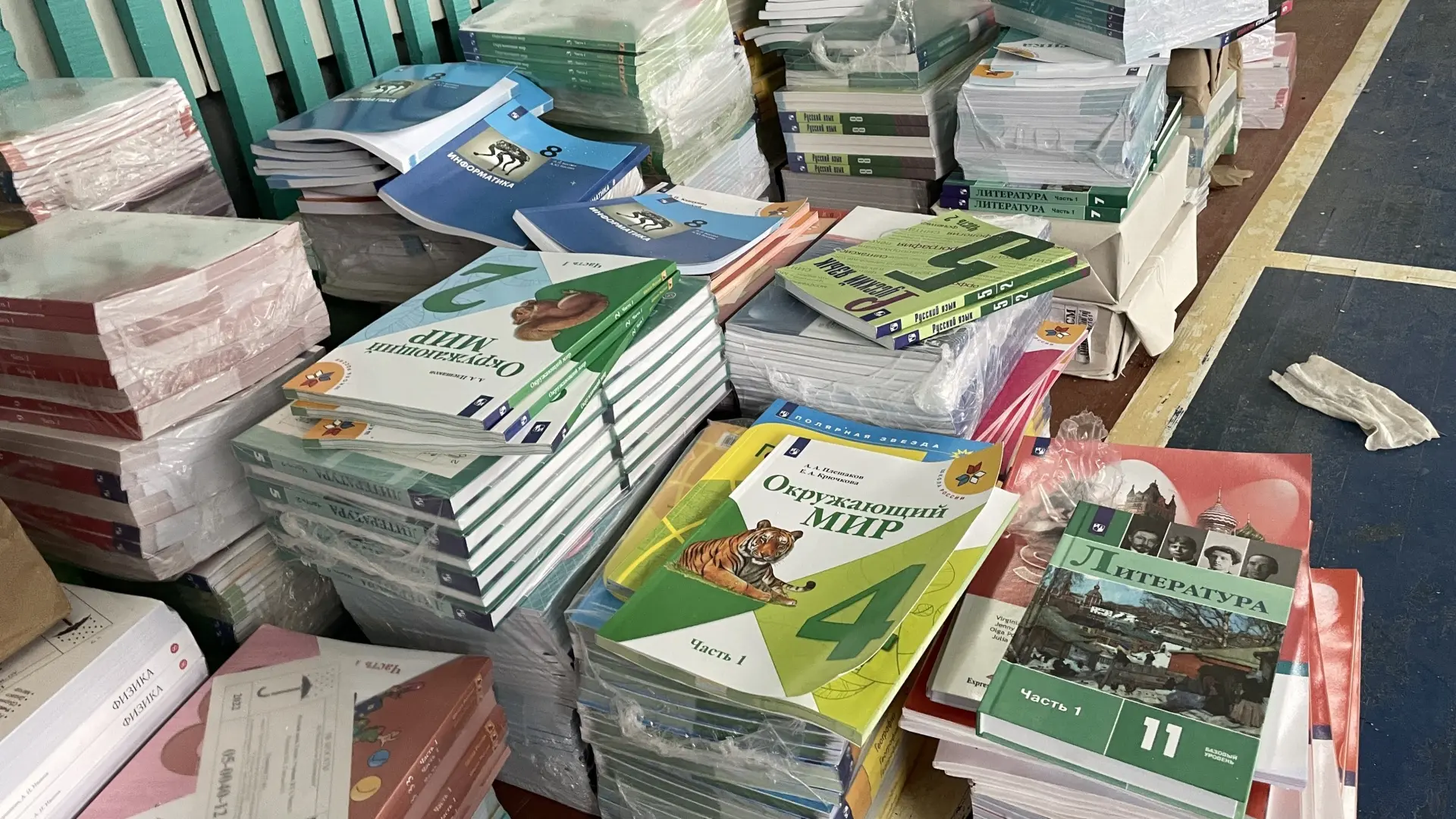
According to available data, before the start of the school year in September 2022, the Russian Ministry of Education sent 5 million Russian textbooks to Ukraine, and Russian regional authorities sent another 2.5 million. Teachers at several regular Ukrainian schools confirmed to Human Rights Watch that Russian textbooks were brought in during the occupation.
Teachers noted that in addition to introducing Russian textbooks, the occupying authorities also confiscated and destroyed school materials in the Ukrainian language.
In the village of Borova in Kharkiv Oblast, Russian authorities delivered Russian textbooks to schools for the planned start of the school year on September 1, 2022, and held an assembly for students on September 2. “They couldn’t distribute the textbooks because there was heavy shelling. Then the school year was postponed to October 1, and then hostilities began,” the teacher said, referring to the Ukrainian military’s counteroffensive. Before leaving with the Russian military, the occupying authorities “burned some of the Ukrainian textbooks and took others. “We’re distributing the remaining [Ukrainian textbooks] to our students and children from other villages,” the teacher said. When Human Rights Watch researchers visited the Borivska school in November 2022, teachers showed them stacks of Russian textbooks that were still there.
The textbooks, particularly those on social studies, were standard textbooks used in Russian schools from grades 1 through 11. A section in the middle school history textbook glorified the occupation of Crimea. Human Rights Watch also obtained copies of two documents stating that in the Balakliya district of Kharkiv region, a special commission of school staff collaborating with the occupying authorities had conducted an inventory and seized Ukrainian textbooks and other materials from the Yakovenkovka School and School No. 3 in Balakliya, the district center of Kharkiv Oblast.
Torture and Pressure on Teachers
At the same time, teachers described pressure, threats, arbitrary detentions, and torture by the occupying authorities aimed at forcing them to participate in or support the implementation of the Russian education system. Additionally, as of December 2023, the Office of the United Nations High Commissioner for Human Rights (OHCHR) had documented 13 cases in which Russian and occupation officials arbitrarily detained, tortured, or otherwise subjected to cruel treatment or threats of violence against Ukrainian school administrators and teachers who refused to teach under the Russian system. In one particularly egregious case, “a school principal in the Kherson region was arbitrarily detained twice (for a total of 40 days), during which time he was punched and kicked to force him to cooperate.” In several cases documented by Human Rights Watch, the occupying authorities deported teachers who refused to cooperate to territory controlled by Ukraine.
Attacks on civilians and their mistreatment violate the laws of war, and in cases such as torture, may constitute war crimes. The infliction of bodily harm and the abduction of teachers and education workers falls under one of the six serious violations of children’s rights in armed conflict identified by the UN—attacks on educational institutions.
Russian troops occupied the city of Izyum in mid-March 2022 and “carried out a sort of screening to get people to tell them who works as a teacher at the school,” recalls Tetyana, a math teacher and representative of the teachers’ union. The head of the occupation’s education department came to Tetyana’s home with soldiers: “If a man with an AK-47 comes to your home and asks you to come to the school, it’s hard [to refuse]. But I refused.”
Lyudmila, the deputy principal of the Borivska School, said that during the occupation in 2022, “officers from the [Federal Security Service] of Russia came to my home and [repeatedly] asked: ‘Why aren’t you coming to work for us? What are you waiting for?’” Representatives of the occupation administration warned that school employees who did not agree to work in a timely manner would be barred from holding positions in the education sector in the future. “They applied psychological pressure—you’ll lose your job, you won’t be able to work. They intimidated us,” says Lyudmila.
According to Galina, the director of a kindergarten in the village of Yakovenkove in the Balakliya district, the occupying authorities decided to reopen one kindergarten in the district and convert the kindergarten where she worked into a hospice for the elderly. In late July or early August 2022, armed representatives of the occupying authorities came to her home and ordered her to show them the kindergarten premises. Then, on August 18, “a ‘Niva’ [four-wheel-drive vehicle] was waiting for me.” The armed men, who “said they were from the People’s Militia [working for the occupying administration],” accused her of taking computers from the kindergarten. The day before, in order to be able to work from home, Galina had told her colleagues to take the computers home, and she had also hidden the students’ personal files. These men took her to their office, where another man pulled a bag over her head and drove her to (as she later learned) the FSB office that the Russian authorities had set up in the Balakliya District Police Department. She heard an officer say that she would be interrogated by a person with the military nickname “Tourist.” She was taken to the basement and held there along with the local school principal, who had been detained the day before, and a woman who worked at a local government agency.
The next day, representatives of the occupying authorities deported the three women, but first ordered them to record a compromising video because, as Galina explained, “they wanted to blackmail us. They didn’t release it, but they planned to use it if we appeared in the news [after leaving the occupied territory].” A Russian officer told them, “I’ll turn on the phone, and you must repeat what you hear” on camera, Galina recalls. “The woman on the phone said she hated Ukrainian security forces and loved the Russian Federation. All three of us were forced to repeat it. They recorded me four times because they didn’t like how I was saying it.”
Then Russian officials ordered the women to cross the front line into territory controlled by Ukraine. Galina’s husband picked her up in his car. The authorities allowed him to take their dog, but not his mother. The school principal was not allowed to take her husband with her. They were escorted to the Russian front lines, where an FSB officer told them: “You won’t be able to return. We’ll shoot you.” They drove five kilometers across the contact line on a road “littered with fallen trees and craters. It was very hot. I could smell dead bodies.” When they reached the first Ukrainian checkpoint, shelling began nearby. “I covered my ears with a scarf so it wouldn’t be so loud. We were speeding [driving very fast] to the next [Ukrainian] checkpoint,” Galina said. She returned home after Balakliya was liberated by Ukrainian troops. Her husband’s mother survived.
According to media reports, a teacher from the village of Ivanivka, 100 km north of Balakliya, Lidiia Tilna, was held in custody for 19 days during the 2022 occupation and tortured by Russian investigators for refusing to establish a school under the occupying authorities. The director of a civil society organization recounted an incident involving an acquaintance of hers, a teacher in the Kherson region: “His son was abducted [in the summer of 2022] and threatened that if he wanted to see him again, he would have to cooperate with Russia.” When the minor was returned, the family was able to leave for territory controlled by Ukraine.
Before the start of the school year in September 2022, the occupying “mayor” of Balakliya sent his car to Inna Mandryka, the acting principal of School No. 5, to bring her to his office. He told her: “You will be the principal.” I said, “No,” and he replied, “You don’t know me well. You will be the principal.” She refused. A teacher from Shevchenkove, who later left for territory controlled by Ukraine, recounted: “Men came to my home and ordered me to report to their director. He said that if I didn’t agree to start working in the school year, I’d be sent to the ‘basement’ for two days.” A physical education teacher from the village of Vasylenkove recounted that armed representatives of the occupying authorities “came to my home, put a gun on the table, and said, ‘Friend, why didn’t you tell us that your wife is the school principal?’” He replied that his wife had gone to Kharkiv. Eventually, they both managed to leave.
Vitaliy Chernov, the school principal in the village of Borivske, described how Russian security forces tortured him for refusing to hand over information about the school. Chernov told Human Rights Watch that he had hidden the computers and school documents, but on September 2, 2022—"on my wedding anniversary," as he recalled—he saw "six men in balaclavas shoving my son into the apartment." They ordered Chernov to hand over “all school documents,” confiscated his laptop and other devices, and took him to Kupiansk, where they held him for three days in a small open-air courtyard at the local pretrial detention center. On the third day, he was taken inside, where an FSB officer attached electric clamps to Chernov’s little fingers and administered electric shocks to him for 30 minutes—as he later learned, this method of torture is called “the telephone.” Chernov recounted:
He repeatedly asked about the missing documents from the school, and I replied that I didn’t know what had happened. Then he said that if I wanted to go home, I had to give them “some meaningful information”—if not about the documents, then about people from Borivskyi who served in the Ukrainian army, spoke ill of Russia, or hid weapons. I said I wasn’t very sociable, that I rarely left the house... “Do you have anything to tell us?” His voice was irritated, and that was when I was shocked with electricity for the first time.
Before ordering the guards to take Chernov away, the investigator threatened: “If you don’t talk, we’ll keep doing this until the end of the special operation.” The guards transferred Chernov to an overcrowded cell inside the building. According to Chernov, he spent the night there and three more days, and on the second day of his detention in that cell, he was tortured again. Fleeing shelling during the Ukrainian counteroffensive, Russian prison guards left the detainees locked in their cells. Men from one cell managed to climb out through a window and help Chernov and others escape.
Punishment for participating in distance learning at a Ukrainian school in the occupied territories
Russian authorities and their allies are persecuting teachers for participating in Ukrainian distance learning programs and subjecting them to repression. Despite this, at the start of the 2023–24 school year, approximately 80,000 Ukrainian children in Russian-occupied territories exercised their right to receive an education through the Ukrainian curriculum online, exposing themselves to the risk of persecution by the occupying authorities against them and their families.According to Alina, an English teacher from Rubizhne in the Luhansk region, the occupying authorities require Ukrainian children to attend school in person and warn parents that their children must not study remotely in Ukrainian schools. According to a representative of the humanitarian education sector, in one instance, a student from Zaporizhzhia Oblast wrote to his Ukrainian language teacher that the occupying authorities “found out that I am studying [under the Ukrainian curriculum online] and took my father away, so I have to stop studying.” “They are going door to door to make sure that children are studying in Russian schools,” the official said. The UN stated that Russian authorities detained a teacher in Zaporizhzhia for two days for teaching the Ukrainian curriculum online, threatened to torture her and harm her father, pressured her to sign a pledge not to engage in teaching activities, and stated that after her release they would monitor all her electronic devices.
In Mariupol, the occupying authorities “are checking to ensure that every child attends school and does not attend a Ukrainian school online. Homeschooling is prohibited. “They check to see if your child is attending a Ukrainian online school on the weekends. If so, you may be stripped of your parental rights,” says Yaroslava Mozgova, head of a civic organization for online education.
She explained that in Melitopol, the occupying authorities detained a teacher for participating in a Ukrainian online program for school administrators. If a child does not attend a Russian school in Melitopol, her family faces a fine of 40,000 rubles (US$402) “or they are threatened with having their children taken away,” said Anna But, a teacher at a vocational school who managed to leave Melitopol. According to But’s acquaintances in Melitopol, the occupying authorities “are going around schools, forcing students to delete their accounts on websites where videos from [the Ukrainian school] and homework assignments are posted.” Some officials forced them to write statements with the following content: “I have left the Ukrainian school and will attend a Russian one.”
An acquaintance of But’s, a first-grade teacher, was interrogated by the occupying authorities “for teaching the Ukrainian curriculum online.” She said that after the interrogation, officials confiscated the teacher’s computer and phone. But also knows two families whose children attended online Ukrainian language classes but were afraid of being exposed. One of these two families “did not go outside with their school-age daughter for eight months because they were very afraid of checkpoints, where [the occupying authorities] could force the child to attend a Russian school or search her phone and find messages about the [Ukrainian] school.”
Despite significant risks, Ukrainian educators continued to work in the occupied territories. In the summer of 2022, Inna, the deputy principal of a school in the then-occupied Balakliya, secretly worked in her basement on the school’s lesson plans, which were necessary for the start of the school year and could be used for distance learning. She downloaded the plans to her phone to send them to the school principal, who was in territory controlled by Ukraine. At that time, there was no signal in her neighborhood, “Lagerya,” on the outskirts of Balakliya. She says she rode her bike through Russian checkpoints to the city center, where she could go up to the top floor of a nine-story building and get a cell signal.
The Russians at the checkpoints were checking everyone. My documents were on my phone, so I had to hide it in my underwear. They searched me. If they had found it, they would have taken me “to the basement.” I managed to send the documents to the principal, and the school started the new academic year.
In the occupied territories, it may not be possible to study under the Ukrainian educational program, even if Ukrainian teachers are willing to risk their lives to teach it, and children have devices and internet access. For example, the Russian occupation authorities in Mariupol have blocked access to Ukrainian online education platforms. This was reported by a teacher whose former students are still there.
A Ukrainian teacher who fled the occupied area of Zaporizhzhia Oblast and continues to conduct online lessons for children told a news outlet in an interview that her students have to hide from the occupying authorities. According to the teacher, one student barely left the house for six months, while another boy went out every day with a backpack, as if he were going to a Russian school, but in reality he was going to a relative’s house to study the Ukrainian curriculum online. A fifth-grade student required psychological help due to a “nervous breakdown” in the second semester of the 2022–23 school year after a Russian teacher discovered that he was studying under the Ukrainian curriculum online and reported this to the occupying police.
Pressure on parents of schoolchildren
The occupying authorities imposed fines on parents who did not send their children to Russian-controlled schools, even if their children were attending Ukrainian schools remotely—which is prohibited in any case. According to teachers, in Balakliya, the occupying authorities established district “street committees” (ulichkomi) and appointed representatives to act as intermediaries between residents and the authorities. These committees were tasked with informing parents about the consequences for families who did not send their children to a “Russian school.” “In some cases, they went to every home and said that either you submit documents to the school, or we will take your children to [the Russian city of] Belgorod [for schooling],” the teacher said. “They spread rumors to intimidate people.”An education expert from the Ukrainian non-governmental human rights organization ZMINA learned of five cases that occurred in Berdyansk, Zaporizhzhia Oblast, where the occupying authorities imposed fines on parents whose children did not attend school, even though they were studying at home. In October 2022, the occupying authorities detained a man from a village near Nova Kakhovka in the Kherson region because he did not send his daughter to a Russian school, according to Amnesty International. According to the report, he was held in custody for six days, and he said that “they beat me only one day.”
According to Anna But, a teacher at the Melitopol Professional Agricultural Lyceum who managed to leave Melitopol and continues to stay in touch with her former colleagues, “one [former colleague] received a text message: ‘If you don’t send your children [to school], we’ll force you to join the Russian army.’
Olga, a teacher from Shevchenkove, recalls that the occupying authorities offered parents of school-age children free school backpacks, as well as one-time payments of 10,000 rubles (US$100) for enrolling their children in school, but also threatened them. Some parents told her that the de facto authorities warned them: “If you don’t send your children to school, they will be sent to an orphanage.” A teacher from the occupied region of Zaporizhzhia Oblast told a Ukrainian news site that the occupying authorities offered to pay 4,000 rubles (US$44) monthly to families whose children attended Russian schools, while students who were studying remotely at home under the Ukrainian curriculum feared they would be reported to the occupiers.
Ukrainian parents continue to face pressure from the occupying authorities regarding their children’s education. According to available data, for example, in occupied Tokmak, parents were forced at the beginning of the 2023 school year to “demand” that their children be allowed to attend Russian schools. The UN also reported cases in the Zaporizhzhia and Kherson regions where Russian authorities threatened parents that they would take their children away if they did not attend Russian schools, as well as instances of Russian security forces inspecting mobile phones for the presence of Ukrainian onlineeducation.
Interrupted Education During the Occupation
During the 2022–23 school year, many children living under Russian occupation received little or no education under the Russian curriculum, even though Russian authorities had banned schooling in Ukrainian schools. According to a teacher who fled to Western Ukraine, in Melitopol—where there were five vocational schools before the occupation—Russian authorities established a single vocational school based on School No. 16.Only two of the 70 teachers at her former school agreed to work under the occupying authorities, “so by the end of 2022, physical education teachers were teaching five subjects.”In Shevchenkove, prior to the full-scale invasion, 1,600 students attended 11 schools, but according to documents left behind after the Russian troops’ retreat in September 2022, only 60 children were enrolled in the “Russian” schools, and even then, according to local teachers, there was a shortage of staff to conduct classes. “They opened the school to the Russian national anthem on September 1, but it was just a show, [to] create the appearance that something was functioning there,” the teacher said.
According to Alina, an English teacher who moved to Kyiv, in Rubizhne, Luhansk Oblast, the Russian occupation authorities opened only one of 11 schools during the 2022–2023 school year. She said that the school had no water, electricity, or internet, and classes were held only once a week. Alina and her colleagues saw a video on social media in which the newly appointed school principal praises the Russian authorities:
In one video, Russian soldiers are carrying desks and chairs into the school, and she says, “Thank God, they brought us furniture!” We were so upset when we saw that. We [at the school, before] had laptops, furniture, everything. Now all that’s left are broken windows, and you’re happy about a few desks?
According to estimates by Ukrainian experts, as of April 2023, there were one million Ukrainian school-age children in Russian-occupied territories. A significantly smaller number of them registered for the 2022–2023 school year: according to Russia’s claims, 160,000 in the so-called “DPR,” 105,000 in the so-called “LPR,” 18,000 in the then-occupied territory of the Kherson region, and 16,000 in the then-occupied territory of the Kharkiv region. Even these figures may have been exaggerated, as Russian officials clearly sought to project an image of a rapid, large-scale, and successful takeover of the education sector in the recently occupied Ukrainian territories. On August 5, 2022, the occupying authorities in the Kherson region stated that 645 teachers had “volunteered to work” and would be teaching 10,740 students. By September 1, Russian media and occupation officials claimed that 800 teachers had already been recertified to teach under the Russian curriculum and that 18,000 students had started the school year.
Ukrainian authorities, who plan to restore education in the formerly occupied territories, may need programs to assess knowledge and conduct lessons tailored not only for children who studied under the Russian curriculum but also for those who had no opportunity to study at all during the occupation.
II. Collaboration in the Field of Education
Human Rights Watch is concerned that the Ukrainian authorities’ efforts to punish collaborators in the education sector do not always comply with international law.
Screening and Prosecution of Education Workers in Ukraine
In early March 2022, Ukraine introduced criminal liability for collaboration during wartime by adopting amendments to the Criminal Code. The amendments prohibit actions “aimed at introducing the educational standards of the aggressor state in educational institutions,” as well as “propaganda in educational institutions [...] with the aim of facilitating armed aggression against Ukraine, establishing and consolidating temporary occupation..., [or] evading responsibility for the aggressor state’s armed aggression against Ukraine.” This is punishable by community service for a term of two to three years’ imprisonment and the deprivation of the right to hold certain positions or engage in certain activities for a term of ten to fifteen years.According to data provided to Human Rights Watch by the UN Human Rights Monitoring Mission in Ukraine, as of March 15, 2024, Ukrainian courts had handed down 1,168 convictions in criminal cases on charges of “collaboration” under Article 111-1 of the Criminal Code of Ukraine. Of this number, convictions were handed down to 35 school principals or their deputies, university administrators, and employees of “education departments” in the occupied territory for “implementing the educational standards of the Russian Federation” or “propaganda in educational institutions.” In nearly half of these cases, the defendants were convicted in absentia. All were barred from holding certain positions, and most were sentenced to prison terms ranging from 1 to 10 years.
The director of the Kharkiv Regional Department of Science and Education told Human Rights Watch that, according to a directive from the Ministry of Education and Science—which is not publicly available—the law applies to employees of educational institutions in three cases: “if they began teaching according to the Russian curriculum, if they participated in training courses on Russian territory or in any educational events organized by Russians, or if they signed a cooperation agreement with the occupying authorities.”
However, a letter sent by the Ministry of Education and Science to the heads of educational institutions and district and regional administrations in September 2022, which Human Rights Watch has in its possession, outlines a broader and harsher approach. The letter warns education workers that “betrayal of one’s own state and collaboration with the occupiers are criminal offenses and carry severe penalties.” The letter emphasizes that working in any administrative, teaching, or research position under the occupying authorities is “categorically unacceptable.” Although “the scale and consequences of such behavior” will be considered by the court when determining the sentence in each specific case, the letter states that “the evident nature of the crime leaves no doubt” regarding these actions.
The letter specifies that the following, in particular, should be considered “collaboration”: “participation in the educational process at so-called educational institutions under the control of the occupying authorities” and “the implementation of the aggressor state’s educational standards.” It states that accusations of such actions must be supported by specific facts documented through the results of an official investigation. The letter refers to the Methodological Recommendations of the National Agency for the Prevention of Corruption regarding the identification of cases of collaboration. However, in the methodological recommendations reviewed by Human Rights Watch, collaboration is treated as a general offense without defining specific criteria for what actions would constitute a crime.
Ukrainian law enforcement agencies also take a broad approach to defining the concept of “collaboration” and holding individuals accountable for it, particularly teachers and professors suspected of justifying Russian aggression or spreading pro-Russian propaganda among students. According to information received from an employee in the field of humanities education in Zhytomyr, there was “one case where a teacher was prosecuted for collaborationism for ‘spreading Russian narratives.’” In several cases, courts took into account the remorse of individuals who admitted their guilt and barred them from holding public office for 10 or 13 years, but did not sentence them to imprisonment.
Between May 2022 and August 2023, Human Rights Watch counted 293 criminal cases under this law, of which only 9 were brought against education workers. They received sentences ranging from fines to five years in prison. In all recorded cases, they were barred from working in the education sector for a period of 10 to 15 years. All those convicted were heads or deputy heads of educational institutions or worked in education departments under the occupying authorities. The charges included “organizing the educational process under occupation,” “implementing the Russian curriculum,” and “spreading pro-Russian propaganda.”
For example, in one case, a teacher was sentenced to a fine, three years’ imprisonment, and a 15-year ban on working in the education sector for having served as the director of a lyceum on a part-time basis. The court acknowledged that she had not been forced to take this position, but failed to provide substantiated grounds to refute her statements in court that she felt threatened by Russian military personnel and believed she had no choice but to take the position to protect the children. In only three of the nine cases were the defendants present in the courtroom; two of them pleaded guilty in order to receive a lighter sentence; four other cases were heard in absentia, and two via videoconference.
Ukrainian civil society organizations expressed concern regarding double jeopardy (being prosecuted a second time for the same crime), disproportionate punishments, as well as punishments for actions that do not constitute support for Russia’s armed aggression against Ukraine. The Ukrainian Education Ombudsman told Human Rights Watch that the law should make a clearer distinction between “when people do this voluntarily and when they do so under pressure.” His office “has received many questions from teachers” regarding the legislation on collaboration. He noted that “I can only advise them to gather evidence that they may have been subjected to pressure by the occupiers.”
The previous section discussed how, in some cases, the occupying authorities used threats and violence to force educators to work in schools. Some teachers also worked under occupation to provide themselves with basic necessities. A teacher at a vocational school in Izyum recounts:
For two months [March and April 2022], we had absolutely nothing. People were dying while gardening in their yards to grow some food. My neighbor was killed by a cluster bomb. There was no bread. We collected rainwater to wash ourselves. I think the Russians did this on purpose to force people to go out and work to get food. In the second half of May, they started giving us food in exchange for cleaning [the school], but with very long delays.
Teachers from the Kharkiv and Luhansk regions reported that Russian authorities distributed humanitarian aid—a cup of rice, a cup of flour, canned tuna, and canned meat—in exchange for cleaning schools that the military used as barracks, as well as for moving the bodies of the dead and digging graves.
The law on combating collaborationism also fails to distinguish between teachers who agreed to teach subjects such as “physics and mathematics,” which “have no ideological component,” unlike “history taught in the Russian style,” noted the Ukrainian education ombudsman. He is aware of false accusations of collaboration that “violate [teachers’] rights.”
The head of the Kharkiv Regional Teachers’ Union said she believes that “teachers who had no other choice, who were held at gunpoint, will not face any problems.” The rector of Mariupol State University, who has left the city, also believes that only those teachers “who voluntarily sided with the occupying authorities and facilitated the implementation of the Russian education system” will be targeted.
However, employees of a vocational school in the Kharkiv region reported that their colleague, who “did nothing against Ukraine,” but who cooperated with the occupying authorities for pragmatic reasons, was detained for three weeks for “screening” when Ukraine liberated those territories. When their district came under occupation, the staff elected this colleague as acting director “so that he could represent us in dealings with the occupying authorities, prevent looting, and oversee the process so that we could receive humanitarian aid.” The Russian authorities sent him to Belgorod in Russia, where he was “taken to various vocational schools and provided with training materials,” which, according to staff members, were never used. Teachers from Borova reported that six educators agreed in writing to work with the occupying authorities. They also underwent SBU vetting and were subsequently released from custody.
Screening is a mandatory reliability check, the use of which is strictly limited as an exceptional last resort in accordance with international law. The laws of war do not explicitly address collaboration during wartime, but they require the occupying authorities to facilitate the proper functioning of institutions responsible for children’s education in cooperation with state and local authorities. The norms of international law regarding occupation prohibit occupying authorities from resorting to coercive measures against civilians who are not citizens of their country, thereby preventing attempts by the occupiers to do so. Ukrainian authorities must not punish teachers in the occupied territories merely for teaching children under the Russian curriculum and must ensure the implementation of policies, measures, and laws regarding cooperation, screening procedures, and administrative penalties in accordance with Ukraine’s obligations regarding due process and fair trial under international human rights law.
Charges of collaboration should be brought only against those individuals for whom there is evidence of incriminating acts indicating intentional cooperation that threatens Ukraine’s security. Authorities should review the broad definition of collaboration in legislation and the corresponding statutory penalties to ensure compliance with necessary human rights safeguards and due process.
Administrative measures taken by Ukrainian education officials
Ukrainian education officials have taken administrative measures against individuals suspected of collaboration within their lawful authority to make decisions regarding personnel policy and dismissals, as well as to dismiss teachers for serious violations of ethical standards. A September 2022 letter from the Ministry of Education states that anyany education worker “who has tarnished themselves through collaboration must be immediately dismissed” for “committing an immoral offense” in accordance with Article 41 of the Labor Code. The letter does not raise the issue of coercion. In fact, it asserts that teachers who collaborated [with the occupying authorities] must be dismissed, even if they managed to “simultaneously fulfill their duties in providing distance learning to Ukrainian students.” The letter notes that while courts will determine the severity of criminal punishment, “the evident nature of the crime is beyond doubt.”The principal of the school in Borivskyi said he knows of only one teacher—a former student of the school—who agreed to teach under the occupation. According to him, the SBU closed the case against her “because she didn’t sign anything,” but the teacher resigned voluntarily after the Ministry of Education and Science notified her of her dismissal.
Education officials are also vetting teachers who have returned to work in de-occupied territories before paying them their salaries, “so some teachers will receive back pay, while others will not,” said the head of the teachers’ union. According to Yulia, a school principal from Vasilenkove, her staff received their July 2022 salaries in November 2022 because “they said they were checking the lists for collaborators.” Oleksiy Litvinov, director of the Department of Science and Education of the Kharkiv Regional Administration, called this process “complex and bureaucratic, but necessary to exclude collaborators.”
The verification process begins with each school principal sending a list of their school’s employees who are to receive salaries to the district administration, which then checks whether any of them appear on the lists of collaborators compiled by the authorities. This first stage can be delayed due to staff shortages in local administrations following liberation from occupation. The district then sends the verified list to the regional administration, which requires the head of the regional education department to verify it once more. “We check the lists twice a day,” said Oleksiy Litvinov. “But there’s no electricity, and we have to send the list via the internet.” Finally, the regional administration sends the list to state financial institutions, which transfer the funds.
Any administrative penalties that Ukraine imposes on teachers who worked for the occupying authorities must comply with the principles of legality, necessity, non-discrimination, and proportionality, as well as the standards of fair trial and effective legal remedies. As stated by the UN Committee of Experts, which monitors states’ compliance with the International Covenant on Civil and Political Rights, the Covenant’s prohibition on “anypropaganda for war and any incitement to national, racial, or religious hatred that constitutes incitement to discrimination, hostility, or violence ... [in no way contradicts] the right to freedom of expression, ... the exercise of which imposes special duties and responsibilities.” In any case, Ukraine has deviated from compliance with the standards of international law regarding freedom of expression and other norms, citing Russian aggression as justification.
It should be noted that the choice to apply wartime repressive measures against teachers in the form of dismissal instead of a fine, or requiring them to apologize or promise that the situation will not recur once the territory returns to Ukrainian control, must be assessed for necessity and proportionality. Ukraine must also ensure consistency in measures aimed at ensuring that the withholding of salaries from teachers accused of collaboration is consistent with other policies regarding salary payments when teachers are suspected of disciplinary violations. Such measures must also be assessed for necessity and proportionality in terms of the number of teachers who may be affected by the delay in salary payments, and the affected party must have the opportunity to defend themselves and challenge such actions.
III. Measures Taken by Ukraine to Ensure the Continuation of Education Following the Start of the Full-Scale Invasion
Among the positive examples of innovations aimed at improving access to education in Ukraine, the Ministry of Education and Science, in collaboration with civil society, facilitated the implementation of online learning with digital textbooks for children whose schools were closed for safety reasons — particularly if staff and students did not have enough time to reach bomb shelters during air raid alerts — as well as for children living on the other side of the front line and in occupied territories. In the Lviv region, the ministry established a school offering exclusively distance learning; according to a humanitarian education expert, at least 450 of the 1,000 students are internally displaced persons from occupied territories.
During the COVID-19 pandemic, the civic initiative “Osvitoria Hub,” in collaboration with the Ministry of Education and Science, developed an unofficial distance learning module called “All-Ukrainian Online School.” According to the director, the platform has proven its effectiveness even during the war—it contains over 10,000 video lessons for grades 5–11. At the time of this report, the platform for grades 1–4 is under development. UNESCO has distributed 50,000 Chromebook computers to educators across the country. Students across Ukraine received 10,000 tablets and laptops, with another 10,000 devices to be provided in 2023 to the de-occupied territories of the Kherson and Kharkiv regions by the Republic of Korea and the EU.
The Ministry of Education and Science of Ukraine noted that one of the goals of distance learning is “to ensure adequate conditions for education in territories not controlled by Ukraine.” According to data obtained by Human Rights Watch from the Ministry of Education and Science of Ukraine, 62,436 children in the occupied territories continue to study remotely in Ukrainian general education schools. However, providing children in the occupied territories with access to online education remains a particularly difficult task, as Russian authorities and their allies shut down all foreign telecommunications providers in these territories following the occupation.
Russian occupation authorities in Mariupol have blocked access to Ukrainian online learning platforms. This was reported by a teacher whose former students still remain there. As a result, local residents had no choice but to purchase SIM cards from Russia or the so-called “DPR,” which do not provide access to Ukrainian websites. As Stas Prybytko, head of the mobile broadband development department at Ukraine’s Ministry of Digital Transformation, said in an interview with The New York Times in August 2022, “the first thing the occupiers do when they enter Ukrainian territory is shut down the networks.” Instead of studying online through the Ukrainian curriculum, children in the occupied territories are mostly only able to receive and submit assignments to teachers via the Viber or Telegram messaging apps, which are accessed through Russian providers or the “Phoenix” provider from the “DPR.”
To ensure that internally displaced children have access to education, the Ministry has simplified the enrollment procedure for educational institutions and introduced a flexible schedule for issuing final grades, including the option of “pass/fail” grading. The Ministry also simplified university entrance exams and conducted them online over the course of several days. A total of 187,000 applicants from Ukraine and Ukrainian refugees residing in Europe took part. A teacher from Izyum said that her 11th-grade students are now “in Ireland, Israel, Germany, the Netherlands, and Canada, and they took the test.” In Melitopol, a woman managed to smuggle diplomas printed in Zaporizhzhia into the occupied territory for graduates who completed their studies under the Ukrainian curriculum. The school in Shevchenkove completed the academic year under the Ukrainian curriculum through distance learning, and students who evacuated to territory controlled by Ukraine received their diplomas.
According to Ukrainian law, citizens from Russian-occupied territory have the right to receive an education in other regions of Ukraine at public expense, with dormitory housing provided. Before fleeing, the occupation administration of the Kharkiv region destroyed student records at some schools, but teachers say that students who left without identification cards or school documents managed to enroll in schools in territory controlled by Ukraine. A positive step is the law passed by the Verkhovna Rada of Ukraine and signed by the President in 2023, which came into effect on March 24, 2024, allowing for the assessment and certification of the level of education obtained under the occupying authorities after 2014.
Ukrainian civil society and education officials have expressed concern about filling the gaps in the education of children who attended schools in Russian-occupied territories. The director of the Kharkiv Regional Department of Education described the measures being taken in the region to reintegrate students from de-occupied territories into schools, particularly children who received Russian diplomas or began studying under the Russian curriculum. Following Ukraine’s counteroffensive, education workers “visited every home with children and collected the phone numbers of family members to help enroll the children in functioning schools,” he said. In addition, applicants from de-occupied territories “have been added to the categories of applicants eligible for admission benefits to higher education institutions—they are exempt from certain entrance exams and receive an additional 50 points” when submitting their applications.
A Ukrainian civil society expert on education noted that Ukraine must continue its efforts in this direction, by introducing additional classes or programs to support children who studied under the Russian educational curriculum, in order to give them the opportunity to “bridge the gap between the [Russian and Ukrainian] curricula.”
The Ukrainian Education Ombudsman noted that the Ukrainian and Russian curricula for mathematics and the natural sciences are very similar; the only areas of concern are Ukrainian language, literature, history, and social studies. “We are helping children who are returning [from the occupied territories or who have experienced the occupation]. Each school develops its own program to help them catch up on what they’ve missed,” he said.
Challenges of Distance Learning
In August 2023, the UN reported that one-third of schoolchildren in Ukraine attend school in person, one-third receive education in a blended format (in-person and remote), and one-third study online. In the blended, or hybrid, model, children attend school in person every other week, provided the school has a bomb shelter. Decisions to suspend in-person learning are made at the regional level. According to the director of the Kharkiv Regional Department of Education, on August 15, 2022, the Regional Defense Council decided to switch all educational institutions to remote learning:We cannot ensure the evacuation of children to shelters. A missile from Belgorod takes less than a minute to reach us, and an artillery shell even faster. It is irresponsible to send children to in-person classes. [...] But, of course, teachers depend on internet access, which is a problem in all de-occupied territories. Moreover, the enemy is shelling critical infrastructure, including power plants and substations.
The Kharkiv region accounted for 17% of all damage to telecommunications networks in Ukraine during the first year of the full-scale invasion. According to the head of the Kupiansk District Military Administration, more than a month after de-occupation, only one part of the district had internet connectivity and the ability to conduct classes via distance learning. In August 2023, due to the resumption of Russian shelling, Ukraine evacuated residents of the city of Kupiansk, including 600 children.
As a result of Russian attacks on Ukraine’s energy infrastructure, electricity generation capacity across the country dropped from 37 to 19 gigawatts, and half of the high-voltage transformers in territory controlled by Ukraine were destroyed. According to a humanitarian education expert, in some de-occupied areas without adequate electricity and communication services, the only way to get an education is through “parents teaching their children at home.” According to a representative of the education department in Balakliya, in June 2022, Russian security forces forced internet providers to block access to Ukrainian websites. In the de-occupied town of Izyum, one school was teaching 700 students remotely, but due to constant power outages, it reduced lessons to 25 minutes per 3-hour shift.
After February 24, 2022, regular in-person classes were not held in schools in the Kharkiv region, but staff at some schools volunteered to provide time-limited “consultations” to students “to help them catch up on what they’ve missed,” said the head of one of the schools. “If the children can download [the lessons], they come to our school, and we explain [the lessons]. They come for a few hours twice a week. We come every day.” The director of the regional department of education opposed such voluntary initiatives to use school facilities for short periods due to serious safety concerns stemming from Russian attacks on educational institutions. However, such initiatives, if implemented with proper precautions, may be the best opportunity for a child to stay connected to school. Ukrainian authorities could work more closely with teachers to identify and facilitate the implementation of safe methods to supplement distance learning in private homes, according to one of the teachers. “We would go to people’s homes and teach classes if we could,” says the school principal.
“Often, families who have fled the occupied territories have no devices [for online learning] at all, and sometimes there is only one mobile phone for four children,” notes a representative from the field of humanitarian education. High school students may suffer particularly from the lack of devices. As a school security guard in Izyum, who has two school-age children, explained two months after de-occupation: “Teachers assign tasks, and we do everything we can to complete them at home. With our younger child, we can at least do something, but our older child needs a laptop. He can’t set up the virtual classroom on his phone.”
Barriers to distance learning for children with special needs
Displaced children with special needs can continue their education at their schools online. However, even in cases where children have devices and internet access is available in their area, distance learning may prove inaccessible to them. Teacher Anna explained that due to the invasion, classes at the inclusive education center where she works—and where 30 children with special needs are enrolled—have been suspended. For them, distance learning has proven completely ineffective. Parents have repeatedly appealed to Ukrainian authorities to reopen regular schools on an inclusive basis, but their requests were denied due to security concerns stemming from Russian attacks.There are 17 community support centers for children with special needs operating in Kharkiv, but as of November 2022, only one bus and three specialists were allocated for children with disabilities in remote communities. According to Anna, the consequences of the Russian invasion for the education of children with special needs were particularly severe, as very few of them managed to leave for regions where they could attend school. Of the 70 children with special needs in the district known to her, only seven were successfully evacuated or taken out of the occupied area, as “it was very difficult to transport children with autism or cerebral palsy.”
In order for displaced children with disabilities to be enrolled in a new school, their parents must provide a certificate of registration as internally displaced persons and undergo a “comprehensive psychological and pedagogical assessment of the child’s development.” At the same time, Ukrainian authorities are taking steps to improve access to education for children with special needs, specifically, removing limits on the number of children with “special educational needs” in an inclusive classroom or group, and prohibiting schools from refusing to organize inclusive education. With the support of the government, specifically the Ministry of Education, UNICEF and the Kyiv Children’s Center for Psychological Rehabilitation “Dzherelo” launched a project to support families with children with special needs, focusing on displaced children, although this program was not implemented in the Kharkiv region. As reported by the League of the Strong and the European Disability Forum in November 2023, newly established facilities for displaced children and local communities do not yet have sufficient resources to meet the needs of children with special needs. The report recommends urgently implementing “community-based services for children with special needs, particularly educational and psychological services,” as well as regularly monitoring children’s access to education, since distance learning does not meet the needs of many children with special needs.
Issues with the payment of salaries to displaced teachers
According to the head of the regional teachers’ union, approximately 15,000 teachers in the Kharkiv region did not receive their salaries during the occupation, which lasted more than six months. As a representative of the teachers’ union from Izyum explained, her Ukrainian employment record book states that “the employment contract is suspended for the duration of the occupation,” but in October 2022, her employment contract was reinstated. The Ukrainian Education Ombudsman reported that a large number of the 630 appeals he received from late February to early November 2022 from teachers in occupied and de-occupied territories concerned salaries, the processing of documents necessary for teaching, as well as future employment.Teachers who left for territory controlled by Ukraine received their salaries if they or their colleagues managed to flee the occupied territory with the necessary documents and re-register the school in Ukraine-controlled territory so that their schools could operate online under the Ukrainian curriculum, the teachers said. This is impossible if the school principal collaborates with the occupying authorities—one teacher said that for this reason, his former school “no longer exists.” Children who moved to territory controlled by Ukraine could attend classes at other schools while remaining enrolled in their former schools. As the principal of a school in Izyum—which was destroyed during the fighting—explained, all students were “transferred to other schools for online learning.”
In order for school teachers to receive their salaries, their schools must have access to documents and electronic data, including employment records, digital keys, and digital signatures. According to teachers, whether they received their salaries in the early days of the full-scale Russian invasion often depended on whether they had managed to evacuate these documents and equipment. In Balakliya, education workers left for territory controlled by Ukraine with “employment records, laptops, and equipment so they could resume the educational process,” said one official. But Alina, a teacher from the Luhansk region, said that she and her colleagues were not paid because they left “without documents, and the school’s accountants did not take the servers with them.”
Some teachers whose schools could not be reopened found jobs at other schools in territory controlled by Ukraine. Some said they needed to obtain “an IDP certificate as proof of relocation to territory controlled by the [Ukrainian] government,” which can be difficult for people who left without identification.
In April 2022, the Ministry of Education announced that teachers who had moved from the occupied territory to territory controlled by Ukraine and had not found work were to be paid two-thirds of their salary. However, due to the war, complications have arisen in Ukraine’s decentralized system of public administration regarding the payment of salaries to teachers who are from Ukraine’s occupied regions and have not transferred to work at another school in territory controlled by Ukraine. Teachers’ salaries must also be approved by local administrations, and Ukraine suspended the operations of many local administrations in the Kharkiv region while they were under Russian occupation. The work of these local administrations has resumed, but their heads must be approved by the President of Ukraine, which is a slow process, says a representative of the regional teachers’ union.
According to the Ukrainian education ombudsman, the third problem is that after martial law was imposed in Ukraine following the full-scale invasion, some local administrations attempted to cut costs forcing teachers to sign requests for unpaid leave and threatening dismissal if they refused, as well as in the fact that the contracts of principals and teachers were not renewed without any grounds for doing so. “This is a matter of awareness of one’s rights” under the Labor Code, he says. As a positive example, the ombudsman cites the city of Kherson, “where teachers were paid their full salaries [even during the occupation]; that was the position of the city’s education department.”
Mental Health and Psychosocial Support
According to UNESCO, by 2023, “26% of Ukrainian adolescents will be diagnosed with post-traumatic stress disorder. 75% of schoolchildren have experienced stress. 54% of Ukrainian teachers have experienced professional burnout.” According to UNICEF, from February 2022 to February 2024, children in frontline cities were forced to hide from shelling in basements, in subway stations, or in other bomb shelters for up to 5,000 hours during air raid alerts—a total of nearly seven months. The Ukrainian government’s plan for mental health preservation and the provision of psychosocial support to students and teachers notes that, prior to the full-scale invasion, 35% of schools lacked the staff to provide psychosocial support services.Teachers and students from territories occupied by Russian forces told Human Rights Watch about particularly horrific incidents and emphasized the need to significantly expand mental health and psychosocial support services.
Staff at a vocational school in Izyum said that a student named Liza and seven members of her family were killed in a Russian airstrike. What remained of them was buried together “in a bag, in a mass grave.” A teacher reported that two of his students, along with “their entire family,” were killed in their home during shelling in Mariupol. The teacher had been hiding in his Lyceum No. 14, which had been shelled by Russian troops “from day one,” and then fled to School No. 12 until it was captured by Russian troops. “I think I’ve changed mentally; I think a part of me has died,” he said. In Izyum, 600 local residents, including 52 children, found shelter in a vocational school during freezing temperatures and heavy shelling, without electricity or water. Russian soldiers entered the building and took away three men, who were later found hanged in their homes. The occupation administration in Shevchenkove handed over the dormitories of the vocational school, where 10–15 students had been living, to house Russian soldiers. A teacher showed Human Rights Watch researchers a message from parents stating that soldiers were beating, shoving, or insulting their children.
The Ukrainian Education Ombudsman noted that, according to the requirements of the Ministry of Education and Science, every rural school with more than 300 students and every urban school with more than 700 students must have a psychologist. But during the war in late 2022, teachers and parents said that the need for mental health support far exceeded the available resources. A vocational school teacher in Izyum said that the local hospital was unable to provide psychosocial support. A mother from Izyum said that her 8-year-old son “gets scared every time a plane flies overhead, or even if something falls off the table,” but there is no psychological support available. Mental health support for children in the de-occupied communities of Kharkiv Oblast, which Human Rights Watch researchers visited in late 2022, was provided by only one mobile team from the organization “Doctors Without Borders.” As of May 2023, they had provided approximately 2,000 individual consultations in the Kharkiv region, although this figure includes the city of Kharkiv, which was not occupied. As of February 2024, the group had provided 26,000 consultations nationwide.
A mental health consultant in the education sector noted: “Teachers need to interact with colleagues in small groups in a safe space, as well as expert support from psychologists who are familiar with teachers’ needs.” The consultant emphasized the need for “proven, evidence-based methods for school psychologists.” According to the recommendations of the Ministry of Education and Science, “teachers are advised to start the workday with a ‘psychological moment,’ but [they] need to be taught how to do this,” said one of the teachers in 2022. By mid-2023, the Ministry of Education and Science of Ukraine had approved professional standards for school psychologists and was working on implementing a system to oversee their activities.
Ukrainian volunteer and government organizations are trying to fill this gap. In June 2022, a “humanitarian hub” opened at Mariupol State University, which had relocated to Kyiv, where, in addition to providing aid, free psychological counseling sessions are held. But the psychologist sees patients only three days every three weeks. “We’re compiling lists,” says the university’s rector.
Even at the start of the full-scale invasion, the Foundation of First Lady Olena Zelenska initiated a nationwide process to reform the mental health care system. In 2023, as part of the project, an assessment of existing practices was conducted, 4,500 school psychologists were surveyed, and training for 15,000 school psychologists across the country was planned. In March 2024, with the support of UNICEF in Ukraine, two centers were opened in the Kharkiv region to provide support and counseling to families on mental health issues.
IV. International Law, Education, and Occupation
Russia is systematically imposing its own education system in the occupied territories of Ukraine and banning Ukrainian education in the territories under its control, which violates both international and relevant domestic laws.The laws of armed conflict require the occupying power to ensure that children have the opportunity to receive an education and strictly limit its authority to make changes to curricula and the language of instruction. The occupying power must comply with “the laws in force in the country, except where this is absolutely impossible” and is obligated to restore and ensure public order and safety, as well as to uphold its human rights obligations toward the population of the occupied territory. Regarding education, the legal scholar notes that the occupying power may not “alter educational materials, curricula, syllabi, etc.,” except in cases where this is necessary to remove materials that promote hatred and intolerance.
One of the provisions of Ukraine’s 2017 Law “On Education” guarantees education in the Ukrainian language. Russia has limited the teaching of the Ukrainian language in the territories it occupies to a maximum of a few hours per week. On January 31, 2024, the International Court of Justice ruled that “Russia’s legislative and other practices... regarding school education in the Ukrainian language in Crimea” following the occupation of that territory in 2014, “constitutes an example of racial discrimination” under the Convention on the Elimination of All Forms of Racial Discrimination.
Ukraine’s Law on Education also guarantees instruction in the native language for students belonging to one of Ukraine’s “indigenous peoples,” such as the Crimean Tatars. In 2023, the Council of Europe reported that following the Russian occupation of the Crimean Peninsula in 2014, Crimean Tatar students have been unable to receive education in their native language, but only to study it as a subject or elective, with “insufficient accessibility, scope, and quality of education” in that language.
Russia’s international human rights obligation to ensure access to education that “fosters respect for … the child’s own cultural identity, language, and values” extends to the Ukrainian territory it occupies. Russia is also prohibited from depriving children of “the right … to use their native language.” UN experts have noted that children “achieve better academic results and stay in school longer” when taught in their native language. There is also evidence that early childhood education is most effective when conducted in the child’s native language, and that children who learn in their native language during their early years acquire better language and social skills.
According to the laws of armed conflict, “the occupying power, in cooperation with state and local authorities, must facilitate the proper functioning of all institutions involved in the care and education of children.” For example, the UN General Assembly condemned Israel’s closure of educational institutions and ban on Syrian textbooks in the occupied Golan Heights as a violation of the Geneva Conventions. The education of orphans and children separated from their families must be facilitated “under all circumstances” and, as far as possible, “entrusted to persons of the same cultural traditions.” The International Committee of the Red Cross explains that this rule was introduced to “prevent any religious or political propaganda aimed at removing children from their familiar environment, as this would cause additional suffering to those who are already struggling with the loss of their parents.”
As a signatory to the International Covenant on Economic, Social and Cultural Rights, Russia is obligated to respect “the freedom of parents … to choose for their children not only schools established by the state, but also other schools that provide religious and moral education for children in accordance with their own convictions.”
In Russian-controlled schools in the occupied territory of Ukraine, children undergo military training. However, under the conditions of occupation, the occupying power is “prohibited from any pressure or propaganda aimed at ensuring voluntary enlistment in military service” by the local population of the occupied territory.
As a State Party to the Convention on the Rights of the Child, Russia is obligated to ensure education aimed at “preparing the child for a conscious life in a free society in the spirit of understanding, peace, tolerance, equality between men and women, and friendship among all peoples, ethnic, national, and religious groups, as well as indigenous peoples.” The Committee on the Rights of the Child has determined that “educational programs [must] be implemented in such a way that they promote mutual understanding, peace, and tolerance, and help prevent violence and conflict,” particularly with regard to education in the field of international humanitarian law.
The International Covenant on Civil and Political Rights requires states to prohibit by law “any propaganda for war” and “anyany advocacy of national, racial, or religious hatred that constitutes incitement to discrimination, hostility, or violence.” In accordance with the Convention on the Elimination of All Forms of Racial Discrimination, Russia must not allow “national or local public authorities or public institutions to promote or incite racial discrimination,” including discrimination on the basis of nationality.
Acknowledgments
The report was prepared by Bill Van Esveld, deputy director of the Children’s Rights Division at Human Rights Watch, and Tanya Lokshina, deputy director of the Europe and Central Asia Division. Ksenia Kvitka, a junior researcher on Ukraine, assisted with field and desk research.The report was edited by Bid Sheppard, Deputy Director of the Children’s Rights Division; Rachel Denber, Deputy Director of the Europe and Central Asia Division; and Yulia Gorbunova, Senior Researcher in the Europe and Central Asia Division. Legal expertise and analysis: Senior Legal Advisor Eishling Reidy. From the Program Office: Deputy Director of the Program Management Department Tom Porteos. The report was also reviewed by Junior Researcher in the Rights of Persons with Disabilities Division Karolina Kozik and Deputy Director of the Crises, Conflicts, and Arms Division Belkis Wille. Desk research was assisted by Alexander Lokhmutov, Research Assistant in the Europe and Central Asia Division.
The report was prepared for publication by Ellen Blayer, Senior Staff Member in the Europe and Central Asia Division; Travis Carr, Senior Publications Coordinator; and Fitzroy Hepkins, Senior Administrator.
We would like to thank the Trade Union of Education and Science Workers of Ukraine and all the educators, human rights defenders, and others who met with us, shared their experiences, or provided information for this report.
This is an automatic translation generated by DeepL.