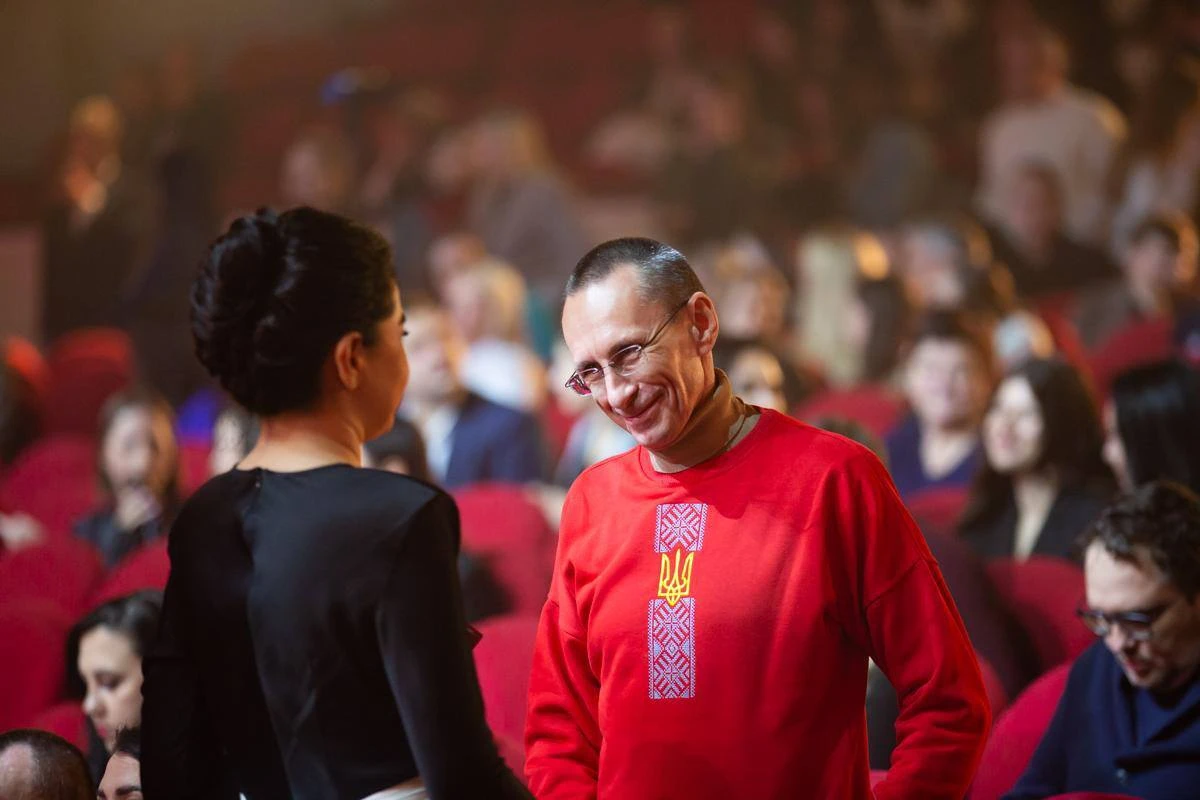
You can't give up territories hoping that it will be the end of the war - pediatrician and Kremlin prisoner Yuriy Shapovalov
Source: Ukrainska Pravda
Author: Yevhen Rudenko
What do you know about true resilience and unwavering faith?
Yuriy Shapovalov, a 61-year-old doctor from Donetsk and head of the local cactus club, faced the full-scale Russian invasion while in a maximum-security prison in Makiivka, in the occupied territory.
The TV told the inmates that the Russian army was finishing off what remained of Ukraine. This meant that Shapovalov, who had already been behind bars for four years, would have to spend nearly another 10 years there. But he never lost hope that Ukraine would hold out. He sensed that Kremlin propagandists were greatly exaggerating the Russian army’s successes.
Yuriy Shapovalov, a pediatric neurophysiologist with 25 years of experience, was arrested in 2018 on charges of espionage. Since 2014, he had been blogging on Twitter under the username “The Donetsk Left-Behind,” where he simply described what life was like in the city under occupation.
In August 2025, Yuriy’s belief that miracles are possible came true. After 7 years and 7 months in captivity, he was returned to Ukrainian-controlled territory as part of a prisoner exchange.
In November of this year, Yuriy Shapovalov was named a laureate of the “UP 100” award as one of Ukraine’s leaders in the “Society” category.
In an interview with UP, he spoke about how Donbas chose Ukraine’s independence and then succumbed to the “Russian Spring.” He also discussed whether it is worth ceding territory to the enemy for the sake of peace, and what freedom looks like after Russian captivity.
Below is a direct quote.
I am a fifth-generation native of Donetsk.
My great-great-grandfather was a contractor during the Yuziv era, a fairly wealthy man. He made a lot of money and built a huge house that stood until the Khrushchev era. His estate was in the village of Semenivka until it became part of Yuzivka and then a district of Donetsk, which was built up with “Khrushchevkas.” My great-great-grandfather had a son who, back in the Tsarist era, rose to the rank of non-commissioned officer. It so happened that in 1917 he defected to the Reds and held significant positions in the cavalry. He was killed in 1918 at Perekop (during the advance on Crimea by the units of UNR commander Bolbochan – Ed.). He had three sons, including my grandfather.
The house was not confiscated because the family had the status of a “Civil War hero’s family.” During World War II, my grandfather joined the air force and served as a navigator. He received medals for landing a downed, burning plane with wounded people on board. My father became a doctor, and I followed in his footsteps.
I was born in the Luhansk region, where my father was assigned to work after medical school. We lived there for two years, and then the family returned to Donetsk. Although my birth certificate states that I was born in the Stanitsa Luhanska district, I am still a native of Donetsk.
People ask me how I became a patriotic Ukrainian. I’m actually curious about that myself. I suppose it’s because I’ve always been interested in politics. I was never an activist or a representative of any party, but ever since my school days (smiles) I listened to “enemy radio stations” (“Voice of America,” “Radio Liberty”—UP).
During Perestroika, I went to miners’ strikes and rallies in Donetsk. I found it interesting. All the well-known activists of the time, the leaders of the former dissident movement, came to visit us: Chornovil. Lukyanenko, the Horyni brothers, Yukhnovsky. Yavorivsky. I think that’s what influenced the fact that in 1991, Donbas voted for Ukraine’s independence.
It was sad to watch in 2014 how, in one fell swoop, Ukraine somehow wrote off Donbas, slapping a label on it as a pro-Russian region.
I didn’t see any serious interest from prominent media figures or politicians in those pro-Ukrainian rallies that people were holding in Donetsk. Few dared to come. But Donetsk patriots continued to gather at the Shevchenko monument and Lenin Square, risking their lives. They organized a march down Artema Street.
I believe that interregional differences exist in any large country. They stem from certain differences in mentality. But what happened in Ukraine, in the Donbas, was artificially inflated by political strategists. Personally, right up until the events of 2014, I didn’t notice people wanting to merge with Russia.
Yes, there was some rivalry, some political confrontation with Kyiv or with the western regions. Nevertheless, I still believe (even if this is just my imagination, an exaggeration): the Russians deliberately stoked the situation. And this was part of an information and psychological operation that led to this “Russian Spring” and the war as a whole.
Even after the Orange Revolution, starting around 2007, various organizations like the “Donetsk Republic” began to emerge. With the help of the media, rumors, lies, the Russian Orthodox Church, and concerts by various performers, they stoked this local patriotism and the desire to oppose the central, Kyiv-based government.
But the vast majority of people weren’t that politicized; they were just living their lives. During political tensions, they didn’t have a clear stance of their own and ultimately supported the views of those who seemed stronger to them.
If we use the term “the masses,” who lack their own point of view, they always align themselves with whoever is stronger. It’s like training animals. Such a crowd is easier to control than individual, conscious people.
Of course, I am very saddened that many of my fellow countrymen went along with this betrayal—to put it bluntly. But I believe that most of them should be viewed as victims of a very powerful, targeted information and psychological operation that the Russians carried out after the Orange Revolution. It was difficult for someone who wasn’t interested in politics to navigate such a situation.
I consider those Russians who came to our land to be unquestionable enemies. I cannot paint all my fellow countrymen with the same brush. Each case must be treated individually.
I rarely have dreams, but when I do, I sometimes dream of my family home in a residential neighborhood in the Kirovsky district of Donetsk. With my plot of land and a collection of thousands of cacti.
Once, I was walking near the Covered Market and saw an unusual military vehicle on the street. I took a photo and posted it on Twitter. People got interested and started discussing what kind of vehicle it was. Then, a news site published a story linking to my page, stating that the latest Russian electronic warfare vehicle had been spotted in Donetsk—one that hadn’t even been officially adopted by the Russian military yet.
After that post, I started blogging in earnest. I wouldn’t say there was any secret, highly valuable information there. I didn’t infiltrate any classified military facilities. I simply shared what I saw and heard on the city streets.
Over three years of active use, my Twitter account accumulated hundreds of photos and thousands of posts about the sounds of various incoming projectiles and explosions. Well, an investigator from the MGB (the so-called “DPR Ministry of State Security”—UP) picked out about seventy tweets and wrote that I’d posted each one on orders from Ukraine’s special services (smiles).
The years I spent behind bars were an experience I never should have had. Before that, I lived a completely different life. Imprisonment is an experience that changed me. It made me stronger. But I wouldn’t wish on anyone to undergo such changes in this way.
At first, I was in “Izolyatsia.” It’s such an interesting place—before the occupation, it was a cultural space. But I’d never been there. In 2013, there was some kind of book festival there. I planned to go, studied the route, but then the trip fell through because of work. I never could have imagined that I’d finally end up there only when it had already become a prison.
The greatest loss for me during my years in prison was the loss of my mother, who didn’t live to see me. That was the hardest thing to go through, even harder than the torture and physical suffering.
At the beginning of my sentence, I had no contact with my mom for five months. But then, despite her advanced age, she heroically supported me. It was a time when, without that support and the care packages sent from the outside, it would have been impossible to survive.
My mother supported me when I was in the Donetsk pretrial detention center, and later when I was in the Makiivka penal colony. She passed away in 2023, when everything began to change—when the Russians had officially entered the region.
When a person isn’t deprived of their freedom, they don’t realize how important freedom is. But to truly understand this, it’s better not to end up in circumstances like mine.
Even before the occupation, I saw my own life as something routine. You wake up in the morning like some kind of bio-robot, go to work, come back. But actual deprivation of liberty is something that is truly very difficult to endure. Even if there is no torture, even if you are treated kindly.
When I was released, I was simply bewildered by ordinary, simple life. Everyone involved in prisoner exchanges takes this reaction into account. The first few days after we arrived in Chernihiv, we were kept in isolation at the hospital. We weren’t allowed to leave the premises.
And then, along with another doctor who had been held captive, we were brought to Kyiv. And when we stepped outside the hospital for the first time, it was something that’s hard to put into words. It felt like we had stepped into a different reality: people were dressed in all sorts of ways, coffee was sold at every corner, cars and public transportation were driving by.
I felt no irritation toward this whole world, toward all these people. I was just glad that someone could live like that. But I still can’t stop thinking about those who remain behind bars. There are people who ended up there before me—since 2017 and even 2015.
I still see their faces, the eyes that looked at me when we said goodbye. Among them are many true patriots who need to be rescued from there. During the full-scale invasion, the number of civilian prisoners rose not by the hundreds, but by the thousands. Russia is holding all of them completely illegally. On trumped-up charges.
Now all these peace plans are being discussed. But the prerequisite for any negotiations must be the release of all our people.
Hang in there
Why are the Russians like this? To be honest, I haven’t yet found an answer for myself as to where their inhuman attitude toward others comes from. Before I personally encountered this, I generally had a normal attitude toward Russians.
This war is abnormal in and of itself. But the way they behave during it is beyond comprehension.
I also find it completely incomprehensible when someone suggests that we could hand over the Donetsk and Luhansk regions to the enemy. I strongly oppose the idea that the people living there are mentally alien to us, or that we should just forget about this region.
You cannot give up territory in the hope that it will end the war. The Russians are aggressors who will take not just a finger, but a hand and a head if you give them just a finger. We have already seen that they perceive every action as a sign of weakness. This gives them even more free rein.
Until the very last moment, I didn’t expect there could be a massive invasion with missile strikes across the entire territory, accompanied by the deployment of regular troops. This is something abnormal. Some kind of anomaly we’ve encountered.
After the full-scale invasion began, when the front line hadn’t yet moved far from Donetsk, we sometimes managed to pick up Ukrainian news on the radio in the colony. With interference, but sometimes we could hear some other information besides Russian propaganda, which had long since “destroyed” Ukraine.
We realized that Ukraine was holding on, that Ukrainians were resisting. Our belief that the country would survive grew stronger.
In the first days after February 24 (2022 – UP), we watched Russian TV channels, and some people started to panic: “That’s it, this is the end.” But I didn’t give in to those feelings. It was clear even from their news reports that things weren’t going so well for them. They cited some fantastical figures for downed Ukrainian planes, in numbers we didn’t even have (smiles).
As long as Putin is in the Kremlin, it’s futile to hope for peace. The key to true peace lies precisely there. Once that regime is gone, perhaps something will change.
Be that as it may, we all need to believe that in the end, everything will turn out exactly as we wish.
A lot depends on our faith, desires, and actions in this world.
Of course, there is still much to endure and overcome. I have learned from my own experience that a miracle can happen at any moment.
The main thing is to hang in there.
Author: Yevhen Rudenko
What do you know about true resilience and unwavering faith?
Yuriy Shapovalov, a 61-year-old doctor from Donetsk and head of the local cactus club, faced the full-scale Russian invasion while in a maximum-security prison in Makiivka, in the occupied territory.
The TV told the inmates that the Russian army was finishing off what remained of Ukraine. This meant that Shapovalov, who had already been behind bars for four years, would have to spend nearly another 10 years there. But he never lost hope that Ukraine would hold out. He sensed that Kremlin propagandists were greatly exaggerating the Russian army’s successes.
Yuriy Shapovalov, a pediatric neurophysiologist with 25 years of experience, was arrested in 2018 on charges of espionage. Since 2014, he had been blogging on Twitter under the username “The Donetsk Left-Behind,” where he simply described what life was like in the city under occupation.
In August 2025, Yuriy’s belief that miracles are possible came true. After 7 years and 7 months in captivity, he was returned to Ukrainian-controlled territory as part of a prisoner exchange.
In November of this year, Yuriy Shapovalov was named a laureate of the “UP 100” award as one of Ukraine’s leaders in the “Society” category.
In an interview with UP, he spoke about how Donbas chose Ukraine’s independence and then succumbed to the “Russian Spring.” He also discussed whether it is worth ceding territory to the enemy for the sake of peace, and what freedom looks like after Russian captivity.
Below is a direct quote.
"I’ve always been interested in politics"
I am a fifth-generation native of Donetsk.
My great-great-grandfather was a contractor during the Yuziv era, a fairly wealthy man. He made a lot of money and built a huge house that stood until the Khrushchev era. His estate was in the village of Semenivka until it became part of Yuzivka and then a district of Donetsk, which was built up with “Khrushchevkas.” My great-great-grandfather had a son who, back in the Tsarist era, rose to the rank of non-commissioned officer. It so happened that in 1917 he defected to the Reds and held significant positions in the cavalry. He was killed in 1918 at Perekop (during the advance on Crimea by the units of UNR commander Bolbochan – Ed.). He had three sons, including my grandfather.
The house was not confiscated because the family had the status of a “Civil War hero’s family.” During World War II, my grandfather joined the air force and served as a navigator. He received medals for landing a downed, burning plane with wounded people on board. My father became a doctor, and I followed in his footsteps.
I was born in the Luhansk region, where my father was assigned to work after medical school. We lived there for two years, and then the family returned to Donetsk. Although my birth certificate states that I was born in the Stanitsa Luhanska district, I am still a native of Donetsk.
People ask me how I became a patriotic Ukrainian. I’m actually curious about that myself. I suppose it’s because I’ve always been interested in politics. I was never an activist or a representative of any party, but ever since my school days (smiles) I listened to “enemy radio stations” (“Voice of America,” “Radio Liberty”—UP).
During Perestroika, I went to miners’ strikes and rallies in Donetsk. I found it interesting. All the well-known activists of the time, the leaders of the former dissident movement, came to visit us: Chornovil. Lukyanenko, the Horyni brothers, Yukhnovsky. Yavorivsky. I think that’s what influenced the fact that in 1991, Donbas voted for Ukraine’s independence.
"They were just living their lives"
It was sad to watch in 2014 how, in one fell swoop, Ukraine somehow wrote off Donbas, slapping a label on it as a pro-Russian region.
I didn’t see any serious interest from prominent media figures or politicians in those pro-Ukrainian rallies that people were holding in Donetsk. Few dared to come. But Donetsk patriots continued to gather at the Shevchenko monument and Lenin Square, risking their lives. They organized a march down Artema Street.
I believe that interregional differences exist in any large country. They stem from certain differences in mentality. But what happened in Ukraine, in the Donbas, was artificially inflated by political strategists. Personally, right up until the events of 2014, I didn’t notice people wanting to merge with Russia.
Yes, there was some rivalry, some political confrontation with Kyiv or with the western regions. Nevertheless, I still believe (even if this is just my imagination, an exaggeration): the Russians deliberately stoked the situation. And this was part of an information and psychological operation that led to this “Russian Spring” and the war as a whole.
Even after the Orange Revolution, starting around 2007, various organizations like the “Donetsk Republic” began to emerge. With the help of the media, rumors, lies, the Russian Orthodox Church, and concerts by various performers, they stoked this local patriotism and the desire to oppose the central, Kyiv-based government.
But the vast majority of people weren’t that politicized; they were just living their lives. During political tensions, they didn’t have a clear stance of their own and ultimately supported the views of those who seemed stronger to them.
If we use the term “the masses,” who lack their own point of view, they always align themselves with whoever is stronger. It’s like training animals. Such a crowd is easier to control than individual, conscious people.
Of course, I am very saddened that many of my fellow countrymen went along with this betrayal—to put it bluntly. But I believe that most of them should be viewed as victims of a very powerful, targeted information and psychological operation that the Russians carried out after the Orange Revolution. It was difficult for someone who wasn’t interested in politics to navigate such a situation.
I consider those Russians who came to our land to be unquestionable enemies. I cannot paint all my fellow countrymen with the same brush. Each case must be treated individually.
Worse than torture
I rarely have dreams, but when I do, I sometimes dream of my family home in a residential neighborhood in the Kirovsky district of Donetsk. With my plot of land and a collection of thousands of cacti.
Once, I was walking near the Covered Market and saw an unusual military vehicle on the street. I took a photo and posted it on Twitter. People got interested and started discussing what kind of vehicle it was. Then, a news site published a story linking to my page, stating that the latest Russian electronic warfare vehicle had been spotted in Donetsk—one that hadn’t even been officially adopted by the Russian military yet.
After that post, I started blogging in earnest. I wouldn’t say there was any secret, highly valuable information there. I didn’t infiltrate any classified military facilities. I simply shared what I saw and heard on the city streets.
Over three years of active use, my Twitter account accumulated hundreds of photos and thousands of posts about the sounds of various incoming projectiles and explosions. Well, an investigator from the MGB (the so-called “DPR Ministry of State Security”—UP) picked out about seventy tweets and wrote that I’d posted each one on orders from Ukraine’s special services (smiles).
The years I spent behind bars were an experience I never should have had. Before that, I lived a completely different life. Imprisonment is an experience that changed me. It made me stronger. But I wouldn’t wish on anyone to undergo such changes in this way.
At first, I was in “Izolyatsia.” It’s such an interesting place—before the occupation, it was a cultural space. But I’d never been there. In 2013, there was some kind of book festival there. I planned to go, studied the route, but then the trip fell through because of work. I never could have imagined that I’d finally end up there only when it had already become a prison.
The greatest loss for me during my years in prison was the loss of my mother, who didn’t live to see me. That was the hardest thing to go through, even harder than the torture and physical suffering.
At the beginning of my sentence, I had no contact with my mom for five months. But then, despite her advanced age, she heroically supported me. It was a time when, without that support and the care packages sent from the outside, it would have been impossible to survive.
My mother supported me when I was in the Donetsk pretrial detention center, and later when I was in the Makiivka penal colony. She passed away in 2023, when everything began to change—when the Russians had officially entered the region.
"I can still see their faces"
When a person isn’t deprived of their freedom, they don’t realize how important freedom is. But to truly understand this, it’s better not to end up in circumstances like mine.
Even before the occupation, I saw my own life as something routine. You wake up in the morning like some kind of bio-robot, go to work, come back. But actual deprivation of liberty is something that is truly very difficult to endure. Even if there is no torture, even if you are treated kindly.
When I was released, I was simply bewildered by ordinary, simple life. Everyone involved in prisoner exchanges takes this reaction into account. The first few days after we arrived in Chernihiv, we were kept in isolation at the hospital. We weren’t allowed to leave the premises.
And then, along with another doctor who had been held captive, we were brought to Kyiv. And when we stepped outside the hospital for the first time, it was something that’s hard to put into words. It felt like we had stepped into a different reality: people were dressed in all sorts of ways, coffee was sold at every corner, cars and public transportation were driving by.
I felt no irritation toward this whole world, toward all these people. I was just glad that someone could live like that. But I still can’t stop thinking about those who remain behind bars. There are people who ended up there before me—since 2017 and even 2015.
I still see their faces, the eyes that looked at me when we said goodbye. Among them are many true patriots who need to be rescued from there. During the full-scale invasion, the number of civilian prisoners rose not by the hundreds, but by the thousands. Russia is holding all of them completely illegally. On trumped-up charges.
Now all these peace plans are being discussed. But the prerequisite for any negotiations must be the release of all our people.
Hang in there
Why are the Russians like this? To be honest, I haven’t yet found an answer for myself as to where their inhuman attitude toward others comes from. Before I personally encountered this, I generally had a normal attitude toward Russians.
This war is abnormal in and of itself. But the way they behave during it is beyond comprehension.
I also find it completely incomprehensible when someone suggests that we could hand over the Donetsk and Luhansk regions to the enemy. I strongly oppose the idea that the people living there are mentally alien to us, or that we should just forget about this region.
You cannot give up territory in the hope that it will end the war. The Russians are aggressors who will take not just a finger, but a hand and a head if you give them just a finger. We have already seen that they perceive every action as a sign of weakness. This gives them even more free rein.
Until the very last moment, I didn’t expect there could be a massive invasion with missile strikes across the entire territory, accompanied by the deployment of regular troops. This is something abnormal. Some kind of anomaly we’ve encountered.
After the full-scale invasion began, when the front line hadn’t yet moved far from Donetsk, we sometimes managed to pick up Ukrainian news on the radio in the colony. With interference, but sometimes we could hear some other information besides Russian propaganda, which had long since “destroyed” Ukraine.
We realized that Ukraine was holding on, that Ukrainians were resisting. Our belief that the country would survive grew stronger.
In the first days after February 24 (2022 – UP), we watched Russian TV channels, and some people started to panic: “That’s it, this is the end.” But I didn’t give in to those feelings. It was clear even from their news reports that things weren’t going so well for them. They cited some fantastical figures for downed Ukrainian planes, in numbers we didn’t even have (smiles).
As long as Putin is in the Kremlin, it’s futile to hope for peace. The key to true peace lies precisely there. Once that regime is gone, perhaps something will change.
Be that as it may, we all need to believe that in the end, everything will turn out exactly as we wish.
A lot depends on our faith, desires, and actions in this world.
Of course, there is still much to endure and overcome. I have learned from my own experience that a miracle can happen at any moment.
The main thing is to hang in there.
This is an automatic translation generated by DeepL.