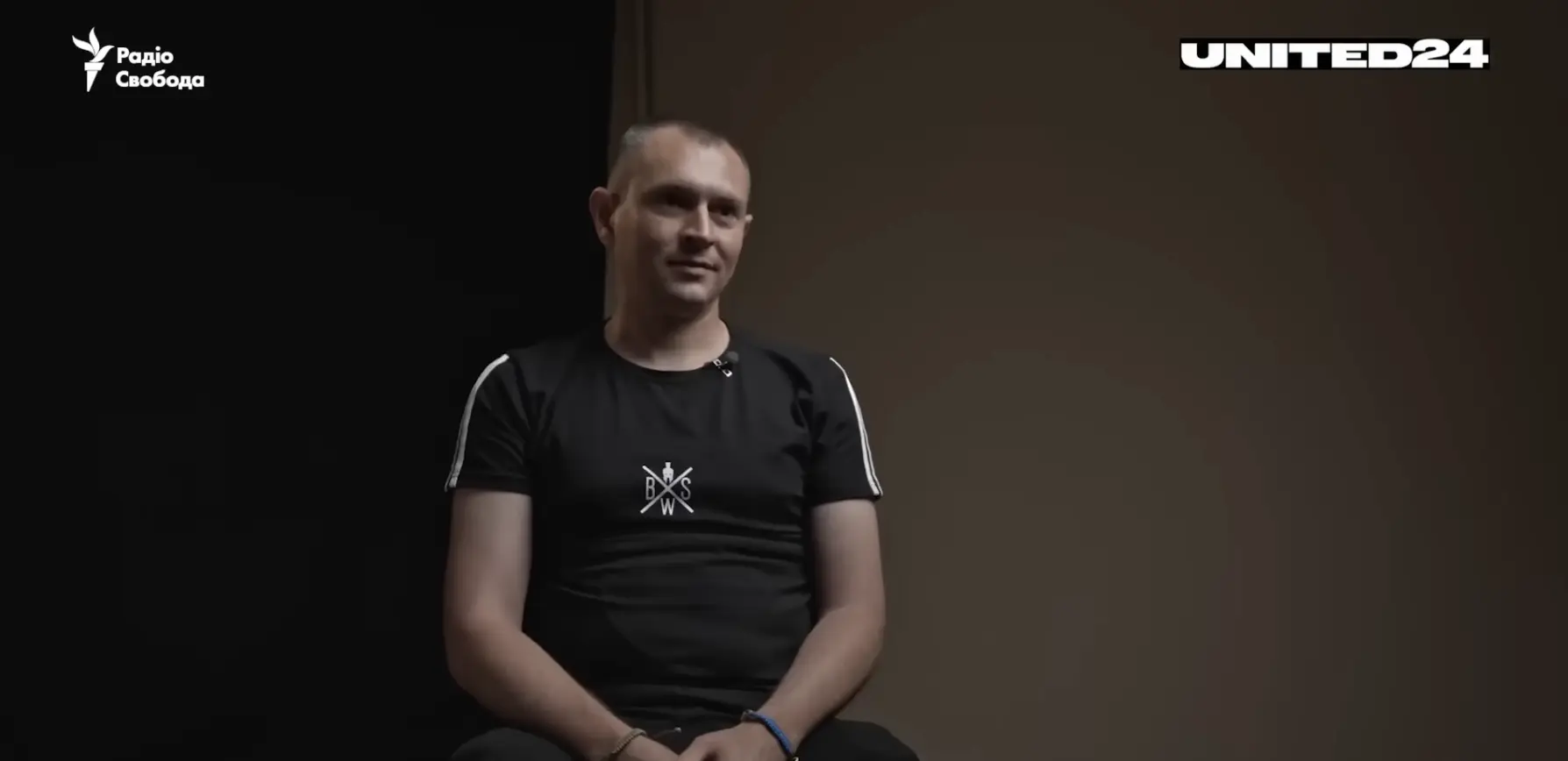
Who burned "Glory to Russia" on the stomach of a Ukrainian prisoner?
Source: “Schemes” (a Radio Free Europe/Radio Liberty project)
Author: Olga Ivleva
In the summer of 2025, a photo showing the words “Glory to Russia” and the letter Z burned into the body of Ukrainian soldier Andriy Pereverzev, who had returned from captivity, went viral around the world.
Little was known about the circumstances surrounding how the mocking inscription appeared on the prisoner of war’s abdomen. He himself said that he heard medical staff talking among themselves that the operation, which left such scars, was performed by a Russian doctor. A Ukrainian doctor, who is currently helping Pereverzev get rid of these scars, believes that this was a “gift from the surgeon.”
“Schemes” (a Radio Free Europe/Radio Liberty project) set out to determine who could have done this to the Ukrainian soldier and where.
By reconstructing the chronology of events from the winter of 2024—when the inscription appeared on Andriy Pereverzev’s body—journalists were able to determine exactly which hospital in Donetsk operated on the prisoner after he was wounded and to identify its staff. Most importantly, they uncovered evidence indicating that specific Russian surgeons could have performed the surgery (and, consequently, left the inscription).
For English subtitles, please enable captions in the video settings and select Auto-translate → English.
Author: Olga Ivleva
In the summer of 2025, a photo showing the words “Glory to Russia” and the letter Z burned into the body of Ukrainian soldier Andriy Pereverzev, who had returned from captivity, went viral around the world.
Little was known about the circumstances surrounding how the mocking inscription appeared on the prisoner of war’s abdomen. He himself said that he heard medical staff talking among themselves that the operation, which left such scars, was performed by a Russian doctor. A Ukrainian doctor, who is currently helping Pereverzev get rid of these scars, believes that this was a “gift from the surgeon.”
“Schemes” (a Radio Free Europe/Radio Liberty project) set out to determine who could have done this to the Ukrainian soldier and where.
By reconstructing the chronology of events from the winter of 2024—when the inscription appeared on Andriy Pereverzev’s body—journalists were able to determine exactly which hospital in Donetsk operated on the prisoner after he was wounded and to identify its staff. Most importantly, they uncovered evidence indicating that specific Russian surgeons could have performed the surgery (and, consequently, left the inscription).
For English subtitles, please enable captions in the video settings and select Auto-translate → English.
“You’ll get a tattoo”
According to him, he was wounded twice during his service: first, he was hit by a Russian drone, and later he suffered a concussion during shelling. Both times, after recovering, he returned to the front.
For a long time, Russian troops actively tried to dislodge Andriy’s unit from their positions near Novomykhailivka, where they were stationed. Fierce fighting ensued.
“It was the toughest in the morning; they wouldn’t even let us smoke or drink water. Infantry was constantly advancing. We had to hold our ground; we were constantly firing at them. Sometimes, while we were repelling an attack on one side, they would close in from the other,” recalls Pereverzev.
Later, the Coordination Headquarters for the Treatment of Prisoners of War and the brigade itself were informed:
“On February 23, 2024, at approximately 10:30 p.m., as a result of the enemy’s assault, the position lost contact. The position was captured by the enemy.”
According to Pereverzev, he was taken prisoner after a Russian tank fired on their position and infantry moved in. They began throwing grenades at the Ukrainian fighters.
“A grenade flew right into the dugout, right under my butt. My leg caught fire, and I started putting it out. And while it was burning in our dugout, I looked at my comrades. One fell right away; I realized he was ‘200’ (killed—ed.). And the second one, who was next to me—we were still exchanging fire, taking turns—I look, and he’s already lying dead. I lost consciousness,” Pereverzev said.
Andriy recalls that he was evacuated by members of the “DPR” group—he recognized them by their accent—and then transported to occupied Donetsk. “To the basement.”
“I begged them to finish me off. So I could stay here with the guys. They said, ‘No, we’ll take you; we’ll get a bonus and time off for you,’” said Pereverzev.
“Like for a prisoner of war?” asked the Schemes journalist.
“Yes.”
At every stage of this journey, Andriy was beaten and interrogated. Due to severe injuries and significant blood loss, he repeatedly lost consciousness, regained it briefly, and then passed out again.
“My entire left side is in pieces; I have a burn on my leg, my left buttock is torn, and there are many shards in it. There are many shards in my spine. My rectum was torn, and part of it was removed. My urethra and bladder were torn. And shards flew right into my stomach,” Andriy Pereverzev said.
After being held in the basements, the Ukrainian soldier was taken, as he recalls, to one of the hospitals in Donetsk, where he underwent emergency surgery.
He barely remembers that day: in the morning, they brought him, blindfolded and with his hands tied, onto the hospital grounds and took him into the operating room. There was only a nurse there who administered the anesthesia, and he “passed out.”
“They performed the surgery. Then they wheeled me to the ICU on a stretcher. I lay in the ICU for another two days. They came in and changed my bandages. Then a nurse came in. She told me, ‘Don’t worry. When you get home, you’ll either get it removed or get a tattoo over it.’ I didn’t understand what she was talking about at all at the time. And I saw it for the first time a week later. When I had already been transferred to a ward. I lifted my head off the pillow, just to see what was going on with my stomach. I looked and was simply stunned,” Andriy said in an interview with United24.
DOCTMO
“Schemes” decided to reconstruct the chronology of events from that time: to determine exactly where the Ukrainian soldier underwent surgery, after which he developed such a scar.The medical facility itself became the starting point for the journalists.
He himself names the hospital in occupied Donetsk—where Andriy was taken after being wounded, captured, and held in a basement. He heard it from the medical staff.
And “Schemes” was able to confirm this further. We’re talking about the “Donetsk Clinical Territorial Medical Association”—abbreviated as DOKTMO.
After surgery and a stay in intensive care, Andriy was transferred to the proctology department. He recalled that it was on the sixth floor of an eight-story building.
In occupied Donetsk, journalists found only one medical facility with an eight-story building on its grounds—with the relevant department on the sixth floor. At the aforementioned DOKTMO.
In occupied Donetsk, only DOKTMO has an eight-story building with a proctology department on the sixth floor
“Schemes” calculated what view the soldier might have seen from the window while he was in the ward on the sixth floor of the hospital—and showed it to him. He confirmed: that’s the spot.
DOKTMO is the largest and most well-known hospital in occupied Donbas. It has 14 buildings and employs nearly 2,500 staff members.
Since the late 1990s (with a brief interruption—ed.), it has been headed by Tetyana Bakhteyeva, an ally of Yanukovych and a former deputy from the “Party of Regions,” and later the “Opposition Bloc.”
In 2014, during the occupation of Donetsk, this hospital was one of the first to be seized. A military hospital of the so-called “DPR” was set up here. Wounded Ukrainian soldiers were also held there, including defenders of Donetsk Airport.
Since then, the hospital has continued to operate under the control of the occupation administration. Medical staff were issued Russian passports. Some of them joined the pro-government party “United Russia” and began participating in events in support of Russia.
In 2023, after the start of the full-scale invasion, the hospital was renamed from DOKTMO to the “M. I. Kalinin Republican Clinical Hospital.” Russian politicians and artists began coming here even more frequently to make appearances on camera.
Some of the medical staff at this Donetsk hospital joined the so-called “SVO,” while others remained to treat Russian soldiers. Here is what hospital director Ivan Plakhotnikov personally boasted to Vladimir Putin in the summer of 2025: “We have reserved 600 beds and are actively providing assistance to the wounded and participants in the ‘Special Military Operation.’”
“Friends of Donbas Medicine”
The former prisoner’s recollections served as a starting point for journalists in their search for the doctor who had left such an inscription on his body. He recounted hearing nurses—already at the second hospital in Donetsk, where he was later transferred—talking among themselves that a Russian doctor had performed his surgery.“That’s what I heard back at the 15th Hospital. She said it was a Muscovite or a Russian,” Pereverzev said.
Another clue: the inscription was most likely made by the operating surgeon himself, not by anyone else on the medical staff. After all, the inscription was made on the right side—where the doctor usually works—and with a special medical instrument.
“It could have been a standard electrocoagulator, or it could have been a radio knife. Now let’s put everything together logically: we have the right side, where the operating surgeon stands; we know that no one would just leave a patient under anesthesia for no reason. The operation is over, and the anesthesiologist begins to bring him out of anesthesia,” says dermatologist Oleksandr Turkevych.
As part of the “Neopalimi” project, Turkevych is helping Andriy and other Ukrainian soldiers get rid of their scars.
“The inscription is practically perfectly straight. Moreover, it’s clear that when they started, they were more inspired than when they finished. He must have been under deep enough anesthesia to feel absolutely nothing. Which is good, because he didn’t suffer,” says Turkevych.
So “Schemes” decided to find out which Russian surgeons visited the Donetsk hospital and worked there during the period when Andriy Pereverzev underwent his major surgery.
Russian medical personnel appeared at the Donetsk hospital as early as the first weeks of the full-scale invasion.
An analysis of the hospital’s social media pages and reports on local channels showed that over time these visits became regular—a group of Russian doctors from various regions of the Russian Federation began working at the medical facility on a permanent basis under the name “Friends of Donbas Medicine.” As they themselves note, this is a “voluntary community of doctors that formed in the early days of the ‘special military operation’; they travel to the occupied territories on a voluntary basis.”
Their explanation for their regular trips to the occupied Donbas is quite typical—they refer to the Ukrainian region as “part of Russia.”
Russian doctors began bringing so-called “humanitarian aid” and conducting workshops on providing medical care. But the key point is that they began performing surgeries in Donbas hospitals, including at the DOKTMO.
They openly admit that they also operate on wounded Ukrainian soldiers.
With the following caveats:
“I wasn’t prepared for the reaction when they brought me a person who deliberately wants to destroy us. And that I would have to provide them with medical care,” said Russian trauma surgeon Boris Sichenikov.
Russian doctors have been repeatedly honored for such activities by the leadership of the so-called “republic,” notably Denis Pushilin.
Journalists have identified key figures among them—in fact, the core of this Russian medical “task force.”
The initiative to create it came from Badma Bashankayev, a Moscow-based surgeon of Kalmyk origin.
A medical professional by training, Bashankayev completed internships in Germany and the United States and promoted Western medical standards.
In 2021, Bashankayev became a “United Russia” deputy from Kalmykia in the Russian State Duma and was appointed to the Health Committee. Since then, his public rhetoric has also changed: after the start of the full-scale invasion, he openly supported Russia’s aggression.
For example, using medical terminology, he commented on the so-called “special military operation” as follows:
As a result, he was almost immediately subject to Ukrainian sanctions, and later to international sanctions—specifically from the U.S., the European Union, and the United Kingdom. In Ukraine, a case was also opened against him in 2022—for violating territorial integrity—he was notified of the charges and placed on the wanted list.
But this did not seem to stop the doctor-lawmaker: in late October 2022, Bashankaev was mobilized. And he headed to Donetsk, to the DOKTMO hospital—to perform surgeries.
Just five months later, Bashankaev was demobilized. But he continued to perform surgeries at the Donetsk hospital—as a surgeon—and to serve—as a deputy of the Russian State Duma.
“If we need to save someone—we’ll save them. That’s it. And we tell each other—even if he’s a ‘Ukrainian soldier’—the work is the same. No harassment or any of that ‘let’s “forget” a napkin in his stomach’ stuff,” Bashankaev said in one of his interviews.
Krasnodar surgeons
As the founder of the so-called “Friends of Donbas Medicine” group, Bashankayev led journalists to other Russian doctors.On February 24, 2024—the day of Andriy’s surgery, which fell on a Saturday—Bashankayev posted another message in support of the so-called “special military operation.” He added old photos taken in the occupied territory of Donbas in the first weeks of 2022, noting that Donetsk had “already become home” to him. In the photos, standing next to him are doctors from the “Friends of Donbas Medicine” group.
On the same day, Bashankayev posted another message in which he tagged two Russian doctors from this group: surgeons from Krasnodar, Yuri Kuznetsov and Andriy Kryachko.
“…spending my days off in Donetsk again with humanitarian aid. This is already the 4th trip this year alone,” he captioned the photo.
In it are Yuri Kuznetsov, an abdominal surgeon (a doctor who performs surgery on the abdominal organs), and proctologist Andriy Kryachko.
Both work at the same hospital in Krasnodar and often perform joint surgeries.
Like Bashankaev, these doctors willingly wear clothing featuring the Z symbol or the inscription “Putin’s team.” They provide technical assistance to the Russian military, post photos featuring Stalin, and reminisce about “days of military glory.”
The Krasnodar surgeons began arriving at the Donetsk hospital just six months after the start of the full-scale invasion. As they say themselves: at Bashankaev’s invitation. And they began performing surgeries there regularly. Often—all in a single day.
“And so our latest mission is coming to an end. With a sense of duty fulfilled, we are returning to the city of Krasnodar. A series of surgical procedures were performed, and assistance was provided to the wounded. We visited both field hospitals and our beloved DOCTMO,” Kuznetsov wrote on his Telegram channel.
His colleague Andriy Kryachko also frequently posts photos and videos from the operating room of the Donetsk hospital.
Ultimately, “Schemes” found the key evidence on their social media: posts from February 24, 2024—that is, the day after Pereverzev was taken prisoner, according to his unit. And the day when he was apparently operated on and left with the mocking inscription “Glory to Russia.”
In the photos, Kuznetsov and Kryachko are unloading “humanitarian aid” near the surgical wing of the DOKTMO, carrying the cargo inside, and posing with Ivan Plakhotnikov, then the hospital’s deputy director, in his office.
“The holiday weekend was very eventful—my trusted friend Andriy Kryachko and I traveled to Donbas, delivered humanitarian aid, helped our fellow surgeons, supported the fighters on the front lines, and congratulated everyone on the holiday of February 23,” Kuznetsov wrote that day.
“My colleague and friend Yuriy Serhiyovych Kuznetsov and I are spending this day on the front lines. We came to help military surgeons, soldiers, and everyone who shares our stance on peace throughout the world,” Kryachko says on social media.
Of course, the publication date on social media is far from always reliable evidence. After all, the photos could have been taken earlier but published on a different day.
If you look at the metadata of the video published by Yuriy Kuznetsov on Telegram, the date of creation is also listed as February 24, 2024, at 3:43 p.m.—that is, two hours before publication. Metadata can be altered, but journalists found additional confirmation that doctors from Krasnodar were in Donetsk during that period.
According to border crossing data for surgeon Andriy Kryachko, which “Schemes” obtained through sources with access to such information, on February 24, 2024, he entered the occupied territory of Ukraine.
In addition, in one of the photos taken in the office of Ivan Plakhotnikov, who was the hospital’s deputy director at the time, a calendar with a mark is visible. It appears to be a Saturday, and likely February 24, 2024.
Another clue: in a photo of surgeon Kuznetsov from that trip on that day, a UAZ military evacuation vehicle marked “300” is visible—the occupiers typically use such vehicles to transport the wounded.
“Schemes” showed this photo to Andriy, and he confirmed that it was in exactly such a vehicle that he was taken to the hospital that day.
After all, February 24 is a symbolic date for Russia—marking the day of a large-scale offensive on Ukrainian territory.
So, most likely, the inscriptions with the military slogan “Glory to Russia” and the letter Z appeared on the Ukrainian prisoner’s body on that very day for a reason.
“What do you think was the Russian doctor’s motivation?” a “Schemes” journalist asked Andriy Pereverzev.
“Just to mock him. That’s what I think. Like, ‘If he survives, let him live and remember it for the rest of his life.’”
“Schemes” contacted the Russian surgeons. Andriy Kryachko and Badma Bashankaev have not yet responded to the journalists.
Here is how Yuriy Kuznetsov responded.
– On February 24, 2024, you were in Donetsk, at the Kalinin Hospital (DOKTMO). That day, you and your colleague Andriy Kryachko performed surgery on Ukrainian prisoner of war Andriy Pereverzev, during which the words “Glory to Russia” appeared on his body. “How would you comment on that?” asked a journalist from “Schemes.”
“Nothing like that ever happened. Where did you get that from?” replied Kuznetsov.
“You were in that very building that day; you arrived together with your colleague from Krasnodar.”
“Complete nonsense. Complete nonsense. First of all, on February 24, 2024, neither I nor my colleague Andriy Kryachko were there. Period.
— Yuriy, I open your Telegram channel and find a post from February 24, 2024, where you’re taking a photo…
– But that doesn’t mean I was there on February 24, you understand? We can’t post something on the very same day.
In a conversation with the Russian surgeon, journalists mentioned the photo in Plakhotnikov’s office, the video metadata, the calendar on the wall, and information about his colleague crossing the border.
– None of that ever happened. I don’t even know any Andriy Pereverzev. I didn’t operate on the wounded man there, – said Kuznetsov.
– But you operate there all the time. So why not Andriy…
– We went on February 24; we just brought humanitarian aid, and that’s it. We didn’t even perform any surgeries.
– Your post says that you assisted the surgeons.
– The assistance to the surgeons was advisory. We didn’t operate on anyone.
– Just 10 minutes ago you said you weren’t there at all, and now you’re saying you were there with humanitarian aid.
– But not on February 24.
– If you weren’t at the Kalinin Hospital on February 24, can you tell us where you were?
– No.
– Why?
– That’s my personal information.
The nurse and other hospital staff
“Schemes” was also able to identify the nurse from the proctology department mentioned by the Ukrainian soldier in the interview. The one who first drew Pereverzev’s attention to the scars and told him: “Don’t worry. When you get home, you can either have them removed or cover them up with a tattoo.” The soldier recognized her when journalists showed him a photo.This is 43-year-old Tetyana Tregulova, a native of Donetsk. She has most likely been working at the DOKTMO since the early 2000s.
On social media, she supports the occupying forces: on TikTok, she goes by the username “dnr628,” and on Telegram, she follows the pro-Russian channels “Wagner Group” and “SpetsVojenkorZ.” According to data from Russian leaks, she obtained a Russian passport during the occupation of Donbas.
“Schemes” reached the nurse by phone and asked if she knew anything about who exactly had left such a taunting message for the Ukrainian prisoner.
– I can’t say anything about that because I don’t have that information. “When I came on shift, I was changing his bandages. Of course, I saw it. But we had a meeting about this, and we were warned that it shouldn’t be discussed at all—that, no matter what, medical professionals are above politics,” said Tregulova.
“Do you think a local doctor from Donetsk could have written something like that?” asked the journalist from “Schemes.”
“I have no idea how something like that could be done. It’s wild to me.”
“Look, he was brought to the hospital on Saturday. As far as I understand, emergency surgeries are performed on Saturdays, and most likely there was a small surgical team there, and by my logic, as I understand it, Russian doctors joined in.
“Here, yes, we very often simply have a lot of patients coming in, and it’s quite likely that there weren’t enough hands.”
In a comment to “Schemes,” former DOCTMO doctor Ihor Kyryanenko, who spent seven years in Russian captivity and was released in August 2025, also expressed the opinion that such a note was most likely left for the Ukrainian soldier by Russian doctors. He believes that Donetsk doctors would hardly have done so.
According to dermatologist Oleksandr Turkevych, who currently works with Andriy Pereverzev, the other members of the surgical team could not have failed to notice what the surgeon was doing:
“If they don’t notice who is doing what, they’re out of the team very quickly. This is true even under normal conditions. It’s a team that has to work in sync. So there’s no way. They could have pretended not to notice. But they couldn’t have actually failed to notice.”
That is precisely why, in this investigation, “Schemes” decided to also name the other doctors who may have been present during Andriy’s surgery or who headed the departments at the Donetsk hospital where he was being held.
These include, in particular, the heads of two surgical departments—Oleksandr Shatalov (Department No. 1) and Nikos Yengenov (No. 2), the urology department—Valentin Kobets, the intensive care unit—Natalia Tolstova, and the proctology department—Oleksandr Borota.
The last one, Oleksandr Borota, is the doctor who later performed additional surgery on Pereverzev; he recognized him in a photo. And this is the doctor whom Badma Bashankaev praised.
Another doctor the former captive remembered was proctologist Valentin Volkov, who treated Pereverzev after the surgery.
“They would visit each other and talk. They’d come to take photos. And they’d just laugh. You could tell from their faces that they knew who did it. The whole hospital knows, the entire staff knows,” Pereverzev recalls.
“Schemes” contacted doctors Volkov and Borota.
“What do you know about this case?” a “Schemes” journalist asked Valentin Volkov.
“Nothing,” he replied.
“But you treated him, you saw the wound?”
“Well, I treated him, yes, it was a wound. You shouldn’t be asking me these questions; ask our management. I don’t know where those inscriptions came from.”
“And do you yourself consider this a war crime?”
“I don’t know what it is. Once again—where did it come from, who did it, how was it done? You’re thinking about it all so simply—war crime, not a war crime. Maybe it’s not a war crime? Maybe it’s not a crime at all? Who knows how it (the inscription—ed.) could have appeared on him.
– Before he was admitted to your proctology department, the soldier underwent surgery during which the words “Glory to Russia” were burned onto his body. As far as we know, you performed a second operation on him—a corrective one, so to speak—said Oleksandra Borota, a journalist for “Schemes.”
– I’m not sure I can recall that specific case right now; we see so many patients that I can’t answer that. I’m sorry.
– So, you don’t remember the case where the words “Glory to Russia” were burned onto the body of a Ukrainian prisoner of war?
– Well, I suppose not.
In this investigation, “Schemes” names the hospital’s leadership.
This includes the previously mentioned Ivan Plakhotnikov, director and chief physician since 2024; and his deputy for surgical operations, Denis Stupachenko. Two other deputies to Plakhotnikov are Iryna Milner and Nataliia Momot.
It was Nataliia Momot, in particular, who headed the Donetsk Regional Clinical Hospital (DOKTMO) after Russia’s invasion back in 2014—and until 2024. She is also a former assistant to MP Tatyana Bakhteyeva, who ran the Donetsk hospital for many years before Momot.
Current Director Ivan Plakhotnikov and his deputy, Natalia Momot, did not respond to calls from journalists.
After Captivity
In May of this year, after basements, Donetsk hospitals, surgeries, mocking inscriptions on his body, and imprisonment in a penal colony in the occupied town of Chistyakove in the Donetsk region, Andriy Pereverzev was finally released from captivity—as part of a large-scale “thousand-for-thousand” prisoner exchange.
All this time, he recalls, he was sustained by a promise to his daughter: “When I was leaving after my first injury, I promised I would return.”
He is currently undergoing rehabilitation. He is trying to recover both physically and mentally.
“This was done solely because Andriy is Ukrainian and a soldier of the Ukrainian Armed Forces. In other words, this is genocide on ethnic grounds, and it is a war crime,” says Dr. Turkevych.
And how do Ukrainian law enforcement officials classify this?
“Criminal proceedings have been initiated regarding the cruel treatment of Andriy Pereverzev. This is undoubtedly one of the most brazen crimes committed against prisoners of war during the full-scale invasion. While Andriy was in the medical facility, there was no access by outsiders, and the people who performed this surgical procedure were fully aware that he was a prisoner of war and that he was entitled to the protections guaranteed to him by the Geneva Conventions.
Therefore, there is clearly a connection to the armed conflict, which provides grounds to classify this as a war crime. “We will conduct a pre-trial investigation until these individuals are brought to justice. And I am convinced that this will happen,” said Taras Semkiv, head of the Department for Combating Crimes Committed in the Context of Armed Conflict at the Office of the Prosecutor General.
According to him, the information presented in this journalistic investigation will be included in the criminal case file.
If you have additional information regarding this story, please email “Schemes” at radiosvoboda@rferl.org.
– I’m not sure I can recall that specific case right now; we see so many patients that I can’t answer that. I’m sorry.
– So, you don’t remember the case where the words “Glory to Russia” were burned onto the body of a Ukrainian prisoner of war?
– Well, I suppose not.
In this investigation, “Schemes” names the hospital’s leadership.
This includes the previously mentioned Ivan Plakhotnikov, director and chief physician since 2024; and his deputy for surgical operations, Denis Stupachenko. Two other deputies to Plakhotnikov are Iryna Milner and Nataliia Momot.
It was Nataliia Momot, in particular, who headed the Donetsk Regional Clinical Hospital (DOKTMO) after Russia’s invasion back in 2014—and until 2024. She is also a former assistant to MP Tatyana Bakhteyeva, who ran the Donetsk hospital for many years before Momot.
Current Director Ivan Plakhotnikov and his deputy, Natalia Momot, did not respond to calls from journalists.
After Captivity
In May of this year, after basements, Donetsk hospitals, surgeries, mocking inscriptions on his body, and imprisonment in a penal colony in the occupied town of Chistyakove in the Donetsk region, Andriy Pereverzev was finally released from captivity—as part of a large-scale “thousand-for-thousand” prisoner exchange.
All this time, he recalls, he was sustained by a promise to his daughter: “When I was leaving after my first injury, I promised I would return.”
He is currently undergoing rehabilitation. He is trying to recover both physically and mentally.
“This was done solely because Andriy is Ukrainian and a soldier of the Ukrainian Armed Forces. In other words, this is genocide on ethnic grounds, and it is a war crime,” says Dr. Turkevych.
And how do Ukrainian law enforcement officials classify this?
“Criminal proceedings have been initiated regarding the cruel treatment of Andriy Pereverzev. This is undoubtedly one of the most brazen crimes committed against prisoners of war during the full-scale invasion. While Andriy was in the medical facility, there was no access by outsiders, and the people who performed this surgical procedure were fully aware that he was a prisoner of war and that he was entitled to the protections guaranteed to him by the Geneva Conventions.
Therefore, there is clearly a connection to the armed conflict, which provides grounds to classify this as a war crime. “We will conduct a pre-trial investigation until these individuals are brought to justice. And I am convinced that this will happen,” said Taras Semkiv, head of the Department for Combating Crimes Committed in the Context of Armed Conflict at the Office of the Prosecutor General.
According to him, the information presented in this journalistic investigation will be included in the criminal case file.
If you have additional information regarding this story, please email “Schemes” at radiosvoboda@rferl.org.
This is an automatic translation generated by DeepL.