"Valuable" Prisoners: Why Russia Doesn't Want to Return Ukrainian Military Medics
Source: MIPL
Author: Maria Klymik
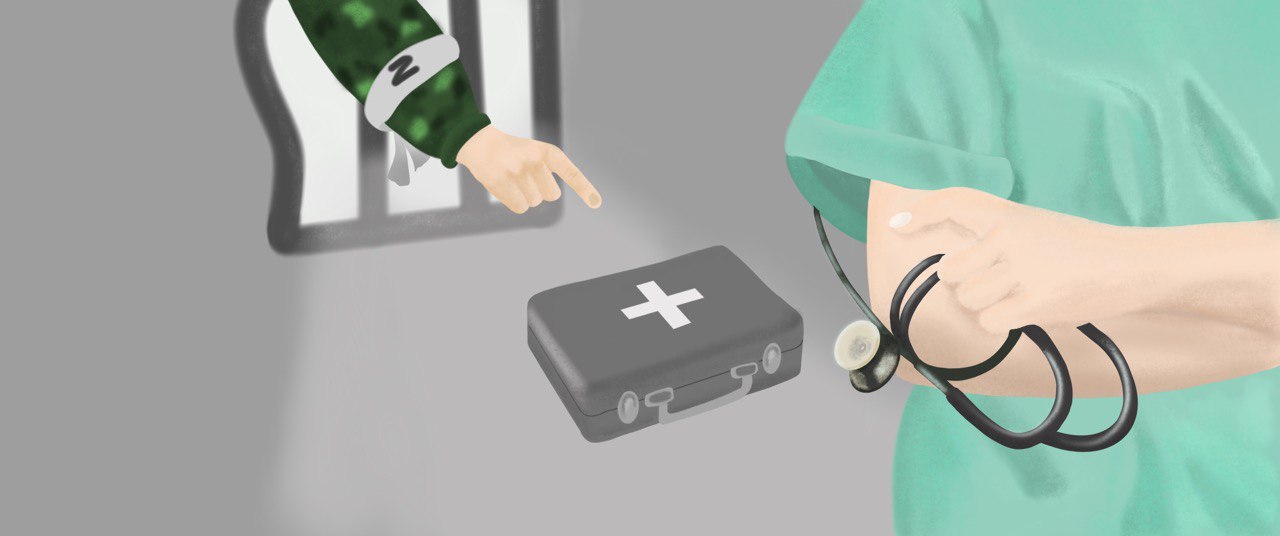
Russia is holding approximately 100 military medics captive who were captured at Azovstal and the Ilyich Steel Works in Mariupol. For a long time, they were “invisible prisoners,” as both Russian and Ukrainian authorities refused to acknowledge the very fact of their captivity. Recently, Ukraine changed their status from “missing in action” to “prisoners of war.” However, Russia continues to insist that it does not hold any medical personnel from Mariupol.
The medical staff from Military Hospital No. 555 in Mariupol were taken prisoner on April 12 while they were at the Illich Steel Works. There, they were alongside soldiers from the 36th Separate Marine Brigade named after Rear Admiral Bilinsky, the 56th Separate Motorized Infantry Brigade, National Guard troops, and former civilian medical personnel who had joined the local territorial defense forces the day before.
Before being taken prisoner, they had spent a month in the plant’s shelters, where they had been evacuated—along with their patients—from a military hospital that had been destroyed by the Russians.
The MIPL has compiled their stories. Some are being held by the Russians in the occupied territories of Ukraine, while others are in pretrial detention centers in the Russian Federation.
Olena is 27 years old; her husband, Yuriy, is also a medic. They met at the Kyiv Military Medical Academy. After graduating, they were assigned to serve in Mariupol. Olena worked at Military Hospital No. 555, while Yuriy worked at a field hospital far outside the city.
When Russia’s full-scale invasion of Ukraine began, the hospital continued to operate. Every day, many seriously wounded and injured soldiers and civilians were brought there.
“Around March 15, an aerial bomb was dropped on the hospital, and the building was destroyed. The medical staff who remained there split into two groups. One went with the Azov fighters to Azovstal; the other joined the 36th Marine Brigade at the Ilyich Steel Plant. In addition to them, there were medical personnel from the Dnipro hospital, who were sent by helicopter to provide assistance after March 15,” says Andriy Kryvtsov of the International Center for Human Rights (MIPL), Yuriy’s older brother.
Contact with Olena was lost when she arrived at the Illich Steel Plant.
“Communication was very difficult. They radioed a message to some people, and those people passed it on to others, saying they were alive. It was a sort of word-of-mouth chain,” says Andriy.
Andriy and his brother learned that Olena had been taken prisoner from the relatives of another captive who was allowed to call home.
“We were getting reports that they might be taken prisoner. There were no weapons in the hospital itself—after all, it’s not just doctors; there’s also medical staff, nurses, drivers, and orderlies. They were unarmed. The only ones who could have protected them were the 36th Brigade. When they ran out of ammunition, they were completely surrounded,” says Andriy.
Olena’s family received no official information from her military unit. So they took matters into their own hands.
“On April 21, I got through to the General Staff; they confirmed that the hospital was under captivity and that they had been divided into two groups. The first group was sent to the ‘DPR’ to four locations: two hospitals in Donetsk and two regional hospitals. The second group was sent to a pretrial detention center in Taganrog. Later, we learned that Olena had been seen on Russian territory,” adds Andriy.
Olena Zubova is 47 years old and has been serving since 2017. From February 21 to 22, she was on duty, but after her shift ended, they weren’t allowed to go home.
“When it all started, on February 24, my wife called and told me to get the kids out of there. That’s exactly what I did. We were still in touch until March 14; we had a connection. She didn’t say much about her service; she only mentioned that many wounded people were being brought in, including a great many civilians and children,” recalls Olena’s husband, Vyacheslav.
He didn’t know that an aerial bomb had been dropped on Hospital No. 555. He learned this from the mother of one of Olena’s colleagues.
“This woman wrote to me that they had been evacuated from the hospital to a bunker, and that she was going to look for her daughter. But, as far as I know, she never made it to Mariupol. And then it turned out that her daughter was at Azovstal, and my wife was at the Illich Steel Plant,” adds Vyacheslav.
After the evacuation, he—like other relatives—had almost no contact with his wife. Occasionally, text messages would come in from unknown numbers. Someone claiming to be Olena would message that she was okay.
“On April 3, her phone went online, and we received a text message from her. I called her right away, but some girl answered. She said they’d given her a lot of phones and she was trying to get in touch to pass on a message to her family,” adds Zubova’s husband.
When it became known that everyone who had been at the Illich Plant had been taken prisoner, Vyacheslav contacted the SBU and other agencies to find out his wife’s fate, but received almost no information. Later, on one of the Russian Telegram channels, he saw a photo of his wife; among the women in the posted photos, relatives recognized several other medical staff members from Hospital No. 555.
Later, a neighbor of theirs from Mariupol contacted Vyacheslav. Her husband—a police officer—had been held captive by the Russians for 30 days at the Olenivka penal colony. On April 17, he saw Olena there. The man has no further information about his wife.
49-year-old Olena Biyovska was transferred to Military Hospital No. 555 six months before the start of Russia’s full-scale invasion.
“A week before February 24, the hospital announced a general mobilization, and Olena was no longer allowed to go home,” Olena’s sister, Svitlana, told the MIPL.
She didn’t know Olena’s colleagues, so when she learned that an aerial bomb had been dropped on the hospital, she began searching for relatives of other medical staff on social media. That’s how Svitlana found out that Olena had been at the Illich Plant.
Until April 12, there was almost no contact with Olena.
“Something must have happened to Olena’s phone; her colleagues often messaged me, passing on messages from her. Once I managed to talk to her briefly—that was still before April 12. She said she was going into surgery, that she was alive and doing well,” says Svitlana. “Then, on April 12, the last text message from Olena arrived, in which she wrote that she didn’t know what would happen next—captivity or something worse. She asked us to spread the word everywhere that they were heavily surrounded.”
Eventually, the family saw a photo of Olena—it was among the photos of female prisoners of war released by the Russian side.
“We reached out everywhere we could. At first, we were told there was no information about Olena. The entire hospital staff had been taken prisoner, but they weren’t recognized as prisoners—it was as if they didn’t exist. Then a woman contacted me and said she had been in the same cell as Olena in Olenivka; later, they were transferred to Taganrog,” says Svitlana.
Yurik Mkrtchyan, lieutenant in the medical service, resident physician at the Clinic of Anesthesiology, Resuscitation, Intensive Care, and Detoxification in Dnipro
Yurik Mkrtchyan found his calling in medicine in 2014, when Russia launched its war against Ukraine. At the time, he was living in the Luhansk region and had just graduated from medical school. He received his diploma amid shelling.
“When Yurik picked up his diploma, a car was hit by shelling nearby. At that moment, something clicked in his mind; he said he wanted to save people’s lives. He had graduated as a pediatrician, so he decided to change his specialty and train to become an anesthesiologist or surgeon. He enrolled in the Military Medical Academy in Kyiv and trained as an anesthesiologist and intensive care specialist. “After graduating from the academy, he was assigned to Dnipro,” says Yurik’s sister, Karina.
His family didn’t know that Mkrtchyan was in Mariupol until the city was completely surrounded by Russian forces. Yurik was among the medical personnel sent from Dnipro to assist the doctors in Mariupol. Despite the great risk, they were immediately sent to the Illich Steel Plant and Azovstal.
“He only admitted he was there when our contact started to drop out more frequently. In early April, I received a text message from him: ‘I’m in Mariupol—don’t tell Mom,’” says Karina.
On April 12, Yurik called his sister and told her that they would most likely have to surrender. After that, for nearly two weeks, his family had no information about him.
Later, Yurik’s wife received a message from an unknown number saying that he was alive and being held at the prison in Olenivka. A short time later, his wife received another message—this time a photo of a handwritten letter from Yurik.
“When we received the letter, we realized he was in a very difficult situation. Yurik isn’t the kind of person who says more than necessary; he just goes out and does everything he can. But if he’s asking for publicity, asking for help, it means he’s in a situation where he can’t save people,” says Yurik’s sister.
The last time Yurik was allowed to call his family was on June 8. Every time during the brief, permitted calls, he spoke only about the wounded—of whom there were so many—and who were not receiving medical care.
“When he called for the last time, he spoke only about the wounded, saying they needed to be evacuated. There are so many wounded that Russia is hiding. He mentioned 300 wounded, 50 of whom were in critical condition,” notes Karina.
The doctor’s sister adds that almost all the military medics with whom Yurik trained are currently being held captive.
Captured medics we know
of
Andriy Kryvtsov also wrote on his Facebook page about other captured medics who, along with his brother’s wife, were taken prisoner at the Illich Plant.
Valentina Zubko—senior lieutenant in the medical service, a therapist and endoscopist.
Vladimir Shapkov—a military resident surgeon. In one of the videos published on a Russian Telegram channel, his wife recognized Volodymyr. Together with Yurik Mkrtchyan, he provided medical care to wounded Ukrainian soldiers at the Olenivska Colony.
Vladislav Didukh — Lieutenant in the Medical Service, head of the inpatient ward at Hospital No. 555.
Serhiy Doroshenko—a civilian pediatrician from Mariupol. On February 25, he enlisted in Mariupol’s territorial defense, after which he was assigned to Hospital No. 555.
Kostyantyn Klochikhin—a captain in the medical service. At the start of the full-scale war, he was sent to Mariupol to provide medical care to military personnel. After losing contact with command, his unit joined the hospital located at the Illich Plant.
This list is not exhaustive. The exact number of medical personnel currently held captive is unknown.
According to their relatives, until mid-June they knew almost nothing about the conditions in which the captives were being held or what was happening to them. Moreover, in response to all inquiries, representatives of the relevant Ukrainian authorities stated that the medical personnel were considered missing in action. But later, they were recognized as prisoners of war.
Russia, however, does not confirm the capture of these medical personnel. Their families believe that one of the reasons is the involvement of Ukrainian doctors in treating Russian military personnel, as well as Ukrainian citizens who were injured while already in captivity.
One of the servicemen released from captivity confirmed to the International Institute for Human Rights (IIHR) that these concerns are not unfounded.
“They kept us in cells of 40 people each. Sometimes the medical personnel were asked to provide care both to their own wounded and to those working in the detention center,” the woman says. “Russia does not recognize many of them as prisoners of war—both women and men from various units. The hospital is no exception.”
According to her, at first they were all held at a penal colony in the city of Olenivka in the Donetsk region, and on April 19, most of the women were transported to the Russian Federation to a pretrial detention center in the city of Taganrog. At that time, some of the men were left in Olenivka, while others were transferred to Kursk or Rostov.
Author: Maria Klymik
Russia is holding approximately 100 military medics captive who were captured at Azovstal and the Ilyich Steel Works in Mariupol. For a long time, they were “invisible prisoners,” as both Russian and Ukrainian authorities refused to acknowledge the very fact of their captivity. Recently, Ukraine changed their status from “missing in action” to “prisoners of war.” However, Russia continues to insist that it does not hold any medical personnel from Mariupol.
The medical staff from Military Hospital No. 555 in Mariupol were taken prisoner on April 12 while they were at the Illich Steel Works. There, they were alongside soldiers from the 36th Separate Marine Brigade named after Rear Admiral Bilinsky, the 56th Separate Motorized Infantry Brigade, National Guard troops, and former civilian medical personnel who had joined the local territorial defense forces the day before.
Before being taken prisoner, they had spent a month in the plant’s shelters, where they had been evacuated—along with their patients—from a military hospital that had been destroyed by the Russians.
The MIPL has compiled their stories. Some are being held by the Russians in the occupied territories of Ukraine, while others are in pretrial detention centers in the Russian Federation.
Olena is 27 years old; her husband, Yuriy, is also a medic. They met at the Kyiv Military Medical Academy. After graduating, they were assigned to serve in Mariupol. Olena worked at Military Hospital No. 555, while Yuriy worked at a field hospital far outside the city.
When Russia’s full-scale invasion of Ukraine began, the hospital continued to operate. Every day, many seriously wounded and injured soldiers and civilians were brought there.
“Around March 15, an aerial bomb was dropped on the hospital, and the building was destroyed. The medical staff who remained there split into two groups. One went with the Azov fighters to Azovstal; the other joined the 36th Marine Brigade at the Ilyich Steel Plant. In addition to them, there were medical personnel from the Dnipro hospital, who were sent by helicopter to provide assistance after March 15,” says Andriy Kryvtsov of the International Center for Human Rights (MIPL), Yuriy’s older brother.
Contact with Olena was lost when she arrived at the Illich Steel Plant.
“Communication was very difficult. They radioed a message to some people, and those people passed it on to others, saying they were alive. It was a sort of word-of-mouth chain,” says Andriy.
Andriy and his brother learned that Olena had been taken prisoner from the relatives of another captive who was allowed to call home.
“We were getting reports that they might be taken prisoner. There were no weapons in the hospital itself—after all, it’s not just doctors; there’s also medical staff, nurses, drivers, and orderlies. They were unarmed. The only ones who could have protected them were the 36th Brigade. When they ran out of ammunition, they were completely surrounded,” says Andriy.
Olena’s family received no official information from her military unit. So they took matters into their own hands.
“On April 21, I got through to the General Staff; they confirmed that the hospital was under captivity and that they had been divided into two groups. The first group was sent to the ‘DPR’ to four locations: two hospitals in Donetsk and two regional hospitals. The second group was sent to a pretrial detention center in Taganrog. Later, we learned that Olena had been seen on Russian territory,” adds Andriy.
Olena Zubova is 47 years old and has been serving since 2017. From February 21 to 22, she was on duty, but after her shift ended, they weren’t allowed to go home.
“When it all started, on February 24, my wife called and told me to get the kids out of there. That’s exactly what I did. We were still in touch until March 14; we had a connection. She didn’t say much about her service; she only mentioned that many wounded people were being brought in, including a great many civilians and children,” recalls Olena’s husband, Vyacheslav.
He didn’t know that an aerial bomb had been dropped on Hospital No. 555. He learned this from the mother of one of Olena’s colleagues.
“This woman wrote to me that they had been evacuated from the hospital to a bunker, and that she was going to look for her daughter. But, as far as I know, she never made it to Mariupol. And then it turned out that her daughter was at Azovstal, and my wife was at the Illich Steel Plant,” adds Vyacheslav.
After the evacuation, he—like other relatives—had almost no contact with his wife. Occasionally, text messages would come in from unknown numbers. Someone claiming to be Olena would message that she was okay.
“On April 3, her phone went online, and we received a text message from her. I called her right away, but some girl answered. She said they’d given her a lot of phones and she was trying to get in touch to pass on a message to her family,” adds Zubova’s husband.
When it became known that everyone who had been at the Illich Plant had been taken prisoner, Vyacheslav contacted the SBU and other agencies to find out his wife’s fate, but received almost no information. Later, on one of the Russian Telegram channels, he saw a photo of his wife; among the women in the posted photos, relatives recognized several other medical staff members from Hospital No. 555.
Later, a neighbor of theirs from Mariupol contacted Vyacheslav. Her husband—a police officer—had been held captive by the Russians for 30 days at the Olenivka penal colony. On April 17, he saw Olena there. The man has no further information about his wife.
49-year-old Olena Biyovska was transferred to Military Hospital No. 555 six months before the start of Russia’s full-scale invasion.
“A week before February 24, the hospital announced a general mobilization, and Olena was no longer allowed to go home,” Olena’s sister, Svitlana, told the MIPL.
She didn’t know Olena’s colleagues, so when she learned that an aerial bomb had been dropped on the hospital, she began searching for relatives of other medical staff on social media. That’s how Svitlana found out that Olena had been at the Illich Plant.
Until April 12, there was almost no contact with Olena.
“Something must have happened to Olena’s phone; her colleagues often messaged me, passing on messages from her. Once I managed to talk to her briefly—that was still before April 12. She said she was going into surgery, that she was alive and doing well,” says Svitlana. “Then, on April 12, the last text message from Olena arrived, in which she wrote that she didn’t know what would happen next—captivity or something worse. She asked us to spread the word everywhere that they were heavily surrounded.”
Eventually, the family saw a photo of Olena—it was among the photos of female prisoners of war released by the Russian side.
“We reached out everywhere we could. At first, we were told there was no information about Olena. The entire hospital staff had been taken prisoner, but they weren’t recognized as prisoners—it was as if they didn’t exist. Then a woman contacted me and said she had been in the same cell as Olena in Olenivka; later, they were transferred to Taganrog,” says Svitlana.
Yurik Mkrtchyan, lieutenant in the medical service, resident physician at the Clinic of Anesthesiology, Resuscitation, Intensive Care, and Detoxification in Dnipro
Yurik Mkrtchyan found his calling in medicine in 2014, when Russia launched its war against Ukraine. At the time, he was living in the Luhansk region and had just graduated from medical school. He received his diploma amid shelling.
“When Yurik picked up his diploma, a car was hit by shelling nearby. At that moment, something clicked in his mind; he said he wanted to save people’s lives. He had graduated as a pediatrician, so he decided to change his specialty and train to become an anesthesiologist or surgeon. He enrolled in the Military Medical Academy in Kyiv and trained as an anesthesiologist and intensive care specialist. “After graduating from the academy, he was assigned to Dnipro,” says Yurik’s sister, Karina.
His family didn’t know that Mkrtchyan was in Mariupol until the city was completely surrounded by Russian forces. Yurik was among the medical personnel sent from Dnipro to assist the doctors in Mariupol. Despite the great risk, they were immediately sent to the Illich Steel Plant and Azovstal.
“He only admitted he was there when our contact started to drop out more frequently. In early April, I received a text message from him: ‘I’m in Mariupol—don’t tell Mom,’” says Karina.
On April 12, Yurik called his sister and told her that they would most likely have to surrender. After that, for nearly two weeks, his family had no information about him.
Later, Yurik’s wife received a message from an unknown number saying that he was alive and being held at the prison in Olenivka. A short time later, his wife received another message—this time a photo of a handwritten letter from Yurik.
“When we received the letter, we realized he was in a very difficult situation. Yurik isn’t the kind of person who says more than necessary; he just goes out and does everything he can. But if he’s asking for publicity, asking for help, it means he’s in a situation where he can’t save people,” says Yurik’s sister.
The last time Yurik was allowed to call his family was on June 8. Every time during the brief, permitted calls, he spoke only about the wounded—of whom there were so many—and who were not receiving medical care.
“When he called for the last time, he spoke only about the wounded, saying they needed to be evacuated. There are so many wounded that Russia is hiding. He mentioned 300 wounded, 50 of whom were in critical condition,” notes Karina.
The doctor’s sister adds that almost all the military medics with whom Yurik trained are currently being held captive.
Captured medics we know
of
Andriy Kryvtsov also wrote on his Facebook page about other captured medics who, along with his brother’s wife, were taken prisoner at the Illich Plant.
Valentina Zubko—senior lieutenant in the medical service, a therapist and endoscopist.
Vladimir Shapkov—a military resident surgeon. In one of the videos published on a Russian Telegram channel, his wife recognized Volodymyr. Together with Yurik Mkrtchyan, he provided medical care to wounded Ukrainian soldiers at the Olenivska Colony.
Vladislav Didukh — Lieutenant in the Medical Service, head of the inpatient ward at Hospital No. 555.
Serhiy Doroshenko—a civilian pediatrician from Mariupol. On February 25, he enlisted in Mariupol’s territorial defense, after which he was assigned to Hospital No. 555.
Kostyantyn Klochikhin—a captain in the medical service. At the start of the full-scale war, he was sent to Mariupol to provide medical care to military personnel. After losing contact with command, his unit joined the hospital located at the Illich Plant.
This list is not exhaustive. The exact number of medical personnel currently held captive is unknown.
According to their relatives, until mid-June they knew almost nothing about the conditions in which the captives were being held or what was happening to them. Moreover, in response to all inquiries, representatives of the relevant Ukrainian authorities stated that the medical personnel were considered missing in action. But later, they were recognized as prisoners of war.
Russia, however, does not confirm the capture of these medical personnel. Their families believe that one of the reasons is the involvement of Ukrainian doctors in treating Russian military personnel, as well as Ukrainian citizens who were injured while already in captivity.
One of the servicemen released from captivity confirmed to the International Institute for Human Rights (IIHR) that these concerns are not unfounded.
“They kept us in cells of 40 people each. Sometimes the medical personnel were asked to provide care both to their own wounded and to those working in the detention center,” the woman says. “Russia does not recognize many of them as prisoners of war—both women and men from various units. The hospital is no exception.”
According to her, at first they were all held at a penal colony in the city of Olenivka in the Donetsk region, and on April 19, most of the women were transported to the Russian Federation to a pretrial detention center in the city of Taganrog. At that time, some of the men were left in Olenivka, while others were transferred to Kursk or Rostov.
This is an automatic translation generated by DeepL.