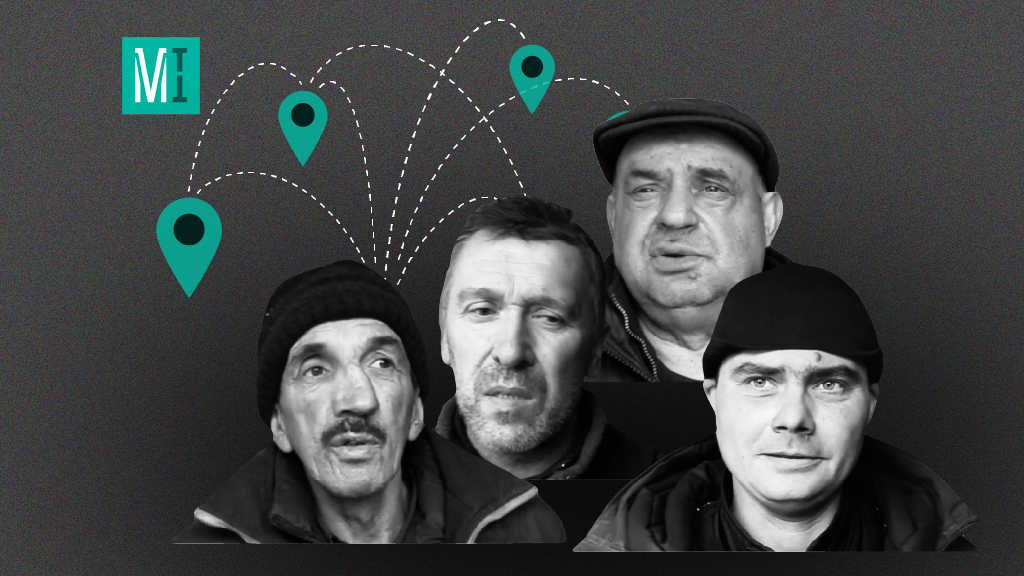
They were riding on school buses—and became hostages. Russia has been holding civilian drivers captive for ten months
Source: MIPL
Four school bus drivers from the Mykolaiv region were detained in Mariupol on April 12. MIPL has already reported on their abduction. However, the men are still being held hostage. Here’s what happened to them and where they might be.
How They Ended Up in Mariupol
All four men—Vladimir Androsovich (62), Vitaliy Profatilov (54), Vitaliy Kuznetsov (37), and Vasyl Malanchuk (55), lived in various towns in the Bashtanka District of the Mykolaiv region and worked in the education system. When Russia’s full-scale invasion began, they were ordered to transport conscripts to their destinations.
“My father lived in the village of Ulyanivka, which is 25 km from Novyi Buh. He was told to transport refugees from Bashtanka to Novyi Buh. But when my father arrived in Bashtanka, he was given a different assignment—to transport conscripts,” recalls Lyudmyla Dibrova, Volodymyr Androsovych’s daughter. “At first, he was supposed to take the soldiers to Novyi Buh, but the head of the military registration and enlistment office said they had to go further.”
They left Novyi Buh in four buses. Androsovich drove one of them, while the other three were driven by Vitaliy Profatilov from the town of Novyi Buh, Vitaliy Kuznetsov from the village of Pryshyb, and Vasyl Malanchuk from the village of Berezneguvate. The latter volunteered to drive—replacing another driver who had been assigned to that particular bus but refused to go.
Thus, four school bus drivers transported the mobilized soldiers. According to their relatives, they were servicemen from the 36th Marine Brigade. “Halfway to Mykolaiv, they were turned back because the situation in Mykolaiv was too dangerous—they couldn’t go there. They went to Mariupol,” says Olga Profatilova.
“He told us, ‘We’re going to Kryvyi Rih. We’ll drop you off, and by evening, I think, we’ll be home,” recalls Margarita Kovalchuk, Vitaly Kuznetsov’s sister. “Then he called us later and said, ‘It looks like we’re not heading to Kryvyi Rih after all.’ Later still, already at night, he reported, ‘We must be near Volnovakha by now, because I see we’ve passed the sign.’ That’s how we ended up in Mariupol.”
We were
no longer able to leave Mariupol
During those days, fierce battles raged around Mariupol. The city was under massive attack by the Russian army. One of the Ukrainian defense strongholds was the Ilyich Mariupol Metallurgical Plant. Having arrived in the city alongside the military, the civilian drivers were unable to return.
“When we arrived in Mariupol, my father said that they first dropped off the conscripts,” says Lyudmila Dibrova. “The city was surrounded by Russian troops. On February 28, the Ilyich Steel Plant was already under heavy fire. The buses couldn’t make it back. An armored personnel carrier (APC) arrived behind them and directed them where to go. They followed the APC at high speed, despite the poor road conditions. They were escorted to the plant. There were bunkers there. And so, starting on February 28, they were at the Ilyich Plant, which stretches for 25 km. Soldiers from the 36th Brigade were also there at the plant. But from what my father said, I understand that the drivers were stationed separately from the soldiers.”
The drivers’ families report that the men wanted to return home and use those same buses to help evacuate local residents, but they didn’t have that opportunity.
“They were surrounded, but they found spots where they could slip out and call us. They said they wanted to help get people out and leave themselves, but they couldn’t manage it. And on TV, we saw that help was on its way from Zaporizhzhia, that there would be an evacuation assembly point at such-and-such a location, and that both private cars and school buses would be used for this. We hoped they’d be able to get out and help people. We’d call them to let them know where they might be allowed to leave and where people were gathering. But the corridor was closed several times due to shelling,” says Lyudmila Dibrova.
The Main Thing Is to Survive
Finding themselves in an unfamiliar place, surrounded by Russian troops, the drivers realized that their main task was to survive.
“My brother told me they were hiding in hangars,” says Margarita Kovalchuk. “I remember he called me somewhere—probably during those days when the drama theater was being bombed. He said there were a lot of casualties. Then things got even worse there. He said that before, they could at least go out somewhere to get some water, but now ‘we’re just sitting here and not sticking our heads out, because it’s hard to even lift our heads. They’re shooting at everything they can—aircraft and whatever else.’” A shell hit the hangar where the buses were parked; my brother sent me a photo of his bus from that hangar.”
The bus from the hangar
“A lot of soldiers would come to where they were staying; they’d chat and drink tea. In early April, they were surrounded, then the occupiers were pushed back 5 km. And then they were surrounded again. The factory was constantly under attack; they were under constant shelling, including from the air. My father said that our soldiers were fighting well and that, if it weren’t for the airstrikes, they would have managed and there wouldn’t have been so many casualties. “The guys fought back; they realized they were being surrounded, but they held out hope for reinforcements until the very end—they believed they’d be able to break out,” says Lyudmila Dibrova.
“My husband is already retired due to length of service (a retired Ministry of Internal Affairs officer). His health is poor; he has a host of illnesses. I’ve heard from others that while he was there, he suffered a heart attack and frostbite on his extremities,” notes Olga Profatilova.
The women report that the drivers also had problems with food.
“They weren’t registered with any military unit. Because of this, no meals were allocated for them,” says Lyudmila Dibrova. “They made friends with some people, asked for food, and cooked something for themselves. During my last few days of communication with my father, I realized that there were other civilians there besides them. He mentioned once that there were nine of them.”
“He said they had some kind of humanitarian aid to eat there. And on April 4, they had just a few cans of food left, and that was it,” says Margarita Kovalchuk. “Then, after the Russians captured them, they posted a video of an interview with them, in which my brother said they had nothing left to eat.”
To call their families, they had to run 500 meters under fire
The drivers’ relatives say they tried to stay in touch with them the whole time, but the connection kept cutting out.
“My father tried to call at least once a day. But in March, the connection was lost for about ten days. In the last few days, when the occupiers had already closed in on the plant, they had to run 500 meters under fire to a spot where they could get a signal,” says Lyudmila Dibrova.
“The last time they called was on April 4,” recalls Olga Profatilova. “The connection was very poor. My husband only managed to say, ‘Hello, hello.’ And that was it—the connection with him was lost.”
According to Margarita Kovalchuk, after about a week had passed, they began searching for their husbands. Then they saw a video online showing that the drivers were being held at the Olenivka Correctional Colony.
As Hostages
Russian troops detained the drivers on April 12 along with part of the 36th Brigade. Their families learned about this from social media. “The Russians posted photos of Androsovich and my husband on a Telegram channel,” says Vitaliy Profatilov’s wife. “They captioned the photos, stating that they were prisoners of war, with each assigned a number. Kuznetsov and Malanchuk weren’t there at first, but later their photos were posted as well, and it was also stated that they were prisoners of war. They also posted a video from the Olenivska penal colony showing the prisoners. There were many of them in the video; they were standing in the colony’s courtyard. In the front rows, I saw my husband; I recognized him by his clothes. In the same video—though it was hard to see clearly—we recognized Androsovich and Kuznetsov; they were standing behind my husband. They had changed a lot; they looked terrible. That’s how we found them. Later, another Russian Telegram channel posted lists of civilians detained by the Russians. On that list of civilians, we saw our four men as well. They also posted a separate video of Androsovich in a penal colony, but we don’t know which one or where they are now. We showed photos of our drivers to some of the guys who’ve already been exchanged, but no one recognizes them.”
Vitaliy Profatilov
“A photo of my father appeared on the Telegram channel,” says Lyudmila, the daughter of Vladimir Androsovich. “He was holding a sign with his last name and date of birth written in his own handwriting. Then we saw a video of them being detained. There’s also a video showing him in a penal colony wearing the same clothes as the prisoners of war. Eight months have passed since then, and we haven’t received a single letter or phone call from my father. It’s very painful to watch him in the latest video—he’s lost a lot of weight, even though he weighed 90 kg before these events.”
Lyudmila Dibrova also does not know where the drivers are now.
“At first, he was in Olenivka. Then, after 32 drivers were released (these were volunteer drivers released from the Olenivka penal colony on July 15, 2022—MIPL), I sent them photos from Telegram channels. They replied that my father had been taken out of Olenivka in early May. His current whereabouts are unknown,” she says.
For each of the drivers’ families, these events have been a severe ordeal.
“My mom has lost a lot of weight during this time and is sick,” admits Lyudmila Dibrova. “There are several children in our family; my youngest brother is 16 years old. He’s a late-in-life child and was very close to his father—he used to go fishing with him and everywhere else—and now he’s having a very hard time coping with his father not being around.”
The war affected the drivers’ families directly in the Bashtanka District when the Russians tried to occupy the Mykolaiv region.
“My brother lived in the village of Pryshyb. It was recently on the front line. The neighboring village of Snigurivka, 15 km away, was under occupation. The Russians surrounded our village in a semicircle and shelled it. Around May 15–16, my brother’s house was hit twice—the roof was blown off, and only the walls remained. But my father patched up the roof a bit,” says Margarita Kovalchuk.
Vitaliy Kuznetsov’s
house
In their search for their loved ones, the three women joined forces. Together, they are also searching for the fourth driver—Vasyl Malanchuk, who has no relatives.
Vasyl Malanchuk
The women note that when they learned the men were being held alongside military personnel, they immediately contacted the relevant government agencies—the police, the Security Service of Ukraine (SBU), the Ukrainian Parliament Commissioner for Human Rights, and the International Committee of the Red Cross. According to unconfirmed information from those who were released, the drivers from the Mykolaiv region were taken to Russia. Their possible location is Kursk Colony No. 1.
“We’re reaching out everywhere, but there’s a lack of coordination among government agencies. No one can confirm the status of our loved ones. It’s sad that when the state needed them, our men fulfilled their civic duty, but now the state can’t help them in any way. I’ve been trying to bring my father home for eight months, but since he’s a civilian, they say there’s no mechanism for his return or for an exchange,” laments Lyudmila Dibrova.
Despite everything, the women hope that their husbands will finally be released. A banner has been hung in downtown Kyiv, on Volodymyr Ivasyuk Avenue (formerly Heroes of Sevastopol Avenue), in support of the drivers illegally detained by the Russians. “We hope that the banner we hung will draw attention to the story of our loved ones,” says Margarita Kovalchuk.
Four school bus drivers from the Mykolaiv region were detained in Mariupol on April 12. MIPL has already reported on their abduction. However, the men are still being held hostage. Here’s what happened to them and where they might be.
How They Ended Up in Mariupol
All four men—Vladimir Androsovich (62), Vitaliy Profatilov (54), Vitaliy Kuznetsov (37), and Vasyl Malanchuk (55), lived in various towns in the Bashtanka District of the Mykolaiv region and worked in the education system. When Russia’s full-scale invasion began, they were ordered to transport conscripts to their destinations.
“My father lived in the village of Ulyanivka, which is 25 km from Novyi Buh. He was told to transport refugees from Bashtanka to Novyi Buh. But when my father arrived in Bashtanka, he was given a different assignment—to transport conscripts,” recalls Lyudmyla Dibrova, Volodymyr Androsovych’s daughter. “At first, he was supposed to take the soldiers to Novyi Buh, but the head of the military registration and enlistment office said they had to go further.”
They left Novyi Buh in four buses. Androsovich drove one of them, while the other three were driven by Vitaliy Profatilov from the town of Novyi Buh, Vitaliy Kuznetsov from the village of Pryshyb, and Vasyl Malanchuk from the village of Berezneguvate. The latter volunteered to drive—replacing another driver who had been assigned to that particular bus but refused to go.
Thus, four school bus drivers transported the mobilized soldiers. According to their relatives, they were servicemen from the 36th Marine Brigade. “Halfway to Mykolaiv, they were turned back because the situation in Mykolaiv was too dangerous—they couldn’t go there. They went to Mariupol,” says Olga Profatilova.
“He told us, ‘We’re going to Kryvyi Rih. We’ll drop you off, and by evening, I think, we’ll be home,” recalls Margarita Kovalchuk, Vitaly Kuznetsov’s sister. “Then he called us later and said, ‘It looks like we’re not heading to Kryvyi Rih after all.’ Later still, already at night, he reported, ‘We must be near Volnovakha by now, because I see we’ve passed the sign.’ That’s how we ended up in Mariupol.”
We were
no longer able to leave Mariupol
During those days, fierce battles raged around Mariupol. The city was under massive attack by the Russian army. One of the Ukrainian defense strongholds was the Ilyich Mariupol Metallurgical Plant. Having arrived in the city alongside the military, the civilian drivers were unable to return.
“When we arrived in Mariupol, my father said that they first dropped off the conscripts,” says Lyudmila Dibrova. “The city was surrounded by Russian troops. On February 28, the Ilyich Steel Plant was already under heavy fire. The buses couldn’t make it back. An armored personnel carrier (APC) arrived behind them and directed them where to go. They followed the APC at high speed, despite the poor road conditions. They were escorted to the plant. There were bunkers there. And so, starting on February 28, they were at the Ilyich Plant, which stretches for 25 km. Soldiers from the 36th Brigade were also there at the plant. But from what my father said, I understand that the drivers were stationed separately from the soldiers.”
The drivers’ families report that the men wanted to return home and use those same buses to help evacuate local residents, but they didn’t have that opportunity.
“They were surrounded, but they found spots where they could slip out and call us. They said they wanted to help get people out and leave themselves, but they couldn’t manage it. And on TV, we saw that help was on its way from Zaporizhzhia, that there would be an evacuation assembly point at such-and-such a location, and that both private cars and school buses would be used for this. We hoped they’d be able to get out and help people. We’d call them to let them know where they might be allowed to leave and where people were gathering. But the corridor was closed several times due to shelling,” says Lyudmila Dibrova.
The Main Thing Is to Survive
Finding themselves in an unfamiliar place, surrounded by Russian troops, the drivers realized that their main task was to survive.
“My brother told me they were hiding in hangars,” says Margarita Kovalchuk. “I remember he called me somewhere—probably during those days when the drama theater was being bombed. He said there were a lot of casualties. Then things got even worse there. He said that before, they could at least go out somewhere to get some water, but now ‘we’re just sitting here and not sticking our heads out, because it’s hard to even lift our heads. They’re shooting at everything they can—aircraft and whatever else.’” A shell hit the hangar where the buses were parked; my brother sent me a photo of his bus from that hangar.”
The bus from the hangar
“A lot of soldiers would come to where they were staying; they’d chat and drink tea. In early April, they were surrounded, then the occupiers were pushed back 5 km. And then they were surrounded again. The factory was constantly under attack; they were under constant shelling, including from the air. My father said that our soldiers were fighting well and that, if it weren’t for the airstrikes, they would have managed and there wouldn’t have been so many casualties. “The guys fought back; they realized they were being surrounded, but they held out hope for reinforcements until the very end—they believed they’d be able to break out,” says Lyudmila Dibrova.
“My husband is already retired due to length of service (a retired Ministry of Internal Affairs officer). His health is poor; he has a host of illnesses. I’ve heard from others that while he was there, he suffered a heart attack and frostbite on his extremities,” notes Olga Profatilova.
The women report that the drivers also had problems with food.
“They weren’t registered with any military unit. Because of this, no meals were allocated for them,” says Lyudmila Dibrova. “They made friends with some people, asked for food, and cooked something for themselves. During my last few days of communication with my father, I realized that there were other civilians there besides them. He mentioned once that there were nine of them.”
“He said they had some kind of humanitarian aid to eat there. And on April 4, they had just a few cans of food left, and that was it,” says Margarita Kovalchuk. “Then, after the Russians captured them, they posted a video of an interview with them, in which my brother said they had nothing left to eat.”
To call their families, they had to run 500 meters under fire
The drivers’ relatives say they tried to stay in touch with them the whole time, but the connection kept cutting out.
“My father tried to call at least once a day. But in March, the connection was lost for about ten days. In the last few days, when the occupiers had already closed in on the plant, they had to run 500 meters under fire to a spot where they could get a signal,” says Lyudmila Dibrova.
“The last time they called was on April 4,” recalls Olga Profatilova. “The connection was very poor. My husband only managed to say, ‘Hello, hello.’ And that was it—the connection with him was lost.”
According to Margarita Kovalchuk, after about a week had passed, they began searching for their husbands. Then they saw a video online showing that the drivers were being held at the Olenivka Correctional Colony.
As Hostages
Russian troops detained the drivers on April 12 along with part of the 36th Brigade. Their families learned about this from social media. “The Russians posted photos of Androsovich and my husband on a Telegram channel,” says Vitaliy Profatilov’s wife. “They captioned the photos, stating that they were prisoners of war, with each assigned a number. Kuznetsov and Malanchuk weren’t there at first, but later their photos were posted as well, and it was also stated that they were prisoners of war. They also posted a video from the Olenivska penal colony showing the prisoners. There were many of them in the video; they were standing in the colony’s courtyard. In the front rows, I saw my husband; I recognized him by his clothes. In the same video—though it was hard to see clearly—we recognized Androsovich and Kuznetsov; they were standing behind my husband. They had changed a lot; they looked terrible. That’s how we found them. Later, another Russian Telegram channel posted lists of civilians detained by the Russians. On that list of civilians, we saw our four men as well. They also posted a separate video of Androsovich in a penal colony, but we don’t know which one or where they are now. We showed photos of our drivers to some of the guys who’ve already been exchanged, but no one recognizes them.”
Vitaliy Profatilov
“A photo of my father appeared on the Telegram channel,” says Lyudmila, the daughter of Vladimir Androsovich. “He was holding a sign with his last name and date of birth written in his own handwriting. Then we saw a video of them being detained. There’s also a video showing him in a penal colony wearing the same clothes as the prisoners of war. Eight months have passed since then, and we haven’t received a single letter or phone call from my father. It’s very painful to watch him in the latest video—he’s lost a lot of weight, even though he weighed 90 kg before these events.”
Lyudmila Dibrova also does not know where the drivers are now.
“At first, he was in Olenivka. Then, after 32 drivers were released (these were volunteer drivers released from the Olenivka penal colony on July 15, 2022—MIPL), I sent them photos from Telegram channels. They replied that my father had been taken out of Olenivka in early May. His current whereabouts are unknown,” she says.
For each of the drivers’ families, these events have been a severe ordeal.
“My mom has lost a lot of weight during this time and is sick,” admits Lyudmila Dibrova. “There are several children in our family; my youngest brother is 16 years old. He’s a late-in-life child and was very close to his father—he used to go fishing with him and everywhere else—and now he’s having a very hard time coping with his father not being around.”
The war affected the drivers’ families directly in the Bashtanka District when the Russians tried to occupy the Mykolaiv region.
“My brother lived in the village of Pryshyb. It was recently on the front line. The neighboring village of Snigurivka, 15 km away, was under occupation. The Russians surrounded our village in a semicircle and shelled it. Around May 15–16, my brother’s house was hit twice—the roof was blown off, and only the walls remained. But my father patched up the roof a bit,” says Margarita Kovalchuk.
Vitaliy Kuznetsov’s
house
In their search for their loved ones, the three women joined forces. Together, they are also searching for the fourth driver—Vasyl Malanchuk, who has no relatives.
Vasyl Malanchuk
The women note that when they learned the men were being held alongside military personnel, they immediately contacted the relevant government agencies—the police, the Security Service of Ukraine (SBU), the Ukrainian Parliament Commissioner for Human Rights, and the International Committee of the Red Cross. According to unconfirmed information from those who were released, the drivers from the Mykolaiv region were taken to Russia. Their possible location is Kursk Colony No. 1.
“We’re reaching out everywhere, but there’s a lack of coordination among government agencies. No one can confirm the status of our loved ones. It’s sad that when the state needed them, our men fulfilled their civic duty, but now the state can’t help them in any way. I’ve been trying to bring my father home for eight months, but since he’s a civilian, they say there’s no mechanism for his return or for an exchange,” laments Lyudmila Dibrova.
Despite everything, the women hope that their husbands will finally be released. A banner has been hung in downtown Kyiv, on Volodymyr Ivasyuk Avenue (formerly Heroes of Sevastopol Avenue), in support of the drivers illegally detained by the Russians. “We hope that the banner we hung will draw attention to the story of our loved ones,” says Margarita Kovalchuk.
This is an automatic translation generated by DeepL.