“They pulled out a gun and said, ‘No lawyer for you.’” Lenie Umerova’s account of her abduction and unlawful detention in Russia
Source: Grati
Author: Anastasia Moskvichova
Leniye Umerova is one of the first Crimean Tatars imprisoned in Russia for political reasons whose release Ukraine has secured in recent years. In December 2022, she was abducted at the Georgian-Russian border while traveling from Kyiv to Russian-occupied Crimea to support her father, who had fallen seriously ill. At first, Russian security forces filed reports against her alleging fabricated administrative offenses, then transferred her to the Lefortovo pretrial detention center and charged her with espionage.
The case never went to trial: Leniye was released along with several other civilians as part of a prisoner-of-war exchange on September 13, 2024. A total of 69 Ukrainian citizens returned home at that time.
“Grati” spoke with Leniye Umerova about the Russian “administrative merry-go-round” in the Caucasus, the conditions of detention for political prisoners in various Russian detention centers, planted cellmates, psychological pressure, and the circumstances of the exchange.
“The Person Who Should Be There in Difficult Times”
I was born in 1998 in Crimea. In 2014, I was in tenth grade, and when the annexation of Crimea took place, I really didn’t like the attitude [toward it] of the so-called adults at school.
I began to feel contempt for the people who were supposed to be role models for me at the time. I refused to go to school. So my family decided that I would move and attend school near Kyiv. I graduated from high school there, then went on to university, and after that worked as a marketer.
I worked there until the full-scale invasion, until November 2022, when I found out that my dad was having health problems: his illness had relapsed, and he needed immediate surgery.
I decided very quickly that I had to go and support my father—as his daughter, as someone who needs to be by his side during difficult times. After packing my things, I told almost no one; I traveled through several countries, following what seemed to me at the time to be the best route, the best way.
I was just driving along without a care in the world, crossed the Georgian border—everything was fine. And at the border crossing into the Russian Federation, border guards stopped me and started asking for my documents—I showed them. Then they say, “Well, wait a minute, wait a minute.” Some people arrive and take me away. In fact, it was a kidnapping, because there’s no official explanation for it.
“This is my job. I’m taking you away.”
At first, during the initial interrogation, when I asked for a lawyer, they refused. They pulled out a gun and said, “No lawyer.” They started making threats. The interrogation lasted about 8 hours; after that, they let me go and said, “You can go home. Now you’re going to a hotel,” because it was already half past one in the morning. They sent me to a hotel in a taxi. “And after that, you can continue on your way home.”
I got into the taxi then, and after that, they detained me again. Legally, it was framed as if I had crossed a road in North Ossetia without special permission. There’s a legal provision stating that foreign citizens are not allowed to drive on intercity roads, but only on certain routes. And this taxi took me on exactly that kind of road—an intercity one.
The taxi driver was stopped at a traffic police checkpoint; [the officer] asked for his documents, checked them, and then asked for my documents as a passenger. I handed them over. He looked them over, saw that this particular document was missing, and asked me where it was. I said, “Well, you can see from the stamp that I just arrived. I haven’t had a chance to get it yet.” To which he replied, “There’s nothing I can do here. This is my job. I’m taking you to the police station, and there, the authorized officials will decide what to do with you next.”
After that, they took me to the police station, and then to court. The hearing took place at four in the morning. I was prohibited from using the services of a lawyer.
And at five in the morning, I was already taken to the Center for Temporary Detention of Foreign Citizens (Russian: ЦВСИГ — Центр временного содержания иностранных граждан). The court’s verdict was deportation and a fine of 2,000 rubles.
But the deportation procedure works like this: you’re placed in this center, and then diplomats and consular offices from both countries decide where to deport you from and where to deport you to. But because there are no diplomatic relations between Ukraine and Russia—since there is a full-scale war between us, and we are at war with that country—it is impossible to deport Ukrainians anywhere, so they remain detained.
The Administrative “Carousel”
After we appealed my sentence to the Court of Cassation, I was released from the Central Detention Facility at 10 p.m.: a car pulled up, they put a bag over my head, and took me somewhere; they drove for about half an hour, then they stopped somewhere in the middle of the city and dropped me off.
When they took the bag off my head, I saw police officers approaching me again—they were apparently looking for “stashers”—drug couriers who hide packages of drugs in specific locations, which they reveal to buyers once they’ve paid—and they asked for my passport. I started looking for it. You’re still too overwhelmed by your emotions to fully understand what these people want from you; you start looking for your documents, and they take you by the arms and tell you, “You didn’t want to give us your passport, so we’re taking you to the police station.”
That’s when they drew up the first report of an administrative offense against me. Then, apparently, I refused to hand over my phone after a walk. Then I refused to get out of the police van several times. In other words, every time it was a completely fabricated story.
I think I was in every court in North Ossetia during that time, because we appealed every verdict. They took us to the Court of Appeals, and each time—for every verdict—I had five or six of them—they took us to a different court.
At one point, my parents, who had come to Vladikavkaz, were allowed to visit me, but the visits were very brief. We managed to meet once every 15 days, but for that to happen, my parents first had to find me—figure out which pretrial detention center or temporary detention facility I’d been sent to. And during these “carousel”-style detentions, I was sent to various temporary detention centers, and from there I would somehow try each time to let them know exactly where I was. This was done specifically to hide me from my lawyers.
“She tried to get me to talk”
The conditions I found myself in varied greatly because each place of detention had its own specific characteristics. They allowed care packages, but they inspected absolutely everything that was sent to me.
There were various situations. There were a great many violations, ranging from a lack of basic hygiene to the fact that at one facility—I don’t remember exactly where, I think it was in Beslan—I was simply fed only once a day. So there were situations like that—all kinds of them.
At some point, my nervous system couldn’t take it anymore—this whole ordeal—and I started feeling sick. I went up to the person who was holding me and said that I wasn’t feeling well and needed some medicine. He said, “Well, I can only give you a phone. If someone—a lawyer or maybe some relatives—brings you medicine, then you’ll get it. We don’t have anything. There’s nothing we can do.” So those were the conditions.
When I was in Vladikavkaz, during one of my stays there, they put a woman in the cell next to mine. She started talking to me, but my strategy was not to talk to anyone, because it wasn’t clear how they would use those words against me. That was obvious to me at the time.
But she tried to get me to talk. This girl told me some stories from her life. At one point, she started saying that they were holding her there because they’d taken her phone away, and her boyfriend was fighting in the Kharkiv region, and apparently, there might be some information on her phone. That’s how she put it to me. And it was said almost in passing, but I clearly remember that I was detained in December, while Kharkiv, I think, was liberated either in November or October. So, based on my own understanding of the world, I figured everything in Kharkiv should be okay, but she says he’s fighting there. Well, it just didn’t add up for me. I’ll keep a close eye on her, I think. Meanwhile, she’s telling me her whole life story. And at some point she starts saying, “I’m sick, and it seems like your dad is sick too.” But I realize I didn’t say that—I didn’t say anything at all. I look her in the eyes and say, “I didn’t tell you that.” Less than half an hour later, some people came and told [my neighbor], “We’ve checked you out; we can let you go.” And they took her away, took her belongings.
The situation changed in early May 2023. They woke me up in the morning and told me that someone had come to see me. A man came in and told me to read a statement on camera. He had a prepared text that I was supposed to recite—and they said they would supposedly take me to be exchanged. I said, “A lawyer. I won’t say anything without a lawyer.” To which they replied that if a lawyer were present, the offer would be canceled. I said, “I need a lawyer anyway.” He said, “If you don’t want one, then we’re taking you to Lefortovo.” And that was it. They took me away, put me in a cell in the morning, and by evening they had already taken me to the first division of the FSB Investigative Directorate, where they announced right there that I was being charged.
“The harshest prison in terms of conditions of detention”
Lefortovo is the harshest prison in terms of living conditions; there, there are only 1–2 people per cell. The cells are very small. At one point, the hardest part was that if your lawyer didn’t come to see you, you could go weeks—or even months—without speaking to anyone at all, except during the morning head count—you just sit there and stay silent. And that really takes a toll on you. And now I feel that I’m still dealing with the consequences of that.
They’d take me out of one cell and put me in another. So my cell was about 8 square meters. And so they lead you down the hallway to the 5th floor, and there you walk around in the same kind of cell, but without any furniture—that is, an empty cell with an open ceiling covered by a mesh net. And a man walks around above, making sure everything is okay, that you don’t escape anywhere.
Another thing about the conditions at Lefortovo—they played propaganda. Especially during exercise time. They’d turn on the radio—I think it’s called “Vesti-FM”—and amid all the other propaganda, you’d sometimes hear interrogations of Ukrainian prisoners of war, where they supposedly confess to some war crimes. Stories like that, in other words.
The food provided by the detention center is peculiar. Most of the time, they serve potatoes with cabbage and some chicken of absolutely terrible quality. It’s over-frozen… it doesn’t matter—it’s very hard to eat. Because your body simply isn’t getting the vitamins it needs, at some point your body just says, “We’ve got a problem here; we need to find something.” And at some point—I think it was winter, early spring—I just realized that I hadn’t eaten any decent meat in so long that I was starting to pass out. A few times, you know, I was almost unconscious when I went to the bathhouse. By then I’d already asked my relatives for help; they sent me some vitamins, and we’ve more or less sorted that out.
There’s a lot of red tape involved. First, you have to write a request to the detention center doctor, and he has to approve it. The doctor calls you in, asks why you need it, and you explain that you have health issues that need to be addressed somehow. Then he approves it, forwards it to another department that handles these packages, and only then are they allowed through. That whole process takes about two months. If you request something, you have two months to get everything ready in time so they’ll let it through.
But I’ve actually seen with my own eyes that they go through my packages, sort through them, and inspect absolutely everything inside. A chocolate bar arrives—it’s broken in half. God forbid there’s anything inside. When they were taking me to the exchange, they gave me all my belongings. I tried to pack them up and realized I had four pairs of shoes sitting in storage. In other words, my family had sent me four pairs of shoes, and after half a year—with a lot of hassle—they gave me back only one pair.
“The women I was imprisoned with were all ‘political prisoners’”
I think it was in November 2023 when they assigned my first cellmate to me. We were together for a month, and then I was immediately moved to another cellmate, with whom I’d already spent four or five months. Literally two or three weeks before the transfer—or maybe a month before—they assigned my last cellmate to me. That’s how long it lasted. All in all, roughly speaking, I spent about 7 months of my entire sentence with a cellmate.
The [Russian] women I was imprisoned with were all “political prisoners”: two of them were charged with “treason,” and one with “terrorism.” Everyone understood that we shouldn’t say anything unnecessary, so we only talked about the weather, the birds around us, and the food. Just that sort of thing—absolutely minimal communication.
I managed to strike up a conversation with my one cellmate. She told me about herself and her story—apparently, at the start of the full-scale invasion, she sent 5,000 rubles to the Ukrainian Armed Forces to help buy ammunition, and for that, she was arrested in early 2023 and sent to a pretrial detention center. Later, she was sentenced to 12 years in prison.
While we’re kept in cells alone or in pairs, when they transfer us to the police van, the conditions are less strict, and you can talk to the people inside. That’s when I met some [Ukrainian] women. One of them was charged with “terrorism” and “espionage,” if I’m not mistaken. That’s what she was charged with. She was detained with two young men [in Russian-occupied territory]. They were interrogated very harshly there, beaten—they broke her jaw and knocked out some of her teeth. And I just remember that when I spoke with her, her jaw was clicking very loudly because it had been broken.
Another woman was taken right from her home [in the occupied territory]. Once they brought her to a dug-out pit and said, “If you confess to us, we’ll let you go. If not, we’ll just shoot you right here. We’ll either shoot you or even bury you alive. And we won’t tell anyone where you are.”
“Red Viburnum”
It was also December. I was being led back from a walk, and, you know, that’s the human factor for you—the guard who was leading me simply mixed up the cell numbers and took me into some separate room. It was a Saturday, I don’t know—maybe they had some kind of holiday. He opened the cell and led me inside. Everyone looked up, and then they realized they’d put me in the wrong cell—there was already a person lying on the bed there.
They just grabbed me by the collar, dragged me out of that cell, and locked me in another one—which wasn’t mine either. I start banging on the wall—it’s the wall between our cells. I start banging; I just started banging at first, and then I think, “I’ll try to tap out ‘Oh, the red viburnum in the meadow.’” And I realize they understood me, so they pick up the rhythm and start banging back. So I tapped out the verse, and he tapped out the chorus for me. And then we were being transported with other prisoners in police vans, and I told them this story, and they said, “I know who’s in there. That’s our DRG guy (DRG—sabotage and reconnaissance group).” So they’d captured him there and brought him in.
“The guard yells: ‘Girkin!’”
We once traveled with Girkin. Former FSB officer Igor Girkin. In March 2014, he participated in the annexation of Crimea, and in April, the unit he commanded seized Sloviansk in the Donetsk region; from May to August 2014, he held the position of “defense minister” in the “DPR” group. In 2022, he was found guilty by a Dutch court, along with two other “DPR” militants, of shooting down a Malaysia Airlines Boeing over Donetsk Oblast and causing the deaths of 298 people; he was sentenced to life in prison. In 2024, he was convicted in Russia for inciting extremism through posts criticizing the Russian government on his Telegram channel. They were taking me to court. No, actually, I was being taken for a psychological and psychiatric evaluation.
You have to understand how police vans are set up: there are two long, enclosed compartments—women are seated on one side, men on the other. The women can’t see the men, and the men can’t see the women. We pulled up to the Moscow City Court, and they began leading people out one by one. There, they first call out a person’s last name; the person gets ready, steps forward, is led out, then stands in that hallway for a moment—about two minutes—and then they’re handcuffed and led away.
And then some guard yells, “Girkin!” And there we are with the girls—a few of us Ukrainian women—and we look up. Wow! I was so scared. I realized I had to react to the situation somehow. And I thought, “Oh my God, what should I do? What should I say?” I just shouted, “Glory to Ukraine!” Of course, he didn’t respond. He lowered his head slightly and walked away. A week later, volunteers sent me some very short letters with updates, and they said that he had a court hearing that day—his first hearing.
The Exchange
They took me away a little earlier, a few days before the exchange, because they were transferring me to another detention center. When I later checked the maps, it was roughly Bryansk—most likely, they were taking me from there.
On the morning of September 11, guards came into my cell and told me to pack my things. I handed over everything I had, and they put me in a police van. And on the way, while we were driving, they picked up three more people in Moscow.
Since the distance between Moscow and where they were taking us was very long, the drive took about 12 hours. They took us out of the van a few times; once they took us to the restroom, and we managed to chat a little there: where we were from, where we were going, and what was happening. It turned out they were also Ukrainians. And then at some point, the guard who was in the car with us also got out, and we managed to talk to a man who was traveling with us along the way. He turned out to be a soldier who had been held captive since early 2022—since April, I think. He’s a medic from Mariupol. Interestingly, they didn’t put all of us in one place, but in different compartments. And for me, this was the first time I’d traveled exclusively with Ukrainians. I realized something was going on—it was strange.
They brought us to Bryansk, leading us in with bags over our heads. There, they checked us, took our photos, and questioned us. Then they took us to a cell, where I spent the night of the 11th, the entire day of the 12th, and the morning of the 13th. Then they lined us all up, asked for our last names, and led us onto a bus—a plain, civilian bus.
By then, we all had a final, complete understanding of where we were going. And the girls and I just started smiling at each other, to which we were, of course, told, “Keep your heads down! Sit very quietly—no smiling!” But by then, you just can’t hold that energy inside anymore.
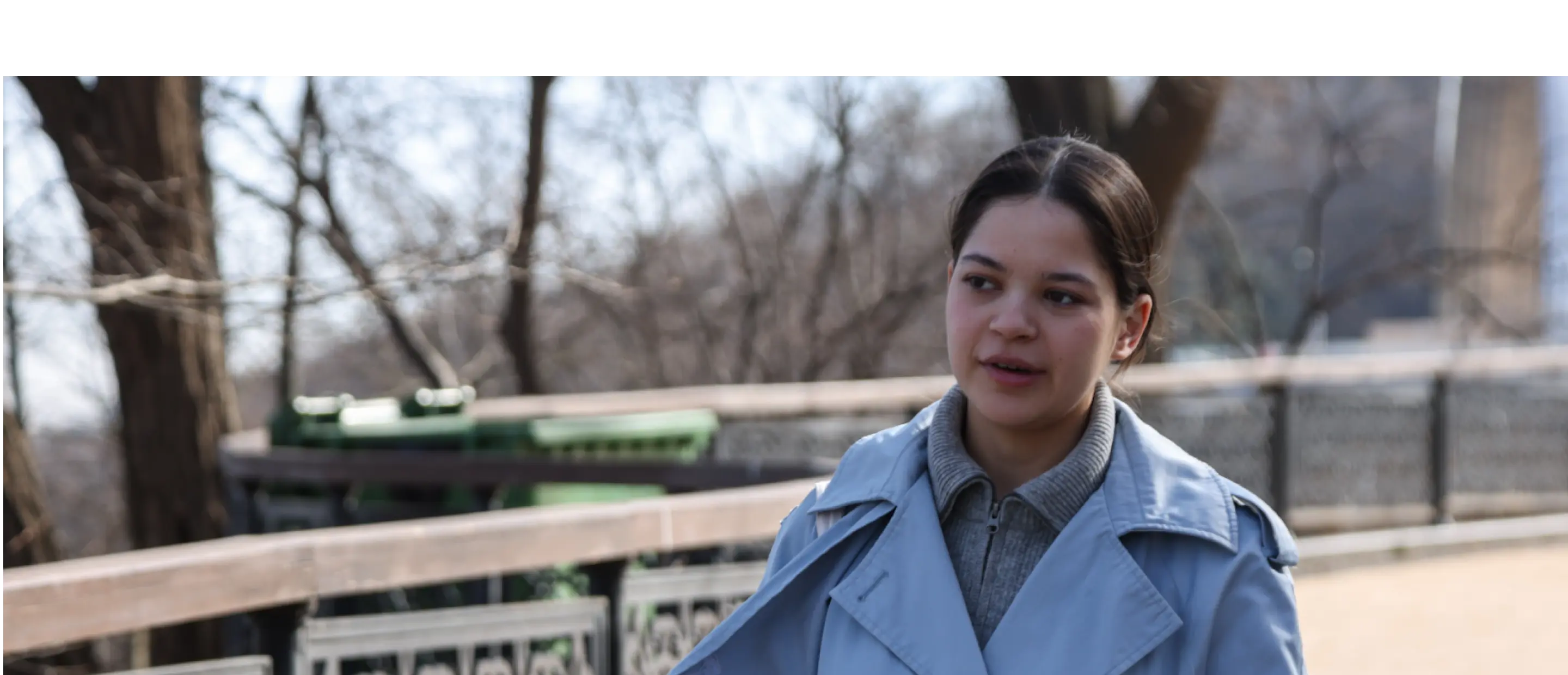
Lenia Umerova, Kyiv, March 6, 2025. Photo: Stas Yurchenko, Grati
The drive to the Belarusian border didn’t take very long—I don’t know, maybe half an hour to an hour, I guess. The Russian officials left, and the Belarusians came in. We’d already been fully briefed and instructed on where we were going, what was happening, and that we were being sent for an exchange. They handed us a “gift” from “Dad”—a bag of food, some fruit, vegetables, some hot and cold items.
I took the bag and shoved it under my seat, you know. I left it there—well, I didn’t need it. We went through some basic briefing—and then they drove us to the border with Ukraine. We walked in a single file in one direction—the Ukrainians—and the Russians being exchanged walked in a single file opposite us. And that was it. And then you already know the rest of the story, how everything went.
You can also listen to Leniye Umerova’s story on our podcast “Defender. Imayeci.”
***
This material was produced with the support of the Ministry of Foreign Affairs of the Netherlands
Author: Anastasia Moskvichova
Leniye Umerova is one of the first Crimean Tatars imprisoned in Russia for political reasons whose release Ukraine has secured in recent years. In December 2022, she was abducted at the Georgian-Russian border while traveling from Kyiv to Russian-occupied Crimea to support her father, who had fallen seriously ill. At first, Russian security forces filed reports against her alleging fabricated administrative offenses, then transferred her to the Lefortovo pretrial detention center and charged her with espionage.
The case never went to trial: Leniye was released along with several other civilians as part of a prisoner-of-war exchange on September 13, 2024. A total of 69 Ukrainian citizens returned home at that time.
“Grati” spoke with Leniye Umerova about the Russian “administrative merry-go-round” in the Caucasus, the conditions of detention for political prisoners in various Russian detention centers, planted cellmates, psychological pressure, and the circumstances of the exchange.
“The Person Who Should Be There in Difficult Times”
I was born in 1998 in Crimea. In 2014, I was in tenth grade, and when the annexation of Crimea took place, I really didn’t like the attitude [toward it] of the so-called adults at school.
I began to feel contempt for the people who were supposed to be role models for me at the time. I refused to go to school. So my family decided that I would move and attend school near Kyiv. I graduated from high school there, then went on to university, and after that worked as a marketer.
I worked there until the full-scale invasion, until November 2022, when I found out that my dad was having health problems: his illness had relapsed, and he needed immediate surgery.
I decided very quickly that I had to go and support my father—as his daughter, as someone who needs to be by his side during difficult times. After packing my things, I told almost no one; I traveled through several countries, following what seemed to me at the time to be the best route, the best way.
I was just driving along without a care in the world, crossed the Georgian border—everything was fine. And at the border crossing into the Russian Federation, border guards stopped me and started asking for my documents—I showed them. Then they say, “Well, wait a minute, wait a minute.” Some people arrive and take me away. In fact, it was a kidnapping, because there’s no official explanation for it.
“This is my job. I’m taking you away.”
At first, during the initial interrogation, when I asked for a lawyer, they refused. They pulled out a gun and said, “No lawyer.” They started making threats. The interrogation lasted about 8 hours; after that, they let me go and said, “You can go home. Now you’re going to a hotel,” because it was already half past one in the morning. They sent me to a hotel in a taxi. “And after that, you can continue on your way home.”
I got into the taxi then, and after that, they detained me again. Legally, it was framed as if I had crossed a road in North Ossetia without special permission. There’s a legal provision stating that foreign citizens are not allowed to drive on intercity roads, but only on certain routes. And this taxi took me on exactly that kind of road—an intercity one.
The taxi driver was stopped at a traffic police checkpoint; [the officer] asked for his documents, checked them, and then asked for my documents as a passenger. I handed them over. He looked them over, saw that this particular document was missing, and asked me where it was. I said, “Well, you can see from the stamp that I just arrived. I haven’t had a chance to get it yet.” To which he replied, “There’s nothing I can do here. This is my job. I’m taking you to the police station, and there, the authorized officials will decide what to do with you next.”
After that, they took me to the police station, and then to court. The hearing took place at four in the morning. I was prohibited from using the services of a lawyer.
And at five in the morning, I was already taken to the Center for Temporary Detention of Foreign Citizens (Russian: ЦВСИГ — Центр временного содержания иностранных граждан). The court’s verdict was deportation and a fine of 2,000 rubles.
But the deportation procedure works like this: you’re placed in this center, and then diplomats and consular offices from both countries decide where to deport you from and where to deport you to. But because there are no diplomatic relations between Ukraine and Russia—since there is a full-scale war between us, and we are at war with that country—it is impossible to deport Ukrainians anywhere, so they remain detained.
The Administrative “Carousel”
After we appealed my sentence to the Court of Cassation, I was released from the Central Detention Facility at 10 p.m.: a car pulled up, they put a bag over my head, and took me somewhere; they drove for about half an hour, then they stopped somewhere in the middle of the city and dropped me off.
When they took the bag off my head, I saw police officers approaching me again—they were apparently looking for “stashers”—drug couriers who hide packages of drugs in specific locations, which they reveal to buyers once they’ve paid—and they asked for my passport. I started looking for it. You’re still too overwhelmed by your emotions to fully understand what these people want from you; you start looking for your documents, and they take you by the arms and tell you, “You didn’t want to give us your passport, so we’re taking you to the police station.”
That’s when they drew up the first report of an administrative offense against me. Then, apparently, I refused to hand over my phone after a walk. Then I refused to get out of the police van several times. In other words, every time it was a completely fabricated story.
I think I was in every court in North Ossetia during that time, because we appealed every verdict. They took us to the Court of Appeals, and each time—for every verdict—I had five or six of them—they took us to a different court.
At one point, my parents, who had come to Vladikavkaz, were allowed to visit me, but the visits were very brief. We managed to meet once every 15 days, but for that to happen, my parents first had to find me—figure out which pretrial detention center or temporary detention facility I’d been sent to. And during these “carousel”-style detentions, I was sent to various temporary detention centers, and from there I would somehow try each time to let them know exactly where I was. This was done specifically to hide me from my lawyers.
“She tried to get me to talk”
The conditions I found myself in varied greatly because each place of detention had its own specific characteristics. They allowed care packages, but they inspected absolutely everything that was sent to me.
There were various situations. There were a great many violations, ranging from a lack of basic hygiene to the fact that at one facility—I don’t remember exactly where, I think it was in Beslan—I was simply fed only once a day. So there were situations like that—all kinds of them.
At some point, my nervous system couldn’t take it anymore—this whole ordeal—and I started feeling sick. I went up to the person who was holding me and said that I wasn’t feeling well and needed some medicine. He said, “Well, I can only give you a phone. If someone—a lawyer or maybe some relatives—brings you medicine, then you’ll get it. We don’t have anything. There’s nothing we can do.” So those were the conditions.
When I was in Vladikavkaz, during one of my stays there, they put a woman in the cell next to mine. She started talking to me, but my strategy was not to talk to anyone, because it wasn’t clear how they would use those words against me. That was obvious to me at the time.
But she tried to get me to talk. This girl told me some stories from her life. At one point, she started saying that they were holding her there because they’d taken her phone away, and her boyfriend was fighting in the Kharkiv region, and apparently, there might be some information on her phone. That’s how she put it to me. And it was said almost in passing, but I clearly remember that I was detained in December, while Kharkiv, I think, was liberated either in November or October. So, based on my own understanding of the world, I figured everything in Kharkiv should be okay, but she says he’s fighting there. Well, it just didn’t add up for me. I’ll keep a close eye on her, I think. Meanwhile, she’s telling me her whole life story. And at some point she starts saying, “I’m sick, and it seems like your dad is sick too.” But I realize I didn’t say that—I didn’t say anything at all. I look her in the eyes and say, “I didn’t tell you that.” Less than half an hour later, some people came and told [my neighbor], “We’ve checked you out; we can let you go.” And they took her away, took her belongings.
The situation changed in early May 2023. They woke me up in the morning and told me that someone had come to see me. A man came in and told me to read a statement on camera. He had a prepared text that I was supposed to recite—and they said they would supposedly take me to be exchanged. I said, “A lawyer. I won’t say anything without a lawyer.” To which they replied that if a lawyer were present, the offer would be canceled. I said, “I need a lawyer anyway.” He said, “If you don’t want one, then we’re taking you to Lefortovo.” And that was it. They took me away, put me in a cell in the morning, and by evening they had already taken me to the first division of the FSB Investigative Directorate, where they announced right there that I was being charged.
“The harshest prison in terms of conditions of detention”
Lefortovo is the harshest prison in terms of living conditions; there, there are only 1–2 people per cell. The cells are very small. At one point, the hardest part was that if your lawyer didn’t come to see you, you could go weeks—or even months—without speaking to anyone at all, except during the morning head count—you just sit there and stay silent. And that really takes a toll on you. And now I feel that I’m still dealing with the consequences of that.
They’d take me out of one cell and put me in another. So my cell was about 8 square meters. And so they lead you down the hallway to the 5th floor, and there you walk around in the same kind of cell, but without any furniture—that is, an empty cell with an open ceiling covered by a mesh net. And a man walks around above, making sure everything is okay, that you don’t escape anywhere.
Another thing about the conditions at Lefortovo—they played propaganda. Especially during exercise time. They’d turn on the radio—I think it’s called “Vesti-FM”—and amid all the other propaganda, you’d sometimes hear interrogations of Ukrainian prisoners of war, where they supposedly confess to some war crimes. Stories like that, in other words.
The food provided by the detention center is peculiar. Most of the time, they serve potatoes with cabbage and some chicken of absolutely terrible quality. It’s over-frozen… it doesn’t matter—it’s very hard to eat. Because your body simply isn’t getting the vitamins it needs, at some point your body just says, “We’ve got a problem here; we need to find something.” And at some point—I think it was winter, early spring—I just realized that I hadn’t eaten any decent meat in so long that I was starting to pass out. A few times, you know, I was almost unconscious when I went to the bathhouse. By then I’d already asked my relatives for help; they sent me some vitamins, and we’ve more or less sorted that out.
There’s a lot of red tape involved. First, you have to write a request to the detention center doctor, and he has to approve it. The doctor calls you in, asks why you need it, and you explain that you have health issues that need to be addressed somehow. Then he approves it, forwards it to another department that handles these packages, and only then are they allowed through. That whole process takes about two months. If you request something, you have two months to get everything ready in time so they’ll let it through.
But I’ve actually seen with my own eyes that they go through my packages, sort through them, and inspect absolutely everything inside. A chocolate bar arrives—it’s broken in half. God forbid there’s anything inside. When they were taking me to the exchange, they gave me all my belongings. I tried to pack them up and realized I had four pairs of shoes sitting in storage. In other words, my family had sent me four pairs of shoes, and after half a year—with a lot of hassle—they gave me back only one pair.
“The women I was imprisoned with were all ‘political prisoners’”
I think it was in November 2023 when they assigned my first cellmate to me. We were together for a month, and then I was immediately moved to another cellmate, with whom I’d already spent four or five months. Literally two or three weeks before the transfer—or maybe a month before—they assigned my last cellmate to me. That’s how long it lasted. All in all, roughly speaking, I spent about 7 months of my entire sentence with a cellmate.
The [Russian] women I was imprisoned with were all “political prisoners”: two of them were charged with “treason,” and one with “terrorism.” Everyone understood that we shouldn’t say anything unnecessary, so we only talked about the weather, the birds around us, and the food. Just that sort of thing—absolutely minimal communication.
I managed to strike up a conversation with my one cellmate. She told me about herself and her story—apparently, at the start of the full-scale invasion, she sent 5,000 rubles to the Ukrainian Armed Forces to help buy ammunition, and for that, she was arrested in early 2023 and sent to a pretrial detention center. Later, she was sentenced to 12 years in prison.
While we’re kept in cells alone or in pairs, when they transfer us to the police van, the conditions are less strict, and you can talk to the people inside. That’s when I met some [Ukrainian] women. One of them was charged with “terrorism” and “espionage,” if I’m not mistaken. That’s what she was charged with. She was detained with two young men [in Russian-occupied territory]. They were interrogated very harshly there, beaten—they broke her jaw and knocked out some of her teeth. And I just remember that when I spoke with her, her jaw was clicking very loudly because it had been broken.
Another woman was taken right from her home [in the occupied territory]. Once they brought her to a dug-out pit and said, “If you confess to us, we’ll let you go. If not, we’ll just shoot you right here. We’ll either shoot you or even bury you alive. And we won’t tell anyone where you are.”
“Red Viburnum”
It was also December. I was being led back from a walk, and, you know, that’s the human factor for you—the guard who was leading me simply mixed up the cell numbers and took me into some separate room. It was a Saturday, I don’t know—maybe they had some kind of holiday. He opened the cell and led me inside. Everyone looked up, and then they realized they’d put me in the wrong cell—there was already a person lying on the bed there.
They just grabbed me by the collar, dragged me out of that cell, and locked me in another one—which wasn’t mine either. I start banging on the wall—it’s the wall between our cells. I start banging; I just started banging at first, and then I think, “I’ll try to tap out ‘Oh, the red viburnum in the meadow.’” And I realize they understood me, so they pick up the rhythm and start banging back. So I tapped out the verse, and he tapped out the chorus for me. And then we were being transported with other prisoners in police vans, and I told them this story, and they said, “I know who’s in there. That’s our DRG guy (DRG—sabotage and reconnaissance group).” So they’d captured him there and brought him in.
“The guard yells: ‘Girkin!’”
We once traveled with Girkin. Former FSB officer Igor Girkin. In March 2014, he participated in the annexation of Crimea, and in April, the unit he commanded seized Sloviansk in the Donetsk region; from May to August 2014, he held the position of “defense minister” in the “DPR” group. In 2022, he was found guilty by a Dutch court, along with two other “DPR” militants, of shooting down a Malaysia Airlines Boeing over Donetsk Oblast and causing the deaths of 298 people; he was sentenced to life in prison. In 2024, he was convicted in Russia for inciting extremism through posts criticizing the Russian government on his Telegram channel. They were taking me to court. No, actually, I was being taken for a psychological and psychiatric evaluation.
You have to understand how police vans are set up: there are two long, enclosed compartments—women are seated on one side, men on the other. The women can’t see the men, and the men can’t see the women. We pulled up to the Moscow City Court, and they began leading people out one by one. There, they first call out a person’s last name; the person gets ready, steps forward, is led out, then stands in that hallway for a moment—about two minutes—and then they’re handcuffed and led away.
And then some guard yells, “Girkin!” And there we are with the girls—a few of us Ukrainian women—and we look up. Wow! I was so scared. I realized I had to react to the situation somehow. And I thought, “Oh my God, what should I do? What should I say?” I just shouted, “Glory to Ukraine!” Of course, he didn’t respond. He lowered his head slightly and walked away. A week later, volunteers sent me some very short letters with updates, and they said that he had a court hearing that day—his first hearing.
The Exchange
They took me away a little earlier, a few days before the exchange, because they were transferring me to another detention center. When I later checked the maps, it was roughly Bryansk—most likely, they were taking me from there.
On the morning of September 11, guards came into my cell and told me to pack my things. I handed over everything I had, and they put me in a police van. And on the way, while we were driving, they picked up three more people in Moscow.
Since the distance between Moscow and where they were taking us was very long, the drive took about 12 hours. They took us out of the van a few times; once they took us to the restroom, and we managed to chat a little there: where we were from, where we were going, and what was happening. It turned out they were also Ukrainians. And then at some point, the guard who was in the car with us also got out, and we managed to talk to a man who was traveling with us along the way. He turned out to be a soldier who had been held captive since early 2022—since April, I think. He’s a medic from Mariupol. Interestingly, they didn’t put all of us in one place, but in different compartments. And for me, this was the first time I’d traveled exclusively with Ukrainians. I realized something was going on—it was strange.
They brought us to Bryansk, leading us in with bags over our heads. There, they checked us, took our photos, and questioned us. Then they took us to a cell, where I spent the night of the 11th, the entire day of the 12th, and the morning of the 13th. Then they lined us all up, asked for our last names, and led us onto a bus—a plain, civilian bus.
By then, we all had a final, complete understanding of where we were going. And the girls and I just started smiling at each other, to which we were, of course, told, “Keep your heads down! Sit very quietly—no smiling!” But by then, you just can’t hold that energy inside anymore.
Lenia Umerova, Kyiv, March 6, 2025. Photo: Stas Yurchenko, Grati
The drive to the Belarusian border didn’t take very long—I don’t know, maybe half an hour to an hour, I guess. The Russian officials left, and the Belarusians came in. We’d already been fully briefed and instructed on where we were going, what was happening, and that we were being sent for an exchange. They handed us a “gift” from “Dad”—a bag of food, some fruit, vegetables, some hot and cold items.
I took the bag and shoved it under my seat, you know. I left it there—well, I didn’t need it. We went through some basic briefing—and then they drove us to the border with Ukraine. We walked in a single file in one direction—the Ukrainians—and the Russians being exchanged walked in a single file opposite us. And that was it. And then you already know the rest of the story, how everything went.
You can also listen to Leniye Umerova’s story on our podcast “Defender. Imayeci.”
***
This material was produced with the support of the Ministry of Foreign Affairs of the Netherlands
This is an automatic translation generated by DeepL.