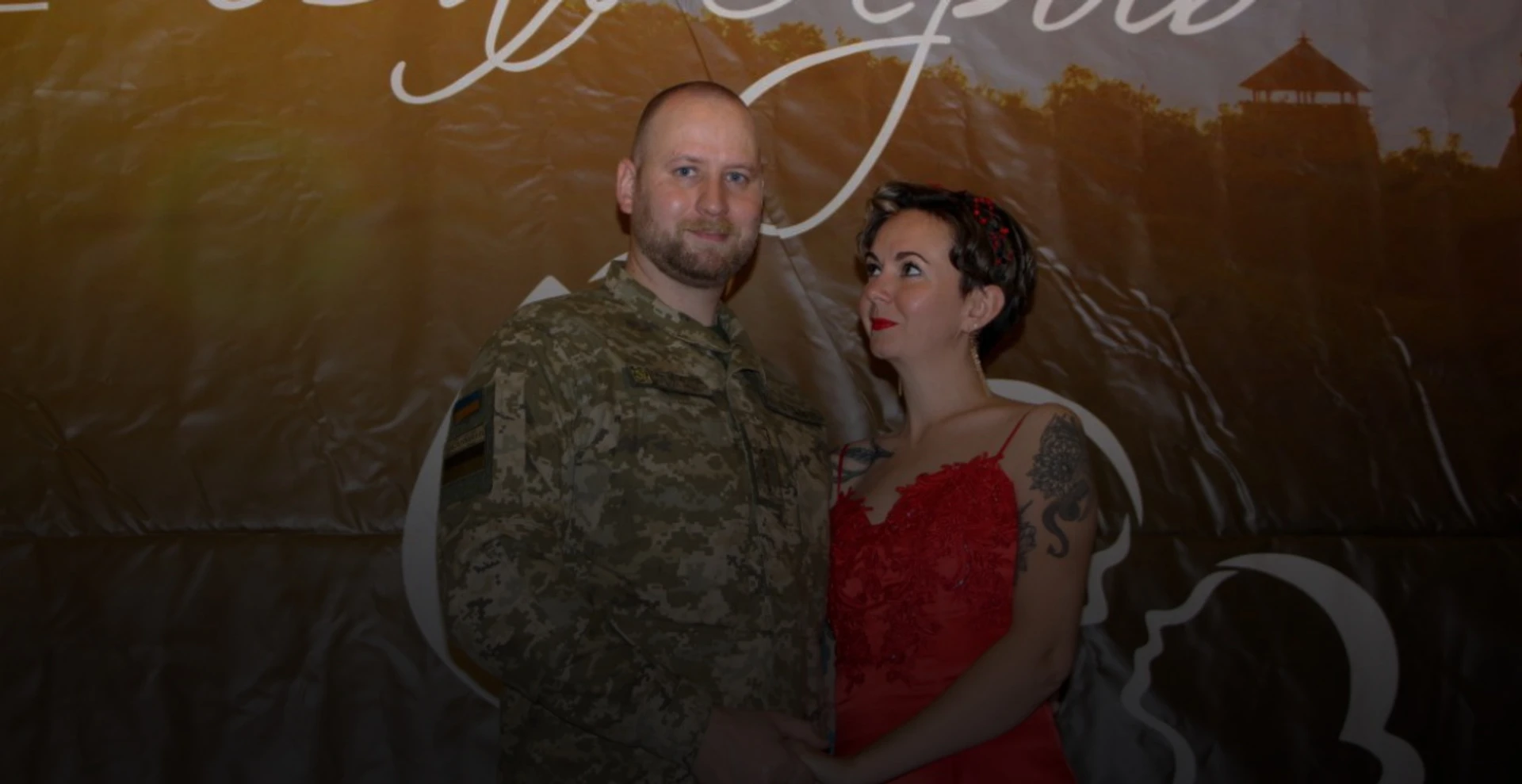
"Now I will live for two". The love story of Valeria and Andriy, who got married in a bunker at Azovstal
Source: Ukrainska Pravda
Valeria Karpilenko and Andriy Subotin met while serving in the Donetsk Border Guard Detachment. Their brief acquaintance blossomed into true love.
The couple was planning their wedding and dreaming of moving to the Kyiv region. However, everything changed after the full-scale invasion began. Andriy went to defend Mariupol. Valeria also enlisted and joined the Azov press service.
While at Azovstal, Andriy proposed to Valeria. The couple married on May 5. And on the night of May 7, while carrying out a combat mission, Andriy was killed. Ten days after her husband’s death, Valeria found herself in Russian captivity.
For nearly a year, she held on and believed that after her release, she would be able to visit her beloved’s grave and embrace his parents.
On April 10, 2023, the defender returned home. And now she continues to live for two, cherishing the memory of her husband and doing everything she can to ensure that all defenders—both the living and the fallen—return to Ukraine as soon as possible.
Valeria
Valeria Subotina (Karpilenko) was born in Mariupol. She lost her mother at an early age. Her father was a military pilot who passed away when his daughter was still young. Her grandparents took the girl under their care. She lived with them near Shakhtarsk.
“I grew up in a picturesque area, surrounded by nature. I was raised in the Ukrainian traditions. My family instilled in me a love for all things Ukrainian. And when I was in school, I sang our songs,” says Valeria.
When she was a teenager, her grandfather, Valery Mykolayovych, passed away.
“My grandmother, Antonina Gavrylivna, became my whole family. I am infinitely grateful to her, because she lived for me. It was from her that I inherited my strength,” adds the woman.
At age 15, Valeria graduated from high school. In 2003, she enrolled at Mariupol State University. At that time, she and her grandmother moved to Mariupol.
Valeria majored in Journalism. She received her master’s degree and immediately entered graduate school. While studying, she taught journalism and PR at the university. In 2014, she defended her doctoral dissertation.
“Alongside my work at the university, I worked as a journalist for the local TV-7 channel. When the war began in 2014, I became the author and host of the project ‘Mariupol – City of Peace,’ in which I reported on soldiers and volunteers,” she says.
That’s when Valeria met soldiers from the Azov Regiment. They invited her to join their press service.
“In 2015, I became a volunteer with the Azov Regiment. I handled public relations and worked with journalists,” she says.
In 2017, Valeria left the regiment and joined the border guards. She served as assistant to the head of the press service of the Donetsk Border Guard Detachment. In 2020, she resigned for health reasons.
She says she needed a break from service. She began studying at a computer academy. She pursued creative work and worked on publishing her second book. Later, she took a civilian position in the press service of the State Emergency Service in the Donetsk region.
Andriy
Andriy Subotin was born in the village of Tolbuzino in the Amur Region to a military family.
“His parents were border guards. So their life consisted of constant travel. Because of this, Andriy often changed schools,” Valeria says.
Andriy earned three higher education degrees. He initially worked in Kyiv. In 2019, he was assigned to serve in Mariupol. He became a lawyer for the Donetsk Border Guard Detachment.
Valeria recalls that Andriy was always smiling and ready to help:
"He always had a kind attitude toward everyone. He never refused to help anyone. He seemed to find joy in the smallest things: good weather, smiles, time spent with interesting people."
Love at first sight
Andriy and Valeriya worked in the same office at the Donetsk Border Guard Detachment.
“We started talking. And surprisingly, it turned out we had a lot in common. For example, my birthday is July 20, and Andriy’s is the 19th. His name is Andriy Valeriyovych, and mine is Valeriya Andriivna. From the very first day we met, I realized that Andriy was very different from the others. He was special, and being around him felt so warm. I fell head over heels in love almost immediately. And the feeling was mutual," Valeria says.
Three months later, the couple moved in together.
"I don’t like to be very active. I prefer to stay at home or in nature, watch a movie. Andriy, on the other hand, preferred active recreation. And with his enthusiasm, he drew me in. We traveled a lot, met with friends. It was important to him that we enjoy life together among our loved ones. We were into fishing and spent a lot of time outdoors. We went to theaters, concerts, and exhibitions. We had a full life,” the woman recalls.
Traditions held a special place in Valeria and Andriy’s family:
“In our family, we combined the traditions of our families. We decorated the Christmas tree for New Year’s with toys painted in the Petrykivka style. Andriy’s mom gave them to us as a gift. We prepared 12 dishes for Christmas Eve dinner. We made gifts for St. Nicholas Day. At Easter, we decorated and filled a basket, then went to church in embroidered shirts to have it blessed. We always gathered with our loved ones for the holidays. Maybe these are just simple traditions, but they’re all about bringing us together."
The main goal for Valeria and Andriy was to strengthen their relationship. They made plans together, enjoyed each other’s company, and dreamed of their wedding.
“We even picked out wedding rings. We were thinking of moving to the Kyiv region in the future to be closer to Andriy’s parents. We dreamed of our own home and often discussed what it would be like. We didn’t want any drastic changes, because our life was practically perfect for us,” says Valeria.
The Voice of Mariupol
On the eve of the full-scale invasion, Valeria and Andriy understood that aggressive actions from the Russians were to be expected in the near future.
“However, we didn’t think it would be this brutal. Of course, soldiers must always be on alert. But I don’t think anyone in our country was prepared for this. And no one was prepared for the enemy to be so ruthless. We wanted to believe that even the Russians had some humanity. But now we understand that they don’t,” says Valeria.
She recalls that a few days before the full-scale war began, Andriy told her to pack an emergency bag. She did so. She put his uniform and combat boots in it.
“Andriy wanted to protect me; he asked me to leave Mariupol. But he knew I would stay. That was my choice, which Andriy accepted. We knew in advance what we would do if hostilities broke out,” says Valeria.
On the first day of the full-scale invasion, Andriy was called up on emergency duty to the border guard unit. From there, he was sent to the front lines, where he was stationed with the Azov Regiment.
“A few days later, the border guards were withdrawn from the city. Andriy had a choice: to stay or to leave with them. He decided to remain at the front lines with the Azov fighters. Later, the border guards returned to Mariupol. But Andriy didn’t leave the city for a single moment,” the woman recalls.
From the very first day of the invasion, Valeria wanted to enlist in the border guards. However, the military registration offices left the city almost immediately.
“So I turned to my friend ‘Kalyna.’ He told me to go to military unit No. 3057. I registered there. And immediately, Orest took me to a bunker at Azovstal, where Azov was partially based. I joined the regiment’s press service. That was on February 27. Andriy was very supportive of me and constantly told me how proud he was of me. When I was at Azovstal, he was still holding his positions in the city. For a long time, I didn’t know what had become of him, since there was virtually no communication. We passed letters back and forth through our comrades, but they took a very long time to arrive,” Valeria recalls.
Andriy ended up on the plant’s grounds after sustaining injuries to his arm and thigh. It was March 26.
“They brought him to a field hospital called ‘Zalizyaka.’ He literally ran straight to me in the bunker. We hadn’t seen each other for over a week before that. We talked for just a little while, and he immediately went back to his position on the plant grounds,” Valeria says.
At Azovstal, she wrote posts for the “Azov. Mariupol."
"I wrote posts about Mariupol. At that time, I was essentially speaking for the city," she adds.
In extremely difficult conditions
At Azovstal, the defenders were in extremely difficult conditions. There was a shortage of food and water. But the main problem was the constant shelling.
“We were shelled with almost every type of weapon available: aerial bombs were dropped, naval artillery, tanks, artillery, and small arms were all used. There were no safe places on the plant’s grounds. Every day, our brothers and sisters were dying. And for those who were wounded, there was simply nothing with which to provide medical care. For us, the main thing was to protect civilians and our city. That was the priority then, and it remains our priority now. “We dreamed that everyone would return, but, unfortunately, that dream is impossible,” says Valeria.
On April 15, the Russians once again dropped a massive aerial bomb on Azovstal. Valeria was wounded:
“I ended up in the hospital at ‘Zalizyak.’ Andriy and his comrade popped in to see me for a few minutes. He told me that they had found a bunker at the plant where civilians were hiding. There were many children there. Despite the shelling, they went there to bring food and water to the people. Because they couldn’t go out for supplies themselves due to the constant explosions. So Andriy and his comrade actually saved those Mariupol residents. People already knew them well and were very happy that they came to them, cared for them, and protected them."
It’s fitting to be a Subotina
At Azovstal, Valeria and Andriy rarely saw each other, since they were stationed at different posts. There was no communication. The lovers communicated by passing letters to each other through their comrades.
"During those infrequent meetings, Andriy proposed marriage at Azovstal. But I always felt like we were rushing things. I didn’t want to. I believed we had our whole lives ahead of us. And then Andriy brought an iron box, and inside were two foil wedding rings. He made them himself. It was a marriage proposal. I said yes right away, and we exchanged those rings: I put his on, and he put mine on," Valeria recalls.
At first, she suggested postponing the wedding. However, Andriy suggested formalizing their relationship on the Azov Regiment’s birthday—May 5. Valeria agreed. The couple decided to register their marriage at Azovstal and have a church wedding in Kyiv:
“We filled out the necessary paperwork. We were married by the commander’s authority. Then copies of these documents were handed over to our representatives—Andriy’s parents. That same day, his dad took the documents to the civil registry office, where our marriage was officially registered. We replaced the foil wedding rings with gold ones. I had my mother’s ring, and Andriy had my grandmother’s ring."
After the official ceremony, the couple spent about 30 minutes together.
“Orest took wedding photos, and we recorded a video for our parents. In it, we said that our love would protect us. Despite the endless shelling, it was a joyful day for us. I took my husband’s last name and became Valeria Subotina. Andriy kept saying that this last name suited me very well. He was proud and very happy that now we share the same last name," says Valeria.
Not Drowning in Grief
After the wedding, Andriy returned to his post.
"The last time we saw each other was on May 6. Mother’s Day was approaching, and it was very important for us to congratulate our mom on the holiday. Together we chose a bouquet, and I placed the order and arranged for delivery on May 8. My mother received flowers from a son who was no longer alive. She still keeps the dried buds as a memento of our Hero,” says Valeria.
Andriy died on the night of May 7 while carrying out a combat mission. The officer came under fire and sustained fatal injuries.
“Neither his comrades nor Andriy’s parents told me about this. They knew he was already gone. Everyone hoped that we would be evacuated from Azovstal, and that I would learn of my beloved’s death in safer conditions. All this time, I was sending him letters and talking with friends about the wedding. Everyone around us had to pretend that everything was fine. But it was hard for them to keep it up. So on May 9, the commander “Kalina” told me about my beloved’s death.
I didn’t want to believe it. We talked a lot with “Kalina” then, and he emphasized that I had no right to give in to my emotions. I had to be a source of support for my comrades and keep writing. After all, my texts were crucial for the Azov fighters’ withdrawal from Azovstal, for determining our future fate, and for informing the international community about what was happening in Mariupol. I couldn’t drown in my grief. I learned to hold myself back. But I had no idea I’d have to hold myself back for almost a year,” Valeria says.
He kept appearing in my dreams
On May 16, the commander of the Azov regiment, “Redis,” announced the order to withdraw from Azovstal.
“We were to surrender, but under certain conditions. The commander said that this would be honorable captivity, because we were surrendering not by our own choice, but by order. We were told that the captivity would last 3–4 months, and that we would all be together. I left the plant grounds on May 17. From that day on, I was in Olenivka. On September 27, I was transferred to Taganrog. “I was there until April 10, 2023,” says Valeria.
The conditions for the prisoners varied. The women were held in small cells. They were overcrowded, and we had to sleep on the floor. There were problems with food. Valeria’s faith that people were waiting for them helped her endure the extremely difficult conditions:
“Even though we were in a complete information vacuum for almost a year, we knew that our families, loved ones, and friends were waiting for us. And I was also driven by anger toward the enemy who committed a crime against humanity, who took the lives of my beloved, my sons, daughters, mothers, and brothers."
It was in Taganrog that Andriy constantly appeared to Valeria in her dreams.
"In my dreams, he was in Mariupol, and I was right beside him. We walked through the devastated grounds of Azovstal. I could see it all so clearly. In my dreams, Andriy was always smiling, and our boys were with him. He kept asking why I didn’t buy myself a white wedding dress. Because back then, during our wedding, he was so upset that I never ended up wearing one. In my dreams, I asked Andriy to leave Mariupol, but he said I had to get out on my own. And he has to stay with the boys for now," the woman says.
Breathing the Free Ukrainian Air
On April 10, 2023, Valeria was released from Russian captivity.
"I couldn’t believe it for a long time. It felt like a dream. I was overwhelmed with joy. I felt like I could finally breathe in the free Ukrainian air to my heart’s content. It’s hard to describe these emotions. After all, despite everything I had to go through, all the hardships I endured, I felt like a free person,” the woman says.
That same day, the defenders arrived in Kyiv.
“I didn’t know if anyone would be there to meet us. But near the bus, I saw my Andriy’s parents. They had come with a large bouquet of tulips. These were the very flowers I had dreamed of seeing and smelling while I was in captivity. Because as soon as they appeared, my room was already decorated with them thanks to my beloved.
In our cell, the windows had thick bars, but my little hand could fit through them, and I drew tulips on the wet window. I don’t remember what we talked about with my parents back then. But Mom was crying, and Dad was holding us tight,” Valeria says.
In memory of the Hero
She is currently undergoing rehabilitation. Andriy’s parents are always by her side:
“We often talk about Andriy. Dad and Mom tell stories about his childhood, recalling happy and cheerful memories. We look through photos. I told Vitya a lot about my Andriy—the female soldier with whom we shared a cell in Taganrog. In our minds, we spoke to him, asking him to convey our requests to God, and specifically about his release."
Valeria believes that Andriy is always nearby and watching over the whole family from heaven.
"We have a photo of him here. And now, whenever we go shopping or hear the news, we tell him all about it. We even try to cook the things Andriy really loved," Valeria says.
According to a decree by the President of Ukraine, Captain of Justice Andriy Subotin was awarded the Order "For Courage" of the Third Degree (posthumously).
"We received the award on the eve of Border Guard Day. Although the decree was issued last year, my mom refused to accept it without me. So on that day, we picked up our Andriy’s award together," says Valeria.
At the same time, she ordered the wedding rings that she and Andriy had chosen back in Mariupol:
“I received them on the eve of our wedding anniversary. Now I’ll wear both: mine on my finger, and Andriy’s on a chain. And for our anniversary, I put on a white dress and had a photo shoot. I held my beloved’s medal in my hands. I am infinitely proud to be his wife.” Right now, Valeria’s greatest wish is for Andriy to have a grave so she can visit him.
“I want to visit Andriy’s grave and talk to him, bring him the roses he used to give me most often. Now I understand why, in my dreams, he said he was staying with his comrades in Mariupol. His body is still there," says Valeria.
Now Valeria plans to spend more time in nature, alone with her thoughts and Andriy, whom she continues to feel even now:
“Before, I was always rushing somewhere, never stopping. But now I understand how right Andriy was. He taught me to seize the moment, to find joy in the little things, to enjoy every day. I will definitely do this for both of us. But a little later. We must win and bring all our defenders—both men and women—home. Both the living and the dead."
This text was prepared by the Memorial remembrance platform, which tells the stories of civilians killed by Russia and fallen Ukrainian soldiers, specifically for [PUBLICATION NAME]. To report information about Ukraine’s losses, please fill out the forms: for fallen soldiers and civilian victims.
Valeria Karpilenko and Andriy Subotin met while serving in the Donetsk Border Guard Detachment. Their brief acquaintance blossomed into true love.
The couple was planning their wedding and dreaming of moving to the Kyiv region. However, everything changed after the full-scale invasion began. Andriy went to defend Mariupol. Valeria also enlisted and joined the Azov press service.
While at Azovstal, Andriy proposed to Valeria. The couple married on May 5. And on the night of May 7, while carrying out a combat mission, Andriy was killed. Ten days after her husband’s death, Valeria found herself in Russian captivity.
For nearly a year, she held on and believed that after her release, she would be able to visit her beloved’s grave and embrace his parents.
On April 10, 2023, the defender returned home. And now she continues to live for two, cherishing the memory of her husband and doing everything she can to ensure that all defenders—both the living and the fallen—return to Ukraine as soon as possible.
Valeria
Valeria Subotina (Karpilenko) was born in Mariupol. She lost her mother at an early age. Her father was a military pilot who passed away when his daughter was still young. Her grandparents took the girl under their care. She lived with them near Shakhtarsk.
“I grew up in a picturesque area, surrounded by nature. I was raised in the Ukrainian traditions. My family instilled in me a love for all things Ukrainian. And when I was in school, I sang our songs,” says Valeria.
When she was a teenager, her grandfather, Valery Mykolayovych, passed away.
“My grandmother, Antonina Gavrylivna, became my whole family. I am infinitely grateful to her, because she lived for me. It was from her that I inherited my strength,” adds the woman.
At age 15, Valeria graduated from high school. In 2003, she enrolled at Mariupol State University. At that time, she and her grandmother moved to Mariupol.
Valeria majored in Journalism. She received her master’s degree and immediately entered graduate school. While studying, she taught journalism and PR at the university. In 2014, she defended her doctoral dissertation.
“Alongside my work at the university, I worked as a journalist for the local TV-7 channel. When the war began in 2014, I became the author and host of the project ‘Mariupol – City of Peace,’ in which I reported on soldiers and volunteers,” she says.
That’s when Valeria met soldiers from the Azov Regiment. They invited her to join their press service.
“In 2015, I became a volunteer with the Azov Regiment. I handled public relations and worked with journalists,” she says.
In 2017, Valeria left the regiment and joined the border guards. She served as assistant to the head of the press service of the Donetsk Border Guard Detachment. In 2020, she resigned for health reasons.
She says she needed a break from service. She began studying at a computer academy. She pursued creative work and worked on publishing her second book. Later, she took a civilian position in the press service of the State Emergency Service in the Donetsk region.
Andriy
Andriy Subotin was born in the village of Tolbuzino in the Amur Region to a military family.
“His parents were border guards. So their life consisted of constant travel. Because of this, Andriy often changed schools,” Valeria says.
Andriy earned three higher education degrees. He initially worked in Kyiv. In 2019, he was assigned to serve in Mariupol. He became a lawyer for the Donetsk Border Guard Detachment.
Valeria recalls that Andriy was always smiling and ready to help:
"He always had a kind attitude toward everyone. He never refused to help anyone. He seemed to find joy in the smallest things: good weather, smiles, time spent with interesting people."
Love at first sight
Andriy and Valeriya worked in the same office at the Donetsk Border Guard Detachment.
“We started talking. And surprisingly, it turned out we had a lot in common. For example, my birthday is July 20, and Andriy’s is the 19th. His name is Andriy Valeriyovych, and mine is Valeriya Andriivna. From the very first day we met, I realized that Andriy was very different from the others. He was special, and being around him felt so warm. I fell head over heels in love almost immediately. And the feeling was mutual," Valeria says.
Three months later, the couple moved in together.
"I don’t like to be very active. I prefer to stay at home or in nature, watch a movie. Andriy, on the other hand, preferred active recreation. And with his enthusiasm, he drew me in. We traveled a lot, met with friends. It was important to him that we enjoy life together among our loved ones. We were into fishing and spent a lot of time outdoors. We went to theaters, concerts, and exhibitions. We had a full life,” the woman recalls.
Traditions held a special place in Valeria and Andriy’s family:
“In our family, we combined the traditions of our families. We decorated the Christmas tree for New Year’s with toys painted in the Petrykivka style. Andriy’s mom gave them to us as a gift. We prepared 12 dishes for Christmas Eve dinner. We made gifts for St. Nicholas Day. At Easter, we decorated and filled a basket, then went to church in embroidered shirts to have it blessed. We always gathered with our loved ones for the holidays. Maybe these are just simple traditions, but they’re all about bringing us together."
The main goal for Valeria and Andriy was to strengthen their relationship. They made plans together, enjoyed each other’s company, and dreamed of their wedding.
“We even picked out wedding rings. We were thinking of moving to the Kyiv region in the future to be closer to Andriy’s parents. We dreamed of our own home and often discussed what it would be like. We didn’t want any drastic changes, because our life was practically perfect for us,” says Valeria.
The Voice of Mariupol
On the eve of the full-scale invasion, Valeria and Andriy understood that aggressive actions from the Russians were to be expected in the near future.
“However, we didn’t think it would be this brutal. Of course, soldiers must always be on alert. But I don’t think anyone in our country was prepared for this. And no one was prepared for the enemy to be so ruthless. We wanted to believe that even the Russians had some humanity. But now we understand that they don’t,” says Valeria.
She recalls that a few days before the full-scale war began, Andriy told her to pack an emergency bag. She did so. She put his uniform and combat boots in it.
“Andriy wanted to protect me; he asked me to leave Mariupol. But he knew I would stay. That was my choice, which Andriy accepted. We knew in advance what we would do if hostilities broke out,” says Valeria.
On the first day of the full-scale invasion, Andriy was called up on emergency duty to the border guard unit. From there, he was sent to the front lines, where he was stationed with the Azov Regiment.
“A few days later, the border guards were withdrawn from the city. Andriy had a choice: to stay or to leave with them. He decided to remain at the front lines with the Azov fighters. Later, the border guards returned to Mariupol. But Andriy didn’t leave the city for a single moment,” the woman recalls.
From the very first day of the invasion, Valeria wanted to enlist in the border guards. However, the military registration offices left the city almost immediately.
“So I turned to my friend ‘Kalyna.’ He told me to go to military unit No. 3057. I registered there. And immediately, Orest took me to a bunker at Azovstal, where Azov was partially based. I joined the regiment’s press service. That was on February 27. Andriy was very supportive of me and constantly told me how proud he was of me. When I was at Azovstal, he was still holding his positions in the city. For a long time, I didn’t know what had become of him, since there was virtually no communication. We passed letters back and forth through our comrades, but they took a very long time to arrive,” Valeria recalls.
Andriy ended up on the plant’s grounds after sustaining injuries to his arm and thigh. It was March 26.
“They brought him to a field hospital called ‘Zalizyaka.’ He literally ran straight to me in the bunker. We hadn’t seen each other for over a week before that. We talked for just a little while, and he immediately went back to his position on the plant grounds,” Valeria says.
At Azovstal, she wrote posts for the “Azov. Mariupol."
"I wrote posts about Mariupol. At that time, I was essentially speaking for the city," she adds.
In extremely difficult conditions
At Azovstal, the defenders were in extremely difficult conditions. There was a shortage of food and water. But the main problem was the constant shelling.
“We were shelled with almost every type of weapon available: aerial bombs were dropped, naval artillery, tanks, artillery, and small arms were all used. There were no safe places on the plant’s grounds. Every day, our brothers and sisters were dying. And for those who were wounded, there was simply nothing with which to provide medical care. For us, the main thing was to protect civilians and our city. That was the priority then, and it remains our priority now. “We dreamed that everyone would return, but, unfortunately, that dream is impossible,” says Valeria.
On April 15, the Russians once again dropped a massive aerial bomb on Azovstal. Valeria was wounded:
“I ended up in the hospital at ‘Zalizyak.’ Andriy and his comrade popped in to see me for a few minutes. He told me that they had found a bunker at the plant where civilians were hiding. There were many children there. Despite the shelling, they went there to bring food and water to the people. Because they couldn’t go out for supplies themselves due to the constant explosions. So Andriy and his comrade actually saved those Mariupol residents. People already knew them well and were very happy that they came to them, cared for them, and protected them."
It’s fitting to be a Subotina
At Azovstal, Valeria and Andriy rarely saw each other, since they were stationed at different posts. There was no communication. The lovers communicated by passing letters to each other through their comrades.
"During those infrequent meetings, Andriy proposed marriage at Azovstal. But I always felt like we were rushing things. I didn’t want to. I believed we had our whole lives ahead of us. And then Andriy brought an iron box, and inside were two foil wedding rings. He made them himself. It was a marriage proposal. I said yes right away, and we exchanged those rings: I put his on, and he put mine on," Valeria recalls.
At first, she suggested postponing the wedding. However, Andriy suggested formalizing their relationship on the Azov Regiment’s birthday—May 5. Valeria agreed. The couple decided to register their marriage at Azovstal and have a church wedding in Kyiv:
“We filled out the necessary paperwork. We were married by the commander’s authority. Then copies of these documents were handed over to our representatives—Andriy’s parents. That same day, his dad took the documents to the civil registry office, where our marriage was officially registered. We replaced the foil wedding rings with gold ones. I had my mother’s ring, and Andriy had my grandmother’s ring."
After the official ceremony, the couple spent about 30 minutes together.
“Orest took wedding photos, and we recorded a video for our parents. In it, we said that our love would protect us. Despite the endless shelling, it was a joyful day for us. I took my husband’s last name and became Valeria Subotina. Andriy kept saying that this last name suited me very well. He was proud and very happy that now we share the same last name," says Valeria.
Not Drowning in Grief
After the wedding, Andriy returned to his post.
"The last time we saw each other was on May 6. Mother’s Day was approaching, and it was very important for us to congratulate our mom on the holiday. Together we chose a bouquet, and I placed the order and arranged for delivery on May 8. My mother received flowers from a son who was no longer alive. She still keeps the dried buds as a memento of our Hero,” says Valeria.
Andriy died on the night of May 7 while carrying out a combat mission. The officer came under fire and sustained fatal injuries.
“Neither his comrades nor Andriy’s parents told me about this. They knew he was already gone. Everyone hoped that we would be evacuated from Azovstal, and that I would learn of my beloved’s death in safer conditions. All this time, I was sending him letters and talking with friends about the wedding. Everyone around us had to pretend that everything was fine. But it was hard for them to keep it up. So on May 9, the commander “Kalina” told me about my beloved’s death.
I didn’t want to believe it. We talked a lot with “Kalina” then, and he emphasized that I had no right to give in to my emotions. I had to be a source of support for my comrades and keep writing. After all, my texts were crucial for the Azov fighters’ withdrawal from Azovstal, for determining our future fate, and for informing the international community about what was happening in Mariupol. I couldn’t drown in my grief. I learned to hold myself back. But I had no idea I’d have to hold myself back for almost a year,” Valeria says.
He kept appearing in my dreams
On May 16, the commander of the Azov regiment, “Redis,” announced the order to withdraw from Azovstal.
“We were to surrender, but under certain conditions. The commander said that this would be honorable captivity, because we were surrendering not by our own choice, but by order. We were told that the captivity would last 3–4 months, and that we would all be together. I left the plant grounds on May 17. From that day on, I was in Olenivka. On September 27, I was transferred to Taganrog. “I was there until April 10, 2023,” says Valeria.
The conditions for the prisoners varied. The women were held in small cells. They were overcrowded, and we had to sleep on the floor. There were problems with food. Valeria’s faith that people were waiting for them helped her endure the extremely difficult conditions:
“Even though we were in a complete information vacuum for almost a year, we knew that our families, loved ones, and friends were waiting for us. And I was also driven by anger toward the enemy who committed a crime against humanity, who took the lives of my beloved, my sons, daughters, mothers, and brothers."
It was in Taganrog that Andriy constantly appeared to Valeria in her dreams.
"In my dreams, he was in Mariupol, and I was right beside him. We walked through the devastated grounds of Azovstal. I could see it all so clearly. In my dreams, Andriy was always smiling, and our boys were with him. He kept asking why I didn’t buy myself a white wedding dress. Because back then, during our wedding, he was so upset that I never ended up wearing one. In my dreams, I asked Andriy to leave Mariupol, but he said I had to get out on my own. And he has to stay with the boys for now," the woman says.
Breathing the Free Ukrainian Air
On April 10, 2023, Valeria was released from Russian captivity.
"I couldn’t believe it for a long time. It felt like a dream. I was overwhelmed with joy. I felt like I could finally breathe in the free Ukrainian air to my heart’s content. It’s hard to describe these emotions. After all, despite everything I had to go through, all the hardships I endured, I felt like a free person,” the woman says.
That same day, the defenders arrived in Kyiv.
“I didn’t know if anyone would be there to meet us. But near the bus, I saw my Andriy’s parents. They had come with a large bouquet of tulips. These were the very flowers I had dreamed of seeing and smelling while I was in captivity. Because as soon as they appeared, my room was already decorated with them thanks to my beloved.
In our cell, the windows had thick bars, but my little hand could fit through them, and I drew tulips on the wet window. I don’t remember what we talked about with my parents back then. But Mom was crying, and Dad was holding us tight,” Valeria says.
In memory of the Hero
She is currently undergoing rehabilitation. Andriy’s parents are always by her side:
“We often talk about Andriy. Dad and Mom tell stories about his childhood, recalling happy and cheerful memories. We look through photos. I told Vitya a lot about my Andriy—the female soldier with whom we shared a cell in Taganrog. In our minds, we spoke to him, asking him to convey our requests to God, and specifically about his release."
Valeria believes that Andriy is always nearby and watching over the whole family from heaven.
"We have a photo of him here. And now, whenever we go shopping or hear the news, we tell him all about it. We even try to cook the things Andriy really loved," Valeria says.
According to a decree by the President of Ukraine, Captain of Justice Andriy Subotin was awarded the Order "For Courage" of the Third Degree (posthumously).
"We received the award on the eve of Border Guard Day. Although the decree was issued last year, my mom refused to accept it without me. So on that day, we picked up our Andriy’s award together," says Valeria.
At the same time, she ordered the wedding rings that she and Andriy had chosen back in Mariupol:
“I received them on the eve of our wedding anniversary. Now I’ll wear both: mine on my finger, and Andriy’s on a chain. And for our anniversary, I put on a white dress and had a photo shoot. I held my beloved’s medal in my hands. I am infinitely proud to be his wife.” Right now, Valeria’s greatest wish is for Andriy to have a grave so she can visit him.
“I want to visit Andriy’s grave and talk to him, bring him the roses he used to give me most often. Now I understand why, in my dreams, he said he was staying with his comrades in Mariupol. His body is still there," says Valeria.
Now Valeria plans to spend more time in nature, alone with her thoughts and Andriy, whom she continues to feel even now:
“Before, I was always rushing somewhere, never stopping. But now I understand how right Andriy was. He taught me to seize the moment, to find joy in the little things, to enjoy every day. I will definitely do this for both of us. But a little later. We must win and bring all our defenders—both men and women—home. Both the living and the dead."
This text was prepared by the Memorial remembrance platform, which tells the stories of civilians killed by Russia and fallen Ukrainian soldiers, specifically for [PUBLICATION NAME]. To report information about Ukraine’s losses, please fill out the forms: for fallen soldiers and civilian victims.
This is an automatic translation generated by DeepL.