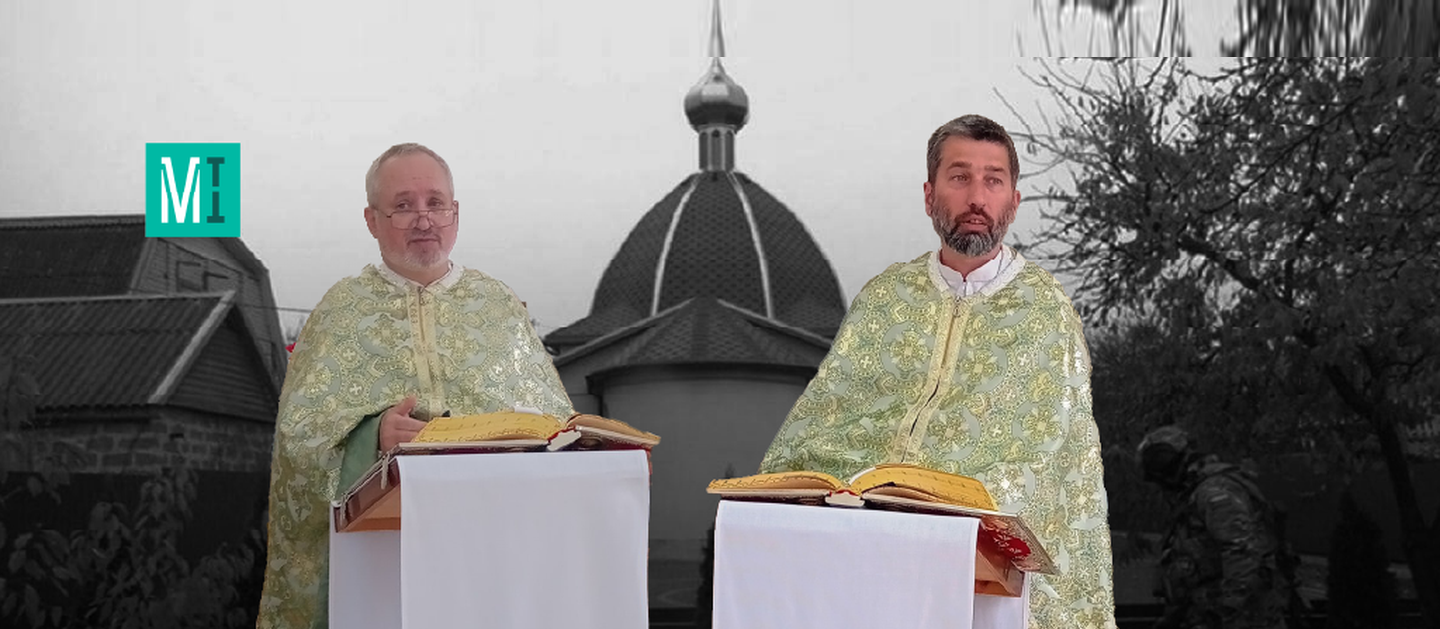
Nothing Is Sacred: How the Russians Abducted UGCC Priests Ivan Levytskyi and Bohdan Heleta in Berdiansk
Source: MIPL
Authors: Lidiya Tarash, Artur Prikhn
Ivan Levytskyi is originally from the Lviv region, and Bohdan Heleta is from the Ivano-Frankivsk region. Both once decided to become monks, following the call of their hearts. They served in Berdiansk for about four years. The parish of the Nativity of the Blessed Virgin Mary of the Ukrainian Greek Catholic Church had a small congregation. According to their fellow priests, their term of service in Berdiansk was set to end in late 2022, and they were supposed to return home.
“When the full-scale war began, we suggested to Father Ivan that he return home, but he said he would not abandon the people or the church,” says Khrystyna Lekh, a relative of Ivan Levytskyi.
On February 27, 2022, Russian troops captured Berdiansk. Rejecting the occupation, local residents took to the streets for peaceful protests, in which clergy of the Ukrainian Greek Catholic Church also participated. Every day at noon, Father Ivan Levytskyi led prayers for peace in the city center—near the “I Love Berdiansk” installation.
According to Father Andriy Bukhvak, chancellor of the Donetsk Exarchate of the UGCC, at the beginning of the occupation of Berdiansk, priests held prayer services for peace under Ukrainian flags, but after the violent suppression of the peaceful protests, they prayed without Ukrainian symbols. On November 16, during another prayer for peace in the city center, Ivan Levytskyi was detained. That same evening, the Russians also detained another priest from the UGCC Parish of the Nativity of the Most Holy Mother of God—Bogdan Geleta.
The next day, Russian security forces conducted a search of the Church of the Nativity of the Blessed Virgin Mary, which Russian propagandists filmed.
Fabricated Charges
Russian propagandists released a news report about the detention of the rector of the Greek Catholic church on November 24 of last year. It claimed that three TNT blocks, electronic detonators for them, mortar shells, and two pistols had allegedly been found in the church. Ukrainian religious literature was also discovered, which was cited as evidence of the priests’ illegal activities. They also showed footage of Ivan Levytskyi’s interrogation, but he made no confessions regarding the “crimes.”
“We know for certain that they couldn’t have done such a thing. You just have to know them. Father Ivan Levytskyi is a very kind, compassionate person. He has always helped the poor and those in need, and he always listens to everyone,” assures Khrystyna Lekh.
The Donetsk Exarchate of the Ukrainian Greek Catholic Church believes that the charges against the priests were fabricated in response to the SBU searches at the Kyiv-Pechersk Lavra. The exarchate’s leadership justifies this position, in particular, by the fact that the Russian special services had not made any complaints against the priests from the start of the full-scale war until their arrest. Furthermore, the search of the church, the rectory, and other parish facilities took place after both priests had already been detained, and they were unable to control either these buildings or the actions of the Russian military.
“It is solely because of their fidelity to God and the Church that these pastoral priests are facing the aforementioned ‘charges,’” the Exarchate’s statement reads.
On December 1, 2022, the head of the UGCC, Sviatoslav (Shevchuk), called for the priests’ release: “Yesterday we received a report that they are being mercilessly tortured. In accordance with classic Stalinist repressive methods, they are being forced to confess to a crime they did not commit. They face death any day now.”
Viktor Dudukalov, deputy chairman of the Berdiansk District Council, also reported on the torture of the priests: “Father Bohdan has diabetes. Being in prison is life-threatening for him. They are being held and tortured in Colony No. 77,” he wrote on his Facebook page.
In April of this year, the Russians seized the building of the Roman Catholic church in Berdyansk. In a video report, propagandists accused Catholic priests of “large-scale subversive activities” against Orthodox Berdyansk.
“There is a high probability that the church at the foot of the hill provided shelter to Ukrainian military personnel and sabotage groups and served as a safe haven for Greek Catholics who hid weapons and explosives in their hideout,” the report stated. In addition, the propagandists claimed that Catholic priests were illegally using parishioners’ personal data and biological samples.
Here is what the Berdiansk City Military Administration had to say on the matter: “The Church of the Nativity of the Blessed Virgin Mary was not merely a religious community. Here, those in need could receive support, and residents and visitors to the city had the opportunity to hear organ music. From the very beginning of the occupation, the church provided shelter and assistance to anyone who needed it.”
Petro Krenitsky, pastor of the Ukrainian Greek Catholic Church’s Parish of the Dormition of St. Anne in Melitopol, is well acquainted with the priests in Berdiansk. Having remained in Melitopol, which was occupied by Russian troops, he also faced persecution and was later “deported.”
He tried not to provoke them and sometimes even joked
Petro Krenitsky, a Slovak by nationality who recently turned 67, shares his experiences of interacting with the occupiers with the International Institute for Human Rights (IIHR). He says he arrived in Melitopol 12 years ago from Zakarpattia. He founded the Parish of the Assumption of St. Anne here, and later others, including the Parish of the Nativity of the Most Holy Mother of God, where Oleksandr (Sashko, as he is also known) Bohomaz served.
Petro Krenitsky calls Melitopol an oasis of Ukrainian culture, spirituality, and conscious, intelligent people. Many residents of this region have roots in western Ukraine, so after the collapse of the USSR, they felt a need for a Greek Catholic church.
“The first chapel we set up in Melitopol was in an ordinary house. Then we built a church in the Melitopol district, in the village of Orlove. There were many migrants from Transcarpathia there, so we brought wood there and built a church. Later, communities formed in other villages near Melitopol,” says Petro Krenitsky.
The number of parishioners and priests grew over time. According to Fr. Petro Krenitsky, the Ukrainian Greek Catholic Church has gained prestige during its time in this region, and the priests maintained good relations with the authorities, the people, and other churches.
From the start of Russia’s full-scale invasion of Melitopol—as in Berdiansk—clergy held prayer services for peace in the city center. When the settlements in the district were occupied, they organized aid for the civilian population—bringing bread, water, and medicine to the villages, and helping retirees withdraw money from ATMs.
Petro Krenitsky notes that when arrests began in the city, he knew they would come for him too. The occupiers’ main goal was to intimidate people. They first came to Father Petro in mid-March 2022.
“They were representatives of the Russian FSB. I tried to maintain a positive attitude so as not to let them fill me with fear, so they wouldn’t gain control over me,” Krenitsky recalls.
The Russians, however, behaved hostilely. They couldn’t understand why a Ukrainian priest was speaking Ukrainian: “And I jokingly replied, ‘Look how old I am! When am I supposed to learn Russian?” I explained to them that I’m a Slovak who stayed here to help people,” recalls Petro Krenitsky.
There were other encounters with Russian security services as well, particularly at checkpoints, since the priest often had to travel through villages from which other clergy had left.
“There were all kinds of people among those soldiers,” Father Petro shares. “There were also our own people—guys from Donetsk and Luhansk—who treated me well and even asked, ‘Father, pray that we can return home!’” Some, knowing that I was delivering bread to the villages, would say to me when they saw me, ‘Oh, Father, you smell like bread.’ And some would attack me. For example, once, upon learning that I was Slovak, they aggressively asked if I was aware that Slovakia had provided some weapons to Ukraine. Then I jokingly replied, “Guys, it pains me to the core that the Slovak authorities didn’t consult with me but made the decision without me.” And then I added: “Guys, I’m just a priest; I live with people and for people.” And I explained that I have nothing to fear and nothing to hide, because my mission is to serve people in shelters, to help the needy, the bedridden, and the homeless.”
Father Petro says he tried to communicate with Russian soldiers without sarcasm, so as not to provoke aggression. Instead, they were the ones who provoked him. After each such conversation, he felt “wringed out like a rag,” and sought strength to recover through prayer.
“It is not golden domes that adorn the church, but golden hearts.”
Petro Krenitsky’s next encounter with the security services took place on November 22, following the detention of the Berdyansk priests. At that time, Father Petro decided to travel to Berdyansk to find out the details. But at a checkpoint outside Berdiansk, he was detained and roughly taken in for questioning.
“A soldier asked me, ‘Why aren’t you afraid?’ I replied, ‘What harm can you do to me? Nothing. If you can kill me, I’ll be grateful to you, because I have all the documents I need to go to heaven,” the priest recounts. — They asked why our church’s policy is against Moscow, to which I replied that no matter what the policy is—whether under a tsar or a president—there will always be people who have been wronged, who bear emotional wounds, and who need support. And I am here to help them find peace and strength of spirit.”
Petro Krenitsky notes that by that time, his residence permit had already expired; to renew it, a Russian military officer advised him to go to Zaporizhzhia—to the free territory of Ukraine.
“He said that with a new residence permit, I would be able to obtain other documents in the occupied territory. Later, I discussed this with our Bishop and warned him that I would not leave, because they would not let me back in after I left,” recalls Father Petro.
According to the priest, the Russians wanted to “buy him off,” offering a large sum of money for the construction of a cathedral in honor of the martyrs in Melitopol.
“To that I replied that a church is adorned not by golden domes, but by golden hearts. Help the people, I said—donate that money for medical treatment. And if people need a church, there will be a building; if they don’t need one, we’ll pray on the street. God doesn’t need gold; God needs us to live in love for others,” says Father Petro. “I learned what the KGB was like when I was still young. Nothing has changed in Russia since the days of the USSR—the attitude is condescending, and there’s only one rule: you can have your own god, but he has only as much power as we allow him to have, and you are nobody. I realized that they are slaves to fear; they’re afraid of betraying one another, which is why they hide from each other.”
That day, they held him for about four hours, and afterward he went to the Church of the Nativity of the Most Holy Mother of God, where Ivan Levytskyi and Bohdan Heleta were serving. The church was sealed. A woman was crying by the fence.
“We knew each other because I’d been here before. She rushed over, hugged me, cried her heart out, and told me this story: that Father Ivan drove into the city center every day to pray. He was always accompanied by three or four women. One of the elderly parishioners had written a Ukrainian poem, which the Russians found in a prayer book in the church. The poem was about war, pain, and suffering. She had written it on a sheet of paper and signed it. Based on this information, they tracked her down, arrested her, and held her for three days. They released her on a humiliating condition: she had to learn the Russian national anthem in four hours and sing it in the city center,” says Father Petro.
Caught up in the “Berdyansk wave”
Petro Krenitsky’s next encounter with the occupiers took place three days later—on November 25. During the morning service, he saw two unfamiliar men posing as parishioners. Next to the church stood an old house where Father Petro lived. Workers were renovating the house. After the morning service, the priest brought breakfast to the workers and stepped out into the courtyard near the church. At that moment, a car with tinted windows “swooped in,” and masked soldiers jumped out. One of them rushed up to the priest, ordered him to take off his cassock and get down on his knees.
“He gave the order, but didn’t wait for it to be carried out; he started beating me,” recalls Petro Krenitsky. “He kicked and punched me, and struck my spine with his rifle. While I was on my knees, they led the workers out of the house. One of them asked what had happened. A soldier grabbed him by the hair and slammed him against the wall, injuring his head. They behaved very harshly. Their FSB chief, who supposedly respected me, held his subordinates back and told me that I had fallen victim to the ‘Berdyansk wave.’ Then they searched the church and the house, but found nothing. They wanted to take my car, but I managed to give it to someone else.
The priest says that no one told him about “deportation”; he was simply ordered to pack a change of clothes. He asked to be allowed to take his Bible, prayer book, and rosary. The soldiers refused to let him take them. They put a bag over his head, sat him in the back seat between armed soldiers, and drove him away. After about 10 km, he began to suffocate.
“I told them, ‘Guys, either help me pass on to the next world, or I can’t breathe anymore—I’m suffocating.’ And this FSB officer says, ‘Take it off.’ After that, they told me that the Russian Federation was showing me kindness and taking me to the border for free,” says Petro Krenitsky.
He was taken to the Vasylivka checkpoint, where he was handed over to other soldiers, one of whom began to taunt him.
“When they handed me over to him, he said, ‘I’m going to do to you everything your fascists do to our soldiers.’ He was so vulgar; he said, ‘Let’s play, shall we?’ Then they drove me 500 meters from Vasylivka; a soldier took my money and phone, read out the ‘deportation’ order, and said, ‘That’s it, go. I’ll shoot you on the way.”
The Russian didn’t shoot. Petro Krenitsky made it to a Ukrainian checkpoint, after which he was helped to leave for Zaporizhzhia. Later, he went back to serve in Zakarpattia. A week after his “deportation,” another Melitopol priest of the Ukrainian Greek Catholic Church—Oleksandr Bohomaz—was expelled.
According to Petro Krenitsky, representatives of other faiths also faced persecution. For example, members of the “Jehovah’s Witnesses” left immediately at the start of the occupation, since this organization is banned in Russia. Members of the Protestant churches “New Generation,” “New Life,” and “Grace” were also forced to flee.
International Law and the Protection of Clergy
The actions of Russian Federation officials who make decisions regarding the unlawful detention, deportation, and abduction of civilians in the occupied territories—including members of the clergy—constitute war crimes, according to Andriy Yakovlev, an expert at the International Institute for Human Rights (IIHR) and managing partner of Ambrela Law Firm.
— Under international humanitarian law, religious personnel, like civilians who, due to armed conflict or occupation, are under the authority of a party of which they are not nationals, are considered victims of war. Accordingly, such persons are protected by the Geneva Conventions. Specifically, they are protected by the Convention relative to the Protection of Civilian Persons in Time of War (the Fourth Geneva Convention) and its Additional Protocols, adopted in 1977 and 2005.
These documents contain a number of rules that the occupying power is obligated to observe with regard to the civilian population remaining in the occupied territory. For example, a civilian in an occupied territory has the right, under all circumstances, to personal dignity, respect for their honor, religious beliefs and practices, and customs and traditions. A State party to the conflict under whose authority civilians find themselves is obligated to treat them humanely and to take appropriate security measures.
With regard to the clergy, Article 58 of the Fourth Geneva Convention stipulates that the occupying power must allow religious ministers to provide spiritual support to their co-religionists. In addition, the occupying power is obligated to accept parcels containing books and items necessary to meet religious needs and to facilitate their distribution in the occupied territory.
With regard to acts of violence against any civilians, it is prohibited to commit torture, subject people to cruel, inhuman, or degrading treatment, arbitrarily depriving people of their lives, arbitrarily arresting and detaining people, denying freedom of thought, conscience, and religion, or presuming a person guilty until proven so by a court—is prohibited! The taking of hostages is also prohibited.
It may be assumed that a person has committed some kind of offense on the territory of the occupying state; in that case, the potential offender has the right to a fair trial. A trial can be considered fair only if it adheres to principles such as the equality of all participants in the judicial process before the law and the court; the adversarial nature of the proceedings and the parties’ freedom to present their evidence to the court and to demonstrate its persuasiveness; and the guarantee of the accused’s right to a defense, among others. If these conditions are not met, this constitutes a violation of international law by the occupying state.
With regard to deportation as a form of punishment imposed by the Russian side, first, international humanitarian law prohibits, regardless of the motives, the forced individual or mass resettlement or deportation of the population from occupied territory, with the exception of evacuation, if there are grounds for it. Second, if we are talking about a form of punishment, then, returning to what was said above, the adoption of such a decision should be preceded by a fair trial. Otherwise, it constitutes a violation of international humanitarian law. According to Article 7 of the Rome Statute of the International Criminal Court of July 17, 1998, “deportation or forcible transfer of the population” is classified as a crime against humanity, which entails international criminal liability.
In light of the foregoing, we can conclude that the actions of officials of the Russian Federation who make decisions regarding the unlawful detention, deportation, and abduction of civilians in the occupied territories—in particular, members of the clergy—constitute war crimes. I would like to note that war crimes and crimes against humanity are not subject to a statute of limitations.
Authors: Lidiya Tarash, Artur Prikhn
Ivan Levytskyi is originally from the Lviv region, and Bohdan Heleta is from the Ivano-Frankivsk region. Both once decided to become monks, following the call of their hearts. They served in Berdiansk for about four years. The parish of the Nativity of the Blessed Virgin Mary of the Ukrainian Greek Catholic Church had a small congregation. According to their fellow priests, their term of service in Berdiansk was set to end in late 2022, and they were supposed to return home.
“When the full-scale war began, we suggested to Father Ivan that he return home, but he said he would not abandon the people or the church,” says Khrystyna Lekh, a relative of Ivan Levytskyi.
On February 27, 2022, Russian troops captured Berdiansk. Rejecting the occupation, local residents took to the streets for peaceful protests, in which clergy of the Ukrainian Greek Catholic Church also participated. Every day at noon, Father Ivan Levytskyi led prayers for peace in the city center—near the “I Love Berdiansk” installation.
According to Father Andriy Bukhvak, chancellor of the Donetsk Exarchate of the UGCC, at the beginning of the occupation of Berdiansk, priests held prayer services for peace under Ukrainian flags, but after the violent suppression of the peaceful protests, they prayed without Ukrainian symbols. On November 16, during another prayer for peace in the city center, Ivan Levytskyi was detained. That same evening, the Russians also detained another priest from the UGCC Parish of the Nativity of the Most Holy Mother of God—Bogdan Geleta.
The next day, Russian security forces conducted a search of the Church of the Nativity of the Blessed Virgin Mary, which Russian propagandists filmed.
Fabricated Charges
Russian propagandists released a news report about the detention of the rector of the Greek Catholic church on November 24 of last year. It claimed that three TNT blocks, electronic detonators for them, mortar shells, and two pistols had allegedly been found in the church. Ukrainian religious literature was also discovered, which was cited as evidence of the priests’ illegal activities. They also showed footage of Ivan Levytskyi’s interrogation, but he made no confessions regarding the “crimes.”
“We know for certain that they couldn’t have done such a thing. You just have to know them. Father Ivan Levytskyi is a very kind, compassionate person. He has always helped the poor and those in need, and he always listens to everyone,” assures Khrystyna Lekh.
The Donetsk Exarchate of the Ukrainian Greek Catholic Church believes that the charges against the priests were fabricated in response to the SBU searches at the Kyiv-Pechersk Lavra. The exarchate’s leadership justifies this position, in particular, by the fact that the Russian special services had not made any complaints against the priests from the start of the full-scale war until their arrest. Furthermore, the search of the church, the rectory, and other parish facilities took place after both priests had already been detained, and they were unable to control either these buildings or the actions of the Russian military.
“It is solely because of their fidelity to God and the Church that these pastoral priests are facing the aforementioned ‘charges,’” the Exarchate’s statement reads.
On December 1, 2022, the head of the UGCC, Sviatoslav (Shevchuk), called for the priests’ release: “Yesterday we received a report that they are being mercilessly tortured. In accordance with classic Stalinist repressive methods, they are being forced to confess to a crime they did not commit. They face death any day now.”
Viktor Dudukalov, deputy chairman of the Berdiansk District Council, also reported on the torture of the priests: “Father Bohdan has diabetes. Being in prison is life-threatening for him. They are being held and tortured in Colony No. 77,” he wrote on his Facebook page.
In April of this year, the Russians seized the building of the Roman Catholic church in Berdyansk. In a video report, propagandists accused Catholic priests of “large-scale subversive activities” against Orthodox Berdyansk.
“There is a high probability that the church at the foot of the hill provided shelter to Ukrainian military personnel and sabotage groups and served as a safe haven for Greek Catholics who hid weapons and explosives in their hideout,” the report stated. In addition, the propagandists claimed that Catholic priests were illegally using parishioners’ personal data and biological samples.
Here is what the Berdiansk City Military Administration had to say on the matter: “The Church of the Nativity of the Blessed Virgin Mary was not merely a religious community. Here, those in need could receive support, and residents and visitors to the city had the opportunity to hear organ music. From the very beginning of the occupation, the church provided shelter and assistance to anyone who needed it.”
Petro Krenitsky, pastor of the Ukrainian Greek Catholic Church’s Parish of the Dormition of St. Anne in Melitopol, is well acquainted with the priests in Berdiansk. Having remained in Melitopol, which was occupied by Russian troops, he also faced persecution and was later “deported.”
He tried not to provoke them and sometimes even joked
Petro Krenitsky, a Slovak by nationality who recently turned 67, shares his experiences of interacting with the occupiers with the International Institute for Human Rights (IIHR). He says he arrived in Melitopol 12 years ago from Zakarpattia. He founded the Parish of the Assumption of St. Anne here, and later others, including the Parish of the Nativity of the Most Holy Mother of God, where Oleksandr (Sashko, as he is also known) Bohomaz served.
Petro Krenitsky calls Melitopol an oasis of Ukrainian culture, spirituality, and conscious, intelligent people. Many residents of this region have roots in western Ukraine, so after the collapse of the USSR, they felt a need for a Greek Catholic church.
“The first chapel we set up in Melitopol was in an ordinary house. Then we built a church in the Melitopol district, in the village of Orlove. There were many migrants from Transcarpathia there, so we brought wood there and built a church. Later, communities formed in other villages near Melitopol,” says Petro Krenitsky.
The number of parishioners and priests grew over time. According to Fr. Petro Krenitsky, the Ukrainian Greek Catholic Church has gained prestige during its time in this region, and the priests maintained good relations with the authorities, the people, and other churches.
From the start of Russia’s full-scale invasion of Melitopol—as in Berdiansk—clergy held prayer services for peace in the city center. When the settlements in the district were occupied, they organized aid for the civilian population—bringing bread, water, and medicine to the villages, and helping retirees withdraw money from ATMs.
Petro Krenitsky notes that when arrests began in the city, he knew they would come for him too. The occupiers’ main goal was to intimidate people. They first came to Father Petro in mid-March 2022.
“They were representatives of the Russian FSB. I tried to maintain a positive attitude so as not to let them fill me with fear, so they wouldn’t gain control over me,” Krenitsky recalls.
The Russians, however, behaved hostilely. They couldn’t understand why a Ukrainian priest was speaking Ukrainian: “And I jokingly replied, ‘Look how old I am! When am I supposed to learn Russian?” I explained to them that I’m a Slovak who stayed here to help people,” recalls Petro Krenitsky.
There were other encounters with Russian security services as well, particularly at checkpoints, since the priest often had to travel through villages from which other clergy had left.
“There were all kinds of people among those soldiers,” Father Petro shares. “There were also our own people—guys from Donetsk and Luhansk—who treated me well and even asked, ‘Father, pray that we can return home!’” Some, knowing that I was delivering bread to the villages, would say to me when they saw me, ‘Oh, Father, you smell like bread.’ And some would attack me. For example, once, upon learning that I was Slovak, they aggressively asked if I was aware that Slovakia had provided some weapons to Ukraine. Then I jokingly replied, “Guys, it pains me to the core that the Slovak authorities didn’t consult with me but made the decision without me.” And then I added: “Guys, I’m just a priest; I live with people and for people.” And I explained that I have nothing to fear and nothing to hide, because my mission is to serve people in shelters, to help the needy, the bedridden, and the homeless.”
Father Petro says he tried to communicate with Russian soldiers without sarcasm, so as not to provoke aggression. Instead, they were the ones who provoked him. After each such conversation, he felt “wringed out like a rag,” and sought strength to recover through prayer.
“It is not golden domes that adorn the church, but golden hearts.”
Petro Krenitsky’s next encounter with the security services took place on November 22, following the detention of the Berdyansk priests. At that time, Father Petro decided to travel to Berdyansk to find out the details. But at a checkpoint outside Berdiansk, he was detained and roughly taken in for questioning.
“A soldier asked me, ‘Why aren’t you afraid?’ I replied, ‘What harm can you do to me? Nothing. If you can kill me, I’ll be grateful to you, because I have all the documents I need to go to heaven,” the priest recounts. — They asked why our church’s policy is against Moscow, to which I replied that no matter what the policy is—whether under a tsar or a president—there will always be people who have been wronged, who bear emotional wounds, and who need support. And I am here to help them find peace and strength of spirit.”
Petro Krenitsky notes that by that time, his residence permit had already expired; to renew it, a Russian military officer advised him to go to Zaporizhzhia—to the free territory of Ukraine.
“He said that with a new residence permit, I would be able to obtain other documents in the occupied territory. Later, I discussed this with our Bishop and warned him that I would not leave, because they would not let me back in after I left,” recalls Father Petro.
According to the priest, the Russians wanted to “buy him off,” offering a large sum of money for the construction of a cathedral in honor of the martyrs in Melitopol.
“To that I replied that a church is adorned not by golden domes, but by golden hearts. Help the people, I said—donate that money for medical treatment. And if people need a church, there will be a building; if they don’t need one, we’ll pray on the street. God doesn’t need gold; God needs us to live in love for others,” says Father Petro. “I learned what the KGB was like when I was still young. Nothing has changed in Russia since the days of the USSR—the attitude is condescending, and there’s only one rule: you can have your own god, but he has only as much power as we allow him to have, and you are nobody. I realized that they are slaves to fear; they’re afraid of betraying one another, which is why they hide from each other.”
That day, they held him for about four hours, and afterward he went to the Church of the Nativity of the Most Holy Mother of God, where Ivan Levytskyi and Bohdan Heleta were serving. The church was sealed. A woman was crying by the fence.
“We knew each other because I’d been here before. She rushed over, hugged me, cried her heart out, and told me this story: that Father Ivan drove into the city center every day to pray. He was always accompanied by three or four women. One of the elderly parishioners had written a Ukrainian poem, which the Russians found in a prayer book in the church. The poem was about war, pain, and suffering. She had written it on a sheet of paper and signed it. Based on this information, they tracked her down, arrested her, and held her for three days. They released her on a humiliating condition: she had to learn the Russian national anthem in four hours and sing it in the city center,” says Father Petro.
Caught up in the “Berdyansk wave”
Petro Krenitsky’s next encounter with the occupiers took place three days later—on November 25. During the morning service, he saw two unfamiliar men posing as parishioners. Next to the church stood an old house where Father Petro lived. Workers were renovating the house. After the morning service, the priest brought breakfast to the workers and stepped out into the courtyard near the church. At that moment, a car with tinted windows “swooped in,” and masked soldiers jumped out. One of them rushed up to the priest, ordered him to take off his cassock and get down on his knees.
“He gave the order, but didn’t wait for it to be carried out; he started beating me,” recalls Petro Krenitsky. “He kicked and punched me, and struck my spine with his rifle. While I was on my knees, they led the workers out of the house. One of them asked what had happened. A soldier grabbed him by the hair and slammed him against the wall, injuring his head. They behaved very harshly. Their FSB chief, who supposedly respected me, held his subordinates back and told me that I had fallen victim to the ‘Berdyansk wave.’ Then they searched the church and the house, but found nothing. They wanted to take my car, but I managed to give it to someone else.
The priest says that no one told him about “deportation”; he was simply ordered to pack a change of clothes. He asked to be allowed to take his Bible, prayer book, and rosary. The soldiers refused to let him take them. They put a bag over his head, sat him in the back seat between armed soldiers, and drove him away. After about 10 km, he began to suffocate.
“I told them, ‘Guys, either help me pass on to the next world, or I can’t breathe anymore—I’m suffocating.’ And this FSB officer says, ‘Take it off.’ After that, they told me that the Russian Federation was showing me kindness and taking me to the border for free,” says Petro Krenitsky.
He was taken to the Vasylivka checkpoint, where he was handed over to other soldiers, one of whom began to taunt him.
“When they handed me over to him, he said, ‘I’m going to do to you everything your fascists do to our soldiers.’ He was so vulgar; he said, ‘Let’s play, shall we?’ Then they drove me 500 meters from Vasylivka; a soldier took my money and phone, read out the ‘deportation’ order, and said, ‘That’s it, go. I’ll shoot you on the way.”
The Russian didn’t shoot. Petro Krenitsky made it to a Ukrainian checkpoint, after which he was helped to leave for Zaporizhzhia. Later, he went back to serve in Zakarpattia. A week after his “deportation,” another Melitopol priest of the Ukrainian Greek Catholic Church—Oleksandr Bohomaz—was expelled.
According to Petro Krenitsky, representatives of other faiths also faced persecution. For example, members of the “Jehovah’s Witnesses” left immediately at the start of the occupation, since this organization is banned in Russia. Members of the Protestant churches “New Generation,” “New Life,” and “Grace” were also forced to flee.
International Law and the Protection of Clergy
The actions of Russian Federation officials who make decisions regarding the unlawful detention, deportation, and abduction of civilians in the occupied territories—including members of the clergy—constitute war crimes, according to Andriy Yakovlev, an expert at the International Institute for Human Rights (IIHR) and managing partner of Ambrela Law Firm.
— Under international humanitarian law, religious personnel, like civilians who, due to armed conflict or occupation, are under the authority of a party of which they are not nationals, are considered victims of war. Accordingly, such persons are protected by the Geneva Conventions. Specifically, they are protected by the Convention relative to the Protection of Civilian Persons in Time of War (the Fourth Geneva Convention) and its Additional Protocols, adopted in 1977 and 2005.
These documents contain a number of rules that the occupying power is obligated to observe with regard to the civilian population remaining in the occupied territory. For example, a civilian in an occupied territory has the right, under all circumstances, to personal dignity, respect for their honor, religious beliefs and practices, and customs and traditions. A State party to the conflict under whose authority civilians find themselves is obligated to treat them humanely and to take appropriate security measures.
With regard to the clergy, Article 58 of the Fourth Geneva Convention stipulates that the occupying power must allow religious ministers to provide spiritual support to their co-religionists. In addition, the occupying power is obligated to accept parcels containing books and items necessary to meet religious needs and to facilitate their distribution in the occupied territory.
With regard to acts of violence against any civilians, it is prohibited to commit torture, subject people to cruel, inhuman, or degrading treatment, arbitrarily depriving people of their lives, arbitrarily arresting and detaining people, denying freedom of thought, conscience, and religion, or presuming a person guilty until proven so by a court—is prohibited! The taking of hostages is also prohibited.
It may be assumed that a person has committed some kind of offense on the territory of the occupying state; in that case, the potential offender has the right to a fair trial. A trial can be considered fair only if it adheres to principles such as the equality of all participants in the judicial process before the law and the court; the adversarial nature of the proceedings and the parties’ freedom to present their evidence to the court and to demonstrate its persuasiveness; and the guarantee of the accused’s right to a defense, among others. If these conditions are not met, this constitutes a violation of international law by the occupying state.
With regard to deportation as a form of punishment imposed by the Russian side, first, international humanitarian law prohibits, regardless of the motives, the forced individual or mass resettlement or deportation of the population from occupied territory, with the exception of evacuation, if there are grounds for it. Second, if we are talking about a form of punishment, then, returning to what was said above, the adoption of such a decision should be preceded by a fair trial. Otherwise, it constitutes a violation of international humanitarian law. According to Article 7 of the Rome Statute of the International Criminal Court of July 17, 1998, “deportation or forcible transfer of the population” is classified as a crime against humanity, which entails international criminal liability.
In light of the foregoing, we can conclude that the actions of officials of the Russian Federation who make decisions regarding the unlawful detention, deportation, and abduction of civilians in the occupied territories—in particular, members of the clergy—constitute war crimes. I would like to note that war crimes and crimes against humanity are not subject to a statute of limitations.
This is an automatic translation generated by DeepL.