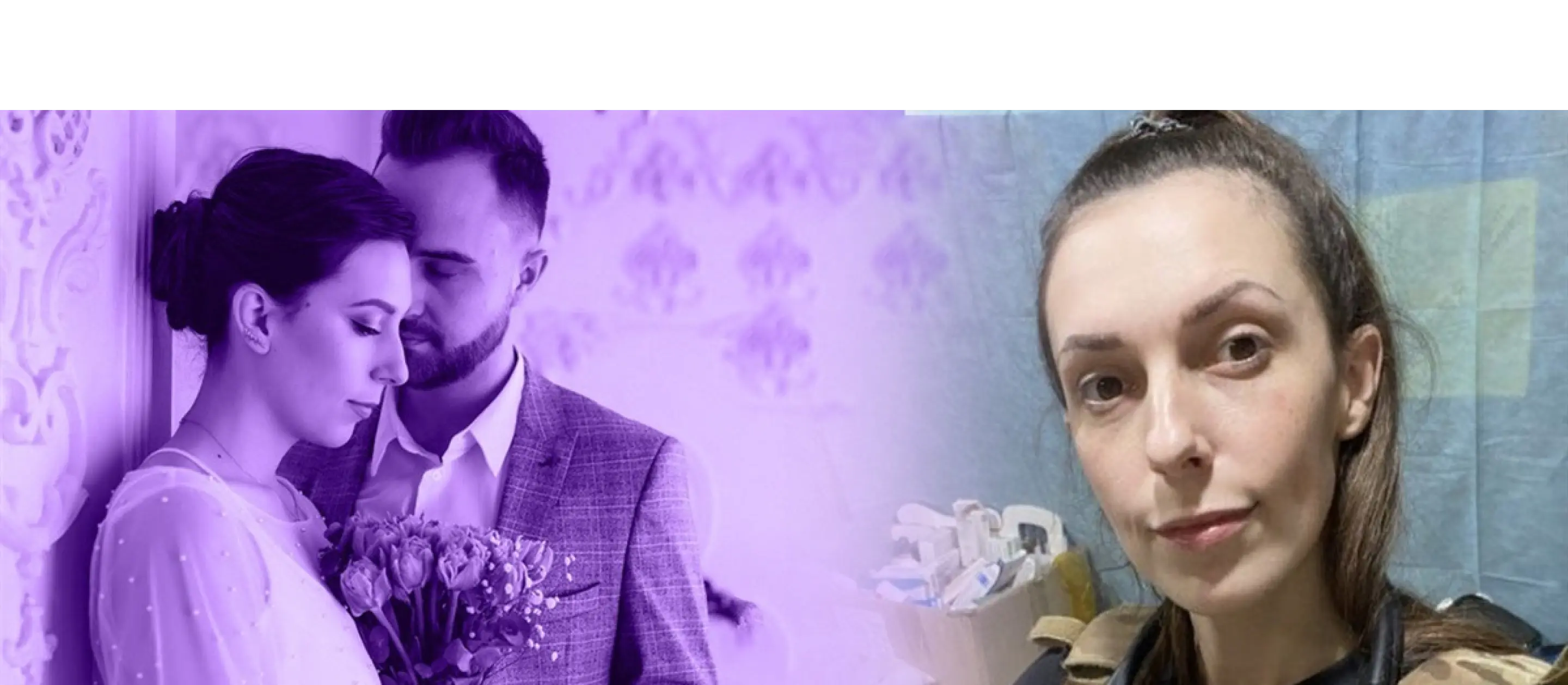
For a year now, I’ve been fighting from freedom to bring my beloved home from captivity. We rescued people in Volnovakha and at Azovstal.
Source: Svoi.City
Author: Hanna KURTSANOVSKA
They studied together and traveled to Mariupol
together Nina and Andriy are both from the Rivne region: she’s from Varash, and he’s from Dubno. They met during their sixth year at Ternopil National Medical University. Nina’s studies at the university—which, by the way, she completed with honors—coincided with the start of the Russian-Ukrainian war. The student closely followed reports in the media and on various social networks about the work of military medics, admiring their dedication, professionalism, and courage. So when, after graduating from university, the question arose of where to pursue a master’s degree, Nina chose the Ukrainian Military Medical Academy. Andriy also continued his studies there, and together they signed a contract with the Armed Forces of Ukraine. On February 23, 2021, Andriy and Nina got married.
“We trained as anesthesiologists for three years, and after graduating from the academy, based on the assignment results in September 2021, we were both assigned to the Donetsk region, to the 555th Mariupol Military Hospital of the Armed Forces of Ukraine. We worked in the Department of Anesthesiology, Resuscitation, and Intensive Care: Andriy as a resident, and I as a senior resident.”
She had the opportunity to leave, but Nina stayed with her husband
The full-scale war caught Nina in Volnovakha, where she was on a business trip.
“There was a team of doctors and nurses from the Mariupol hospital, consisting of a surgeon, an anesthesiologist, an internist, and a nurse. We were also joined by a dentist and his nurse. That’s where we began treating the first wounded and injured. We provided medical care to everyone—both military personnel and civilians.”
Nina had the opportunity to leave, but she decided to stay with her husband. According to her, two days later, Volnovakha was all but destroyed. Nina and the other doctors moved to Mariupol to join their colleagues. Garrison Hospital No. 555 in Mariupol was established on the basis of the 61st Mobile Hospital in July 2020. It was located in the Kalmius district of the city.
Full-scale war caught the Kolosinskis in Volnovakha—there, they were saving the lives of civilians and military
personnel Full-scale war caught the Kolosinskis in Volnovakha—there, they were saving the lives of civilians and military personnel
“I had never had to work with so many wounded people at once before. There were many civilians: women, the elderly, and children. I felt especially sorry for the children. It was hard to work at that pace, under those conditions, because the shelling was constant. But we had to keep working, regardless of the circumstances, because the hospital was one of the few medical facilities still operating in Mariupol at that time.”
We were short on everything—equipment, medications, and staff
After yet another airstrike, the hospital was destroyed. This happened on March 16, 2022. The medical staff was split up: some hospital workers went to the Ilyich Steel Plant, while others went to Azovstal. Nina and Andriy ended up at the steel mill, which the whole world would later come to know.
“At Azovstal, they set up a hospital and named it ‘Zalizyaka.’ This place was not at all designed to provide medical care, but we managed to set up an operating room and successfully perform surgeries and save lives. The number of wounded was increasing, and there was a critical shortage of antibiotics, painkillers, and bandages. And we needed more hands to help the wounded as quickly as possible.”
According to Nina Kolosinska, there were initially 150 wounded at “Zalizaka,” and their number later rose to as many as 400.
“The worst thing I felt back then was helplessness. You can’t provide help in these horrific conditions due to a lack of medical supplies and human resources. Intellectually, I understand that under normal circumstances I would have had no trouble providing the necessary care to the wounded, but back then, unfortunately, I couldn’t… But there are also good memories: I met many wonderful people, some of whom became my friends. In those conditions, the word ‘comrade’ takes on a special meaning. It’s incredible how, even in hellish conditions, people come together for a common good cause.”
Working at the hospital and at Azovstal was a major test of my fortitude, endurance, and mental and physical strength
.
“There were many people who showed their best sides, people I wanted to emulate. And looking at them, I didn’t give up, even though I wanted to many times. I stood my ground until the end and did my job properly.”
In captivity, they were stripped, beaten, and humiliated
Nina and Andriy Kolosinski were taken into captivity on May 18. At first, everyone from “Azovstal” was taken to a penal colony in Olenivka. Nina stayed there for 4 months.
“The colony workers didn’t consider us human beings. Disrespectful treatment, constant psychological humiliation, being stripped naked, and body searches. The conditions were horrific: I was in a cell with other girls that was meant to hold a maximum of six people, but there were up to twenty-five of us there. There was absolutely no space: you slept on your side on the floor so that everyone could fit. We were fed three times a day, but the food had almost no calories, so we were always hungry. The water was of terrible quality. All the girls had constant digestive problems.”
After Olenivka, Nina was transferred to the Voronezh region. There, she stayed for about two weeks with the other girls, the defenders of Mariupol. Next stop—Taganrog.
“The conditions of detention in Russia are even worse than in the so-called ‘DPR.’ They make you undress in front of men, constantly shove you around, kick you in the legs, humiliate you, and call you names. I can’t tell you everything because I don’t want it to affect those who are still in those prisons. But everything that happens there is hell on earth.”
The memories of her captivity are still vivid. A year has passed, but Nina Kolosinska remembers everything in detail. These horrific memories will stay with her for the rest of her life.
It was unbearable to hear your comrades screaming as they were being tortured. And the worst day was the terrorist attack in Olenivka
“In the evening, we all heard a very loud explosion, followed by cries for help that tore at our hearts and souls. We realized it was our boys, our comrades, screaming. Then we heard gunfire. We had absolutely no idea what was happening. In the morning, the wounded were brought to us from that barracks, which everyone would later call ‘Barracks 200.’ And they told us about the horrors they’d endured, about the crime that had been committed, about the boys who’d been killed. What I heard was beyond my comprehension. It was terrifying and painful.”
I was held captive for 5 months, while my comrades had already been there for a year
and a half. Every day in captivity, Nina Kolosinska imagined the day of her release. I thought I’d cry with joy and kiss the ground. And I also thought about how happy I’d be at that moment.
“But when that day finally came, of course, I felt relieved—to be home, to be able to call my parents. But there was no particular joy, because all my family and loved ones remain behind bars. And they’ve been there for a year and a half, in conditions I endured for only five months. Not a day goes by that I don’t think about them, about how they’re faring in enemy captivity.”
Nina’s husband, Andriy, remains in captivity. They’ve been together since 2018. They got married a year before the full-scale invasion. The last time Nina heard her beloved’s voice was when the prisoners were being transported to Russia; that was on October 1, 2022.
“And since then, I’ve known absolutely nothing about Andriy: where he is, what condition he’s in, and so on. There’s no information about him at all. I don’t know how to describe how I feel—there’s a whole range of emotions, but mostly anger that international conventions aren’t being upheld. According to the Geneva Convention, medical personnel are not combatants; they shouldn’t be held captive and aren’t bargaining chips. I no longer know where to turn or who to appeal to. I don’t understand how these exchanges take place—this mechanism is a mystery to me.”
During Andriy’s time in captivity, his family received a letter from him dated November 2, 2022. No further news has been received. At home, Andriy’s wife Nina, his parents, and his elderly grandmother are waiting for him.
She impressed the world and continues to work
on In August of this year, Forbes Ukraine presented its “30 Under 30” list for the fourth time. These are incredible young Ukrainians who have made an impact on the country and the world before the age of 30. Among those on the list is Senior Lieutenant of the Medical Service of the Armed Forces of Ukraine, anesthesiologist Nina Kolosinska, who is currently 28 years old.
Nina Kolosinska, quite unexpectedly, made it onto this year’s Forbes “30 Under 30: Shapers of the Future”
list Nina Kolosinska, completely unexpectedly, made it onto this year’s Forbes “30 Under 30: Shapers of the Future”
list.
“When the editorial staff called me, I had absolutely no idea what was going on. They explained the situation and asked me to answer a few questions. I was very surprised by all of this; I didn’t know who had nominated me. It wasn’t until the magazine issue came out that I found out my comrades from another unit had told the editorial team about me. Of course, it was very nice.”
After her captivity and rehabilitation, Nina Kolosinska continues to save the lives of Ukraine’s defenders and is fighting for the return of her beloved husband
After her captivity and rehabilitation, Nina Kolosinska continues to save the lives of Ukraine’s defenders and is fighting for the return of her beloved husband
After returning from captivity, Nina underwent a full medical examination. Next came treatment, rehabilitation, and time off. Then she returned to work. Now Nina Kolosinska, who saved dozens of lives in Mariupol, works as an anesthesiologist at one of the military hospitals.
Author: Hanna KURTSANOVSKA
They studied together and traveled to Mariupol
together Nina and Andriy are both from the Rivne region: she’s from Varash, and he’s from Dubno. They met during their sixth year at Ternopil National Medical University. Nina’s studies at the university—which, by the way, she completed with honors—coincided with the start of the Russian-Ukrainian war. The student closely followed reports in the media and on various social networks about the work of military medics, admiring their dedication, professionalism, and courage. So when, after graduating from university, the question arose of where to pursue a master’s degree, Nina chose the Ukrainian Military Medical Academy. Andriy also continued his studies there, and together they signed a contract with the Armed Forces of Ukraine. On February 23, 2021, Andriy and Nina got married.
“We trained as anesthesiologists for three years, and after graduating from the academy, based on the assignment results in September 2021, we were both assigned to the Donetsk region, to the 555th Mariupol Military Hospital of the Armed Forces of Ukraine. We worked in the Department of Anesthesiology, Resuscitation, and Intensive Care: Andriy as a resident, and I as a senior resident.”
She had the opportunity to leave, but Nina stayed with her husband
The full-scale war caught Nina in Volnovakha, where she was on a business trip.
“There was a team of doctors and nurses from the Mariupol hospital, consisting of a surgeon, an anesthesiologist, an internist, and a nurse. We were also joined by a dentist and his nurse. That’s where we began treating the first wounded and injured. We provided medical care to everyone—both military personnel and civilians.”
Nina had the opportunity to leave, but she decided to stay with her husband. According to her, two days later, Volnovakha was all but destroyed. Nina and the other doctors moved to Mariupol to join their colleagues. Garrison Hospital No. 555 in Mariupol was established on the basis of the 61st Mobile Hospital in July 2020. It was located in the Kalmius district of the city.
Full-scale war caught the Kolosinskis in Volnovakha—there, they were saving the lives of civilians and military
personnel Full-scale war caught the Kolosinskis in Volnovakha—there, they were saving the lives of civilians and military personnel
“I had never had to work with so many wounded people at once before. There were many civilians: women, the elderly, and children. I felt especially sorry for the children. It was hard to work at that pace, under those conditions, because the shelling was constant. But we had to keep working, regardless of the circumstances, because the hospital was one of the few medical facilities still operating in Mariupol at that time.”
We were short on everything—equipment, medications, and staff
After yet another airstrike, the hospital was destroyed. This happened on March 16, 2022. The medical staff was split up: some hospital workers went to the Ilyich Steel Plant, while others went to Azovstal. Nina and Andriy ended up at the steel mill, which the whole world would later come to know.
“At Azovstal, they set up a hospital and named it ‘Zalizyaka.’ This place was not at all designed to provide medical care, but we managed to set up an operating room and successfully perform surgeries and save lives. The number of wounded was increasing, and there was a critical shortage of antibiotics, painkillers, and bandages. And we needed more hands to help the wounded as quickly as possible.”
According to Nina Kolosinska, there were initially 150 wounded at “Zalizaka,” and their number later rose to as many as 400.
“The worst thing I felt back then was helplessness. You can’t provide help in these horrific conditions due to a lack of medical supplies and human resources. Intellectually, I understand that under normal circumstances I would have had no trouble providing the necessary care to the wounded, but back then, unfortunately, I couldn’t… But there are also good memories: I met many wonderful people, some of whom became my friends. In those conditions, the word ‘comrade’ takes on a special meaning. It’s incredible how, even in hellish conditions, people come together for a common good cause.”
Working at the hospital and at Azovstal was a major test of my fortitude, endurance, and mental and physical strength
.
“There were many people who showed their best sides, people I wanted to emulate. And looking at them, I didn’t give up, even though I wanted to many times. I stood my ground until the end and did my job properly.”
In captivity, they were stripped, beaten, and humiliated
Nina and Andriy Kolosinski were taken into captivity on May 18. At first, everyone from “Azovstal” was taken to a penal colony in Olenivka. Nina stayed there for 4 months.
“The colony workers didn’t consider us human beings. Disrespectful treatment, constant psychological humiliation, being stripped naked, and body searches. The conditions were horrific: I was in a cell with other girls that was meant to hold a maximum of six people, but there were up to twenty-five of us there. There was absolutely no space: you slept on your side on the floor so that everyone could fit. We were fed three times a day, but the food had almost no calories, so we were always hungry. The water was of terrible quality. All the girls had constant digestive problems.”
After Olenivka, Nina was transferred to the Voronezh region. There, she stayed for about two weeks with the other girls, the defenders of Mariupol. Next stop—Taganrog.
“The conditions of detention in Russia are even worse than in the so-called ‘DPR.’ They make you undress in front of men, constantly shove you around, kick you in the legs, humiliate you, and call you names. I can’t tell you everything because I don’t want it to affect those who are still in those prisons. But everything that happens there is hell on earth.”
The memories of her captivity are still vivid. A year has passed, but Nina Kolosinska remembers everything in detail. These horrific memories will stay with her for the rest of her life.
It was unbearable to hear your comrades screaming as they were being tortured. And the worst day was the terrorist attack in Olenivka
“In the evening, we all heard a very loud explosion, followed by cries for help that tore at our hearts and souls. We realized it was our boys, our comrades, screaming. Then we heard gunfire. We had absolutely no idea what was happening. In the morning, the wounded were brought to us from that barracks, which everyone would later call ‘Barracks 200.’ And they told us about the horrors they’d endured, about the crime that had been committed, about the boys who’d been killed. What I heard was beyond my comprehension. It was terrifying and painful.”
I was held captive for 5 months, while my comrades had already been there for a year
and a half. Every day in captivity, Nina Kolosinska imagined the day of her release. I thought I’d cry with joy and kiss the ground. And I also thought about how happy I’d be at that moment.
“But when that day finally came, of course, I felt relieved—to be home, to be able to call my parents. But there was no particular joy, because all my family and loved ones remain behind bars. And they’ve been there for a year and a half, in conditions I endured for only five months. Not a day goes by that I don’t think about them, about how they’re faring in enemy captivity.”
Nina’s husband, Andriy, remains in captivity. They’ve been together since 2018. They got married a year before the full-scale invasion. The last time Nina heard her beloved’s voice was when the prisoners were being transported to Russia; that was on October 1, 2022.
“And since then, I’ve known absolutely nothing about Andriy: where he is, what condition he’s in, and so on. There’s no information about him at all. I don’t know how to describe how I feel—there’s a whole range of emotions, but mostly anger that international conventions aren’t being upheld. According to the Geneva Convention, medical personnel are not combatants; they shouldn’t be held captive and aren’t bargaining chips. I no longer know where to turn or who to appeal to. I don’t understand how these exchanges take place—this mechanism is a mystery to me.”
During Andriy’s time in captivity, his family received a letter from him dated November 2, 2022. No further news has been received. At home, Andriy’s wife Nina, his parents, and his elderly grandmother are waiting for him.
She impressed the world and continues to work
on In August of this year, Forbes Ukraine presented its “30 Under 30” list for the fourth time. These are incredible young Ukrainians who have made an impact on the country and the world before the age of 30. Among those on the list is Senior Lieutenant of the Medical Service of the Armed Forces of Ukraine, anesthesiologist Nina Kolosinska, who is currently 28 years old.
Nina Kolosinska, quite unexpectedly, made it onto this year’s Forbes “30 Under 30: Shapers of the Future”
list Nina Kolosinska, completely unexpectedly, made it onto this year’s Forbes “30 Under 30: Shapers of the Future”
list.
“When the editorial staff called me, I had absolutely no idea what was going on. They explained the situation and asked me to answer a few questions. I was very surprised by all of this; I didn’t know who had nominated me. It wasn’t until the magazine issue came out that I found out my comrades from another unit had told the editorial team about me. Of course, it was very nice.”
After her captivity and rehabilitation, Nina Kolosinska continues to save the lives of Ukraine’s defenders and is fighting for the return of her beloved husband
After her captivity and rehabilitation, Nina Kolosinska continues to save the lives of Ukraine’s defenders and is fighting for the return of her beloved husband
After returning from captivity, Nina underwent a full medical examination. Next came treatment, rehabilitation, and time off. Then she returned to work. Now Nina Kolosinska, who saved dozens of lives in Mariupol, works as an anesthesiologist at one of the military hospitals.
This is an automatic translation generated by DeepL.